Emphatic DO for Contrast and Emotion

 The article explains what emphatic DO means, how it adds contrast or emotion in statements, and where to place it with main verbs. It also warns about overuse, points out common learner mistakes, and gives practice tips for adding emphasis.
In English, we often use the auxiliary verb "do" to add emphasis or show contrast in our statements, allowing us to express strong feelings or highlight important differences. For example, saying "I do like chocolate" instead of just "I like chocolate" makes the preference much clearer and more forceful. Mastering this technique can make your spoken and written English sound more natural and persuasive, as it helps convey your intentions and emotions more effectively in conversation or writing.
Meaning of Emphatic DO
Emphatic "do" is used in English to add emphasis, particularly when contrasting statements or expressing strong feelings. Instead of simply stating an action, this construction highlights the action or response, drawing attention to it. The use of "do," "does," or "did" in affirmative sentences is not required for grammatical correctness, but it serves a stylistic and communicative purpose.
When Emphatic "Do" Is Used
Speakers often turn to this form in the following situations:
- To contradict a negative statement or assumption ("You don't like coffee." – "I do like coffee!")
- To reinforce sincerity or insistence ("I do appreciate your support.")
- To add emotional weight, such as surprise or annoyance ("She did call you.")
- To clarify or correct information ("He does work here.")
- To urge or encourage ("Do come in!")
Form and Placement
The emphatic "do" is inserted before the base form of the main verb. In the present simple, use "do" or "does"; in the past simple, use "did." This pattern only applies to affirmative statements and commands—not questions or negatives, where "do" is already required for grammatical reasons.
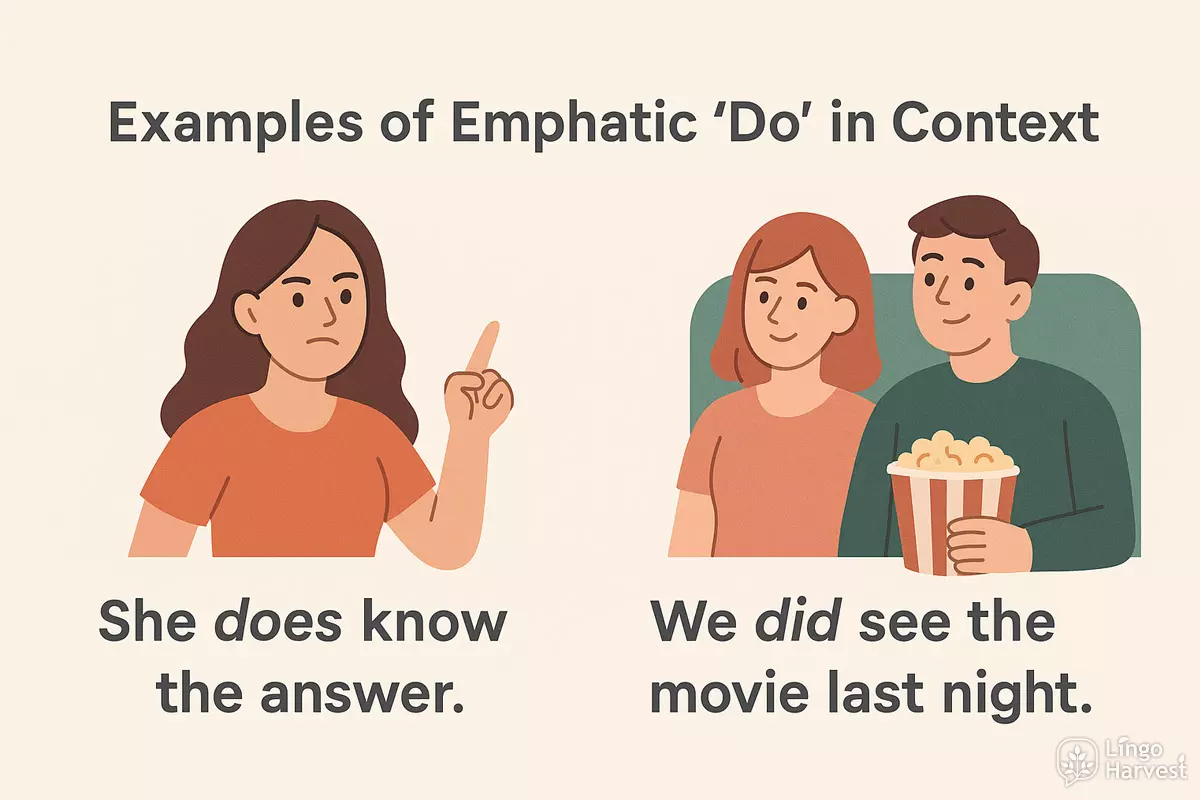
Examples of Emphatic "Do" in Context
- I do appreciate your help.
- She does know the answer.
- We did see the movie last night.
- He does want to join us.
- I do understand what you mean.
- They did finish the project on time.
- You do make a difference.
- She did remember my birthday.
- I do believe you.
- He does care about the results.
- We do need to leave now.
- She did tell me the truth.
- I do want to go.
- You did warn me.
Contrast and Emotion
Emphatic "do" is especially useful when you wish to highlight a difference or correct someone’s impression. It can also express frustration, affection, or urgency, depending on tone and context. The effect is subtle but powerful, helping speakers convey intention and attitude beyond the literal meaning of their words.
Contrastive Uses in Statements
Emphatic DO is often used to highlight a sharp contrast between two ideas, especially when correcting misconceptions or emphasizing a surprising truth. This construction draws the listener’s attention to the verb, making it clear that the speaker wants to stress the action or state in question.
Typical Contexts for Emphatic DO
- Correcting someone else’s assumption or statement
- Highlighting a difference between two people or situations
- Expressing surprise or strong feelings about a fact
- Reinforcing the truth of a statement when it might be doubted
Examples of Contrastive Emphatic DO
- She does like jazz, even if she rarely talks about it.
- We do need your help, despite what you’ve heard.
- I did finish my homework, but I left it at home.
- They do know the answer, although they’re pretending not to.
- You do matter to us, no matter what anyone says.
- He did call you; perhaps you missed it.
- I do want dessert, even if I said I was full.
- We do have tickets for the show, so let’s go.
- She does care about the results, regardless of her calm attitude.
- I do remember meeting him, just not where.
Patterns and Structure
The placement of do/does/did before the base verb is essential for this contrastive emphasis. Intonation in speech also plays a role, with extra stress on the auxiliary. Negation can be used for even sharper contrast, but in positive statements, the effect is one of insistence or correction.
| Emphatic DO Example | Contrast or Correction |
|---|---|
| She does know the answer. | Corrects the idea that she doesn’t know. |
| I did call you last night. | Disputes the claim that no call was made. |
| They do want to come. | Contrasts with the belief they’re not interested. |
| We do have enough time. | Refutes the suggestion that time is lacking. |
Speakers use this construction to make their stance unmistakable, especially when it differs from what others believe or expect. The result is a statement that stands out for its clarity and emotional strength, signaling both correction and emphasis.
Emotional Emphasis in Spoken English
Expressing strong feelings or highlighting contrasts in conversation often depends on more than just word choice. English speakers use special techniques—intonation, stress, and emphatic structures like "do"—to make their emotions clear and to contrast ideas sharply. These methods help speakers clarify what matters most to them, or to correct misunderstandings.
How Speakers Convey Strong Feelings
When someone wants to show surprise, frustration, excitement, or disagreement, they often shift their tone or stress certain words. The auxiliary verb "do" is especially useful for adding force to statements, especially in present simple and past simple tenses. For example, saying "I do like chocolate" sounds much more emphatic than "I like chocolate."
- I do want to help! (shows insistence)
- She does care about you. (contradicts doubt)
- We did finish our work. (corrects a misconception)
- He does play the piano beautifully. (adds positive emotion)
- I did call you earlier! (expresses frustration or surprise)
- You do know the answer! (encourages or urges)
- I do appreciate your help. (adds warmth or sincerity)
- They did invite us. (contrasts a previous belief)
- She does remember your birthday. (contradicts expectation)
- We do need to leave now. (adds urgency)
- He did see the movie. (emphasizes certainty)
- I do think it's a good idea. (shows conviction)
- You did warn me. (admits a truth)
- They do make the best coffee. (adds praise)
- I did enjoy the concert. (responds to doubt)
Contrast vs. Neutral Statements
Emphatic "do" is frequently used to draw a clear line between two ideas, often correcting or contradicting a previous statement. Notice the difference in meaning and feeling:
- Neutral: She likes tennis.
- Emphatic: She does like tennis (especially if someone suggested otherwise).
Common Situations for Emphatic Structures
- Correcting misunderstandings
- Expressing surprise or disbelief
- Highlighting a contrast
- Showing support or encouragement
- Adding warmth or sincerity
- Emphasizing urgency or importance
Placement with Main Verbs
When “do,” “does,” or “did” is used for emphasis, its position in a sentence follows clear rules. Emphatic “do” always comes directly before the main verb, never after or separated by other elements. This placement is crucial for both contrast and emotional expression, especially in spoken English when stressing a point or correcting someone.
Basic Structure
The pattern is simple: subject + emphatic “do/does/did” + base form of the main verb + rest of the sentence. For example:
- I do understand your concerns.
- She does want to come with us.
- They did call you yesterday.
Notice that the main verb stays in its base form, regardless of tense.
Common Uses and Examples
Emphatic “do” is most often used:
- To contradict a previous statement or assumption: “He does like jazz, not rock.”
- For emotional emphasis: “I do care about this project!”
- In polite requests or encouragements: “Do try the cake.”
- To reinforce a positive statement: “You did finish on time.”
Examples in Different Contexts
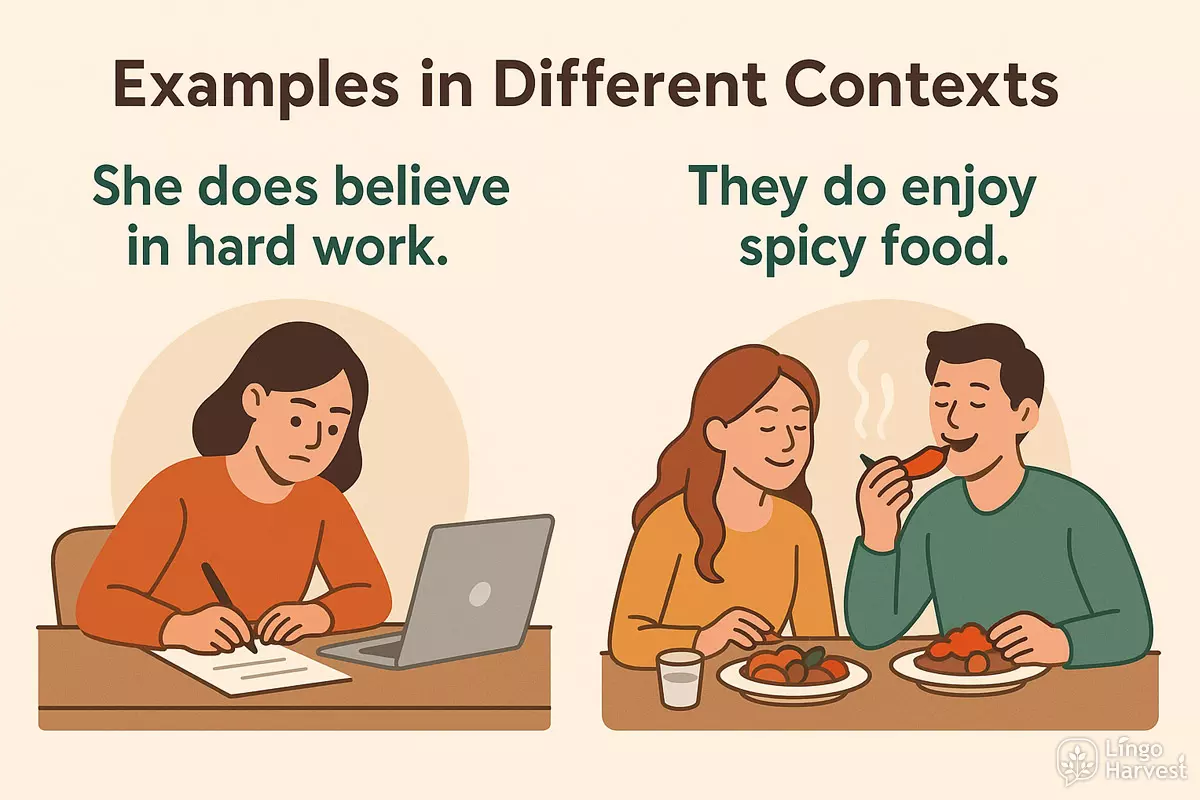
Here are more examples showing a variety of verbs and situations:
- We do appreciate your help.
- You did mention the deadline.
- She does believe in hard work.
- They do enjoy spicy food.
- He did see the announcement.
- I do hope you can come.
- We did try our best.
- You do look tired today.
- She does know the answer.
- He did forget his keys.
- I do need your advice.
- They do make excellent coffee here.
Placement Errors to Avoid
Placing “do/does/did” incorrectly can make sentences sound unnatural or change their meaning. Here are some typical mistakes:
- ❌ She likes do jazz. → She does like jazz.
- ❌ Did you finished? → Did you finish?
- ❌ I did went home. → I did go home.
Quick Reference: Correct Placement
| Emphatic Form | Example Sentence |
|---|---|
| do + base verb | I do agree with you. |
| does + base verb | She does want to help. |
| did + base verb | They did finish the work. |
| do/does/did + not + base verb | He does not like crowds. |
Keep in mind: the auxiliary “do” for emphasis is only used with main verbs, not with “be,” modal verbs, or in passive constructions. Proper placement helps your speech and writing sound more fluent and expressive.
Avoiding Overuse and Tone Problems
Using emphatic "do" can make your statements stand out, but relying on it too much can create an unnatural or even confrontational tone. When used with every verb, this pattern loses its impact and may come across as insistent or emotional in ways you didn’t intend. It’s important to balance emphasis with clarity and restraint.
Recognizing When Emphatic "Do" Is Appropriate
Reserve this structure for moments where you want to highlight contrast, convey strong emotion, or correct an assumption. For example, saying "I do like jazz" works well if someone assumes you don’t, but sounds odd if there’s no context for emphasis. Overusing it can make your writing or speech sound forced or defensive.
- Highlighting genuine contrast: "She thinks I dislike tea, but I do enjoy it."
- Expressing strong feeling: "I do appreciate your help."
- Correcting misunderstandings: "He does know about the meeting."
- Signaling reassurance: "You do belong here."
- Responding to disbelief: "I do remember your birthday!"
- Polite insistence: "I do insist you join us."
- Adding weight to apologies: "I do apologize for the delay."
- Emphasizing positive qualities: "This method does work."
- Contradicting rumors: "She does care about the project."
- Reinforcing commitments: "We do plan to attend."
Common Tone Pitfalls to Avoid
Writers sometimes use emphatic "do" out of habit, not realizing it can sound overly intense. Watch for these tone problems:
- Unintentional aggression: Overuse may sound like you’re arguing or correcting harshly.
- Artificial enthusiasm: If every positive statement uses "do," your emotion may seem insincere.
- Loss of subtlety: Emphasis loses meaning when applied everywhere.
- Awkward formality: In casual conversation, repeated use can sound stilted.
Tips for Natural Emphasis
Alternating your emphasis strategies helps maintain a natural, effective tone. Try these alternatives:
- Use intonation or stress in speech instead of always relying on "do".
- Vary sentence structure: "I really like it," "That’s absolutely true."
- Let context build contrast: "Unlike last year, I enjoyed it."
- Employ adverbs for nuance: "I genuinely care," "He truly understands."
- Limit emphatic "do" to key points for maximum effect.
Careful, selective use of this emphatic form ensures your message comes across as intended—clear, sincere, and engaging, never abrupt or exaggerated.
Common Learner Mistakes
Using emphatic "do" for contrast or emotion often causes confusion, especially for those unfamiliar with the subtleties of English emphasis. Many learners try to apply this structure as they would in their native language, resulting in sentences that feel unnatural or lose their intended strength.
Mixing Up Regular and Emphatic "Do"
A frequent issue is using "do" where it simply forms a question or negative, rather than to highlight a statement. For example, saying, "I do like pizza?" in a question, instead of as an emphatic declaration: "I do like pizza, even if I rarely eat it." Recognizing the difference between emphatic usage and auxiliary function is crucial.
Overusing Emphatic "Do"
Learners sometimes add "do" for emphasis in every sentence, which quickly sounds unnatural. Emphatic "do" should be reserved for contrast, strong emotion, or correction—not for every positive statement.
- Incorrect: I do go to school every day.
- Correct: I do go to school every day, even when I’m tired.
Misplacing "Do" in the Sentence
Another error is placing "do" incorrectly. The emphatic "do" must come before the base verb, not after or at the end.
- ❌ She likes do chocolate.
- ❌ She likes chocolate do.
- ✅ She does like chocolate.
Forgetting Subject-Verb Agreement
The form of "do/does/did" must match the subject and tense. Mistakes with agreement are common, especially with third-person singular.
| Incorrect Form | Corrected Version |
|---|---|
| He do like music. | He does like music. |
| I does want to help. | I do want to help. |
| They did likes it. | They did like it. |
| She do enjoys reading. | She does enjoy reading. |
Confusing Emphatic "Do" with Other Emphasis
Learners may try to combine "do" with other forms of emphasis, creating awkward sentences like "I do really like it," which can sound redundant. It's usually enough to use just one form of emphasis.
Summary of Pitfalls to Watch For
- Using emphatic "do" in questions instead of statements.
- Adding "do" to every positive sentence.
- Placing "do" in the wrong position in the sentence.
- Forgetting subject-verb agreement.
- Combining multiple emphasis markers unnecessarily.
- Using "do" with stative verbs incorrectly ("I do be hungry" ❌).
- Applying emphatic "do" in formal writing where it may not be appropriate.
- Missing the contrast or emotional context that justifies emphatic "do."
- Directly translating from another language without adjusting for English emphasis patterns.
- Neglecting intonation and stress when speaking, which is essential for the emphasis to sound natural.
Mastering emphatic "do" takes practice and attention to context, but avoiding these common errors will help you sound more fluent and expressive.
Practice: Add Emphasis with DO
Using "do" for emphasis can clarify contrast, show strong feelings, or correct misunderstandings. Let’s practice recognizing and using this structure in different contexts.
Below are some sentences where you can add "do," "does," or "did" for extra force. Try to spot where emphasis is useful, especially when you want to stress a correction, contradiction, or strong emotion.
Insert Emphatic "Do" in the Sentences
- I ___ like chocolate, even if you think I don’t.
- She ___ know the answer, but she’s too shy to say it.
- We ___ want to help, despite what you heard.
- They ___ finish their homework before dinner every day.
- He ___ remember your birthday last year.
- You ___ look tired—are you feeling okay?
- The movie ___ get better after the first half.
- My parents ___ support my decision.
- I ___ appreciate your honesty.
- Our team ___ try their best, even if the result wasn’t perfect.
Show answers
- I do like chocolate, even if you think I don’t.
- She does know the answer, but she’s too shy to say it.
- We do want to help, despite what you heard.
- They do finish their homework before dinner every day.
- He did remember your birthday last year.
- You do look tired—are you feeling okay?
- The movie does get better after the first half.
- My parents do support my decision.
- I do appreciate your honesty.
- Our team did try their best, even if the result wasn’t perfect.
Contrast: Emphatic "Do" vs. Normal Statements
Notice how adding "do" changes the tone and meaning. The table below compares standard and emphatic forms:
| Normal Statement | With Emphatic "Do" |
|---|---|
| I like spicy food. | I do like spicy food. |
| She speaks French. | She does speak French. |
| We finished the project. | We did finish the project. |
| They enjoy classical music. | They do enjoy classical music. |
| He apologized. | He did apologize. |
| You need help. | You do need help. |
Try It Yourself: Make It Emphatic
- I understand your point. → Make it emphatic
- They like vegetables. → Make it emphatic
- He called yesterday. → Make it emphatic
- We trust you. → Make it emphatic
Show answers
- I do understand your point.
- They do like vegetables.
- He did call yesterday.
- We do trust you.
Adding "do," "does," or "did" is especially useful when you want to correct someone, express strong feelings, or highlight a contrast. Practice using this structure in your own sentences to become more comfortable with its effect.