Modal Verbs in American vs British English Usage

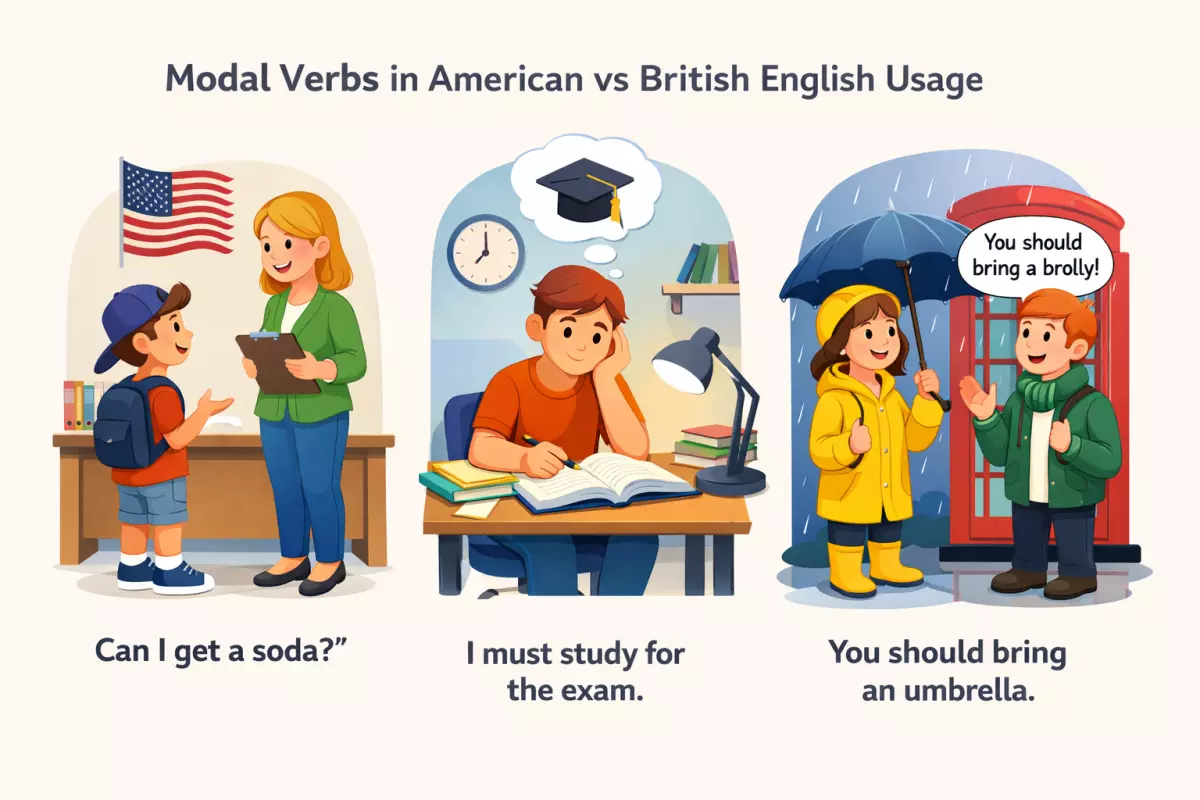 This article explains how modal verbs evolved differently in American and British English, which modals are more common in each, and examples of different choices. It also covers tone and formality, what sounds natural vs odd, and practice exercises to spot patterns.
- How modal verbs developed slightly different usage patterns in American and British English
- Modal verbs that are more common in one variety than the other
- Examples where Americans and British speakers choose different modal verbs
- How tone and formality influence modal choices across the two varieties
- Situations where modal usage may sound natural in one variety but unusual in another
- How learners can recognize regional modal patterns in real communication
- Exercises and practice activities identifying American and British modal usage
Ever notice Americans and Brits sound a bit different when they say what they can, should, or might do? You are hearing a shift in modal verb habits between the two varieties. In daily conversation, these small choices affect how polite, direct, or certain you seem. This guide highlights the patterns you will meet in emails, requests, and advice, so you can pick forms that suit the situation and audience.
How modal verbs developed slightly different usage patterns in American and British English
Differences in modal verb usage between American and British English grew out of a few long-running tendencies: American English generally favors simpler, more direct forms in everyday speech, while British English more often preserves older distinctions and uses modals for politeness and nuance. Over time, this led to predictable contrasts in frequency, formality, and the choice between a true modal and a semi-modal alternative.
Key historical and usage tendencies that shaped today’s patterns
- Preference for semi-modals in American English: Forms like have to, need to, and be able to
- Retention of traditional modals in British English: British usage more readily keeps shall (in certain registers), needn’t, and ought to
- Different paths for obligation: must became more “official” or emphatic in American English, while British English kept it more available for ordinary obligation alongside have to.
- Politeness strategies diverged: British English often leans on modals to soften requests (especially could, would, might), whereas American English frequently uses straightforward phrasing with supportive context (tone, please, or a brief reason).
- Survival of negative forms: Contractions and negative patterns evolved differently; British English kept some modal negatives productive (for example needn’t), while American English tends to prefer don’t need to.
- “Shall” narrowed more in American English: In the U.S., shall is mostly legal, very formal, or used for offers/questions in fixed phrases; in the U.K., it still appears more naturally in formal planning and some polite suggestions.
- Past-time and “tentative” meanings settled differently: Both varieties use could and would
- Regional and class variation mattered: British English shows stronger internal variation by region and formality level, which helped preserve certain modal choices in some communities and contexts.
- Standardization through education and publishing: Style conventions in schools, newspapers, and government writing reinforced different “default” modal choices on each side of the Atlantic.
- Influence of spoken norms on writing: American informal writing (emails, messaging, workplace chat) often mirrors speech and favors semi-modals; British writing more often retains modal-based politeness formulas.
- Different comfort with “mandative” patterns: In American English, structures like “They insisted that he go” are common, which can reduce reliance on modals like should in that slot; British English more readily uses “They insisted that he should go.”
- Modal “need” developed unevenly: British English keeps modal-like need in negatives and questions more than American English (where it can sound formal or uncommon).
Common outcomes you can still see in modern usage
- Must vs have to: American English often reserves must for strong insistence or written rules; British English uses it more comfortably for ordinary obligation.
- Needn’t vs don’t need to: Needn’t is more at home in British English; American English strongly prefers don’t need to.
- Shall: More limited in American English outside legal/formal contexts; broader (though still formal-leaning) use in British English for proposals and arrangements.
- Should in that-clauses: British English often keeps should after verbs like suggest/insist; American English often uses the bare verb form instead.
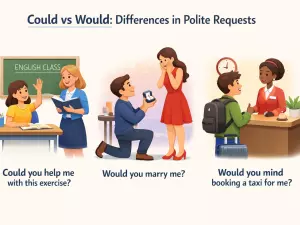
- Polite requests: British English frequently uses modal-heavy softeners (“Could you…”, “Would you mind…”); American English uses these too, but also commonly opts for direct requests with courteous framing (“Can you… when you get a chance?”).
Modal verbs that are more common in one variety than the other
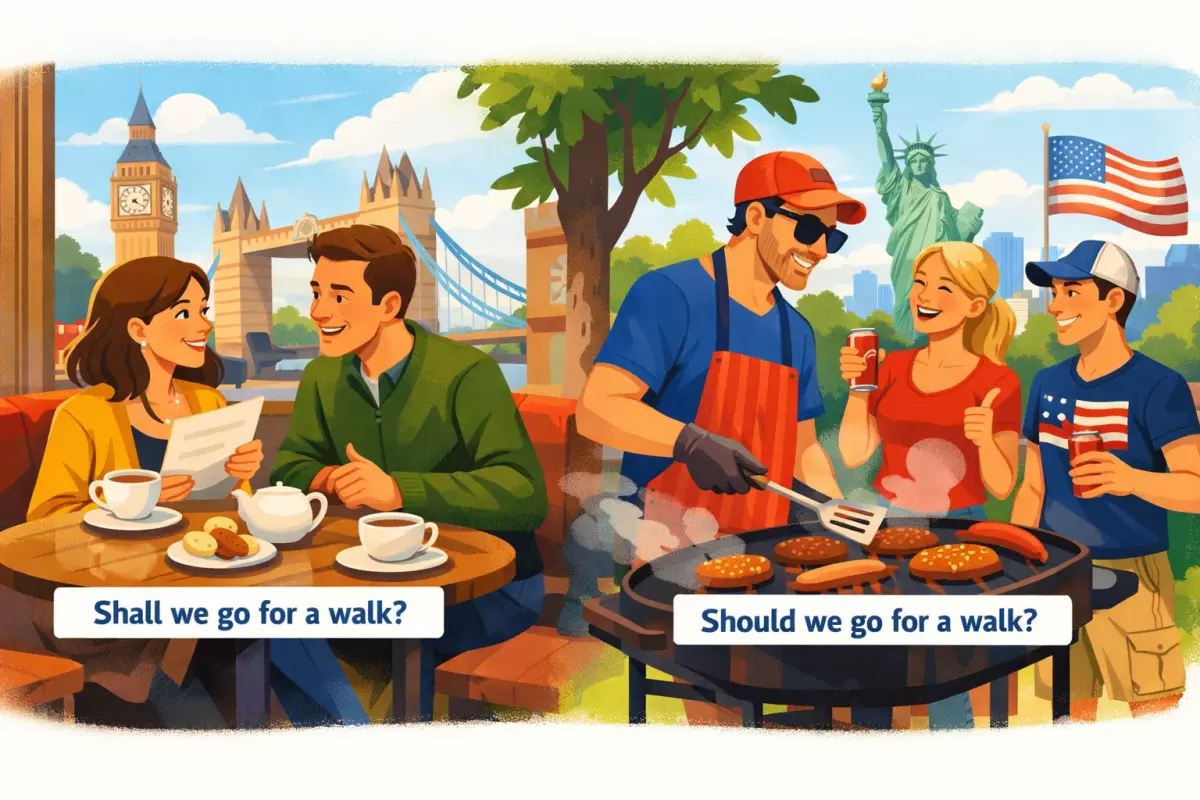
Some modals and semi-modals show clear preferences in everyday American and British usage. The differences are usually about frequency and context rather than “right vs wrong”: both varieties understand most forms, but one will often sound more natural than the other in a given setting.
-
Shall (BrE more frequent; AmE limited and formal)
In modern British English, shall still appears in offers, suggestions, and polite questions, especially with I/we. In American English it is much less common outside legal writing and very formal speech.
- BrE natural: “Shall we start?” / “Shall I open the window?”
- AmE more typical alternatives: “Should we start?” / “Do you want me to open the window?”
- Formal/legal (both): “The tenant shall pay…” (common in contracts)
-
Needn’t (BrE common; AmE rare)
British English often uses needn’t as a negative modal meaning “don’t need to.” American English usually prefers don’t need to or don’t have to.
- BrE: “You needn’t worry.” / “You needn’t come tomorrow.”
- AmE: “You don’t need to worry.” / “You don’t have to come tomorrow.”
-
Ought to (BrE somewhat more common; AmE more formal/less frequent)
Ought to expresses advice or expectation. It exists in both varieties, but it tends to sound more at home in British speech, while American speakers often choose should instead.
- BrE: “You ought to tell her.” / “It ought to be fine.”
- AmE often: “You should tell her.” / “It should be fine.”
-
Have got to (BrE very common; AmE common but more informal)
Both varieties use have got to for strong obligation, but British English uses it extremely widely in speech. American English uses it too, often in casual contexts, with have to as the more neutral option.
- BrE: “I’ve got to go now.” / “Have you got to work tomorrow?”
- AmE: “I have to go now.” (neutral) / “I’ve got to go now.” (more casual)
-
Had better (AmE and BrE both; BrE slightly more willing in everyday advice)
Had better is understood everywhere, but it can feel stronger or more admonishing in American usage, so speakers may choose should more often. In British English it remains a very normal way to give firm advice.
- BrE: “You’d better take an umbrella.”
- AmE often softer: “You should take an umbrella.” (with “You’d better…” used for stronger warning)
-
Dare as a modal (BrE more common; AmE usually lexical “dare to”)
British English sometimes uses dare like a modal in negatives and questions (without to). American English typically uses do-support and/or dare to.
- BrE: “Dare you tell him?” / “I daren’t say.”
- AmE: “Do you dare (to) tell him?” / “I don’t dare (to) say.”
-
May vs might for permission (BrE slightly more “may”; AmE often “can”)
For permission, British English keeps may in polite or formal requests a bit more than American English. In American English, can is the everyday choice, with may sounding more formal or rule-based.
- BrE: “May I come in?” (polite/formal) / “Can I come in?” (informal)
- AmE: “Can I come in?” (default) / “May I come in?” (more formal)
-
Must (BrE more common for obligation; AmE often replaced by “have to”)
Both varieties use must, but British English uses it more freely for obligation in speech. American English often prefers have to, especially for everyday requirements, keeping must for strong insistence, rules, or emphasis.
- BrE: “I must call my mum.” / “You must try this.”
- AmE often: “I have to call my mom.” / “You have to try this.”
-
Should vs shall in suggestions (AmE “should” where BrE may use “shall”)
When making suggestions with we, British English can sound natural with shall, while American English overwhelmingly uses should or another structure.
- BrE: “Shall we meet at 7?”
- AmE: “Should we meet at 7?” / “Do you want to meet at 7?”
-
Will vs shall in future reference (AmE favors “will”; BrE has some “shall” in formal style)
For simple future meaning, both varieties mainly use will. British English still allows shall in some formal writing or set phrases, while American English treats it as marked or legalistic.
- BrE formal: “We shall contact you shortly.”
- AmE typical: “We will contact you shortly.”
These preferences are strongest in spoken language and informal writing. In edited prose, especially in legal, academic, or institutional contexts, the same modal verbs may appear more evenly across both varieties because style guides and fixed conventions can override everyday patterns.
Examples where Americans and British speakers choose different modal verbs
Differences often show up in how speakers express obligation, suggestions, permission, and expectations. In many cases both varieties are grammatical, but one choice sounds more natural in everyday speech, or carries a slightly different level of formality.
| Situation / meaning | More typical in American English | More typical in British English | Notes on tone and pattern |
|---|---|---|---|
| Strong obligation (rules, requirements) | We have to submit it by Friday. | We must submit it by Friday. | BrE uses must more readily; AmE often prefers have to for external obligation. |
| No obligation / not necessary | You don’t have to come early. | You needn’t come early. | Needn’t is common in BrE and sounds formal or uncommon in AmE. |
| Future expectation / “likely” | That should be enough. | That should be enough. | Both use should, but BrE more often extends it to polite, tentative predictions in conversation. |
| Suggestion (polite advice) | You should call them. | You ought to call them. | Ought to is understood in AmE but is more frequent and natural in BrE. |
| Permission (informal) | Can I leave early? | Can I leave early? | Both use can widely; in formal settings, both may choose may. |
| Permission (more formal) | May I speak to the manager? | May I speak to the manager? | Similar in both, but may can sound more old-fashioned in casual AmE. |
| Polite request | Could you send that today? | Could you send that today? | Shared pattern; differences are more about intonation and formality than the modal itself. |
| Polite request (very common BrE form) | Can you…? / Could you…? | Shall we start? / Shall I open the window? | Shall for offers/suggestions is much more natural in BrE; in AmE it can sound legalistic or very formal. |
| Making arrangements (suggesting a plan) | Should we meet at 6? | Shall we meet at 6? | AmE often uses should or simple present (“Do you want to…”); BrE keeps shall in this role. |
| Asking what someone wants you to do | Should I email you the file? | Shall I email you the file? | Both are possible, but BrE shall I…? is a routine service/offer phrase. |
| Logical deduction (strong) | They must be home by now. | They must be home by now. | Here must means “I’m sure,” not obligation; this use is common in both varieties. |
| Negative deduction | They can’t be serious. | They can’t be serious. | Shared usage; note that mustn’t usually means prohibition, not “can’t be.” |
| Prohibition | You can’t park here. | You mustn’t park here. | BrE uses mustn’t more for rules; AmE often prefers can’t or not allowed to. |
| Past obligation (reported) | We had to redo the report. | We had to redo the report. | Both use had to; must has no simple past form for obligation. |
| Habitual past (narrative) | When I was a kid, we would go there every summer. | When I was a kid, we would go there every summer. | Shared; BrE may also use used to heavily in storytelling, but it’s not a modal verb. |
| Conditional possibility (tentative) | It might rain later. | It might rain later. | Shared; differences are minimal here compared with obligation and “shall/needn’t/ought to.” |
When choosing between these forms, focus on the social meaning: BrE tends to keep shall, needn’t, and ought to in everyday use, while AmE often replaces them with should, don’t have to, or other common structures. For learners, matching the local pattern usually matters more than strict correctness.
How tone and formality influence modal choices across the two varieties

In both American and British English, modal verbs help speakers manage politeness, authority, distance, and warmth. The main differences are not usually about grammar rules, but about which modal sounds appropriately formal, suitably indirect, or pleasantly friendly in a given setting.
Common tone shifts and the modal patterns behind them
- Direct instructions (more forceful): must and have to increase authority. In everyday American usage, have to is often preferred for obligations because it can feel less heavy than must.
- Formal rules and notices: must remains common in both varieties for official requirements (policies, regulations, safety wording), because it signals non-negotiable obligation.
- Polite requests (neutral to formal): could and would soften the request. British English tends to lean more on indirectness in service and workplace interactions, so could/would may appear more frequently in routine requests.
- Friendly, everyday requests (casual): American English often uses can very naturally for requests (“Can you…?”) without sounding abrupt, especially among peers. In British English, can is also common, but could may be chosen more often to keep the tone gently deferential.
- Softening advice: should gives guidance without commanding. In more formal British writing, should can sound measured and professional; in American speech, it is equally common but may be paired with more direct phrasing.
- Stronger recommendations: ought to is understood in both, but it is more at home in British English and can sound slightly old-fashioned or marked in many American contexts.
- Permission (casual vs. formal): can is typical in speech; may is more formal and more common in careful writing. In American English, may is still used for permission in formal contexts, but in everyday conversation it can sound stiff.
- Possibility and uncertainty (careful tone): might is often chosen when a speaker wants to sound cautious or non-committal. British English frequently uses might to keep claims modest; American English uses it too, but may use may more in formal writing for possibility.
- Offers and invitations: shall is rare in everyday American English and can sound overly formal or legal. In British English, shall can still appear for suggestions (“Shall we…?”), especially in more traditional or polite contexts.
- Negotiating and compromising: could is useful for proposing options without pressure (“We could…”). This works similarly in both varieties, but British workplace talk may rely on it more to keep proposals tentative and collaborative.
- Refusals and boundaries (polite but firm): can’t is straightforward; won’t signals unwillingness and can sound sharper. Speakers in both varieties often choose can’t to avoid sounding confrontational when the issue is preference rather than impossibility.
- Expectation vs. insistence: will can sound like a confident prediction or a firm directive depending on context (“You will need to…”). In formal British instructions, this can read like policy language; in American corporate writing, it is also common but may be balanced with softer modals in customer-facing text.
- Polite persistence: would helps maintain courtesy when repeating a request (“Would you mind…?”). This is widely shared, but British English often layers additional softeners around it.
- Hedging in professional writing: Modals like may, might, and could reduce overstatement. British academic and institutional styles often prefer heavier hedging; American styles may be slightly more direct while still using these modals to qualify claims.
- Negative obligation (prohibition): mustn’t is natural in British English for “it is forbidden.” American English often avoids mustn’t in everyday speech and instead uses can’t or not allowed to to express the same idea.
- Polite “maybe” responses: British English commonly uses modal-based understatement (“I might…” / “I could…”), which can sound more reserved. American English may choose a clearer commitment or refusal sooner, depending on the setting.
Practical guidance for choosing a modal by formality
- For formal policies: prefer must (requirement), may (permission/possibility), and carefully used will (procedural certainty).
- For customer-facing or collaborative workplace tone: prefer could and would for requests and proposals; use should for recommendations rather than commands.
- For everyday conversation: can is usually fine for requests and permission; choose could when you want extra politeness or distance.
- When writing for a mixed US/UK audience: avoid relying on mustn’t for prohibition if clarity is critical; consider must not (formal) or not allowed to (plain) to reduce ambiguity.
Situations where modal usage may sound natural in one variety but unusual in another
Some modal choices are grammatically possible on both sides of the Atlantic but differ in how routine, polite, or formal they sound. The patterns below highlight contexts where a speaker’s default modal can make the sentence feel “native” in one variety and slightly marked in the other.
| Context | More typical in British English | More typical in American English | Notes on effect |
|---|---|---|---|
| Polite requests in shops, offices, service encounters | Could you…? / Would you…? | Can you…? / Could you…? | In the US, can is often neutral and polite; in the UK, could/would may sound more standard in careful service politeness. |
| Offers and suggestions | Shall I…? / Shall we…? | Should I…? / Do you want me to…? / Let’s… | Shall is common in UK offers; in the US it can sound formal, legalistic, or old-fashioned outside set phrases. |
| Stating absence of obligation | You needn’t… | You don’t have to… / You don’t need to… | Needn’t is natural in the UK; in the US it can sound bookish, even though it is understood. |
| Permission in formal settings | May I…? | May I…? / Can I…? | Both use may for formality; the US more readily uses can for everyday permission without sounding incorrect. |
| “Have got to” vs “have to” for necessity | I’ve got to… | I have to… / I’ve got to… | Both occur, but the UK uses have got to very freely in speech; in the US it can feel more informal and is less common in careful writing. |
| Past-time expectation/assumption | He’ll have left by now. | He must have left by now. | Both are possible, but UK English often uses will for confident inference; in the US must is a frequent choice for deduction. |
| Softening opinions and advice | You might want to… / You may want to… | You might want to… | May want to can sound slightly more formal/indirect; might want to is widely natural in both, especially in American speech. |
| Negative deduction (present) | He can’t be at home. | He can’t be at home. | This is shared, but the US sometimes avoids mustn’t for deduction (see below), preferring can’t for “it’s impossible.” |
| Negative deduction vs prohibition | He mustn’t be at home. (deduction possible in context) | He mustn’t be at home. (often heard as prohibition) | In American English, mustn’t is strongly associated with “not allowed,” so it can sound odd for “it’s not possible that…”. |
| Conditional politeness in emails and letters | I should be grateful if you could… | I would appreciate it if you could… | UK business style often uses should in set polite formulas; US style tends to use would + appreciation phrasing. |
| “Will” in instructions and notices | You will need to… / You will be required to… | You will need to… / You must… / You are required to… | Both use will for procedural tone; in the US, must may appear more readily in compliance contexts, while everyday instructions often prefer need to. |
| Using “shall” for rules and obligations (legal/official) | The tenant shall… (common in formal drafting) | The tenant shall… (still used, but increasingly avoided) | Legal shall exists in both, but American plain-language policies often replace it with must to reduce ambiguity. |
Practical takeaways for choosing a modal
- For everyday requests, UK speakers often default to could/would, while US speakers commonly use can without sounding blunt.
- For offers, shall is a reliable UK choice; in the US, prefer should, do you want me to…, or let’s… unless you want a formal tone.
- To say “no obligation”, don’t have to works everywhere; needn’t is safest if you are targeting a British readership.
- To express deduction, must is widely understood, but be cautious with mustn’t for “it can’t be true” in American contexts, where it is likely to be read as prohibition.
- In formal writing, both varieties use more conservative modals (may, would), but set phrases differ: UK often uses I should be grateful…, while US often uses I would appreciate….
How learners can recognize regional modal patterns in real communication
Notice regional modal usage by focusing on what speakers choose for everyday politeness, certainty, and obligation. In practice, the differences show up less in grammar rules and more in repeated preferences: which modal sounds “normal” in requests, how strongly advice is phrased, and whether a speaker uses a modal at all or swaps in a semi-modal (like have to).
What to listen for in conversations
- Request style (directness): American speakers often prefer straightforward modals in service and workplace requests (e.g., “Can you…?”), while British speakers often soften with more tentative choices (e.g., “Could you…?”, “Would you mind…?”).
- Advice strength: “You should…” can sound like firm guidance in both varieties, but British English frequently uses softer phrasing (“You might want to…”, “You could…”), especially with strangers or in professional settings.
- Obligation wording: American English commonly leans on have to for obligation (“I have to leave”), while British English still uses must more naturally in some contexts (“I must go”), particularly for speaker-imposed necessity.
- Permission patterns: “Can I…?” is very common in American English for permission; British English often uses “Could I…?” in more formal or cautious situations.
- Likelihood and hedging: British speech often contains extra hedging around predictions (“It might be…”, “It could be…”), where American speech may use “probably” plus a simpler modal choice.
- Polite offers: Listen for “Shall I…?” and “Shall we…?”—these are more at home in British English, while American English often uses “Should I…?” or “Do you want me to…?” for the same function.
- Set phrases with modals: Some modals appear in fixed, high-frequency chunks that signal region (for example, “I might just…” is especially common as a British softener before a suggestion or action).
- Tag questions and softeners: British English often pairs modal statements with tags to reduce force (“You could send it today, couldn’t you?”). American English uses tags too, but often relies more on intonation and “okay?” / “right?” style checks.
- Conditional politeness: Both varieties use “would” for polite distance, but British English tends to stack softeners (“I was wondering if you could…”), which learners can treat as a politeness pattern rather than “extra grammar.”
- Modal avoidance: Sometimes the regional signal is the absence of a modal—American English may choose a simple present with a politeness marker (“I need you to…”, “I’d like you to…”) where British English might keep a modal (“Could you…?”).
High-signal modal choices to track (with quick examples)
- Shall for suggestions/offers: UK “Shall we start?” / “Shall I open the window?”; US often prefers “Should we start?” / “Do you want me to open the window?”
- Must vs have to: UK “I must ring her later”; US “I have to call her later” is more typical in casual speech.
- Could as a politeness default: UK “Could you send that over?” is a common neutral request; US “Can you send that over?” is often equally polite in context.
- Might for gentle suggestions: UK “You might want to check the time”; US also uses it, but “You may want to…” is especially common in American professional advice.
- Would you mind…? frequency: widely understood in both, but it’s especially common as a British-style softener in routine requests.
- May for formal permission: both varieties use it, but it often sounds more formal than everyday “can/could” in modern speech.
- Needn’t (where it appears): more British-leaning (“You needn’t worry”); American English often uses “don’t need to.”
- Ought to: understood in both, but tends to sound more British or more formal/old-fashioned in many American contexts.
- Had better: used in both, but pay attention to tone—this often signals a warning or strong advice regardless of region.
- Would for habitual past (context-dependent): more noticeable in British narrative style (“When we were kids, we would…”), though it exists in American English too.
A practical method for learners
- Collect “request frames”: write down the full pattern you hear, not just the modal (e.g., “Could you possibly…?” “Do you mind if I…?” “Would it be possible to…?”). These frames carry the regional feel.
- Sort by function: group examples into permission, requests, advice, obligation, and offers. Regional preferences become clearer when you compare the same function across speakers.
- Track context: note who is speaking to whom (friends vs coworkers vs customer service). Many differences are really differences in default politeness strategies.
- Watch for softening layers: British English often adds layers (modal + softener + tag), while American English may rely on a single modal plus friendly tone. Treat these as patterns you can copy.
- Check for meaning shifts: some modals change force by region and setting. For example, “You must…” can sound like a strong instruction; in casual British speech it can also sound like warm insistence (“You must come round sometime”).
- Practice swapping equivalents: if you learn one variety, rehearse alternatives so you can adjust quickly (e.g., “Shall we…?” → “Should we…?”; “needn’t” → “don’t need to”).
- Avoid overcorrecting: if your modal choice is grammatically fine, the main risk is sounding too forceful or too formal. When unsure, choose a softer request form (often “could” or “would”) and add a brief softener (“when you have a moment”).
Exercises and practice activities identifying American and British modal usage
Focus on the cues that usually signal regional preference: (1) which modal is chosen (for example, shall vs will), (2) whether a modal is followed by have for past meaning, and (3) whether a speaker uses a modal-like phrase (such as have got to) instead of a “core” modal. The activities below train you to notice patterns rather than memorize isolated sentences.
1) Quick identification: AmE, BrE, or both?
Label each sentence as AmE, BrE, or Both based on typical usage. If you think it is grammatical in both but more natural in one variety, choose the more natural variety.
- I’ll call you later, shall I?
- Do you have to leave now?
- You needn’t worry about it.
- We should meet up sometime.
- He might have left already.
- I’ve got to go.
- Shall we start?
- We will be able to finish by Friday.
- You should write to her more often.
- Need I sign this form?
- You ought to see a doctor.
- I’d better not say anything.
Show answers
- BrE (tag question with shall I? is strongly associated with BrE)
- Both
- BrE (negative needn’t is much more common in BrE)
- Both
- Both
- Both (common in both; often heard in BrE and informal AmE)
- BrE (suggestion with shall we is more BrE)
- Both
- Both
- BrE (inversion Need I…? is rare in AmE)
- Both (slightly more frequent in BrE, but natural in both)
- Both
2) Choose the more natural option for the variety
For each item, pick the option that sounds more natural in the stated variety. Pay attention to how requests, offers, and obligations are framed.
- BrE: (A) Shall I open the window? (B) Will I open the window?
- AmE: (A) You needn’t do that. (B) You don’t need to do that.
- BrE: (A) Need I bring anything? (B) Do I need to bring anything?
- AmE: (A) I shall call you tomorrow. (B) I’ll call you tomorrow.
- BrE: (A) You’d better not be late. (B) You better not be late.
- AmE: (A) I haven’t got any time. (B) I don’t have any time.
- BrE: (A) I haven’t got to work tomorrow. (B) I don’t have to work tomorrow.
- AmE: (A) May I get a coffee? (B) Can I get a coffee?
- BrE: (A) Shall we meet at six? (B) Should we meet at six?
- AmE: (A) You might want to check that. (B) You may want to check that.
Show answers
- A
- B
- A (more distinctly BrE; B is also fine but less diagnostic)
- B
- A (B is common in informal AmE)
- B
- A (common BrE pattern; B is also acceptable)
- B (very common in AmE service/ordering contexts)
- A
- A (often used as a soft suggestion in AmE)
3) Rewrite for the other variety (keep the meaning)
Convert each sentence into a version that would sound more natural in the other variety. Keep the same level of formality.
- BrE → AmE: You needn’t come in early tomorrow.
- AmE → BrE: Do I need to pay now?
- BrE → AmE: Shall we take a taxi?
- AmE → BrE: I don’t have any cash on me.
- BrE → AmE: Need I send it today?
- AmE → BrE: I’ll see you Monday, okay?
- BrE → AmE: I haven’t got to work this weekend.
- AmE → BrE: You don’t need to explain.
Show answers
- You don’t need to come in early tomorrow.
- Need I pay now? (or: Do I need to pay now? is also fine; the point is the BrE-leaning inversion)
- Should we take a taxi? (or: Do you want to take a taxi?)
- I haven’t got any cash on me.
- Do I need to send it today?
- I’ll see you on Monday, shall I? (or: See you Monday, then.)
- I don’t have to work this weekend.
- You needn’t explain.
4) Error spotting: modal patterns that clash
Each sentence has one usage issue related to modals or modal-like forms. Rewrite it so it matches standard patterns in either AmE or BrE.
- He must to leave now.
- We didn’t must pay yesterday.
- She can to drive.
- You should to call your mother.
- I may can help later.
- Do you must finish today?
- He might left already.
- I don’t can come tonight.
- We will can start at six.
- You needn’t to worry.
Show answers
- He must leave now.
- We didn’t have to pay yesterday. (or: We weren’t required to pay yesterday.)
- She can drive.
- You should call your mother.
- I may be able to help later. (or: I might be able to help later.)
- Do you have to finish today? (or: Must you finish today? in more formal style)
- He might have left already.
- I can’t come tonight.
- We will be able to start at six.
- You needn’t worry. (or: You don’t need to worry.)
5) Pattern checklist for self-correction
- Modal + base verb: can go, should write, must leave (❌ should to write).
- Past possibility/inference: modal + have + past participle (might have gone, must have forgotten).
- Past obligation: usually had to (Both): I had to work late (❌ I musted).
- Negative “no necessity”: BrE often uses needn’t; AmE often prefers don’t need to.
- Offers/suggestions: BrE commonly uses Shall we…? / Shall I…?; AmE often uses Should we…? / Do you want to…?.
- Very formal future: shall for simple future is rare in modern AmE and limited in BrE; check tone and context.
- Double modals: avoid combinations like may can in standard writing; use might be able to instead.