Verbs of Communication and Reporting in English

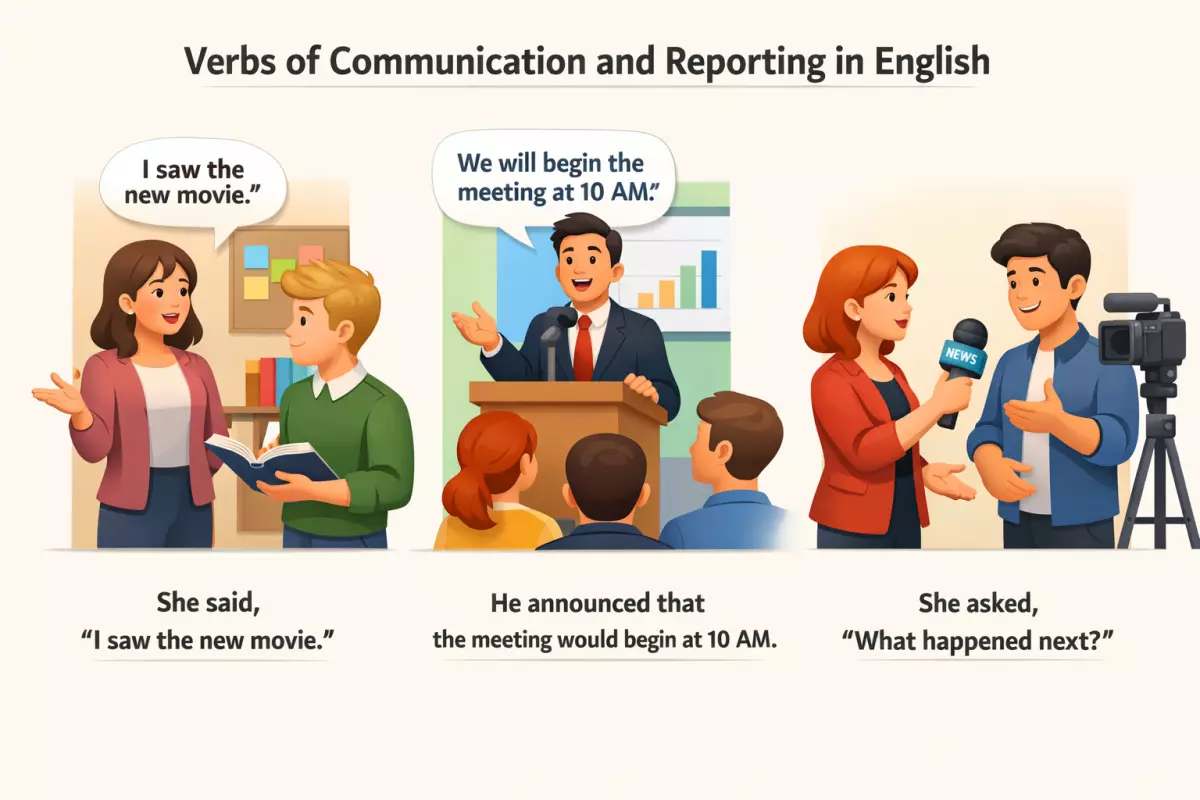 This article explains what communication verbs express, how say differs from tell and speak from talk, and how to use report, announce, mention, and explain with objects or clauses. It also covers reporting questions and requests, formal vs informal choices, common mistakes, and homework practice.
- What communication verbs express
- Say vs tell vs speak vs talk
- Report, announce, mention, explain patterns
- Verb + object and verb + clause structures
- Reporting questions and requests overview
- Formal vs informal reporting verbs
- Typical learner mistakes and fixes
- Homework: communication verb practice tasks
In everyday English, the verbs you use to report messages can shape meaning more than you expect. When you share news, give instructions, or retell a conversation, these words signal how direct, certain, or polite the original speaker was. This guide helps you choose the best option so your speaking and writing stay accurate, clear, and natural.
What communication verbs express
These verbs do more than report that someone “said something.” They package information about the speaker’s purpose, the strength of the message, the social relationship, and how the message is delivered (directly, indirectly, publicly, privately, formally, or casually). Choosing the right verb helps you show stance and intent without adding extra explanation.
Common meanings these verbs add
- Stating information (neutral reporting): say, state, remark, mention, note.
- Adding detail or clarification: explain, clarify, elaborate, spell out.
- Giving an opinion or interpretation: argue, claim, suggest, insist, contend.
- Making something official or public: announce, declare, proclaim, confirm, disclose.
- Correcting or denying: deny, refute, reject, contradict, retract.
- Admitting responsibility or truth: admit, confess, acknowledge, concede.
- Requesting or inviting a response: ask, inquire, question, invite, prompt.
- Advising or recommending: advise, recommend, urge, encourage, caution, warn.
- Directing or requiring action: tell, instruct, order, command, forbid, authorize.
- Promising or committing: promise, pledge, vow, guarantee, assure.
- Negotiating or reaching agreement: propose, offer, agree, consent, concur.
- Expressing emotion or attitude: complain, criticize, praise, apologize, thank, congratulate.
- Accusing or blaming: accuse, blame, allege, charge.
- Private vs. low-volume speech: whisper, murmur, mutter, confide.
- Repetition or emphasis: repeat, reiterate, stress, emphasize, underline.
How meaning affects grammar choices
- Reporting a statement vs. directing someone: verbs like say typically report information, while tell often targets a listener and commonly takes an object (e.g., “tell someone …”).
- Strength of commitment: promise and guarantee imply responsibility; suggest and hint keep the message softer and less direct.
- Certainty and evidence: confirm and verify imply checking; claim and allege can signal that the speaker’s statement is not proven.
- Public vs. private delivery: announce and declare fit formal, public contexts; confide implies trust and a limited audience.
- Conflict or disagreement: deny, refute, and reject often appear when responding to another statement, so they naturally pair with what is being denied (a claim, an accusation, a report).
Quick usage signals to watch for
- Politeness and power: request is softer than demand; advise differs from order in authority.
- Whether the verb implies a listener: tell, ask, warn, and advise usually point to a recipient; announce may not.
- Whether the verb frames the speaker’s attitude: complain and boast describe how the message is presented, not just its content.
- Whether the verb implies follow-up content: explain, clarify, and elaborate typically introduce extra information rather than a single short quote.
Say vs tell vs speak vs talk

These four verbs overlap in meaning, but they follow different grammar patterns and fit different situations. The easiest way to choose is to focus on (1) whether you name the listener, (2) whether you quote exact words, and (3) whether you mean “use language” in general or “have a conversation.”
| Verb | Main idea | Typical patterns | Common examples |
|---|---|---|---|
| say | report words or a message (often the exact words) | say + (that) clause; say + quote; say + something; say to + person | She said (that) she was tired. / He said, “Wait.” / She said hello to me. |
| tell | give information or instructions to someone | tell + person + (that) clause; tell + person + to + verb; tell + person + noun | He told me (that) he was late. / They told us to sit down. / Tell her the truth. |
| speak | use the voice; more formal; ability or one-way communication | speak (to/with) + person; speak about/on + topic; speak + language | May I speak to Mr Lee? / She spoke about safety. / He speaks Spanish. |
| talk | conversation; informal; two-way interaction | talk (to/with) + person; talk about + topic; talk + noun (talks) | I talked to my manager. / We talked about the plan. / Let’s have a talk. |
Key grammar differences (what sounds natural)
- Listener named? Use tell when you include the person who receives the message: ✅ She told me the news. ❌ She said me the news.
- No listener named? say is the default for reporting: ✅ She said (that) she was busy.
- Exact words (quotes)? say is most common with direct speech: ✅ He said, “I’m sorry.” (You can use tell with quotes, but it is less common and often sounds heavier: He told me, “I’m sorry.”)
- Instructions? tell + person + to is the standard pattern: ✅ They told him to leave. (Not: They said him to leave.)
- General ability? Use speak for languages: ✅ She speaks Japanese. (Not: She talks Japanese.)
- Conversation focus? Use talk for an exchange: ✅ We talked for hours. / We talked about work.
High-frequency patterns to copy
- say + (that) clause: She said (that) she would call.
- say + quote: He said, “Don’t worry.”
- say + noun (a word/hello/sorry/anything): Say hello to your sister. / I didn’t say anything.
- say to + person: I said to him, “Stop.” (More common in some varieties; often replaced by “I told him” or “I said, ‘Stop.’”)
- tell + person + (that) clause: Tell me (that) you understand.
- tell + person + to + verb: She told us to wait.
- tell + person + noun: Tell them the address.
- tell + person + wh-word: Tell me what happened. / Tell her where to go.
- speak to/with + person: I need to speak to you.
- speak about/on + topic: The doctor spoke about prevention.
- speak up: Please speak up. (talk louder)
- talk to/with + person: Can I talk to you?
- talk about + topic: Let’s talk about tomorrow.
- talk over: We need to talk it over. (discuss before deciding)
- talk someone into/out of something: They talked him into applying.
Common problem areas
- “Say me” vs “tell me”: Use tell with an indirect object. ✅ Tell me your name. ❌ Say me your name.
- “Explain me” confusion: English prefers “explain to me.” This is similar to say to, but much more common with “explain.”
- “Speak with” vs “speak to”: Both are correct; speak to can sound more one-directional (especially in formal contexts), while speak with suggests a two-way exchange.
- “Talk” in formal writing: Talk is fine in everyday English, but speak often fits better in formal announcements, presentations, or professional contexts.
Quick choice guide
- If you are reporting what someone said (no listener mentioned) → use say.
- If you include the listener or give instructions → use tell.
- If you mean formal communication, public speaking, or language ability → use speak.
- If you mean an informal conversation or discussion → use talk.
Report, announce, mention, explain patterns
These four verbs often introduce information, but they differ in what they focus on (facts, news, brief references, or reasons) and in the grammar that typically follows. Choosing the right structure helps you sound natural and avoid common errors with objects, clauses, and prepositions.
Core meaning and typical focus
- report: gives information as a result of observing, investigating, or receiving data; often sounds formal or journalistic.
- announce: makes news public, often officially; the act of making it known is central.
- mention: refers to something briefly without developing it.
- explain: makes something clear by giving reasons, details, or steps; focuses on understanding.
Common sentence patterns (with examples)
- report + that-clause: “They reported that the bridge was closed.”
- report + noun phrase: “The agency reported delays.”
- report + wh-clause: “She reported what she saw.”
- report + on + noun: “He reported on the election results.”
- report + to + person: “Please report the issue to IT.”
- announce + noun phrase: “The company announced a new policy.”
- announce + that-clause: “They announced that the store would reopen on Monday.”
- announce + to + audience: “She announced the decision to the staff.”
- announce + (something) + publicly/officially: “The results were announced publicly.”
- mention + noun phrase: “He mentioned your name.”
- mention + that-clause: “She mentioned that she might be late.”
- mention + to + person: “Don’t mention it to anyone.”
- mention + -ing: “He mentioned meeting you last year.”
- explain + noun phrase: “Can you explain the process?”
- explain + wh-clause: “She explained why the plan changed.”
- explain + that-clause: “He explained that the figures were estimates.”
- explain + noun + to + person: “Please explain the rules to the children.”
- ❌ explain me → ✅ explain to me: “Explain it to me.”
Object choices and pronouns
- report and announce commonly take a direct object: “report the findings,” “announce the winner.”
- mention easily takes small, specific objects: “mention the email,” “mention his comment.”
- explain usually takes the thing explained as the object, and the listener with to: “explain the problem to them.”
- With pronouns, announce and report often sound best with the object first: “announce it,” “report it,” rather than long clauses after a pronoun.
Passive voice and reporting style
- report is frequent in passive for neutral sourcing: “It was reported that the flight was canceled.”
- announce also appears in passive when the announcer is unimportant: “The date was announced yesterday.”
- mention in passive highlights what was briefly referred to: “The issue was mentioned in the meeting.”
- explain in passive is common in instructions and academic writing: “The method is explained in the appendix.”
Typical collocations and register hints
- report: report a crime, report a problem, report findings, report losses, report back.
- announce: announce a decision, announce a merger, announce a winner, announce plans, announce a resignation.
- mention: mention in passing, mention briefly, mention by name, mention a detail.
- explain: explain clearly, explain in detail, explain the difference, explain how/why, explain step by step.
Verb + object and verb + clause structures
Many reporting verbs let you choose between giving a direct recipient (a person or group) and giving the content as a clause. The choice affects word order, whether you need a preposition, and which clause type sounds natural (that-clause, wh-clause, to-infinitive, or -ing form).
Common patterns and what they do
- Verb + object: focuses on the listener/recipient. Example: “She told me the news.”
- Verb + object + (that) clause: names the recipient and states the message. Example: “She told me (that) the meeting was cancelled.”
- Verb + (that) clause: focuses on the message, with no recipient mentioned. Example: “She said (that) the meeting was cancelled.”
- Verb + object + to-infinitive: often reports advice, requests, or instructions. Example: “He advised us to leave early.”
- Verb + wh-clause: reports questions, uncertainty, or information gaps. Example: “They explained what had happened.”
- Verb + object + wh-clause: adds a recipient to the wh-content. Example: “They explained to us what had happened.”
- Verb + -ing: can report an action or an admission/denial. Example: “She admitted lying.”
Verb-by-verb usage notes (with model sentences)
- say: typically takes a clause, not a direct person-object. ✅ “She said (that) she was tired.” ❌ “She said me…” (use told or said to me).
- tell: normally needs a person-object when reporting information. ✅ “He told me (that) he was leaving.” ❌ “He told that…” (missing recipient).
- tell + object + to-infinitive: for commands/instructions. “They told him to sit down.”
- ask: for questions and requests. “She asked me where I lived.” / “She asked me to help.”
- explain: often needs to before the recipient. “He explained the problem.” / “He explained the problem to us.”
- describe: similar to explain; recipient usually with to. “She described the scene to the police.”
- inform: more formal; commonly “inform + object + that-clause.” “We informed staff that the system would be offline.”
- notify: formal; often “notify + object + that-clause.” “They notified customers that prices would change.”
- remind: often “remind + object + to-infinitive” or “remind + object + that.” “Please remind me to call.” / “She reminded him that the deadline was Friday.”
- warn: commonly “warn + object + about/of” or “warn + object + that.” “They warned us about delays.” / “They warned us that the road was closed.”
- promise: can take a recipient and/or a to-infinitive. “He promised me that he’d help.” / “He promised to help.”
- assure: usually “assure + object + that.” “She assured us that everything was under control.”
- persuade: “persuade + object + to-infinitive.” “They persuaded him to stay.”
- encourage: “encourage + object + to-infinitive.” “The coach encouraged the team to keep going.”
- advise: “advise + object + to-infinitive” or “advise + that-clause” (more formal). “I advised her to wait.” / “We advise that you arrive early.”
- suggest: does not take “suggest + person + to…”. ✅ “She suggested that we leave early.” / “She suggested leaving early.” ❌ “She suggested me to leave…”
- recommend: often “recommend + -ing” or “recommend + that-clause.” “They recommended booking ahead.” / “They recommended that we book ahead.”
- admit: commonly “admit + -ing” or “admit + that.” “He admitted taking the file.” / “He admitted that he took the file.”
Practical checks for choosing a structure
- If you want to highlight the audience, add a recipient: “tell/ask/inform/warn + object …”
- If the verb doesn’t normally take a direct person-object (for example, say), use “to + person” or omit the recipient: “say to me” or “say (that) …”
- Use a to-infinitive after verbs of advice, requests, and persuasion: “advise/encourage/persuade/tell/ask + object + to …”
- Use a wh-clause to report information questions: “ask/explain/describe + what/why/how/where …”
- Use -ing for general recommendations or admissions: “recommend/suggest + -ing,” “admit/deny + -ing.”
Reporting questions and requests overview
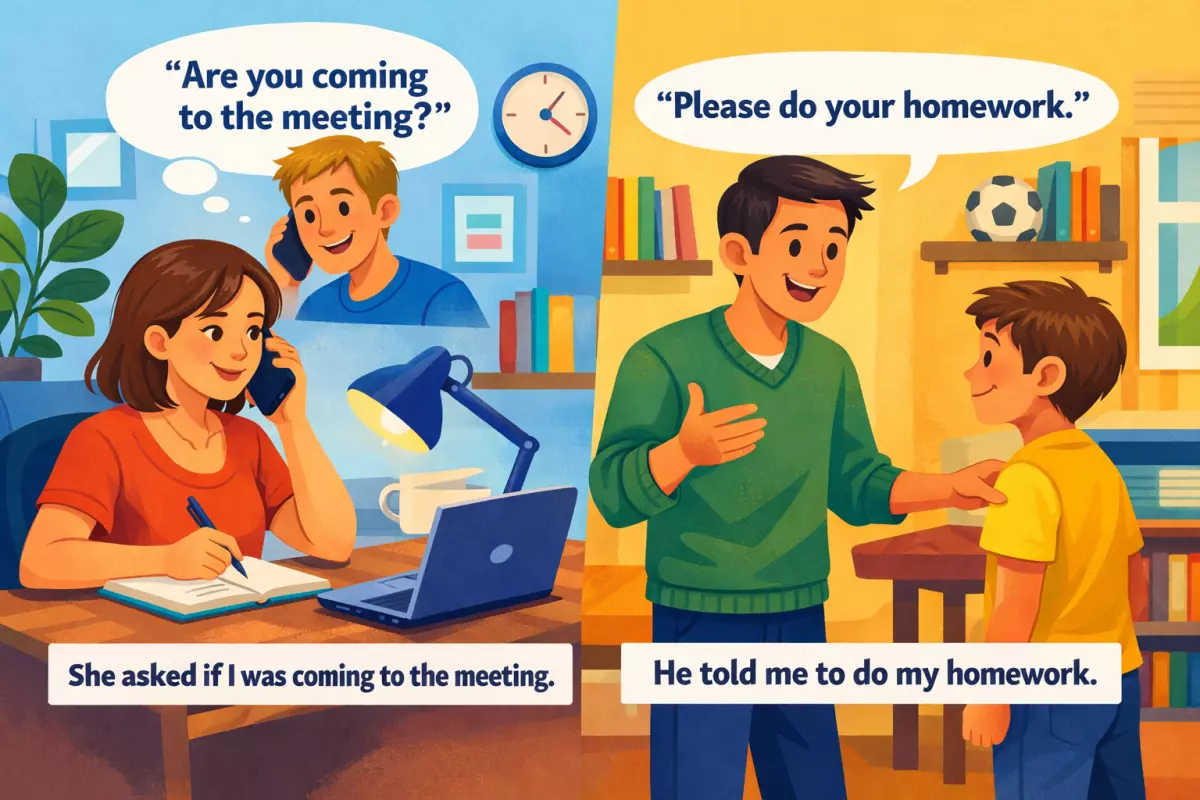
When you turn a direct question or request into indirect speech, the main changes are usually in word order, tense/time reference, and the choice of a reporting verb. Questions typically become noun clauses introduced by if/whether or a wh- word, while requests commonly use an infinitive pattern (often with an object) such as ask/tell + someone + to + verb.
Core patterns for reporting questions
- Yes/no questions: use if or whether + statement word order.
- Direct: “Are you ready?” → Reported: She asked if I was ready.
- Direct: “Do they agree?” → Reported: He wondered whether they agreed.
- Wh- questions: keep the wh-word (what/where/when/who/why/how) and use statement word order.
- Direct: “Where do you live?” → Reported: She asked where I lived.
- Direct: “Why did he leave?” → Reported: They asked why he had left.
- No auxiliary inversion in reported questions:
- ✅ She asked where I was.
- ❌ She asked where was I.
- Do-support disappears because the clause becomes a statement structure:
- Direct: “What do you want?” → Reported: He asked what I wanted.
- Whether is common in more formal contexts and with alternatives:
- She asked whether we were staying or leaving.
- He didn’t say whether he would call.
Core patterns for reporting requests and instructions
- ask + (someone) + to + verb for requests:
- “Please wait here.” → She asked me to wait there.
- “Could you email the file?” → He asked her to email the file.
- tell + (someone) + to + verb for instructions/orders (often stronger than ask):
- “Stop talking.” → The teacher told us to stop talking.
- “Don’t touch it.” → He told me not to touch it.
- Negative requests: use not to:
- She asked him not to mention it.
- They told us not to park there.
- request + that-clause is possible (more formal), often with a modal:
- The manager requested that everyone (should) arrive on time.
- beg/urge/encourage/warn + (someone) + to + verb adds attitude (pleading, pressure, support, caution):
- She urged him to apply.
- They warned us not to swim there.
Common reporting verbs and the structures they prefer
- ask: questions (if/whether, wh-) and requests (to-infinitive).
- wonder: questions only (often if/whether or wh-), not requests.
- inquire (formal): questions, typically about + noun or whether + clause.
- request (formal): to-infinitive or that-clause.
- tell: instructions/commands (someone to), not yes/no question clauses.
- order/command: strong instructions (someone to).
- advise: recommendations (someone to, or that + clause in formal style).
- remind: prompts about an obligation (someone to, or someone that).
- invite: polite request/offer (someone to).
- forbid: prohibition (someone to is not used; use someone from -ing or say (that) ... mustn’t).
Reference shifts to watch for
- Backshift after a past reporting verb is common when the meaning is still “past from that viewpoint”:
- “Where are you going?” → He asked where I was going.
- “Did you see it?” → She asked if I had seen it.
- No backshift when the information is still true or the speaker treats it as current:
- He asked where I live. (still true now)
- She asked if the meeting starts at nine. (fixed schedule)
- Pronouns, time, and place often change:
- “I’ll do it tomorrow.” → He said he would do it the next day.
- “Put it here.” → She told me to put it there.
Expanded example set (direct → reported)
- “What time is it?” → She asked what time it was.
- “Where did you buy it?” → He asked where I had bought it.
- “Can you drive?” → She asked if I could drive.
- “Will they join us?” → He asked whether they would join us.
- “How long have you worked here?” → She asked how long I had worked there.
- “Why are you late?” → He asked why I was late.
- “Who told you?” → She asked who had told me.
- “Please speak more slowly.” → He asked me to speak more slowly.
- “Don’t open the window.” → She told us not to open the window.
- “Remember to lock the door.” → He reminded me to lock the door.
- “Could you help me with this?” → She asked him to help her with that.
- “Don’t forget to call.” → She reminded him not to forget to call.
- “Try restarting the computer.” → He advised me to try restarting the computer.
- “Please don’t mention my name.” → She begged them not to mention her name.
Formal vs informal reporting verbs
Register affects which verb sounds natural, how direct the message feels, and which grammar patterns are expected. In academic writing, news reporting, and workplace documents, more neutral or institutional verbs are common. In everyday conversation, shorter and more personal verbs are preferred, often with simpler clause structures.
Typical choices by context
- Formal contexts (reports, essays, official emails): verbs that sound precise, cautious, or evidence-based, such as state, report, announce, confirm, deny, argue, maintain, conclude, indicate, note, observe, emphasize, acknowledge, recommend, advise.
- Informal contexts (chat, storytelling, casual talk): verbs that feel immediate or expressive, such as say, tell, ask, talk about, mention, go (as in “He goes…”), be like, complain, joke, promise, admit, confess, shout, whisper, yell.
Grammar patterns that often signal formality
- That-clauses are common in more careful writing: “The spokesperson stated that the policy would change.”
- Passive reporting helps keep focus on information, not the speaker: “It was reported that delays were expected.”
- Noun + reporting verb patterns appear in institutional style: “The report concludes that…”, “The study indicates that…”
- Hedging verbs reduce certainty when evidence is limited: “The data suggest…”, “The results appear to…”
- Preposition patterns can be more fixed and formal: “The minister commented on the decision,” “The author argues for reform.”
Grammar patterns that often signal informality
- Direct speech with “say” is frequent: “She said, ‘I’m not going.’”
- “Tell + object” is common when the listener matters: “He told me he was tired.” (Not: ❌ “He told that he was tired.”)
- Discourse-quotative forms are conversational: “And she was like, ‘No way.’” / “He goes, ‘Seriously?’”
- Short reporting clauses interrupt stories naturally: “I asked, ‘Why?’ and she said nothing.”
- Emotion or manner verbs add color more than precision: “He laughed that it was easy,” “She snapped that she was busy.”
Practical switching: same message, different register
- Informal: “He said the meeting’s off.” → More formal: “He announced that the meeting was cancelled.”
- Informal: “She told me she didn’t agree.” → More formal: “She stated that she disagreed.”
- Informal: “They said it might rain.” → More formal: “The forecast indicates that rain is possible.”
- Informal: “He kept saying it wasn’t his fault.” → More formal: “He maintained that he was not responsible.”
- Informal: “She talked about changing jobs.” → More formal: “She discussed a potential job change.”
When choosing a reporting verb, match the level of certainty and the relationship between speaker and listener. Verbs like confirm, deny, and admit carry strong implications about evidence or responsibility, while say and tell are more neutral and flexible in casual speech.
Typical learner mistakes and fixes
Errors with reporting and message verbs usually come from mixing verb patterns (that-clauses, infinitives, -ing forms), choosing the wrong preposition, or using the wrong level of certainty. Use the fixes below as quick checks when you write or paraphrase what someone said.
1) Mixing up verb patterns (that-clause vs infinitive vs -ing)
- ❌ He suggested to take a taxi. → ✅ He suggested taking a taxi. / He suggested that we take a taxi.
- ❌ She advised me that I should leave. → ✅ She advised me to leave. / She advised that I (should) leave.
- ❌ They insisted me to stay. → ✅ They insisted that I stay. (No object + to-infinitive after insist.)
- ❌ He promised me that to call. → ✅ He promised to call. / He promised me that he would call.
- ❌ I agreed him. → ✅ I agreed with him. / I agreed to the plan.
- ❌ She explained me the problem. → ✅ She explained the problem to me. (Object comes after to.)
- ❌ He told that he was late. → ✅ He said that he was late. / He told me that he was late.
- ❌ She asked me where is the station. → ✅ She asked me where the station was. (No question word order in reported questions.)
- ❌ He recommended me to visit the museum. → ✅ He recommended that I visit the museum. / He recommended visiting the museum.
- ❌ They denied to break the rule. → ✅ They denied breaking the rule. (Commonly deny + -ing.)
- ❌ I refused him to help. → ✅ I refused to help. / I refused his request.
- ❌ She admitted to steal the file. → ✅ She admitted stealing the file.
2) Confusing “say” and “tell”
- Use say without a direct object: ✅ She said she was tired. / She said to me that she was tired.
- Use tell with a person/object: ✅ She told me she was tired. ❌ She told she was tired.
- For instructions and information, tell + object + to is common: ✅ He told us to wait.
3) Wrong prepositions after reporting verbs
- ❌ She complained me about the noise. → ✅ She complained to me about the noise.
- ❌ He apologized me. → ✅ He apologized to me. / He apologized for being late.
- ❌ They accused for cheating. → ✅ They accused him of cheating.
- ❌ She blamed on me. → ✅ She blamed me for the mistake. / She blamed the mistake on me.
- ❌ He congratulated for the promotion. → ✅ He congratulated her on the promotion.
- ❌ We warned about him. → ✅ We warned him about the risk. / We warned them against investing.
4) Overusing “inform” and “explain” like “tell”
- Inform is formal and usually needs an object: ✅ Please inform us that the meeting is cancelled. ❌ Please inform that the meeting is cancelled.
- Explain does not take a person directly as the first object: ✅ He explained the rules to us. ❌ He explained us the rules.
5) Reporting questions: keeping question word order
- Reported questions use statement order: ✅ She asked where I was. ❌ She asked where was I.
- Yes/no questions often use if/whether: ✅ He asked if I had finished. ❌ He asked did I finish.
- Keep the question mark only for direct questions: ✅ He asked if I was ready. (No ?)
6) Backshift problems (and when not to backshift)
- After a past reporting verb, tense often shifts back: ✅ “I am busy.” → She said she was busy.
- Do not backshift for facts that are still true: ✅ The teacher said that water boils at 100°C.
- Use would for future-in-the-past: ✅ He said he would call later.
7) Choosing a verb that changes the meaning (certainty, evidence, attitude)
- Say is neutral; claim can sound doubtful or unverified: ✅ He claimed he had proof. (Implies “he says so,” not necessarily true.)
- Admit suggests something negative or reluctant: ✅ She admitted she was wrong. (Not the same as “said.”)
- Confirm needs a clear fact to verify: ✅ They confirmed that the flight was cancelled. (Not for opinions.)
- Deny is used to reject an accusation or statement: ✅ He denied taking the money. (Avoid using it as a synonym of “refuse.”)
Homework: communication verb practice tasks
Use these exercises to practice choosing accurate reporting verbs, building correct patterns (verb + object + clause/infinitive), and controlling tense shifts in reported speech. Focus on the grammar each verb requires, not only the meaning.
1) Choose the best reporting verb
Replace said with a more precise verb. Keep the meaning the same.
- “I didn’t break it,” he said. (He was sure it wasn’t him.)
- “Please, please help me,” she said.
- “You must wear a helmet,” the instructor said.
- “I’m sorry I’m late,” he said.
- “I saw her take the file,” the witness said.
- “Let’s meet at 6,” Maya said.
- “If you finish early, you can leave,” the manager said.
- “I will definitely call you tomorrow,” he said.
- “The results are better than last year,” the report said.
- “I didn’t take the money,” she said again and again.
Show answers
- He denied breaking it.
- She begged for help.
- The instructor insisted that everyone wear a helmet.
- He apologized for being late.
- The witness claimed to have seen her take the file.
- Maya suggested meeting at 6.
- The manager offered to let them leave if they finished early.
- He promised to call the next day.
- The report stated that the results were better than the previous year.
- She repeated that she hadn’t taken the money.
2) Pattern practice: complete the sentence
Fill each blank with a correct structure. Use the verb given and add any necessary words (object, preposition, that-clause, -ing, or infinitive).
- admit: She __________ (take) the keys without asking.
- accuse: They __________ him __________ (leak) the documents.
- warn: The doctor __________ me __________ (drive) for 24 hours.
- persuade: I finally __________ her __________ (apply) for the role.
- remind: Please __________ me __________ (send) the invoice.
- announce: The company __________ that it __________ (close) the branch.
- explain: He __________ to us why the system __________ (fail).
- complain: Customers __________ about __________ (wait) times.
- promise: They __________ us that they __________ (deliver) on Friday.
- refuse: He __________ __________ (answer) any questions.
- advise: She __________ me __________ (not/sign) the contract yet.
- agree: We __________ __________ (meet) again the following week.
Show answers
- She admitted taking the keys without asking.
- They accused him of leaking the documents.
- The doctor warned me not to drive for 24 hours.
- I finally persuaded her to apply for the role.
- Please remind me to send the invoice.
- The company announced that it was closing the branch.
- He explained to us why the system had failed.
- Customers complained about long waiting times.
- They promised us that they would deliver on Friday.
- He refused to answer any questions.
- She advised me not to sign the contract yet.
- We agreed to meet again the following week.
3) Fix the error (verb pattern or preposition)
Each sentence has one common mistake with communication/reporting verbs. Rewrite it correctly.
- He suggested me to take a taxi.
- She explained me the problem.
- They accused him to steal the laptop.
- I insisted to pay for dinner.
- He warned me don’t touch the wire.
- She reminded that I should call my mother.
- They promised me for help.
- He complained me about the noise.
- The spokesperson denied to know anything.
- She admitted that to be wrong.
Show answers
- He suggested that I take a taxi / He suggested taking a taxi.
- She explained the problem to me.
- They accused him of stealing the laptop.
- I insisted on paying for dinner.
- He warned me not to touch the wire.
- She reminded me that I should call my mother / She reminded me to call my mother.
- They promised to help / They promised me help.
- He complained to me about the noise.
- The spokesperson denied knowing anything.
- She admitted being wrong / She admitted that she was wrong.
4) Report it: shift time and pronouns
Rewrite each quote as reported speech. Use an appropriate reporting verb (not always say) and make natural tense/time changes where needed.
- “I can’t attend the meeting today,” Lina said.
- “We will send the revised draft tomorrow,” they said.
- “I didn’t see anything unusual last night,” the guard said.
- “Don’t share this password with anyone,” IT said.
- “Let me carry that for you,” he said.
- “Why did you delete the file?” my colleague said.
- “Yes, I broke the rule,” he said.
- “No, I never contacted them,” she said.
Show answers
- Lina said she couldn’t attend the meeting that day.
- They promised they would send the revised draft the next day.
- The guard said he hadn’t seen anything unusual the night before.
- IT warned us not to share the password with anyone.
- He offered to carry it for me.
- My colleague asked why I had deleted the file.
- He admitted breaking the rule.
- She denied ever contacting them.
5) Production task: build a short report
Write 8–10 sentences summarizing a workplace or school situation (a meeting, a complaint, a project update, or an incident). Include at least 10 different verbs of communication and reporting, and use at least five different patterns from the list below. Check that each verb matches its grammar.
- verb + that-clause: “They confirmed that…”
- verb + object + that-clause: “She assured us that…”
- verb + to-infinitive: “He agreed to…”
- verb + object + to-infinitive: “They advised me to…”
- verb + -ing: “She admitted…”
- verb + preposition + -ing: “He apologized for…” / “They insisted on…”
- verb + object + of + -ing: “They accused him of…”
- verb + question word + clause: “She explained why…”