Lexical vs Auxiliary Verbs: Forms and Functions Explained

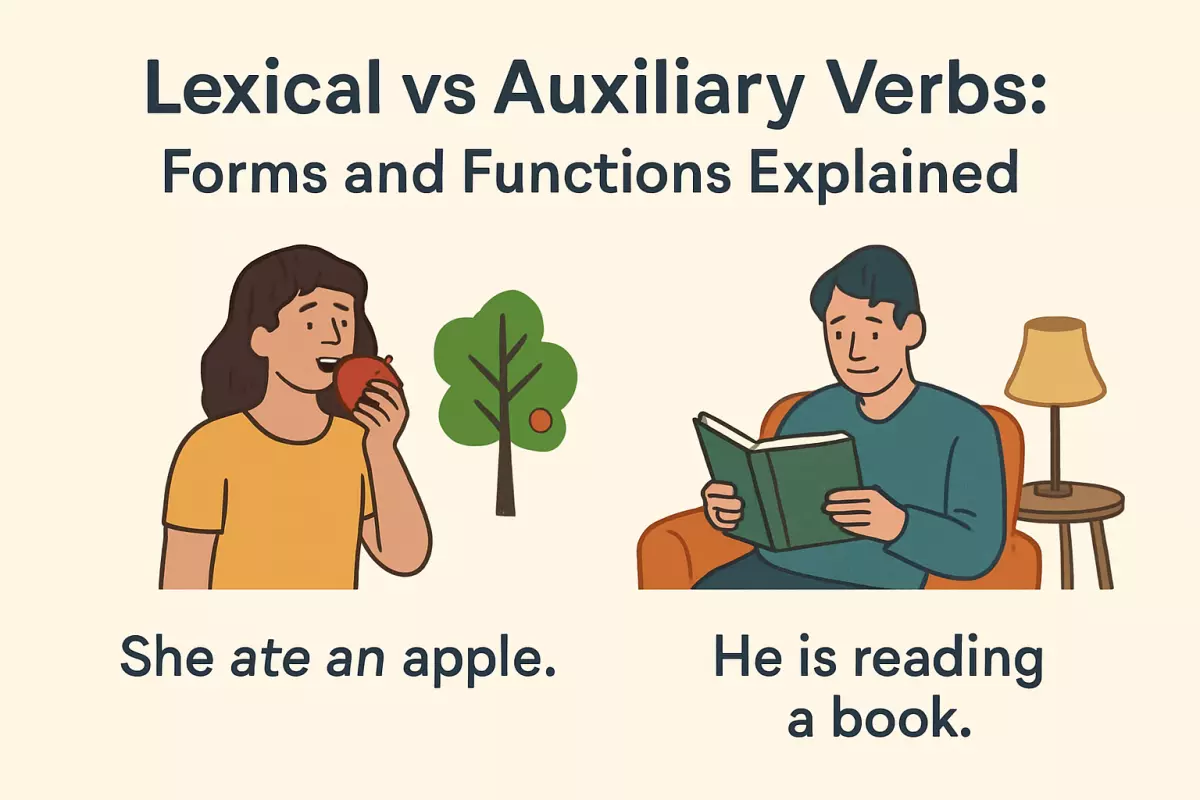 Learn what lexical verbs do in a sentence and how auxiliary verbs support them to form tense, aspect, and voice. It also explains do-support for questions, negatives, and emphasis, plus verbs that can be both types.
- Lexical verbs: meaning and sentence role
- Auxiliary verbs: grammatical support functions
- How auxiliaries modify lexical verbs
- Tense, aspect, and voice built with auxiliaries
- Do-support: questions, negatives, and emphasis
- Verbs that function as both lexical and auxiliary
- Frequent learner errors with examples
- Practice: lexical vs auxiliary verb tasks
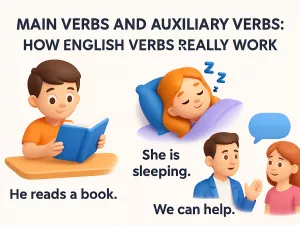
In everyday English, some verbs carry the main meaning, while others support them by showing tense, forming questions, or making negatives. This guide helps you identify both types in real sentences, so you can speak and write with more confidence. You will learn how helping verbs work with main verbs, how word order changes in questions, and how negatives are built, with clear examples you can apply right away.
Lexical verbs: meaning and sentence role
Content verbs carry the main idea of an action, event, process, or state. They tell you what is happening or what is true, while any auxiliary verbs around them mainly add grammar information such as time, aspect, voice, emphasis, or modality.
What lexical verbs contribute
- Core meaning: the key action or state (e.g., run, decide, belong).
- Event type: whether something is dynamic (actions like build) or stative (states like know).
- Argument structure: what complements are needed (e.g., put typically needs an object and a place: “put the keys on the table”).
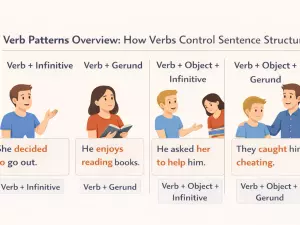
- Selection of patterns: which forms sound natural after the verb (e.g., enjoy + -ing, decide + to-infinitive).
- Lexical choice and nuance: similar grammar, different meaning (e.g., look vs. stare vs. glance).
Where they appear in the verb phrase
In a clause, the lexical verb is the “main verb” inside the verb phrase. Auxiliaries can stack before it, but the content verb stays last in the chain.
- No auxiliary: “They arrived early.”
- With aspect: “They have arrived.” / “They are arriving.”
- With modality: “They might arrive later.”
- With passive voice: “The tickets were checked at the door.”
- With multiple auxiliaries: “The tickets might have been checked already.” (lexical verb: checked)
Common sentence patterns with lexical verbs
Different lexical verbs prefer different complements. Learning these patterns helps you build accurate sentences and avoid missing required information.
- Intransitive (no object): “The baby slept.”
- Transitive (direct object): “She opened the window.”
- Ditransitive (two objects): “He sent her a message.”
- Complex transitive (object + complement): “They painted the door red.”
- Copular / linking (subject complement): “He became a doctor.”
- Verb + prepositional complement: “We rely on you.”
- Verb + clause: “I think (that) it’s true.”
Useful usage cues (with examples)
- Stative verbs often avoid the progressive in standard use: ✅ “I know the answer.” ❌ “I am knowing the answer.”
- Action verbs commonly appear in the progressive to show an ongoing event: “She is cooking dinner.”
- Some verbs change meaning by pattern: “I stopped to smoke.” (purpose) → “I stopped smoking.” (quit the activity)
- Lexical choice affects naturalness: “make a decision” vs. “do a decision” (collocation depends on the main verb).
High-frequency lexical verbs to notice in patterns
- make (make a plan, make someone laugh)
- take (take a break, take responsibility)
- give (give advice, give someone a call)
- get (get ready, get someone to agree)
- go (go home, go missing)
- come (come back, come to an agreement)
- put (put it down, put someone under pressure)
- keep (keep trying, keep something secret)
- let (let someone know, let it happen)
- seem (seem tired, seem to understand)
- become (become aware, become a problem)
- feel (feel better, feel like leaving)
- know (know the answer, know how to do it)
- think (think about it, think that it’s fine)
- need (need help, need to leave)
- want (want a coffee, want to go)
Auxiliary verbs: grammatical support functions
Helping verbs add grammar to a main verb rather than carrying the main meaning themselves. They commonly mark tense, aspect (how an action unfolds), voice (active vs. passive), and modality (ability, permission, obligation, likelihood). They also provide “support” for negatives, questions, and emphasis when English grammar requires an auxiliary.
Core auxiliaries and what they typically do
- Be → forms the progressive (be + -ing) and the passive (be + past participle).
- Have → forms perfect aspect (have + past participle).
- Do → provides “do-support” for questions, negation, and emphasis in the simple present/past.
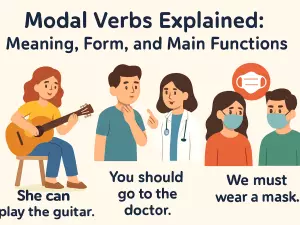
- Modal auxiliaries (can, could, may, might, must, shall, should, will, would) → express modality and combine with a bare infinitive (no to).
- Marginal/semi-auxiliaries (need, dare, used to, ought to; and multiword forms like have to, be going to) → behave partly like auxiliaries but follow their own patterns.
Common auxiliary patterns (with examples)
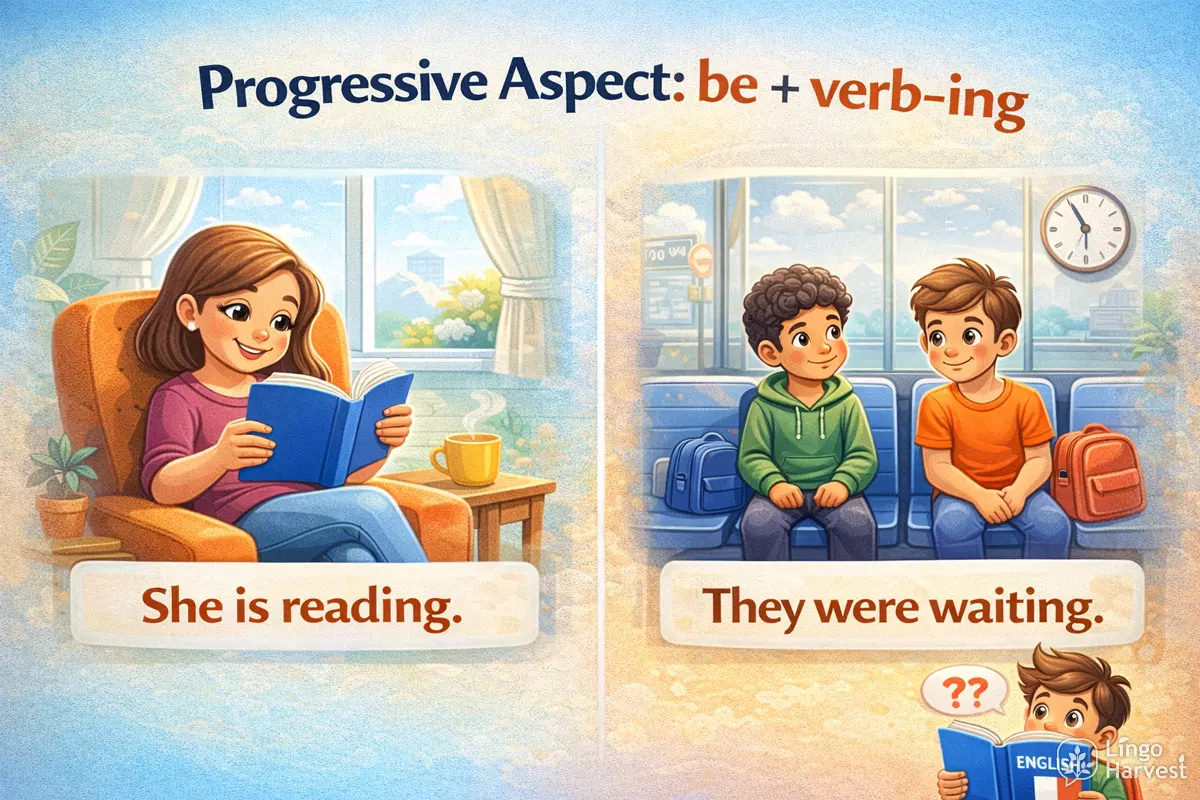
- Progressive aspect: be + verb-ing → “She is reading.” / “They were waiting.”
- Perfect aspect: have + past participle → “I have finished.” / “He had left.”
- Perfect progressive: have been + verb-ing → “We have been working.”
- Passive voice: be + past participle → “The window was broken.”
- Modal + base verb: modal + bare infinitive → “You must leave.” / “She can swim.”
- Modal perfect: modal + have + past participle → “They might have missed the train.”
- Modal progressive: modal + be + verb-ing → “He could be joking.”
- Modal passive: modal + be + past participle → “It should be repaired.”
- Stacking auxiliaries (order matters) → “The report will have been reviewed.”
- Infinitive with auxiliary meaning in a larger verb phrase → “She seems to have forgotten.”
- Future meaning with a semi-auxiliary: be going to + base verb → “I am going to call later.”
- Obligation with a semi-auxiliary: have to + base verb → “We have to leave now.”
Do-support: negatives, questions, and emphasis
- Negation in simple present/past: do/does/did + not + base verb → “She does not like olives.” / “They didn’t see it.”
- Yes/no questions: Do/Does/Did + subject + base verb → “Do you work here?”
- Wh- questions: wh-word + do/does/did + subject + base verb → “Where did you put it?”
- Emphatic do (contrast or insistence): do/does/did + base verb → “I do agree.” / “He did call.”
- When do-support is not used: with be as the main verb → “She isn’t ready.” / “She doesn’t be ready.”
Auxiliaries in short answers and tags
- Short answers repeat the auxiliary (not the full lexical verb) → “Have you eaten?” “Yes, I have.”
- Tag questions mirror the auxiliary → “You are coming, aren’t you?” / “She can drive, can’t she?”
- If there is no auxiliary, use do-support in the tag → “He works here, doesn’t he?”
Quick form notes that affect usage
- Modals don’t take -s in the third person singular → “She can swim.” / “She cans swim.”
- Modals are followed by the base form → “They should go.” / “They should goes.”
- Contracted negatives are common (isn’t, haven’t, didn’t, won’t), but keep the auxiliary structure intact.
- Auxiliary order is predictable: modal → perfect have → progressive be → passive be → main verb.
How auxiliaries modify lexical verbs
Auxiliary verbs work with a main (lexical) verb to add grammar and meaning that the lexical verb alone cannot easily show. They help express time, aspect, voice, mood, and speaker attitude, while the lexical verb carries the core action or state.
Core patterns: auxiliary + verb form
Most auxiliary constructions follow a small set of predictable combinations. Learning the verb form that follows each helper verb is the key to accurate usage.
- Modal + base verb: can go, should wait, might happen (no to and no -s on the lexical verb).
- be + -ing (progressive aspect): is running, were talking.
- have + past participle (perfect aspect): has eaten, had finished.
- be + past participle (passive voice): is built, was chosen, will be delivered.
- do + base verb (support for questions, negatives, emphasis): do you know?, did not agree, do remember.
- be going to + base verb (planned future): is going to leave, are going to meet.
- be about to + base verb (immediate future): is about to start.
- be able to + base verb (ability, alternative to can): will be able to attend.
What auxiliaries add to meaning
Different auxiliaries contribute different layers of meaning, even when the lexical verb stays the same.
- Tense: walk vs. did walk vs. will walk.
- Aspect:
- She writes → She is writing.
- She wrote → She has written.
- She was writing → She had been writing.
- Voice:
- The team solved the problem.
- The problem was solved by the team.
- Modality:
- It may rain.
- You must submit the form.
- You should rest.
- Politeness and stance: Could you help? sounds softer than Can you help?
Stacking auxiliaries: order and limits
English allows more than one auxiliary before the lexical verb, but the order is constrained. A common sequence is: modal → perfect have → progressive be → passive be → lexical verb.
- She may have been working.
- The files will have been sent by noon.
- The report might have been being reviewed.
Negatives, questions, and emphasis with auxiliaries
Auxiliaries are central to sentence structure because they carry negation and inversion in many clauses.
- Negation attaches to the first auxiliary:
- She has not arrived.
- They will not agree.
- He is not joking.
- Questions invert subject and auxiliary:
- Have you finished?
- Is she coming?
- Will they call?
- Do-support appears when there is no auxiliary:
- Do you like it? / Like you it?
- She did not call. / She not called.
- I do understand.
Common usage patterns to model
These examples show how the same lexical verb changes meaning when paired with different auxiliaries.
- know: I know (state) → I do know (emphasis) → I might know (uncertainty).
- work: They work (habit) → They are working (now) → They have worked (completed experience/result).
- choose: We chose → We have chosen (decision with current relevance) → It was chosen (passive).
- finish: She finished → She had finished (before another past event) → She will have finished (before a future deadline).
- deliver: They will deliver → It will be delivered (passive focus on the item).
- go: He goes → He is going → He is going to go (planned; sometimes avoided by rephrasing to reduce repetition).
- see: Did you see it? (question) → You did see it. (contrast/emphasis).
- wait: You must wait (requirement) → You should wait (recommendation) → You may wait (permission).
- agree: They can agree (ability) → They may agree (possibility) → They will agree (prediction/insistence).
- be: She is (state) → She has been (duration up to now) → She is being (temporary behavior in progress).
Tense, aspect, and voice built with auxiliaries
English often relies on auxiliary verbs to build time, completeness, ongoingness, and perspective. The main verb carries core meaning, while auxiliaries such as be, have, and do supply grammar: tense marking, aspect choices, passive voice, and question/negation patterns.
Core building blocks and what they signal
- Simple present/past (no aspect auxiliary): use the lexical verb form for present, and the past form for past. She works. / She worked.
- Progressive aspect: be + -ing for actions in progress or temporary situations. They are studying. / They were studying.
- Perfect aspect: have + past participle for earlier time with current relevance, experience, or completion. I have finished. / She had left.
- Perfect progressive: have + been + -ing for duration leading up to a time. We have been waiting. / He had been working.
- Passive voice: be + past participle to focus on the receiver of the action. The window was broken.
- Passive with perfect: have + been + past participle to show earlier passive events. The reports have been submitted.
- Passive progressive: be + being + past participle for an action in progress in the passive. The road is being repaired.
- Future reference with will: will + base verb. They will arrive soon.
- Future progressive: will be + -ing. This time tomorrow, I will be flying.
- Future perfect: will have + past participle. By Friday, we will have completed it.
- Future perfect progressive: will have been + -ing. By noon, she will have been teaching for six hours.
- Modals (can, could, may, might, must, should, would): modal + base verb to add meaning like ability, permission, obligation, probability. You must leave. / It might rain.
- Modal perfect: modal + have + past participle for past-time inference or regret. He might have missed the train. / You should have called.
- Emphatic do: do/does/did + base verb to add emphasis in affirmative clauses. I do agree. / She did try.
Common usage patterns (questions, negatives, and agreement)
- Subject–auxiliary inversion for questions: move the first auxiliary before the subject. She is leaving. → Is she leaving?
- Do-support when there is no other auxiliary: use do/does/did for questions and negatives in simple present/past. ✅ Do you like it? / ❌ Like you it?
- Negation attaches to the auxiliary: not follows the first auxiliary. He has not finished. / They are not coming.
- Only the first auxiliary is tensed: in multi-auxiliary strings, tense shows on the first verb. She has been working. (not has been worked for this meaning)
- Main verb form depends on the auxiliary before it:
- After be (progressive) → -ing: is running
- After have → past participle: has eaten
- After a modal → base form: can swim
- After passive be → past participle: was built
- Agreement appears on the auxiliary in the present: He is, She has, but They are, They have.
Stacking auxiliaries: typical order
When more than one auxiliary is used, the order is fairly regular: modal (if any) → perfect have → progressive be → passive be → main verb. Not every slot appears at once, but this template helps explain why forms like will have been being examined are possible (though uncommon in everyday use).
- The team will have been training (modal + perfect + progressive)
- The files have been archived (perfect + passive)
- The patient is being monitored (progressive passive)
- The results will be published (modal + passive)
Do-support: questions, negatives, and emphasis
In modern English, the verb do is inserted as an auxiliary when a clause needs an operator for word order or negation, but the main verb is a simple lexical verb (not be, not an auxiliary like have or a modal). This “helper” do carries tense and agreement, while the main verb stays in the bare infinitive form.
When it appears (and when it doesn’t)
- Use auxiliary do with most lexical verbs in the present simple and past simple for questions, negatives, and certain types of emphasis.
- Do not add it when the clause already has an auxiliary or modal: is/are/was/were, have/has/had, will, can, should, etc.
- Do not use it for affirmative statements in ordinary style: ❌ She does like coffee (only if emphasizing) vs ✅ She likes coffee.
- With be as the main verb, form questions and negatives without do: Are you ready? / He isn’t ready.
Core patterns
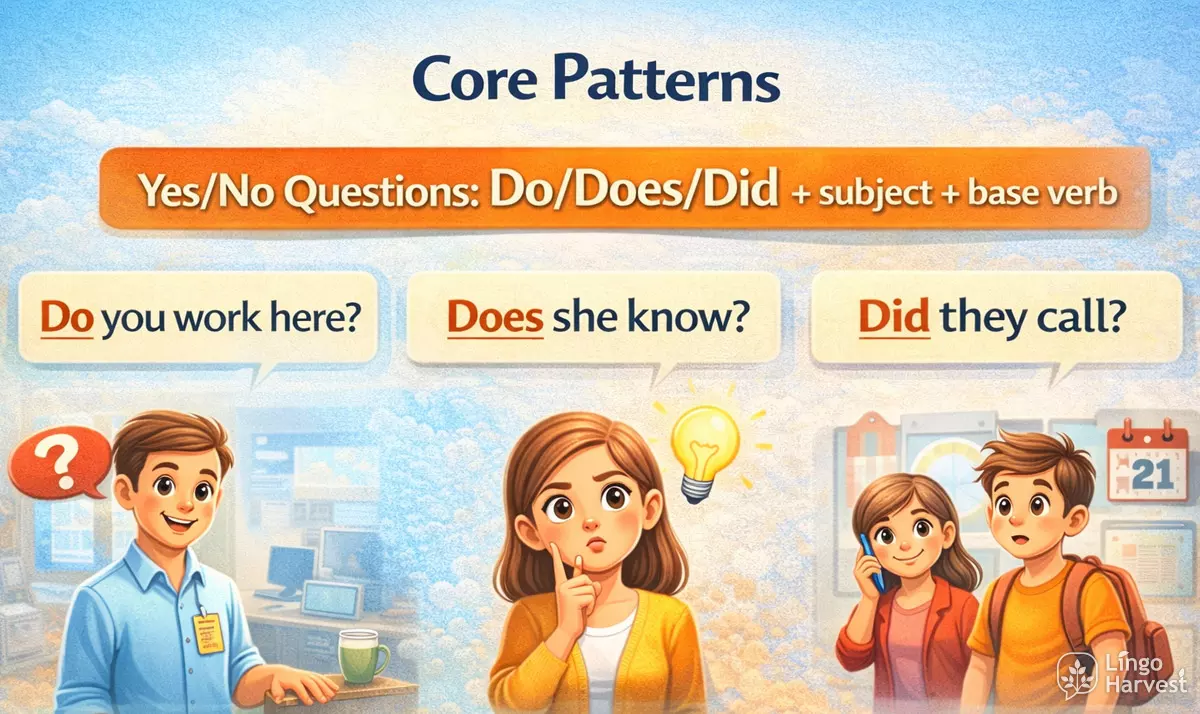
- Yes/no questions: Do/Does/Did + subject + base verb
Examples: Do you work here? / Does she know? / Did they call? - Wh- questions: Wh-word + do/does/did + subject + base verb
Examples: Where do you live? / Why did he leave? / What does it mean? - Negatives: Subject + do/does/did + not + base verb
Examples: I don’t agree. / She doesn’t drive. / We didn’t notice. - Negative questions: Do/Does/Did + subject + not + base verb (or contracted form)
Examples: Don’t you want to go? / Didn’t she email? - Emphatic affirmative: Subject + do/does/did + base verb (stress on the auxiliary)
Examples: I do understand. / He did try.
Form details that cause most errors
- The main verb always stays in the base form:
✅ Does she like it? → ❌ Does she likes it? - Tense is carried by the auxiliary, not the main verb:
✅ Did you see it? → ❌ Did you saw it? - Present tense agreement: use does with third-person singular subjects
Examples: Does the manager approve? / She doesn’t know. - Negation comes after the auxiliary, not after the main verb:
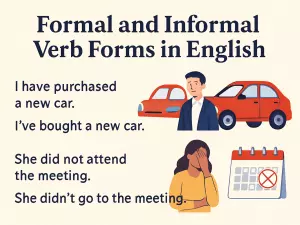
✅ They did not finish. → ❌ They finished not. - Contractions (don’t, doesn’t, didn’t) are normal in speech and informal writing; full forms are used for emphasis or formality.
Expanded examples (common classroom patterns)
- Do you remember his name?
- Does this bus stop here?
- Did they arrive on time?
- Where do your parents live?
- When did you last see her?
- Why does it matter?
- I don’t eat meat.
- She doesn’t speak French.
- We didn’t hear anything.
- Don’t you trust him?
- Doesn’t it look strange?
- Didn’t you send the file?
- I do want to help.
- He does know the answer.
- They did finish the project.
- Do call me when you arrive. (polite, slightly formal emphasis)
Interaction with other auxiliaries
- If another auxiliary is present, it becomes the operator and do is not used:
✅ Are you leaving? → ❌ Do you are leaving? - With the perfect aspect, use have for questions and negatives:
Examples: Have you seen it? / I haven’t seen it. - With modal verbs, the modal handles inversion and negation:
Examples: Can you swim? / She can’t swim. - With the progressive aspect, use be as the auxiliary:
Examples: Is he working? / He isn’t working.
Verbs that function as both lexical and auxiliary
Some verbs can act as a main verb with full meaning in one sentence, but switch to a “helper” role in another. The key is to look at what follows: if the verb is supporting another verb (often in a special form like a participle or bare infinitive), it is functioning as an auxiliary; if it carries the core meaning by itself, it is lexical.
How to tell which role the verb has
- Auxiliary use: it combines with another verb to build tense, aspect, voice, or emphasis (for example, be + -ing, have + past participle, do + base verb).
- Lexical use: it can stand alone as the main predicate, taking complements like noun phrases, adjectives, or prepositional phrases (for example, be + adjective; have + noun).
- Negation and questions: auxiliaries typically take not directly and invert with the subject in questions; lexical verbs usually need do-support for these patterns.
Common verbs that switch roles (with patterns and examples)
- be
- Auxiliary: be + present participle → “She is working.”
- Auxiliary: be + past participle (passive) → “The window was broken.”
- Lexical (copular): be + adjective/noun/PP → “He is tired.” / “They are teachers.” / “The keys are on the table.”
- have
- Auxiliary: have + past participle (perfect) → “We have finished.”
- Lexical (possession/relationship): have + noun phrase → “I have a car.” / “She has two brothers.”
- Lexical (experience/illness): → “He had a headache.” / “They had a great time.”
- do
- Auxiliary: do + base verb (questions/negatives/emphasis) → “Do you agree?” / “I do not know.” / “I do remember.”
- Lexical: do as an action verb → “They did their homework.” / “What are you doing?”
- need (varies by variety and structure)
- Lexical: need + to-infinitive → “You need to leave now.”
- Auxiliary-like (mainly BrE pattern): need + bare infinitive (often in negatives/questions) → “You needn’t worry.” / “Need we wait?”
- dare (similar alternation)
- Lexical: dare + to-infinitive → “She didn’t dare to ask.”
- Auxiliary-like: dare + bare infinitive (often in negatives/questions) → “He daren’t say a word.” / “Dare I mention it?”
Usage notes and frequent learner issues
- Don’t add do-support when an auxiliary is already present: ❌ “Do you are ready?” → ✅ “Are you ready?”
- When have is lexical, questions/negatives commonly use do in many varieties: “Do you have any questions?” / “I don’t have time.”
- When be is lexical (copular), it still behaves like an auxiliary for inversion and negation: “Is she your manager?” / “He isn’t available.”
- Use the following verb form as the clue: perfect aspect requires a past participle after have (“have eaten”), progressive requires -ing after be (“is eating”), and do-support requires a base verb (“do eat”).
Frequent learner errors with examples
Many mistakes come from mixing up what a verb is doing in the sentence: carrying the main meaning (lexical verb) or supporting tense, aspect, voice, or modality (auxiliary verb). The patterns below show common problem areas and how to fix them.
Common mix-ups and how to correct them
- Using be as a main verb when an action verb is needed
❌ I am go to school every day. → ✅ I go to school every day.
(Use be for identity/state; use a lexical verb for actions.) - Leaving out an auxiliary in the progressive
❌ She working now. → ✅ She is working now.
(Progressive needs be + -ing.) - Leaving out an auxiliary in the perfect
❌ They finished already. (when you mean present perfect) → ✅ They have finished already.
(Perfect needs have + past participle.) - Using the wrong form after an auxiliary
❌ He has eat breakfast. → ✅ He has eaten breakfast.
(After have, use the past participle.) - Adding do in affirmative statements
❌ I do like coffee every day. (unnecessary in neutral statements) → ✅ I like coffee every day.
(Use do for questions/negatives or emphasis.) - Forming questions without do-support (simple present/past)
❌ You like it? → ✅ Do you like it?
❌ She went yesterday? → ✅ Did she go yesterday?
(When there is no other auxiliary, add do/does/did.) - Keeping -s on the lexical verb after does
❌ Does he likes it? → ✅ Does he like it?
(The auxiliary carries the agreement; the main verb stays in base form.) - Using a double negative with an auxiliary
❌ I don’t need no help. → ✅ I don’t need any help.
(In standard English, one negative is enough.) - Confusing be (progressive) with do (simple aspect)
❌ Are you like this movie? → ✅ Do you like this movie?
(Use be for -ing forms; use do for simple present questions.) - Mixing passive and active forms
❌ The letter was wrote yesterday. → ✅ The letter was written yesterday.
(Passive needs be + past participle.) - Using an -ing form after a modal
❌ You must going now. → ✅ You must go now.
(Modals take the base form.) - Adding to after a modal
❌ She can to swim. → ✅ She can swim.
(Modals are followed by the bare infinitive.) - Using will plus an extra tense marker
❌ I will went tomorrow. → ✅ I will go tomorrow.
(After will, use the base form.) - Overusing be instead of a lexical verb for possession
❌ I am having a car. (for ownership) → ✅ I have a car.
(For possession, simple have is usually the lexical verb.) - Confusing lexical have with auxiliary have
❌ Do you have finished? → ✅ Have you finished?
(Perfect have acts as an auxiliary and inverts directly in questions.) - Using did with a past-tense lexical verb
❌ Did you went? → ✅ Did you go?
(When did is present, the main verb returns to base form.) - Misplacing not with auxiliaries
❌ She is going not. → ✅ She is not going.
(In standard word order, not follows the auxiliary.)
Quick pattern reminders
- Progressive: be + -ing (She is reading.)
- Perfect: have + past participle (They have arrived.)
- Passive: be + past participle (It was made in Spain.)
- Modal: modal + base form (You should call.)
- Simple present/past questions and negatives: do/does/did + base form (Did you see it?)
Practice: lexical vs auxiliary verb tasks
These activities help you spot when a verb is doing the main meaning (a lexical verb) and when it is supporting grammar such as tense, aspect, voice, or emphasis (an auxiliary verb). Focus on patterns: auxiliaries commonly come before another verb, allow inversion in questions, and take not directly in negatives.
Task 1: Identify the verb type (lexical or auxiliary)
- She runs every morning.
- They are studying for the exam.
- I have finished my work.
- He does like spicy food.
- We were invited to the wedding.
- You can swim across the pool.
- The soup smells good.
- She has a new laptop.
- Where did you put the keys?
- They will arrive at noon.
- He is a teacher.
- The team was winning until the last minute.
Show answers
- Lexical (main action: runs).
- Auxiliary (are + studying forms present progressive).
- Auxiliary (have + finished forms present perfect).
- Auxiliary (do-support for emphasis: does like).
- Auxiliary (were + invited forms passive).
- Auxiliary (modal: can).
- Lexical (linking/sense verb used as main verb: smells).
- Lexical (have meaning “possess”).
- Auxiliary (did for question formation; main verb is put).
- Auxiliary (modal: will).
- Lexical (be as main verb linking subject to complement: is a teacher).
- Auxiliary (was + winning forms past progressive).
Task 2: Choose the correct auxiliary (do/does/did, have/has/had, am/is/are/was/were)
- She ______ not understand the instructions. (present)
- ______ you ever visited Kyoto? (present perfect)
- They ______ working late last night. (past progressive)
- I ______ already eaten. (present perfect)
- He ______ call me yesterday. (past negative)
- Where ______ she going right now? (present progressive question)
- We ______ finished by 6 p.m. yesterday. (past perfect)
- ______ he like jazz? (present question)
- The documents ______ being reviewed at the moment. (present passive progressive)
- She ______ not been feeling well lately. (present perfect progressive)
Show answers
- does
- Have
- were
- have
- did not
- is
- had
- Does
- are
- has
Task 3: Rewrite using the target pattern (keep the meaning)
- Rewrite as a question using do-support: “You know the answer.”
- Rewrite as a negative using do-support: “They agree with the plan.”
- Rewrite in the passive (simple past): “Someone stole my bike.”
- Rewrite in the present perfect: “I finish my report.”
- Rewrite with emphasis using do: “I want to help.”
- Rewrite as a question with inversion (auxiliary first): “She is coming.”
- Rewrite in the past progressive: “We watch the match.”
- Rewrite in the past perfect: “He leaves before I arrived.”
Show answers
- Do you know the answer?
- They do not (don’t) agree with the plan.
- My bike was stolen.
- I have finished my report.
- I do want to help.
- Is she coming?
- We were watching the match.
- He had left before I arrived.
Quick pattern checklist (use while correcting)
- Auxiliaries typically appear before another verb: is running, have eaten, will go.
- In questions, an auxiliary usually moves before the subject: Are you ready? Have they left?
- In negatives, not attaches to the auxiliary: did not go, has not seen, cannot swim.
- If there is no auxiliary in a simple present/past clause, English often adds do/does/did for questions and negatives: Do you work here? She didn’t call.
- Be and have can be lexical or auxiliary depending on whether they support another verb: She is happy (lexical) vs. She is smiling (auxiliary).