Dummy It with Weather, Time, Distance (extended patterns)

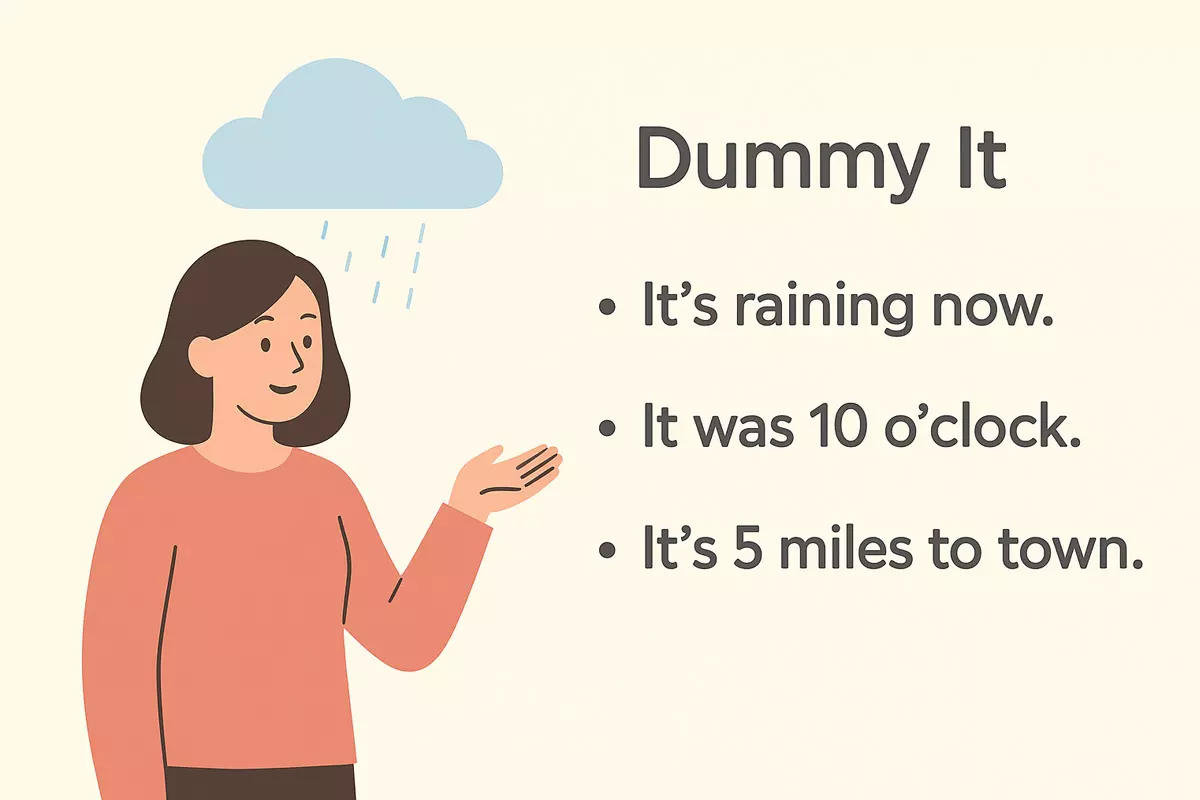 This article explains how dummy it is used in English for weather, time, and distance expressions. It details what dummy it represents, formal usage patterns, common mistakes, and provides practice exercises for clarity and confidence.
Have you ever wondered how English speakers naturally talk about things like the weather, time, or distance, even when there isn’t an obvious subject in the sentence? Mastering these impersonal expressions—such as it’s raining, it’s late, or it’s far—can help your English sound more fluent and authentic. Using phrases like these is an important part of everyday conversation, allowing you to describe situations clearly and naturally, just as native speakers do.
What Dummy It Represents
When using "dummy it" in contexts like weather, time, or distance, the word "it" doesn’t refer to any specific object or person. Instead, it acts as a grammatical placeholder, allowing us to construct sentences about phenomena, measurements, or conditions that don’t have a tangible subject. This kind of construction is common in English, making it easier to talk about abstract or impersonal situations.
Abstract and Impersonal Subjects
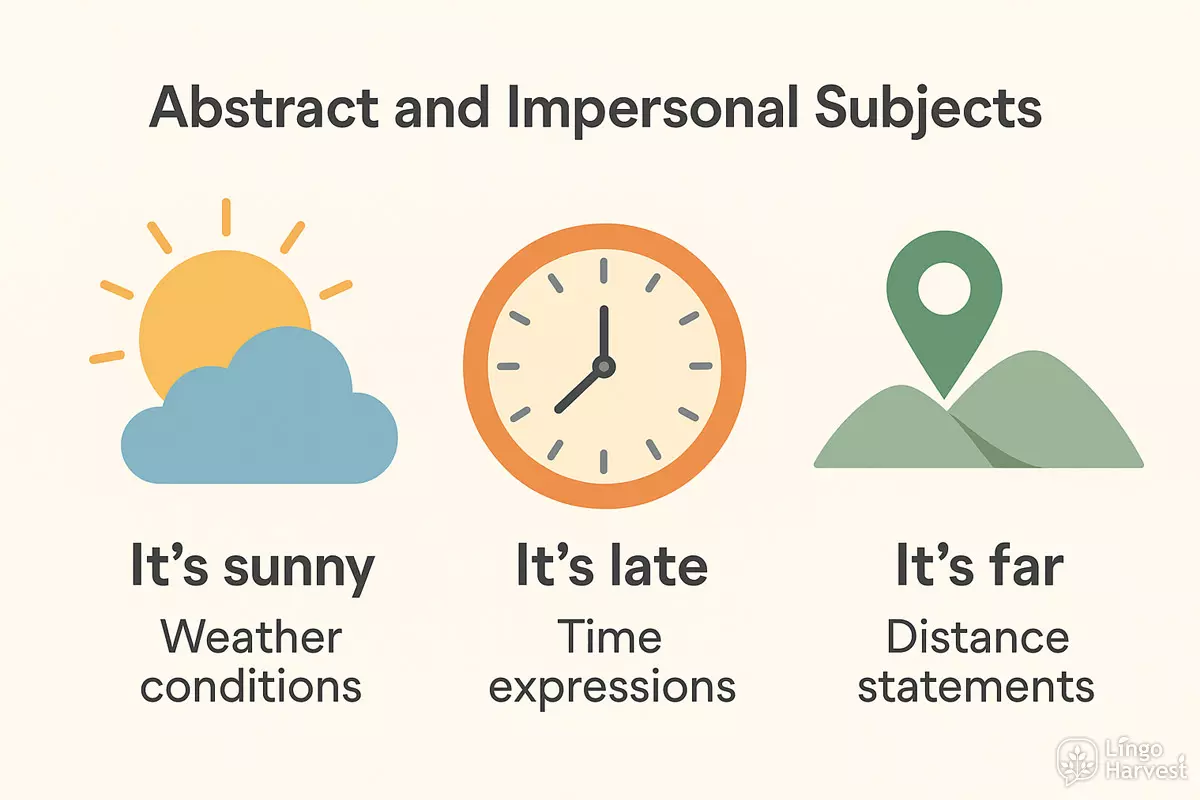
The pronoun "it" is used to introduce statements where there’s no clear agent or actor. For example, in phrases such as "It is raining," "It’s 8 o’clock," or "It’s five miles to the station," the word "it" doesn’t actually point to anything concrete. The real subject is either the condition (like rain), a measurement (like time or distance), or an environmental factor.
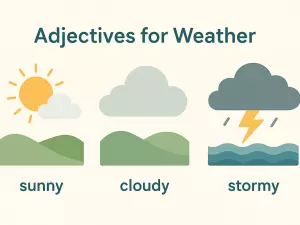
- Weather conditions: "It’s sunny," "It’s snowing"
- Time expressions: "It’s late," "It’s noon"
- Distance statements: "It’s far," "It’s a short walk"
- Temperature: "It’s hot," "It’s freezing"
- Atmospheric states: "It’s humid," "It’s windy"
- Seasons: "It’s spring," "It’s winter"
- Calendar dates: "It’s the first of May"
- General environmental facts: "It’s dark," "It’s quiet"
- Time until an event: "It’s ten minutes to midnight"
- Distance to a location: "It’s two blocks from here"
- Unusual phenomena: "It’s raining cats and dogs"
- Climatic events: "It’s stormy"
- Time for actions: "It’s time to go"
- Event occurrence: "It’s my birthday"
Why Use a Dummy Subject?
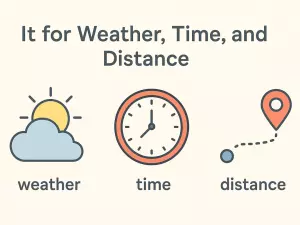
English sentence structure often requires a subject, even when there isn't a natural one. By using "it," speakers can frame statements about environmental factors, time, or measurements without needing a concrete agent. This pattern is especially frequent with extended patterns involving weather, time, and distance, where the focus is on the condition or fact itself, not on who or what is acting.
| Type | Example Sentence |
|---|---|
| Weather | It’s cloudy today. |
| Time | It’s almost midnight. |
| Distance | It’s three miles to the lake. |
| General Conditions | It’s noisy in the city at night. |
| Temperature | It’s below zero outside. |
In summary, this kind of "it" doesn’t represent a thing, person, or place, but serves as a tool to introduce statements about situations, measurements, or states that are general and impersonal. This makes communication about weather, time, and distance both natural and grammatically correct in English.
Dummy It for Weather Expressions
In English, “it” often acts as a grammatical subject for weather-related statements. This use of “dummy it” helps us form sentences about conditions like rain, snow, temperature, and more, especially when there’s no clear subject. Instead of saying “The rain is raining,” we say “It is raining.” This structure is common, natural, and essential for fluent communication.
Common Weather Sentences with “It” as a Dummy Subject
Here are some typical examples of how “it” is employed to describe various weather conditions:
- It’s raining.
- It’s snowing.
- It’s sunny.
- It’s cloudy.
- It’s windy.
- It’s foggy.
- It’s hailing.
- It’s drizzling.
- It’s freezing.
- It’s hot.
- It’s cold.
- It’s humid.
- It’s stormy.
- It’s thundering.
- It’s lightning.
- It’s calm.
- It’s breezy.
Notice that in all these cases, “it” does not refer to anything specific. Instead, it simply allows us to construct a sentence about the current weather.
Patterns and Variations in Weather Expressions
The structure often follows this pattern: It + be (is/was/will be) + weather adjective/noun/verb-ing. This can be varied for tense and modality:
- It was raining yesterday.
- It will be sunny tomorrow.
- It might snow tonight.
- It has been windy all day.
You can also add time, place, or manner for more detail:
- It’s foggy in the morning.
- It’s getting colder this evening.
- It will be stormy along the coast.
Comparing Weather Expression Structures
Below is a table highlighting how “dummy it” is used with weather, compared to similar sentences in other languages or with different English structures.
| English Expression | Structure Explanation |
|---|---|
| It’s raining. | “It” as a subject + “is” + verb-ing (no real subject) |
| It’s hot. | “It” as a subject + “is” + adjective (describing weather) |
| It will snow. | “It” as a subject + future tense + verb (weather event) |
| It was foggy. | “It” as a subject + past tense + adjective (weather condition) |
| It’s getting dark. | “It” as a subject + progressive aspect (change in weather/light) |
Dummy It for Time and Distance
English often uses “dummy” constructions—sentences with a subject that doesn’t actually refer to a person or thing—to talk about time and distance. These patterns help speakers express when something happens, how long it takes, or how far something is, without focusing on who or what is involved. Instead, the sentence starts with “it” as a grammatical placeholder, followed by information about time or distance.
Common Patterns for Time and Distance
Here are some typical structures used for these situations:
- It is/was + [time expression] + since/until + [event or action]
- It takes/took + [amount of time] + to + [verb]
- It’s + [distance] + from/to + [place]
- It will be + [time] + before/until + [event]
- It has been + [duration] + since + [event]
- It’s + [ordinal time] + that + [event]
- It is + [distance] + to + [destination]
- It only takes + [time period] + to + [action]
- It was + [distance] + from + [origin] + to + [destination]
- It will take + [time] + for + [event] + to happen
Examples in Context
Let’s look at how these “dummy it” patterns appear in real sentences:
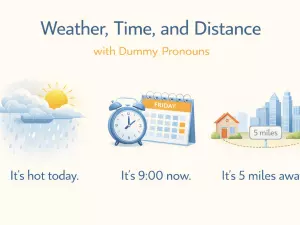
- It’s five miles from here to the station.
- It takes twenty minutes to get to work by bus.
- It has been three years since I last saw her.
- It will be a week before the repairs are finished.
- It is only a short walk to the museum from here.
- It took us an hour to solve the problem.
- It’s a long way from London to Edinburgh.
- It will take two hours for the cake to bake.
- It was ten minutes before anyone noticed the mistake.
- It’s about 300 kilometers to the border.
- It takes less than a minute to heat this in the microwave.
- It’s the second time that I’ve visited this city.
- It was a short drive from the airport to the hotel.
- It will be several months until the next update.
- It’s nearly midnight.
- It has been a long day.
Quick Reference: Time vs. Distance Patterns
| Time Expressions | Distance Expressions |
|---|---|
| It takes ten minutes to walk there. | It is five miles from here to the park. |
| It has been a year since we met. | It’s a long way to the nearest store. |
| It will be an hour before dinner is ready. | It was only a short distance to the river. |
| It’s the third time this has happened. | It is 200 meters to the finish line. |
Formal Patterns with Dummy It
In English, "dummy it" is used in set expressions about weather, time, and distance, where "it" does not refer to anything specific. These patterns are common in both spoken and written language, and mastering them helps learners sound natural. Below, we break down the most frequent structures where "it" acts as a formal subject, especially when describing conditions or measurements.
Common Constructions with Dummy "It"
Here are typical sentence patterns using "it" in contexts such as weather, time, and distance. These are fixed forms, and changing the subject is usually not possible.
- It is raining. (weather)
- It’s sunny today. (weather)
- It snowed last night. (weather)
- It is hot/cold/windy. (weather/temperature)
- It is five o’clock. (time)
- It’s late. (time)
- It is time to go. (time)
- It takes 10 minutes to walk there. (distance/duration)
- It’s 3 miles from here to the station. (distance)
- It will be a long journey. (distance/time)
- It seems cold outside. (weather/appearance)
- It’s getting dark. (time/condition)
- It’s almost noon. (time)
- It was a short trip. (distance)
- It appears to be snowing. (weather)
- It’s about two kilometers away. (distance)
- It’s pouring. (weather)
- It’s freezing tonight. (weather/temperature)
- It’s just after midnight. (time)
Pattern Comparison Table
To clarify how "dummy it" works across different contexts, here is a table comparing key forms in weather, time, and distance expressions.
| Type | Example Expression | Typical Structure |
|---|---|---|
| Weather | It’s raining. It’s sunny. |
It + be/verb + (adjective/adverb) |
| Time | It’s 9 o’clock. It’s late. |
It + be + (time noun/adjective) |
| Distance/Duration | It’s 5 miles to town. It takes 20 minutes. |
It + be/take + (measurement/expression) |
| General Condition | It’s getting dark. It seems cold. |
It + be/seem/get + (adjective) |
Notes on Usage
These patterns are not usually interchangeable. For example, we say "It is raining," not "The rain is it-ing." The "it" fills the grammatical subject position, making the sentence complete and natural in English. Remember that in these cases, "it" has no real meaning; it simply supports the structure.
Recognizing and using these fixed phrases will help you communicate more clearly and understand native speakers when they talk about weather, time, or distances.
Avoiding Confusion with Real It
When working with "dummy it"—the impersonal it used for weather, time, and distance—learners often mix it up with the "real it" that refers to something specific mentioned before. This mix-up can cause awkward or unclear sentences. Recognizing the difference between these uses is essential for clarity in both writing and conversation.
Key Differences: Dummy vs. Real "It"
The impersonal form appears in sentences where "it" does not stand for any noun; instead, it fills the subject slot for grammatical reasons. In contrast, the referential (real) form points to a previously mentioned object, idea, or event. Consider these distinctions:
- Dummy (Impersonal): It is raining. (It doesn’t refer to anything)
- Real (Referential): I bought a book. It was expensive. (It = "the book")
Common Patterns for Dummy "It"
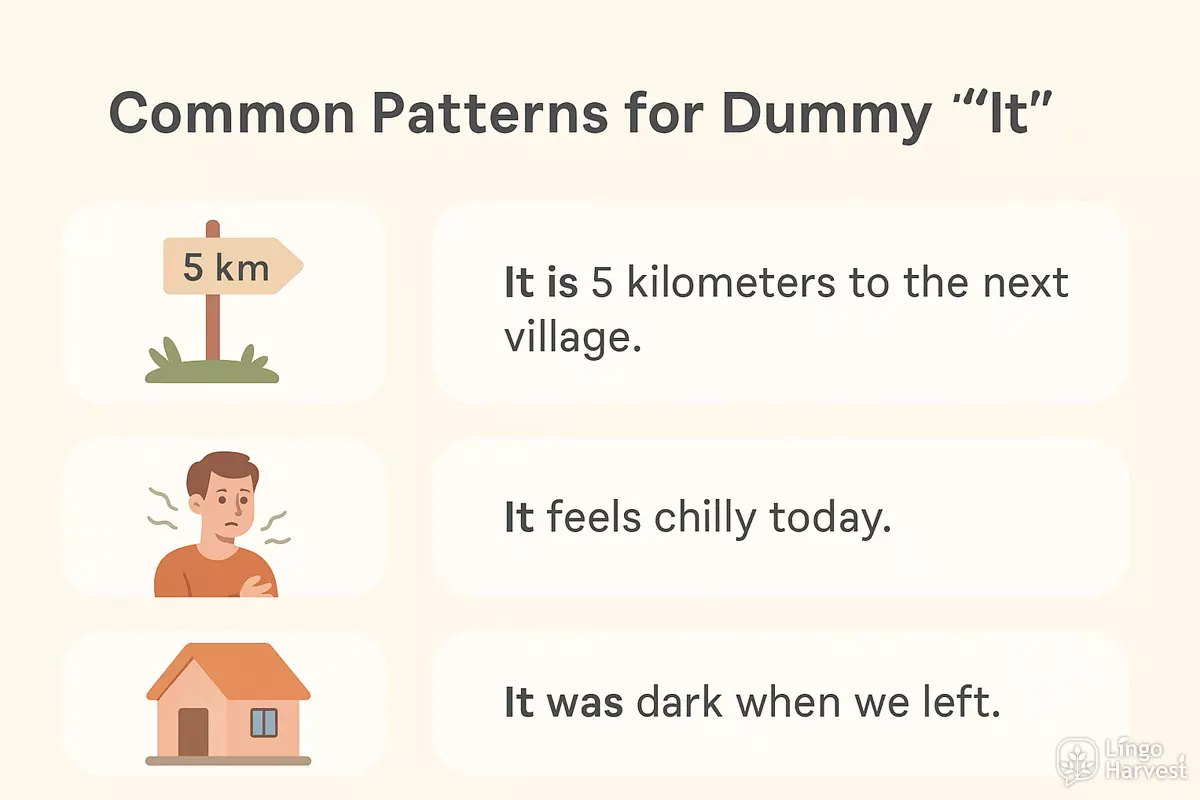
Look for these extended patterns where "it" is just a grammatical placeholder:
- It is drizzling.
- It is getting late.
- It takes 20 minutes to walk there.
- It is 5 kilometers to the next village.
- It feels chilly today.
- It was dark when we left.
- It seems like a good idea.
- It is important to listen.
- It will be sunny tomorrow.
- It is time to go.
- It surprised me that he came.
- It appears that nobody is home.
- It costs a lot to travel now.
- It is worth trying.
- It was a long journey.
- It doesn’t matter.
- It is believed that the weather will improve.
- It is likely to rain later.
Spotting the Difference
If you can replace "it" with a specific noun, you’re probably dealing with the referential form. If not, and especially in weather, time, or distance contexts, it’s the impersonal version. For more clarity, see the table below comparing the two types in context.
| Impersonal "It" (Dummy) |
Referential "It" (Real) |
|---|---|
| It is raining. (no noun referred to) |
I saw a dog. It was barking. (“It” = the dog) |
| It’s 7 o’clock. | My phone is lost. I can’t find it. |
| It’s far to the station. | The movie was long. I enjoyed it. |
| It seems cold today. | This cake is delicious. I made it myself. |
Quick Tips
- If "it" is used in weather, time, or distance sentences, do not try to assign it a specific meaning.
- Check if a noun can replace "it"—if not, it’s probably impersonal.
- Be careful with ambiguous sentences; context usually makes the meaning clear.
Practicing with plenty of real examples helps avoid mistakes and builds confidence when using both forms of "it" naturally.
Common Errors to Avoid
When using extended patterns with weather, time, and distance, learners often stumble over a few recurring pitfalls. Awareness of these missteps can help you construct smoother, more natural sentences and avoid confusion in communication.
Misusing "It" as a Dummy Subject
A frequent source of mistakes is neglecting to use "it" as a placeholder subject when describing weather, time, or distance. For example, saying "Is raining" instead of "It is raining" or "Is five o’clock" instead of "It is five o’clock" results in incomplete sentences.
Incorrect Prepositions and Word Order
Prepositions and word sequence are crucial in these constructions. Learners sometimes say "It rains in heavily" instead of "It rains heavily," or "It is to five miles the station" instead of "It is five miles to the station." Mixing up prepositions or the order of words can distort the intended meaning.
Confusing Weather, Time, and Distance Patterns
Some mix up the patterns for weather, time, and distance, leading to sentences like "It is raining five miles" (incorrect) when trying to describe distance, or "It is five o’clock to the park" (incorrect) for time or place.
Omitting or Misplacing Adverbs
Forgetting to add adverbs or placing them incorrectly can make sentences sound unnatural. For example, "It is cold very" instead of "It is very cold."
Examples of Typical Mistakes and Corrections
- ❌ Is overcast today. → ✅ It is overcast today.
- ❌ Is five o'clock. → ✅ It is five o'clock.
- ❌ It is to the park two kilometers. → ✅ It is two kilometers to the park.
- ❌ Rains a lot here. → ✅ It rains a lot here.
- ❌ It’s raining at now. → ✅ It’s raining now.
- ❌ It is very late the time. → ✅ It is very late.
- It is three hours by train to London. (Correct!)
- ❌ It is cold very. → ✅ It is very cold.
- It’s five o’clock in the morning now. (Correct!)
- It’s raining very heavily. (Correct!)
Summary Table: Correct vs. Incorrect Extended Patterns
| Incorrect Example | Correct Usage |
|---|---|
| Is cold outside. | It is cold outside. |
| Is ten kilometers to the city. | It is ten kilometers to the city. |
| Is six o'clock now. | It is six o'clock now. |
| Rains a lot in spring. | It rains a lot in spring. |
| It is to the station three miles. | It is three miles to the station. |
Additional Tips
- Always start these sentences with "It" when talking about weather, time, or distance.
- Check word order—place adverbs (like "very" or "now") in their natural position.
- Be careful with prepositions: "to" for distance, "at" or "in" for time only in specific contexts.
- Review common phrases and fixed expressions (e.g., "It is sunny," "It’s late," "It is five miles to...").
By keeping these points in mind, you’ll avoid the most common stumbling blocks and sound more fluent when discussing weather, time, or how far something is.
Practice: Rewrite Using Dummy It
Working with “dummy it” constructions helps make your English sound more natural, especially when talking about weather, time, or distance. To practice, try transforming sentences that use a real subject into versions that use “it” as a formal subject. This exercise will build your confidence in using these extended patterns correctly.
Rewrite These Sentences
Change each of the following sentences so that “it” is the grammatical subject. Focus on situations about weather, time, and distance.
- Rain started early in the morning.
- To walk to the station takes ten minutes.
- That the meeting lasted three hours surprised everyone.
- Monday is when the exam will be held.
- A long way separates the two villages.
- Snow fell all night.
- For us to arrive on time will be difficult.
- Driving from here to the airport requires half an hour.
- That John didn’t call bothered her.
- Summer is when the days are longest.
- Fifteen kilometers lie between the town and the lake.
- Your being late makes things complicated.
- The fact that it rained ruined the picnic.
- To finish this project in a day is impossible.
- That she left early surprised me.
- Darkness comes quickly in winter.
- Reaching the summit takes three hours.
- To learn a new language takes patience.
- Thunderstorms are common in July.
- The fact that he won amazed everyone.
Show answers
- It started to rain early in the morning.
- It takes ten minutes to walk to the station.
- It surprised everyone that the meeting lasted three hours.
- It is on Monday that the exam will be held.
- It is a long way between the two villages.
- It snowed all night.
- It will be difficult for us to arrive on time.
- It takes half an hour to drive from here to the airport.
- It bothered her that John didn’t call.
- It is in summer that the days are longest.
- It is fifteen kilometers from the town to the lake.
- It makes things complicated that you are late.
- It ruined the picnic that it rained.
- It is impossible to finish this project in a day.
- It surprised me that she left early.
- It gets dark quickly in winter.
- It takes three hours to reach the summit.
- It takes patience to learn a new language.
- It is common to have thunderstorms in July.
- It amazed everyone that he won.
Common Patterns with Dummy It
Below are some typical structures where “it” is used in talking about weather, time, and distance. Study these forms to recognize and use them more easily.
| Pattern | Example |
|---|---|
| It + verb (weather) | It’s raining. |
| It + takes + time + to + verb | It takes 20 minutes to get there. |
| It + is + distance + from/to | It’s five miles from here to school. |
| It + is + adjective + to + verb | It’s hard to wake up early. |
| It + is + time/date/day | It’s Monday. |
| It + clause (emphasis) | It was John who called. |
| It + seems/appears + clause | It seems that he’s late. |
| It + is + possible/important + that | It’s important that you listen. |
Reviewing these examples and patterns will help you confidently use “it” in a wide range of sentences, making your English clearer and more idiomatic.