Quantifiers with Measurements and Units in English

 Here we how measurements are used as quantities in English, differences between units and counted items, common quantifiers, number and unit agreement, expressing exact and approximate amounts, frequent learner mistakes, real-life examples, and practice…
- How measurements function as quantities in English
- Difference between units and counted items
- Quantifiers commonly used with measurements
- Agreement and structure with numbers and units
- Approximate vs exact measurement expressions
- Common learner mistakes with units
- Examples from everyday and technical contexts
- Practice: choosing correct quantifiers with measurements
Expressing quantities with numbers and units, such as a few liters of water or several meters of fabric, can be surprisingly challenging in English. Accurately using these expressions is essential for clear and precise communication, whether you are describing measurements in a scientific context or simply discussing everyday items. By learning the correct ways to combine numbers and units, you can avoid confusion and ensure that your message is easily understood by others. This skill is valuable in both professional and casual conversations, making your language use more effective overall.
How measurements function as quantities in English
Measurements are used in English to specify amounts, distances, weights, volumes, and other quantifiable properties. These expressions often combine a number, a unit, and sometimes a quantifier to provide clear information about size, amount, or degree. The structure and usage of these expressions can vary depending on whether the measurement is being used as a noun, adjective, or adverb in a sentence.
Typical patterns for expressing measurements
Measurement phrases generally follow a predictable pattern, making them easy to recognize. Here are some of the most common ways to construct them:
- Number + unit: three meters, five kilograms, ten liters
- Quantifier + measurement: about two hours, nearly a liter, more than 50 miles
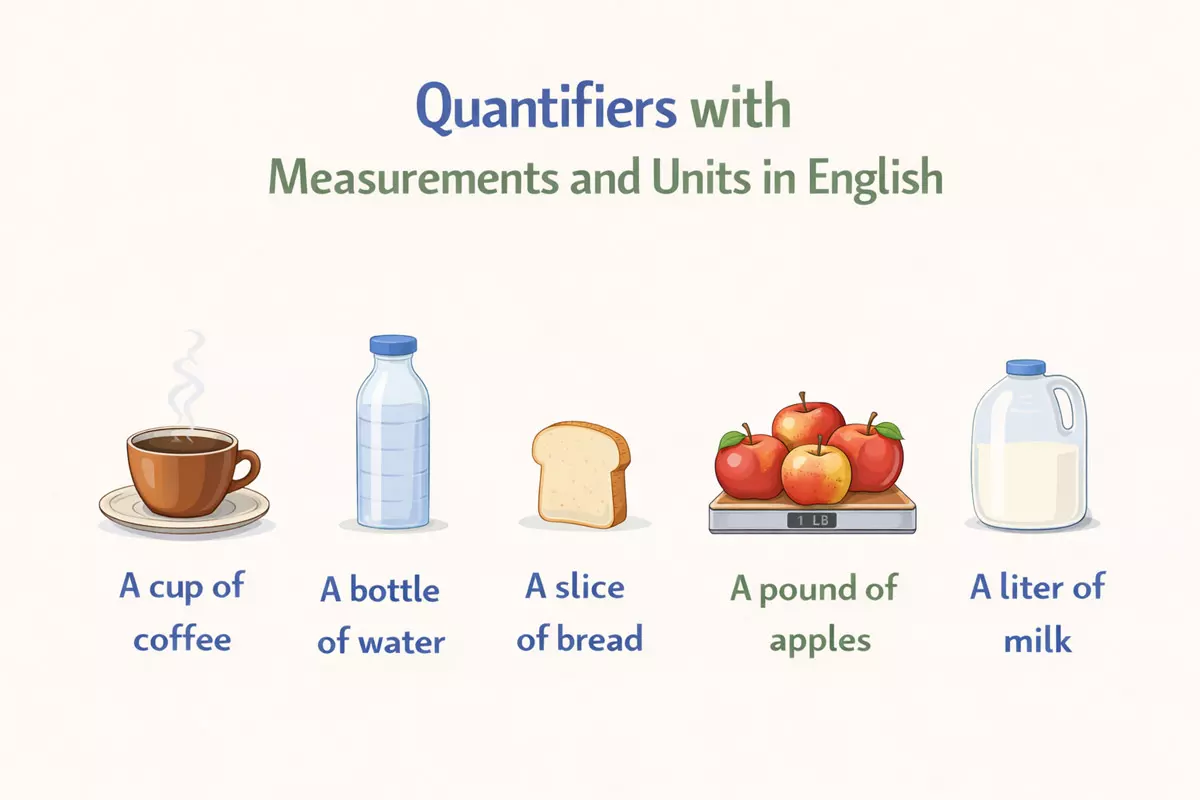
- Measurement + of + noun: a liter of water, a pound of apples, two cups of flour
- Adjective forms: a 10-minute break, a 5-kilometer run
- Comparisons: twice as much, half as long, three times the length
- Approximation: around 20 degrees, roughly 500 grams
- Zero or negative values: no liters, less than zero degrees
- Fractions and decimals: one and a half meters, 2.3 kilometers
- Collective and plural forms: hundreds of meters, dozens of eggs
- Unit abbreviations: 5 km, 3 kg, 12 oz
How quantifiers interact with measurement units
Quantifiers like some, many, much, few, several, and a lot of are often paired with measurement nouns to indicate non-specific quantities or to emphasize relative size. The choice of quantifier depends on whether the noun is countable or uncountable, as well as the context. For example:
- Much water (uncountable)
- Many kilometers (countable)
- Some sugar (uncountable)
- A few meters (countable)
- A lot of energy (uncountable)
- Several liters (countable)
Comparison of measurement structures
| Structure | Example | Function |
|---|---|---|
| Number + Unit | 4 meters | Specifies an exact amount |
| Quantifier + Measurement | about 10 liters | Indicates an approximate amount |
| Measurement + of + Noun | a cup of rice | Describes the measured substance or object |
| Adjective Form | a 20-minute walk | Modifies a noun with a measurement |
| Comparative/Multiplicative | twice as much | Compares quantities |
In summary, measurement expressions play a vital role in English for making precise or approximate statements about quantity. Their structure is flexible, allowing for both exact and estimated values, and they frequently combine with quantifiers to convey a wide range of meanings in both everyday and technical language.
Difference between units and counted items
In English, quantifiers often interact differently with measurements and with things we count directly. Understanding this distinction helps with both grammar and clarity, especially when describing amounts or quantities.
What are units?
Units are standard measures used to express quantities of mass, volume, length, time, and more. They answer the question “How much?” rather than “How many?” These terms are usually uncountable by themselves and require a numerical value or quantifier to specify an amount.
- Liter (for liquids: water, milk, oil)
- Kilogram (for mass: rice, flour, apples)
- Meter (for length: fabric, rope)
- Hour (for time: meetings, journeys)
- Piece (for general counting: equipment, advice)
- Dozen (for groups: eggs, roses)
- Cup (for volume: sugar, coffee)
- Gram (for small weights: spices, jewelry)
- Pack (for sets: cards, candies)
- Bottle (for containers: wine, perfume)
What are counted items?

Counted items are things you can enumerate individually, like “one apple, two apples, three apples.” These nouns can take plural forms and are paired with quantifiers like many, a few, or numbers.
- Books — She borrowed three books from the library.
- Cars — Several cars were parked outside the building.
- Pens — I bought a few pens for the office.
- Chairs — The room has ten chairs.
- Dogs — Many dogs need homes at the shelter.
- Coins — He found a handful of coins in his pocket.
- Shirts — I packed five shirts for the trip.
- Cups — We used four cups during breakfast.
- People — Many people attended the event.
- Tickets — All the tickets were sold out.
How quantifiers change with units vs. counted items
The choice of quantifier depends on whether you’re talking about a measurement or individual objects. For uncountable nouns (like water or rice), we use quantifiers such as some, much, a little, or specify a unit (a cup of rice). For countable nouns, quantifiers like many, a few, several, or numbers are appropriate.
| Measurement (Unit) | Counted Item | Example Quantifier Phrase |
|---|---|---|
| Liter | Bottle | three liters of juice / five bottles of juice |
| Kilogram | Apple | two kilograms of apples / six apples |
| Meter | Shirt | four meters of fabric / ten shirts |
| Hour | Lesson | two hours of study / three lessons |
| Cup | Cookie | one cup of sugar / twelve cookies |
| Pack | Card | a pack of cards / fifty-two cards |
| Bottle | Pill | a bottle of pills / twenty pills |
| Dozen | Egg | a dozen eggs / eighteen eggs |
| Gram | Coin | ten grams of gold / five coins |
| Piece | Advice | a piece of advice / three pieces of advice |
Summary
Units like liter or kilogram help measure amounts of substances or materials that cannot be counted individually, while counted items refer to things you can enumerate directly. Quantifiers must match the type of noun—using much or some for mass nouns and many or a few for count nouns. Being aware of this distinction is key to using English quantifiers naturally and correctly.
Quantifiers commonly used with measurements
When talking about amounts, distances, weights, volumes, and similar concepts in English, certain quantifiers appear frequently with units and measurements. These words help specify quantity more precisely, whether you’re discussing large or small amounts, or expressing approximations versus exact figures.
Typical quantifiers with units and amounts
Some quantifiers naturally pair with measurements, making your statements clearer and more accurate. Here are several common options:
- Much (for uncountable quantities: much water, much time)
- Many (for countable units: many liters, many kilometers)
- A lot of (neutral, works with most measurements: a lot of money, a lot of meters)
- Some (unspecified quantity: some sugar, some hours)
- Several (for a small number, usually with countable units: several meters)
- A few (small countable number: a few grams)
- A little (small uncountable amount: a little salt)
- Plenty of (more than enough: plenty of liters, plenty of time)
- Enough (sufficient quantity: enough water, enough kilograms)
- Most (majority: most kilometers, most energy)
- All (entire quantity: all the liters, all the flour)
- No (zero amount: no calories, no liters)
- About (approximate amount: about 20 grams)
- Almost (nearly, but not quite: almost a kilometer)
- Over (more than: over 2 hours)
- Less (a smaller amount: less than a liter)
- More (a greater amount: more than 10 kilograms)
- Exactly (precise amount: exactly 5 meters)
- At least (minimum: at least 3 liters)
- Up to (maximum: up to 500 milligrams)
Comparing quantifiers for precision and approximation
Some quantifiers are used to show a rough estimate, while others signal a specific measurement. Here’s a comparison of how these words function:
| Quantifier | Usage Example | Precision |
|---|---|---|
| About | about 3 kilometers | Approximate |
| Exactly | exactly 2 liters | Precise |
| Less than | less than 5 grams | Upper limit |
| At least | at least 10 minutes | Lower limit |
| Up to | up to 100 meters | Maximum |
| Over | over 50 kilograms | Minimum |
Choosing the right quantifier
Selecting the most suitable quantifier depends on whether you want to be vague or exact, and on the type of measurement. For instance, “a little” and “a few” are useful for smaller amounts, while “plenty of” or “a lot of” indicate abundance. For technical or scientific contexts, precise quantifiers like “exactly,” “less than,” or “at least” are often preferred.
Using the appropriate quantifier with your measurement not only clarifies your meaning but also helps you communicate with the right level of detail for your audience.
Agreement and structure with numbers and units
When dealing with measurements in English, the way numbers interact with units and quantifiers can be tricky. The form of both the number and the unit often depends on the structure of the phrase. Typically, the unit stays singular after a number, especially in compound noun phrases, but there are exceptions based on context and the quantifier used.
Patterns for combining numbers, quantifiers, and units
Phrases with measurements follow certain patterns. Here are some common structures:
- Number + unit (noun form): "Three liters," "ten pounds"
- Number + unit (adjective form): "A three-liter bottle," "a ten-pound note"
- Quantifier + unit: "Several miles," "many kilograms," "a few centimeters"
- Approximate quantifier + number + unit: "About five meters," "almost two hours"
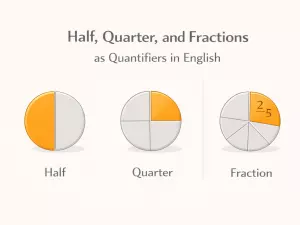
- Fractional expressions: "Half a liter," "a quarter of a mile"
- Using 'of' with plural units: "Dozens of eggs," "hundreds of grams"
- Uncountable units with 'much' or 'a little': "Much water," "a little salt"
- Singular compound modifiers: "A 20-minute break" (not "20-minutes break")
- Quantifiers with measurements: "Plenty of sugar," "lots of kilometers"
- Using 'per' for rates: "60 kilometers per hour," "five dollars per kilogram"
Agreement: Singular vs. Plural Forms
The choice between singular and plural for units depends on the phrase structure:
- When a measurement is used as a compound adjective before a noun, the unit is singular: "a six-foot table," "a 100-meter race."
- When the number and unit stand alone, the unit is plural (except for 'one'): "two liters," "five kilometers."
- After 'one,' use the singular unit: "one hour," "one inch."
Examples: Correct and Incorrect Forms
- ✅ "She bought three liters of milk."
- ❌ "She bought three liter of milk."
- ✅ "It’s a five-kilometer walk."
- ❌ "It’s a five-kilometers walk."
- ✅ "There are several grams of salt."
- ❌ "There are several gram of salt."
Comparison of common measurement structures
| Structure | Example |
|---|---|
| Number + plural unit | Four kilometers |
| Number + singular unit (compound modifier) | A five-mile run |
| Quantifier + unit | Several liters |
| Fraction + unit | Half a kilogram |
| Number + unit + per + unit | 60 miles per hour |
Key tips for usage
- Always use the singular form of the unit in compound modifiers.
- Use plural units after numbers greater than one, except in compound adjectives.
- Quantifiers like "much" and "little" go with uncountable units; "many" and "few" with countables.
- Check for correct placement of quantifiers: "a few grams," not "few a grams."
- Rates and ratios use "per": "per hour," "per liter."
Understanding these patterns helps you use quantifiers and measurements naturally and accurately in English.
Approximate vs exact measurement expressions
English uses a range of expressions to communicate both precise and rough measurements. The choice between an exact quantity and an estimate can affect the clarity and tone of a sentence. In scientific, technical, or legal contexts, speakers tend to prefer specific values, while in everyday conversation, people often use more flexible, general descriptions.
How English signals approximation and precision
Specific wording or quantifiers often mark whether a measurement is meant as an estimate or a precise value. Approximate measurements use modifiers or special terms that signal uncertainty or rounding. In contrast, exact measurements are typically given as straightforward numbers without hedging language.
| Type | Common Forms & Examples |
|---|---|
| Approximate | about 10 miles, around 50 grams, nearly 2 liters, more than 100 people, less than 5 minutes, approximately 3 hours, over a hundred dollars, under 10 kilograms |
| Exact | 10.0 miles, 50 grams, 2 liters, 100 people, 5 minutes, 3 hours, $100, 10 kilograms |
Common ways to express rough quantities
- About: about 20 minutes, about 3 feet
- Around: around 200 miles, around 1 kilogram
- Roughly: roughly 300 pages, roughly 8 hours
- Nearly: nearly 5 liters, nearly 100 dollars
- Almost: almost 2 meters, almost 50 people
- More than / Over: more than 1,000 words, over 60 degrees
- Less than / Under: less than 10 minutes, under 5 kilometers
- Approximately: approximately 7 days, approximately 20 grams
- Some: some 30 volunteers, some 500 units
- Or so: 100 or so guests, 40 or so miles
Real-life examples: approximate vs exact measurements

- It’s about 10 miles from here to the airport.
- The package weighs around 2 kilograms.
- The meeting lasted roughly 45 minutes.
- There’s nearly 1 liter of juice left in the bottle.
- Almost 50 people showed up to the workshop.
- We need more than 100 signatures to submit the petition.
- The hike is less than 5 kilometers from the parking lot.
- The delay was approximately 3 hours due to weather.
- Some 30 volunteers helped clean up the park.
- He spent $100 on groceries, not $98.50.
When to choose each style
Use precise amounts when accuracy is essential—such as in instructions, contracts, or data reporting. Vague or approximate phrasing is more natural in informal speech, storytelling, or when the exact number is unknown or irrelevant. The context and your communicative goal will guide the right choice between a tight measurement or a looser, estimated one.
In summary, English provides a rich toolkit for quantifying measurements, allowing speakers to be as exact or as flexible as needed. Whether to use a precise figure or a rough estimate depends on audience, purpose, and context.
Common learner mistakes with units
Many English learners struggle with the correct use of quantifiers and units, especially when combining them in sentences. Errors often come from confusion over countable and uncountable nouns, incorrect pluralization, or missing prepositions. Understanding the typical pitfalls can help you avoid forming awkward or unclear sentences.
Mixing up singular and plural forms
One frequent issue is using the wrong form of the unit after a number or quantifier. In English, units follow strict rules depending on the quantity:
- Singular form is used after “one” and sometimes after “a” or “an”: “one liter,” “a meter.”
- Plural form is used after numbers greater than one: “two liters,” “five kilometers.”
- Uncountable nouns do not take a plural: “some water,” not “some waters.”
Omitting "of" after quantifiers
Quantifiers like “a lot,” “a piece,” or “a bottle” often require “of” before the unit or noun. Learners sometimes forget this, resulting in unnatural phrases:
- Incorrect: “a glass water” ❌
- Correct: “a glass of water” ✅
- Incorrect: “a kilo apples” ❌
- Correct: “a kilo of apples” ✅
Confusing countable and uncountable units
Some nouns and units are always countable or always uncountable, and using the wrong type of quantifier can cause confusion:
- “Much liters” (incorrect); “many liters” (correct)
- “Many water” (incorrect); “much water” (correct)
- “A few rice” (incorrect); “a little rice” (correct)
Incorrect unit-noun order or structure
In English, the typical pattern is “number/quantifier + unit + of + noun.” Learners sometimes mix up this order, especially when translating from their native language.
| Incorrect Form | Correct Form |
|---|---|
| three breads | three loaves of bread |
| five water bottles | five bottles of water |
| two kilo sugar | two kilos of sugar |
| a litre milk | a litre of milk |
Dropping necessary articles or quantifiers
Leaving out articles like “a” or quantifiers can make sentences sound incomplete or incorrect:
- Incorrect: “I bought kilo of rice.”
- Correct: “I bought a kilo of rice.”
Using inappropriate quantifiers with certain units
Not every quantifier fits every unit. For example, “a piece” is used for things that can be separated into parts, like “a piece of cake,” but not “a piece of milk.”
- “A piece of cake” ✅
- “A piece of advice” ✅
- “A piece of tea” ❌
By paying attention to these common problems, you can improve your accuracy and sound more natural when talking about quantities and measurements in English.
Examples from everyday and technical contexts
Understanding how quantifiers combine with measurements and units can be easier when you see how they appear in daily conversation and in specialized fields. In ordinary situations, people often use quantifiers to describe quantities, amounts, or approximations. Technical writing, on the other hand, tends to use more precise and standardized expressions, especially when accuracy is crucial.
Common patterns in daily life
Quantifiers are frequently used with measurements and units in casual speech. Here are some typical ways they show up:
- A few grams of salt
- Several liters of water
- About ten kilometers to the next town
- Less than a minute left
- Plenty of time before the movie starts
- Hundreds of meters above sea level
- More than five hours of sleep
- Almost a kilogram of apples
- Dozens of milliliters needed
- No cups of sugar required
- A couple of miles from here
- Too much caffeine in one serving
- Enough fuel for the trip
- Half a liter of milk
- Thousands of dollars in damages
Technical and scientific usage
In scientific, medical, or engineering contexts, the pairing of quantifiers with units often follows stricter conventions. Quantifiers such as "approximately," "at least," or "maximum" are used to indicate tolerances or limits, while numbers are often more exact.
| Expression | Context/Meaning |
|---|---|
| At least 50 milligrams | Minimum safe dosage (medicine) |
| No more than 5% error | Acceptable margin (statistics/engineering) |
| Roughly 20°C | Approximate temperature (science/meteorology) |
| Maximum load: 200 kg | Weight limit (engineering) |
| Less than 2 seconds | Performance benchmark (computing) |
| Greater than 1 liter | Threshold for overflow (chemistry/physics) |
Comparing casual and technical phrasing
While casual English allows for a range of quantifiers and sometimes even exaggeration ("tons of homework"), technical language is more restrictive. For example, "a few grams" in a recipe is imprecise, but "3.0 ± 0.2 grams" in a laboratory protocol is exact. The choice of quantifier and the way units are presented depends greatly on the goal—whether to convey an estimate, a minimum, or a precise value. In summary, the way quantifiers interact with measurements and units varies widely depending on context, ranging from relaxed and idiomatic to precise and formulaic. Recognizing these patterns helps in both interpreting and producing clear, context-appropriate English.
Practice: choosing correct quantifiers with measurements
Understanding which quantifier to use before measurements and units is key to sounding natural in English. This section will guide you through common patterns and give you a chance to test your skills with real-world examples. Notice how different expressions are used with countable and uncountable nouns, and how the choice of quantifier can subtly change the meaning.
Common quantifiers with measurements
First, review some frequent quantifiers that appear with measurements and units:
- a little — Add a little water to the mixture.
- a few — We need a few more minutes.
- much — There isn’t much space left.
- many — How many miles did you walk?
- some — Pour some oil into the pan.
- several — She waited several hours for the result.
- plenty of — There’s plenty of room inside.
- lots of — The recipe uses lots of butter.
- a bit of — Add a bit of salt to taste.
- a number of — A number of meters were measured incorrectly.
- a couple of — Give me a couple of seconds.
- enough — Do we have enough fuel for the trip?
- no — There is no time to waste.
- not much — There isn’t much water left.
- not many — Not many kilometers remain.
- most — Most of the distance is flat.
- all — All the weight was removed.
Choosing the right quantifier: examples with units
Here are examples showing typical usage of quantifiers in measurement contexts:
| Correct quantifier + measurement | Explanation |
|---|---|
| a little water | Used for small, uncountable amounts |
| a few kilometers | Used for small, countable numbers |
| much time | Uncountable noun, often in questions/negatives |
| many liters | Countable plural unit, larger quantity |
| some sugar | Uncountable, non-specific amount |
| several meters | Countable, more than a few but not a lot |
| plenty of milk | Uncountable, more than enough |
| lots of cups | Countable, informal, large quantity |
| a bit of salt | Small non-specific amount, uncountable |
| a number of grams | Countable, several units |
| a couple of hours | Countable, means two |
| enough flour | Sufficient amount, uncountable |
| no money | Zero amount, uncountable |
| not much energy | Negative, uncountable |
| not many kilometers | Negative, countable |
| most liters | Majority of a group, countable |
| all the rice | Entire quantity, uncountable |
Quiz: select the best quantifier
Try choosing the most natural quantifier for each measurement phrase below. Think about whether the noun is countable or uncountable, and if you want to express a small, large, or exact amount.
- There isn’t ________ milk left in the fridge.
- We walked ________ miles yesterday.
- She added ________ sugar to her tea.
- Do you have ________ coins for the machine?
- He spent ________ time on his homework.
- I only need ________ minutes to finish.
- We don’t have ________ bread for sandwiches.
- They have ________ bottles of water for the trip.
- Can I have ________ rice, please?
- There are ________ centimeters in a meter.
Show answers
- much
- several / many
- a little / some
- a few / some
- much
- a few / a couple of
- much
- plenty of / several / a few
- some / a bit of
- one hundred
Tips for selecting quantifiers with units
- Use many, several, a few, or a number of for countable units (e.g., kilometers, bottles, hours).
- Use much, a little, a bit of, or some for uncountable measures (e.g., water, time, flour).
- Plenty of and lots of work for both countable and uncountable units to indicate a large amount.
- No, not much, and not many are used to express negatives.
- When specifying an exact number, use numerals (e.g., “three liters,” “ten grams”).