Weather, Time, and Distance with Dummy Pronouns

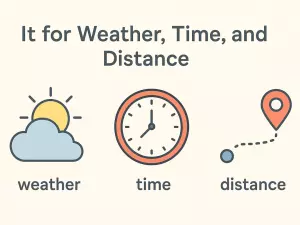
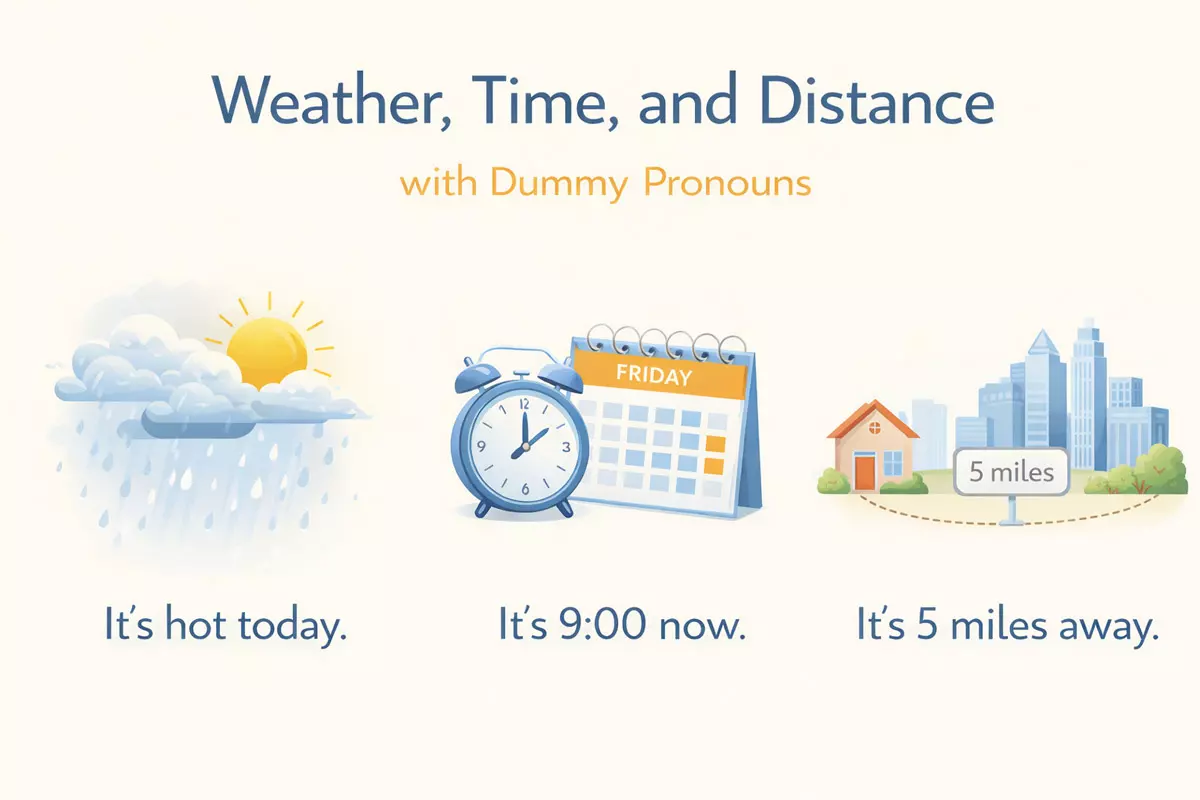 This article explains how to use it as a dummy subject in English with weather, time, and distance expressions like it’s raining, it’s 7 o’clock, and it’s 5 km to the station. It covers tense forms, typical mistakes, and natural spoken phrases.
- Weather expressions with it: It’s raining, It’s cold
- Time expressions: It’s 7 o’clock, It’s late
- Distance expressions: It’s 5 km to the station
- Situation “it”: It’s hard, It’s nice, It’s a pity
- Common tense forms: It was, It’s been, It will be
- Common mistakes and quick corrections
- Natural spoken phrases and short replies with it
- Practice: complete dialogues with weather/time/distance
Have you ever thought about why we use phrases like "It is raining" or "It takes an hour to get there"? In English, the word "it" often acts as a placeholder, helping sentences about weather, time, or distance sound natural and easy to understand. This structure allows us to convey information clearly without needing to mention a specific subject, making communication smoother in everyday conversation. Using placeholders like "it" is a common way English speakers keep their language concise and effective.
Weather expressions with it: It’s raining, It’s cold
Talking about the weather in English relies heavily on the word it as a subject, even when there’s no clear noun being described. This use of it is called a "dummy pronoun," because it doesn’t refer to anything specific—instead, it helps us form grammatically correct sentences about conditions like temperature, precipitation, or sunlight.
Common patterns with it for weather
We use it to start many weather-related statements. Here are several standard ways to talk about what’s happening outside:
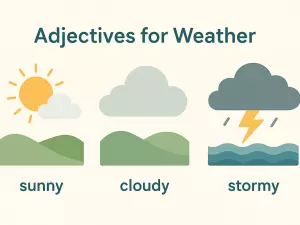
- It’s raining → It’s raining, so take an umbrella.
- It’s snowing → It’s snowing heavily this morning.
- It’s sunny → It’s sunny, perfect for a walk.
- It’s cloudy → It’s cloudy, but still warm.
- It’s windy → It’s windy near the coast.
- It’s foggy → It’s foggy, so drive carefully.
- It’s drizzling → It’s drizzling, not real rain yet.
- It’s hailing → It’s hailing, stay inside.
- It’s stormy → It’s stormy tonight.
- It’s freezing → It’s freezing outside.
- It’s warm → It’s warm enough to sit outside.
- It’s cold → It’s cold, wear a jacket.
- It’s humid → It’s humid and uncomfortable.
- It’s dry → It’s dry this time of year.
- It’s clear → It’s clear, with no clouds.
- It’s overcast → It’s overcast all day.
- It’s mild → It’s mild for this season.
- It’s scorching → It’s scorching in the afternoon.
- It’s breezy → It’s breezy by the sea.
How it works in weather sentences
In these constructions, it doesn’t point to a particular object or person. Instead, it fills the subject slot in the sentence, allowing us to describe conditions in a natural way. This is different from languages where weather expressions might use verbs alone or a different kind of subject.
Comparing English with other languages
Many learners notice that English often requires a “dummy subject” (it) in weather and time expressions. In many other languages, these meanings are commonly expressed without an explicit subject or through an impersonal structure. The examples below show how this idea is typically expressed across several widely spoken languages.
| English | Spanish | French | German | Portuguese |
|---|---|---|---|---|
| It’s raining. | Llueve. | Il pleut. | Es regnet. | Está chovendo. |
| It’s cold. | Hace frío. | Il fait froid. | Es ist kalt. | Está frio. |
| It’s snowing. | Nieva. | Il neige. | Es schneit. | Está nevando. |
| It’s sunny. | Hace sol. | Il fait soleil. | Es ist sonnig. | Está ensolarado. |
The key takeaway is simple: when English describes weather or time, it often starts with it, even though it does not refer to a real “thing”. Learning this pattern helps your sentences sound natural and complete.
Quick tips for using it with weather
- Always include it at the start: It’s raining ✅, not just "Raining" ❌.
- You can use it with adjectives (It’s cold) or verbs ending in -ing (It’s snowing).
- For questions, invert it and the verb: "Is it windy today?"
- Don’t use it for weather nouns as the subject: say "The rain is heavy," not "It the rain is heavy."
Understanding how it functions in these sentences helps you sound more natural and grammatically correct when talking about the weather in English.
Time expressions: It’s 7 o’clock, It’s late
English often uses the dummy pronoun it to talk about the time. This construction is essential for forming basic statements about hours, parts of the day, or general timing. The word it doesn’t refer to anything specific here; instead, it serves as a grammatical placeholder.
Common patterns for telling the time
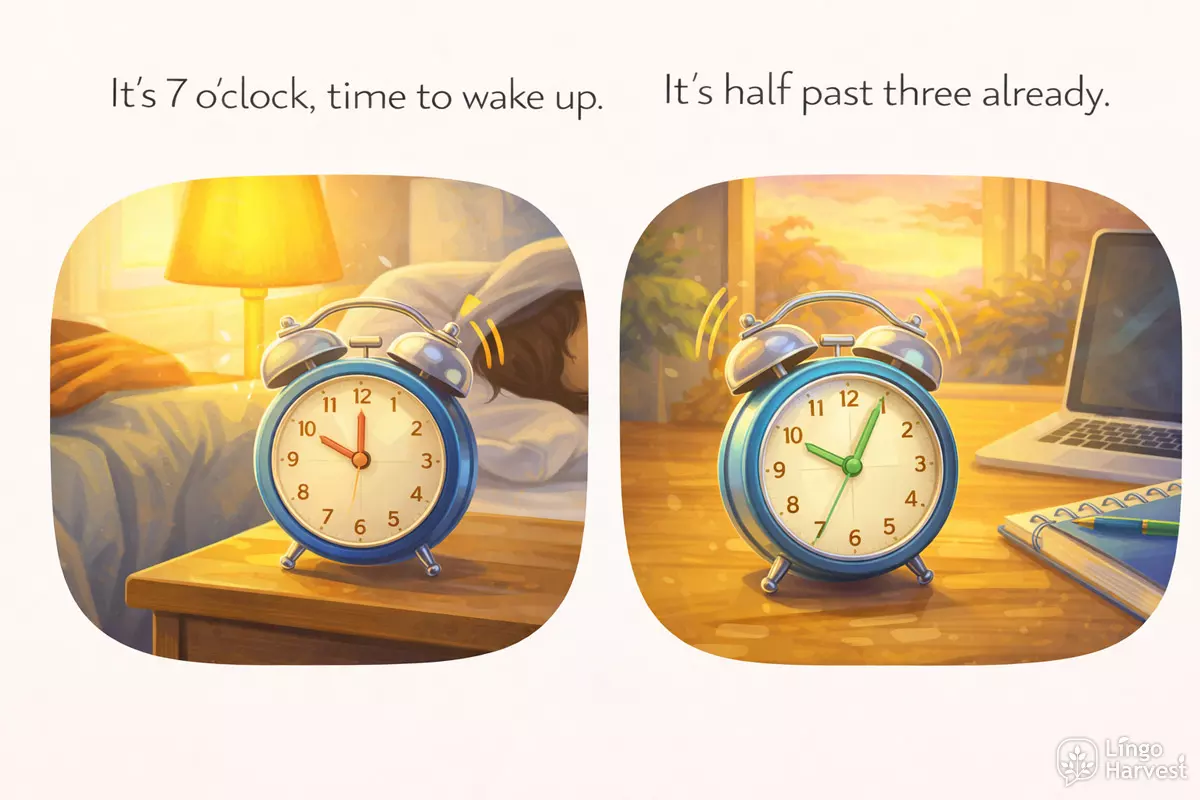
- It’s 7 o’clock → It’s 7 o’clock, time to wake up.
- It’s half past three → It’s half past three already.
- It’s quarter to five → It’s quarter to five, let’s finish.
- It’s noon → It’s noon, let’s take a break.
- It’s midnight → It’s midnight, the streets are quiet.
- It’s almost eight → It’s almost eight, we should leave.
- It’s just after four → It’s just after four now.
- It’s ten minutes to twelve → It’s ten minutes to twelve.
- It’s five past nine → It’s five past nine, you’re late.
- It’s about six fifteen → It’s about six fifteen, give or take.
- It’s early → It’s early, the office is still empty.
- It’s late → It’s late, let’s go home.
- It’s time to go → It’s time to go, don’t be late.
- It’s getting dark → It’s getting dark outside.
- It’s the weekend → It’s the weekend, relax.
- It’s a new day → It’s a new day, start fresh.
- It’s your turn → It’s your turn to speak.
- It’s almost time for lunch → It’s almost time for lunch.
- It’s the middle of the night → It’s the middle of the night, everyone is asleep.
- It’s a quarter past seven → It’s a quarter past seven, the bus is coming.
How the dummy pronoun works in time statements
In all these examples, it stands in for the idea of time itself. English doesn’t use “he” or “she” for time; only it fits. This is different from some other languages, which might use a different structure or omit the subject entirely. Using it makes English time expressions clear and consistent.
Comparing time-related sentences
| English Expression | Meaning |
|---|---|
| It’s 7 o’clock. | The current time is 7:00. |
| It’s late. | The time is considered to be after the expected or usual hour. |
| It’s time to go. | The appropriate moment to leave has arrived. |
| It’s almost midnight. | The time is nearly 12:00 AM. |
| It’s early. | The time is before the usual or expected hour. |
Remember, when talking about hours, general times of day, or abstract time-related situations, it is always the subject. This pattern is a fundamental part of everyday English, and mastering it will make your speech and writing sound more natural.
Distance expressions: It’s 5 km to the station
Talking about how far places are in English often involves a “dummy” subject, usually the word it. This structure is especially common for expressing distance between two points, focusing attention on the distance itself rather than the people or things involved.
How English frames distance statements
English speakers typically use the pattern It is + distance + to + place to discuss how far locations are from one another. The dummy pronoun “it” doesn’t refer to anything specific but is necessary for the sentence to sound natural.
Here are some typical examples:
- It’s 5 kilometers to the station.
- It is 3 miles from here to the airport.
- It’s about 200 meters to the nearest bus stop.
- It’s a long way to the next village.
- It’s just a short walk to the park.
- It’s 10 minutes on foot to my school.
- It’s 25 kilometers from the city to the coast.
- It’s less than a mile to the supermarket.
- It’s quite far to the museum from here.
- It’s not far to the library.
- It’s a couple of blocks to the cinema.
- It’s around half an hour to the airport by taxi.
- It’s over 100 kilometers to the border.
- It’s a five-minute drive to the office.
- It’s a long distance to the mountains.
- It’s only ten minutes away.
Key features of these expressions
- Dummy “it”: The subject “it” doesn’t point to anything concrete, but is needed for grammatical correctness.
- Flexible units: You can use kilometers, miles, meters, minutes, hours, or even phrases like “a long way.”
- Direction or destination: The final part usually gives the endpoint, introduced by “to,” “from,” or sometimes “away.”
Comparing patterns for distance
Sometimes, distance can be expressed in different ways. Here’s a comparison of common forms:
| Pattern | Example sentence |
|---|---|
| It’s + distance + to + place | It’s 4 km to the beach. |
| It’s + distance + from + place + to + place | It’s 10 miles from London to Oxford. |
| It’s + time (by transport) + to + place | It’s 15 minutes by bus to the stadium. |
| It’s + a/an + [adjective] + way to + place | It’s a long way to the store. |
Tips for using distance statements
- Use “it’s” for both short and long distances.
- Don’t try to replace “it” with another subject; “it” is standard.
- For emphasis, you can add modifiers: It’s quite far, It’s only a few steps.
When describing how far something is, these constructions help keep your sentences natural and clear. They’re frequently used in directions, travel information, and everyday conversation.
Situation “it”: It’s hard, It’s nice, It’s a pity
In English, “it” often acts as a placeholder or dummy subject, especially when describing general situations, feelings, or opinions. This use helps form sentences about experiences or judgments without specifying a particular subject. Instead of naming who or what causes the situation, “it” introduces the idea, and the real subject may follow in an infinitive phrase, gerund, or clause.
Common Patterns with Dummy “it”
We use this construction to make statements about how things are, or to express reactions. The typical structure is: It + be + adjective/noun phrase + (to/that clause). This pattern is especially common when talking about difficulty, emotions, or abstract ideas.
- It’s important to finish on time.
- It’s difficult to understand.
- It’s a pity that you can’t come.
- It’s nice meeting new people.
- It’s strange that he didn’t call.
- It’s easy to get lost here.
- It’s not worth the trouble.
- It’s exciting to travel abroad.
- It’s unusual for her to be late.
- It’s possible that they forgot.
- It’s helpful to make notes.
- It’s sad to see them leave.
- It’s dangerous to swim here.
- It’s obvious who did it.
- It’s clear that we need help.
- It’s fun playing games together.
- It’s no use arguing.
- It’s necessary to practice daily.
Why Use Dummy “it”?
This structure allows speakers to comment on situations or actions in a general way. The real focus is on the action or situation itself, not the person involved. For example, instead of saying “To understand this is hard,” we naturally say, “It’s hard to understand this.” This keeps the sentence smooth and emphasizes the situation.
Comparing Structures
Here’s a look at how dummy “it” constructions compare to sentences with a clear subject:
| With Dummy “it” | With Real Subject |
|---|---|
| It’s hard to find parking here. | Finding parking here is hard. |
| It’s surprising that he left early. | That he left early is surprising. |
| It’s enjoyable to walk in the park. | Walking in the park is enjoyable. |
| It’s unfortunate that they lost. | That they lost is unfortunate. |
| It’s necessary to be careful. | Being careful is necessary. |
Typical Adjectives and Expressions
Certain adjectives and phrases are commonly used with dummy “it” in this context:
- easy, hard, difficult, important, necessary, possible, impossible, useful, helpful, dangerous, safe, strange, obvious, surprising, wonderful, terrible, sad, exciting, fun, worth, no use, a shame, a pity
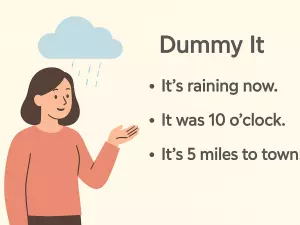
When talking about time, weather, or distance, English also uses “it” as a dummy subject (e.g., “It’s raining,” “It’s late,” “It’s five miles to town”), but in the patterns above, “it” frames our opinion or reaction to a situation. This is a flexible way to make your English sound more natural and less awkward, especially when expressing thoughts about actions or events.
Common tense forms: It was, It’s been, It will be
English often uses the pronoun “it” to talk about weather, time, and distance, especially when the real subject doesn’t exist or isn’t important. This “dummy” subject makes sentences clear and natural, and the choice of tense helps show whether something happened in the past, is ongoing, or will happen in the future. Let’s look at how “it was,” “it’s been,” and “it will be” work in everyday conversation.
Describing the Weather
When talking about weather, people use these forms to refer to different times:
- It was sunny yesterday. (past)
- It’s been raining all morning. (from past to now)
- It will be cold tomorrow. (future)
- It was foggy last night.
- It’s been windy since noon.
- It will be stormy later.
- It was snowing when I left.
- It’s been hot all week.
- It will be clear after sunset.
- It was humid during the trip.
Talking About Time

These structures are also common for time-related statements:
- It was ten o’clock when we arrived.
- It’s been a long day.
- It will be midnight soon.
- It was late by the time we finished.
- It’s been years since we met.
- It will be an hour before dinner.
- It was almost morning.
- It’s been ages since I saw her.
- It will be time to go soon.
Expressing Distance
For distances, these dummy forms help describe how far, long, or difficult something is:
- It was five miles to the next town.
- It’s been a long journey.
- It will be a short walk.
- It was only a few steps away.
- It’s been a tough climb.
- It will be an easy drive.
- It was a quick trip.
- It’s been a long commute.
- It will be another hour by bus.
Comparing Tense Usage
These three tense forms each serve a specific function. Here’s how they compare:
| Form | When to Use | Example |
|---|---|---|
| It was | Describes a finished event or condition in the past | It was cold last night. |
| It’s been | Links past with present; ongoing or recent | It’s been sunny all week. |
| It will be | Describes a future event or condition | It will be windy tomorrow. |
Understanding these patterns helps you sound more natural when talking about weather, time, or distance. Using the right tense with dummy pronouns makes your English clearer and more precise.
Common mistakes and quick corrections
Misusing dummy pronouns like "it" and "there" is a frequent issue when talking about weather, time, or distance. These words don't refer to a specific thing, but English sentences often need them for correct structure. Learners sometimes forget to use a dummy pronoun, or they use the wrong one, especially when translating directly from other languages.
Typical errors and how to fix them
- Omitting the dummy pronoun: Saying "Is raining" instead of "It is raining."
- Using "there" instead of "it": "There is cold today" should be "It is cold today."
- Translating word-for-word: "Exists a long way" instead of "It is a long way."
- Confusing subjects: "They is five kilometers to the station" instead of "It is five kilometers to the station."
- Overusing dummy pronouns: "It there is raining" instead of just "It is raining."
- Misplacing time expressions: "It is late six o'clock" instead of "It is six o'clock" or "It is late."
- Forgetting the verb 'to be': "It raining" instead of "It is raining."
- Using "this" or "that" instead of "it": "This is snowing" instead of "It is snowing."
- Wrong tense with dummy pronouns: "It raining yesterday" should be "It was raining yesterday."
- Missing plural agreement with "there": "There is two miles to go" instead of "There are two miles to go."
Quick reference: Correct forms
| Incorrect | Correction |
|---|---|
| Is raining. | It is raining. |
| There is cold today. | It is cold today. |
| Exists a long way. | It is a long way. |
| This is snowing. | It is snowing. |
| It raining yesterday. | It was raining yesterday. |
Tips for avoiding mistakes
- Remember to use "it" for weather, time, and distance statements.
- Use "there" when introducing the existence of something (e.g., "There is a park nearby").
- Always include the correct form of "to be" after the dummy pronoun.
- Double-check tense and agreement, especially in past or plural sentences.
- Read your sentences aloud—if they sound incomplete, a dummy pronoun might be missing.
By practicing these patterns, you can quickly correct your sentences and sound more natural when talking about weather, time, and distance.
Natural spoken phrases and short replies with it
Everyday English relies on dummy pronouns like "it" for talking about weather, time, and distance. Native speakers often use short, natural responses or set expressions in these contexts. Understanding these patterns helps make your speech sound more fluent and authentic.
Common Expressions with "It"
- It's raining.
- It's cold outside.
- It's getting late.
- It's time to go.
- It's five o'clock.
- It's a long way from here.
- It's not far.
- It's about ten minutes by car.
- It's just around the corner.
- It's twenty degrees today.
- It's sunny this morning.
- It's snowing again.
- It's been a while.
- It's almost midnight.
- It's two kilometers to the station.
- It's only a short walk.
- It's windy, isn't it?
- It's supposed to rain later.
Short Replies Using "It"
Quick answers with "it" are common in conversation, especially when responding to questions about the weather, time, or how far something is. These make exchanges feel friendly and efficient.
- Is it cold? – It is.
- Is it far? – It's not.
- Is it raining? – It was, but it stopped.
- Is it late? – It isn't.
- Is it time yet? – It is.
- Is it five o'clock? – It will be soon.
- Is it close? – It is.
- Is it snowing? – It might be.
- Is it hot today? – It sure is!
Comparing Natural and Unnatural Patterns
Non-native speakers sometimes avoid "it" or use awkward phrasing. See the difference below:
| Natural (with "it") | Unnatural/Incorrect |
|---|---|
| It's raining. | Rains are coming. |
| It's ten kilometers away. | Ten kilometers away. |
| It's late. | The time is late. |
| It's not far. | Not far. |
| It's windy today. | Windy today. |
Tips for Sounding Natural
Use "it" in short, formulaic statements about time, weather, and distance. Listen for these patterns in movies and conversations, and practice replying with similar concise phrases. This approach helps you blend in more naturally and keeps your speech clear and idiomatic.
Practice: complete dialogues with weather/time/distance
Working with dialogues about weather, time, and distance helps you get comfortable using dummy pronouns like “it” in natural conversation. In these exchanges, “it” often stands in for the real subject, especially when describing conditions, making statements about time, or talking about how far things are.
Below are several short dialogues with missing parts. Use the context to fill in the blanks, focusing on weather, time, or distance expressions. Remember: these sentences usually begin with “it” (“it is,” “it’s”) or “there is/are” for distance, but sometimes need a different construction. Pay attention to the cues for each blank.
Dialogue Completion Practice
- A: ______ raining outside.
B: Oh, really? I forgot my umbrella! - A: What time is it?
B: ______ 7:30 already. We should hurry. - A: How far is it from here to the station?
B: ______ about two kilometers. - A: Do you know if ______ going to snow tomorrow?
B: I heard the forecast says yes. - A: Is it hot today?
B: No, ______ quite chilly this morning. - A: How long does it take to walk to school?
B: ______ takes about 15 minutes. - A: What’s the weather like?
B: ______ sunny and warm. - A: Is there a long way to the museum?
B: No, ______ just around the corner. - A: What’s the time difference between Paris and Tokyo?
B: ______ an 8-hour difference. - A: Should we leave soon?
B: Yes, ______ getting late.
Useful Phrases for Describing Weather, Time, and Distance
Complete each sentence with the best option from the word bank.
Word bank: It’s, It takes, There’s, It looks like, It might, It’s getting
- _____ raining today, so take an umbrella.
- _____ sunny right now, but the wind is strong.
- _____ cold in the evening, so bring a jacket.
- _____ midnight already.
- _____ time to go.
- _____ 10 minutes to get to the station on foot.
- _____ about three miles from here.
- _____ a long way to the next town.
- _____ late, so we should leave now.
- _____ like rain, so the sky is probably going to open up.
- _____ just around the corner.
- _____ an hour by car.
- _____ snow tomorrow.
- _____ only five minutes away.
- _____ almost noon.
- _____ a 2-hour delay on this line.
Show answers
- It’s
- It’s
- It’s
- It’s
- It’s
- It takes
- It’s
- There’s
- It’s getting
- It looks like
- It’s
- It’s
- It might
- It’s
- It’s
- There’s