Adjectives for Weather: sunny, cloudy, stormy

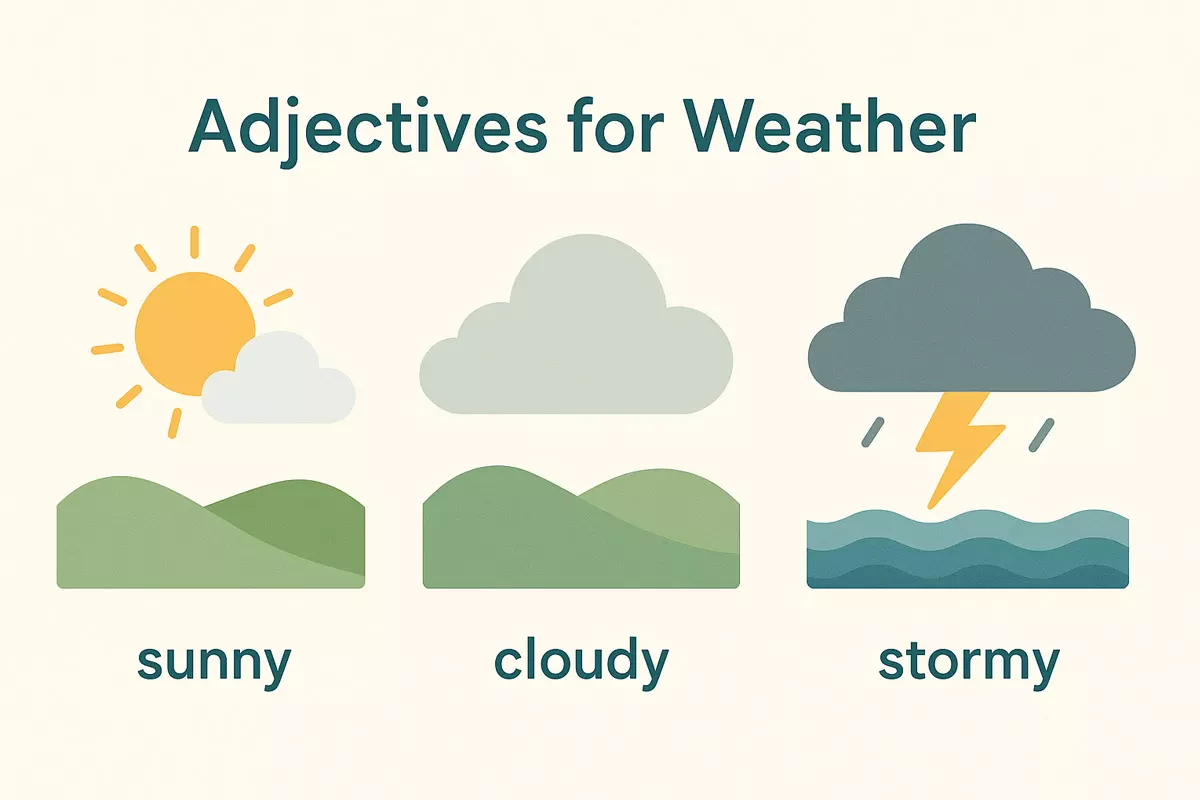 Here we basic weather adjectives, how to describe temperature and sensations, and how to combine these adjectives with nouns. It also provides phrases for small talk, discusses today’s weather and seasons, and includes practice sentences.
The language we use to describe the sky and atmosphere—be it a radiant sunrise, a gloomy afternoon, or a stormy night—shapes how we perceive and remember each day. Words like clear, hazy, brooding, or electric evoke specific images and emotions, allowing us to capture the essence of fleeting moments. By choosing precise terms for changing weather and light, we not only communicate the physical conditions but also share the mood and energy of the day, enriching our conversations and memories.
Basic weather adjectives for daily use
Describing the weather accurately helps in daily conversation, travel planning, and understanding forecasts. There are many simple words we use to talk about what’s happening outside, whether it’s bright, gloomy, or unpredictable. These descriptive terms make it easy to share how the sky looks, the temperature feels, or if you need an umbrella.
Common adjectives to describe weather conditions
- Sunny → It’s sunny and bright outside today.
- Cloudy → The sky is cloudy with no sun at all.
- Stormy → The weather turned stormy in the afternoon.
- Rainy → It’s rainy, so don’t forget your umbrella.
- Windy → It’s very windy near the coast.
- Foggy → The road is foggy, so drive carefully.
- Misty → The morning was misty and calm.
- Snowy → It’s snowy and the streets are covered in white.
- Hot → It’s too hot to walk outside.
- Cold → The water is cold even in summer.
- Chilly → The evening feels chilly, so take a jacket.
- Humid → It’s very humid after the rain.
- Dry → The climate here is dry almost all year.
- Muggy → The air is muggy and uncomfortable today.
- Breezy → It’s breezy and perfect for a walk.
- Freezing → It’s freezing outside, below zero degrees.
- Drizzly → The weather is drizzly with light rain.
- Clear → The sky is clear with no clouds.
- Blustery → It’s blustery and hard to walk against the wind.
- Thunderous → The thunderous sky scared the children.
How to use these adjectives in sentences
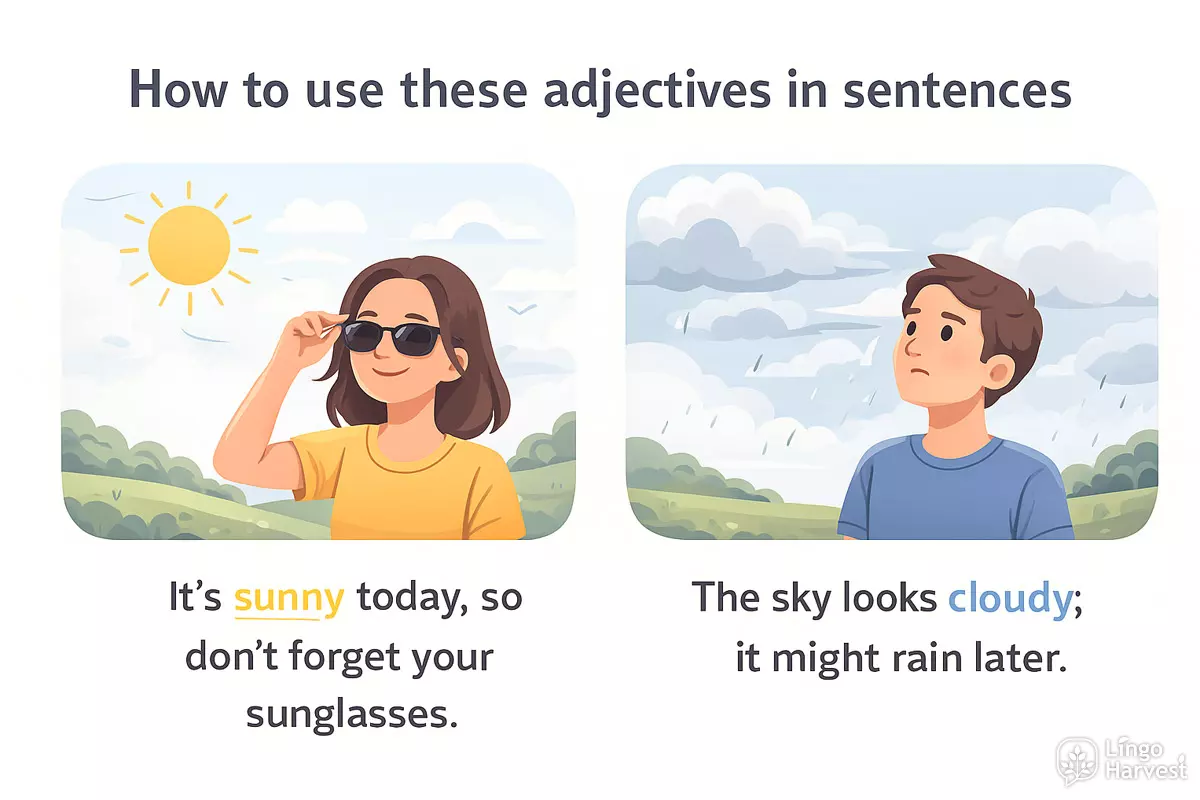
You can combine these weather words with simple sentences to express the current conditions or forecast. For example:
- It’s sunny today, so don’t forget your sunglasses.
- The sky looks cloudy; it might rain later.
- It was stormy last night, with lots of thunder and lightning.
- This morning feels chilly, so a jacket is a good idea.
- The air is humid, making it feel warmer than it is.
Comparing different weather types
When you need to talk about similarities or differences between types of weather, adjectives help you make quick comparisons. For instance, “breezy” is less intense than “windy,” while “drizzly” means a lighter rain than “rainy.”
| Adjective | What it describes |
|---|---|
| Sunny | Bright, lots of sunshine, no clouds |
| Cloudy | Sky covered with clouds, little or no sun |
| Stormy | Strong winds, rain, thunder, or lightning |
| Foggy | Low visibility, air filled with thick mist |
| Humid | Air feels moist or sticky, high moisture |
| Breezy | Gentle wind, not too strong |
| Freezing | Very cold, temperature below 0°C (32°F) |
These words are useful for describing the weather in daily conversations, making your speech more precise and relatable. Whether you’re chatting with friends or checking the forecast, knowing a variety of weather adjectives helps you communicate clearly.
Describing temperature and feeling (hot, chilly, freezing)
When talking about the weather, people often use specific adjectives to express how warm or cold it feels. These words help create a clear picture of the atmosphere, whether you’re experiencing a heatwave or shivering in the cold. Let’s look at some common ways to describe temperature and the sensations it creates.
Warm and Hot Conditions
If the day feels pleasant and above average in warmth, words like warm, balmy, or mild are often used. When temperatures rise further, you might hear hot, scorching, sweltering, or boiling to express discomfort or intensity. Sometimes, people say it’s stifling or blazing outside when the heat is particularly oppressive.
- warm → It’s warm enough to eat outside.
- balmy → We enjoyed a balmy evening by the beach.
- mild → The weather is mild and pleasant today.
- hot → It’s hot outside, so stay hydrated.
- scorching → The sun is scorching this afternoon.
- sweltering → It was sweltering, even in the shade.
- boiling → It feels boiling outside—almost unbearable.
- stifling → The air is stifling and hard to breathe.
- blazing → The blazing sun made the sand too hot to walk on.
- tropical → We woke up to tropical heat and humidity.
- oppressive → The heat is oppressive and draining.
Cool, Chilly, and Cold Descriptions
For lower temperatures, English speakers use a range of adjectives to capture the feeling. Cool describes a comfortable, slightly cold experience. Chilly suggests a sharper coolness, often requiring a jacket. When it’s even colder, terms like cold, freezing, icy, or frosty come into play. People might say it’s biting cold or that there’s a nip in the air when the cold is noticeable.
- cool → It’s cool outside—perfect for hiking.
- chilly → The morning felt chilly and fresh.
- cold → It’s cold enough to see your breath.
- freezing → It’s freezing; wear a thick coat.
- icy → The wind is icy and sharp.
- frosty → The windows were frosty this morning.
- crisp → The air is crisp and refreshing.
- biting → A biting wind hit us as we stepped out.
- nippy → It’s a bit nippy—grab a sweater.
- brisk → The brisk air woke everyone up.
- glacial → The glacial wind made walking difficult.
- wintry → A wintry chill filled the evening.
Comparing Sensations
The sensation of temperature can be subjective. What feels chilly to one person may be refreshing to another. Here’s a quick comparison to help clarify how these adjectives are typically used:
| Adjective | Typical Use / Feeling |
|---|---|
| Warm | Pleasantly above average, comfortable without being hot |
| Hot | Uncomfortably high temperature, may cause sweating |
| Chilly | Noticeably cool, often requires light outerwear |
| Freezing | Very cold, close to or below 0°C (32°F), may cause shivering |
| Sweltering | Extremely hot and humid, oppressive |
| Brisk | Cool and invigorating, often associated with wind |
| Frosty | Cold enough for frost to form; crisp and possibly sparkling |
| Scorching | Intensely hot, often used for summer days or deserts |
Expressing Personal Reactions
People often combine these adjectives with phrases to describe how they feel: “I’m roasting,” “It’s nippy out,” or “My hands are freezing.” These expressions make weather conversations more lively and personal.
Choosing the right adjective helps clearly communicate not just the actual temperature, but also the emotional or physical response to the weather.
Combining weather adjectives with nouns
Describing the weather often means pairing adjectives like "sunny," "cloudy," and "stormy" with appropriate nouns. This combination helps create clear, vivid expressions about current conditions or forecasts. For instance, instead of just saying "It’s sunny," you might talk about "sunny skies" or a "stormy afternoon." Using these pairs makes your language more precise and natural.
Common patterns for weather descriptions
In English, weather adjectives typically come before nouns. Here are some frequent patterns:
- adjective + noun: sunny day, cloudy weather, stormy night
- adjective + noun + time: cloudy morning, sunny afternoon, stormy evening
- adjective + noun (with modifiers): partly cloudy sky, unusually sunny period
Examples of weather adjective + noun combinations
Here are some practical ways to use weather adjectives with nouns in sentences or descriptions:
- sunny weather → We had sunny weather all weekend.
- cloudy sky → A cloudy sky covered the whole city.
- stormy weather → The stormy weather kept everyone indoors.
- sunny morning → It was a sunny morning perfect for a walk.
- cloudy afternoon → A cloudy afternoon made the park look dull.
- stormy night → We couldn’t sleep because of the stormy night.
- sunny forecast → The sunny forecast says no rain today.
- cloudy horizon → The cloudy horizon warned us of bad weather.
- stormy clouds → Dark stormy clouds gathered above the lake.
- sunny spell → After the rain, a sunny spell brightened the day.
- cloudy period → The week began with a long cloudy period.
- stormy season → This region often has a stormy season in summer.
- sunny interval → There was a short sunny interval between the showers.
- cloudy conditions → Cloudy conditions made the morning feel gloomy.
- stormy winds → Stormy winds shook the trees all night.
- sunny outlook → The weather report shows a sunny outlook ahead.
- cloudy sky → By noon, the cloudy sky blocked all sunlight.
- stormy day → It was such a stormy day that schools closed early.
Choosing the right noun for your adjective
Selecting nouns that fit naturally with each weather adjective improves clarity. For example, "sunny" pairs well with "day," "weather," or "sky," while "stormy" is often used with "night," "season," or "winds." "Cloudy" frequently describes "sky," "conditions," or "afternoon." Matching the adjective and noun appropriately communicates the mood and specifics of the weather.
Comparison of usage
| Adjective | Typical Nouns |
|---|---|
| Sunny | day, sky, weather, morning, spell, outlook |
| Cloudy | sky, weather, afternoon, period, conditions, horizon |
| Stormy | night, weather, season, winds, clouds, evening |
Using these combinations will help you talk about the weather in a more natural and descriptive way, whether you’re writing or speaking.
Talking about today’s weather and seasons
Describing the weather is a common topic in everyday conversations, especially when meeting friends or starting a discussion. Using specific adjectives like "sunny," "cloudy," and "stormy" helps make your descriptions accurate and vivid. Not only do these words help you talk about what’s happening outside right now, but they also let you compare different times of the year.
Useful phrases for discussing current weather
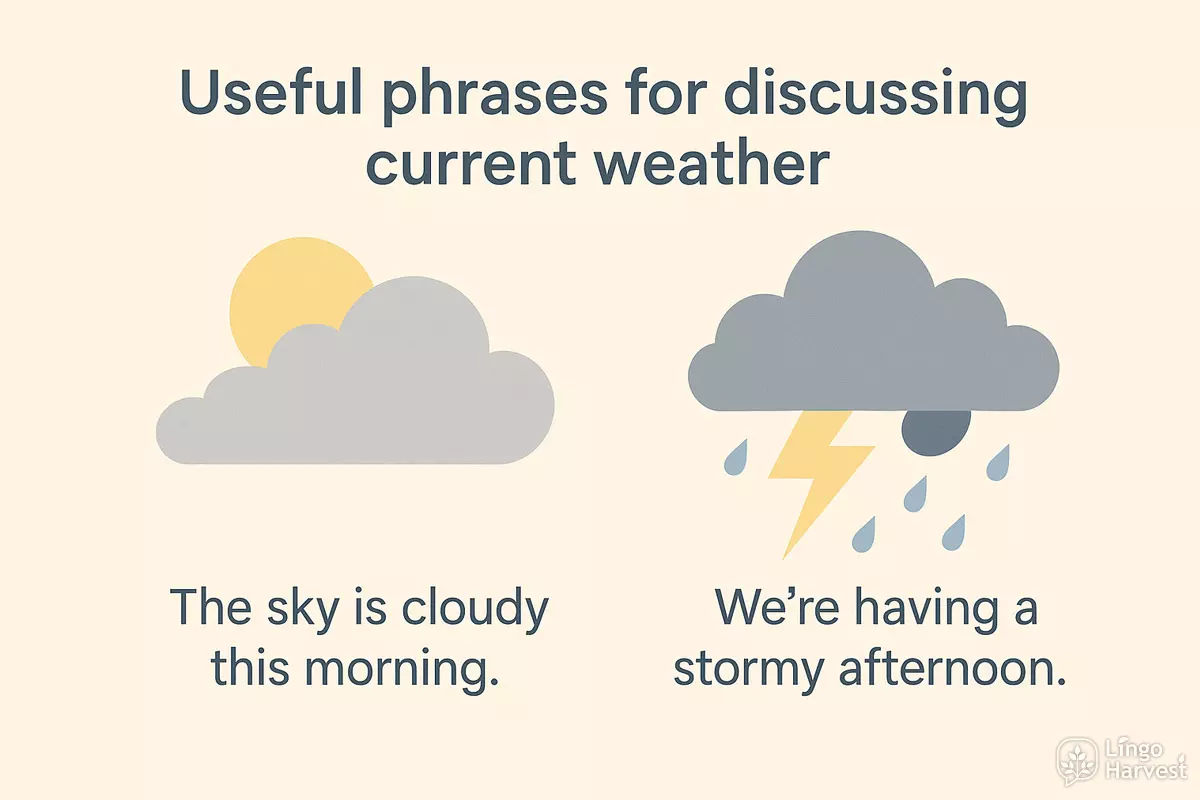
When you want to mention what the sky looks like or how the air feels, try these patterns:
- It’s sunny today.
- The sky is cloudy this morning.
- We’re having a stormy afternoon.
- The weather is clear and bright.
- It feels chilly but sunny.
- There are dark clouds overhead.
- It’s warm and pleasant outside.
- Today is quite humid and overcast.
- The wind is strong and it looks stormy.
- It’s mild with a gentle breeze.
Explaining seasonal weather patterns
Seasons often determine the type of weather you can expect. For instance, summer is usually described with words like "hot," "sunny," or "dry," while winter might be "cold," "cloudy," or "stormy." Here are some ways to talk about seasonal changes:
- Spring is often rainy and cool.
- Summer days are mostly sunny and hot.
- Autumn tends to be windy and cloudy.
- Winter brings cold, stormy weather.
- Some places have mild winters with little snow.
- In the fall, the weather becomes crisp and breezy.
- During summer, afternoons can be very bright and warm.
- Cloudy skies are common in early spring.
- Stormy nights happen more often in winter.
- Sunny mornings make spring feel fresh.
Comparing weather using adjectives
Describing how today’s conditions differ from other times is helpful in conversation. Here’s a table with sample sentences to compare different types of weather:
| Weather Adjective | Example Sentence |
|---|---|
| Sunny | Yesterday was cloudy, but today is sunny and bright. |
| Cloudy | It’s less sunny than last week; the sky is mostly cloudy now. |
| Stormy | Last month was calm, but this week has been stormy every day. |
| Mild | After a stormy night, the weather turned mild and pleasant. |
| Humid | Summer mornings are often humid, unlike the dry winter air. |
| Chilly | Spring evenings can be chilly, especially after sunset. |
Choosing the right adjectives and patterns makes your weather conversations clearer and more engaging, whether you’re chatting about today’s sky or describing the feel of a whole season.
Useful phrases for small talk about weather
Talking about weather is a classic way to start a friendly conversation or break the ice, especially with people you don’t know well. Using descriptive adjectives like "sunny," "cloudy," or "stormy" can make your conversation sound more natural and engaging. Below, you’ll find practical expressions and questions you can use in everyday conversations.
Common ways to comment on the weather
- It’s so sunny today, isn’t it?
- Looks like it might get stormy later.
- I can’t believe how cloudy it is this morning.
- What a beautiful, bright day!
- The weather’s really gloomy right now.
- It feels a bit stormy—did you hear the thunder?
- We finally got some sunshine after all that rain.
- Is it always this cloudy here?
- Such a change from yesterday’s sunny skies.
- The wind is really picking up—do you think a storm is coming?
- It’s perfect picnic weather today.
- This cloudy weather makes me want to stay indoors.
- Did you see how clear the sky is?
- The sun finally came out!
- It’s getting darker—maybe a storm’s on the way.
Questions to invite conversation
- How do you usually spend a sunny day?
- Do you like it when it’s cloudy, or do you prefer the sun?
- Are you prepared for stormy weather?
- Does this kind of weather affect your mood?
- What’s your favorite kind of day—sunny, cloudy, or stormy?
Comparing different weather conditions
You can also use comparisons to keep the conversation going. Here are a few examples:
- It’s much sunnier than it was yesterday.
- The clouds seem heavier than this morning.
- I think today feels stormier than last week.
- Sunny days always make everything look brighter.
Sample responses for different weather types
| Weather Type | Possible Response |
|---|---|
| Sunny | “I love days like this—makes me want to go outside.” |
| Cloudy | “It’s a bit dull, but at least it’s not raining.” |
| Stormy | “I hope the storm passes quickly. It’s intense out there!” |
| Mixed (sun/clouds) | “It can’t seem to make up its mind today—sunny one minute, cloudy the next!” |
Using these expressions and responses can help you feel more confident when chatting about the weather, whether you’re meeting someone new or just making friendly conversation. Mixing in adjectives like "sunny," "cloudy," and "stormy" keeps your language varied and interesting.
Practice: complete sentences about weather conditions
Understanding how to describe the weather using adjectives is essential for everyday conversations. Below, you'll find various activities to help you use words like "sunny," "cloudy," and "stormy" in complete, natural sentences. These tasks will help you practice both recognition and production of weather-related language.
Fill in the blanks
Read each sentence and choose the correct adjective to complete it: sunny, cloudy, or stormy.
- Yesterday was very ________, so we went for a picnic in the park.
- It's quite ________ today; I can't see the sun at all.
- The sky looks dark and ________—don’t forget your umbrella!
- We stayed inside because it was too ________ to play outside.
- My favorite days are ________ ones, with blue skies and lots of light.
- The forecast says it will stay ________ until the weekend.
- The wind is strong and the rain is heavy; it’s really ________ today.
- On ________ days like this, I like to sit by the window and read.
- The beach is crowded whenever it’s ________ and warm.
- We lost power last night because the weather was so ________.
Show answers
- sunny
- cloudy
- stormy
- stormy
- sunny
- cloudy
- stormy
- cloudy
- sunny
- stormy
Make your own sentences
Use each adjective below to write a sentence describing the weather. Try to be specific about activities or feelings:
- Sunny
- Cloudy
- Stormy
Show answers
- Sunny: It is sunny today, so I am wearing sunglasses.
- Cloudy: The sky is cloudy, and it might rain later.
- Stormy: The weather is stormy, so flights are delayed.
Adjectives in context
Read these short descriptions and match them to the correct weather adjective.
- The sky is covered with grey clouds, and the sunlight is weak.
- Thunder is rumbling, and strong winds are blowing.
- There are no clouds, and the sun is shining brightly.
- A light drizzle is falling, but it’s not heavy rain.
- A thick layer of fog makes it hard to see the road.
- The temperature is below zero, and everything is frozen.
- The air feels warm and pleasant, perfect for an evening walk.
- The sun is extremely strong, and the ground feels scorching.
- A gentle breeze is blowing, making the day feel refreshing.
- Snow is falling softly, covering everything in white.
Show answers
- Cloudy
- Stormy
- Sunny
- Drizzly
- Foggy
- Freezing
- Warm
- Hot / Scorching
- Breezy
- Snowy
Useful sentence patterns
Here are some sentence structures you can use to describe the weather with different adjectives:
- It is sunny today.
- The weather is cloudy this morning.
- Tomorrow will be stormy according to the forecast.
- I love sunny afternoons at the beach.
- It’s too cloudy to see the stars tonight.
- The match was canceled because it was stormy.
- The park is beautiful on sunny days.
- On cloudy evenings, the sunset is less colorful.
- We heard loud thunder on the stormy night.
- It’s not safe to swim when it’s stormy outside.
Compare the adjectives
Use this quick reference to see how "sunny," "cloudy," and "stormy" are used in different types of sentences:
| Adjective | Example Sentence |
|---|---|
| Sunny | The weather is sunny, so let’s go outside. |
| Cloudy | It's cloudy today, and the sky looks grey. |
| Stormy | It became stormy in the afternoon, with heavy rain and wind. |