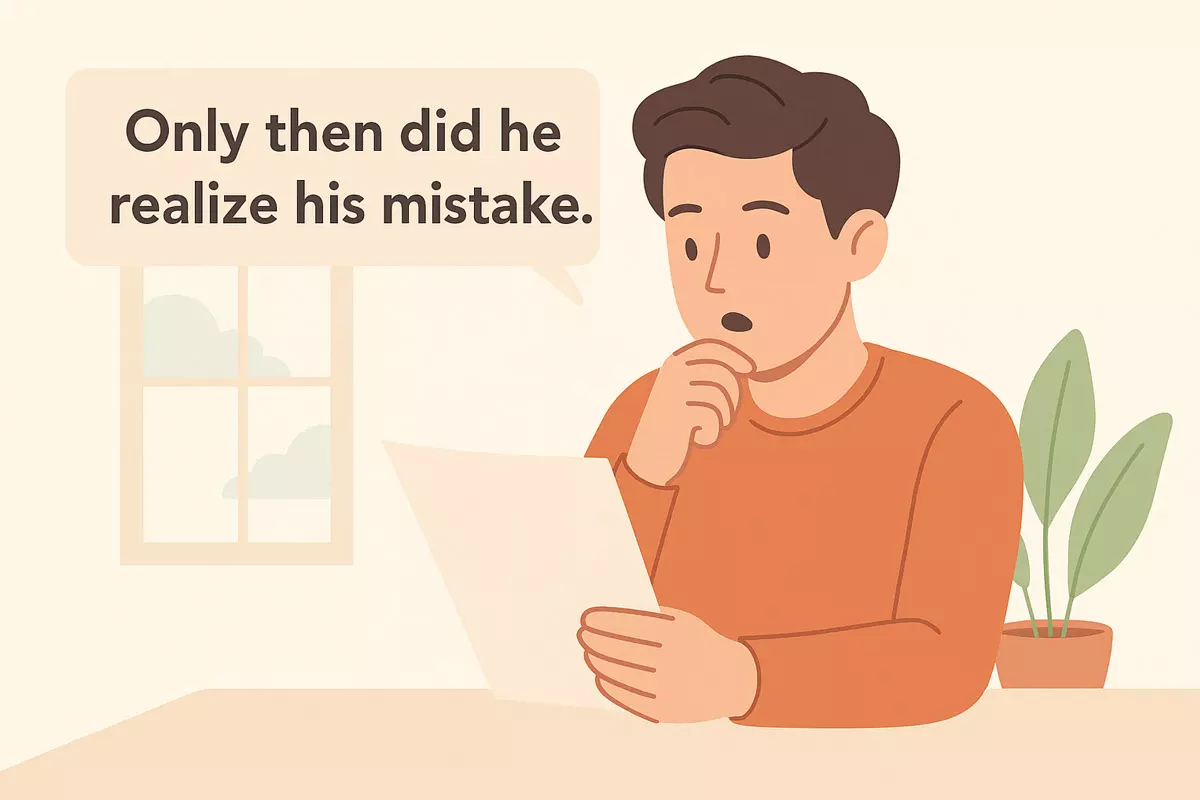
Focus with Fronting: Only then did he realize...

 This article explains what fronting means in English, how it is used for emphasis and contrast, and how it changes word order. It covers time, place, and adverbial fronting, formal writing, common errors, and practice exercises.
Only when that pivotal moment struck him did the truth finally become clear, changing his entire perspective. Often, it is the act of bringing the most significant detail to the forefront that allows us to see things differently. By reordering what we focus on, our understanding can shift dramatically, revealing insights that were previously hidden. This process shows how a single realization or change in emphasis can illuminate a situation and give us a deeper, more accurate grasp of reality.
What Fronting Means in English
Fronting refers to shifting a part of a sentence, often for focus or emphasis, to the beginning of the clause. Instead of following the usual subject-verb-object order, a different element—such as an adverb, object, or complement—appears first. This technique is common in both spoken and written English when the speaker wants to highlight or draw attention to specific information.
Why Speakers Use Fronting
Moving elements to the front can serve several purposes:
- Emphasizing a particular detail or circumstance
- Creating a dramatic or literary effect
- Improving flow and cohesion, especially when connecting sentences
- Signaling contrast or surprise
Types of Fronting Patterns
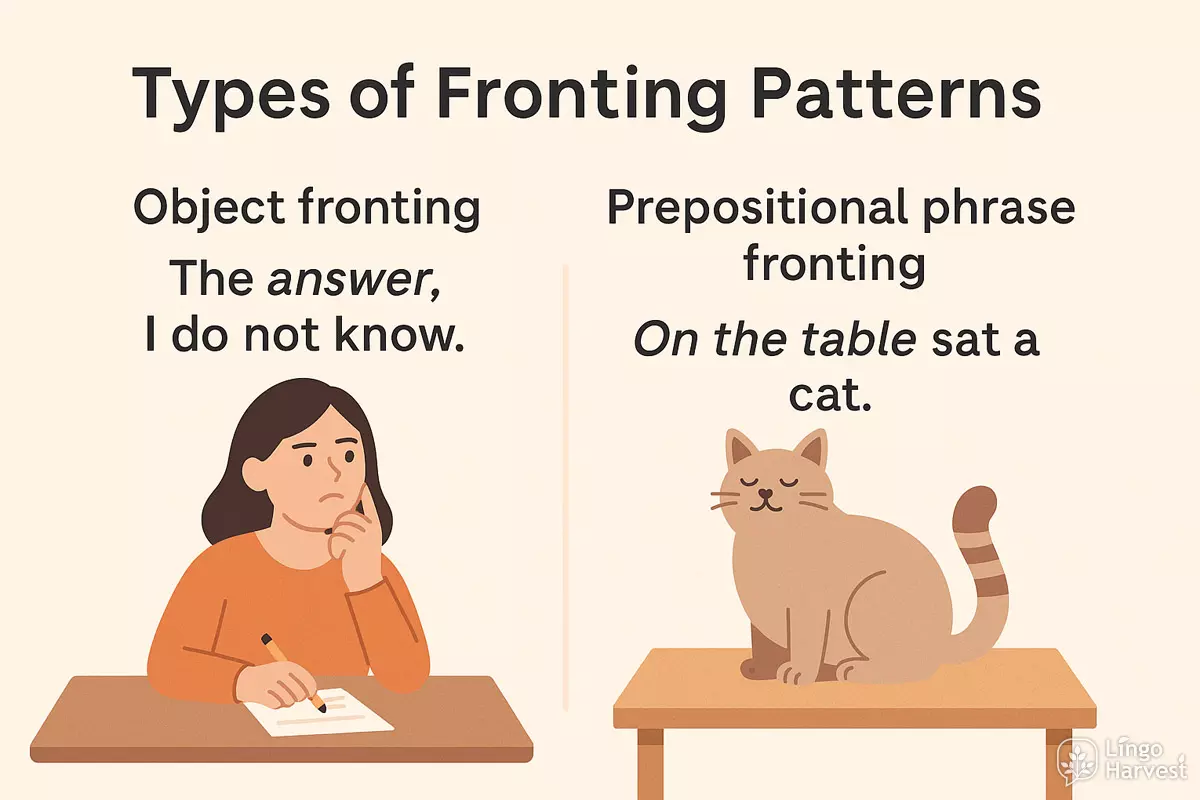
There are several ways this structure appears in English. Here are some common forms:
- Adverbial fronting: Only then did he realize the truth.
- Object fronting: The answer, I do not know.
- Prepositional phrase fronting: On the table sat a cat.
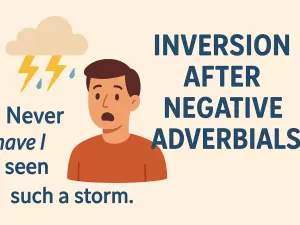
- Negative inversion: Never have I seen such chaos.
- Comparative fronting: More important than money is health.
Fronting vs. Standard Word Order
Changing the order can make a sentence stand out, but it can also affect grammar, especially with auxiliary verbs. Consider the difference below:
| Standard Order | With Fronting |
|---|---|
| He realized the truth only then. | Only then did he realize the truth. |
| I have never seen such chaos. | Never have I seen such chaos. |
| A cat sat on the table. | On the table sat a cat. |
| Health is more important than money. | More important than money is health. |
Examples of Fronted Elements
Writers and speakers use fronting for different elements, including:
- Time expressions (Yesterday, I met her.)
- Place phrases (Into the room walked the teacher.)
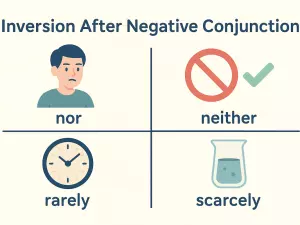
- Negative adverbs (Rarely do we see such dedication.)
- Conditional clauses (Had I known, I would have acted differently.)
- Comparatives (Better than anyone, she understood the risk.)
- Objects (This book, I must finish.)
- Questions without inversion (What he did, I cannot explain.)
- Prepositional phrases (Under the bed hid the dog.)
- Emphasized adjectives (So tired was she that she fell asleep instantly.)
- Result clauses (So fast did he run that he broke the record.)
- Contrastive focus (Her idea, not his, won the prize.)
- Purpose phrases (To win the game, he practiced daily.)
Fronting adds variety and clarity, allowing speakers to guide listeners to the most important information. When used thoughtfully, it can make language more engaging and precise.
Fronting for Emphasis and Contrast
Shifting parts of a sentence to the front draws attention and creates a marked effect. This technique is especially useful in English when you want to highlight a particular element or set up a contrast with what came before. By moving phrases like "Only then," "Never before," or "Into the room" to the beginning, speakers can focus the listener’s attention on new or surprising information. Fronting often signals that something unusual or important is coming. For example, "Only then did he realize the truth" is much more dramatic than "He realized the truth only then." Writers and speakers use this strategy to add drama, suspense, or irony, and to clarify comparisons between ideas or events.
Common Patterns for Emphatic Fronting
- Only then did he understand...
- Never before had she seen...
- Rarely do we encounter...
- Under no circumstances should you...
- Little did they know...
- Not until midnight did the phone ring.
- Hardly had I arrived when...
- No sooner had they left than...
- Down the road came a parade.
- Into the dark walked the cat.
- So quickly did she finish...
- Such was his anger that...
- Nowhere will you find...
- Out of the blue appeared a solution.
- On no account must you...
- Not only did he apologize, but...
- Up the hill trudged the hikers.
- Around the corner lurked danger.
Contrast and Nuance
Fronting is also a powerful way to set up contrasts. For example, placing "Not until the end" at the start emphasizes the unexpected timing, while "Never before" can highlight a complete change from the norm. These structures often require inversion (verb before subject), which further marks the sentence as special or emphatic.
Comparing Standard and Fronted Sentences
| Standard Order | Fronted for Emphasis |
|---|---|
| He realized the problem only then. | Only then did he realize the problem. |
| She had never seen such chaos before. | Never before had she seen such chaos. |
| They found help nowhere. | Nowhere did they find help. |
| You should not open the box under any circumstances. | Under no circumstances should you open the box. |
| He finished so quickly that we were surprised. | So quickly did he finish that we were surprised. |
Fronting is especially common in formal writing and speech, but it can also be used in storytelling or when you want to make your point stand out. Experimenting with this structure can give your sentences greater impact and subtlety.
Time/Place/Adverbial Fronting
Moving adverbials of time, place, or manner to the start of a sentence is a common way to emphasize new or important information. This technique often appears in written English, particularly in narratives or formal contexts, to set the scene or highlight a sequence of events. By fronting these elements, writers can guide readers’ attention and sometimes trigger subject–auxiliary inversion, especially with negative or restrictive adverbials.
How and When Fronting Occurs
Fronting typically involves shifting words or phrases like “never,” “only then,” “under the table,” or “at no point” before the main clause. This is especially noticeable with expressions that limit or restrict, such as “only,” “never,” or “at no time.” In these cases, English inverts the subject and auxiliary verb for emphasis:
- Only then did he realize the truth.
- Never before had she seen such chaos.
- On the hill stood a lonely cottage.
- At no point was the plan abandoned.
- Under the old bridge lay the lost treasure.
- Rarely do we witness such courage.
- No sooner had they left than it began to rain.
- In the morning the city feels quiet.
- Suddenly the lights went out.
- At midnight the bells chimed.
- Across the river stands the ancient castle.
- Only after the meeting did she understand the problem.
- Hardly ever do we get such an opportunity.
- On no account should you touch that switch.
- Down the street marched the band.
Different Patterns and Effects
Not all initial adverbials trigger inversion. With neutral time or place expressions, the word order typically stays the same:
- Yesterday, we went to the museum. ✅
- In Paris, she met her old friend. ✅
But when the fronted element is negative, restrictive, or expresses limitation, inversion is required:
- Never had I seen such a view. ✅
- Only then did he understand. ✅
- At no time were they informed. ✅
Common Fronted Adverbials
Writers frequently use the following for emphasis or stylistic effect:
- Only then
- Never before
- Hardly ever
- Rarely
- At no time
- No sooner
- On no account
- Not until
- Down the road
- Across the field
- Suddenly
- Just then
- At last
- Afterwards
- Eventually
- In the distance
- Early in the morning
- Above the city
Summary Table: Inversion with Fronted Adverbials
| Fronted Adverbial | Sentence Structure |
|---|---|
| Only then | Only then did he realize the mistake. |
| Never | Never have I heard such a story. |
| At no point | At no point was the project delayed. |
| On the hill | On the hill stood an old oak tree. |
| At midnight | At midnight, the phone rang. (No inversion) |
This fronting strategy is a powerful tool for shifting focus, creating suspense, or simply adding variety to sentence structure in English.
Fronting and Word Order Changes
When speakers want to highlight a particular element in a sentence—such as in the phrase “Only then did he realize…”—they often move that element to the beginning, a process known as fronting. This shift draws attention to the focused information and can require significant changes to the standard word order, especially in English.
How Fronting Affects Sentence Structure
Fronting typically involves moving an adverbial, object, or other sentence element before the subject and verb. When certain expressions (like “only then,” “never,” or “rarely”) are placed at the front, English grammar often requires subject-auxiliary inversion, which means the auxiliary verb comes before the subject. This is unusual in statements, giving the sentence a marked or emphatic tone.
- Only then did she understand why he had left.
- Never have we received so many complaints in one day.
- Rarely do scientists agree so quickly on a new theory.
- Seldom had he encountered such determination.
- Not until midnight did the lights finally come back on.
- On the table lay a letter she had been waiting for.
- So quickly did the weather change that everyone was caught off guard.
- Hardly ever do we see that street so empty.
- Under no circumstances should the documents be shared online.
- Nowhere could the missing shipment be traced.
- Little did they realize how much time had passed.
- Not only did she finish early, but she also improved the design.
- Only by asking the right questions can you find the solution.
- Scarcely had the film begun when the projector broke.
Common Triggers for Inversion
Certain adverbs and expressions almost always trigger this type of inversion when placed at the start of a sentence. These include negative adverbs, phrases with “only,” and expressions of restriction or frequency. The process is not limited to literary or formal contexts; it can appear in spoken English for emphasis.
| Fronted Expression | Resulting Word Order |
|---|---|
| Only then | did + subject + base verb Only then did he realize… |
| Never | have/has + subject + past participle Never have I seen… |
| Seldom | do/does/did + subject + base verb Seldom do we hear… |
| Not until | did + subject + base verb Not until midnight did the phone ring. |
| Under no circumstances | should/will/can + subject + base verb Under no circumstances should you… |
| On the table | verb + subject On the table lay the keys. |
Why Speakers Use Fronting
This construction is favored when the speaker wants to add drama, surprise, or contrast. It is especially common in storytelling, written narratives, or when giving instructions and warnings. The result is a sentence that immediately draws the listener’s attention to the most important information.
Summary
Changing the usual position of sentence elements for focus often leads to auxiliary inversion or other shifts in word order. Mastering these patterns can make your English both more expressive and more nuanced, especially when you want to highlight a key point or create emphasis.
Fronting in Formal Writing
In academic and professional texts, shifting certain elements to the start of a sentence can serve several purposes: emphasizing new or important information, creating cohesion, and guiding the reader’s attention. This stylistic technique, often called fronting, is especially effective in argumentative essays, reports, and analytical writing. It adds variety to sentence structure and can subtly highlight details that might otherwise be overlooked if left in their usual position.
Why Use Fronting in Formal Contexts?
Writers employ this device to foreground information, making transitions smoother and arguments clearer. By placing adverbials, objects, or even entire clauses at the beginning, the writer can shift the focus and tone of a passage. This not only aids readability but also enhances rhetorical impact.
- Emphasis: Draws attention to a specific detail or circumstance.
- Contrast: Highlights differences or unexpected results.
- Cohesion: Links ideas across sentences and paragraphs.
- Variation: Prevents monotonous subject–verb–object patterns.
- Clarity: Clarifies relationships between actions and conditions.
- Formality: Conveys a polished, authoritative tone.
- Focus: Directs the reader to new or relevant information.
- Logical order: Presents background or conditions before the main action.
- Subtlety: Allows nuanced argumentation without explicit markers.
- Rhythm: Improves flow and pacing in dense passages.
Common Patterns in Formal Fronting
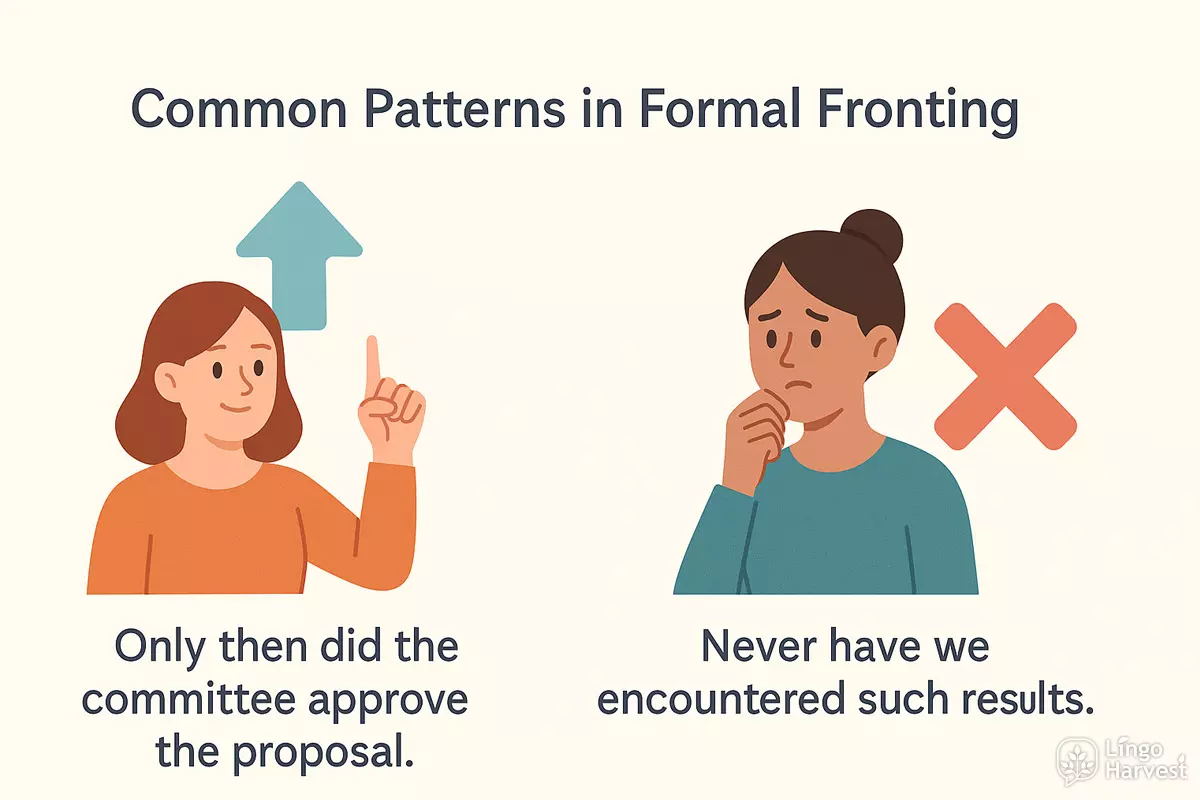
Writers most frequently move adverbs, negatives, or prepositional phrases to the front. Here are some typical structures:
- Only then did the committee approve the proposal.
- Never have we encountered such results.
- Into the archive went the original manuscripts.
- Rarely is this method questioned.
- Under no circumstances should this rule be ignored.
- Not until the data was reviewed did the error emerge.
- On no account must the contract be altered.
- Hardly had the meeting begun when objections were raised.
- So important is this finding that it warrants further study.
- No sooner had he arrived than the discussion started.
- Up the hill ran the survey team.
- Little did the researchers expect such a response.
- Scarcely had the analysis finished when new data arrived.
- Thus was the consensus formed.
- So effective is the policy that results improved rapidly.
- Down the list appeared several anomalies.
- Only by collaboration can this project succeed.
- Seldom do such opportunities arise.
Fronted Structures: A Quick Comparison
| Standard Order | Fronted Order |
|---|---|
| The board approved the plan only then. | Only then did the board approve the plan. |
| We rarely observe this phenomenon. | Rarely do we observe this phenomenon. |
| The report was submitted under no circumstances. | Under no circumstances was the report submitted. |
| The error emerged not until the data was reviewed. | Not until the data was reviewed did the error emerge. |
Using these constructions judiciously can elevate the sophistication of your writing. However, overuse may make prose sound forced or overly dramatic, so moderation is key. When applied with care, fronting brings clarity and emphasis to complex formal texts.
Common Errors to Avoid
When using fronting for emphasis, like in “Only then did he realize…”, writers and speakers often stumble over word order, auxiliary verbs, and punctuation. These issues can make sentences confusing or grammatically incorrect. Recognizing and sidestepping these pitfalls ensures your meaning is clear and your style remains natural.
Typical Mistakes in Fronting Structures
- Incorrect word order: Placing the subject before the auxiliary verb, e.g., “Only then he did realize…” ❌
- Omitting the auxiliary: Forgetting to add “did,” “does,” or “do” in statements, e.g., “Only then he realized…” ❌
- Using the wrong tense: Mismatching the tense of the auxiliary verb with the main verb, leading to confusion.
- Misplacing adverbials: Not positioning the adverbial (e.g., “only then,” “never before”) at the front for emphasis, losing the intended effect.
- Punctuation errors: Missing necessary commas or using unnecessary punctuation can disrupt the sentence flow.
- Overusing fronting: Employing emphatic structures too frequently, which can make writing feel forced or unnatural.
- Misunderstanding negatives: Forgetting that negative or restrictive adverbials (“never,” “rarely,” “only then”) trigger inversion.
- Mixing up direct and indirect speech: Applying inversion inappropriately in reported speech.
- Confusing fronting with questions: Mistaking the structure for a question due to the auxiliary-subject inversion.
- Incorrect use with modal verbs: Inverting with modal verbs incorrectly, e.g., “Only then could he realized…” ❌
Fronting vs. Standard Word Order: Examples
| Standard Order | Fronted/Emphatic Order |
|---|---|
| He realized the truth only then. | Only then did he realize the truth. |
| She had never seen such chaos before. | Never before had she seen such chaos. |
| You rarely see mistakes like this. | Rarely do you see mistakes like this. |
| They not only finished early, but also under budget. | Not only did they finish early, but they also finished under budget. |
How to Avoid These Issues
Double-check that you invert the subject and auxiliary after negative or restrictive expressions. Practice with example sentences, and read them aloud to catch awkward phrasing. If unsure, compare your sentence with standard examples. Remember, fronting is for emphasis—use it where it adds value, not as a default.
Practice: Rewrite with Fronting
Understanding how to bring focus to information through fronting can clarify meaning and add emphasis. In English, fronting often involves moving adverbials, prepositional phrases, or entire clauses to the start of a sentence. This practice will help you identify where fronting is possible and rewrite sentences for greater impact.
Task: Transform the Sentences
Read each sentence below. Rewrite it by moving the underlined part to the front of the sentence. Pay attention to word order and auxiliary verbs, especially when the sentence requires inversion (as in “Only then did he realize…”).
- He understood the problem only after reading the instructions carefully.
- They met by chance in the library.
- She had never seen such a beautiful sunset.
- He realized the truth only then.
- We will start the meeting as soon as everyone arrives.
- He finished his homework before dinner.
- The children ran out of the house suddenly.
- They had rarely experienced such cold weather.
- She will speak about her project tomorrow.
- The announcement was made at noon.
- He bought the car just last week.
- People seldom visit this remote village.
- The answer became clear after several hours.
- He could answer the question only after thinking carefully.
- The guests arrived unexpectedly in the evening.
- I have never tasted such delicious food.
- We realized our mistake only then.
- He left the room without saying a word.
- The team celebrated their victory at the stadium.
- They had hardly begun when the bell rang.
Show answers
- Only after reading the instructions carefully did he understand the problem.
- By chance, they met in the library.
- Never had she seen such a beautiful sunset.
- Only then did he realize the truth.
- As soon as everyone arrives, we will start the meeting.
- Before dinner, he finished his homework.
- Suddenly, the children ran out of the house.
- Rarely had they experienced such cold weather.
- Tomorrow, she will speak about her project.
- At noon, the announcement was made.
- Just last week, he bought the car.
- Seldom do people visit this remote village.
- After several hours, the answer became clear.
- Only after thinking carefully could he answer the question.
- Unexpectedly in the evening, the guests arrived.
- Never have I tasted such delicious food.
- Only then did we realize our mistake.
- Without saying a word, he left the room.
- At the stadium, the team celebrated their victory.
- Hardly had they begun when the bell rang.
Common Patterns for Fronting
To help you recognize and use fronting effectively, here are some typical patterns and triggers. These often require inversion (changing the word order, usually subject-auxiliary inversion):
- Only then/after/when/if… (e.g., Only then did he realize…)
- Never / Rarely / Seldom (e.g., Never have I seen…)
- Hardly / Barely / Scarcely (e.g., Hardly had they left…)
- Not until / Not only… but also
- Prepositional phrases (e.g., In the morning, we begin…)
- Adverbs for emphasis (e.g., Suddenly, the lights went out.)
- Time expressions (e.g., Yesterday, she called me.)
- Place expressions (e.g., On the hill stood a castle.)
- Conditional clauses (e.g., Should you need help, let me know.)
- Negative adverbials (e.g., Under no circumstances should you…)
Practicing these transformations not only sharpens your grammar but also makes your writing more dynamic and expressive.