Inversion after Negative Adverbials (Never have I seen...)

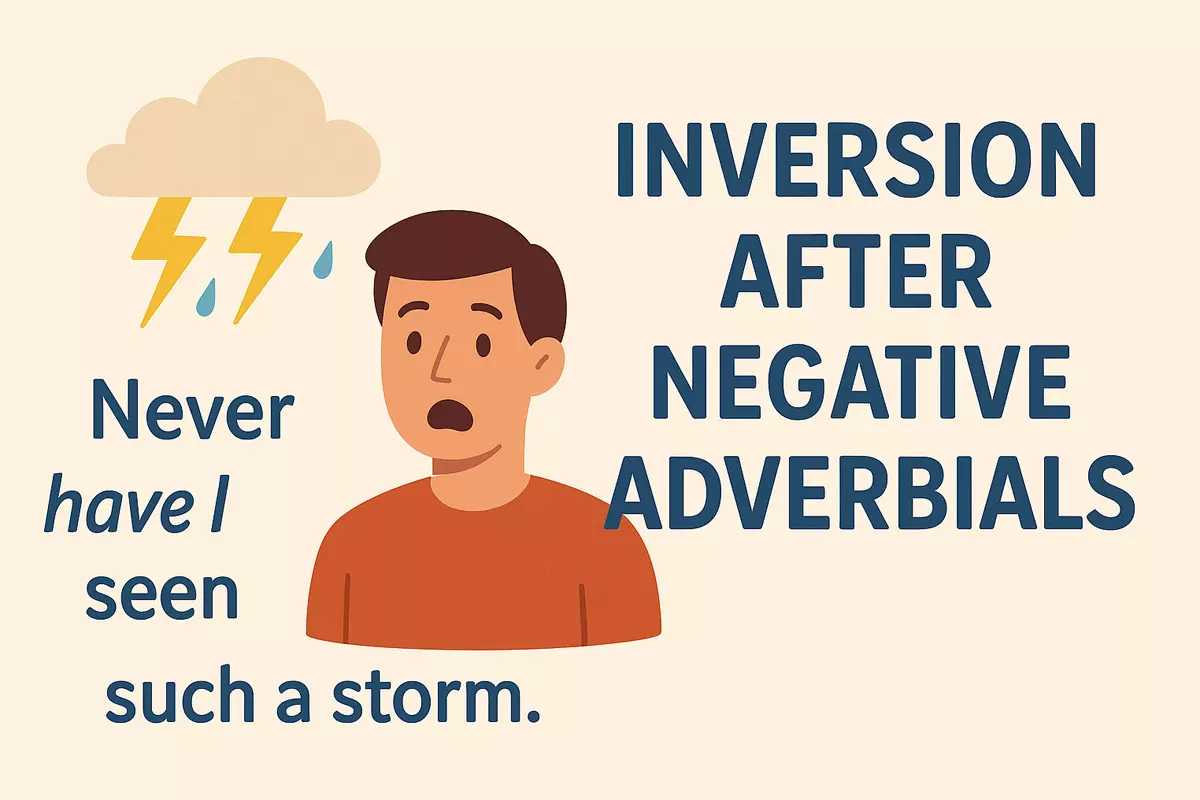 This article explains negative adverbial inversion, showing how words like never, rarely, and hardly cause verb-subject inversion in English. It covers rules, formal usage, common errors, and offers practice rewriting sentences with inversion.
Few grammatical twists in English sound as striking as flipping the subject and auxiliary after an initial negative phrase, a construction known as negative inversion. This technique is used not only to create emphasis but also to add a sense of drama or formality to our statements. By shifting the word order, writers and speakers can highlight what follows the negative phrase, drawing attention to the key information and making their language more engaging. Understanding why and how we use negative inversion helps us appreciate the flexibility and expressiveness of English, as well as the subtle ways in which sentence structure can shape meaning and tone.
Meaning of Negative Adverbial Inversion
When certain negative or restrictive adverbs start a sentence, English often requires the subject and auxiliary verb to switch places. This structure creates a formal or emphatic tone, highlighting the unusual or rare nature of the event described. Instead of the usual subject-verb order, the auxiliary comes before the subject, much like in yes/no questions.
Purpose and Effect
Using this inversion draws attention and emphasizes that something is exceptional or noteworthy. It’s a stylistic device often found in written English, speeches, or when a speaker wants to add drama or intensity.
Common Negative and Restrictive Adverbials That Trigger Inversion
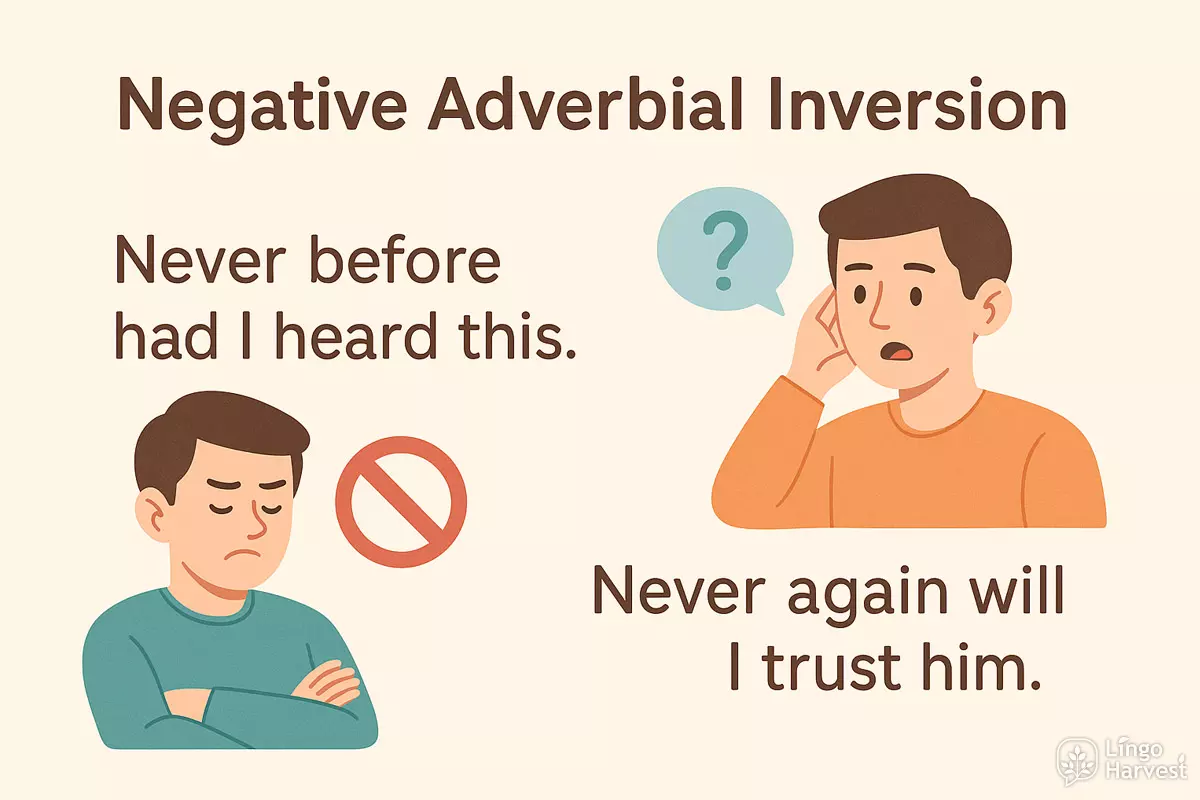
A variety of adverbials can cause this syntactic change, especially those expressing negatives, restrictions, or conditions. Here are some of the most frequent triggers:
| Expression | Example |
|---|---|
| Never | Never have I seen such chaos. |
| Rarely | Rarely do we get snow here. |
| Seldom | Seldom does he speak in class. |
| Hardly ever | Hardly ever does she complain. |
| Hardly | Hardly had we begun when it rained. |
| Scarcely | Scarcely had he arrived when they left. |
| Barely | Barely had I closed the door when it opened again. |
| Not until | Not until later did we understand. |
| Not since | Not since 2010 have they visited. |
| Never before | Never before had I heard this. |
| Never again | Never again will I trust him. |
| Not for a moment | Not for a moment did he hesitate. |
| Not for long | Not for long did the peace last. |
| At no time | At no time did she feel unsafe. |
| At no point | At no point did he admit guilt. |
| In no way | In no way can this be allowed. |
| Under no circumstances | Under no circumstances should you open the door. |
| On no account | On no account must it be repeated. |
| On no occasion | On no occasion did he apologize. |
| By no means | By no means is this finished. |
| Not a single | Not a single word did he say. |
| Not a word | Not a word did she speak. |
| Not a soul | Not a soul was there. |
| Not once | Not once did they complain. |
| Nowhere | Nowhere have I felt safer. |
| Nowhere else | Nowhere else will you find this. |
| No sooner | No sooner had we left than it started raining. |
| Only then | Only then did she understand. |
| Only after | Only after the meeting did he relax. |
| Only when | Only when he spoke did they listen. |
| Only if | Only if you try will you succeed. |
| Only by | Only by working hard can you improve. |
| Only through | Only through practice can you master it. |
| Not in the least | Not in the least was I surprised. |
| Not in any way | Not in any way was this acceptable. |
| Not in a million years | Not in a million years would I agree. |
How the Structure Works
With negative adverbials at the start, the word order switches. For example, instead of saying “I have never seen such chaos,” you would say: “Never have I seen such chaos.” This switch usually involves the auxiliary (have, did, can, etc.) and the subject. If there is no auxiliary in the original sentence, "do/does/did" is added.
Examples in Context
Below are paired examples showing the difference between the standard and inverted forms:
| Standard Word Order | Inversion After Negative Adverbial |
|---|---|
| I had never heard such a story. | Never had I heard such a story. |
| She rarely goes out after dark. | Rarely does she go out after dark. |
| We can in no way accept this offer. | In no way can we accept this offer. |
| He realized only after he left. | Only after he left did he realize. |
| They had hardly finished when the phone rang. | Hardly had they finished when the phone rang. |
Important Points to Remember
- This inversion is mostly used in formal writing or speech.
- It usually requires an auxiliary verb; if none is present, use “do/does/did.”
- Incorrect word order (forgetting inversion) can sound unnatural or be considered a grammar mistake in formal contexts. ❌
- Not every negative word at the start triggers this structure; it’s specific to certain adverbials.
In summary, negative adverbial inversion is a distinct grammatical feature that adds emphasis and formality. Mastering its use can make your English sound more sophisticated and expressive.
Common Triggers: Never, Rarely, Hardly
Inversion in English often occurs after certain negative or restrictive adverbials, especially when they appear at the beginning of a sentence. Among the most frequent triggers are “never,” “rarely,” and “hardly.” These words are used to emphasize how unusual or infrequent an event is, and when placed first, they require the subject and auxiliary verb to switch places. This structure is common in both formal writing and speech when the speaker wants to add drama or emphasis.
How the Triggers Work
When you start a sentence with one of these adverbs, the auxiliary (helping) verb comes before the subject. This pattern is similar to question formation, but it is used for statements. The main reason for this inversion is to highlight the negative or limited quality of the situation described.
- Never – used for things that have not happened at any time
- Rarely – for events that occur very infrequently
- Hardly – to stress that something has happened almost not at all
Typical Sentence Patterns
The structure with these adverbs generally looks like this:
- Adverb + auxiliary verb + subject + main verb
For example:
- Never have I experienced such kindness.
- Rarely do we see this kind of dedication.
- Hardly had she entered the room when the phone rang.
Expanded List of Triggers and Example Sentences
These inversion triggers extend beyond “never,” “rarely,” and “hardly.” Here are more adverbials that function similarly, with sample sentences for each:
- Never have I seen anything like it.
- Rarely does he arrive on time.
- Hardly had they finished when the bell rang.
- Seldom do we get such opportunities.
- Scarcely had I closed my eyes when the alarm sounded.
- Little did she know about the surprise.
- Only then did I understand the problem.
- Not only did they win, but they also broke the record.
- Under no circumstances should you reveal the password.
- In no way can this be considered fair.
- No sooner had we started than it began to rain.
- On no account must this door be left unlocked.
- At no time was the prisoner left alone.
- Nowhere will you find a better offer.
- Only by working hard can you succeed.
- Not until much later did he realize his mistake.
- Never before have I felt so happy.
- Rarely if ever does this species appear in the city.
- Hardly ever do we eat out.
Usage Tips
- These inverted structures are formal and often used for emphasis.
- They are common in writing, speeches, and storytelling to create a dramatic effect.
- In everyday conversation, standard word order is usually preferred unless you want to sound especially formal or emphatic.
Verb–Subject Inversion Rules
When certain negative or restrictive adverbials appear at the beginning of a sentence, English grammar requires the auxiliary verb to come before the subject. This structure, known as inversion, is common in formal writing and speech for emphasis or stylistic effect. Mastering this word order helps convey surprise, emphasis, or formality.
Pattern for Inversion
The typical structure after a negative adverbial is:
Negative adverbial + auxiliary verb + subject + main verb
For example: Never have I seen such chaos.
Usage Examples
- Rarely do we witness such dedication.
- Only then did she realize the truth.
- Not only did he apologize, but he also offered to help.
- At no time were the doors left unlocked.
- No sooner had I sat down than the phone rang.
- Under no circumstances should you reveal the code.
- Little did they know what awaited them.
- Hardly had the meeting begun when the fire alarm sounded.
- Not until the sun set did the temperature drop.
- In no way can this be considered acceptable.
Important Notes
- If there is no auxiliary verb in the affirmative sentence, use do/does/did for inversion: Seldom does she complain.
- Inversion is not typical in everyday informal speech, but it appears often in writing or formal contexts.
- The rest of the sentence follows the usual word order after the subject and verb have been inverted.
- Do not invert when the negative adverbial is not at the beginning of the sentence.
Comparison: Normal vs. Inverted Word Order
| Standard Order | Inverted Order |
|---|---|
| I have never seen such a thing. | Never have I seen such a thing. |
| He rarely visits us. | Rarely does he visit us. |
| We had hardly started when it rained. | Hardly had we started when it rained. |
| She realized the truth only then. | Only then did she realize the truth. |
Inversion in Formal Writing and Speech
Writers and speakers often use inversion after negative adverbials to create emphasis or a sense of drama, especially in more formal contexts. This stylistic choice is common in academic texts, speeches, journalism, and literature, providing a sophisticated tone and highlighting important information. Using such structures signals the rarity, unexpectedness, or strength of the statement.
Why Use Inversion?
Employing inversion after negative adverbs (such as never, rarely, hardly, scarcely, little, under no circumstances) emphasizes the negative or restrictive nature of the statement. It also helps to vary sentence structure and avoid monotony, making the text more engaging and persuasive.
Typical Inversion Patterns
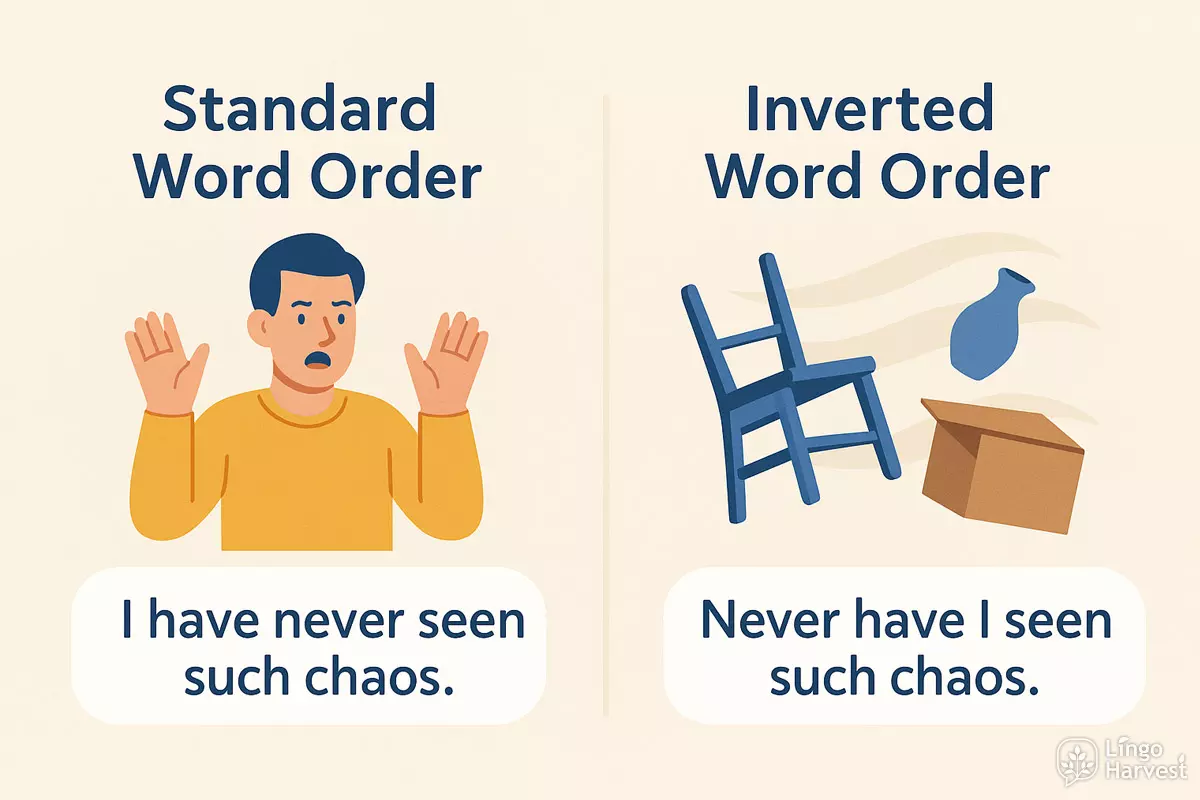
The usual structure involves placing the negative adverbial at the beginning, followed by an auxiliary verb or modal, then the subject and main verb. For clarity, here is a comparison of standard versus inverted forms:
| Standard Word Order | Inverted Word Order |
|---|---|
| I have never seen such chaos. | Never have I seen such chaos. |
| She had hardly finished when the phone rang. | Hardly had she finished when the phone rang. |
| They realized only then what had happened. | Only then did they realize what had happened. |
| He will agree under no circumstances. | Under no circumstances will he agree. |
Usage Tips
- Inversion is typically reserved for written English or formal speech; it sounds unnatural in everyday conversation.
- After adverbials requiring inversion, use an auxiliary verb (do/does/did, have/has/had, will/would, etc.), even if the main verb is in the present or past simple.
- Some phrases (like "no sooner... than...", "not only... but also...") almost always trigger inversion in formal registers.
- Use this structure to add emphasis, contrast, or dramatic effect, but avoid overusing it, as it can make text sound overly ornate or artificial.
Contrast with Standard Word Order
Understanding how inversion after negative adverbials differs from typical English sentence structure is key to mastering this advanced construction. In everyday affirmative statements, English follows a subject-verb-object (SVO) word order: the subject comes first, followed by the verb, and then the object or complement. However, when a negative or restrictive adverbial (like "never," "rarely," "not only," etc.) is placed at the beginning for emphasis, the auxiliary verb typically precedes the subject, mirroring question formation. This shift is not random—it's triggered by specific adverbials and always signals a marked, formal tone or dramatic emphasis. The effect is to highlight the negative or limiting nature of the adverbial, drawing attention to the unusualness or rarity of the situation described.
Standard vs. Inverted Structure
The main distinction lies in the placement of the auxiliary verb and the subject. Below are some typical transformations:
- Standard: I have never seen such chaos.
- Inverted: Never have I seen such chaos.
- Standard: She had hardly finished when the phone rang.
- Inverted: Hardly had she finished when the phone rang.
- Standard: They not only broke the rules, but also lied about it.
- Inverted: Not only did they break the rules, but they also lied about it.
- Standard: He rarely goes out in the evening.
- Inverted: Rarely does he go out in the evening.
- Standard: We nowhere find such dedication.
- Inverted: Nowhere do we find such dedication.
- Standard: She little realized the consequences.
- Inverted: Little did she realize the consequences.
- Standard: I have at no time doubted your sincerity.
- Inverted: At no time have I doubted your sincerity.
- Standard: He seldom arrives late.
- Inverted: Seldom does he arrive late.
- Standard: We had no sooner started than it began to rain.
- Inverted: No sooner had we started than it began to rain.
Situational Use and Tone
Inverted constructions after negative adverbials are more formal and often found in written English, speeches, or when emphasizing something surprising or exceptional. In casual conversation, the standard subject-verb order remains the norm.
Quick Comparison Table
| Regular Order | Inversion After Negative Adverbial |
|---|---|
| She had never experienced such a problem. | Never had she experienced such a problem. |
| They scarcely believed the news. | Scarcely did they believe the news. |
| He only later realized his mistake. | Only later did he realize his mistake. |
| I have in no way offended you. | In no way have I offended you. |
Using inversion after negative adverbials instantly changes the rhythm and focus of a sentence, making it more striking or formal. Recognizing when and how this structure diverges from the usual pattern helps writers and speakers control emphasis and style.
Frequent Learner Errors
Learners often run into trouble when trying to use inversion after negative adverbials, such as "Never have I seen..." or "Rarely do we get...". The most common challenge is forgetting to invert the subject and auxiliary verb, resulting in ungrammatical sentences. Additionally, confusion about which adverbials actually trigger inversion can lead to mistakes, as not all negative expressions work the same way.
Typical Mistakes with Word Order
Many students keep the normal word order after negative adverbials instead of inverting, especially in written work. For example:
- ❌ Never I have seen such a view. → Never have I seen such a view.
- ❌ Seldom people understand this rule. → Seldom do people understand this rule.
Confusing Which Adverbials Require Inversion
Some adverbials require inversion, while others do not. Learners often invert after the wrong expressions or miss inversion where it is needed. Here are some typical issues:
- Inverting after "hardly" without "when" or "before":
❌ Hardly I had arrived when... → Hardly had I arrived when... - Forgetting inversion after "at no time":
❌ At no time the manager was informed. → At no time was the manager informed. - Incorrectly inverting after "not only" in the main clause:
❌ Not only he is clever but also hardworking. → Not only is he clever but also hardworking.
Common Negative Adverbials and Correct Inversion Patterns
| Negative Adverbial | Correct Inversion Example |
|---|---|
| Never | Never have I heard such a story. |
| Rarely | Rarely does she make mistakes. |
| Seldom | Seldom do we see this kind of behavior. |
| Hardly...when | Hardly had they finished when the bell rang. |
| Scarcely...when | Scarcely had I sat down when the phone rang. |
| No sooner...than | No sooner had we arrived than it started to rain. |
| Under no circumstances | Under no circumstances should you open the door. |
| At no time | At no time were we aware of the danger. |
| Not only | Not only did he win, but he also broke the record. |
| Little | Little did they know what awaited them. |
Overusing or Misplacing Inversion
Occasionally, learners use inversion in sentences where it is not needed or misplace the negative adverbial in the sentence. For example:
- ❌ Never have I seen so beautiful a place in my life. (Correct structure, but "so beautiful a place" is awkward for many learners)
- ❌ Never I have seen this. (Missing inversion)
- ❌ Rarely does happens this. (Verb form error after inversion)
Summary of Key Pitfalls
- Omitting inversion after required negative adverbials
- Inverting after the wrong types of adverbials
- Using incorrect auxiliary verbs in the inverted structure
- Word order errors, especially in longer or more complex sentences
- Misunderstanding the meaning or register of the adverbials used
Focusing on these problem areas will help you avoid typical mistakes and use these advanced structures with confidence.
Practice: Rewrite Using Inversion
Understanding how to transform sentences using negative adverbials and inversion helps you sound more formal and sophisticated in English. Here, you'll find a set of exercises designed to develop your ability to rewrite statements with negative adverbial phrases at the beginning, requiring subject-auxiliary inversion.
Instructions
Rewrite each sentence by starting with the negative adverbial in brackets. Remember to invert the subject and auxiliary/modal verb after the negative adverbial. Pay attention to word order and tense.
- (Never) I have seen such a beautiful sunset.
- (Rarely) she goes to the gym on weekdays.
- (Not only) did he forget my birthday, but he also ignored my messages.
- (Seldom) we witness such kindness from strangers.
- (No sooner) had the train left than it started to rain.
- (Hardly ever) do they eat out at restaurants.
- (Under no circumstances) should you open this door.
- (At no time) did the suspect admit to the crime.
- (Little) did he know about the surprise party.
- (Only after) the exam ended did I realize my mistake.
- (Not until) the next day did she call me back.
- (Scarcely) had he finished the meal when the phone rang.
Common Negative Adverbials for Inversion
- Never
- Rarely
- Hardly ever
- Seldom
- At no time
- No sooner
- Not only
- Not until
- Under no circumstances
- Scarcely
- Little
- Only after/before/when
Side-by-Side: Standard vs. Inverted Form
| Standard Word Order | Inversion with Negative Adverbial |
|---|---|
| I have never eaten sushi. | Never have I eaten sushi. |
| She rarely speaks in meetings. | Rarely does she speak in meetings. |
| He didn't realize the truth until now. | Not until now did he realize the truth. |
| They should not, under any circumstances, leave the building. | Under no circumstances should they leave the building. |
| We had no sooner arrived than it started to rain. | No sooner had we arrived than it started to rain. |
Show answers
- Never have I seen such a beautiful sunset.
- Rarely does she go to the gym on weekdays.
- Not only did he forget my birthday, but he also ignored my messages. (Already inverted)
- Seldom do we witness such kindness from strangers.
- No sooner had the train left than it started to rain. (Already inverted)
- Hardly ever do they eat out at restaurants.
- Under no circumstances should you open this door.
- At no time did the suspect admit to the crime.
- Little did he know about the surprise party.
- Only after the exam ended did I realize my mistake.
- Not until the next day did she call me back.
- Scarcely had he finished the meal when the phone rang.