Inversion After Negative Conjunctions: nor, neither, rarely, scarcely

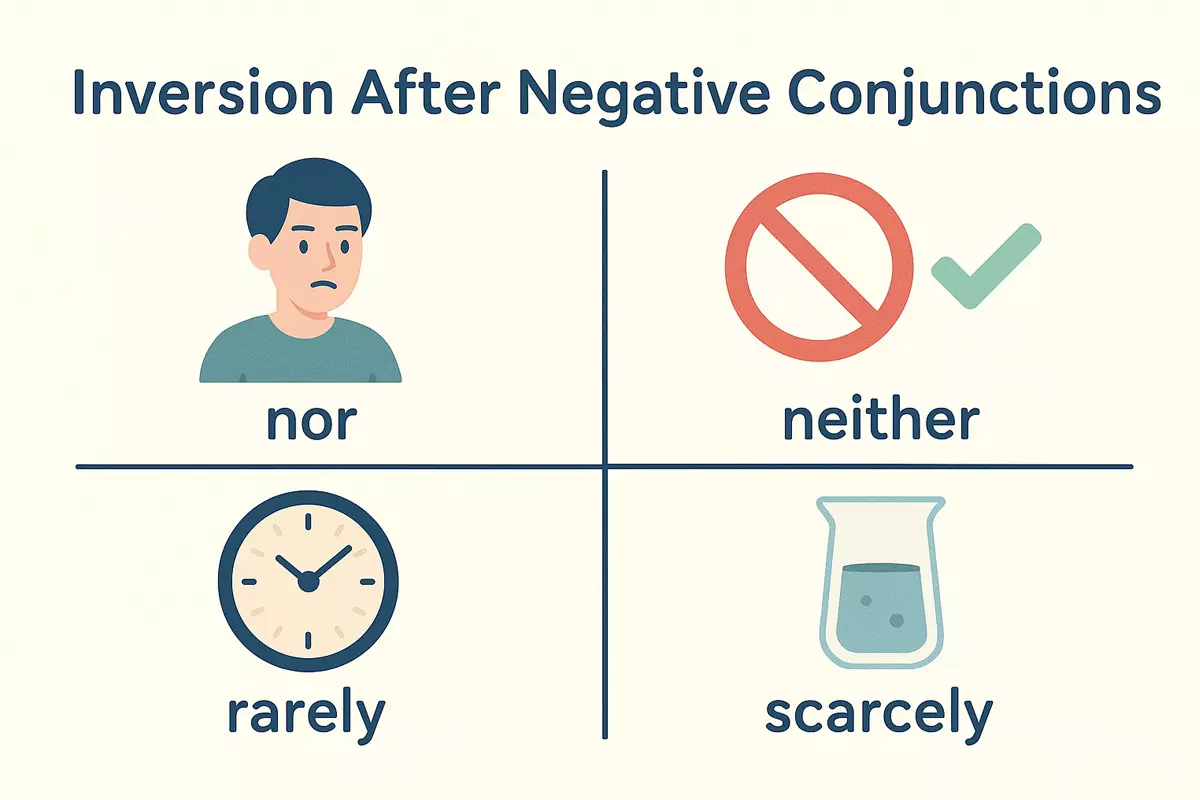 The article explains what inversion is and why it appears in English, highlights the conjunctions and adverbs that trigger it, covers patterns with nor, neither, rarely, and scarcely, and gives rules, examples, and practice for using negative inversion correctly.
- What inversion is and why English uses it
- Conjunctions and adverbs that trigger inversion
- Patterns with nor, neither, rarely, scarcely
- How inversion adds emphasis in formal writing and storytelling
- Word order rules and common mistakes
- Examples from literature, journalism, and academic texts
- Practice: rewrite affirmative sentences using negative inversion
Mastering advanced sentence structures can significantly enhance the sophistication and engagement of your writing. Certain words such as nor, neither, rarely, and scarcely require you to invert the typical word order, which means placing the auxiliary verb before the subject. This technique, known as inversion, not only adds emphasis but also helps vary your sentence patterns, making your writing more dynamic and compelling. By incorporating these structures thoughtfully, you can communicate your ideas with greater clarity and style.
What inversion is and why English uses it
In English, inversion means changing the usual word order so that the verb comes before the subject. This pattern is common in questions ("Are you ready?"), but it also appears in formal writing and after certain negative words or phrases. When you see expressions like nor, neither, rarely, or scarcely at the beginning of a sentence, inversion often follows to emphasize the negative meaning or add stylistic effect.
How inversion works
Normally, English sentences follow the subject-verb-object order: "She can swim." With inversion, this order changes: "Rarely can she swim." The auxiliary verb (like can, does, is) comes before the subject, while the main verb follows.
Why does English use inversion?
Using inversion after negative conjunctions and adverbs adds emphasis and variety. It highlights that the situation is unusual, negative, or restricted. This structure is especially common in written English, speeches, and formal contexts, helping writers and speakers sound more polished or dramatic.
- Draws attention to a negative or limited situation
- Creates a formal or literary tone
- Prevents monotony in sentence structure
- Signals contrast or exception to previous statements
Common triggers for inversion

Below is a list of words and phrases that often cause inversion when they appear at the start of a sentence:
- Nor → Nor did he agree to participate.
- Neither → Neither did they notice the mistake.
- Rarely → Rarely do we see such honesty.
- Scarcely → Scarcely had he arrived when the meeting began.
- Never → Never have I heard such a strange story.
- Seldom → Seldom does she make the same mistake twice.
- Hardly → Hardly had we started when it began to rain.
- Little → Little did he know what was coming.
- No sooner → No sooner had she sat down than the phone rang.
- Not only → Not only did he finish early, he also helped others.
- Under no circumstances → Under no circumstances should you open this door.
- At no point → At no point did they admit the error.
- In no way → In no way was the plan approved.
- On no account → On no account must the files be deleted.
- Only then → Only then did he understand the message.
- Not until → Not until the end did they reveal the truth.
- Nowhere → Nowhere will you find a better example.
- Not once → Not once did she complain about the workload.
- Only after → Only after the meeting did he realize the mistake.
- So (with adjectives): So rare was the bird that people traveled far to see it.
Comparing normal and inverted word order
| Normal Order | Inverted Order |
|---|---|
| She had never seen such chaos before. | Never had she seen such chaos before. |
| He rarely goes out on weekdays. | Rarely does he go out on weekdays. |
| I have neither visited Paris nor London. | Neither have I visited Paris nor London. |
| They scarcely noticed the change. | Scarcely did they notice the change. |
Mastering inversion after negative conjunctions and adverbs allows for more flexible and expressive English, especially in writing. This construction is not used in everyday casual conversation, but understanding it can help you recognize and use a wider range of styles.
Conjunctions and adverbs that trigger inversion
English sometimes requires a switch in normal word order—known as inversion—after certain negatives and restrictive adverbs or conjunctions. This pattern is especially common with words like nor, neither, rarely, and scarcely. In these cases, the auxiliary verb comes before the subject, which is a structure more typical of questions.
Common triggers for inversion
Several adverbs and conjunctions prompt this grammatical shift. Here are some of the most frequent triggers:
- Nor — “Nor do I agree.”
- Neither — “Neither does she know.”
- Rarely — “Rarely have I seen such chaos.”
- Scarcely — “Scarcely had he left when the phone rang.”
- Never — “Never have we experienced this before.”
- Seldom — “Seldom does he arrive on time.”
- No sooner — “No sooner had I sat down than the bell rang.”
- Hardly — “Hardly had they begun when it started raining.”
- Little (meaning ‘not at all’) — “Little did she know what awaited.”
- Only then — “Only then did he understand.”
- On no account — “On no account must this door be opened.”
- Under no circumstances — “Under no circumstances should you touch that.”
- Not only — “Not only did he win, but he also set a record.”
- In no way — “In no way can this be justified.”
- Nowhere — “Nowhere have I seen such beauty.”
- At no time — “At no time were we aware of the danger.”
- Not until — “Not until later did we realize the truth.”
- Not once — “Not once did she complain.”
- Not for a moment — “Not for a moment did he hesitate.”
- Only after — “Only after the meeting did we learn the news.”
How inversion works
After these triggers, the structure typically becomes: adverb/conjunction + auxiliary/modal + subject + main verb. For example, “Rarely have I seen such a crowd,” not “Rarely I have seen.”
| Trigger Word | Inversion Example |
|---|---|
| Nor | Nor did he reply. |
| Neither | Neither have they called. |
| Rarely | Rarely do we see this happen. |
| Scarcely | Scarcely had she entered when it began to rain. |
| Never | Never have I been so surprised. |
| No sooner | No sooner had we started than the lights went out. |
| Seldom | Seldom does he miss a meeting. |
| Hardly | Hardly had I closed my eyes when the alarm rang. |
These patterns are more common in formal or literary styles, but you’ll find them in spoken English as well, especially for emphasis or dramatic effect. Remember, inversion usually follows a negative or restrictive element at the start of the sentence.
Patterns with nor, neither, rarely, scarcely
Using words like "nor," "neither," "rarely," and "scarcely" at the beginning of a sentence often triggers subject-verb inversion in English. This means the auxiliary verb comes before the subject, creating a structure that sounds formal or emphatic. Such patterns are especially common in written or literary styles.
Understanding Inversion After Negative Conjunctions
When a negative conjunction or adverb opens a sentence, the normal word order changes. This inversion emphasizes the negative or restrictive meaning. For example, instead of "He had never seen such chaos," we say, "Never had he seen such chaos." The same applies to sentences starting with "nor," "neither," "rarely," and "scarcely."
Common Sentence Structures
After these negative expressions, the auxiliary verb or modal comes first, followed by the subject, then the main verb. This pattern is consistent across tenses, but the auxiliary will match the tense and verb type (do/does/did, have/has/had, modal verbs, etc.).
- Nor does she attend meetings regularly.
- Neither have they completed the assignment.
- Rarely do we see such dedication.
- Scarcely had the rain stopped when the sun appeared.
- Nor can he explain his absence.
- Neither did I understand nor care.
- Rarely have I felt so inspired.
- Scarcely had she finished speaking when the phone rang.
- Nor will they be able to attend.
- Neither was the answer correct.
- Rarely does this happen in practice.
- Scarcely had we arrived when the show began.
- Nor did he offer an explanation.
- Neither have the results improved.
- Rarely do students ask questions this early.
- Scarcely had the bell rung when the students left.
- Nor should you ignore this warning.
- Neither can I sing nor dance.
Inversion Triggers and Exceptions
Only certain negative expressions cause inversion. Words like "never," "seldom," "hardly," and those discussed here, reliably flip the usual subject-verb order. However, in spoken English, especially informally, inversion may be dropped, but it remains the standard in writing and formal speech.
Comparison of Standard and Inverted Patterns
| Standard Word Order | Inverted Word Order |
|---|---|
| She does not attend meetings regularly. | Nor does she attend meetings regularly. |
| They have not completed the assignment. | Neither have they completed the assignment. |
| We rarely see such dedication. | Rarely do we see such dedication. |
| She had scarcely finished speaking when the phone rang. | Scarcely had she finished speaking when the phone rang. |
These structures help add emphasis and variety to your writing. Mastering them can make your English sound more natural in both formal and creative contexts.
How inversion adds emphasis in formal writing and storytelling
Inverting sentence order after negative conjunctions like nor, neither, rarely, and scarcely is a time-tested way to highlight surprising, dramatic, or important information. This technique shifts the verb before the subject, immediately drawing the reader’s attention and lending a formal, sometimes literary, feel to the sentence. Writers often use this structure to create variety and rhythm, making their language more engaging or authoritative.
Why writers choose inversion for emphasis
The altered word order stands out because it is less common in everyday speech. When readers see a sentence like “Rarely had she felt so alone,” the inversion signals that what follows is notable. This method also allows for a smoother connection between ideas, especially when adding a second, equally negative statement after “neither” or “nor.”
Common contexts for inversion
- Dramatic storytelling: “Scarcely had the clock struck midnight when the door creaked open.”
- Formal writing: “Nor does the evidence support this claim.”
- Academic emphasis: “Neither were the results conclusive, nor was the hypothesis confirmed.”
- Poetic effect: “Seldom have such wonders been witnessed.”
- Contrast and surprise: “Rarely do we encounter such honesty.”
Examples of inversion after negative conjunctions
- Nor did he apologize for his actions.
- Neither have the plans been finalized nor has the budget been approved.
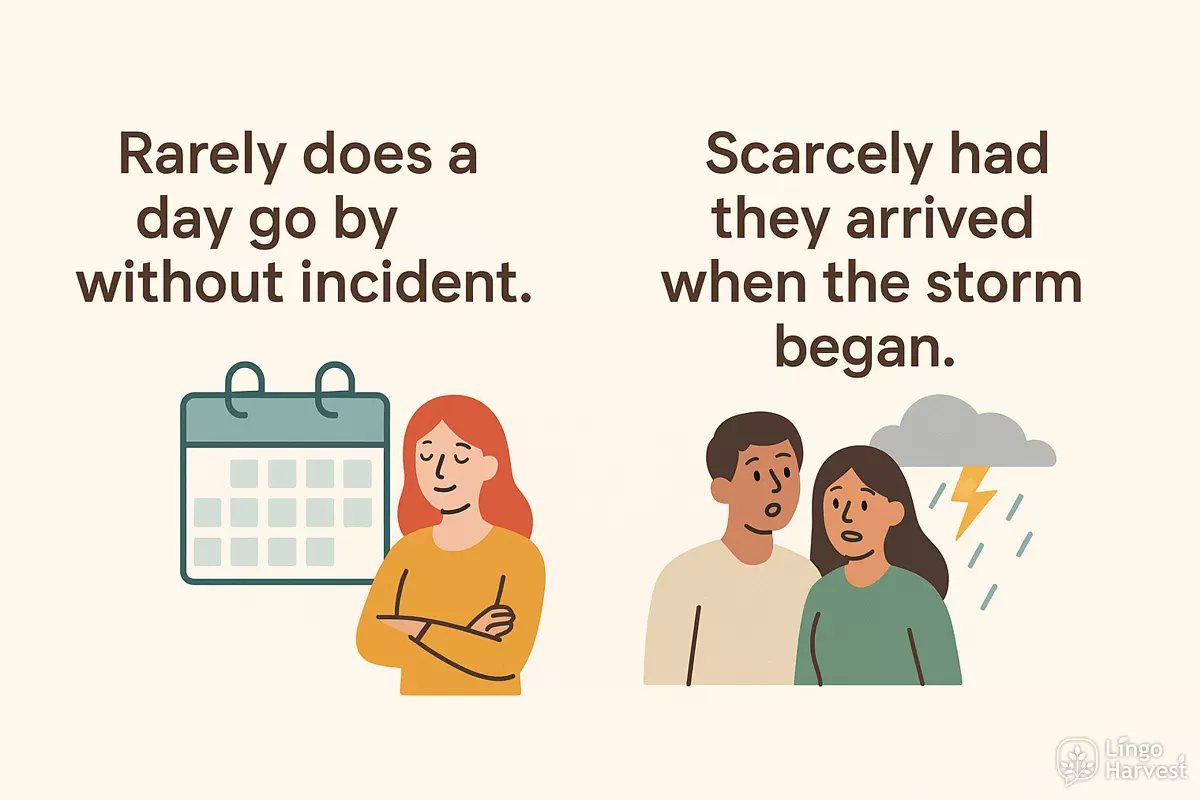
- Rarely does a day go by without incident.
- Scarcely had they arrived when the storm began.
- Seldom do politicians admit their mistakes.
- Never before had the city seen such crowds.
- No sooner had she spoken than the phone rang.
- Hardly had I closed my eyes when the alarm sounded.
- Little did we know what awaited us.
- At no time were the documents released to the public.
- Under no circumstances should you open this door.
- Not only did he win, but he also broke the record.
- On no account must this information be leaked.
- In no way can we accept these terms.
- Nowhere have I felt more at home.
- Only then did she realize the truth.
Effect on tone and reader engagement
This inversion technique instantly shifts the tone to something more formal or dramatic. It’s especially useful when a writer wants to highlight a turning point or underscore a notable fact. By placing the verb before the subject, the writer breaks the reader’s expectations, ensuring the information stands out.
Word order rules and common mistakes
When using negative conjunctions such as nor, neither, rarely, and scarcely at the beginning of a sentence, English requires inversion—placing the auxiliary verb before the subject. This structure can feel unnatural for learners, as it differs from standard affirmative or even some negative sentences. Understanding how and when to apply this inversion is essential for clarity and correctness.
How inversion works after negative conjunctions
Inversion typically occurs when these negative or restrictive words start a sentence or clause. The auxiliary verb (do/does/did, have/has/had, will/would, etc.) comes before the subject, followed by the main verb. This pattern is similar to forming questions, but it’s used in statements for emphasis or stylistic effect.
- Nor: Nor did she reply.
- Neither: Neither have I seen him.
- Rarely: Rarely do we get such good weather.
- Scarcely: Scarcely had he arrived when it started to rain.
Common pitfalls and mistakes
Mistakes often arise from forgetting to invert the subject and auxiliary, or from using the wrong auxiliary verb. Learners also sometimes try to use inversion after these words even when they are not at the beginning of a sentence, which is incorrect.
- ❌ Nor she replied. → Nor did she reply.
- ❌ Neither I have seen him. → Neither have I seen him.
- ❌ Rarely we get such good weather. → Rarely do we get such good weather.
- ❌ Scarcely he had arrived when it started to rain. → Scarcely had he arrived when it started to rain.
Patterns and variations
Different negative adverbials trigger inversion, but the auxiliary used depends on tense and context. Here’s a comparison of correct forms:
| Trigger word | Correct inversion example |
|---|---|
| Nor | Nor did I know about it. |
| Neither | Neither have they responded. |
| Rarely | Rarely does he eat sweets. |
| Scarcely | Scarcely had we left when it began to snow. |
| Seldom | Seldom do they visit us. |
| Never | Never have I heard such a story. |
| No sooner | No sooner had she finished than the phone rang. |
| Hardly | Hardly had he arrived when they started eating. |
Quick tips for avoiding errors
- Always invert the auxiliary and subject after negative adverbials at the start of a sentence.
- Choose the correct auxiliary for the tense (do/does/did for present/past simple, have/has/had for perfect tenses).
- Do not use inversion if the negative word is not in first position.
- Practice with a variety of triggers, not just nor/neither.
Mastering these patterns helps your writing and speech sound more natural and sophisticated in formal contexts.
Examples from literature, journalism, and academic texts
Writers across genres use inversion after negative conjunctions like "nor," "neither," "rarely," and "scarcely" to achieve emphasis or create a formal tone. Classic novels, newspaper articles, and scholarly works often employ this structure, especially to highlight contrasts or reinforce negation. Below are authentic and adapted examples that illustrate how these expressions function in context.
Selected Sentences Demonstrating Inversion
- Nor did she attempt to justify her actions.
- Neither have I seen such dedication, nor has anyone else on the team.
- Rarely do we encounter such a compelling argument in the literature.
- Scarcely had the meeting begun when the interruption occurred.
- Never have the results been so conclusive.
- Seldom does the newspaper retract its statements.
- No sooner had he finished speaking than the crowd erupted in applause.
- Little did they know about the upcoming changes.
- Not only did the experiment fail, but it also yielded unexpected results.
- Hardly had the news broken when rumors began to spread.
- Nor would any responsible scholar make such a claim without evidence.
- Neither does the author provide sources, nor does she address counterarguments.
- Scarcely had the sun risen when the workers arrived.
- Rarely had such a consensus been reached in previous studies.
- Never before have these findings been published.
Comparison of Standard vs. Inverted Word Order
| Standard Word Order | Inverted After Negative Conjunction |
|---|---|
| She had never seen such chaos before. | Never had she seen such chaos before. |
| They did not agree, and I did not either. | Nor did I agree. |
| He rarely visits his hometown. | Rarely does he visit his hometown. |
| The meeting had scarcely begun when the phone rang. | Scarcely had the meeting begun when the phone rang. |
| She has never encountered such resistance. | Never has she encountered such resistance. |
Contextual Usage in Published Texts
Writers use inversion for emphasis or stylistic effect. For instance, in academic articles, phrases like "Rarely do researchers agree on this point" lend authority and highlight exceptions. In journalism, a sentence such as "Nor did officials comment on the allegations" succinctly emphasizes omissions. Literary fiction often uses this construction for dramatic effect, as in "Scarcely had the storm passed when the village emerged from hiding." This variety of examples demonstrates how inversion after negative conjunctions can sharpen meaning, add emphasis, and contribute to a formal or literary tone across different forms of writing.
Practice: rewrite affirmative sentences using negative inversion
Understanding how to transform regular affirmative statements into their negative inversion forms is key for mastering advanced English structures, especially after negative conjunctions like nor, neither, rarely, and scarcely. Here, you'll find guided practice tasks and examples to help you become comfortable with this elegant grammatical pattern.
Step-by-step transformation examples
- He had never seen such a beautiful painting before. → Never had he seen such a beautiful painting before.
- They rarely visit the museum. → Rarely do they visit the museum.
- She understood little of the lecture. → Little did she understand of the lecture.
- We had scarcely finished eating when the phone rang. → Scarcely had we finished eating when the phone rang.
- He didn't know the answer, nor did his friend. → He didn't know the answer, nor did his friend. (already in inversion form)
- He will never agree to those terms. → Never will he agree to those terms.
- They have at no time broken the rules. → At no time have they broken the rules.
- We had hardly arrived when it started to rain. → Hardly had we arrived when it started to rain.
- She seldom makes mistakes. → Seldom does she make mistakes.
- I have never heard such nonsense. → Never have I heard such nonsense.
- He neither smiled nor laughed. → He neither smiled nor laughed. (no change needed: already correct)
- They no sooner finished the project than they started another. → No sooner had they finished the project than they started another.
Practice: Change these sentences using negative inversion
- She rarely goes out on weekdays.
- I had never tasted such delicious food.
- We scarcely believed the news at first.
- He does not smoke, nor does his brother.
- They seldom complain about anything.
- You will never regret your decision.
- He had hardly finished speaking when she interrupted.
- At no time did they express doubt.
Show answers
- Rarely does she go out on weekdays.
- Never had I tasted such delicious food.
- Scarcely did we believe the news at first.
- He does not smoke, nor does his brother. (already correct)
- Seldom do they complain about anything.
- Never will you regret your decision.
- Hardly had he finished speaking when she interrupted.
- At no time did they express doubt. (already correct)
Common triggers for negative inversion
Some expressions and conjunctions almost always require this structure:
- Never
- Rarely
- Seldom
- Scarcely
- Hardly
- No sooner
- At no time
- On no account
- Little (meaning "not much")
- Neither / Nor
Regular practice with these patterns will make your English sound more sophisticated and precise, especially in formal writing and speech.