Inversion in English Questions: Rules and Exceptions

 Here we what inversion in questions means, standard rules, how to use inversion with auxiliary, be, and modal verbs, cases without inversion, exceptions, and common word order mistakes. It also provides practice exercises for self-assessment.
English questions often change word order by swapping the subject and auxiliary verb, a process called subject-auxiliary inversion. For example, the statement "You are coming" becomes "Are you coming?" in question form. Mastering this pattern helps make your spoken and written English sound more natural and clear. However, there are exceptions, such as questions that use question words like "who" as the subject, where inversion does not occur. Understanding these rules and their exceptions will improve your confidence in forming questions.
What Inversion in Questions Means
In English, inversion refers to switching the usual order of the subject and auxiliary verb in a sentence, especially when forming questions. Instead of the typical subject-verb structure found in statements, question forms often require the auxiliary to come before the subject. This change signals to listeners or readers that a question is being asked, not a statement.
How Subject-Auxiliary Inversion Works
Normally, English sentences follow the subject-verb-object word order. However, in questions, the auxiliary verb moves before the subject. For example, the statement "You are coming" becomes "Are you coming?" This inversion is a key marker of interrogative sentences in English.
- She can swim. → Can she swim?
- They have finished. → Have they finished?
- We will go. → Will we go?
- You were there. → Were you there?
- He is ready. → Is he ready?
- I should call. → Should I call?
- Tom did leave. → Did Tom leave?
- Emma has arrived. → Has Emma arrived?
- They could help. → Could they help?
- The dog will bark. → Will the dog bark?
When Inversion Happens
This switch most often takes place in yes/no questions and wh-questions (who, what, where, when, why, how). There are exceptions, but the basic pattern remains: move the auxiliary before the subject to signal a question.
Comparing Statements and Questions

The difference between a statement and its question form is often only the inversion of the subject and auxiliary. This is easier to see in a structured comparison:
| Statement | Question (with Inversion) |
|---|---|
| You have finished. | Have you finished? |
| They are coming. | Are they coming? |
| She was late. | Was she late? |
| We will win. | Will we win? |
Key Points to Remember
- Inversion places the auxiliary verb before the subject to form a question.
- Main verbs alone do not invert; "do/does/did" is used if no auxiliary is present.
- Question word (wh-) questions also use this structure, but the wh-word comes first.
- Some question forms (like subject questions) do not require inversion.
Understanding this switch in word order is essential for constructing clear and correct questions in English.
Standard Inversion Rules
When forming questions in English, word order typically changes so that an auxiliary verb comes before the subject. This pattern is called subject-auxiliary inversion, and it’s a fundamental feature of interrogative structures. Understanding how and when to apply this switch is essential for building correct questions.
Basic Pattern for Yes/No Questions
The most common structure involves placing the auxiliary (or modal) verb before the subject, followed by the main verb:
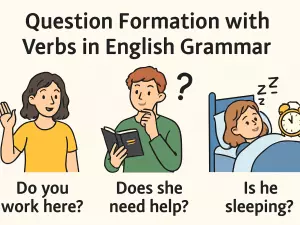
- Are you ready? → Yes, I am.
- Did she call? → Yes, she did.
- Can they swim? → Yes, they can.
- Will it rain? → Probably.
- Do you understand? → Yes, I do.
- Does he work here? → Yes, he does.
- Have you finished? → Yes, I have.
- Is he coming? → Yes, he is.
If no auxiliary is present in the statement, “do/does/did” is added for inversion.
Question Word (Wh-) Inversion
When a question word (who, what, where, etc.) is used, inversion still applies—unless the question word is the subject. Compare:
- Where are they going? → They are going to the airport.
- What did you see? → I saw a strange light.
- Who called? → No inversion, as 'who' is the subject → John did.
- When will you arrive? → I will arrive at noon.
- Why did he leave early? → Because he felt sick.
- How are you feeling today? → I’m feeling fine.
Inversion with Modal Verbs and “Be”
Modal verbs (can, will, should, etc.) and forms of “be” invert directly:
- Should we start now? → Yes, let’s start.
- Is this your book? → Yes, it is.
- Can you help me? → Yes, I can.
- Will they be on time? → Probably.
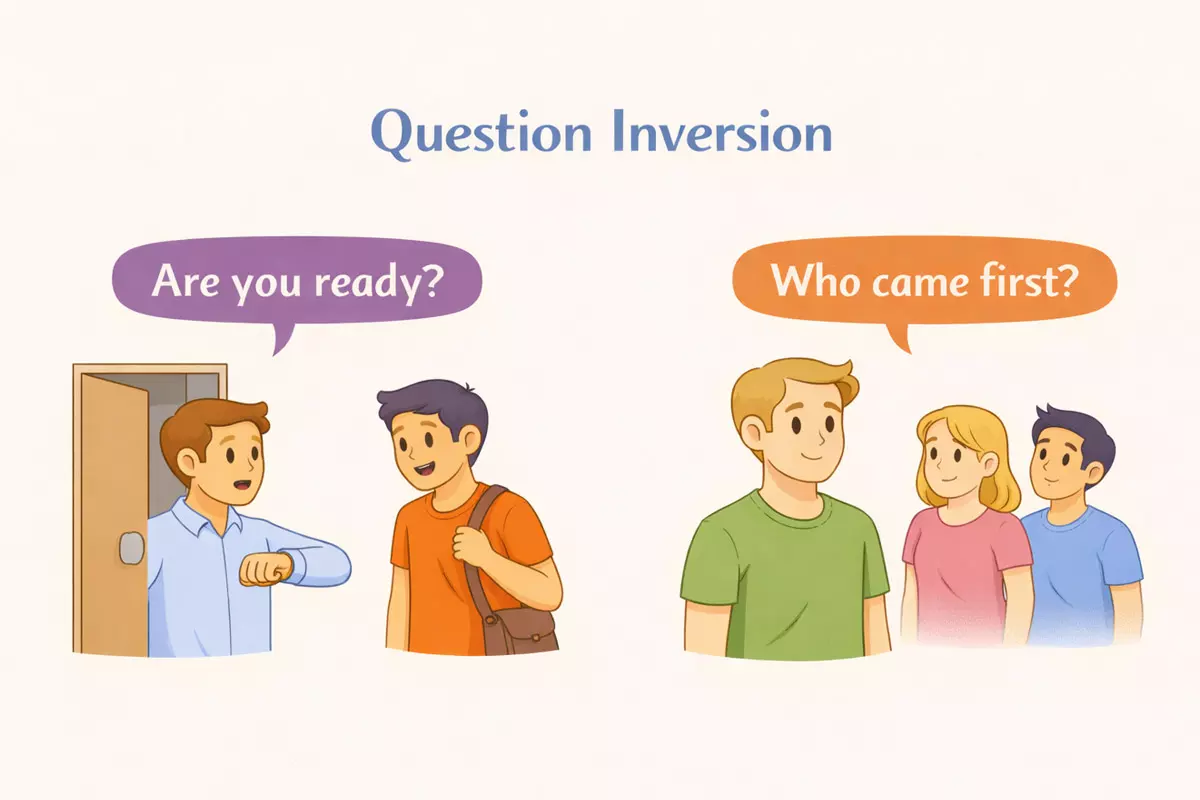
- Are you ready? → Yes, I am.
- Must I sign this? → Yes, you must.
Table: Inverted vs. Regular Word Order
| Statement | Question (Inverted) |
|---|---|
| You are coming. | Are you coming? |
| He can swim. | Can he swim? |
| They have left. | Have they left? |
| She likes coffee. | Does she like coffee? |
| John played tennis. | Did John play tennis? |
Key Points to Remember
- Use inversion only if an auxiliary, modal, or “be” is present. Otherwise, add “do/does/did.”
- Never invert when the question word is the subject (“Who called?”).
- Negative questions also use inversion: “Didn’t you know?”
- Short answers follow the same auxiliary: “Yes, she is.” / “No, he didn’t.”
Mastering these patterns will help you form clear, correct questions in a wide range of situations.
Inversion with Auxiliary Verbs
When forming questions in English, the subject and the first auxiliary verb often switch places. This rearrangement is a key feature of English interrogative structure, especially in present and past simple tenses, as well as with modals and perfect forms. The process is straightforward but can seem tricky with negative forms, embedded questions, and sentences without auxiliaries.
Basic Patterns
In most cases, to ask a yes/no question, you place the auxiliary verb before the subject. If there is no auxiliary in the statement, "do/does/did" is introduced. Here are some foundational patterns:
- She is coming. → Is she coming?
- You have finished. → Have you finished?
- They can swim. → Can they swim?
- He likes pizza. → Does he like pizza?
- We went home. → Did we go home?
- It will rain. → Will it rain?
- You should call. → Should you call?
- They were late. → Were they late?
- She does not know. → Does she not know?
- He has seen it. → Has he seen it?
Common Auxiliary Verbs Used in Inversion
This structure typically involves one of these helping verbs:
- Be (am, is, are, was, were)
- Have (have, has, had)
- Do (do, does, did)
- Modals (can, could, will, would, shall, should, may, might, must)
Examples in Context
The following table illustrates how statements change into questions when an auxiliary is present or needs to be added:
| Statement | Question (Inverted) |
|---|---|
| She is reading. | Is she reading? |
| They have left. | Have they left? |
| You can swim. | Can you swim? |
| He went home. | Did he go home? |
| We will see. | Will we see? |
| She likes coffee. | Does she like coffee? |
| They were tired. | Were they tired? |
| He had finished. | Had he finished? |
Notes on Usage
- When there is no auxiliary in the statement, "do/does/did" must be added for the question.
- Questions with "be" as a main verb invert directly: "She is happy." → "Is she happy?"
- Negative questions invert the auxiliary and place "not" after the subject: "Did he not call?" or in contracted form, "Didn't he call?"
- Indirect (embedded) questions do not use inversion: "Can you tell me where she is?" (not "where is she")
By mastering this word order change with auxiliaries, you can confidently form most English questions, whether they're simple, negative, or modal-based.
Inversion with Be and Modal Verbs
When forming questions in English, the word order often changes, especially with the verb be and with modal verbs like can, should, might, and will. Instead of the usual subject-verb pattern, these verbs typically come before the subject in questions. This switch is a key part of English question structure and is one of the most consistent rules for inversion.
How Be and Modals Change Word Order
The main idea is that be (in all its forms: am, is, are, was, were, etc.) and modal verbs move to the front of the clause when making questions. This applies whether the subject is a noun or a pronoun, and it works with both yes/no and wh- questions.
- Are you ready?
- Is she coming?
- Was the door open?
- Can he swim?
- Should we leave now?
- Will they join us?
- Must I explain again?
- Could you help me?
- Might it rain tonight?
- Are these your keys?
- Were you at home?
- Would you like some tea?
- Shall we dance?
- Is this your bag?
- Was it difficult?
- Can I see that?
- Will there be time?
- Should I call her?
Comparing Statements and Questions
To see the difference that inversion makes, compare the word order in statements and their corresponding questions. Notice how the verb and subject switch places:
| Statement | Question (with Inversion) |
|---|---|
| You are tired. | Are you tired? |
| She can drive. | Can she drive? |
| They will come. | Will they come? |
| He should study. | Should he study? |
| It was raining. | Was it raining? |
| We might win. | Might we win? |
Special Cases and Exceptions
There are a few situations where this inversion does not occur, such as in indirect questions ("I wonder if she is coming" ❌ not "I wonder is she coming" ✅). Also, in reported speech, the subject comes before the verb: "He asked if you could help." Pay attention to these exceptions, as they are common sources of confusion.
In summary, switching the position of be or a modal verb with the subject is a reliable way to form direct questions in English. This pattern makes it easier to recognize and produce correct question forms.
Cases Without Inversion
Many English questions use a different structure and do not require the subject-auxiliary switch. Understanding when inversion is not used can help avoid common mistakes, especially in more formal or complex sentences. Let’s explore these scenarios in detail.
Wh-Questions as Subjects
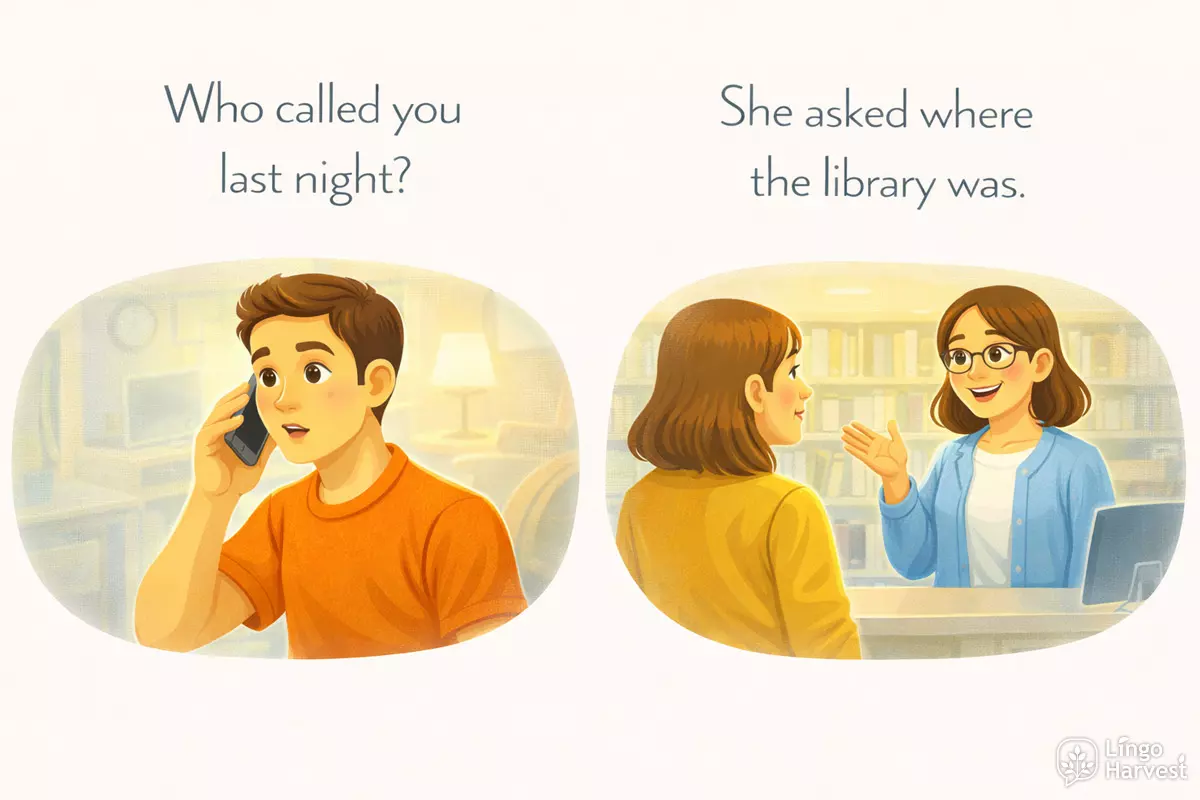
When the question word itself is the subject of the sentence, there is no need to invert the subject and auxiliary. The word order remains the same as in a statement:
- Who called you last night? → My sister called me.
- What happened here? → There was an accident.
- Which book belongs to Sarah? → The blue one does.
- Who lives next door? → A young couple lives there.
- What caused the delay? → Heavy traffic caused it.
Notice that in these examples, the question word (who, what, which) is performing the action, so no inversion is necessary.
Embedded or Indirect Questions
In reported or embedded questions, the normal statement order is preserved, even though a question is being asked indirectly. These often follow verbs like “ask,” “wonder,” or “know.” Examples include:
- She asked where the library was. → She wanted directions.
- I wonder why he left early. → I don’t know the reason.
- Do you know if they are coming? → I’m not sure yet.
- Tell me what time the train arrives. → It arrives at 6:30.
- He asked who was responsible. → He wanted to find the person.
The auxiliary remains after the subject, just as in a regular statement.
Questions with Modal Verbs and Main Verb "Be"
Sometimes, when the main verb is “be” and no auxiliary is present, inversion is not used in certain informal or regional varieties, but standard English generally still requires inversion. However, when “be” acts as a linking verb and is the main verb, direct questions still invert. This can cause confusion, so it’s worth noting the pattern.
Other Patterns Without Subject-Auxiliary Switch
There are additional cases where the typical question order is not applied. Here are some common patterns:
- Echo questions: “You saw what?”
- Tag questions: “You’re coming, aren’t you?”
- Rhetorical questions: “Who cares?”
- Requests for repetition: “You said who?”
- Exclamatory questions: “What a night that was!”
- Short questions after statements: “He did what?”
- Questions with “how about”: “How about we meet tomorrow?”
- “Let’s” suggestions: “Shall we go?” (note: “shall we” is an exception, but “let’s go, shall we?” is a tag question, no inversion in the statement part)
- Multiple choice alternatives: “Coffee or tea?”
- Polite offers: “Another cup?”
- Direct address: “John, you’re ready?”
Direct Comparison: Inversion vs. No Inversion
To clarify the difference, here’s a comparison of typical question forms where inversion is and is not used:
| With Inversion | Without Inversion |
|---|---|
| Did you see the movie? | Who saw the movie? |
| Where are they going? | I wonder where they are going. |
| Is she coming? | She asked if she is coming. |
| Has he finished? | Who has finished? |
| Can you help? | You can help? |
In summary, not every English question requires the typical subject-auxiliary swap. Paying attention to the question type and function will help you choose the correct word order and sound more natural in conversation.
Exceptions and Special Structures
While most English questions follow predictable subject-auxiliary inversion patterns, several notable outliers and unique constructions exist. These cases often puzzle learners because they break with standard expectations or involve special word order rules. Understanding these exceptions is crucial for mastering natural question formation.
Questions Without Inversion
Not every interrogative sentence in English uses inversion. Some structures keep the subject before the verb, even when posing a question:
- Subject questions: When the question word is the subject, no inversion occurs.
Who called you? (not Who did call you?) - Embedded/Indirect questions: In reported speech or embedded clauses, the standard word order is retained.
Can you tell me where she lives? - Echo questions: Used to confirm or clarify, these often repeat the original word order.
You went where?
Inversion Without Auxiliary Verbs
In some cases, inversion happens without the use of a typical auxiliary like do or be. This pattern is most common with the verb be itself and modal verbs:
- Are you ready?
- Can she swim?
- Will it rain?
Negative and Limiting Adverbials Triggering Inversion
Certain negative or restrictive adverbs at the beginning of a sentence can prompt inversion, even outside questions. Examples include never, rarely, only then, and under no circumstances:
- Never have I seen such chaos.
- Only then did he understand.
- Under no circumstances should you open the door.
Tag Questions and Short Responses
Question tags and brief answers use unique inversion rules. Tag questions invert the auxiliary and subject, while short answers typically omit the main verb:
- You're coming, aren't you?
- Yes, I am.
- No, he didn't.
Summary of Inversion Patterns in Special Cases
| Structure | Example |
|---|---|
| Subject question (no inversion) | Who broke the vase? |
| Indirect question (no inversion) | I wonder what time it is. |
| Negative adverbial inversion | Rarely do we see such skill. |
| Question tag | She left early, didn't she? |
| Modal inversion | Could you help me? |
Other Irregular Patterns
Some idiomatic and archaic forms, such as So do I or Long live the King!, also display non-standard inversion. While rare in everyday speech, these forms still appear in literary, formal, or fixed expressions.
- So do we.
- Neither did he.
- Here comes the bus.
- Long may she reign!
Common Word Order Errors
Mastering the right sequence of words in English questions is a challenge for many learners. Mistakes often happen because the word order in questions is different from that in statements. These errors can make questions sound unnatural or confusing. Below, you'll find an overview of the most frequent issues, why they occur, and how to avoid them.
Typical Mistakes in Question Structure
- Forgetting to invert the subject and auxiliary verb (He is coming? instead of Is he coming?).
- Placing the subject before the main verb without an auxiliary (You like pizza? instead of Do you like pizza?).
- Using double auxiliaries (Do did you see him? instead of Did you see him?).
- Leaving out the auxiliary in present simple or past simple questions (She play tennis? instead of Does she play tennis?).
- Incorrect order in negative questions (Not does he understand? instead of Doesn't he understand?).
- Adding unnecessary inversion in embedded questions (Can you tell me where is the station? instead of where the station is).
- Omitting subject-verb inversion in yes/no questions (She is your friend? instead of Is she your friend?).
- Mistakes with question words: placing them incorrectly (What you are doing? instead of What are you doing?).
- Overusing inversion in indirect questions (I wonder where does he live instead of where he lives).
- Incorrectly using inversion after "who" or "what" as the subject (Who does come? instead of Who comes?).
- Mixing up word order in tag questions (You’re coming, isn’t it? instead of aren't you?).
- Confusing question word order with statement order in reported speech (She asked what did I want instead of what I wanted).
- Using statement order after inversion triggers (Never I have seen... instead of Never have I seen...).
- Forgetting inversion after negative adverbials (Seldom I go... instead of Seldom do I go...).
Inversion Patterns: Question vs. Statement
It’s helpful to compare how word order shifts between regular statements and different question types. The table below shows common transformations that often cause confusion.
| Statement | Correct Question Form |
|---|---|
| She is coming. | Is she coming? |
| You like coffee. | Do you like coffee? |
| They went to the park. | Did they go to the park? |
| He can swim. | Can he swim? |
| She has finished. | Has she finished? |
| John saw Mary. | Did John see Mary? |
Special Cases and Exceptions
- Embedded/indirect questions do not use inversion (Can you tell me where he lives? ✅).
- Question words as subjects keep normal order (Who called you? not Who did call you?).
- Negative adverbials at the start trigger inversion (Rarely have I seen...).
- Tag questions invert the auxiliary and subject (She’s here, isn’t she?).
Understanding these frequent pitfalls—and knowing when to apply or avoid inversion—can significantly improve clarity and accuracy in English questions. Practice and careful attention to these patterns will help you form natural-sounding questions and avoid the most common traps.
Practice Exercises and Self-Check
Understanding how to use subject-auxiliary inversion is crucial for forming questions in English. Try these exercises to check your grasp of both the standard rules and common exceptions. You’ll find a variety of tasks: rewriting statements as questions, spotting errors, and matching sentences to their correct forms.
Transform Statements into Questions
Rewrite each statement as a grammatically correct question. Pay attention to word order and auxiliary usage.
- She is coming to the party.
- You have finished your homework.
- They can speak French fluently.
- John went to Spain last year.
- The meeting will start at noon.
- We are waiting for the results.
- He has already sent the email.
- The children were playing outside.
- You understand the instructions.
- She should call him later.
Show answers
- Is she coming to the party?
- Have you finished your homework?
- Can they speak French fluently?
- Did John go to Spain last year?
- Will the meeting start at noon?
- Are we waiting for the results?
- Has he already sent the email?
- Were the children playing outside?
- Do you understand the instructions?
- Should she call him later?
Identify the Error
Each sentence below contains an error related to inversion in English questions. Find the mistake and correct it.
- Why you are late?
- Did saw you the movie?
- Where he goes every morning?
- Has went she home?
- What you are doing?
- Does work he here?
- Can speaks she English?
- When they will arrive?
- Did finished you the task?
- Is raining it outside?
Show answers
- Why are you late?
- Did you see the movie?
- Where does he go every morning?
- Has she gone home?
- What are you doing?
- Does he work here?
- Can she speak English?
- When will they arrive?
- Did you finish the task?
- Is it raining outside?
Recognizing Exceptions: When Not to Invert
Some question words do not require inversion, especially when they function as the subject. Decide whether inversion is needed in these sentences. If not, leave them as they are; if yes, rewrite them.
- Who won the match?
- Which book is best?
- What caused the problem?
- Where did she go?
- Who did you see?
- Which student arrived first?
- What did he break?
- Who called you last night?
- Where does she work?
- What happened after the meeting?
Show answers
- No change needed. ("Who won the match?" — "Who" is the subject.)
- No change needed. ("Which book is best?" — "Which book" is the subject.)
- No change needed. ("What caused the problem?" — "What" is the subject.)
- Already correct. ("Where did she go?" — inversion needed with "did".)
- Already correct. ("Who did you see?" — inversion needed with "did".)
- No change needed. ("Which student arrived first?" — "Which student" is the subject.)
- Already correct. ("What did he break?" — inversion needed with "did".)
- No change needed. ("Who called you last night?" — "Who" is the subject.)
- Already correct. ("Where does she work?" — inversion needed with "does".)
- No change needed. ("What happened after the meeting?" — "What" is the subject.)
Compare Standard and Exception Patterns
See how inversion applies differently depending on the question structure. Study the table below to reinforce the difference between typical auxiliary inversion and subject questions (no inversion).
| Statement | Question Form |
|---|---|
| You are coming. | Are you coming? |
| She left early. | Did she leave early? |
| Someone called. | Who called? |
| They can swim. | Can they swim? |
| Something broke the window. | What broke the window? |
Quick Self-Check: Spot the Correct Question
Choose the correctly formed question for each statement below:
- They will arrive soon.
- a) Will they arrive soon?
- b) They will arrive soon?
- Anna finished her project.
- a) Did Anna finish her project?
- b) Finished Anna her project?
- Someone answered the phone.
- a) Who answered the phone?
- b) Who did answer the phone?
- She is working late tonight.
- a) Is she working late tonight?
- b) She is working late tonight?
- He goes to the gym every morning.
- a) Does he go to the gym every morning?
- b) Goes he to the gym every morning?
- You have finished the report.
- a) Have you finished the report?
- b) You have finished the report?
- They can swim well.
- a) Can they swim well?
- b) Do they can swim well?
- John went to Spain last year.
- a) Did John go to Spain last year?
- b) Went John to Spain last year?
- Someone broke the window.
- a) Who broke the window?
- b) Who did break the window?
- She is going to call you later.
- a) Is she going to call you later?
- b) Does she going to call you later?
Show answers
- 1: a) Will they arrive soon?
- 2: a) Did Anna finish her project?
- 3: a) Who answered the phone?
- 4: a) Is she working late tonight?
- 5: a) Does he go to the gym every morning?
- 6: a) Have you finished the report?
- 7: a) Can they swim well?
- 8: a) Did John go to Spain last year?
- 9: a) Who broke the window?
- 10: a) Is she going to call you later?
Use these activities to sharpen your sense for when English questions require inversion and when they don’t. Regular practice with a variety of examples will help you internalize these patterns and exceptions.