End-Weight and End-Focus: Structuring Sentences for Clarity

 Here we end-weight and end-focus principles, reasons for placing heavy information at sentence ends, balancing subject and predicate length, managing focus in long sentences, using pronouns and given information, and practicing sentence order adjustment.
Arranging information within sentences plays a crucial role in achieving clarity, as placing the most significant or complex details at the end allows readers to process ideas more effectively. By strategically positioning heavier elements last, writers can highlight key points and maintain the reader’s attention throughout the sentence. This method not only enhances comprehension but also aids memory retention, particularly when dealing with intricate or nuanced subjects. Ultimately, thoughtful sentence structure is essential for clear and impactful communication.
Principles of end-weight and end-focus
Effective sentence construction often relies on placing information in the most natural and reader-friendly order. Two core ideas that guide this process are “end-weight” and “end-focus.” These concepts help writers manage how sentences flow, where emphasis lands, and how easily readers can process complex information.
Understanding End-Weight
End-weight is the tendency to position longer, more complex elements toward the end of a sentence. This approach allows the subject and core verb to appear earlier, making the sentence feel balanced and easier to follow. Short, familiar elements up front reduce cognitive load, while heavier phrases or subordinate clauses are shifted to the end.
- Place short subjects before longer predicates whenever possible.
- Move prepositional phrases or relative clauses to the sentence’s end.
- Avoid stacking multiple modifiers before the verb.
- Restructure sentences when a lengthy subject disrupts flow.
- Break up very heavy clauses into separate sentences if clarity suffers.
Applying End-Focus
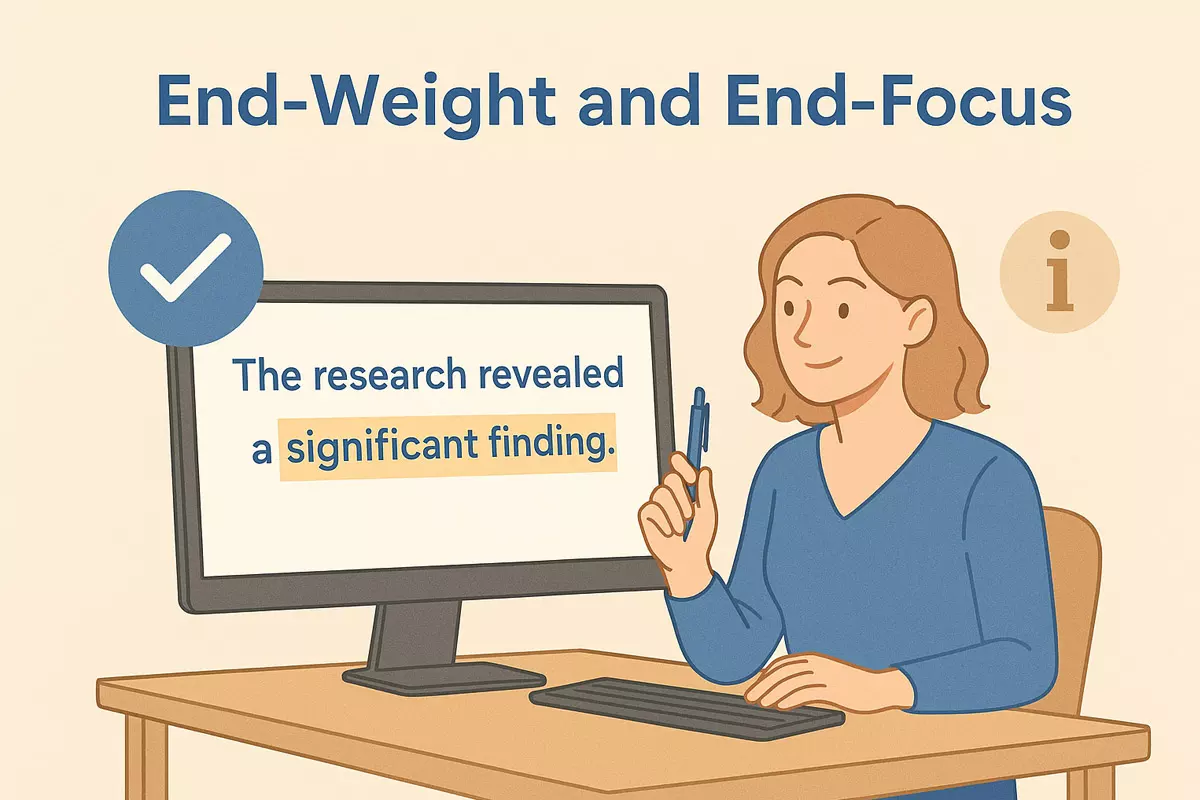
End-focus refers to giving the most important or new information the final position in a sentence. This technique guides the reader’s attention and ensures that key details resonate. It often overlaps with end-weight, but the goal is to create a sense of conclusion or highlight a punchline.
- Reserve the sentence end for new or contrastive information.
- Shift known or background details to the start or middle.
- Use cleft sentences (“It was...” or “What...was...”) for contrast or emphasis.
- Take advantage of passive voice when it moves the focus element to the end.
- Rearrange adverbials or time phrases to avoid burying the main point.
Examples: Rearranging for Clarity

| Before (Less Effective) | After (Improved Structure) |
|---|---|
| To the committee, the proposal for restructuring the entire organization was presented by the manager. | The manager presented the proposal for restructuring the entire organization to the committee. |
| In the garden, a small bird with bright blue feathers that had just migrated from the north was spotted by the children. | The children spotted a small bird with bright blue feathers that had just migrated from the north in the garden. |
| That she would win the competition surprised everyone. | Everyone was surprised that she would win the competition. |
| What the committee failed to consider was the impact on local businesses. | The impact on local businesses was what the committee failed to consider. |
| Reading complex instructions quickly can be difficult for some people. | Some people can find it difficult to quickly read complex instructions. |
When to Prioritize End-Weight or End-Focus
- Use end-weight when the subject is longer than the predicate.
- Favor end-focus when the conclusion or final word carries the main message.
- Combine both for clarity when introducing complex or unfamiliar ideas.
- Be mindful of style; don’t force these patterns if they sound unnatural.
By thoughtfully arranging sentence elements, writers can enhance clarity, highlight what matters, and make their prose smoother for readers. Balancing these two strategies is a practical way to improve both academic and everyday communication.
Why heavy information often moves to the end
Placing complex or detailed material later in a sentence helps readers process ideas more easily. When a sentence begins with lighter, familiar elements, it sets up a clear structure, making it easier for the audience to absorb new or challenging details that follow. This approach aligns with how we naturally parse language: we prefer to start with what’s known and digest new information afterward.
Processing and Readability
Starting with simple subjects or short phrases allows the reader to get their bearings before encountering more substantial content. This “end-weight” strategy reduces cognitive load, as the mind is not immediately taxed with dense or technical language. For example:
- Simple start: The committee approved the new policy after extensive debate and careful consideration of all possible objections.
- Heavy start (less natural): After extensive debate and careful consideration of all possible objections, the committee approved the new policy.
The first sentence flows more naturally because the heavier material comes at the end, allowing the reader to follow the main action before processing the details.
Information Flow and Emphasis
Ending with the most substantial or unexpected information gives it greater emphasis. This technique draws attention to the new or important material, ensuring it stands out. Consider these examples:
- She finally revealed the results of the year-long investigation.
- We need to address several complex logistical challenges before launching the project.
- The report includes data from over 1,000 participants collected across five countries.
Common Patterns for Placing Heavy Elements Last
Writers often delay these elements for clarity and rhythm:
- Long noun phrases (e.g., “the newly renovated, state-of-the-art community center”)
- Relative clauses (“who had been working tirelessly for months”)
- Prepositional phrases (“in the middle of the crowded marketplace”)
- Infinitive phrases (“to improve overall efficiency and reduce costs”)
- Subordinate clauses (“although the outcome remained uncertain”)
- Lists or enumerations (“including laptops, tablets, and mobile phones”)
- Quotations or reported speech (“that the policy would be revised”)
- Parenthetical remarks (“as many experts have noted”)
- Appositive phrases (“a renowned scientist and Nobel laureate”)
- Extended modifiers (“designed to withstand extreme weather conditions”)
- Participial phrases (“having completed the preliminary analysis”)
- Complex adverbials (“with greater accuracy than ever before”)
- Statistical details (“at a rate of 35% per annum”)
- Conditional phrases (“if resources become available”)
- Comparative structures (“than any previous attempt”)
Summary of Benefits
Organizing sentences so that more demanding information comes at the end improves clarity, highlights the most important points, and mirrors the way readers naturally process language. This method not only streamlines comprehension but also enhances the impact of your message.
Balancing subject and predicate length
When constructing sentences, the relationship between the subject (who or what the sentence is about) and the predicate (what is said about the subject) plays a major role in readability. If one part is much longer than the other, the sentence may feel awkward or difficult to process. Keeping these elements in proportion helps maintain clarity and flow.
Why proportion matters
Long, complex subjects paired with short predicates can overwhelm readers before the sentence's point is clear. Conversely, a brief subject followed by an overly lengthy predicate may force readers to hold information in memory for too long. Both scenarios disrupt the natural rhythm and focus of a sentence.
Common pitfalls in sentence construction
- Starting with a detailed subject and ending abruptly
- Placing heavy informational loads at the beginning or end
- Using multiple clauses within the subject or predicate
- Failing to signal the main action until late in the sentence
- Overusing modifiers before the main verb
- Neglecting to balance information between both parts
- Letting the predicate become a string of loosely related ideas
- Forgetting the reader’s need for manageable chunks of information
- Using passive voice that stretches the predicate unnecessarily
- Combining unrelated actions or details in one sentence
Effective strategies
To achieve harmony between these sentence components, consider the following approaches:
- Keep the subject concise unless essential context is required.
- Position longer, more complex information toward the end (end-weight principle).
- Break up sentences when both elements are lengthy.
- Use introductory phrases to set context, then follow with a direct subject and predicate.
- Favor active voice for directness and clarity.
- Check for sentence balance by reading aloud—awkward pauses often signal imbalance.
Examples: Balanced vs. Imbalanced Sentences
| Imbalanced Example | Improved Balance |
|---|---|
| The recent proposal submitted by the committee after weeks of deliberation and consultation with various stakeholders was rejected. | The committee’s recent proposal, submitted after weeks of deliberation, was rejected by the board. |
| The manager explained the reasons for the changes that were being implemented across all departments to improve efficiency and communication. | To improve efficiency and communication, the manager explained the reasons for the changes being implemented across all departments. |
| The decision to postpone the event due to unforeseen circumstances and scheduling conflicts was announced yesterday. | Yesterday, organizers announced the decision to postpone the event due to unforeseen circumstances and scheduling conflicts. |
| The complex issue regarding the allocation of resources among multiple teams with differing priorities remains unresolved. | The issue of resource allocation among teams with differing priorities remains unresolved. |
Managing focus within long sentences
When sentences stretch out, keeping the reader’s attention on the intended main point becomes a challenge. Clarity can easily be lost if important information is buried or if multiple ideas compete for prominence. To maintain coherence, writers often rely on the principles of end-weight and end-focus—placing new or significant information toward the end of the clause, while background or familiar information appears earlier.
Strategies for Emphasizing the Right Information
- Front-load context: Begin with familiar details or background to set the stage for the main message.
- Delay complex information: Keep heavier, more detailed elements at the end to preserve flow and emphasis.
- Use punctuation wisely: Semicolons, dashes, and parentheses can help structure longer sentences and highlight key points.
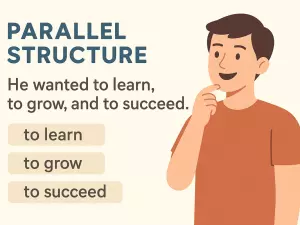
- Employ parallelism: When listing or comparing, parallel structure makes the sentence easier to follow.
- Break up ideas: If a sentence grows unwieldy, consider splitting it, but only if it doesn’t disrupt the intended focus.
- Choose main verbs carefully: The main verb can help anchor the reader’s attention; avoid burying it among modifiers.
- Reserve the sentence-final position: Place new, surprising, or significant information last for maximum impact.
- Avoid excessive embedding: Too many clauses or parenthetical elements dilute the main point.
- Signal shifts: Use transition words or phrases to guide the reader through changes in focus.
- Check for ambiguity: Read the sentence aloud to ensure the emphasis lands where intended.
Common Patterns: Shifting Focus with Structure
Let’s look at how rearranging elements can change what stands out in a lengthy sentence. Consider the following transformations:
- Placing the subject early and the new information late: The committee, after months of deliberation and consultation with experts, finally reached a decision.
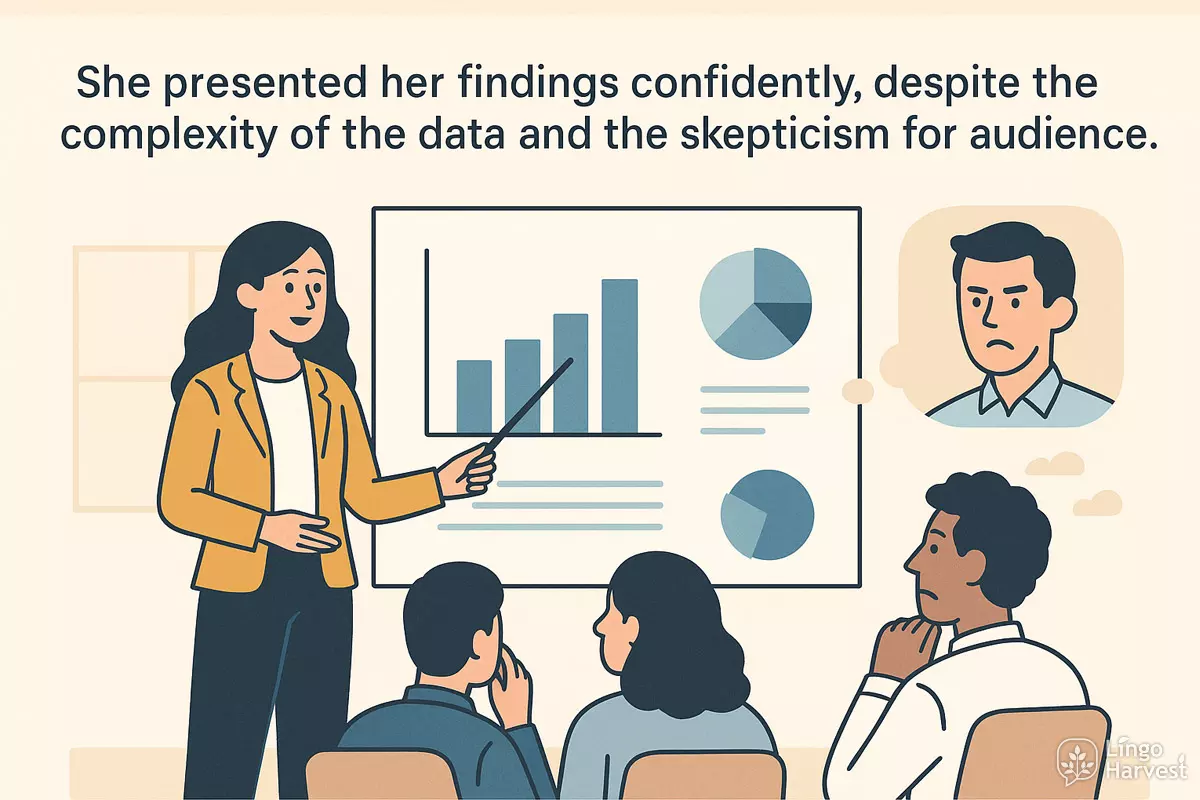
- Moving heavy modifiers to the end: She presented her findings confidently, despite the complexity of the data and the skepticism of her audience.
- Using introductory clauses for background: Although the weather was unpredictable and the team was exhausted, they completed the project on time.
Comparison: Weak vs. Strong Focus in Sentence Structure
| Weak Focus | Improved Focus |
|---|---|
| Despite the complexity of the data and the skepticism of her audience, she presented her findings confidently. | She presented her findings confidently, despite the complexity of the data and the skepticism of her audience. |
| The proposal was rejected by the board, which had met for several hours and considered multiple alternatives, because it lacked sufficient evidence. | Because it lacked sufficient evidence, the board—which had met for several hours and considered multiple alternatives—rejected the proposal. |
| After months of deliberation and consultation with experts, a decision was finally reached by the committee. | The committee, after months of deliberation and consultation with experts, finally reached a decision. |
| The equipment, which was expensive and difficult to transport, was essential to the experiment. | Essential to the experiment was the equipment, which was expensive and difficult to transport. |
Balancing sentence length and focus isn’t just about trimming words. It’s about guiding the reader’s eye to what matters most, using syntactic tools and thoughtful ordering. By practicing these techniques, you can ensure that even your most elaborate sentences remain clear and purposeful.
Interaction with pronouns and given information
How sentences are structured greatly affects how easily readers process pronouns and recall previously mentioned ideas. Placing familiar or "given" information at the start of a sentence and reserving the end for new or important details helps maintain clarity. This order not only supports natural reading patterns but also aligns with the principles of end-weight and end-focus, making texts more comprehensible.
Pronouns and Reference Clarity
Pronouns like "he," "she," "it," or "they" rely on clear antecedents, which are usually established earlier in a paragraph or conversation. When writers introduce new information at the end of a sentence, it becomes easier for readers to connect pronouns in following sentences to their correct referents. Conversely, placing new information at the beginning can create ambiguity, especially if multiple possible antecedents are present.
- He arrived late. (Who is "he"? The previous sentence should clarify.)
- The package was delayed, which surprised everyone. ("Which" refers to the delay, not the package.)
- After the meeting, Susan shared her notes. They were detailed and helpful. ("They" clearly refers to "notes.")
- The company launched two products. The first was a success; the second failed to impress. (Anaphoric reference is easy to follow.)
- John called Mike after he finished his report. (Ambiguous: Who finished the report?)
- If the new manager arrives, tell her the schedule. ("Her" is easily linked to "manager.")
- The city council approved the proposal, but it faced criticism. ("It" refers to "proposal.")
- The experiment produced unexpected results. These findings will guide future research. ("These" refers to "results.")
- The students completed the assignment. Their work was impressive. ("Their" is linked to "students.")
- The car wouldn't start, which frustrated Tom. ("Which" refers to the car not starting.)
Given vs. New Information: Structuring for Readability
Starting with what readers already know and ending with what is new helps manage cognitive load and sets up pronouns for clear reference. This approach also mirrors spoken language patterns, where speakers often begin with shared context before introducing new ideas. When new information appears at the end, it is naturally highlighted, and pronouns in subsequent sentences can refer back unambiguously.
Common Pitfalls and Solutions
Writers sometimes inadvertently create confusion by introducing new entities too early or using pronouns before their referents are established. To avoid this, ensure that:
- Each pronoun has a clear, recent antecedent.
- Given information precedes new details.
- Ambiguous references are reworded for clarity.
- Long, complex noun phrases appear at the end, not the beginning.
By thoughtfully arranging sentences—starting with familiar context and ending with new or complex information—writers can enhance clarity, especially in longer texts where multiple pronouns and references are used. This strategy not only supports end-weight and end-focus but also makes reading smoother and understanding easier.
Practice: adjust sentence order for better end-focus
Clear sentence structure often depends on where you place new or complex information. Shifting elements to the end of a sentence can emphasize important details and keep your writing concise. Let’s explore how reordering phrases and clauses can create a smoother, more impactful flow.
Exercise: Rearranging for Emphasis
Try adjusting the following sentences so that the most significant or complex information appears at the end. This helps readers naturally focus on the main message.
- The committee approved the new policy after a lengthy debate.
- The heavy rain caused delays for commuters traveling home during rush hour.
- She discovered, hidden in the attic, a collection of rare coins from the 19th century.
- We found the solution to the problem after several unsuccessful attempts.
- The company announced a new remote work policy for employees yesterday.
- The researchers published their findings in a well-known scientific journal.
- A strange noise woke us up in the middle of the night.
- They introduced a new training program to improve employee performance.
- The museum displayed a rare painting that had been restored recently.
- She completed the assignment despite having very little time.
Show answers
- After a lengthy debate, the committee approved the new policy.
- Delays for commuters traveling home during rush hour were caused by the heavy rain.
- In the attic, she discovered a collection of rare coins from the 19th century, hidden away.
- After several unsuccessful attempts, we found the solution to the problem.
- Yesterday, the company announced a new remote work policy for employees.
- In a well-known scientific journal, the researchers published their findings.
- In the middle of the night, a strange noise woke us up.
- To improve employee performance, they introduced a new training program.
- Recently, the museum displayed a rare restored painting.
- Despite having very little time, she completed the assignment.
Common Patterns for Achieving End-Focus
Writers often use certain structures to place important information last. Here are some practical patterns to experiment with:
- Moving adverbial phrases to the beginning: “In 2023, major changes were introduced.”
- Shifting subordinate clauses: “Because of the shortage, prices increased.”
- Using passive voice: “The award was won by the youngest participant.”
- Introducing details at the end: “She bought a house in the countryside.”
- Adding relative clauses after the main statement: “They hired the engineer who designed the bridge.”
- Placing explanations or results last: “The machine malfunctioned, which caused delays.”
- Saving lists or complex objects for the end: “He brought with him books, maps, and tools.”
- Starting with old information, ending with new: “This theory, previously overlooked, is now widely accepted.”
- Using parenthetical insertions: “The meeting, which lasted for hours, finally ended.”
- Deferring crucial details: “The main reason for the cancellation was the weather.”
Self-Check: Spot the End-Focus
Below are several sentence pairs. Choose which version places the focus at the end.
| Version A | Version B |
|---|---|
| The results surprised everyone who attended the conference. | Everyone who attended the conference was surprised by the results. |
| We will discuss the new proposal at the end of the meeting. | At the end of the meeting, we will discuss the new proposal. |
| Several important issues were raised during the presentation. | During the presentation, several important issues were raised. |
| The new software increased productivity in the department. | Productivity in the department was increased by the new software. |
| The author published a novel after years of research. | After years of research, the author published a novel. |
Show answers
- Version B: “Everyone who attended the conference was surprised by the results.”
- Version B: “At the end of the meeting, we will discuss the new proposal.”
- Version A: “Several important issues were raised during the presentation.”
- Version D: “Productivity in the department was increased by the new software.”
- Version B: “After years of research, the author published a novel.”
By practicing these adjustments, you’ll develop an instinct for placing emphasis where it matters most, leading to writing that is both clearer and more persuasive.