Advanced Inversion in Conditional Clauses for Formal Style

 This article explains using inversion instead of if-clauses in English conditionals. It covers patterns with had, were, and should, formality and rhetorical effects, tense and subject restrictions, common errors, and practice exercises.
Rearranging word order in if-clauses is a valuable skill that can enhance your writing by adding variety and refinement, particularly in formal contexts. By mastering this technique, you can create sentences that are both engaging and polished, allowing your ideas to stand out with greater clarity and emphasis. This approach not only demonstrates a strong command of grammar but also contributes to a more sophisticated and professional writing style, making your communication more effective and appealing to discerning readers.
Inversion as an alternative to if-clauses
Formal English often allows us to replace standard conditional sentences with an inverted structure, omitting "if" entirely. This approach is especially common in academic, legal, or literary contexts where conciseness and stylistic variety are valued. By inverting the subject and auxiliary verb, writers can create a more sophisticated tone and emphasize the conditional nature of the statement.
How inversion works in conditional sentences
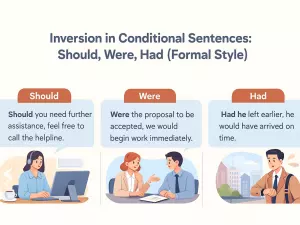
Instead of starting with "if," the sentence begins with an auxiliary verb (such as "had," "should," or "were"), followed by the subject. This pattern is most frequently used with three types of conditionals: third, second, and, to a lesser extent, first conditionals. The structure helps to foreground the hypothetical or unlikely aspect of the situation.
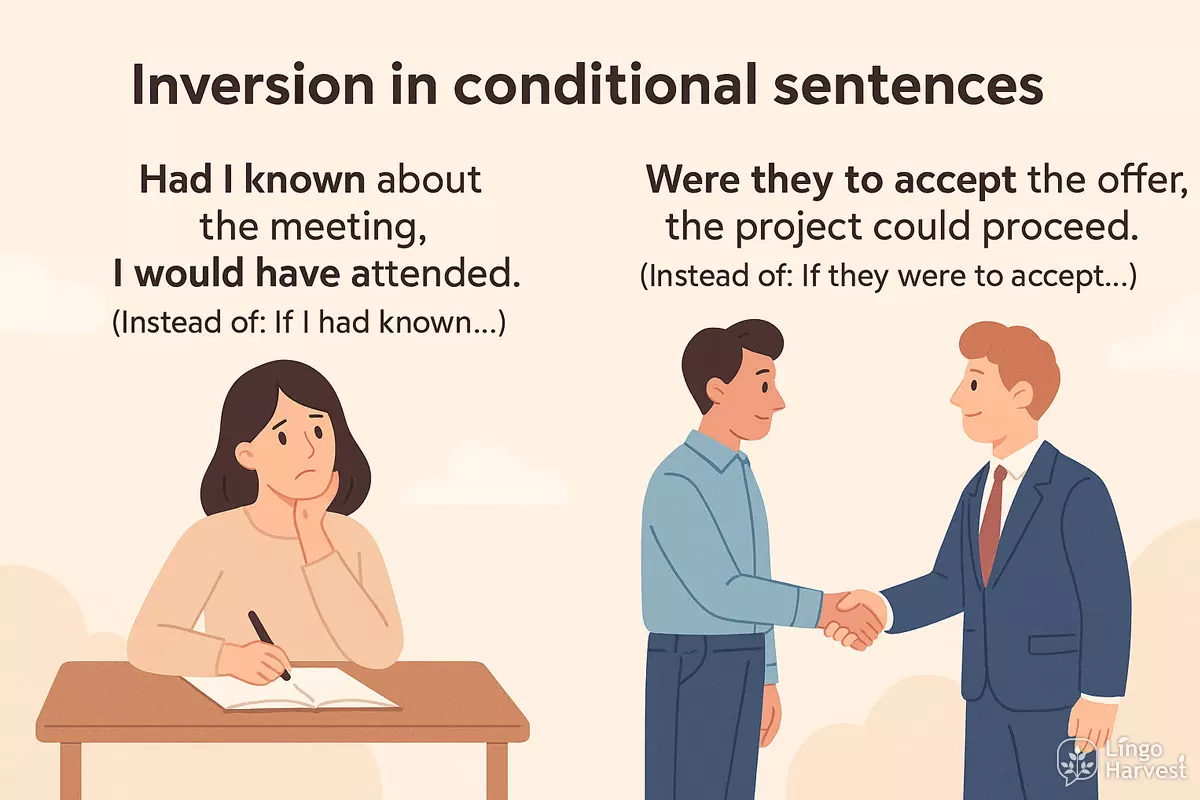
- Had I known about the meeting, I would have attended. (Instead of: If I had known...)
- Were they to accept the offer, the project could proceed. (Instead of: If they were to accept...)
- Should you require further assistance, please contact us. (Instead of: If you should require...)
- Had he realized the risks, he might have reconsidered.
- Were it not for her support, the plan would have failed.
- Should the need arise, the protocol will be updated.
- Had they left earlier, they would have arrived on time.
- Were I in your position, I would make the same choice.
- Should the weather improve, the event will go ahead.
- Had we been informed in advance, preparations could have been made.
- Were it not raining, we could play outside.
- Should this proposal fail, alternatives will be considered.
- Had you seen the announcement, you would understand the changes.
- Were the circumstances different, the outcome might change.
- Should any questions arise, do not hesitate to ask.
Comparing standard and inverted conditional forms
To clarify the differences, see how traditional "if"-clauses and their inverted equivalents align in usage and structure:
| Standard Conditional | Inverted Structure |
|---|---|
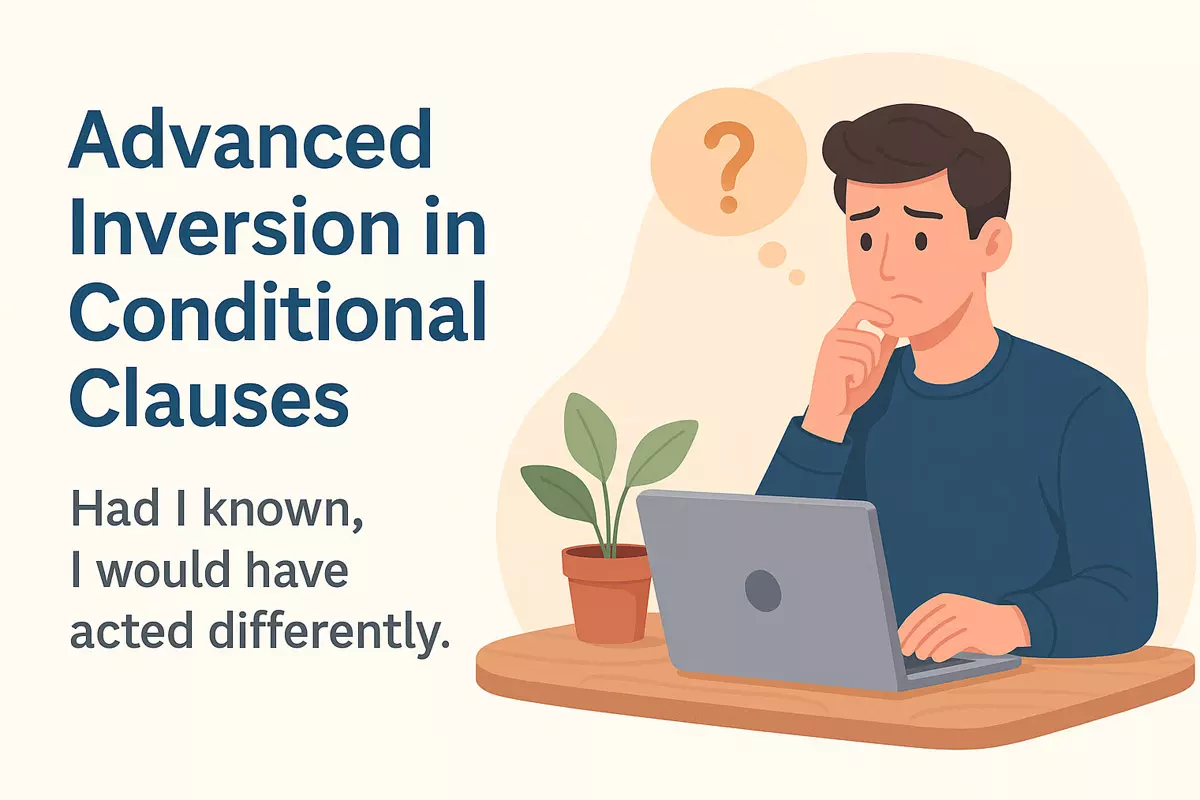
| If I had known, I would have acted differently. | Had I known, I would have acted differently. |
| If she were present, the meeting would begin. | Were she present, the meeting would begin. |
| If you should need help, call this number. | Should you need help, call this number. |
| If they had arrived earlier, we would have started. | Had they arrived earlier, we would have started. |
| If it were not for his advice, I would be lost. | Were it not for his advice, I would be lost. |
Usage notes and stylistic effects
Using inversion in place of "if"-clauses imparts a more formal or literary tone. It is rarely used in everyday conversation but is appreciated in written English for its elegance and efficiency. However, care should be taken to use inversion where it is idiomatic; forcing it in informal contexts may sound unnatural. This technique can also help avoid repetitive sentence structures in academic or official documents.
Patterns with had, were, and should
In formal written English, especially in academic or legal contexts, it’s common to see conditional clauses that use inversion with the verbs “had,” “were,” and “should.” This structure is primarily used for emphasis and to add a sophisticated tone, often replacing the typical “if” clause. Instead of starting the clause with “if,” the auxiliary verb is placed before the subject, creating a more formal style.
How Inversion Works in Formal Conditionals
When crafting these types of sentences, “if” is omitted and the auxiliary verb (had, were, or should) moves to the front. This is mostly used in third, second, and first conditional sentences, respectively. Such forms enhance the elegance and precision of the statement.
- Had I known about the meeting, I would have attended. (Instead of “If I had known…”)
- Were she to arrive early, she would join us for dinner. (Instead of “If she were to arrive…”)
- Should you need further information, please contact us. (Instead of “If you should need…”)
Common Inverted Conditional Structures
The following list provides a variety of examples illustrating each verb’s use in conditional inversion. Notice how these forms often sound more polished and are typical in written or very formal spoken English:
- Had I seen the warning, I would have acted differently.
- Had they realized the risk, they might have reconsidered.
- Had you asked, I could have helped.
- Were I in your position, I would choose otherwise.
- Were it not for his advice, the project would have failed.
- Were they invited, they would certainly attend.
- Should any problems arise, let me know immediately.
- Should you wish to cancel, inform us before noon.
- Should the need occur, backup plans are ready.
- Had the team prepared better, success would have followed.
- Were the circumstances different, the outcome might change.
- Should you have any questions, feel free to ask.
- Had it not rained, we would have gone hiking.
- Were the rules less strict, participation would increase.
- Should a vacancy arise, applications will reopen.
- Had she known the answer, she would have responded.
- Were I to try again, I’d use a different approach.
- Should the weather improve, the match will continue.
Summary Table: Inversion vs. Standard Conditionals
| Standard Conditional | Inverted Formal Version |
|---|---|
| If I had known the answer, I would have told you. | Had I known the answer, I would have told you. |
| If she were here, she could explain it. | Were she here, she could explain it. |
| If you should require assistance, let us know. | Should you require assistance, let us know. |
| If it not been for your help, I would have failed. | Had it not been for your help, I would have failed. |
| If the weather were better, we would go outside. | Were the weather better, we would go outside. |
These advanced inversion forms are ideal for formal writing, allowing you to convey hypothetical or polite conditions while maintaining a refined, concise style. Practice recognizing and using them to elevate your formal English proficiency.
Formality and rhetorical effect in writing
Advanced inversion in conditional clauses is a hallmark of elevated written English, especially in academic, legal, or literary contexts. By inverting the subject and auxiliary verb—for example, "Had I known" instead of "If I had known"—writers achieve a more sophisticated tone and highlight the conditional nature of the statement. This construction is valued for its conciseness and its ability to foreground the consequence or result, rather than the condition itself.
Why use advanced inversion?
Writers may choose inversion in conditional clauses for several reasons. First, it adds a layer of formality, distancing the text from everyday conversational patterns. Second, it can create emphasis or draw the reader's attention to a hypothetical situation. Third, it often enhances the rhythm and flow of a sentence, contributing to the overall rhetorical impact.
Rhetorical effects of inversion
- Signals a deliberate, thoughtful style
- Increases perceived authority and credibility
- Allows for more varied sentence structure
- Highlights the hypothetical or contrary-to-fact nature
- Reduces repetition of "if" in complex writing
- Enables smoother transitions between ideas
- Can introduce suspense or drama in narrative or persuasive texts
- Facilitates parallelism in multi-clause sentences
- Helps avoid ambiguity in complex legal or technical prose
- Creates a sense of tradition or classical style, often found in formal speeches
Comparing standard and inverted conditionals
| Standard Conditional | Inverted Conditional |
|---|---|
| If he were here, he would help. | Were he here, he would help. |
| If you should need assistance, call me. | Should you need assistance, call me. |
| If I had known, I would have acted sooner. | Had I known, I would have acted sooner. |
| If it snowed tomorrow, school would be canceled. | Were it to snow tomorrow, school would be canceled. |
| If they had left earlier, they would have arrived on time. | Had they left earlier, they would have arrived on time. |
Restrictions on tense and subject types
When using advanced inversion in conditional clauses, not all verb tenses or subject types are compatible. The structure is typically limited to certain forms that align with formal written English and avoid ambiguity. Understanding these constraints helps writers maintain clarity and correctness.
Acceptable tenses in inverted conditionals
Inversion is most common with modal verbs or with the past perfect. Other tenses rarely work, and some are ungrammatical in this structure. For example, the present simple and past simple are generally avoided in inverted conditionals.
- Had + subject + past participle (for third conditional): Had she known, she would have acted.
- Should + subject + base verb (for first conditional with a formal twist): Should you require assistance, call this number.
- Were + subject + infinitive or adjective (for second conditional): Were he to arrive early, we would begin.
- Were + subject + noun/adjective: Were it necessary, we would postpone.
Limitations on subject types
Not every subject works naturally in inversion. Pronouns, proper nouns, and abstract nouns can all appear, but the construction is rarely used with complex noun phrases or heavy modifiers, as this can lead to awkwardness or confusion.
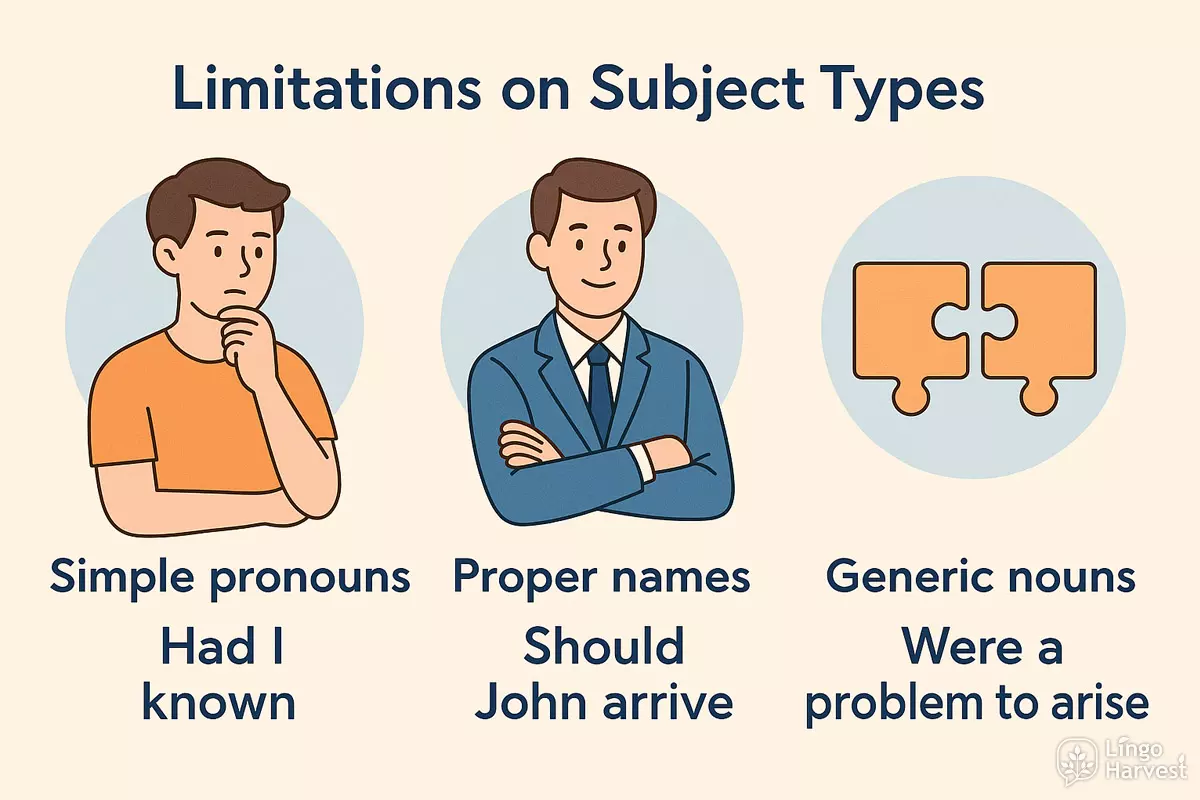
- Simple pronouns: Had I known
- Proper names: Should John arrive
- Generic nouns: Were a problem to arise
- Abstract subjects: Were it possible
- Dummy subject "it": Were it not for his help
Summary of compatible and incompatible forms
For a quick overview, here’s a comparison of what is and isn’t accepted in formal inversion in conditional statements:
| Allowed Forms ✅ | Not Used ❌ |
|---|---|
| Had + subject + past participle Should + subject + base verb Were + subject + infinitive/adjective Simple pronouns or names as subject |
Present simple inversion (e.g., *Do you see, call me) Past simple inversion (e.g., *Did he know, he would...) Complex noun phrases as subject Continuous or perfect continuous tenses |
| Dummy "it" as subject Abstract subjects Modal verbs with inversion |
Future simple inversion (e.g., *Will you need, let me know) Plural or coordinated subjects in awkward constructions |
Key patterns and examples
Writers often rely on a few core patterns when forming these clauses. Here are several that demonstrate the range and limits:
- Had I realized the risks, I would have acted differently.
- Should you wish to proceed, please sign below.
- Were they to agree, the project could start sooner.
- Were it not for her advice, we might have failed.
- Had the weather improved, the event would have continued.
- Should there be any questions, let us know.
- Were this the case, we would consider alternatives.
- Had John been present, the decision might have changed.
- Should the need arise, contact support.
- Were the offer more attractive, acceptance would be likely.
- Had circumstances permitted, travel would have resumed.
- Should further information become available, we will update.
- Were such a situation to occur, immediate action is required.
By keeping to these tense and subject parameters, advanced inversion in conditionals remains both correct and effective in formal contexts.
Typical learner difficulties with inversion
Many advanced students find the formal inversion structures in conditional clauses challenging for several reasons. The rules for subject-auxiliary inversion can differ from everyday English, and subtle points in meaning or register often trip up even experienced users. Below, we explore the most common sources of confusion and error, along with practical examples and tips.
Common challenges faced by learners
- Confusing when inversion is required versus optional.
- Incorrect auxiliary verb placement (e.g., putting the subject before the auxiliary).
- Omitting necessary auxiliaries such as should, had, or were in formal structures.
- Overusing inversion in informal contexts, which sounds unnatural.
- Forgetting to drop if when inversion is used.
- Problems with negative forms or question-like word order.
- Using inversion with the wrong verb tense.
- Misplacing adverbials or conditional markers.
- Transferring patterns from native language structures that don't fit English norms.
- Difficulty distinguishing between inversion in conditionals and other types (e.g., after so or nor).
Errors in form and meaning
One of the main pitfalls is confusing the structure of inverted conditionals with standard conditional sentences. For example, learners might write "Had he knew the answer, he would have helped" instead of the correct "Had he known the answer, he would have helped". The table below illustrates some typical mistakes and their corrected forms:
| Incorrect Form ❌ | Correct Inversion ✅ |
|---|---|
| If he would have arrived earlier, he could have joined us. | Had he arrived earlier, he could have joined us. |
| If you should need assistance, call me. | Should you need assistance, call me. |
| If I were you, I would apologize. | Were I you, I would apologize. |
| If she knew the answer, she would tell us. | Were she to know the answer, she would tell us. |
Register and appropriateness
Another area of difficulty lies in knowing when these advanced structures are suitable. Inversion in conditionals is generally reserved for formal writing, academic contexts, or formal speech. Using it in casual conversation may sound stilted or overly formal.
Summary of key difficulties
- Identifying situations where formal inversion is natural and appropriate.
- Remembering to invert the subject and auxiliary, not the main verb.
- Maintaining correct tense and aspect in the inverted clause.
- Ensuring the conditional meaning is preserved after changing the structure.
Mastering these inversion patterns takes practice, attention to detail, and awareness of both grammar and context.
Practice: convert standard conditionals into inverted forms
Understanding how to invert conditionals is essential for achieving a formal and polished writing style, especially in academic and professional contexts. This section provides practical exercises to help you convert typical "if" clauses into their more advanced inverted counterparts. By practicing these transformations, you’ll become more comfortable using these structures naturally in your own writing.
Common Patterns for Inversion
Before starting, review some frequent patterns used to invert conditional sentences:
- Should + subject + base verb (for future real conditionals)
- Were + subject + to + verb (for unreal or hypothetical present/future conditionals)
- Had + subject + past participle (for unreal past conditionals)
Task: Transform These Sentences
Try rewriting each conditional sentence using inversion. Focus on omitting "if" and starting with the auxiliary verb.
- If you need further assistance, please let us know.
- If he were to arrive early, we could begin the meeting sooner.
- If she had seen the sign, she would have turned left.
- If they decide to cancel the event, everyone will be notified.
- If the weather improves, we will go hiking.
- If you should require clarification, contact the department.
- If I had known about the delay, I would have taken a different route.
- If he were more diligent, he would achieve better results.
- If you should change your mind, inform us immediately.
- If we had started earlier, we would have finished by now.
Show answers
- Should you need further assistance, please let us know.
- Were he to arrive early, we could begin the meeting sooner.
- Had she seen the sign, she would have turned left.
- Should they decide to cancel the event, everyone will be notified.
- Should the weather improve, we will go hiking.
- Should you require clarification, contact the department.
- Had I known about the delay, I would have taken a different route.
- Were he more diligent, he would achieve better results.
- Should you change your mind, inform us immediately.
- Had we started earlier, we would have finished by now.
Quick Reference: Standard vs. Inverted Conditionals
Below is a comparison of common conditional forms and their inverted equivalents for easy reference.
| Standard Conditional | Inverted Conditional |
|---|---|
| If you should need help, call me. | Should you need help, call me. |
| If she were here, she would know the answer. | Were she here, she would know the answer. |
| If they had left earlier, they would have arrived on time. | Had they left earlier, they would have arrived on time. |
| If he were to ask, I would say yes. | Were he to ask, I would say yes. |
| If the opportunity arise, take it. | Should the opportunity arise, take it. |
| If you had told me, I could have helped. | Had you told me, I could have helped. |
| If we were to invest now, profits might increase. | Were we to invest now, profits might increase. |
| If she should call, let me know. | Should she call, let me know. |
| If I had known, I would have acted differently. | Had I known, I would have acted differently. |
| If you were more careful, mistakes would decrease. | Were you more careful, mistakes would decrease. |
Tips for Mastery
- Identify the verb tense and type of conditional before attempting inversion.
- Remove "if" and place the auxiliary verb before the subject.
- Practice with both real and unreal conditionals for fluency.
- Use inversion mainly in formal, written English.