Rhetorical Questions in English: Form and Function

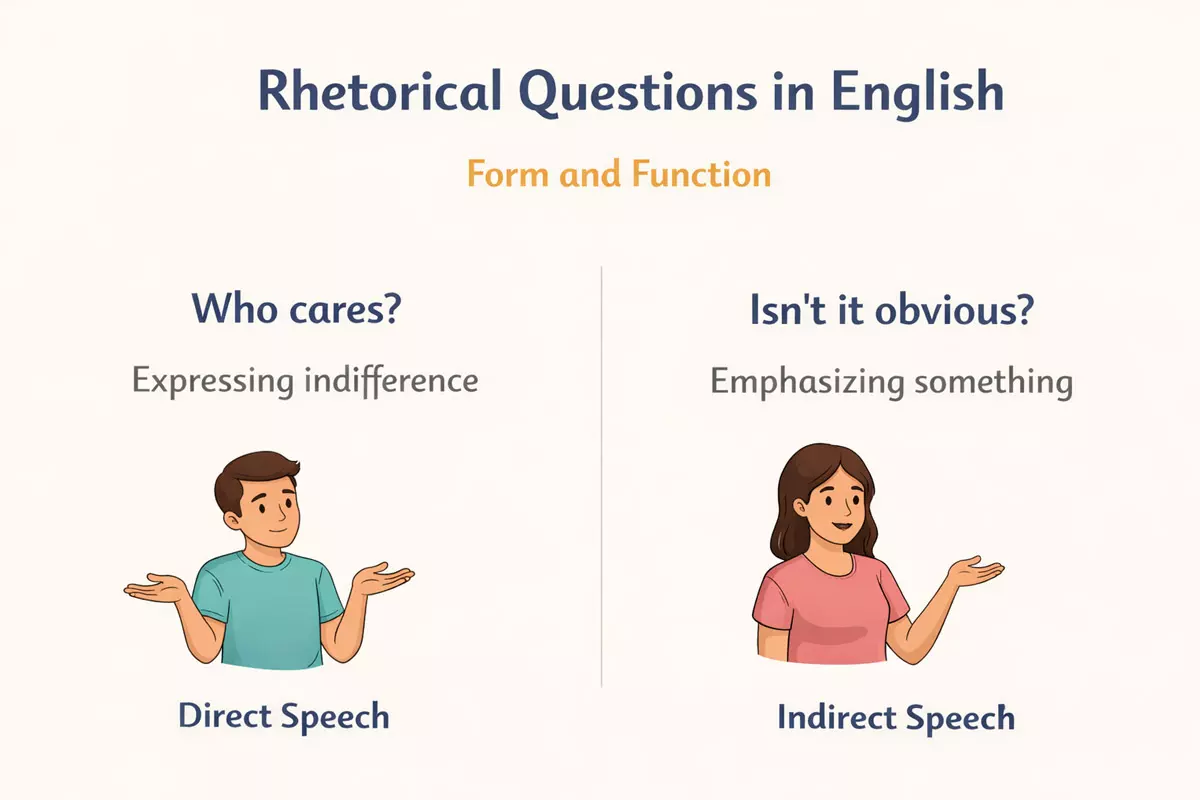 This article explains what rhetorical questions are, their purpose, common structures, and how they differ from real questions. It covers their use in speech and writing, tone and emphasis, common learner mistakes, and includes practice exercises.
Have you ever noticed that we often ask questions without really expecting an answer? These rhetorical questions are a common feature in English, serving to emphasize a point, provoke thought, or add a touch of drama to our conversations. By posing such questions, speakers can engage listeners more effectively, highlight important ideas, or subtly convey their opinions. Rather than seeking information, these questions encourage reflection and help shape the tone and direction of a discussion, making our communication more dynamic and expressive.
What Rhetorical Questions Are
Rhetorical questions are special types of interrogative sentences that are not meant to be answered directly. Instead, they are used to make a point, provoke thought, or emphasize an idea. Rather than seeking information, these questions often imply their own answers or challenge the listener to consider a particular perspective.
Core Characteristics
- They do not expect an explicit response.
- Often used to engage the audience or highlight a concept.
- May express irony, sarcasm, or strong emotion.
- Can be found in both spoken and written English, from casual conversation to formal speeches.
Common Forms and Patterns
Rhetorical questions come in various structures, but some patterns are especially frequent. Recognizing these makes it easier to spot them in context.
- Negative questions: “Isn’t it obvious?”
- Tag questions: “You really think that, do you?”
- Wh- questions: “Who knows?”
- Yes/No questions: “Do you really think I’d forget?”
- Hypothetical scenarios: “If you can’t trust your friends, who can you trust?”
- Echoing statements: “That’s the best you can do?”
- Universal questions: “What is the meaning of life?”
- Questions with implied answers: “Is the sky blue?”
- Suggestive questions: “Why not?”
- Questions for emphasis: “How many times do I have to tell you?”
Function vs. Genuine Questions
It’s important to distinguish these from real queries. While both take the form of a question, only one genuinely seeks new information. The other operates more as a statement in disguise.
| Type | Purpose |
|---|---|
| Rhetorical Question | Emphasizes a point, invites reflection, or adds dramatic effect |
| Genuine Question | Requests information, clarification, or a direct answer |
Typical Contexts of Use
Speakers and writers use these interrogative forms in a wide range of settings, such as persuasive essays, debates, advertisements, and everyday dialogue. They are especially effective in drawing attention, softening criticism, or subtly conveying opinions without making blunt statements.
Purpose of Rhetorical Questions
Rhetorical questions serve several important communicative functions in English. Rather than seeking direct answers, speakers use them to engage listeners, highlight a point, or provoke deeper thought. These questions often guide the conversation, subtly persuading or emphasizing an idea without demanding a literal response.
Common Reasons for Using Rhetorical Questions
- Emphasis: Drawing attention to a statement or viewpoint.
- Persuasion: Influencing the audience by implying agreement or shared understanding.
- Engagement: Inviting listeners to reflect or consider a topic more deeply.
- Expressing Emotion: Conveying frustration, surprise, irony, or disbelief.
- Challenging Assumptions: Questioning commonly held beliefs or opinions.
- Encouraging Agreement: Suggesting that the answer is obvious or universally accepted.
- Introducing Topics: Opening a discussion or transitioning between ideas.
- Softening Criticism: Framing critique in a less direct way.
- Humor: Adding wit or playfulness to conversation.
- Prompting Reflection: Motivating the audience to think independently.
How Rhetorical Questions Shape Communication
These interrogative forms often blur the line between statement and question. By not expecting a direct answer, they allow speakers to assert opinions or emotions more subtly than straightforward declarations. This can make the message more engaging or memorable. For example, a teacher might ask, "Isn’t learning fun?" to encourage a positive attitude, rather than simply stating that learning is enjoyable.
Examples: Purposes and Effects

Below is a table showing various typical purposes for rhetorical questions, along with example phrases and their communicative effects.
| Purpose | Example Question | Effect |
|---|---|---|
| Emphasize a point | How many times do I have to tell you? | Highlights frustration or repetition |
| Express disbelief | Can you believe it? | Signals surprise or shock |
| Persuade or lead | Who wouldn’t want to succeed? | Suggests agreement is obvious |
| Challenge assumptions | Isn’t everyone entitled to respect? | Invites reflection on a shared value |
| Introduce a topic | What’s the real issue here? | Sets up discussion or analysis |
| Add humor | Why do we park on driveways and drive on parkways? | Highlights irony or absurdity |
| Soften criticism | Could you try being on time? | Makes feedback less harsh |
In sum, rhetorical questions are powerful tools for shaping tone, guiding conversations, and encouraging listeners to think beyond the surface. Their flexibility helps speakers connect with audiences, reinforce points, and communicate more effectively in both written and spoken English.
Common Rhetorical Question Structures
Rhetorical questions in English take on a variety of forms, each designed to prompt thought or emphasize a point rather than elicit an actual answer. These question types often mirror standard interrogative structures but are used for effect, not inquiry. Recognizing these patterns can help learners and speakers understand subtle cues in conversation and writing.
Typical Patterns of Rhetorical Questions
Several recurring formats frequently appear in spoken and written English. These include yes-no questions, negative constructions, tag questions, and questions beginning with "wh-" words. The tone and context often signal that the speaker is not expecting a literal response.
- Yes-No Format: "Isn’t that amazing?" or "Could you be any louder?"
- Negative Questions: "Don’t we all want happiness?"
- Tag Questions (with obvious answers): "It’s obvious, isn’t it?"
- Wh- Questions (where the answer is implied): "Who knows?" or "What’s the point?"
- Exaggerated Questions: "How many times do I have to tell you?"
- Choice Questions (with only one real option): "Do I have a choice?"
- Questions with universal scope: "Who doesn’t like weekends?"
- Questions implying futility: "Why bother?"
- Questions expressing disbelief: "Are you serious?"
- Questions for emphasis: "Isn’t that just perfect?"
- Questions that answer themselves: "Who wouldn’t want that?"
- Questions expressing the obvious: "Does a bear live in the woods?"
- Questions with implied criticism: "Could you be any later?"
- Questions for persuasion: "Wouldn’t it be better to wait?"
Comparison of Rhetorical and Standard Question Forms
To clarify how these differ from direct questions, here’s a side-by-side look at common structures and their rhetorical use:
| Standard Question | Rhetorical Question (Purpose/Implied Answer) |
|---|---|
| Are you coming to the party? | Who would miss a party like this? (implies: no one would) |
| Do you want some help? | Who doesn’t need help sometimes? (implies: everyone does) |
| Did you see that? | How could you miss that? (implies: it was impossible to miss) |
| Is it important? | Doesn’t everyone know how important this is? (implies: it's obvious) |
These formats are not limited to casual speech; they also appear in literature, speeches, and persuasive writing. Mastery of these structures can add nuance, emphasis, or stylistic flair to communication.
Rhetorical Questions vs Real Questions
Understanding the distinction between rhetorical and genuine questions is key to using them effectively in English. While both types appear similar in structure, their purposes and expected responses are quite different. A real (or direct) question seeks information or clarification. In contrast, a rhetorical question is generally designed to make a point, emphasize an idea, or provoke thought—often without expecting a direct answer.
Purpose and Function
A direct question is intended to gather information, confirm facts, or invite opinions. Listeners are expected to provide a response. Rhetorical questions, however, serve as a persuasive or stylistic device. They can express irony, highlight an obvious truth, or subtly challenge the listener’s assumptions.
Common Patterns and Examples
You can spot rhetorical questions by their context and tone. They often state something obvious or imply the answer. Here are examples that help illustrate the difference:
- Who knows?
- Isn’t it obvious?
- Why bother?
- Do pigs fly?
- What’s the point?
- How should I know?
- Can you believe it?
- Is the sky blue?
- Am I my brother’s keeper?
- Who cares?
- Why not?
- Could it get any worse?
- What else is new?
- Are you kidding me?
- Is that supposed to be funny?
- Do you want to fail?
- Is water wet?
- Wasn’t that amazing?
- Do you think money grows on trees?
- How many times do I have to tell you?
Comparison Table
| Feature | Rhetorical Question | Real Question |
|---|---|---|
| Purpose | To make a point or provoke thought | To obtain information |
| Expected Answer | Usually none; answer is implied | Yes, no, or specific information |
| Typical Context | Persuasion, emphasis, irony | Conversation, interviews, learning |
| Example | “Isn’t that interesting?” | “What time is it?” |
Quick Tips for Identifying Each Type
- If a question expects a real answer, it’s probably not rhetorical.
- When the answer is obvious or no response is expected, it’s likely rhetorical.
- Context and tone help signal intent—listen for emphasis or sarcasm with rhetorical forms.
By recognizing these differences, you can interpret meaning more accurately and use each type of question to achieve your communication goals.
Use in Spoken English
Rhetorical questions appear frequently in everyday conversations, serving a range of functions beyond simply asking for information. Instead of expecting direct answers, speakers often use these questions to make a point, express emotions, or guide the listener’s thoughts. This conversational tool adds nuance and can influence the tone or direction of dialogue.
Common Purposes in Conversation
- Emphasizing a point: “Isn’t that amazing?” draws attention to something impressive or surprising.
- Expressing disbelief: “Are you serious?” signals shock or skepticism.
- Encouraging reflection: “What would you do in my place?” prompts listeners to consider their own response.
- Offering criticism or challenge: “Do you really think that’s a good idea?” questions someone’s judgment.
- Softening commands or suggestions: “Could you close the window?” is gentler than a direct command.
- Signaling sarcasm or irony: “Oh, who wouldn’t want to work overtime?” implies the opposite of the literal meaning.
- Showing frustration: “How many times do I have to tell you?” expresses exasperation.
- Inviting agreement: “Isn’t it a beautiful day?” seeks shared appreciation.
- Highlighting obvious facts: “Who doesn’t love weekends?” implies universal agreement.
- Initiating humor: “Why do I even bother?” plays with self-deprecation or exaggeration.
Intonation and Delivery
The way rhetorical questions are spoken often signals their intent. Rising intonation can indicate genuine curiosity or surprise, while falling intonation may stress sarcasm or finality. Body language and facial expressions also help listeners interpret whether a response is expected or if the question is meant to be rhetorical.
Examples of Rhetorical Questions in Context
Below is a selection of rhetorical question patterns commonly heard in spoken exchanges, along with typical meanings:
- “Can you believe it?” → Surprise or disbelief
- “Why not?” → Suggesting something is reasonable
- “Who cares?” → Indicating indifference
- “What’s the point?” → Questioning purpose
- “How should I know?” → Expressing lack of knowledge
- “Is that so hard to understand?” → Emphasizing simplicity
- “Do I look like I was born yesterday?” → Challenging someone’s assumption
- “What else is new?” → Suggesting something is unsurprising
- “Could it get any worse?” → Highlighting a negative situation
- “Isn’t that the truth?” → Agreeing emphatically
Comparing Literal and Rhetorical Questions
| Literal Question | Rhetorical Equivalent | Intended Effect |
|---|---|---|
| What time is it? | Is it late already? | Expressing surprise at the time, not seeking the exact hour |
| Are you finished? | Are you done yet? | Impatience or prompting action |
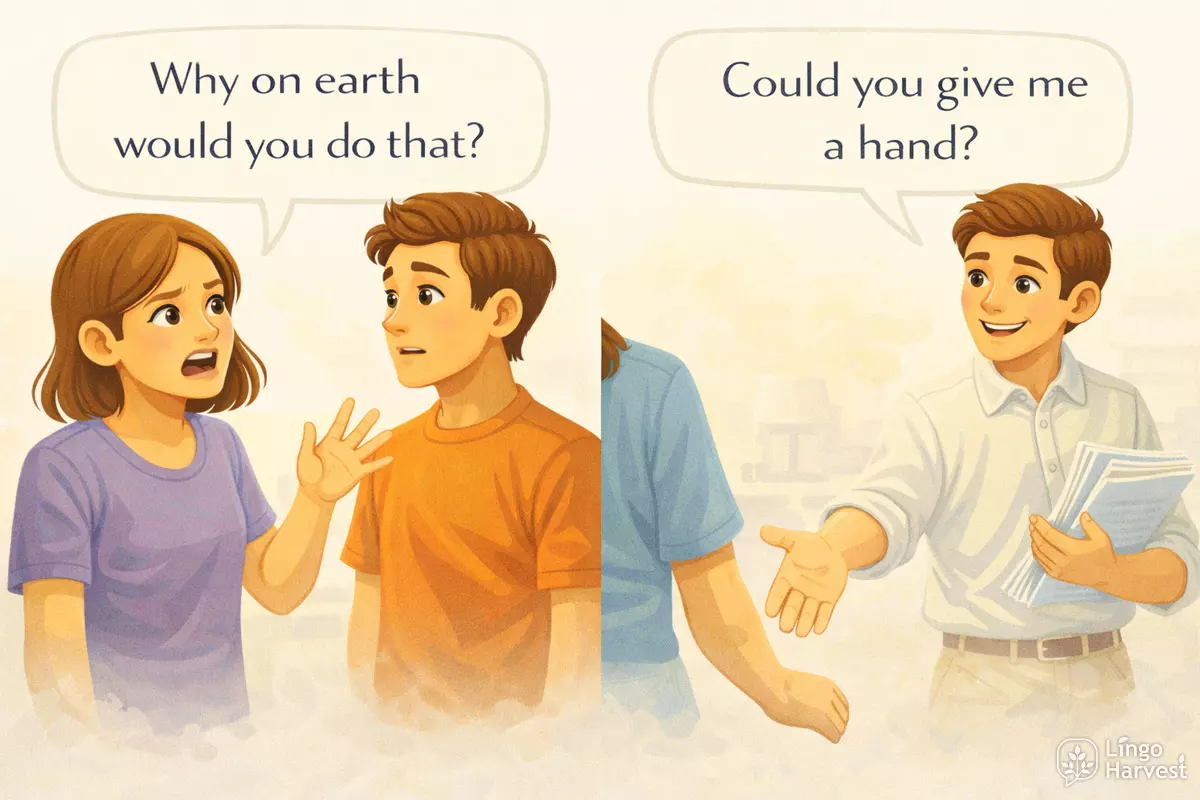
| Why did you do that? | Why on earth would you do that? | Expressing strong disbelief or criticism |
| Can you help me? | Could you give me a hand? | Polite request, not a test of ability |
Mastering rhetorical questions in conversation helps speakers add subtlety, emotion, and engagement to their spoken English, making exchanges more dynamic and expressive.
Use in Writing and Speeches
Rhetorical questions play a significant role in both formal writing and spoken presentations. Rather than expecting an answer, these questions are crafted to provoke thought, emphasize a point, or engage the audience emotionally. In essays, articles, and speeches, they help to guide the reader or listener’s attention, challenge assumptions, and encourage reflection on the topic at hand.
Functions in Different Contexts
- Engagement: Inviting the audience to consider a perspective without demanding a direct response.
- Emphasis: Highlighting crucial ideas or underlining contrasts in an argument.
- Persuasion: Steering listeners or readers toward a conclusion by framing it as self-evident.
- Transition: Signaling a shift in topic or focus within a piece of writing or a speech.
- Irony or Sarcasm: Suggesting the opposite of the literal meaning to create humor or critique.
Common Rhetorical Question Patterns
Writers and speakers often use familiar patterns to achieve clarity and impact. Here are several effective forms:
- Isn’t it obvious?
- Who wouldn’t agree?
- What’s the point?
- How could anyone doubt it?
- Why should we care?
- Do we really have a choice?
- Does it matter?
- Who knows?
- Is that all?
- Can you imagine?
- What else could we expect?
- How long must this continue?
- Is this the best we can do?
- Could anything be clearer?
- Why not?
Comparing Rhetorical and Genuine Questions
Understanding the distinction between rhetorical and genuine questions is essential for effective communication. The table below highlights key differences:
| Rhetorical Question | Genuine Question |
|---|---|
| Asked for effect or emphasis | Seeks actual information |
| No real answer expected | Expects a response |
| Often used in arguments and speeches | Common in everyday conversation |
| Guides thinking or highlights a point | Clarifies uncertainty or gathers facts |
Tips for Effective Use
- Consider your audience: Use rhetorical questions to prompt reflection, not confusion.
- Don’t overuse them; too many can feel manipulative or insincere.
- Pair with strong statements to reinforce your message.
- Vary your structure for a natural flow in both writing and speech.
By thoughtfully incorporating rhetorical questions, writers and speakers can create a more dynamic and persuasive experience, encouraging listeners or readers to actively engage with the material.
Tone and Emphasis in Rhetorical Questions
How a rhetorical question is delivered can change its meaning dramatically. Speakers and writers use these questions to convey irony, sarcasm, surprise, or genuine curiosity, all depending on the context and manner of expression. The tone behind a rhetorical question often signals how the audience should interpret it—whether as a challenge, an invitation to agree, or a subtle critique.
How Tone Shapes Interpretation
The same rhetorical question can suggest different things based on the speaker's pitch, pacing, and emphasis. For example, "Do you really think that's a good idea?" might sound supportive or critical depending on whether it’s spoken softly or sharply. In writing, punctuation and context help establish the intended feeling.
- Sarcasm: "Isn’t that just perfect?" (when something goes wrong)
- Disbelief: "Who could have seen that coming?"
- Agreement-seeking: "Don’t we all want a better future?"
- Emphasis: "How many times do I have to tell you?"
- Criticism: "Was that really necessary?"
- Encouragement: "Who says you can’t do it?"
- Playfulness: "Why not eat dessert first?"
- Reflection: "What would life be without music?"
- Challenge: "If not now, when?"
- Irony: "Am I supposed to be impressed?"
- Exasperation: "Will this ever end?"
- Politeness: "Could you pass the salt?"
- Forewarning: "Do you know what happens if you ignore the rules?"
- Encouraging reflection: "Can we really call that progress?"
- Expressing wonder: "Who would have imagined this day would come?"
Emphasis Through Structure and Delivery
Rhetorical questions can be emphasized in several ways. In speech, a pause before or after the question, a shift in volume, or a change in facial expression can all add weight. In writing, italics, exclamation marks, or strategic placement in a paragraph can highlight importance. The following table compares common methods for adding emphasis in both spoken and written forms.
| Spoken Emphasis | Written Emphasis |
|---|---|
| Raising pitch at the end | Using italics or bold |
| Pausing before or after the question | Placing the question on its own line |
| Changing volume (louder or softer) | Adding an exclamation mark or ellipsis |
| Facial expressions or gestures | Using context or descriptive cues |
Recognizing Intent and Nuance
Understanding the intention behind a rhetorical question is essential. Listeners and readers should pay attention not just to the words themselves, but also to how they’re presented. Subtle cues—like a raised eyebrow or a carefully chosen punctuation mark—can reveal whether the speaker is joking, criticizing, or inviting reflection. By tuning in to these signals, the audience can better appreciate the underlying message and respond appropriately.
Common Learner Mistakes
Misusing rhetorical questions is a frequent challenge for English learners. These questions are not simply about grammar—they depend on subtle cues, tone, and the context of a conversation. When learners miss these nuances, their rhetorical questions can sound confusing or even inappropriate to native speakers.
Typical Errors with Rhetorical Questions
- Taking rhetorical questions literally and trying to answer them.
- Using a rhetorical question form when a direct statement would be clearer.
- Incorrectly intonating, so the listener mistakes a rhetorical question for a real one.
- Forgetting that some rhetorical questions are culturally loaded and may not translate well.
- Overusing them, which can make speech sound sarcastic or insincere.
- Forming grammatically incorrect rhetorical questions, such as missing auxiliary verbs.
- Misplacing negative words (e.g., "Isn’t it obvious?" becoming "Is it not obvious?") and changing the effect.
- Using rhetorical questions in formal writing where they may be inappropriate.
- Confusing rhetorical questions with tag questions ("You’re coming, aren’t you?").
- Failing to recognize that some rhetorical questions need no answer and pausing awkwardly.
- Mixing up rhetorical questions with indirect or polite requests.
- Misjudging when to use them for emphasis versus when they sound passive-aggressive.
Confusing Real and Rhetorical Questions
Learners sometimes struggle to distinguish between genuine questions and those meant for effect. The following table shows examples that often cause confusion:
| Literal Question (expects answer) | Rhetorical Question (no answer needed) |
|---|---|
| Are you coming to the party? | Who wouldn’t want to come to the party? |
| Did you do your homework? | Isn’t it obvious I’ve done my homework? |
| Why did you say that? | Why bother arguing about this? |
| Can you help me? | Can anyone really help in this situation? |
Intonation and Delivery
A common slip is using flat or rising intonation in rhetorical questions. Native speakers usually use a falling tone to signal that no answer is expected. Practicing with audio examples can help learners master the correct delivery.
Tips to Avoid Errors
- Listen to how native speakers use rhetorical questions in movies and conversations.
- Pay attention to intonation and facial expressions.
- Use them sparingly, especially in writing.
- Remember that the goal is to make a point, not to get information.
- If unsure, rephrase as a statement for clarity.
Practice Exercises and Self-Check
Testing your understanding of interrogative forms used for effect can help reinforce key concepts. Below, you’ll find a variety of exercises: some will challenge you to identify, create, or interpret such questions in authentic contexts. Try each activity before peeking at the solutions.
1. Recognizing Rhetorical Questions
Decide whether each sentence is a rhetorical question or a genuine request for information:
- Isn’t it obvious?
- What time does the meeting start?
- How could anyone forget that?
- Will you be joining us for dinner?
- Who doesn’t love a sunny day?
- Don’t you agree?
- Why would anyone say no to that?
- Did you finish the report?
- Who wouldn’t want a break?
- Are we ready to begin?
Show answers
- Rhetorical
- Genuine
- Rhetorical
- Genuine
- Rhetorical
- Rhetorical
- Rhetorical
- Genuine
- Rhetorical
- Genuine
2. Completing Sentences with Appropriate Forms
Fill in each blank with a suitable rhetorical interrogative. Consider tone and context.
- __________ believe that story?
- If not now, __________?
- __________ cares?
- After all this time, __________ could blame you?
- __________ wants to fail on purpose?
- __________ wouldn’t be upset by that?
- __________ could forget such a moment?
- __________ expects perfection?
- __________ wouldn’t agree with this?
- __________ has the time for that?
Show answers
- Who would
- when
- Who
- who
- Who
- Who
- Who
- Who
- Who
- Who
3. Spot the Function
Match each rhetorical inquiry to its likely function in conversation. Choose from:
(A) Emphasizing a point (B) Criticizing (C) Persuading (D) Showing surprise
- Isn’t that just amazing?
- Could you be any later?
- Who wouldn’t want to try this?
- What’s the use?
- Don’t you see the problem here?
- How could anyone think that was acceptable?
- Why not give it a try?
- Isn’t this exactly what we warned about?
- Who would believe such an excuse?
- Wasn’t that unexpected?
Show answers
- D – Showing surprise
- B – Criticizing
- C – Persuading
- A – Emphasizing a point
- A – Emphasizing a point
- B – Criticizing
- C – Persuading
- A – Emphasizing a point
- B – Criticizing
- D – Showing surprise
4. Write Your Own
Think of a context for each prompt and write a rhetorical question that fits.
- Expressing disbelief at a bold claim
- Encouraging someone to take a risk
- Reacting to an obvious answer
- Highlighting frustration with a repeated mistake
- Showing surprise at an unexpected result
- Criticizing careless behavior
- Persuading someone to agree with you
- Expressing impatience while waiting
- Emphasizing that something is inevitable
- Pointing out a contradiction
Show answers
- Do you really expect me to believe that?
- What have you got to lose?
- Isn’t it obvious?
- How many times do I have to explain this?
- Who could have seen that coming?
- Did you even think before doing that?
- Doesn’t that make perfect sense?
- How much longer is this going to take?
- Wasn’t this bound to happen eventually?
- How can you say that and mean the opposite?
Regular practice with these exercises can help you recognize and use rhetorical questions more naturally in conversation and writing. Try creating your own examples for different social situations to deepen your understanding.