Complex Complement Clauses After Verbs, Nouns, and Adjectives

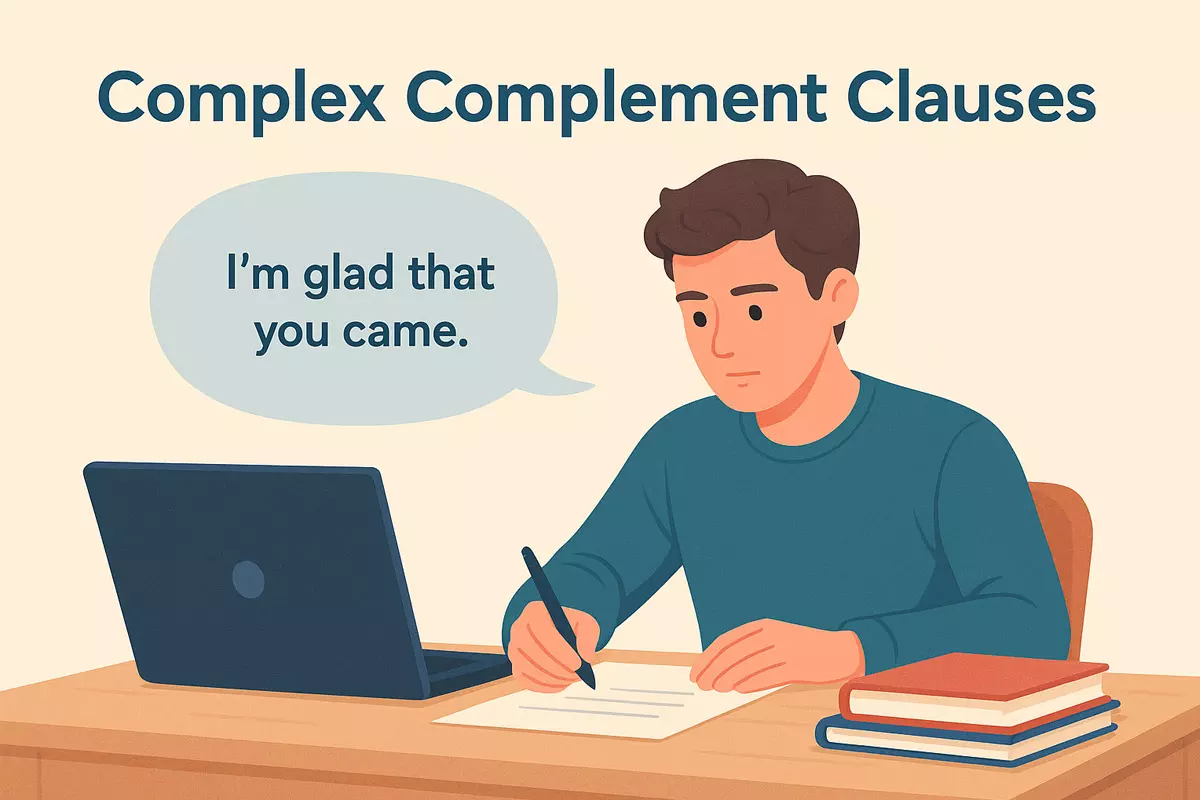 The article defines complement clauses and shows how they work with verbs, nouns, and adjectives. It explains that-, wh-, and if/whether-clauses as complements, addresses ambiguity issues, and includes practice with correct clause patterns.
Have you ever wondered how sentences grow more detailed and nuanced when we add extra information? By examining how subordinate clauses are used after specific verbs, nouns, and adjectives, we can discover the fascinating ways in which English enables us to express complex ideas and subtle relationships. Understanding these patterns not only enriches our language skills but also helps us communicate more clearly and effectively, allowing for greater precision and depth in both writing and conversation.
What complement clauses are
Complement clauses are groups of words that function as a unit within a larger sentence, typically completing the meaning of a verb, noun, or adjective. They often answer questions like “what?”, “who?”, or “that…?” after the main part of a sentence. For example, in “She believes that he is honest,” the phrase “that he is honest” gives necessary information and cannot be removed without altering the sense. These clauses usually start with words like that, whether, if, or question words such as what, who, or how. They can function as the subject or the object of a sentence, or as a complement to adjectives and nouns.
Typical features of complement clauses
- They have their own subject and verb.
- Often introduced by a subordinating word (complementizer).
- Cannot stand alone as a complete sentence.
- Fill a grammatical “slot” required by another word (like a verb or noun).
Common complementizers and clause types
- That: “He said that he was tired.”
- If/whether: “I wonder if she will come.”
- Wh- words: “Do you know where they went?”
Examples of complement clauses in sentences
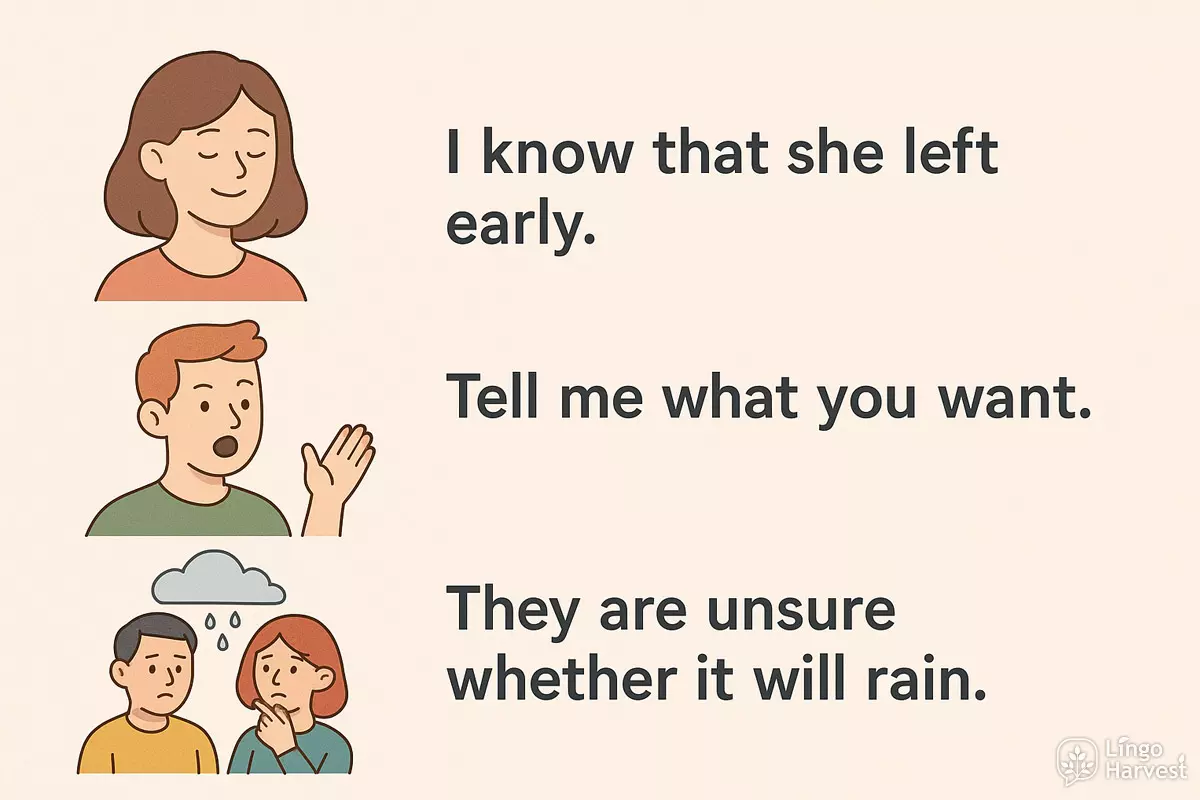
- “I know that she left early.”
- “Tell me what you want.”
- “They are unsure whether it will rain.”
- “Her suggestion that we leave now makes sense.”
- “It is important that you arrive on time.”
- “She is glad that you called.”
- “I wonder who will win.”
- “The fact that he apologized surprised me.”
- “He asked if I could help.”
- “I forgot what she said.”
Functions within sentences
Complement clauses can serve various roles:
- Object of verbs: “She thinks that it’s true.”
- Subject of sentences: “That you arrived early surprised us.”
- Following adjectives: “He is happy that you came.”
- Following nouns: “The idea that we could win inspired us.”
Overview of main types
| Type | Example |
|---|---|
| That-clause | She believes that he is right. |
| If/whether-clause | I wonder whether you agree. |
| Wh-clause | He asked what I wanted. |
| Infinitive clause | She hopes to win. |
| Gerund clause | They admitted cheating. |
In summary, complement clauses are essential building blocks in English, enabling speakers and writers to express complex ideas by embedding one statement within another. They play a vital role in connecting and expanding meaning throughout sentences.
Common verb + clause patterns
Understanding how verbs combine with clauses helps learners create more precise and sophisticated sentences. Some verbs allow or require a specific type of clause to follow, such as a that-clause or a to-infinitive clause. These patterns often signal what kind of information or attitude the speaker wishes to express.
Typical verb + clause constructions
Many English verbs are followed by complement clauses that provide extra information, state an opinion, or report speech. Below are some of the most frequent structures:
- Verb + that-clause: She thinks that he is right.
- Verb + wh-clause: I wonder where they went.
- Verb + if/whether-clause: He asked if she was coming.
- Verb + to-infinitive clause: They decided to leave early.
- Verb + object + to-infinitive: She persuaded him to apply.
- Verb + object + bare infinitive: I heard them sing.
- Verb + object + -ing clause: We caught him stealing.
- Verb + object + past participle: They had their house painted.
- Verb + for + noun/pronoun + to-infinitive: He arranged for her to meet the team.
- Verb + noun clause (as a subject or object): What you said surprised me.
Comparison of clause types after common verbs
Some verbs can be followed by more than one type of complement clause, while others only work with a specific structure. The table below illustrates this variety for a selection of frequent verbs:
| Verb | Possible Complement Clauses | Example |
|---|---|---|
| Advise | to-infinitive, object + to-infinitive, that-clause | She advised me to wait. / She advised that we wait. |
| Suggest | that-clause, -ing clause | He suggested that we leave. / He suggested leaving early. |
| Promise | to-infinitive, that-clause | I promised to help. / I promised that I would help. |
| Ask | object + to-infinitive, if/whether-clause, wh-clause | She asked him to stay. / She asked if he was ready. |
| Know | wh-clause, that-clause | Do you know where she lives? / I know that he is here. |
| Remind | object + to-infinitive, that-clause | Remind me to call. / She reminded him that he was late. |
| Tell | object + to-infinitive, that-clause | He told me to wait. / He told me that he was busy. |
| Decide | to-infinitive, that-clause (formal) | They decided to leave. / They decided that they would leave. |
| Expect | object + to-infinitive, that-clause | I expect him to call. / I expect that he will call. |
| Hope | to-infinitive, that-clause | We hope to visit soon. / We hope that you are well. |
Notes on usage
Some verbs shift meaning depending on the type of clause that follows. For example, remember to do (not forgetting) differs from remember doing (recalling a past event). Paying attention to these patterns is key for accurate and natural expression.
Noun and adjective + clause structures
When discussing how complex complement clauses function after nouns and adjectives, it’s important to recognize the range of patterns and the subtle differences in meaning or emphasis they create. These structures commonly appear in both formal and everyday English, enabling speakers to embed additional information, express opinions, or report facts.
Common Patterns
In English, certain nouns and adjectives naturally take a complement clause—often introduced by “that,” “whether,” “if,” or a wh-word (like “who” or “what”). The clause typically provides content or information related to the noun or adjective. Consider these frequent patterns:
- Noun + that-clause: "The fact that she arrived early surprised everyone."
- Noun + wh-clause: "His question of whether we should continue was important."
- Adjective + that-clause: "She was confident that they would win."
- Adjective + wh-clause: "He’s unsure where to go next."
Function and Meaning
Using these constructions allows for nuanced communication. With nouns, the clause often defines, explains, or specifies the noun’s content. With adjectives, it clarifies the cause or target of the emotion, judgment, or state described.
Examples of Nouns and Adjectives Commonly Used with Complement Clauses
- Nouns: belief, claim, idea, hope, request, suggestion, fact, assumption, knowledge, decision
- Adjectives: glad, aware, certain, afraid, surprised, doubtful, pleased, happy, sorry, sure
Expanded Examples: Noun and Adjective + Clause
- His belief that things will improve keeps him motivated.
- The idea that time travel is possible fascinates many people.
- She is happy that you could join us.
- They are certain that the meeting will start on time.
- We have no knowledge of who sent the package.
- Her suggestion that we leave early was appreciated.
- He is unsure whether he passed the exam.
- The decision whether to proceed has not been made.
- I am afraid that I can’t help you.
- Our request that everyone arrive on time was ignored.
- They are pleased that the project succeeded.
- Her assumption that nobody noticed was incorrect.
- He is aware that the deadline is tomorrow.
- We discussed the question of whether to expand the team.
- She is sorry that she missed your call.
- The fact that it rained didn’t ruin the event.
- He was surprised that the answer was so simple.
- Their claim that the product works was disputed.
- He is doubtful whether the plan will work.
- We welcomed their hope that relations would improve.
Overview Table: Noun/Adjective + Clause Types
| Noun/Adjective | Typical Clause Introducers | Example |
|---|---|---|
| fact, idea, claim, belief | that | The belief that he will win is widespread. |
| question, decision, doubt | whether, if | The question whether we should proceed remains. |
| aware, certain, glad, afraid | that | She is certain that they will help. |
| unsure, doubtful, unclear | wh-words (who, what, where, etc.) | He is unsure where to start. |
Summary
These noun and adjective + clause combinations are essential for expressing complex thoughts, reporting indirect speech, or elaborating on opinions and knowledge. Mastery of these patterns enables clearer, more precise communication in both spoken and written English.
That-, wh-, and if/whether-clauses as complements
Complement clauses introduced by "that," wh-words, and "if/whether" are essential in English for expressing reported speech, thoughts, questions, and uncertainty. These subordinate clauses often serve as the object or subject of verbs, or follow adjectives and nouns to expand meaning. Understanding how each type of clause functions can clarify how complex ideas are structured in sentences.
That-clauses: Statement Complements
"That"-clauses typically report statements, beliefs, or information. They most often follow verbs like "think," "say," "know," or "believe," but are also common after certain nouns and adjectives. The word "that" can often be omitted in informal speech, but its presence makes the sentence clearer, especially in writing.
- She said that she would arrive soon.
- I believe that this is the right answer.
- It is clear that he was mistaken.
- The fact that you called means a lot.
- Everyone agreed that the plan was risky.
Wh-clauses: Embedded Questions
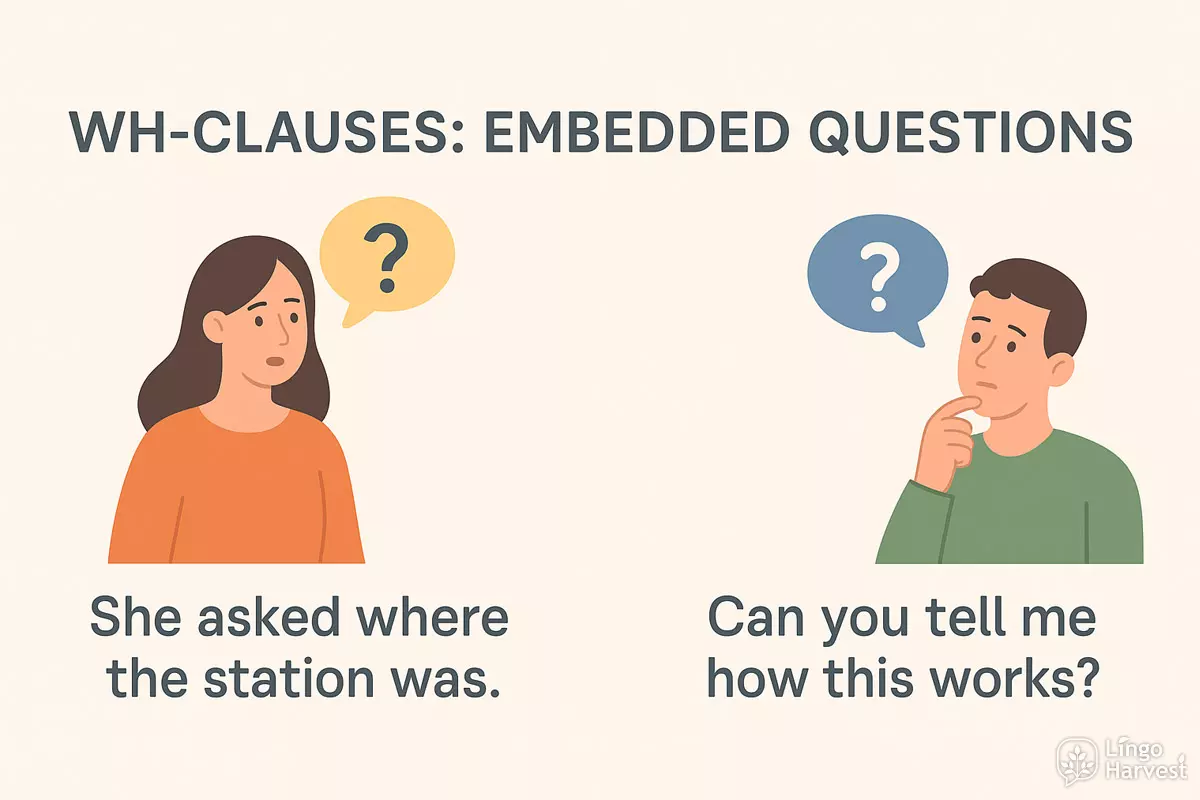
Wh-clauses are used to embed questions within statements. These clauses begin with a wh-word (who, what, where, when, why, how, which, whose, etc.), and serve as the complement of verbs, nouns, or adjectives. They do not follow the word order of direct questions.
- She asked where the station was.
- I don’t know what he wants.
- Can you tell me how this works?
- They wondered who had left the message.
- No one explained why the meeting was canceled.
- We discussed which route would be fastest.
- He forgot when the appointment was scheduled.
- She questioned whose bag was on the table.
If/whether-clauses: Indirect Yes/No Questions
When reporting yes/no questions, "if" or "whether" is used to introduce the complement clause. Both words are often interchangeable, but "whether" is preferred in more formal contexts or when presenting alternatives. These clauses frequently follow verbs like "ask," "wonder," or "know."
- I don’t know if he will come.
- She asked whether the train had left.
- Can you tell me if it’s raining?
- They’re not sure whether to proceed.
- He wondered if anyone noticed.
- We discussed whether we should stay or go.
Comparing Complement Clause Types
The following table highlights the main features, uses, and introductory words for each complement clause type:
| Clause Type | Introductory Word(s) | Typical Function | Examples |
|---|---|---|---|
| That-clause | that (often omitted) | Reporting statements, beliefs, facts | He said that he was tired. It’s obvious that she knows. |
| Wh-clause | who, what, where, when, why, how, which, whose | Reporting indirect questions | I wonder where she went. They asked how it happened. |
| If/whether-clause | if, whether | Reporting yes/no questions, alternatives | I’m not sure if it’s ready. She asked whether to wait. |
Common Verbs, Nouns, and Adjectives Taking Complement Clauses
Many verbs, nouns, and adjectives regularly take these types of subordinate clauses as complements. Here is a selection:
- Verbs: think, know, ask, say, believe, wonder, tell, decide, realize, remember
- Nouns: fact, idea, suggestion, question, possibility, doubt, report, belief, news, issue
- Adjectives: sure, certain, glad, aware, doubtful, afraid, surprised, possible, likely, important
By mastering the use of these clause types, you can create more nuanced and precise sentences, whether you are reporting speech, expressing uncertainty, or embedding questions.
Ambiguity and misattachment problems
Parsing complex complement clauses can be tricky, especially when it comes to determining which part of the sentence a clause attaches to. Sentences with verbs, nouns, or adjectives that take complements are particularly susceptible to confusion. Such constructions often lead to multiple possible interpretations, depending on where the complement clause is understood to connect.
Common sources of confusion
Ambiguity often arises when the structure of a sentence allows a complement clause to be linked to more than one word or phrase. This is sometimes called "misattachment" or "attachment ambiguity." Here are some typical situations where this occurs:
- Verbs followed by a noun and then a complement clause (e.g., "She told the man that she was leaving.")
- Nouns that can be modified by either a preceding or following clause (e.g., "The claim that he made surprised everyone.")
- Adjectives with optional complement clauses (e.g., "She is certain that he will arrive.")
- Sentences with multiple possible antecedents for "that"-clauses
- Relative clauses versus complement clauses after nouns
- Sentences with stacked prepositional phrases
- Use of pronouns or ellipsis increasing referential uncertainty
- Complex sentences with more than one complement-taking verb
- Use of "whether" or "if" clauses, which can function as questions or statements
- Ambiguous punctuation in written language
- Misleading prosody or intonation in spoken language
- Unexpected word order in embedded clauses
Illustrative examples
Ambiguity can be subtle. Consider the following sentences:
- "He said that John left yesterday." (Did John leave yesterday, or was it said yesterday?)
- "She heard the rumor that the project was canceled." (Is the rumor about the project, or is the clause modifying "she heard"?)
- "I am happy that you called." (Does "that you called" modify "happy" or is it a separate statement?)
- "They convinced the manager that the plan would work." (Who is being convinced of what?)
Comparison of potential attachments
| Sentence | Possible Interpretations |
|---|---|
| She told the man that she was leaving. | ✅ She informed the man of her intention to leave. ❌ She told the man who was leaving. |
| The claim that he made was false. | ✅ The claim (which he made) was false. ❌ The claim (that he was false) – less probable, but structurally possible. |
| She is certain that he will arrive. | ✅ She is sure of his arrival. ❌ She is a certain person, who he will arrive (unlikely, but a possible misreading). |
| He noticed the painting that was missing. | ✅ He noticed the painting which was missing. ❌ He noticed the act of the painting being missing. |
Strategies for resolving attachment ambiguities
Writers and speakers often rely on context, punctuation, and prosody to clarify which complement clause attaches where. Some practical approaches include:
- Rephrasing sentences to minimize possible interpretations
- Adding clarifying words or phrases (e.g., "that is," "which means")
- Using active or passive voice to highlight the main subject
- Breaking complex sentences into shorter, simpler ones
- Relying on intonation in speech to signal boundaries
Understanding these challenges is essential for both native speakers and learners, as accurate interpretation often depends on subtle grammatical cues and context.
Practice: complete and correct complement clause patterns
Understanding how to use complement clauses after verbs, nouns, and adjectives is key to constructing clear and precise sentences. Below, you’ll find a variety of exercises designed to help you identify, complete, and correct these patterns in context. The activities include sentence completion, error correction, and recognition of appropriate clause structures.
Complete the Sentences
Fill in the blanks with a suitable complement clause. Focus on correct patterns and verb forms.
- She insisted that ________ immediately.
- It is important that he ________ on time.
- We were surprised that the results ________ so quickly.
- Her suggestion that we ________ the meeting was helpful.
- They demanded that the company ________ the policy.
- The teacher recommended that the students ________ the article before class.
- It is essential that every member ________ the guidelines.
- They proposed that the deadline ________ by one week.
- We were relieved that the problem ________ before the presentation.
- His request that the report ________ again seemed reasonable.
Show answers
- She insisted that he leave immediately.
- It is important that he arrive on time.
- We were surprised that the results were announced so quickly.
- Her suggestion that we postpone the meeting was helpful.
- They demanded that the company change the policy.
- The teacher recommended that the students read the article before class.
- It is essential that every member follow the guidelines.
- They proposed that the deadline be extended by one week.
- We were relieved that the problem had been solved before the presentation.
- His request that the report be checked again seemed reasonable.
Identify and Correct Errors
Each sentence below contains an error in the use of a complement clause. Rewrite the sentences correctly.
- The manager asked that everyone to arrive early.
- It is necessary that he goes home now.
- Her hope is the team win the next match.
- We recommended him to take a break.
- They were happy that to help us.
- It is essential that she follows the instructions.
- The doctor suggested to rest more.
- They demanded that the rules are changed immediately.
- His advice was that to start earlier.
- The teacher insisted that the students to be quiet.
Show answers
- The manager asked that everyone arrive early.
- It is necessary that he go home now.
- Her hope is that the team will win the next match.
- We recommended that he take a break.
- They were happy to help us.
- It is essential that she follow the instructions.
- The doctor suggested resting more.
- They demanded that the rules be changed immediately.
- His advice was to start earlier.
- The teacher insisted that the students be quiet.
Matching Patterns: Verbs, Nouns, and Adjectives
Match the word with the appropriate complement clause structure. This helps reinforce which forms typically follow different parts of speech.
| Word | Typical Complement Clause Pattern |
|---|---|
| Advise (verb) | that + subject + base verb |
| Decision (noun) | to + base verb |
| Happy (adjective) | that + clause / to + base verb |
| Insist (verb) | that + subject + base verb |
| Possibility (noun) | that + clause |
| Afraid (adjective) | that + clause / of + -ing |
| Ask (verb) | to + base verb / that + subject + base verb |
| Suggestion (noun) | that + subject + base verb |
| Likely (adjective) | to + base verb |
| Hope (noun) | that + clause / to + base verb |
Transform the Sentences
Rewrite the following to use a complement clause after the given word.
- (recommend, verb) I suggested. → I recommended ________.
- (afraid, adjective) She fears. → She is afraid ________.
- (decision, noun) They chose. → Their decision ________.
- (happy, adjective) We are pleased. → We are happy ________.
- (necessary, adjective) It is needed. → It is necessary ________.
- (possible, adjective) It might happen. → It is possible ________.
- (plan, noun) They intend. → Their plan ________.
- (willing, adjective) He agrees. → He is willing ________.
- (ability, noun) She can do it. → Her ability ________.
- (important, adjective) It matters. → It is important ________.
Show answers
- I recommended that he try again.
- She is afraid that she might fail.
- Their decision to move abroad surprised us.
- We are happy to help you.
- It is necessary to make changes.
- It is possible that it will happen.
- Their plan to expand the project was approved.
- He is willing to participate.
- Her ability to solve problems impressed everyone.
- It is important to consider all factors.
By practicing these varied tasks, you’ll become more confident in using complex clauses after different word types, and be able to spot and correct errors in both spoken and written English.