Advanced Reported Speech: Multi-Clause Backshifting Techniques

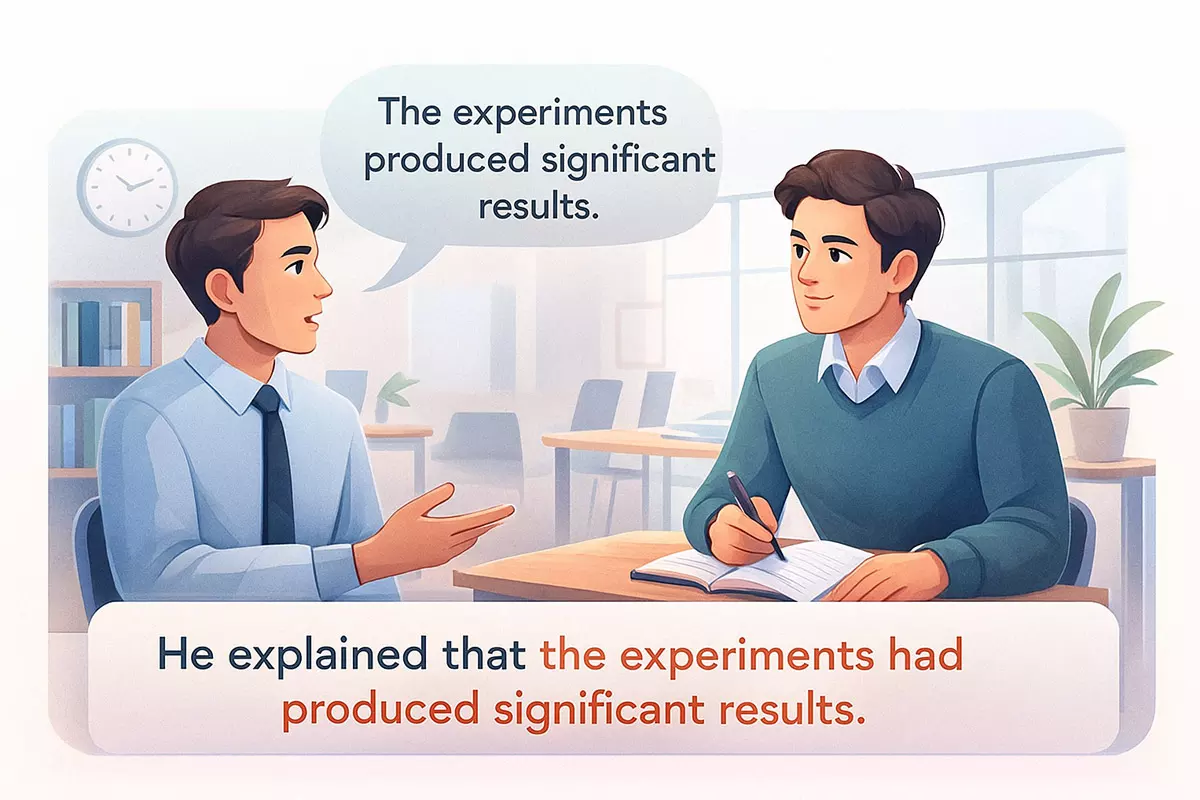 The article reviews basic backshifting rules, explains how to report complex sentences with several clauses, and discusses shifts in time, modality, and aspect. It also covers pronoun tracking and when backshifting is optional, with practice exercises included.
Mastering the ability to accurately convey complex statements from others, particularly those with multiple clauses, is a challenging but vital skill for advanced English learners. This article examines effective strategies for shifting tenses and restructuring layered sentences, providing practical guidance to help you navigate intricate forms of indirect speech with greater confidence and clarity. By applying these techniques, you will become more adept at expressing nuanced ideas that originate from various sources.
Review of basic backshifting rules
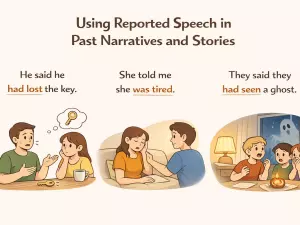
Understanding how verb tenses shift when moving from direct to indirect speech is essential for mastering complex reported speech. This process, called backshifting, ensures that statements remain accurate and consistent when reporting what someone else has said. Let’s revisit the core principles that govern these shifts, as they form the foundation for more advanced techniques.
When and why does backshifting occur?
Backshifting typically happens when the reporting verb (such as "said" or "told") is in a past tense. In these cases, verbs in the original (direct) speech are generally shifted one step back in time in the reported version. This reflects the time difference between when the original statement was made and when it is being reported.
Common tense changes in reported speech
Below is a summary of the most frequent tense transformations. These shifts help maintain clarity and sequence of events when relaying what someone else has said.
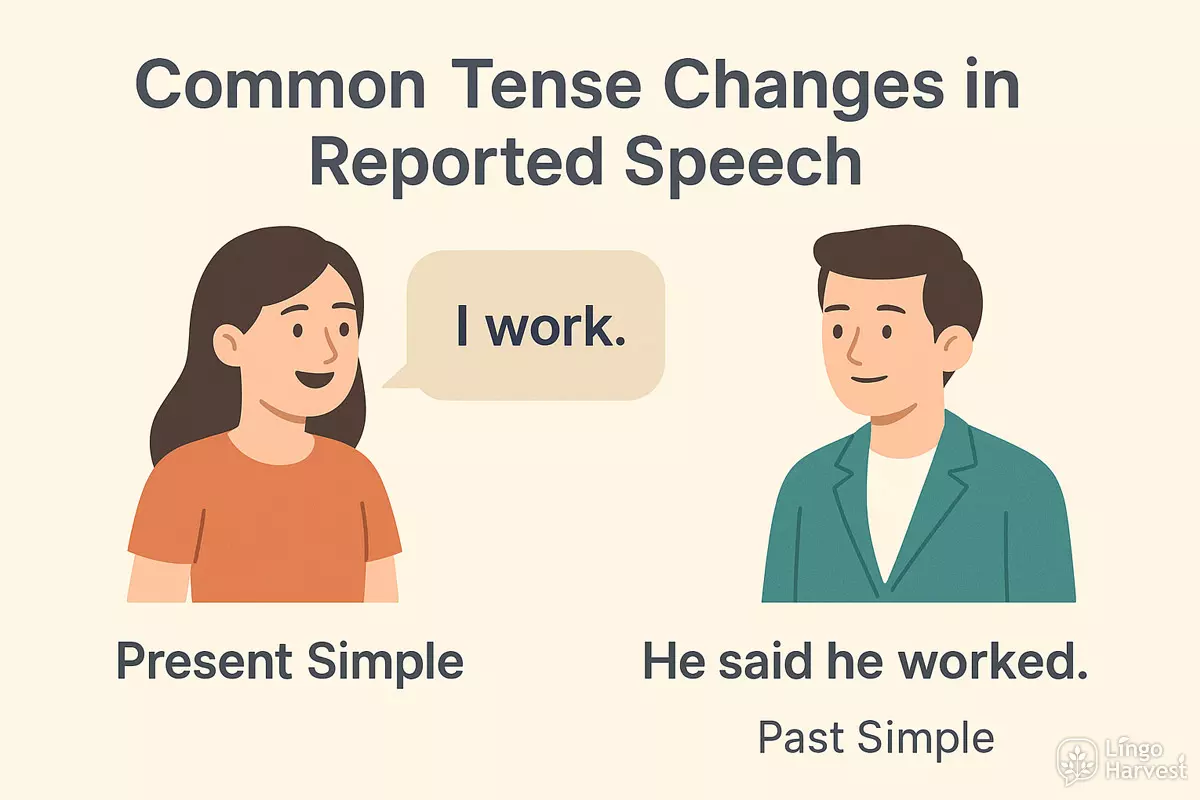
| Direct Speech (Original) | Reported Speech (Backshifted) |
|---|---|
| Present Simple "I work." |
Past Simple He said he worked. |
| Present Continuous "She is reading." |
Past Continuous She said she was reading. |
| Present Perfect "They have arrived." |
Past Perfect They said they had arrived. |
| Past Simple "He left." |
Past Perfect She said he had left. |
| Past Continuous "I was waiting." |
Past Perfect Continuous He said he had been waiting. |
| Will "I will call." |
Would She said she would call. |
| Can "We can help." |
Could They said they could help. |
| May "I may leave." |
Might He said he might leave. |
| Must "You must go." |
Had to She said I had to go. |
Other key points to remember
- Backshifting is usually optional if the reporting verb is in the present, or the information is still true.
- Time expressions often change: today → that day, yesterday → the day before, now → then.
- Modal verbs like could, might, should, and would typically remain unchanged.
- Imperatives usually become infinitives: "Sit down" → He told me to sit down.
- Pronouns and possessives must be adjusted to fit the new speaker and listener roles.
Quick practice: Identify the correct backshifted form
- Direct: "I am tired," she said.
Reported: She said she ______ tired. - Direct: "They have finished," he said.
Reported: He said they ______ finished. - Direct: "I will help," Tom said.
Reported: Tom said he ______ help. - Direct: "We are studying," they said.
Reported: They said they ______ studying. - Direct: "I bought a new phone," she said.
Reported: She said she ______ a new phone. - Direct: "We can start now," they said.
Reported: They said they ______ start then. - Direct: "I have seen this movie," he said.
Reported: He said he ______ seen that movie. - Direct: "I am cooking dinner," Mary said.
Reported: Mary said she ______ cooking dinner. - Direct: "We will travel tomorrow," they said.
Reported: They said they ______ travel the next day. - Direct: "I must finish this today," he said.
Reported: He said he ______ finish it that day.
Show answers
- was
- had
- would
- were
- had bought
- could
- had
- was
- would
- had to
Reporting complex sentences with several clauses
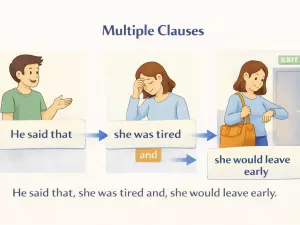
When dealing with sentences that contain multiple clauses—such as combinations of main and subordinate clauses, conditional structures, or embedded questions—accurately shifting tenses and pronouns becomes crucial. Each part of the original statement may require its own backshifting, and it’s important to maintain logical relationships between clauses.
Key considerations for multi-clause indirect speech
- Carefully identify each clause: main, subordinate (e.g. because, if, when), relative, or reported question.
- Apply backshift rules to all verbs where necessary, not just the first verb.
- Adjust time expressions, pronouns, and modal verbs consistently in each clause.
- Preserve the original meaning and connections (cause, result, contrast, etc.) between clauses.
- Be mindful of exceptions: some clauses (like those expressing universal truths or unchanging facts) may not shift tense.
Examples: Step-by-step backshifting
Let’s look at how to transform sentences with multiple clauses into reported speech, keeping all the relationships intact:
- Direct: “If you finish your homework before I arrive, we can watch a movie together,” she said.
Reported: She said that if I finished my homework before she arrived, we could watch a movie together. - Direct: “I will call you when I get home because I want to talk about the project,” he told me.
Reported: He told me that he would call me when he got home because he wanted to talk about the project. - Direct: “Although it’s raining, I am going to the store, and I’ll buy some bread,” she said.
Reported: She said that although it was raining, she was going to the store and she would buy some bread. - Direct: “Can you tell me where you have put the keys, since I need them before I leave?” he asked.
Reported: He asked if I could tell him where I had put the keys, since he needed them before he left. - Direct: “Even though I didn’t like the food, I ate it because I was hungry,” she confessed.
Reported: She confessed that even though she hadn’t liked the food, she had eaten it because she had been hungry. - Direct: “We will go out unless it starts raining,” they said.
Reported: They said that they would go out unless it started raining. - Direct: “If you see John when you visit London, tell him I’m waiting for his call,” she said.
Reported: She asked me to tell John she was waiting for his call if I saw him when I visited London. - Direct: “I don’t know why she left, but I hope she comes back soon,” he said.
Reported: He said that he didn’t know why she had left, but he hoped she would come back soon. - Direct: “Whenever I travel, I feel nervous, which makes me pack early,” she explained.
Reported: She explained that whenever she travelled, she felt nervous, which made her pack early. - Direct: “Since it’s late and you’re tired, you should go to bed now,” he suggested.
Reported: He suggested that since it was late and I was tired, I should go to bed then.
Common patterns and backshifting strategies
Complex sentences often combine several patterns. Below is a structured overview of typical transformations:
| Direct Speech Pattern | Backshifted Reported Speech |
|---|---|
| If + present, will + base | If + past simple, would + base |
| When + present, present | When + past simple, past simple |
| Because + present perfect | Because + past perfect |
| Although + present continuous, will + base | Although + past continuous, would + base |
| Reported question (present perfect) | Reported question (past perfect) |
| Universal truth (present simple) | Often remains present simple |
Tips for mastering multi-clause indirect speech
- Break down long sentences into component clauses before transforming.
- Double-check tense consistency throughout the reported sentence.
- Watch out for relative clauses and embedded questions—they need their own shifts.
- Practice with authentic examples to build fluency in handling layered statements.
Mastering these techniques ensures clarity and accuracy when relaying information that contains several connected ideas or conditions.
Shifts in time, modality, and aspect
When reporting speech that contains multiple clauses, careful attention to changes in verb tense, modal verbs, and grammatical aspect is essential. These adjustments, often called "backshifting," ensure that the reported version accurately reflects the original meaning, especially when the reporting verb is in the past.
Time Shifts: Adjusting Verb Tense
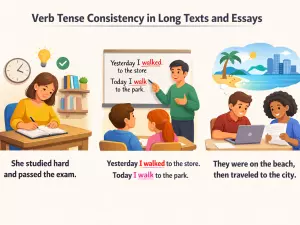
Backshifting typically involves moving verbs one tense back in time. For example, present simple becomes past simple, and present perfect becomes past perfect. In multi-clause sentences, each clause may require a different adjustment depending on its own temporal context. This is especially important when clauses are linked with conjunctions like "because," "if," or "when."
- Direct: "I am leaving because I feel sick." → Reported: He said he was leaving because he felt sick.
- Direct: "She has finished the report, so she can relax." → Reported: He said she had finished the report, so she could relax.
- Direct: "If it rains, we will cancel the picnic." → Reported: They said that if it rained, they would cancel the picnic.
- Direct: "I will call you after I arrive." → Reported: She said she would call me after she arrived.
Modality: Shifting Modal Verbs
Modal verbs often change form in reported speech. "Will" becomes "would," "can" becomes "could," and "may" becomes "might." Some modals, like "should" and "must," may remain unchanged or shift depending on context. In multi-clause sentences, modals in subordinate clauses also need adjusting.
- Direct: "You can stay if you want." → Reported: He said I could stay if I wanted.
- Direct: "She will help when she can." → Reported: They said she would help when she could.
- Direct: "He may come if he finishes early." → Reported: She said he might come if he finished early.
- Direct: "You must leave after the show ends." → Reported: He said I must leave after the show ended.
Aspect: Handling Perfect and Progressive Forms
When reporting speech, perfect and continuous (progressive) aspects often shift as well. Present perfect generally becomes past perfect, and present continuous becomes past continuous. This can become complex in sentences with several clauses, each with its own aspect.
| Direct Speech | Reported Speech |
|---|---|
| "I am working while he is sleeping." | She said she was working while he was sleeping. |
| "They have been waiting because the bus hasn't arrived." | He said they had been waiting because the bus hadn't arrived. |
| "She has already eaten when I called." | He said she had already eaten when he called. |
| "We will have finished before you return." | She said they would have finished before I returned. |
Key Points for Multi-Clause Backshifting
- Each clause may require its own tense, modal, and aspect adjustment.
- Time expressions ("today," "now," "tomorrow") often need to be adapted ("that day," "then," "the next day").
- Maintain logical sequence and clarity, especially with conditional or causal clauses.
- Check for exceptions: universal truths and habitual actions sometimes remain unchanged.
Pronoun and reference tracking in long reports
Managing pronouns and references becomes increasingly complex as reported speech stretches across multiple clauses or paragraphs. Keeping track of who is being referred to, what objects are involved, and the timeline of events is essential for clarity—especially when the original speaker, listener, or context shifts throughout the report.
Common challenges with referential clarity
Long, multi-layered reports often involve several characters and objects. Ambiguous pronoun use can confuse the reader about who said or did what. For example, a sentence like "He told her that she needed to finish it before they arrived" can become unclear if the antecedents for "he," "her," "she," "it," and "they" are not established or maintained consistently.
Strategies for accurate reference tracking
- Restate names at critical junctures, especially after several sentences using pronouns.
- Introduce or reintroduce referents when context changes (e.g., new speakers, locations, or topics).
- Use descriptive noun phrases ("the manager," "her colleague") to reduce ambiguity.
- Vary sentence structure to avoid repetitive pronoun chains.
- Clarify with short parenthetical explanations: (Anna), (the project).
- Maintain tense and aspect consistency for temporal references.
- Break up overly complex sentences into smaller units.
- Check for “dangling” pronouns that lack clear antecedents.
- In written reports, consider using formatting (italics, bold) for emphasis if needed.
- When reporting speech within speech, clarify each speaker’s identity explicitly.
- Use context clues to reinforce reference (e.g., “as mentioned earlier…”).
- Balance between repetition for clarity and conciseness for readability.
Examples of reference management
Below is a table comparing ambiguous and clear reference handling in extended reported speech. Notice how strategic restatement and explicit phrasing improve understanding.
| Ambiguous Reference | Clear Reference |
|---|---|
| She told her that she would call when she arrived. | Maria told Anna that Maria would call Anna when Maria arrived. |
| He said he finished it, but they didn’t believe him. | John said he finished the report, but the managers didn’t believe John. |
| After he spoke to her, she left before he could explain. | After the supervisor spoke to the assistant, the assistant left before the supervisor could explain. |
| They told him to meet them after work, but he forgot. | The team told Mark to meet the team after work, but Mark forgot. |
Checklist for reviewing long reports
- ✅ Double-check every pronoun for a clear, recent antecedent.
- ✅ Ensure that shifts in speaker or context are clearly marked.
- ✅ Watch for repeated objects or people and clarify if their roles change.
- ✅ Read the report aloud to catch confusing references.
- ✅ Ask a peer to review for potential ambiguity.
Through careful attention to reference detail and structured strategies, writers can ensure that even the most complex reported speech remains transparent and easy to follow.
Where backshifting is optional or not used
Backshifting, while a standard practice in reported speech, is not always required. In several contexts, especially with certain types of verbs, time references, or general truths, English allows speakers to maintain the original tense. This flexibility often depends on whether the reported information is still true or relevant at the time of reporting, or if the reporting verb is in the present, rather than the past.
Situations Allowing No Backshift
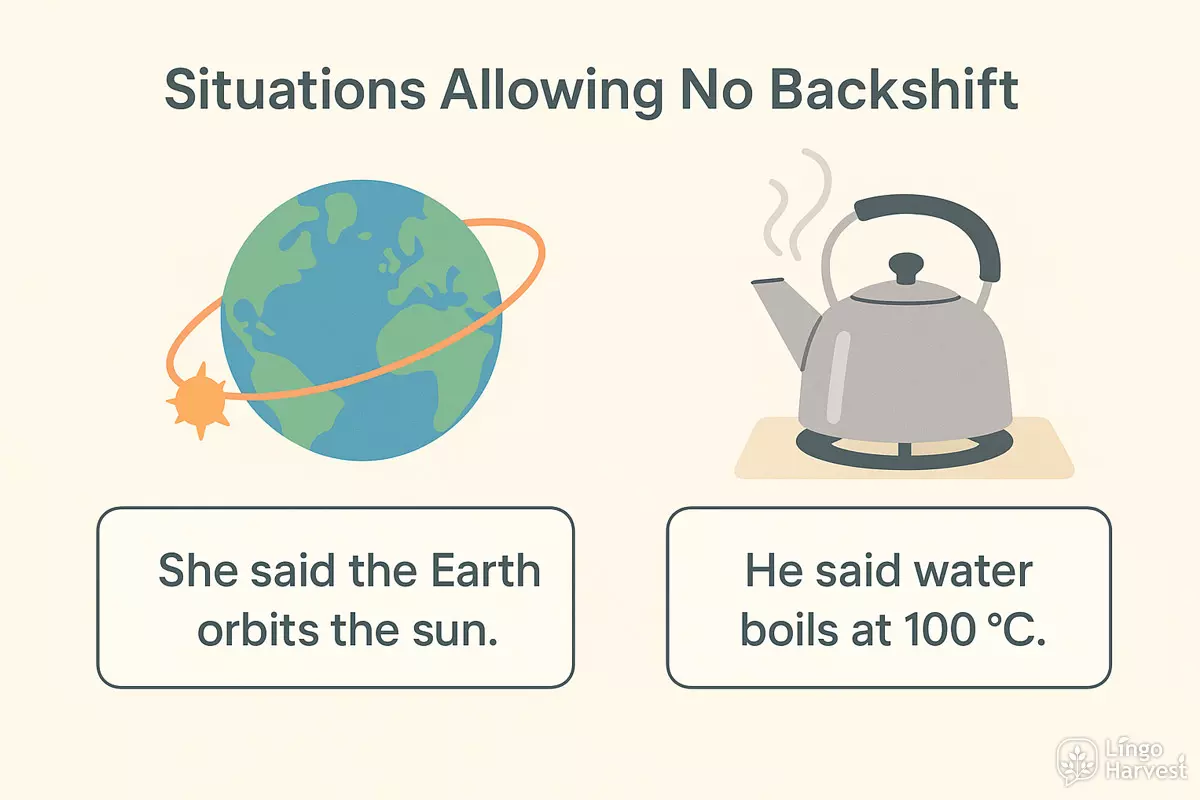
- Universal truths: Facts that are always true do not require tense change.
She said the Earth orbits the sun. - General statements: Widely accepted ideas or habitual actions often retain their tense.
He said water boils at 100°C. - Reporting verb in the present: If the reporting verb is present, keep the original tense.
He says he likes jazz. - Unchanged situations: If the situation reported is still true, backshifting can be skipped.
She said she lives in Paris. - Recent speech: When reporting something just said, speakers often keep the tense.
He just said he is tired. - Modal verbs: Some modals (e.g., "might," "should," "would") do not change.
She said she might come later. - Conditional sentences: Mixed conditionals or second conditionals typically do not backshift.
He said if he won the lottery, he would travel the world. - Direct quotes: When quoting directly, tenses remain unchanged.
She said, "I feel sick." - Formal or written reports: In scientific or journalistic writing, original tense is often retained for accuracy.
- Timeless literature or stories: When reporting from classic texts, present tense is often kept.
Summary of Optional Backshifting Patterns
| Reporting Context | Backshifting Usage |
|---|---|
| Universal facts or general truths | Usually no backshift (tense stays the same) |
| Present reporting verb ("says," "claims") | Original tense often kept |
| Modal verbs (might, should, would) | No change in tense |
| Situations still true at reporting time | Optional: either keep or backshift |
| Direct quotations | No backshift (exact words reported) |
Points to Remember
Choosing whether to shift tenses depends on the meaning you want to convey. If the information remains valid or is a permanent truth, keeping the original tense makes your report clearer and more precise. However, in narrative contexts or when emphasizing the time difference, shifting the tense can be more appropriate. Always consider the context and your communicative goal.
Practice: convert multi-sentence direct speech to reported speech
Transforming multi-sentence quotations into reported speech requires careful attention to verb tense backshifting, pronoun changes, and time references. This practice section will help you apply advanced techniques to convert complex direct speech into fluid, accurate reported statements.
Step-by-step transformation tips
- Backshift all verbs where appropriate (e.g., present simple → past simple).
- Adjust pronouns to match the perspective of the reporting speaker.
- Rephrase time expressions (e.g., “today” → “that day”).
- Link multiple clauses using conjunctions (and, but, because, etc.) or relative pronouns (who, which, that).
- Preserve logical sequence across sentences for clarity.
Common patterns in multi-clause reported speech
- Direct: “I am leaving now. I will call you when I arrive.”
Reported: She said (that) she was leaving then and would call me when she arrived. - Direct: “We haven’t finished the project. The deadline is tomorrow.”
Reported: They said they hadn’t finished the project and that the deadline was the next day. - Direct: “You must study harder. Otherwise, you will fail the exam.”
Reported: He told me that I had to study harder or I would fail the exam.
Exercise: Rewrite these direct quotations
- “I can’t come to the meeting. I have another appointment, and I don’t think I’ll be done in time.”
- “We are moving next month. Our new house is closer to my office.”
- “I’ve lost my keys. I don’t know where they are, but I think I left them at the café.”
- “You should take an umbrella. It looks like it’s going to rain, and I don’t want you to get wet.”
- “My friend called me yesterday. She said she had good news and wanted to meet.”
- “I’m studying for my exams. I need more time, and I might ask for help.”
- “We bought a new laptop. It’s faster than the old one, and we love it.”
- “I will visit my parents tomorrow. They asked me to come earlier.”
- “The train is delayed. I’m not sure when it will arrive.”
- “I’m feeling sick today. I think I should stay home and rest.”
Show answers
- She said she couldn’t come to the meeting because she had another appointment and didn’t think she would be done in time.
- They said they were moving the following month and that their new house was closer to her office.
- He said he had lost his keys, didn’t know where they were, but thought he had left them at the café.
- She told me that I should take an umbrella, as it looked like it was going to rain and she didn’t want me to get wet.
- He said his friend had called him the previous day and had said she had good news and wanted to meet.
- He said he was studying for his exams, needed more time, and might ask for help.
- They said they had bought a new laptop, that it was faster than the old one, and that they loved it.
- He said he would visit his parents the next day because they had asked him to come earlier.
- She said the train was delayed and that she wasn’t sure when it would arrive.
- He said he was feeling sick that day and thought he should stay home and rest.
Signal words: Time and place changes
- now → then
- today → that day
- tomorrow → the next day / the following day
- yesterday → the day before / the previous day
- here → there
- this/these → that/those
Spot the errors: Which sentences use reported speech incorrectly?
- He said that he is going to the gym and he will call me later.
- She told us that she had finished the work and would send the report soon.
- They said they are hungry and they want to eat now.
- He explained that he couldn’t attend because he was ill.
- Maria said that she is working on the project and she will finish it today.
- The teacher told us that the exam would start at 9 a.m.
- Tom said he has never been to London before.
- They mentioned that they were planning a trip and would invite us.
- She said she forgot the keys and she can’t open the door.
- He told me that he was busy and needed more time.
Show answers
- 1 — incorrect (should be: *was going* / *would call*)
- 3 — incorrect (should be: *were hungry* / *wanted to eat then*)
- 5 — incorrect (should be: *was working* / *would finish it that day*)
- 7 — incorrect in most contexts (backshift usually required: *had never been*)
- 9 — incorrect (should be: *couldn’t open the door*)