Reported Speech with Multiple Clauses Explained

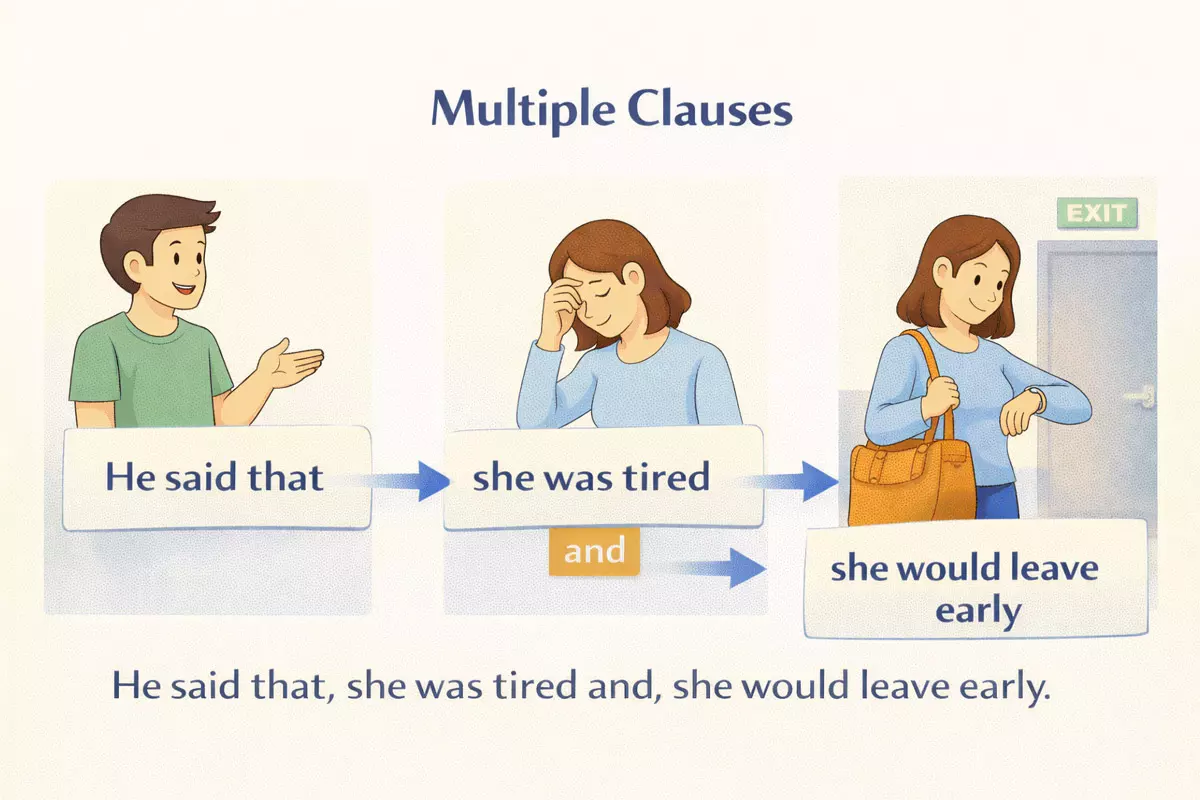 Here we how to report sentences with multiple clauses, focusing on tense shifts between main and subordinate clauses, keeping pronouns and references consistent, and avoiding common structural problems for clarity in complex sentences.
Turning direct statements into indirect ones can be challenging, particularly when multiple ideas are combined in a single sentence. Mastering the use of reported speech in complex, multi-part sentences is important for ensuring clarity and precision in communication. By learning how to restructure such sentences correctly, you can convey the original message faithfully while adapting it to the context. This skill is valuable in both spoken and written English, as it helps avoid misunderstandings and improves the flow of information.
What multiple clauses are in reported speech
When using indirect speech, it’s common to report sentences that contain more than one clause. These combinations can include statements with additional information, reported questions with embedded clauses, or sentences where cause and effect, contrast, or conditions are expressed. Understanding how to handle such structures is crucial for accurate and natural reporting.
Types of Clauses in Indirect Speech
Multiple clauses in reported statements often include combinations such as main clauses with subordinate (dependent) clauses. Here are some typical scenarios:
- Reported statements with that-clauses and relative clauses
- Questions containing if/whether clauses and indirect questions
- Sentences using because, although, when, etc., for reasons, contrast, or time
- Conditionals introduced by if or unless
- Sentences with more than one reported action or thought
Common Patterns and Examples
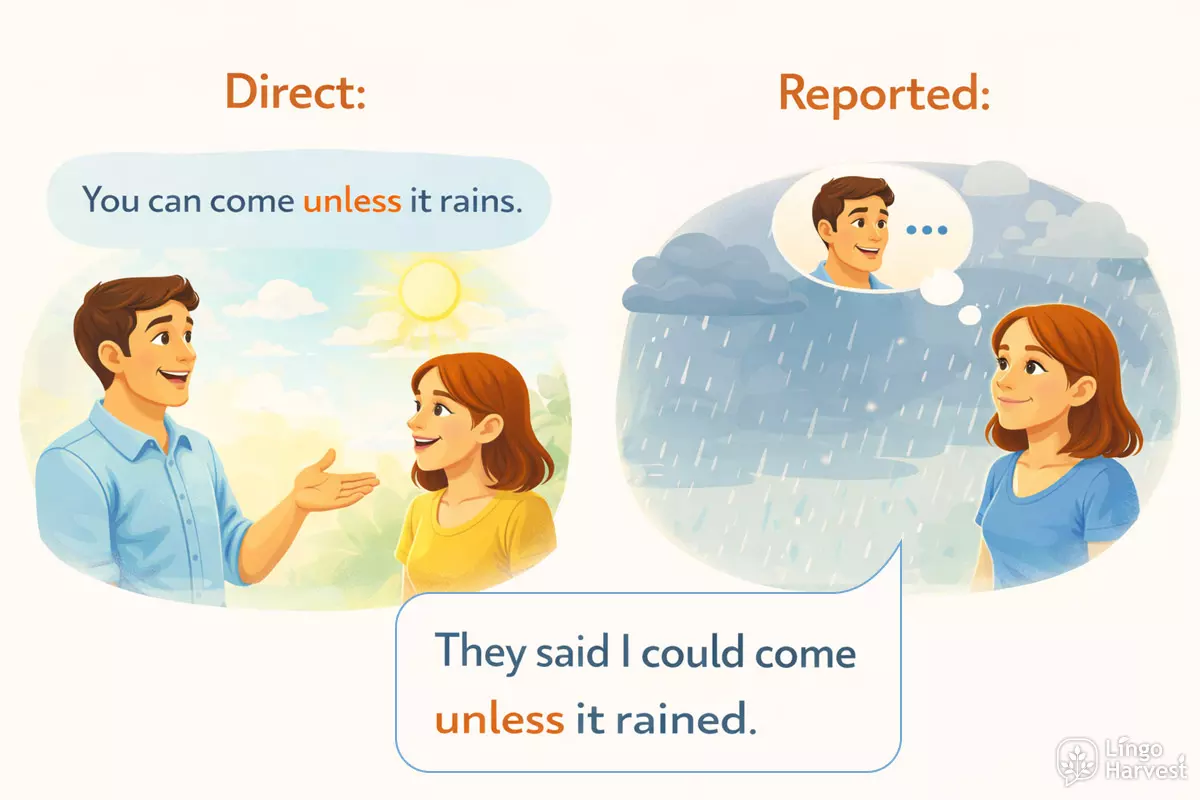
Let’s look at how complex sentences are transformed in reported speech. The table below shows some common forms and how they change when reported:
| Direct Speech | Reported Speech |
|---|---|
| "I will call you when I arrive." | He said he would call me when he arrived. |
| "If you finish early, you can leave." | She said that if I finished early, I could leave. |
| "She is the person who helped me." | He said she was the person who had helped him. |
| "Why did you leave before the meeting ended?" | He asked why I had left before the meeting had ended. |
| "You can come unless it rains." | They said I could come unless it rained. |
Tips for Reporting Sentences with Multiple Clauses
- Adjust verb tenses in all clauses, not just the main one.
- Keep word order for indirect questions (no auxiliary inversion).
- Use reporting verbs (say, tell, ask, explain, etc.) as appropriate for the type of clause.
- Pronouns and time expressions may need to change in each clause.
- Maintain the logical relationships (cause, contrast, condition) between clauses.
Handling multiple clauses in indirect speech requires careful attention to sequence of tenses, pronoun shifts, and the meaning carried by conjunctions. Mastering these skills makes your reported speech clear and accurate, especially in formal writing or storytelling.
Reporting main and subordinate clauses
When reporting speech that includes more than one clause, it’s important to identify the relationship between the main clause and any subordinate (dependent) clauses. In indirect or reported speech, both types of clauses typically undergo changes in verb tense, pronoun, and sometimes word order. The structure can become more complex, especially in sentences with multiple layers of information.
Understanding main and subordinate clauses in reported speech
The main clause contains the primary statement or question, while the subordinate clause provides additional detail. In reported speech, both may need to be adjusted. For example, when the original sentence is: “She said, ‘If it rains, I will stay home,’” the entire conditional sentence must be shifted to match reported speech conventions.
Common patterns and changes
- Verb tenses in both the main and subordinate clauses usually shift back one step (past simple, past perfect, etc.).
- Pronouns are changed to fit the perspective of the reporter.
- Time expressions often shift (e.g., ‘today’ becomes ‘that day’).
- If the original sentence uses a modal verb, the modal may also need to change (e.g., ‘will’ to ‘would’).
- Conditional sentences (if-clauses) require careful adjustment of both clauses.
- Questions embedded within statements need to be rephrased as statements, not direct questions.
- Relative clauses (“who,” “which,” “that”) usually remain but may have pronoun or tense changes.
- Reported commands (imperatives) use structures like ‘told me to...’ or ‘asked me not to...’
- ‘That’ is often added to connect clauses, though it can sometimes be omitted in informal speech.
- Subordinate clauses starting with “if” or “whether” are common in reported yes/no questions.
- Reported speech with multiple subordinate clauses may require several adjustments within the same sentence.
- Complex sentences with both time and reason clauses (“because,” “when,” “after”) need each clause checked for changes.
- Direct speech with multiple clauses can result in long, nested reported sentences.
Examples: Direct to Reported Speech
| Direct Speech | Reported Speech |
|---|---|
| “I know that you are coming because you said so.” | He said that he knew that I was coming because I had said so. |
| “If you finish your work, you can go out,” she said. | She said that if I finished my work, I could go out. |
| “When he arrives, tell him I’m waiting,” Tom told her. | Tom told her to tell him when he arrived that he was waiting. |
| “I will call you if I have time,” John said. | John said that he would call me if he had time. |
| “Because you were late, we started without you,” they explained. | They explained that because I had been late, they had started without me. |
Tips for accuracy
- Always check each verb for correct tense shift.
- Review all pronouns to ensure they match the speaker and listener appropriately.
- Look for multiple clauses and adjust each one as needed.
- Pay attention to time and place words—they often need to change in reported speech.
Mastering the reporting of sentences with several clauses will help you convey complex statements clearly and accurately. Practice with varied examples to become more confident in handling both main and subordinate structures in indirect speech.
Tense relationships between clauses
Understanding how verb tenses interact in reported speech is essential when sentences contain more than one clause. In these cases, the main reporting verb (such as said, told, or asked) often determines the tense shifts that occur in subordinate clauses. However, the rules can be nuanced, especially with complex sentences or when the information in the subordinate clause is still true at the time of reporting.
How the Reporting Verb Influences Tense
When the reporting verb is in the past tense, the verbs in the following clauses usually shift back in time (known as backshifting). If the reporting verb is present or future, the original tenses in the subordinate clauses are often retained. This backshifting can affect both the main and subordinate clauses, depending on their relationship.
Common Patterns in Multi-Clause Reporting
- If the original statement is a fact or general truth, the tense in the subordinate clause may stay the same.
- Time expressions often change to reflect the new context (e.g., today → that day).
- Modal verbs like could, would, might, and should typically remain unchanged.
- Conditional sentences may require both clauses to shift tenses, especially with hypothetical statements.
- When reporting questions, the word order and tense of both clauses may change.
- Relative clauses within reported speech usually follow the same tense shift as the main clause.
- Direct speech with multiple clauses can result in several tense changes in indirect speech.
- If the event in a subordinate clause still holds true, sometimes the tense is not shifted.
- Reported commands and requests often use infinitive forms, but any subordinate clause may still backshift.
- Verbs expressing necessity or advice in subordinate clauses (e.g., must, ought to) often remain unchanged.
- Statements about future events may see will change to would in both main and subordinate clauses.
- If the original clause contains a sequence of tenses, reported speech may preserve this sequence or shift all tenses back.
Sequence of Tenses: Examples
To clarify how tense relationships play out, here are some typical transformations in reported speech with multiple clauses:
| Direct Speech | Reported Speech |
|---|---|
| "I know that she is coming." | He said that he knew that she was coming. |
| "She said, 'If I finish early, I will call you.'" | She said that if she finished early, she would call me. |
| "They believe that the earth moves around the sun." | They believed that the earth moves around the sun. ✅ |
| "He said, 'When I arrive, I will let you know.' | He said that when he arrived, he would let me know. |
| "I thought that you were joking." | He said that he had thought that I had been joking. |
| "She said, 'You must finish your work before you go.' | She said that I must finish my work before I went. |
Special Cases and Exceptions
Not all clauses require a shift in tense. For example, universal truths and facts often keep their original tense in reported speech. Additionally, if the time relationship between the clauses remains unchanged, the subordinate clause may retain its tense even if the reporting verb is in the past.
- Universal truth: He said that water boils at 100°C.
- Ongoing state: She said that she lives in Paris.
- Reported question: She asked if I knew where he lived.
- Advice: He told me that I should see a doctor.
Being aware of these relationships helps to maintain clarity and accuracy when reporting complex statements, especially in academic and formal writing.
Pronoun and reference consistency
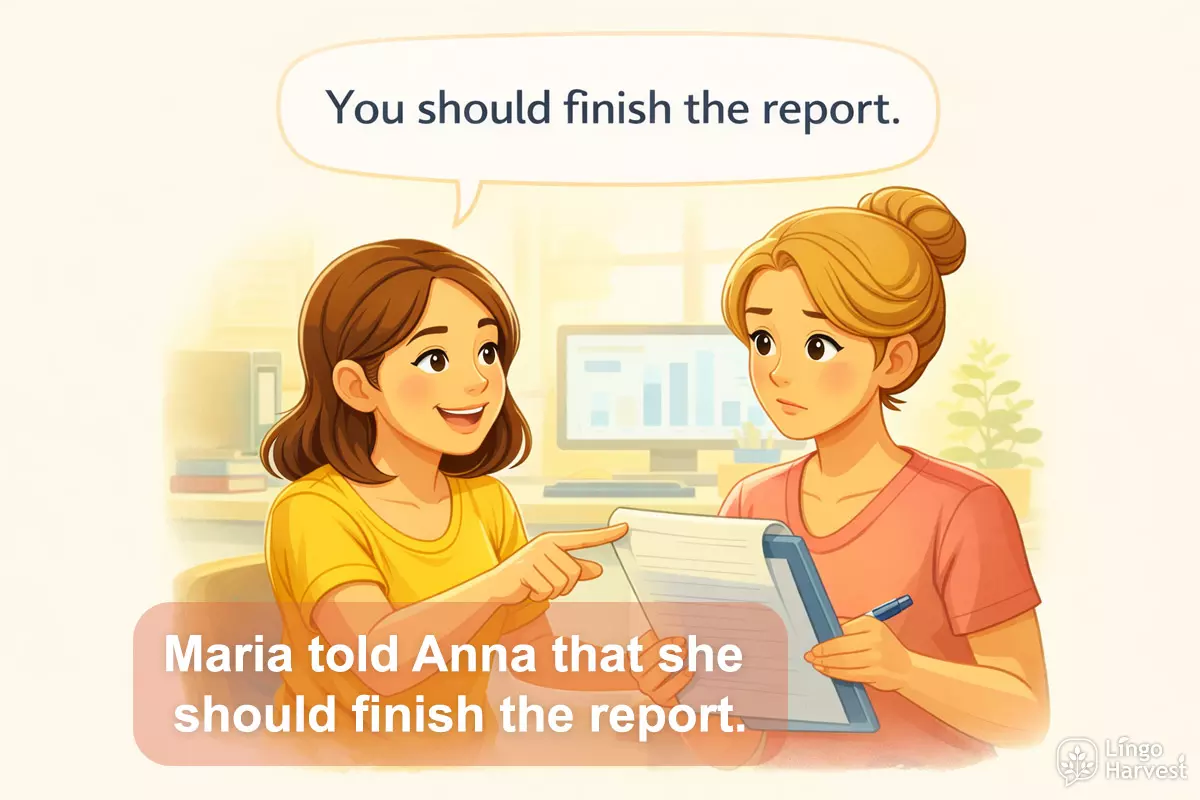
When reporting speech with multiple clauses, it's essential to maintain clarity by accurately tracking pronouns and references. Shifting from direct to indirect speech often means rethinking who or what each pronoun refers to, especially in longer or more complex sentences. Mismanaging these references can confuse readers or listeners about the subject, object, or even the timeline of the reported events.
Why reference clarity matters in reported speech
In multi-clause sentences, pronouns like he, she, they, or it can easily lose their connection to the original noun. Each time you introduce a new clause, double-check which person or thing each pronoun points to. If the reference is ambiguous, replace the pronoun with a clear noun or rephrase the sentence.
- He said that he would call when he arrived. (Who is "he" in each clause?)
- Maria told Anna that she should finish the report. ("She" could refer to Maria or Anna.)
- They promised they would help if it was necessary. ("They" and "it" need clear antecedents.)
- The teacher said the students should check their work before they submit it. (Does "they" refer to students or someone else?)
Common patterns and solutions
If your reported speech includes several clauses, pronoun consistency becomes even more important. Here are some practical strategies:
- Repeat the noun for clarity when two possible antecedents exist.
- Use descriptive phrases ("the manager," "the first team," etc.) instead of pronouns if confusion is likely.
- Rephrase sentences to avoid back-to-back pronouns.
- Introduce context before using a pronoun, especially in long passages.
Examples of pronoun shifts in reported speech
| Direct Speech | Reported Speech |
|---|---|
| "I will help you if you need it," Sarah said to Tom. | Sarah told Tom that she would help him if he needed it. |
| "We finished our work before they arrived," they said. | They said that they had finished their work before the others arrived. |
| "She thinks she can solve the problem herself," Mark explained. | Mark explained that she thought she could solve the problem herself. |
| "You must check your answers before you submit them," the teacher said. | The teacher said that students must check their answers before submitting them. |
| "They told us they would call us if they were late," Jane recalled. | Jane recalled that they had told her and her group that they would call if they were late. |
Tips for keeping references clear
- After transforming direct speech, read each clause and check if the reference is still obvious.
- Pay extra attention when both the speaker and listener are mentioned in the same sentence.
- Rewrite sentences where pronouns could refer to more than one noun.
- Remember: in long reported sentences, repeating a noun is better than risking confusion.
- Use context clues or add clarifying phrases when necessary.
By keeping a close eye on how pronouns and other references shift in reported speech, especially in sentences with multiple clauses, you ensure your writing is easy to follow and unambiguous.
Maintaining clarity in complex sentences
When you report speech that includes several clauses or ideas, it’s easy for meaning to become muddled. To keep your sentences understandable, focus on clear structure and logical sequencing. Breaking down information into digestible parts can help both writers and readers avoid confusion, especially when dealing with indirect speech that contains embedded questions, conditions, or explanations.
Strategies for Clear Multi-Clause Reported Speech
- Identify the main clause first: Start by determining who said what, then add supporting details or subordinate clauses.
- Keep reporting verbs close to the speaker: Place verbs like “said,” “asked,” or “explained” near the subject to anchor the sentence.
- Use conjunctions thoughtfully: Words like “because,” “although,” and “if” help signal how different clauses relate.
- Maintain consistent tense shifts: Ensure that all verbs follow the appropriate backshifting required in reported speech (e.g., present → past).
- Watch for pronoun reference: Make sure it’s always clear who “he,” “she,” or “they” refers to in each part of the sentence.
- Limit nesting: Avoid stacking too many clauses inside one another; two or three levels is usually enough.
- Use punctuation for clarity: Commas and conjunctions can help mark the beginning and end of embedded clauses.
- Paraphrase when necessary: If a direct transformation feels awkward, rephrase to clarify the relationships between ideas.
Common Patterns in Multi-Clause Reported Speech
Below are some typical sentence structures that arise when quoting speech with several clauses. These patterns can guide you in constructing clear, accurate indirect statements.
- He said (that) he would call me if he finished early.
- She explained why she hadn't attended the meeting although she knew it was important.
- They asked whether we could help them because they were lost.
- Maria told me that she was upset since her plans had changed.
- The teacher said that we should submit the assignment after we completed the reading.
- He wondered if I would join him when I finished work.
- She mentioned that she might move unless her job situation improved.
- Paul said that he would help provided that we asked him politely.
- They explained how they solved the problem so that others could understand.
- He admitted that he had made a mistake though he tried his best.
- The manager told us to call her if there were any issues.
- She promised that she would visit after her exams finished.
- The doctor advised that I rest since I was feeling unwell.
- He asked why I hadn't replied when he emailed me.
- They wondered whether we would attend if they invited us.
- My friend said that she was happy because she passed the test.
- The team explained what they had done before the meeting started.
- She insisted that I stay until she returned.
Visualizing Clause Relationships
Sometimes, seeing how clauses interact side by side can help clarify the reporting structure. Here’s a comparison of direct and reported speech involving multiple clauses:
| Direct Speech | Reported Speech |
|---|---|
| “If you finish your work, and if you have time, call me,” she said. | She said that if I finished my work and had time, I should call her. |
| “I will explain how I solved the problem because it was difficult,” he said. | He said that he would explain how he had solved the problem because it had been difficult. |
| “When you arrive, let me know since I’ll be waiting,” John said. | John asked me to let him know when I arrived since he would be waiting. |
| “Although I was tired, I finished the project because it was important,” she said. | She said that although she had been tired, she had finished the project because it was important. |
By paying attention to structure, verb tense, and clear pronoun reference, you can make even the most involved reported statements easy to follow for your audience.
Common structural problems
When working with reported speech that involves more than one clause, learners often run into a range of structural challenges. These issues can lead to confusion, loss of meaning, or ungrammatical sentences. Understanding and avoiding these typical missteps is crucial for clarity and accuracy in complex indirect speech.
Frequent mistakes with clause order and conjunctions
A major source of trouble is misplacing clauses or using the wrong connectors. In reported speech, especially with multiple clauses, keeping the logical flow and correct subordination is essential. For instance, mixing up "if" and "that" or omitting necessary conjunctions can drastically change the meaning.
- Forgetting to use "that" after reporting verbs (e.g., "He said he was coming" instead of "He said that he was coming")
- Confusing "if" for questions with "that" for statements
- Placing time or condition clauses incorrectly (e.g., "She said if she finished, she would call" vs. "She said that she would call if she finished")
- Using direct question word order inside reported speech (e.g., "He asked what did I want" instead of "He asked what I wanted")
- Omitting necessary connectors in compound sentences
Tense backshifting and pronoun confusion
Another stumbling block is the correct adjustment of verb tenses and pronouns, especially when several clauses are embedded. Learners sometimes forget to backshift all verbs or fail to update pronouns to fit the new perspective.
- Not backshifting tenses in subordinate clauses (e.g., "She said she is coming because she feels sick" instead of "She said she was coming because she felt sick")
- Mixing up pronouns, leading to ambiguity about who is being referred to
- Leaving some verbs in the present while others are correctly shifted
- Incorrectly using "my" or "your" instead of "her" or "his"
Problems with reporting questions and commands
Indirect questions and commands with multiple clauses can be tricky. Learners may keep the original question word order or use the imperative incorrectly, which disrupts meaning.
- Using question order after reporting verbs (e.g., "He asked where was I going" instead of "He asked where I was going")
- Failing to change imperatives to infinitives (e.g., "She told me close the door" instead of "She told me to close the door")
- Confusing reported requests with commands
Typical patterns leading to errors
Below is a table that outlines common error patterns alongside their correct forms. Recognizing these can help prevent frequent mistakes when dealing with multiple clauses in indirect speech.
| Incorrect Pattern | Correct Structure |
|---|---|
| He said if he will come, he calls me. | He said that if he came, he would call me. |
| She asked what do I want. | She asked what I wanted. |
| They told we to wait until they arrives. | They told us to wait until they arrived. |
| He said he is tired because he doesn’t sleep. | He said he was tired because he hadn’t slept. |
| I said her I will help if I can. | I told her I would help if I could. |
Summary of key trouble spots
- Incorrect clause sequencing
- Failure to shift all relevant tenses
- Pronoun mismatches
- Omitted or misused conjunctions
- Direct question order in indirect speech
- Imperatives not changed to infinitives
- Ambiguity due to unclear references
- Mixing direct and indirect speech structures
- Neglecting to backshift in embedded clauses
- Using inappropriate reporting verbs for the context
By watching for these pitfalls, learners can greatly improve their handling of complex reported speech structures.
Homework
Practice keeping pronouns, references, and clause structure clear in complex reported speech. Focus on pronoun consistency, correct tense shifts, and logical word order.
Exercise 1: Correct the pronouns and references
- He said that he would help him if he needed it. (speaker = John, listener = Mark)
- Maria told Anna that she had finished her report. (who finished?)
- They said they would call them when they arrived. (who will call whom?)
- The teacher said they must submit their work before they leave. (who is “they”?)
- Paul told Mike that he should check his email. (who should check?)
- She said that she would visit her after she finished her exams. (who visits whom?)
- They promised they would help if it was necessary. (what is “it”?)
- Anna said that she was proud of her because she passed the test. (who passed?)
- He explained that he had told him the truth earlier. (who told whom?)
- Jane said that she would meet her when she arrived. (who meets whom?)
Show answers
- John said that he would help Mark if Mark needed it.
- Maria told Anna that Anna had finished her report.
- They said they would call us when they arrived.
- The teacher said that the students must submit their work before they leave.
- Paul told Mike that Mike should check his email.
- She said that she would visit her friend after she finished her exams.
- They promised they would help if help was necessary.
- Anna said that she was proud of herself because she had passed the test.
- He explained that he had told his brother the truth earlier.
- Jane said that she would meet her sister when she arrived.
Exercise 2: Rewrite the sentences with correct structure and tense
- He said if he will arrive early, he calls me.
- She asked what did I want to do.
- They told us to wait until they arrives.
- He said he is tired because he doesn’t sleep well.
- I told her I help if I can.
- She explained that she is angry because he forgets her birthday.
- They asked where was we going after work.
- He promised he finishes the job when he has time.
- She said that she will call me when she arrives.
- They wondered if we are ready when they came.
Show answers
- He said that if he arrived early, he would call me.
- She asked what I wanted to do.
- They told us to wait until they arrived.
- He said he was tired because he hadn’t slept well.
- I told her I would help if I could.
- She explained that she was angry because he had forgotten her birthday.
- They asked where we were going after work.
- He promised he would finish the job when he had time.
- She said that she would call me when she arrived.
- They wondered if we were ready when they came.