Verb–Complement Patterns in Academic English: That-, Wh-, and -ing Clauses

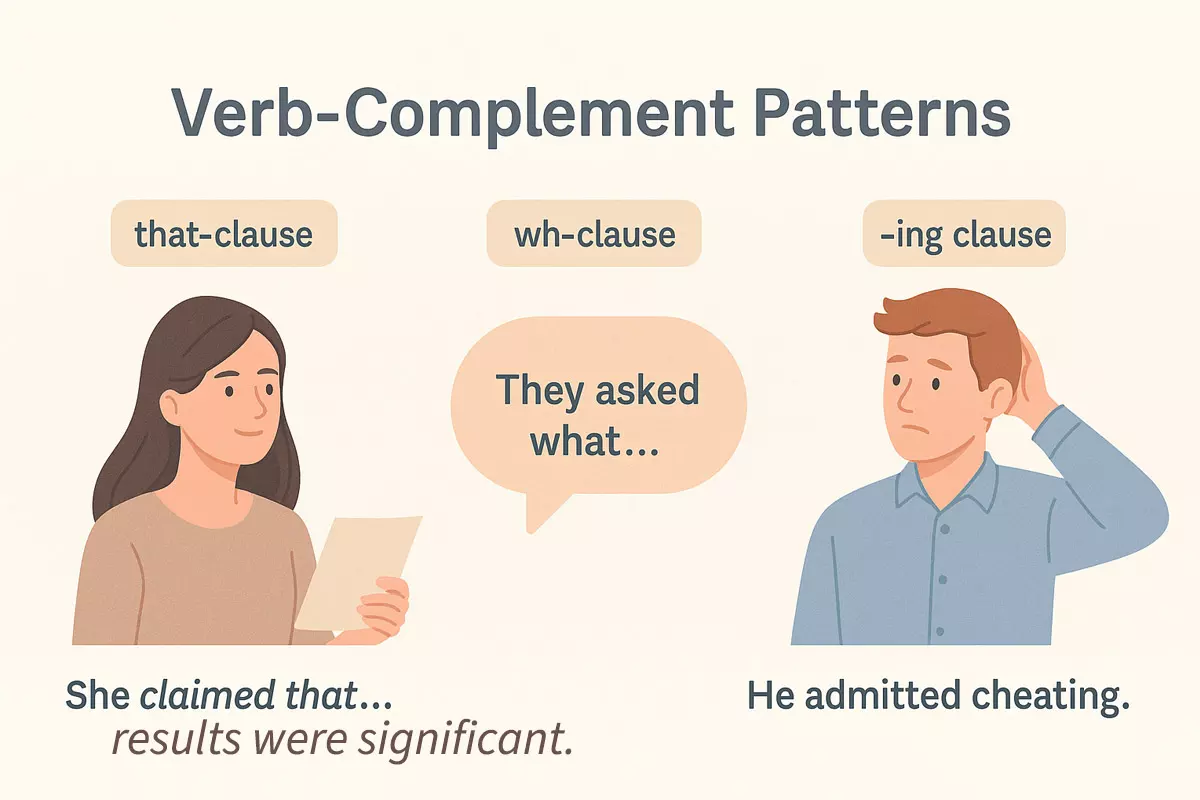 This article explains how academic verbs pair with that-clauses, wh-clauses, and -ing clauses. It highlights subtle meaning changes, offers advice for handling multiple complements, and provides practice matching verbs with their correct clauses.
Mastering academic English requires a solid understanding of how verbs interact with various clause types. By examining the connections between verbs and structures such as that-clauses, wh-clauses, and –ing forms, writers can recognize important patterns that contribute to clarity and precision in scholarly communication. Developing this awareness enables students and researchers to construct more effective arguments, avoid common grammatical errors, and enhance the overall quality of their academic writing.
Common academic verbs that take clauses
Many verbs frequently used in academic English are followed by entire clauses, rather than just nouns or noun phrases. These verbs often introduce that-clauses, wh-clauses, or -ing clauses as their complements, allowing writers to express complex arguments, report findings, or describe processes in detail. Recognizing which verbs commonly take clauses—and which type of clause each prefers—is essential for clear and precise academic writing.
Verbs commonly followed by that-clauses
That-clauses are especially useful for reporting statements, beliefs, or findings. Some of the most frequent verbs that introduce that-clauses in academic texts include:
- argue
- suggest
- claim
- report
- demonstrate
- indicate
- show
- assume
- conclude
- find
- believe
- note
- observe
- propose
- state
Example: The results indicate that the new method is effective.
Verbs typically taking wh-clauses
Wh-clauses are often used after verbs that introduce questions, uncertainty, or points of inquiry. Common choices include:
- explain
- discuss
- describe
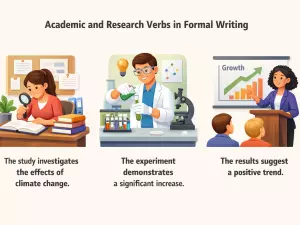
- investigate
- explore
- consider
- examine
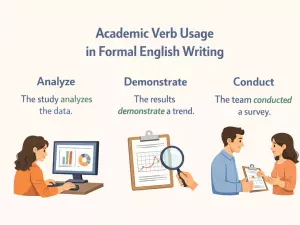
- analyze
- understand
- determine
- assess
- question
Example: The study explores how language influences perception.
Verbs that commonly take -ing clauses
Some verbs are regularly followed by a gerund (-ing form) clause, especially when referring to processes, actions, or experiences. Frequently encountered examples include:
- suggest
- recommend
- consider
- avoid
- admit
- discuss
- deny
- mention
- practice
- support
- appreciate
- anticipate
Example: The authors recommend using a mixed-methods approach.
Comparison of verbs by clause type
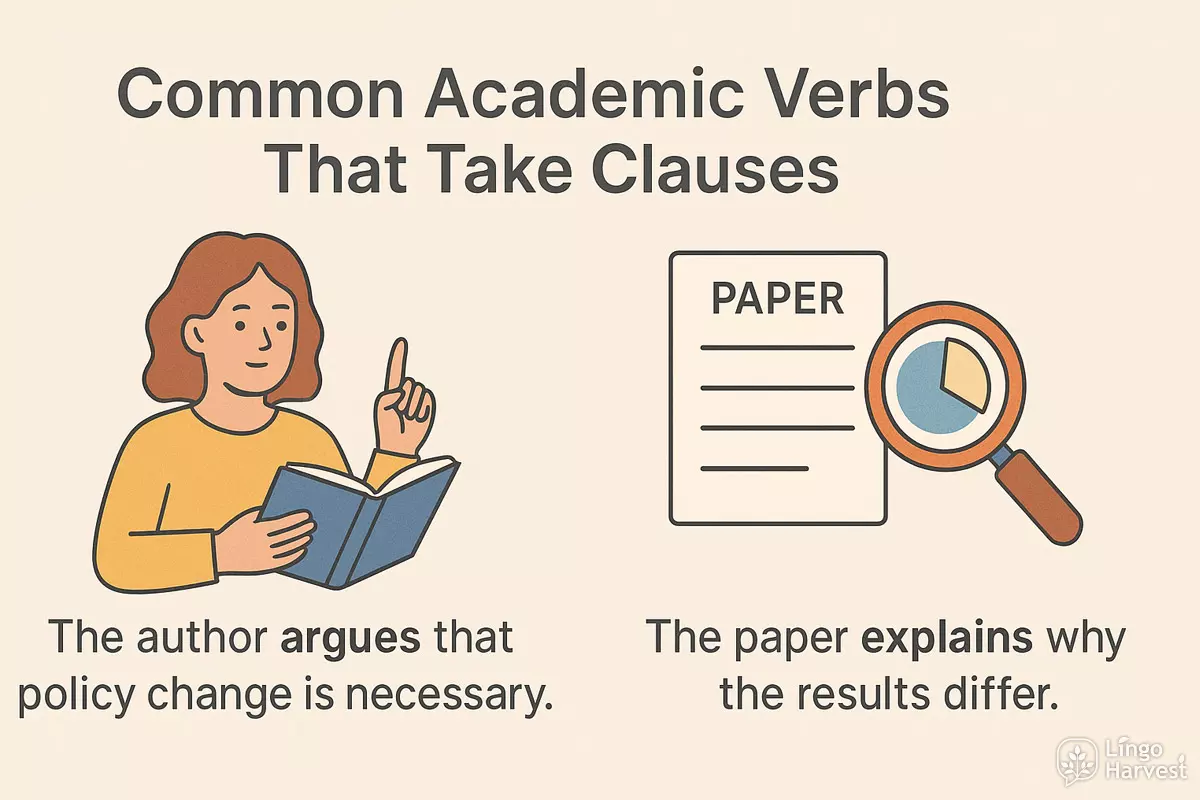
For a clearer overview, the table below summarizes selected academic verbs and the types of clauses they most often introduce:
| Verb | Typical Clause Type | Example |
|---|---|---|
| argue | that-clause | The author argues that policy change is necessary. |
| explain | wh-clause | The paper explains why the results differ. |
| recommend | -ing clause | Researchers recommend adopting new protocols. |
| demonstrate | that-clause | The data demonstrate that the hypothesis is supported. |
| consider | -ing or wh-clause | The team considered using alternative methods. |
| investigate | wh-clause | The project investigates how cells respond to stress. |
| suggest | that- or -ing clause | The findings suggest that further research is needed. |
| report | that-clause | Several studies report that outcomes have improved. |
Understanding which verbs permit or require a clause as their complement helps writers construct more nuanced and accurate arguments. Mastery of these patterns is a hallmark of effective academic communication.
That-clauses as verb complements
In academic English, clauses introduced by that frequently serve as complements to reporting, mental state, and evaluative verbs. These structures allow writers to present statements, claims, or beliefs attributed to various sources. The use of that-clauses increases precision by specifying the content of the verb, making them especially valuable in scholarly writing.
Common verbs followed by that-clauses
A wide range of verbs can take a that-clause as a complement. The choice of verb often signals stance, reporting, or logical relationships. Here are key verbs frequently encountered in academic texts:
- argue
- suggest
- claim
- believe
- assume
- demonstrate
- indicate
- note
- find
- show
- state
- acknowledge
- conclude
- predict
- recognize
- observe
- report
- reveal
Functions and nuances
That-clauses as complements offer several pragmatic functions. They can introduce evidence (Smith (2021) shows that...), summarize findings (The data suggest that...), or hedge claims (It is possible that...). Omitting that is sometimes possible in informal registers, but academic writing typically retains it for clarity.
Structural patterns
These clauses usually follow the verb directly, but passive constructions and anticipatory it are also common. The table below illustrates typical patterns:
| Pattern | Example |
|---|---|
| Main verb + that-clause | Researchers argue that climate change is accelerating. |
| Passive + that-clause | It is believed that the results are significant. |
| Anticipatory it + that-clause | It appears that the hypothesis was correct. |
| Reporting verb + noun + that-clause | The author claims in the article that the method is reliable. |
Usage notes
Writers should avoid overusing the same reporting verb for variety and precision. Additionally, while some that-clause complements can be omitted in spoken or informal writing, their inclusion in academic contexts supports clarity and formality. Understanding these patterns supports both comprehension and production of sophisticated academic prose.
Wh-clauses and -ing clauses after verbs
In academic English, writers frequently use complement clauses introduced by wh-words (such as what, how, why) and gerund clauses (with -ing forms) after certain verbs. These constructions allow for more nuanced and detailed explanations, supporting the complex argumentation typical of scholarly writing. Recognizing which verbs can take these complements—and how their meaning changes—is essential for producing clear, accurate sentences in formal contexts.
Wh-clauses as verb complements
Wh-clauses function as noun clauses, often providing information about an object, result, or process. After verbs like "explain," "describe," "investigate," or "discover," a wh-clause answers or elaborates on a question implied by the verb.
- The researchers examined how the process works.
- She did not specify which variables were tested.
- The study reveals why certain outcomes occurred.
- They discussed what the implications might be.
- He analyzed where the data originated.
- The report considers who should be involved.
- We questioned whether the results were valid.
- The team debated when to implement the solution.
-ing clauses after verbs
Gerund (-ing) clauses are used as objects after verbs that express mental processes, preferences, or communicative acts. They often refer to actions or states and can sometimes be interchangeable with that-clauses, but usually with a shift in nuance.
- They considered revising the methodology.
- The author suggests applying this framework.
- We recommend using a larger sample size.
- She avoided mentioning controversial topics.
- He admitted overlooking some data.
- The committee postponed making a decision.
- Students reported feeling confused.
- The study involved analyzing multiple sources.
- They discussed combining two approaches.
- Researchers denied misinterpreting the results.
Overview: Common verbs with wh- and -ing complements
Some verbs can take both wh-clauses and -ing clauses, while others favor only one type. The table below summarizes typical patterns for selected academic verbs.
| Verb | Wh-clause | -ing clause | Example |
|---|---|---|---|
| consider | ❌ Not standard | ✅ Yes | They considered revising the method. |
| explain | ✅ Yes | ❌ Not standard | He explained why the error occurred. |
| suggest | ❌ Rare | ✅ Yes | The author suggests applying this theory. |
| discover | ✅ Yes | ❌ Not standard | They discovered how the system operates. |
| discuss | ✅ Yes | ✅ Yes | We discussed what could be improved / combining methods. |
| avoid | ❌ Not standard | ✅ Yes | She avoided mentioning the issue. |
| analyze | ✅ Yes | ❌ Rare | He analyzed where the data came from. |
| recommend | ❌ Rare | ✅ Yes | We recommend using larger samples. |
Summary
Selecting between a wh-clause or -ing clause after a verb depends on both the verb’s meaning and academic convention. Mastery of these patterns helps writers build precise, varied, and sophisticated sentences, which is especially valuable in scholarly communication.
Subtle meaning differences between patterns
Academic English often gives writers a choice between that-clauses, wh-clauses, and -ing clauses as verb complements. These options are not always interchangeable; the selection can subtly shift the nuance or focus of a sentence. Understanding these distinctions helps writers convey precise meaning, especially in formal contexts.
Nuances of That-Clauses
That-clauses frequently present statements or beliefs as facts or propositions. Using a that-clause typically gives the complement a sense of objectivity or completeness. For example, "The results indicate that the hypothesis is valid" frames the hypothesis as a clear, testable statement.
Wh-Clauses and Their Implications
Wh-clauses introduce indirect questions or specify information. Choosing a wh-clause often signals uncertainty, inquiry, or the need for specification. For instance, "The study explores what factors influence learning" highlights an open question rather than a settled fact.
Subtle Differences with -ing Clauses
Using an -ing form as a complement tends to foreground processes, ongoing actions, or generalizations. An -ing clause can also make the action feel less definite or more abstract. For example, "The data suggest improving methods is necessary" implies a general recommendation, not a single, specific improvement.
| Pattern | Typical Usage | Example |
|---|---|---|
| That-clause | States facts, beliefs, or conclusions directly | The authors argue that the process is efficient. |
| Wh-clause | Raises questions, focuses on unknowns or details | The research examines how students respond. |
| -ing clause | Highlights ongoing actions, processes, or generalizations | The findings support adopting new strategies. |
| To-infinitive (for contrast) | Often indicates purpose or intention | The team plans to expand the sample size. |
Summary of Key Distinctions
- That-clauses present information as definite or established.
- Wh-clauses introduce elements of uncertainty or specificity.
- -ing clauses generalize, emphasize process, or reduce assertiveness.
- Choice of complement can subtly alter the perceived strength or scope of a claim.
- Writers may select a pattern to align with the intended degree of certainty or generality.
Careful attention to these distinctions allows academic writers to shape the tone and implications of their arguments more precisely.
Avoiding overload with multiple complements
When constructing sentences in academic English, writers often combine verbs with more than one type of complement, such as that-clauses, wh-clauses, or -ing clauses. While this flexibility can add nuance, it also increases the risk of convoluted or ambiguous structures. Careful management of these combinations is crucial to maintain clarity and coherence, especially in formal writing.
Challenges of Multiple Complementation
Combining several complements after a single verb can lead to lengthy, hard-to-follow sentences. Readers may struggle to identify which complement belongs to which verb, or how information is logically connected. For instance, blending a that-clause and an -ing clause after a reporting verb can obscure the intended meaning if not punctuated or ordered effectively.
Strategies to Maintain Clarity
To prevent confusion, academic writers can:
- Choose verbs that naturally take multiple complements (e.g., "inform," "remind," "advise").
- Use punctuation, such as commas, to separate clauses where possible.
- Rephrase to split complex sentences into two or more simpler ones.
- Prioritize the most relevant information by placing it closer to the main verb.
- Be consistent in the type of complements used (e.g., avoid mixing that- and wh-clauses unless necessary).
- Employ parallel structure for similar elements to aid readability.
- Rely on clear referencing (pronouns, noun phrases) to indicate relationships between ideas.
- Review sentences aloud to check for natural flow and logical progression.
Common Verb–Complement Combinations
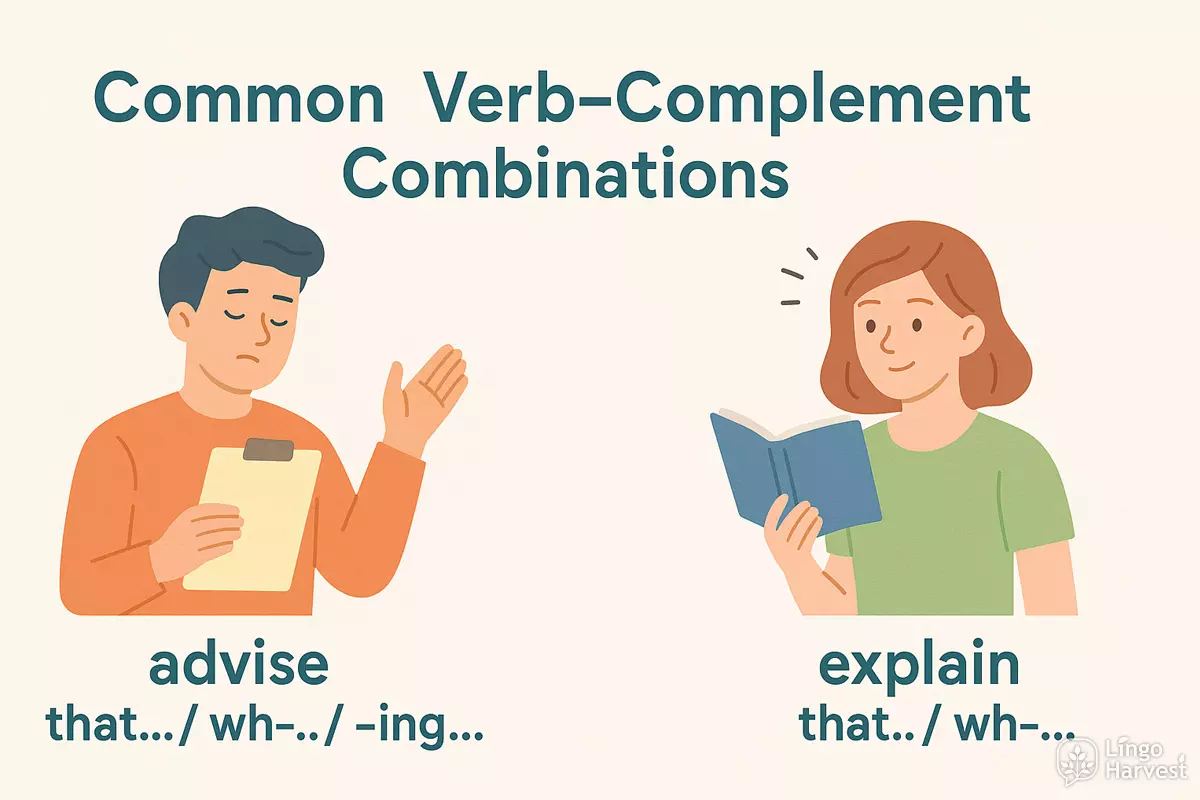
Writers should be aware of which verbs frequently allow or require more than one type of complement. Some verbs are highly versatile, while others are more restrictive. Here are examples illustrating some frequent patterns:
- advise that… / wh-… / -ing…
- explain that… / wh-…
- suggest that… / -ing…
- realize that… / wh-…
- demonstrate that… / wh-…
- report that… / -ing…
- remember that… / -ing…
- confirm that… / wh-…
- understand that… / wh-…
- discuss wh-… / -ing…
- recommend that… / -ing…
- describe wh-… / -ing…
- acknowledge that… / -ing…
- consider wh-… / -ing…
- assume that… / wh-…
- mention that… / -ing…
- note that… / wh-…
- observe that… / -ing…
- predict that… / wh-…
- accept that… / -ing…
Examples: Effective vs. Overloaded Use
Clear sentences typically restrict themselves to one or two complements, using structure and punctuation to guide the reader. Overloaded constructions, on the other hand, often result in confusion. Consider the following:
- Clear: The researchers demonstrated that the process is reversible and explained how it occurs.
- Overloaded: The researchers demonstrated that the process is reversible and how it occurs suggesting that further investigation is needed, which may confuse readers.
In summary, balancing complexity and clarity when combining multiple complements is a hallmark of effective academic writing. Thoughtful verb selection, careful ordering, and strategic punctuation all contribute to sentences that are both sophisticated and accessible.
Practice: match verbs with appropriate complement clauses
Understanding which verbs can take that-clauses, wh-clauses, or -ing clauses is crucial for accurate and natural academic writing. Below, you'll find several verb-complement combinations to test your knowledge of these patterns. Carefully read each item and decide which type of clause best completes the meaning.
Task 1: Select the Suitable Complement Clause
For each verb below, choose the most appropriate type of complement: that-clause, wh-clause, or -ing clause.
- admit
- demonstrate
- suggest
- explain
- predict
- recommend
- discover
- avoid
- identify
- deny
- clarify
- anticipate
Show answers
- admit: -ing clause or that-clause (e.g., admit making a mistake / admit that a mistake was made)
- demonstrate: that-clause (e.g., demonstrate that the hypothesis is valid)
- suggest: -ing clause or that-clause (e.g., suggest trying a new method / suggest that we try a new method)
- explain: wh-clause (e.g., explain how the process works)
- predict: that-clause (e.g., predict that results will improve)
- recommend: -ing clause (e.g., recommend conducting further research)
- discover: wh-clause (e.g., discover where the error occurred)
- avoid: -ing clause (e.g., avoid making assumptions)
- identify: wh-clause (e.g., identify what caused the problem)
- deny: -ing clause or that-clause (e.g., deny breaking the rule / deny that the rule was broken)
- clarify: wh-clause or that-clause (e.g., clarify what was intended / clarify that the issue is resolved)
- anticipate: -ing clause or that-clause (e.g., anticipate facing challenges / anticipate that challenges will arise)
Task 2: Verb–Complement Matching Table
This table shows how certain academic verbs typically pair with specific complement clauses. Review the patterns and use them to inform your own writing choices.
| Verb | Common Complement Clause(s) |
|---|---|
| argue | that-clause (e.g., argue that the data supports the theory) |
| discuss | wh-clause (e.g., discuss how results were obtained) |
| consider | -ing clause (e.g., consider revising the hypothesis) |
| report | that-clause (e.g., report that symptoms improved) |
| question | whether/if-clause (e.g., question whether the method is reliable) |
| avoid | -ing clause (e.g., avoid using biased samples) |
| demonstrate | that-clause (e.g., demonstrate that the effect is significant) |
| show | that-clause or wh-clause (e.g., show that results differ / show how results differ) |
| confirm | that-clause (e.g., confirm that the findings are accurate) |
| explore | wh-clause (e.g., explore why the phenomenon occurs) |
Task 3: Identify the Error
Decide which verb–complement pair is incorrect in each sentence below.
- The authors suggest to use a different approach.
- The study identified that the sample was biased.
- The researchers avoided making generalizations.
- The paper discusses how the experiment was designed.
- They recommended to conduct further interviews.
- The results indicate that the treatment is effective.
- The authors considered to revise the hypothesis.
- The review discusses about the limitations of the method.
- The study failed to show that the intervention works.
- The researchers suggested that we to repeat the test.
Show answers
- 1: Incorrect. "Suggest" is not followed by "to + verb"; use "suggest using" or "suggest that we use."
- 2: Incorrect. "Identify" is not typically followed by a that-clause in this sense; prefer a wh-clause: "identified what the bias was."
- 3: Correct. "Avoid" is followed by an -ing clause.
- 4: Correct. "Discuss" can be followed by a wh-clause.
- 5: Incorrect. "Recommend" is not followed by "to + verb"; use "recommended conducting further interviews" or "recommended that we conduct further interviews."
- 6: Correct. "Indicate that" + clause is standard.
- 7: Incorrect. "Consider" is followed by a noun or -ing form: "considered revising the hypothesis" or "considered whether to revise the hypothesis."
- 8: Incorrect. "Discuss" is not followed by "about"; use "discusses the limitations of the method."
- 9: Correct. "Failed to show that..." is a natural verb + infinitive pattern.
- 10: Incorrect. After "suggest that," use a bare verb: "suggested that we repeat the test" or "suggested repeating the test."
By practicing these patterns, you can strengthen your command of academic verb-complement structures, leading to clearer and more sophisticated writing.