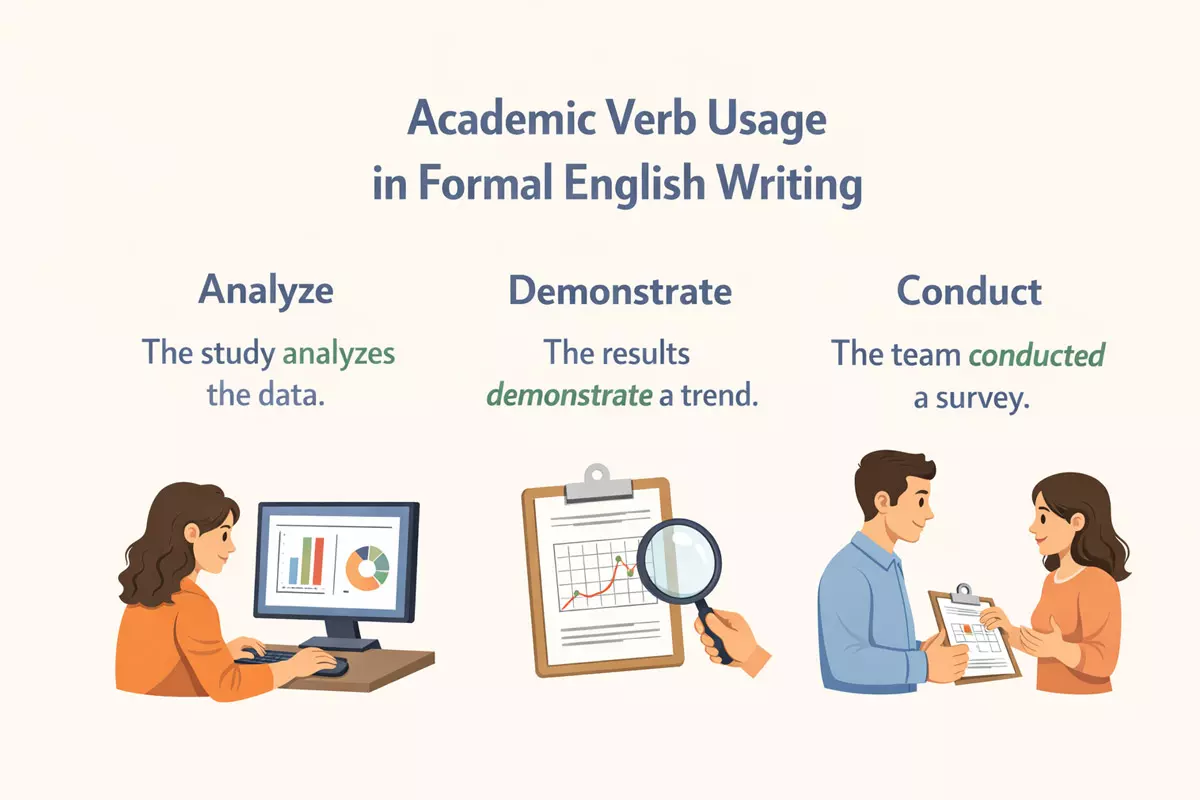
Academic Verb Usage in Formal English Writing

 Here we how to choose academic-sounding verbs, including hedging for cautious claims, describing methods and results, avoiding vague verbs, and recognizing common errors. It also provides practice tasks for improving formal verb use.
Choosing precise action words is essential for creating polished scholarly writing, as the specific verbs selected can greatly affect the clarity, tone, and persuasiveness of academic texts. Careful verb choice helps ensure that ideas are communicated accurately and effectively, allowing readers to understand the intended meaning without ambiguity. By mastering this skill, writers can enhance the overall quality of their work, making arguments more compelling and their writing more engaging for academic audiences.
What makes verbs sound academic
Academic writing often relies on verbs that convey precision, formality, and objectivity. Instead of using everyday language, formal texts favor verbs that are specific and neutral, helping writers present information clearly and avoid ambiguity. This approach not only strengthens arguments but also signals a scholarly tone appropriate for research papers, reports, and essays.
Characteristics of Academic Verbs
- Precision: Academic verbs describe actions or relationships exactly (e.g., demonstrate vs. show).
- Objectivity: They avoid personal or emotional language, focusing on facts and evidence (e.g., indicate instead of feel).
- Formality: These verbs tend to be more formal and less conversational (utilize rather than use).
- Abstractness: Many academic verbs refer to processes, relationships, or states rather than concrete actions (correlate, suggest, constitute).
- Impersonal Tone: They help remove the writer’s subjectivity, contributing to a more scientific or analytical style.
Common Academic Verbs
Writers often choose verbs that are widely accepted in scholarly contexts. Here are examples of verbs that frequently appear in formal texts:
- analyze → The study analyzes the relationship between income and educational attainment.
- assess → The researchers assessed the long-term impact of the policy changes.
- demonstrate → The results demonstrate a clear correlation between the two variables.
- emphasize → The author emphasizes the importance of methodological consistency.
- establish → The experiment established a baseline for future research.
- evaluate → This paper evaluates the effectiveness of the proposed framework.
- examine → The article examines several competing theoretical models.
- illustrate → Figure 2 illustrates the key stages of the process.
- indicate → The data indicates a significant decline in error rates.
- investigate → The study investigates the causes of structural inequality.
- maintain → The author maintains that earlier interpretations were incomplete.
- propose → The paper proposes an alternative approach to data classification.
- reveal → The analysis reveals previously overlooked patterns.
- suggest → The findings suggest that further research is required.
- support → The evidence supports the central hypothesis.
- challenge → The results challenge several widely accepted assumptions.
- clarify → This section clarifies the distinction between the two concepts.
- corroborate → The survey data corroborates earlier qualitative findings.
- constitute → These factors constitute the core of the theoretical model.
Everyday vs. Academic Verb Choices

Many verbs have both informal and formal equivalents. Choosing the more precise or formal option can elevate the tone of your writing. Here’s a comparison to illustrate the difference:
| Informal Verb | Academic Alternative | Example Sentence |
|---|---|---|
| show | demonstrate | The results demonstrate a strong correlation between age and risk perception. |
| look at | examine | This paper examines the effects of urbanization on local ecosystems. |
| find out | determine | The study aims to determine whether early exposure influences language acquisition. |
| talk about | discuss | The following section discusses the limitations of the proposed model. |
| build | construct | The researchers constructed a theoretical framework based on prior studies. |
| use | employ | The experiment employed a mixed-methods approach. |
| prove | establish | The evidence establishes the validity of the hypothesis. |
| point out | highlight | The author highlights several inconsistencies in earlier research. |
| get | obtain | Data were obtained from publicly available databases. |
| start | initiate | The project was initiated in response to growing regulatory concerns. |
| check | verify | The results were verified through independent replication. |
| help | facilitate | This mechanism facilitates communication between the two systems. |
| deal with | address | The paper addresses key challenges in data interpretation. |
| keep | maintain | The model maintains consistency across different datasets. |
| think about | consider | This section considers alternative explanations for the findings. |
| say | state | The author states that further investigation is required. |
| show again | reiterate | The conclusion reiterates the central argument of the study. |
| make clear | clarify | The revised version clarifies several ambiguous terms. |
| support | substantiate | Additional data are needed to substantiate the claim. |
| go against | contradict | The new evidence contradicts earlier assumptions. |
Verb Patterns That Signal Formality
- Passive constructions (e.g., “It is argued that…”)
- Reporting verbs (e.g., suggests, claims, reports)
- Modality for cautious language (e.g., may indicate, could suggest)
In sum, selecting verbs that are precise, formal, and neutral helps writers communicate ideas more effectively and meet academic standards for clarity and professionalism.
Common academic verb choices by function
Academic writing demands precise and purposeful verb selection. The verbs you choose not only convey meaning but also shape the reader’s perception of your arguments, evidence, and reasoning. Different communicative goals—such as reporting findings, describing processes, or making claims—call for distinct sets of verbs that clarify intent and add clarity to your text.
Verbs for Describing Research Actions
Writers often need to explain what was done in a study or paper. Action-focused verbs help specify methods and procedures clearly. Some common choices include:
- scrutinize → The researchers scrutinized the dataset for potential sources of bias.
- probe → The study probes underlying mechanisms driving social behavior.
- inspect → The samples were inspected under controlled laboratory conditions.
- appraise → The framework was appraised using qualitative and quantitative criteria.
- quantify → The model quantifies the impact of temperature variation.
- map → The project maps interactions between key institutional actors.
- administer → The survey was administered to over 2,000 participants.
- compile → Data were compiled from multiple independent sources.
- benchmark → Performance was benchmarked against international standards.
- operationalize → Abstract concepts were operationalized through measurable indicators.
Verbs for Reporting Findings
When presenting results or outcomes, academic writers often rely on verbs that precisely signal evidential strength and interpretation.
- document → The study documents a steady decline in response accuracy.
- uncover → The analysis uncovers previously unreported correlations.
- attest to → The findings attest to the robustness of the proposed method.
- signal → These patterns signal a shift in consumer preferences.
- point to → The data point to structural limitations within the system.
- register → The instruments registered minimal variance across trials.
- delineate → The results delineate clear boundaries between the two groups.
- verify → The hypothesis was verified through repeated experimentation.
- underscore → The evidence underscores the role of contextual factors.
- substantiate → The conclusions are substantiated by longitudinal data.
- correlate with → Performance levels correlate with exposure duration.
Verbs for Stating Claims or Arguments
To position claims within academic discourse, writers employ verbs that signal stance, caution, or theoretical contribution.
- advance → The author advances a novel interpretation of the results.
- posit → The paper posits a direct link between regulation and compliance.
- theorize → Several scholars theorize that language shapes perception.
- articulate → The argument is articulated through a comparative framework.
- postulate → The model postulates a non-linear relationship.
- advocate → The study advocates a shift toward evidence-based policy.
- qualify → The author qualifies earlier claims in light of new data.
- question → The findings question the validity of traditional assumptions.
- reframe → This approach reframes the debate around institutional agency.
- call for → The paper calls for stricter methodological standards.
Comparing, Contrasting, and Connecting Ideas
Academic texts often draw connections or distinctions between sources, theories, or findings. Specialized verbs help clarify these relationships.
| Function | Example Verbs |
|---|---|
| Compare | compare, contrast, liken, differentiate |
| Connect | relate, link, associate, correlate |
| Distinguish | distinguish, discriminate, separate, differentiate |
| Integrate | integrate, synthesize, combine, incorporate |
Verbs for Citing Sources and Literature
Summarizing or referencing prior work requires verbs that attribute ideas or findings to their original authors. These verbs maintain academic integrity and clarify the origin of information.
- state → The author states that the sample size limits the generalizability of the findings.
- report → The study reports a significant improvement in test performance.
- describe → The paper describes the procedure used to collect the data.
- note → The researcher notes a slight variation in the second trial.
- observe → The experimenters observed a consistent pattern across all groups.
- point out → The reviewer points out a potential flaw in the methodology.
- emphasize → The discussion emphasizes the importance of contextual factors.
- argue → The author argues that the current model fails to account for social variables.
- suggest → The results suggest a possible link between stress and memory.
- conclude → The paper concludes that further investigation is necessary.
Choosing the most appropriate verb for your intended function enhances the credibility, clarity, and persuasiveness of your academic writing. Consider your rhetorical purpose, the level of certainty, and the relationships you wish to convey when selecting verbs for scholarly communication.
Hedging verbs for cautious claims
Writers in academic contexts often choose verbs that suggest uncertainty or nuance, rather than direct assertion. This approach helps maintain objectivity and acknowledges the complexity of research findings. By using verbs that indicate possibility, probability, or limited certainty, authors demonstrate awareness of alternative interpretations and avoid overgeneralization.
Why use hedging verbs?
Employing cautious language is essential when presenting results or interpretations that may not be universally applicable. Such verbs allow scholars to protect their claims from being challenged for overstatement, and to signal respect for the evolving nature of knowledge. This strategy also helps readers distinguish between established facts and tentative conclusions.
Common verbs for hedging academic statements
Below is a list of frequently used verbs that help soften claims or indicate a degree of uncertainty. These verbs are particularly useful in introductions, literature reviews, and discussions of results:
- suggest → The findings suggest a gradual shift in consumer preferences.
- indicate → The data indicate a decline in processing efficiency over time.
- appear → The results appear consistent with earlier experimental outcomes.
- seem → The trend seems less pronounced in smaller samples.
- imply → These patterns imply a structural weakness in the existing model.
- assume → The analysis assumes a constant rate of population growth.
- propose → The author proposes a revised framework for data interpretation.
- estimate → The researchers estimate the error margin at approximately five percent.
- speculate → Some scholars speculate about long-term societal effects.
- presume → The model presumes rational behavior among all participants.
- hypothesize → The study hypothesizes a link between exposure and retention.
- predict → The model predicts increased demand under these conditions.
- infer → From these results, we can infer a causal relationship.
- project → Analysts project sustained growth over the next decade.
- anticipate → The authors anticipate further challenges during implementation.
- postulate → The theory postulates an underlying cognitive mechanism.
- suppose → The paper supposes that external factors remain stable.
- allude → The discussion alludes to unresolved methodological issues.
Comparing strong and hedged verb usage
To better illustrate the difference between assertive and cautious phrasing, consider the following table. It contrasts direct verbs with their more tentative counterparts, helping writers select language appropriate for nuanced academic discussion.
| Direct (Strong) Verb | Hedged (Cautious) Verb |
|---|---|
| prove | suggest |
| show | indicate |
| demonstrate | appear |
| confirm | imply |
| establish | assume |
Selecting the right degree of certainty is not just a stylistic choice; it reflects the writer’s critical thinking and understanding of the limitations inherent in scholarly work. By mastering cautious verb usage, academic authors can communicate findings responsibly while engaging with the broader research community.
Verbs for describing research methods
Communicating the steps and strategies used in academic investigations requires precise language. Choosing the right verbs helps clarify how data was gathered, analyzed, or interpreted. These action words not only convey the approach but also add credibility and transparency to your writing.
Choosing precise verbs for different methods
The choice of verb often depends on the research design and data type. For example, “surveyed” and “interviewed” suit studies involving participants, while “simulated” and “modeled” fit computational approaches. Selecting the most accurate verb helps readers understand your approach at a glance.
| Research Activity | Example Verbs |
|---|---|
| Data Collection | gather, survey, interview, record, sample |
| Data Analysis | analyze, interpret, compare, evaluate, code |
| Experimental Procedures | conduct, design, implement, test, replicate |
| Literature Review | review, examine, summarize, synthesize, assess |
| Reporting Results | present, describe, illustrate, report, discuss |
Tips for effective verb usage
- Match the verb to your specific method or procedure.
- Prefer active voice for clarity and directness.
- Vary your vocabulary within the same section to avoid repetition.
- Check for consistency between your method section and other parts of your paper.
Using accurate and varied verbs enhances the professionalism of your writing and ensures readers can follow your methodology without confusion. Selecting the right action words is a key aspect of effective academic communication.
Verbs for reporting results and trends
When discussing outcomes or describing how data changes over time in academic writing, selecting precise verbs is crucial. The choice of verb can subtly influence how readers interpret the significance and direction of findings. Some verbs highlight increases, others signal declines, and several indicate stability or fluctuation. Using a variety of these terms not only improves clarity but also helps avoid monotonous repetition.
Common verbs for increases and decreases

Writers often need to describe data that rises or falls. To do this concisely, consider the following verbs:
- increase → Employment levels increased steadily over the five-year period.
- rise → Average temperatures rose significantly after 2010.
- grow → The market grew at an unprecedented rate.
- climb → Prices climbed sharply during the first quarter.
- surge → Demand surged following the policy announcement.
- decrease → Error rates decreased after the new protocol was introduced.
- fall → Productivity fell slightly in the final phase of the study.
- decline → The number of applicants declined over time.
- drop → Sales dropped dramatically in response to regulatory changes.
- plummet → Output plummeted during the economic downturn.
Describing patterns, stability, and fluctuations
Beyond simple upward or downward movements, academic texts frequently refer to data that remains steady or varies unpredictably. The following verbs are useful in such contexts:
- stabilize → The reaction rate stabilized after the initial adjustment phase.
- fluctuate → Performance levels fluctuated throughout the observation period.
- plateau → Growth plateaued once market saturation was reached.
- level off → The trend leveled off toward the end of the decade.
- oscillate → Measurements oscillated within a narrow range.
- persist → These patterns persisted despite external intervention.
- maintain → The system maintained consistent output under varying conditions.
IELTS Academic Task 1 – Verb Choice Practice
Complete the sentences using an appropriate verb to describe the trend. Use each verb only once.
- Between 2000 and 2005, the number of visitors _______ steadily from 1.2 million to 2 million.
- After an initial peak, sales _______ sharply in the second quarter.
- From 2010 onward, the unemployment rate _______ at around 6%.
- Energy consumption _______ dramatically following the introduction of new regulations.
- During the final phase, production levels _______ within a narrow range.
- After several years of growth, the figure _______ and remained unchanged.
- Housing prices _______ rapidly during the economic boom.
- Error rates _______ gradually as the system was optimized.
- Throughout the period shown, the trend _______ despite minor fluctuations.
- In the final year, output _______ to its lowest recorded level.
Show answers
- rose
- fell
- stabilized
- decreased
- oscillated
- plateaued
- surged
- declined
- persisted
- plummeted
IELTS Task 2 – Precision Upgrade
Replace the underlined verb with a more precise academic alternative.
- The number of users went up steadily over the period.
- Profits went down slightly after 2018.
- The trend stayed the same for almost a decade.
- Figures went up a lot in the final year.
- The rate went up and down throughout the period.
Show answers
- increased / rose
- declined / fell
- remained stable / plateaued
- surged / climbed sharply
- fluctuated
IELTS Task 3 – Sentence Writing
Write one sentence describing each trend using the verb in brackets.
- A steady upward trend (grow)
- A sudden and dramatic fall (plummet)
- Long-term stability (maintain)
- Irregular variation (fluctuate)
- A gradual reduction (decrease)
Show sample answers
- The population grew steadily over the period shown.
- Production plummeted after the factory closed.
- Output levels were maintained throughout the decade.
- Prices fluctuated due to seasonal demand.
- The error rate decreased gradually over time.
Comparing verbs for academic precision
Different verbs can express not just the direction, but also the degree or speed of change. Some are neutral, while others convey intensity. The table below compares several common verbs, their typical contexts, and connotations:
| Verb | Typical Usage / Connotation |
|---|---|
| Increase | General upward movement; neutral |
| Surge | Sudden or dramatic rise |
| Fluctuate | Frequent changes up and down |
| Plummet | Sharp, rapid decrease |
| Stabilize | Becoming steady after variation |
Tips for precise reporting
- Choose verbs that accurately reflect the data’s movement or trend.
- Avoid overusing a single verb; variety enhances readability.
- Be mindful of the verb’s connotation—some suggest stronger changes than others.
- Pair verbs with adverbs or adjectives for greater nuance, e.g., “steadily increased,” “sharply declined.”
In summary, careful verb selection strengthens academic reporting and ensures that descriptions of results and patterns are both accurate and engaging.
Avoiding vague verbs in academic style
In academic writing, clarity and precision are essential. One common obstacle to clear communication is the use of vague or generic verbs—words like “do,” “make,” “get,” or “have”—that fail to convey specific meaning. Instead of using these broad verbs, scholars are encouraged to select verbs that accurately reflect the action or process being described. This approach not only strengthens arguments but also helps readers understand complex ideas without ambiguity.
Why Specific Verbs Matter
General verbs often obscure the nature of a process or relationship. For example, writing “Researchers did an experiment” provides little insight into what actually occurred. In contrast, “Researchers conducted an experiment” gives the reader more precise information. Choosing verbs that fit the context improves both the professionalism and the clarity of academic prose.
Common Vague Verbs and Their Alternatives
Writers sometimes default to familiar verbs out of habit or uncertainty. Here are some frequently used vague verbs, along with more precise alternatives suited for scholarly contexts:
- Do → conduct, perform, execute, undertake, carry out
- Make → create, generate, develop, formulate, compose
- Get → obtain, acquire, receive, derive, secure
- Have → possess, contain, exhibit, experience, feature
- Show → demonstrate, illustrate, reveal, indicate, display
- Go → proceed, advance, move, travel, transition
- Put → place, insert, establish, position, arrange
- Take → acquire, accept, assume, capture, collect
- Use → employ, utilize, apply, implement, exploit
- Give → provide, supply, grant, deliver, offer
- Find → discover, identify, determine, observe, detect
- Tell → inform, notify, explain, describe, report
- Think → consider, hypothesize, assume, reason, reflect
- Say → state, assert, claim, declare, mention
- Get rid of → eliminate, remove, discard, eradicate, abolish
- Keep → retain, maintain, preserve, sustain, continue
- Help → assist, facilitate, support, enable, aid
- Start → initiate, commence, launch, begin, originate
- End → conclude, terminate, cease, finish, complete
- Deal with → address, manage, handle, resolve, tackle
Comparing Weak and Strong Verb Usage
Writers can increase the impact of their academic work by replacing weak verbs with more descriptive options. The table below demonstrates how swapping out generic verbs for precise alternatives improves clarity and scholarly tone.
| Vague Verb Phrase | Precise Academic Alternative |
|---|---|
| Did research | Conducted research |
| Made a decision | Reached a conclusion |
| Got results | Obtained results |
| Had an effect | Exerted an influence |
| Showed a trend | Demonstrated a trend |
| Put forward an idea | Proposed a hypothesis |
| Used a method | Employed a methodology |
| Took action | Implemented measures |
Tips for Selecting Stronger Verbs
- Identify the main action in your sentence and ask if a more specific verb exists.
- Consult academic articles in your field to observe preferred verb choices.
- Avoid overusing the same verb throughout your writing—variety enhances readability.
- Ensure the selected verb accurately matches the nuance of your intended meaning.
- When in doubt, revise sentences to remove unnecessary general verbs and clarify the action.
Precise verb selection is a skill that develops with practice and attention to detail. By replacing ambiguous wording with targeted academic verbs, writers can produce clearer, more authoritative texts that communicate ideas effectively.
Typical errors in formal verb choice
Selecting precise verbs is essential for clarity and professionalism in academic writing. However, writers often make mistakes that can undermine the formal tone or even distort meaning. These verb-related pitfalls frequently stem from confusion between conversational habits and academic conventions, as well as from overgeneralizing or misapplying verb forms.
Common mistakes in selecting academic verbs
Writers frequently use verbs that are either too informal, too vague, or simply incorrect for the context. This can lead to ambiguity or weaken an argument’s impact. Below are some typical issues:
- Using phrasal verbs (e.g., “come up with”) instead of single-word academic equivalents (“devise”).
- Choosing generic verbs (e.g., “do,” “make”) where precise action is required (“conduct,” “perform,” “compose”).
- Overusing “be” verbs (“is,” “are,” “was”) rather than stronger, more descriptive alternatives.
- Inappropriate tense or aspect, such as using present simple instead of present perfect for recent research (“Smith finds” vs. “Smith has found”).
- Confusing similar verbs (e.g., “affect” vs. “effect,” “assure” vs. “ensure” vs. “insure”).
- Employing informal contractions (“can’t,” “won’t”) in place of full forms (“cannot,” “will not”).
- Incorrect use of passive vs. active voice, leading to awkward or unclear sentences.
- Misapplying reporting verbs (“say,” “tell”) instead of academic reporting verbs (“argue,” “claim,” “suggest”).
- Using verbs that imply certainty where caution is needed (“prove” instead of “suggest” or “indicate”).
- Redundant verb phrases (e.g., “repeat again,” “combine together”).
Vague and informal verbs to avoid
Imprecise verbs often weaken scholarly arguments. Here are some commonly misused verbs and their more suitable alternatives:
| Informal or Vague Verb | Formal Academic Alternative |
|---|---|
| get | obtain, acquire, receive |
| show | demonstrate, illustrate, reveal |
| find out | discover, determine, ascertain |
| go up | increase, rise, escalate |
| look at | examine, analyze, consider |
| talk about | discuss, address, elaborate on |
| put forward | propose, suggest, present |
| deal with | address, handle, manage |
| bring up | raise, introduce, mention |
| come up with | devise, formulate, generate |
| make up | constitute, comprise, form |
| set up | establish, create, organize |
Misuse of reporting verbs
Academic writing often relies on reporting verbs to reference other scholars’ work. Selecting the wrong verb can misrepresent the original author’s intent. For example, “claim” implies a weaker, possibly disputed statement, while “demonstrate” suggests strong evidence. Consider the following common reporting verbs and their typical use:
- Argue: Presents a reasoned case.
- Suggest: Offers a possibility or hypothesis.
- State: Presents information directly.
- Assert: Declares something with confidence (may lack evidence).
- Demonstrate: Provides convincing evidence.
- Claim: Asserts, possibly without proof.
Summary
Awareness of these verb selection pitfalls allows writers to communicate ideas with greater accuracy and authority. Developing an academic vocabulary and understanding the nuances of formal verbs can significantly improve the quality of scholarly writing.
Homework: academic verb rewriting tasks
Improving your command of academic verbs is essential for clear and effective scholarly writing. This assignment focuses on developing your ability to recognize, select, and substitute more formal verbs in typical academic contexts. By practicing verb rewriting, you can enhance both the precision and sophistication of your written work.
Task 1: Replace Informal Verbs
Below is a list of sentences that use informal or conversational verbs. Rewrite each sentence, replacing the verb with a more formal academic alternative.
- The study looks at the effects of social media on sleep.
- Researchers found out that the results were unexpected.
- The author talks about climate change in detail.
- This paper gives examples of recent technological advances.
- We got data from several sources.
- The report shows a clear link between diet and health.
- The article looks closely at changes in population growth.
- The researchers checked the accuracy of the measurements.
- The study tries to explain differences between the two groups.
- The paper says that further research is needed.
Show answers
- The study examines the effects of social media on sleep.
- Researchers discovered that the results were unexpected.
- The author discusses climate change in detail.
- This paper provides examples of recent technological advances.
- We collected data from several sources.
- The report demonstrates a clear link between diet and health.
- The article analyzes changes in population growth.
- The researchers verified the accuracy of the measurements.
- The study seeks to explain differences between the two groups.
- The paper concludes that further research is needed.
Task 2: Academic Verb Substitution Table
Review the table below, which presents common informal verbs alongside their academic equivalents and example uses. This will help you internalize patterns for rewriting.
| Informal Verb | Academic Verb | Example Sentence |
|---|---|---|
| look at | examine | This paper examines the impact of policy changes. |
| find out | determine | The study aims to determine whether the intervention is effective. |
| show | demonstrate | The results demonstrate a clear trend. |
| talk about | address | The article addresses the issue of inequality. |
| get | obtain | Participants obtained consent before joining the study. |
| give | provide | The report provides several recommendations. |
| make | create | The researchers created a new framework. |
| look for | seek | The project seeks to improve accessibility. |
| come up with | develop | The team developed a novel approach. |
| bring up | raise | The paper raises several important questions. |
Task 3: Rewrite Using Academic Verbs
Transform the following sentences by substituting the underlined verbs with more formal academic alternatives, based on the table above or your own knowledge.
- The researchers came up with a solution to the problem.
- This article talks about the implications of the findings.
- The team got approval from the ethics committee.
- The paper brings up new perspectives on the topic.
- The study looks at changes in consumer behavior.
- The report points out several limitations of the method.
- The researchers found out that the data were incomplete.
- The article goes into the causes of economic inequality.
- The author puts forward an alternative explanation.
- The study shows a strong correlation between the variables.
Show answers
- The researchers developed a solution to the problem.
- This article addresses the implications of the findings.
- The team obtained approval from the ethics committee.
- The paper raises new perspectives on the topic.
- The study examines changes in consumer behavior.
- The report highlights several limitations of the method.
- The researchers discovered that the data were incomplete.
- The article explores the causes of economic inequality.
- The author proposes an alternative explanation.
- The study demonstrates a strong correlation between the variables.
Tips for Academic Verb Use
- Choose verbs that convey a precise meaning (e.g., "analyze" vs. "look at").
- Avoid phrasal verbs when possible; opt for single-word academic verbs.
- Be aware of subtle differences in meaning and register.
- Read academic articles to expand your verb repertoire.