Verbs of Perception and Cognition Explained

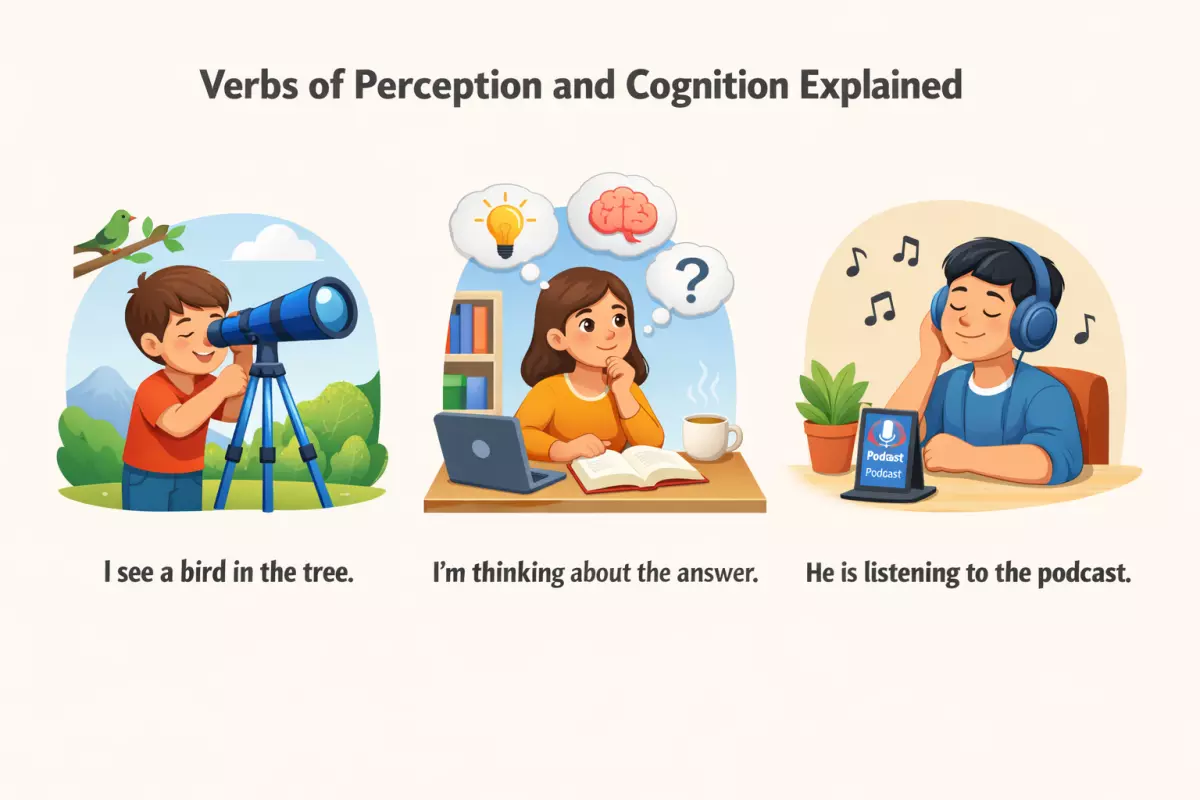 This article explains the difference between perception and cognition verbs, lists common verbs and patterns, and shows complements for think, know, and believe. It covers stative tense choices, common learner errors, natural speech and writing use, and homework practice tasks.
- Difference between perception and cognition verbs
- Common perception verbs and patterns
- Common cognition verbs and meanings
- Verb complements with think, know, believe
- Stative behavior and tense choices
- Common learner errors
- Natural usage in speech and writing
- Homework: perception and cognition practice tasks
In everyday English, we use verbs that express what we notice and what we think, known as perception and cognition verbs. They help you describe real experiences such as smelling something, spotting a mistake, remembering a name, or deciding what something means. This guide explains how they work in common sentences so your English sounds clear, natural, and confident.
Difference between perception and cognition verbs
These two groups often look similar because both can introduce information, but they behave differently in meaning and grammar. One group reports sensory input (what is seen, heard, felt, etc.); the other reports mental activity (beliefs, judgments, understanding). The choice affects which complements sound natural, how certain the statement feels, and what kind of evidence is implied.
| Aspect | Perception verbs (see, hear, feel, notice, smell, taste) | Cognition verbs (think, believe, know, understand, remember, suspect) |
|---|---|---|
| Core meaning | Sensory experience or observation; based on what the speaker perceives. | Mental state or reasoning; based on what the speaker concludes or holds as true. |
| Typical evidence implied | Direct evidence (something witnessed or sensed). | Indirect evidence (inference, belief, knowledge, memory). |
| Common complement patterns | Object + bare infinitive (I saw him leave); object + -ing (I saw him leaving); that-clause is possible but less central (I noticed that…) | That-clause (I think that… / I know that…); wh-clause (I know what…); to-infinitive (I decided to… / I want to…) |
| Meaning contrast with -ing vs bare infinitive | Often meaningful: bare infinitive = whole event; -ing = ongoing/partial view. | Usually not a central contrast; -ing complements are limited and verb-specific (e.g., “remember doing”). |
| Progressive forms | Often avoided for stative senses (I see your point), but allowed for active/temporary uses (I’m seeing a doctor). | Often avoided when stative (I know, I believe), though some allow progressive with a change-in-progress meaning (I’m thinking about it). |
| Reporting style | More “camera-like”: describes what was perceived at a moment in time. | More “mind-like”: describes conclusions, opinions, certainty, or doubt. |
How the complement choice changes the message
- Perception + object + bare infinitive focuses on a complete action: ✅ “I heard her sing the anthem.” (the whole performance)
- Perception + object + -ing focuses on an action in progress: ✅ “I heard her singing in the kitchen.” (ongoing sound)
- Cognition + that-clause states a belief/knowledge claim: ✅ “I think (that) the meeting is tomorrow.”
- Cognition + wh-clause highlights information content: ✅ “I know where he lives.” / “I remember what you said.”
- Cognition + to-infinitive often expresses intention/decision/plan: ✅ “I decided to leave early.”
Practical usage cues
- Use sensory verbs when you want to anchor the statement in observation: “I noticed the lights were off” suggests direct noticing.
- Use mental-state verbs when you want to show evaluation or uncertainty: “I suspect the lights were off” signals inference.
- When describing what someone perceived happening, prefer the object-complement patterns: “She saw him cross the street” is more natural than “She saw that he crossed the street” in many contexts.
- When describing what someone believes or knows, prefer clausal complements: “He believes that it’s true” is standard; “He believes it to be true” is more formal.
- Be careful with stative meanings: ❌ “I am knowing the answer” (not standard) vs ✅ “I know the answer.”
High-value patterns to recognize (quick reference)
- Perception: see/hear/feel + object + bare infinitive (see them arrive; hear him speak; feel it move)
- Perception: see/hear/notice + object + -ing (see them arriving; hear him speaking; notice her shaking)
- Perception: notice/realize + that-clause (notice that it’s late; realize that you’re right)
- Cognition: think/believe/know/assume + that-clause (think that…; know that…; assume that…)
- Cognition: know/remember/understand + wh-clause (know why…; remember where…; understand how…)
- Cognition: decide/plan/hope/expect + to-infinitive (decide to…; plan to…; hope to…; expect to…)
- Cognition (special case): remember/forget + -ing for past experience (remember meeting her) vs to-infinitive for duties (remember to call her)
Common perception verbs and patterns
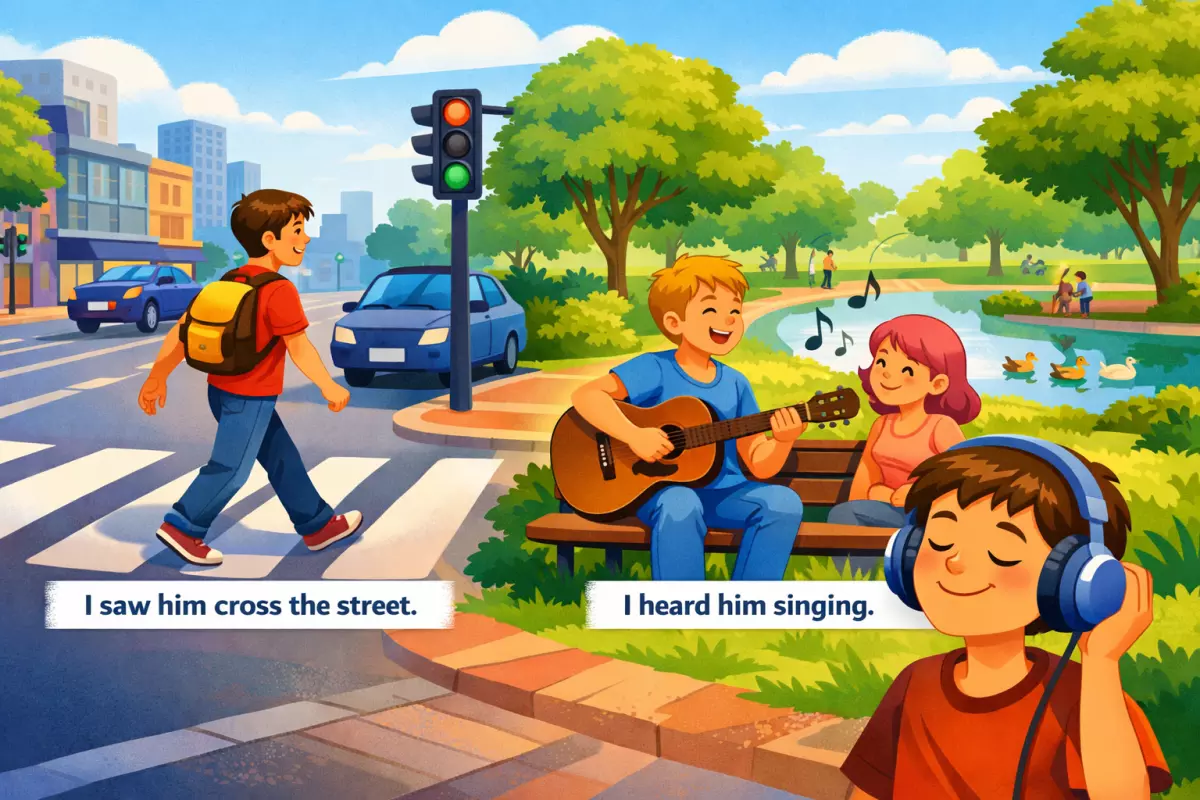
Perception verbs describe what you notice through the senses (sight, hearing, smell, taste, touch). They often appear in a few recurring structures, and the meaning can change depending on whether you use a bare infinitive, an -ing form, or a complement clause.
Core verbs and what they typically take
- see: common with object + bare infinitive / -ing; also with clauses (that-clauses, wh-clauses).
✅ I saw him cross the street. / I saw him crossing the street. - hear: similar to see for events and actions; frequent with sounds and reported content.
✅ We heard her sing. / We heard her singing. - watch: favors visual, ongoing observation; often object + -ing.
✅ They watched the children playing in the yard. - look at: focuses on directing attention rather than passively noticing; commonly followed by a noun phrase.
✅ Look at the screen. - listen to: intentional attention to sound; followed by a noun phrase.
✅ She listened to the announcement. - notice: highlights the moment of becoming aware; works well with object + -ing and with clauses.
✅ I noticed him waiting outside. / I noticed that the door was open. - observe: more formal; often used for careful watching and reporting.
✅ Researchers observed the participants respond to the stimulus. - feel: can be physical perception or internal sensation; takes adjectives and clauses, and sometimes object + -ing.
✅ I felt the floor shake. / She felt that something was wrong. - smell: can be intransitive (sense) or transitive (detect); also links to adjectives.
✅ I smelled smoke. / The soup smells good. - taste: similar to smell in linking use; also transitive for sampling.
✅ This tastes salty. / He tasted the sauce. - touch: physical contact; typically followed by a noun phrase.
✅ Don’t touch the wire. - sound / look (linking verbs): connect the subject to an adjective or like-phrase.
✅ It sounds strange. / She looks tired. / It looks like rain. - seem / appear: perception-based inference; commonly followed by adjective, to-infinitive, or clause.
✅ He seems upset. / She appears to understand.
High-frequency patterns (with meaning differences)
- Verb + noun phrase (direct object): the simplest structure for what is perceived.
✅ I heard a noise. / She saw the sign. - Verb + object + bare infinitive: emphasizes the whole action as a complete event (often from start to finish).
✅ We saw the runner fall. (the fall as a complete event) - Verb + object + -ing: emphasizes an action in progress or as an unfolding scene.
✅ We saw the runner falling. (the action in progress) - Verb + that-clause: shifts from raw sensory input to interpretation or reported information.
✅ I noticed that he was nervous. / I heard that the meeting was canceled. - Verb + wh-clause (what/where/how, etc.): focuses on the content of what was perceived or discovered.
✅ She saw what happened. / I heard how they solved it. - Linking verb + adjective (look/sound/smell/taste/feel): describes the subject’s perceived quality, not an action.
✅ The room smells musty. / The plan sounds reasonable. - Linking verb + like + noun/gerund: compares the perception to something.
✅ It looks like a mistake. / It sounds like someone knocking. - Passive with perception verbs: common in formal style to highlight the person/thing perceived.
✅ He was seen leaving the building. / The song was heard playing next door.
Common learner issues to watch for
- Intentional vs. unintentional: see/hear often describe accidental perception, while look at/listen to/watch describe deliberate attention.
✅ I heard a crash. → (not planned) / ✅ I listened to the recording. → (planned) - Bare infinitive vs. to-infinitive: after see/hear/feel in the “object + verb” pattern, English normally uses the bare infinitive, not to.
✅ I saw him leave. ❌ I saw him to leave. - Linking vs. action meaning: smell/taste/feel can describe either sensing something or a quality of the subject.
✅ I smelled gas. (detected) / ✅ The kitchen smelled smoky. (quality) - Clause vs. event structure: use a clause for conclusions or facts, and the object + infinitive/-ing structure for direct observation of an event.
✅ I saw him running. (direct) / ✅ I saw that he was upset. (interpretation)
Common cognition verbs and meanings
These verbs describe mental processes such as knowing, believing, remembering, deciding, and understanding. Many of them take a that-clause, an infinitive, or a question word clause, and their meaning often shifts depending on the complement pattern used.
- know (have information; be certain)
- Common patterns: know + noun (know the answer), know + wh-clause (know where she lives), know + that-clause (know that it’s late).
- Usage note: often contrasts with think (certainty vs. opinion).
- think (have an opinion; consider)
- Common patterns: think + that-clause (think that it will rain), think about (think about the problem).
- Typical nuance: less certain than know; can be softened with “I think…” in conversation.
- believe (accept as true; have faith or trust)
- Common patterns: believe + that-clause (believe that he’s honest), believe in + noun (believe in democracy).
- Usage note: can sound more formal than think when stating views.
- understand (grasp meaning; see reasons)
- Common patterns: understand + noun (understand the rule), understand + wh-clause (understand why it happened), understand + that-clause (understand that you’re busy).
- Pragmatics: “I understand” can acknowledge feelings or a situation, not just facts.
- realize (become aware; suddenly understand)
- Common patterns: realize + that-clause (realize that you forgot), realize + wh-clause (realize what it means).
- Time focus: often points to a change of awareness.
- remember (keep in memory; recall)
- Common patterns: remember + noun (remember his name), remember + that-clause (remember that we met), remember + -ing (remember meeting her).
- Contrast in meaning: remember to + verb = not forget an action (✅ remember to call); remember + -ing = recall a past event.
- forget (fail to remember)
- Common patterns: forget + noun (forget the password), forget + that-clause (forget that it’s Monday).
- Contrast in meaning: forget to + verb = fail to do something (❌ forgot to lock the door); forget + -ing = not recall doing something (forget locking it).
- decide (choose; reach a conclusion)
- Common patterns: decide to + verb (decide to leave), decide + that-clause (decide that it’s not worth it), decide on + noun (decide on a date).
- Meaning shift: “decide that…” often highlights a judgment; “decide to…” highlights an action.
- choose (select from options)
- Common patterns: choose + noun (choose a seat), choose to + verb (choose to wait), choose between (choose between two plans).
- Usage note: emphasizes options more than decide.
- expect (think something will happen; anticipate)
- Common patterns: expect + noun (expect a call), expect + that-clause (expect that they’ll arrive), expect + to + verb (expect to finish soon).
- Common pitfall: ❌ “expect for” is usually wrong; use expect to or expect that.
- hope (want something to happen; feel optimistic)
- Common patterns: hope + that-clause (hope that you’re well), hope to + verb (hope to see you).
- Typical nuance: desire plus possibility; often more emotional than expect.
- guess (estimate; say without certainty)
- Common patterns: guess + that-clause (guess that it’s true), guess + wh-clause (guess what happened).
- Conversation use: “I guess…” can soften disagreement or show uncertainty.
- suppose (assume; think, often tentatively)
- Common patterns: suppose + that-clause (suppose that she’s right).
- Pragmatics: “I suppose so” signals reluctant agreement; “suppose we…” introduces a suggestion.
- assume (take for granted without proof)
- Common patterns: assume + that-clause (assume that it’s included).
- Usage note: can imply risk of being wrong; often used in careful explanations and instructions.
- mean (intend; signify)
- Common patterns: mean + noun (mean trouble), mean + that-clause (mean that we’re late), mean to + verb (mean to call).
- Meaning split: “What do you mean?” asks for clarification; “I didn’t mean to” refers to intention.
- intend (plan; have a purpose)
- Common patterns: intend to + verb (intend to apply), intend + noun (intend a change).
- Register: often more formal than plan.
- consider (think about carefully; regard as)
- Common patterns: consider + noun (consider the costs), consider + -ing (consider moving), consider + noun + adjective (consider it necessary).
- Usage note: “consider that…” exists but is less common than “consider + noun/-ing.”
- notice (become aware; observe mentally)
- Common patterns: notice + noun (notice a change), notice + that-clause (notice that it’s quiet), notice + object + -ing (notice him leaving).
- Bridge verb: sits between perception and cognition because it starts with observation and ends with awareness.
Pattern shortcuts to learn
- that-clauses are common after certainty or judgment verbs: know, think, believe, realize, assume.
- wh-clauses often follow verbs about information gaps: know, remember, understand, guess (who/what/where/why/how).
- to-infinitive frequently signals intention or future action: decide to, choose to, hope to, intend to, expect to.
- -ing commonly marks recalling or considering experiences: remember doing, consider doing, notice someone doing.
Verb complements with think, know, believe
These cognition verbs commonly take a clause or a non-finite structure as their complement. The choice depends on meaning (opinion vs. fact), certainty, and what you want to highlight (the idea itself, the person involved, or the action).
1) That-clauses (most common for opinions and facts)
A that-clause is the default pattern after all three verbs. In informal style, that is often omitted, especially after think and believe.
- think + (that) clause: I think (that) it’s going to rain.
- believe + (that) clause: She believes (that) the plan will work.
- know + (that) clause: We know (that) the meeting starts at 9.
- Negative with think/believe often prefers “I don’t think…”: I don’t think (that) this is the right time.
- Negative with know states lack of knowledge: I don’t know (that) he’s already left.
- Past reporting: He thought (that) he had locked the door.
- Certainty contrast: I think it’s true (opinion) vs. I know it’s true (certainty).
2) Wh-clauses (what/why/how/where/when/who)
Use a wh-clause to focus on missing information. This is especially natural with know, but think and believe can also appear when the speaker is reasoning or guessing.
- know + wh-clause: Do you know where she lives?
- know + what/how: I know what you mean. / She knows how it works.
- think + wh-clause: I think what you said was fair.
- think + why/how (reasoning): I’m thinking why this keeps happening.
- believe + wh-clause (less common, more formal): I believe what he told us.
3) Object + to-infinitive (common with know; limited with think/believe)
This pattern highlights the subject of the embedded action. With know, it often means “be aware from experience/observation.” With think and believe, it is possible but more restricted and often sounds formal or evaluative.
- know + object + to-infinitive: I know him to be honest.
- know + object + to-infinitive: She’s known him to exaggerate.
- think + object + to-infinitive (formal): We think her to be a strong candidate.
- believe + object + to-infinitive (formal): The police believe him to be in the area.
- ✅ We believe him to be innocent. → more formal
- ✅ We believe (that) he is innocent. → more neutral
4) -ing complements (thinking about / thinking of)
Think often uses an -ing form after a preposition to express considering, planning, or imagining. This is different from giving an opinion with a that-clause.
- think about + -ing: I’m thinking about changing jobs.
- think of + -ing: Have you ever thought of moving abroad?
- think about + noun: Think about the consequences.
- think of + noun: I thought of a better solution.
5) Complements that are usually avoided
Some combinations are possible in special contexts, but these are common learner traps.
- ❌ I know to do it. → ✅ I know how to do it. / I know what to do.
- ❌ I believe him to do it. → ✅ I believe (that) he did it. / I believe him to be capable of doing it.
- ❌ I think him is right. → ✅ I think (that) he is right. / (formal) I think him to be right.
As a practical guide: use a that-clause for statements and opinions, a wh-clause for unknown details, and object + to-infinitive when you want to foreground the person involved (often in formal or report-like language).
Stative behavior and tense choices
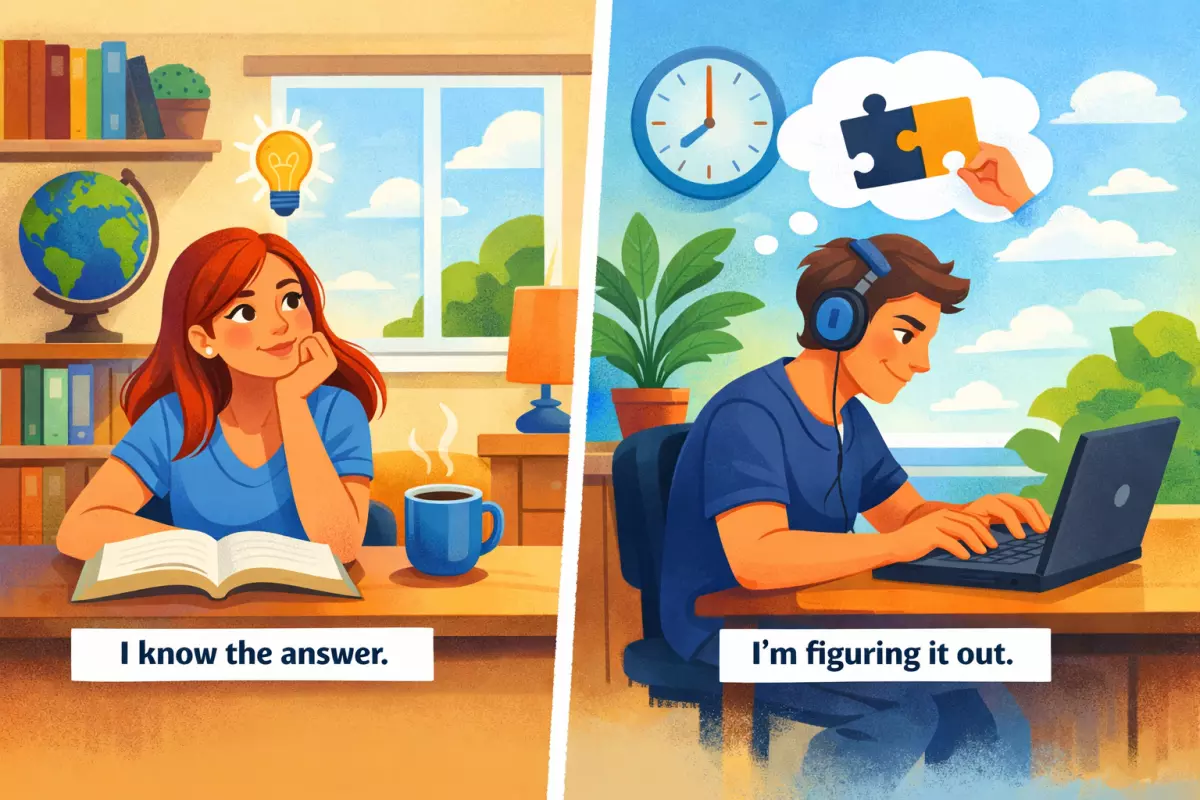
Many perception and cognition verbs describe a state (what is true in the mind or senses at a given time), so they often prefer simple tenses over progressive forms. When writers choose a progressive, it usually signals a temporary, developing, or deliberately controlled activity rather than a stable condition.
Common tense patterns with state-like meanings
- Simple present for general states: “I know the answer.” “She believes you.”
- Simple past for a completed mental state at a past time: “I thought it was Tuesday.” “He noticed the error.”
- Present perfect for a state continuing to now: “I have known her for years.” “They have understood the risks since May.”
- Past perfect for a state that existed before another past event: “She had realized the truth before he arrived.”
- Future with will for a predicted state: “You will see the difference.” “I will remember this.”
- Future with be going to for an expected outcome based on evidence: “You’re going to notice the noise once the music stops.”
- Modal verbs to soften certainty: “I might think it’s too risky.” “She must know by now.”
- Negative forms often sound most natural in simple tenses: “I don’t remember his name.” “They didn’t notice anything.”
When progressive forms are possible (and what they mean)
- Progressive to show a changing opinion or developing judgment: “I’m thinking you’re right.” (opinion forming)
- Progressive for an active mental process: “She’s considering the offer.” “We’re weighing the options.”
- Progressive for deliberate attention: “He’s listening for footsteps.” (intentional activity)
- Progressive for repeated checking/monitoring: “I’m watching the results closely.”
- Progressive for temporary perception conditions: “I’m seeing a strange pattern on the screen.” (right now, not a permanent ability)
- Progressive for social/relationship meanings of see: “She’s seeing someone.” (dating; an ongoing situation)
- Progressive for planned meetings: “I’m seeing the client tomorrow.” (scheduled appointment)
- Progressive with think to mean “use your brain” in the moment: “I’m thinking about the next step.”
- Progressive with wonder for a current question: “I’m wondering if we should leave.”
Verbs that shift meaning between stative and dynamic
- think: “I think it’s late.” (opinion) → “I’m thinking about it.” (mental activity)
- see: “I see what you mean.” (understand) → “I’m seeing the doctor.” (arrangement/visit)
- hear: “I hear a noise.” (perception) → “I’m hearing a lot about this lately.” (receiving reports repeatedly)
- feel: “I feel tired.” (state) → “I’m feeling the fabric.” (touching/exploring)
- look: “It looks expensive.” (appearance) → “She’s looking at the label.” (directed action)
- taste: “It tastes salty.” (result) → “He’s tasting the sauce.” (testing)
- smell: “It smells like smoke.” (result) → “She’s smelling the flowers.” (intentional action)
- appear: “It appears true.” (seems) → “He’s appearing in court today.” (event/participation)
Frequent learner errors (and better choices)
- ❌ “I’m knowing the answer.” ✅ “I know the answer.”
- ❌ “She’s believing you.” ✅ “She believes you.”
- ❌ “We’re understanding the problem.” ✅ “We understand the problem.” (unless emphasizing a developing process: “We’re starting to understand…”)
- ❌ “I’m remembering his name.” ✅ “I remember his name.” (or “I can’t remember…”)
- ❌ “I’m seeing what you mean.” ✅ “I see what you mean.” (understanding is typically non-progressive)
- ❌ “I’m hearing a noise right now.” ✅ “I hear a noise right now.” (simple present can describe immediate perception)
Choosing between simple and progressive is less about “rules” and more about meaning: use simple forms for stable perception or belief, and reserve progressive forms for active attention, ongoing evaluation, repeated exposure, or a situation that is clearly temporary.
Common learner errors
Problems with perception and thinking verbs usually come from mixing up verb patterns (bare infinitive vs. -ing vs. to-infinitive), choosing the wrong complement (that-clause vs. object + infinitive), or using a form that sounds logical but is not natural in English.
1) Using the wrong complement after a verb
- Confusing bare infinitive and -ing after sensory verbs: ❌ “I saw him to leave.” → ✅ “I saw him leave.” / “I saw him leaving.”
- Forgetting that “hear/see/feel + object” needs a verb form: ❌ “I heard him.” (when you mean an action) → ✅ “I heard him sing.” / “I heard him singing.”
- Overusing “that” after “notice/observe”: ❌ “I noticed that him leave.” → ✅ “I noticed him leave.” or “I noticed that he left.”
- Using object + to-infinitive after “see/hear” in active voice: ❌ “I saw him to cross the street.” → ✅ “I saw him cross the street.”
- Using a that-clause where English prefers an object + complement: ❌ “I watched that they were playing.” → ✅ “I watched them playing.”
- Mixing patterns after “think/believe/know”: ❌ “I believe him to is honest.” → ✅ “I believe (that) he is honest.” / “I believe him to be honest.”
- Using a question form after “wonder” incorrectly: ❌ “I wonder do they know.” → ✅ “I wonder if they know.” / “I wonder whether they know.”
- Using “about” when a that-clause is needed: ❌ “I realized about I was wrong.” → ✅ “I realized (that) I was wrong.”
2) Choosing the wrong meaning: action vs. process
- Not distinguishing completion vs. ongoing action: “I saw her cross the road” (whole action) vs. “I saw her crossing the road” (in progress). Mixing these can change the meaning.
- Using -ing when the point is a single, complete event: ❌ “I heard the glass breaking” (suggests the process) when you mean the moment → ✅ “I heard the glass break.”
- Using bare infinitive when the point is the scene in progress: ❌ “I watched them play for an hour” (can sound like repeated/complete units) → ✅ “I watched them playing for an hour” (continuous activity).
3) Confusing “look/see/watch” and “listen/hear”
- Mixing intentional vs. unintentional: ❌ “I was seeing a strange noise.” → ✅ “I heard a strange noise.”
- Using “hear” for deliberate attention: ❌ “I heard to the teacher carefully.” → ✅ “I listened to the teacher carefully.”
- Using “watch” with non-visual experiences: ❌ “I watched a sound.” → ✅ “I heard a sound.”
- Using “see” for long, intentional observation: often ✅ “watch” fits better for events on a screen or in progress: “We watched the match,” not “We saw the match” (though “saw” is possible in some contexts).
4) Errors with “seem/appear” and complements
- Using “seem” with an object + verb in the wrong way: ❌ “He seems me to understand.” → ✅ “He seems to understand.” / “It seems that he understands.”
- Forgetting the dummy subject “it”: ❌ “Seems that it will rain.” → ✅ “It seems that it will rain.”
- Using an adjective without a linking structure: ❌ “He appears tiredly.” → ✅ “He appears tired.”
5) Using stative cognition verbs in progressive forms
- Overusing continuous with “know/believe/understand”: ❌ “I’m knowing the answer.” → ✅ “I know the answer.”
- Missing the special cases where progressive is possible: “I’m thinking about it” (active mental process) is natural, but “I’m believing you” is usually not.
- Confusing “think” meanings: “I think he’s right” (opinion) vs. “I’m thinking about moving” (considering). Using the wrong form can make the sentence sound unnatural.
6) Passive forms and “to” after perception verbs
- Forgetting that passive often takes “to”: ❌ “He was seen leave.” → ✅ “He was seen to leave.”
- Mixing passive perception with -ing incorrectly: ✅ “He was seen leaving” is possible (focus on the action in progress), but learners sometimes use it when they mean a completed action.
7) “Know” vs. “find out/learn” and other meaning mismatches
- Using “know” for the moment of discovery: ❌ “I knew the news yesterday (when I heard it).” → ✅ “I found out/learned the news yesterday.”
- Using “remember” when you mean “remind”: ❌ “Can you remember me to call her?” → ✅ “Can you remind me to call her?”
- Using “realize” as if it meant “think”: ❌ “I’m realizing he is late.” → ✅ “I realize he is late.” (or “I’m realizing” only in special, narrative contexts).
Natural usage in speech and writing
In everyday English, perception and cognition verbs tend to follow a few reliable patterns: they often take a direct object, a clause (that/wh-), or a non-finite verb form (to + verb, or -ing). Choice of pattern changes the meaning slightly, especially with verbs like see, hear, think, and know.
Common patterns speakers rely on
- Verb + noun/pronoun (direct object): “I saw the sign.” “She heard a noise.” “They noticed him.”
- Verb + that-clause (often optional “that” in speech): “I think (that) it’s late.” “We know (that) this works.” “He realized (that) he forgot.”
- Verb + wh-clause (what/why/how/where): “I remember what you said.” “She wondered why he left.” “Do you see how it fits?”
- Verb + to-infinitive (plans, judgments, conclusions): “I expected to win.” “She decided to leave.” “He seems to understand.”
- Verb + object + to-infinitive (assessment of someone else): “I believe him to be honest.” “We consider this to be risky.” (More formal than “I believe he is…”)
- Verb + -ing (ongoing activity, experience, memory): “I remember meeting her.” “He kept noticing small errors.”
- Perception verb + object + bare infinitive (complete event): “I saw her cross the street.” “We heard him shout.”
- Perception verb + object + -ing (activity in progress): “I saw her crossing the street.” “They heard him shouting.”
Meaning differences that affect natural phrasing
- Bare infinitive vs -ing with see/hear: bare infinitive often suggests the whole action; -ing highlights the action as it was happening. ✅ “I saw him fall.” (the fall happened) ✅ “I saw him falling.” (I witnessed it in progress)
- Think vs know: think signals opinion or uncertainty; know signals certainty or established fact. ✅ “I think it’s true.” ✅ “I know it’s true.” ❌ “I know maybe…” (conflicts with certainty)
- Look vs see: look is intentional attention; see is the result of perception. ✅ “Look at this.” ✅ “I see it now.”
- Listen vs hear: listen is intentional; hear is passive reception. ✅ “Listen carefully.” ✅ “I heard a crash.”
- Remember + -ing vs remember + to: -ing refers to a past memory; to-infinitive refers to not forgetting a task. ✅ “I remember locking the door.” ✅ “Remember to lock the door.”
- Forget + -ing vs forget + to: -ing is forgetting a past experience; to-infinitive is failing to do a task. ✅ “I’ll never forget meeting her.” ✅ “I forgot to email you.”
- Realize vs understand: realize often marks the moment of discovery; understand focuses on grasping meaning. ✅ “I realized I was wrong.” ✅ “I understand why you’re upset.”
What sounds natural in conversation
- Dropping “that” is common after think/know/guess/hope: “I think you’re right.” “I guess it’s fine.” (Writing often keeps “that” when clarity matters.)
- Hedges and softeners pair naturally with opinion verbs: “I think,” “I suppose,” “I’m not sure,” “It seems.” These reduce force without changing the core meaning.
- Short response patterns are frequent: “I see.” “I get it.” “I don’t know.” “I remember.” They work as complete turns in dialogue.
- Question forms favor cognition verbs: “Do you think…?” “Do you remember…?” “Have you noticed…?” “Can you tell…?”
- Reporting perception often uses simple past: “I heard someone call my name.” “I noticed you weren’t there.” This keeps the focus on the event, not the speaker’s process.
What sounds natural in formal writing
- More explicit clause marking: “The study suggests that…” “The author argues that…” This reduces ambiguity and reads more controlled than dropping “that.”
- Careful verb choice for claims: “suggest,” “indicate,” “appear,” and “seem” are used to avoid overstating certainty; “demonstrate” and “show” imply stronger evidence.
- Preference for clear subjects: “The data indicate…” often reads cleaner than “We think…” in academic contexts, depending on style guidelines.
- Avoiding vague “feel” for analysis: “feel” is common in speech (“I feel like…”), but writing often replaces it with “think,” “believe,” “argue,” or a specific observation.
- Reduced reliance on perception metaphors in technical prose: “We see that…” is acceptable, but “This suggests that…” may sound more precise when presenting results.
High-value example set (quick models you can reuse)
- “I noticed you changed your tone.”
- “Have you heard what happened?”
- “I heard her singing in the next room.”
- “I saw them leave early.”
- “I see what you mean.”
- “I understand why that matters.”
- “I realized I was mistaken.”
- “I suspect he knew already.”
- “We assume the results are consistent.”
- “They concluded that the method works.”
- “She remembered to call.”
- “He remembered calling.”
- “I forgot to reply.”
- “I’ll never forget seeing that view.”
- “It seems to be working.”
- “She appears to understand the risk.”
Homework: perception and cognition practice tasks
Use these tasks to practice the most common patterns with verbs like see, hear, watch, notice, feel, and cognition verbs like think, know, believe, remember, forget, realize, and understand. Focus on (1) verb + object + bare infinitive vs. -ing, (2) that-clauses, (3) question words (what/why/how), and (4) when a passive form is natural.
Task 1: Choose the correct complement (bare infinitive or -ing)
Complete each sentence with the correct form of the verb in parentheses.
- I saw him (cross) the street and wave to someone.
- We watched the kids (play) in the yard for an hour.
- She heard the door (slam) downstairs.
- Did you notice anyone (leave) early?
- I felt my phone (vibrate) in my pocket.
- They listened to the singer (hit) the final note perfectly.
- He saw the cyclist (fall) and ran to help.
- I heard someone (talk) outside my window.
- We watched the plane (take off) and disappear into the clouds.
- She noticed the baby (reach) for the cup.
Show answers
- cross
- playing
- slam
- leaving
- vibrate
- hit
- fall
- talking
- take off
- reaching
Task 2: Rewrite using a that-clause (cognition verbs)
Rewrite each sentence so it uses a that-clause after the verb of thinking/knowing/believing. Keep the meaning as close as possible.
- I think you’re right.
- She didn’t realize the meeting had been moved.
- We believe the results will improve next month.
- He knows the answer.
- They understood the instructions were incomplete.
- I remembered the file was on my desktop.
- She forgot the shop closes early on Sundays.
- Do you think he meant what he said?
Show answers
- I think that you’re right.
- She didn’t realize that the meeting had been moved.
- We believe that the results will improve next month.
- He knows that the answer is (what it is).
- They understood that the instructions were incomplete.
- I remembered that the file was on my desktop.
- She forgot that the shop closes early on Sundays.
- Do you think that he meant what he said?
Task 3: Indirect questions after cognition verbs
Turn each direct question into an indirect question after the verb given. Use statement word order (no auxiliary inversion).
- (wonder) Where did she go?
- (don’t know) What time does the train leave?
- (remember) Why was he upset?
- (figure out) How can we fix this?
- (realize) What did I just say?
- (understand) How does this work?
- (ask) When will they arrive?
- (not sure) Who is in charge?
Show answers
- I wonder where she went.
- I don’t know what time the train leaves.
- I remember why he was upset.
- I can’t figure out how we can fix this. / I can’t figure out how to fix this.
- I realize what I just said.
- I understand how this works.
- Ask when they will arrive.
- I’m not sure who is in charge.
Task 4: Passive vs. active with perception verbs
Rewrite each sentence in the passive if it sounds natural. If a passive version is awkward or changes the meaning too much, write “no natural passive” and keep the active.
- They saw him enter the building.
- Someone heard the glass break.
- We watched the chef prepare the dish.
- I noticed her smile.
- They heard him singing in the hallway.
- She felt the floor shake.
Show answers
- He was seen to enter the building.
- The glass was heard to break.
- The chef was watched as he prepared the dish. (Also possible: The chef was watched preparing the dish.)
- No natural passive (better: Her smile was noticeable.)
- He was heard singing in the hallway.
- No natural passive (better: The floor could be felt shaking.)
Task 5: Error correction (pattern focus)
Each sentence has one problem with a perception/cognition pattern. Rewrite it correctly.
- ❌ I heard him to sing in the shower.
- ❌ She suggested me to think about it.
- ❌ I don’t know where does he live.
- ❌ We watched that they left.
- ❌ He realized to be wrong.
- ❌ I saw him was running.
- ❌ She remembered me to call.
- ❌ I noticed that her to look tired.
- ❌ They believed him to be honest. (intended meaning: they believed his statement)
- ❌ I felt that the phone vibrate.
Show answers
- ✅ I heard him sing in the shower. / I heard him singing in the shower.
- ✅ She suggested that I think about it. / She suggested thinking about it.
- ✅ I don’t know where he lives.
- ✅ We watched them leave. / We watched them leaving.
- ✅ He realized that he was wrong.
- ✅ I saw him running.
- ✅ She reminded me to call. (Or: She remembered to call.)
- ✅ I noticed that she looked tired. / I noticed her looking tired.
- ✅ They believed what he said. / They believed his story.
- ✅ I felt the phone vibrate. / I felt the phone vibrating.