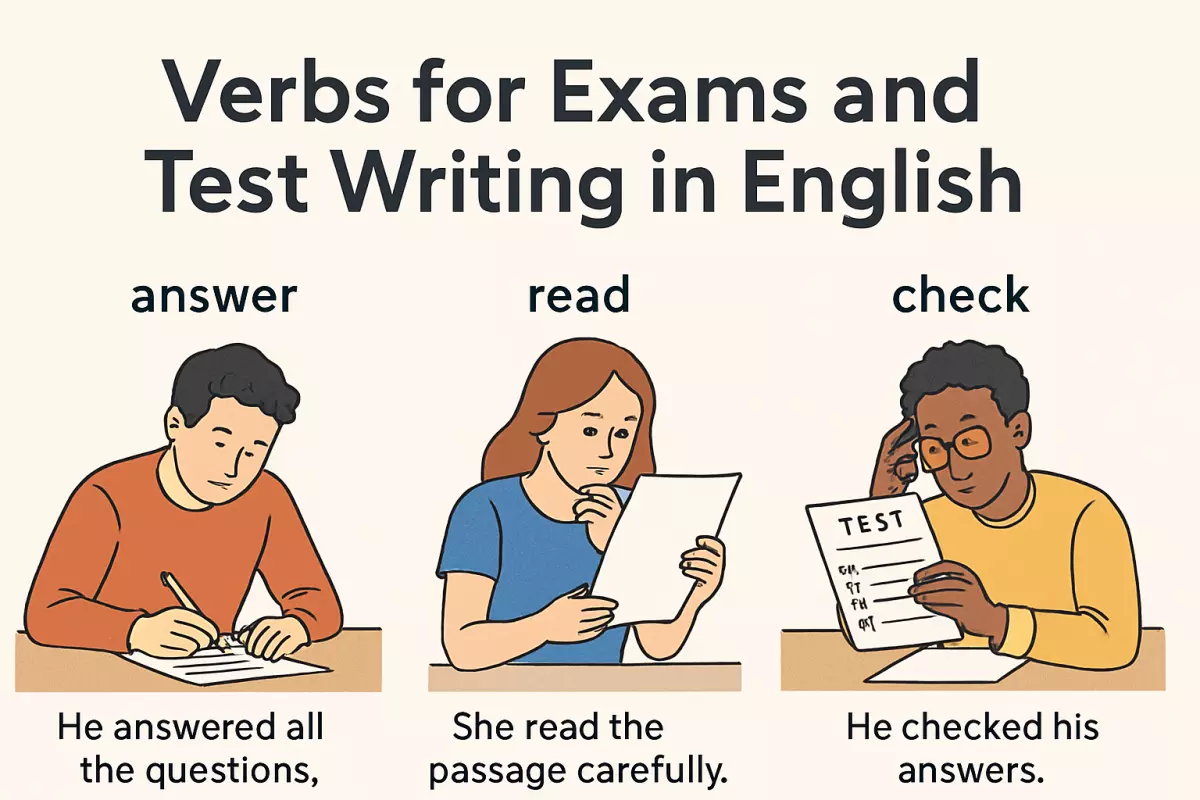
Verbs for Exams and Test Writing in English

 This article explains why verb choice can raise or lower exam scores and reviews common task verbs in questions. It covers academic, reporting, and describing verbs for writing, plus how to avoid informal verbs and fix typical scoring problems.
Using the right action verbs can make your exam answers clearer and more persuasive. This article explains the command words teachers look for, what each one requires you to do, and practical ways to structure your response. You will also learn how to stay focused, manage your time, and write with confidence when the clock is ticking, so your ideas come across quickly and accurately.
Why verb choice matters in exams
In exam writing, verbs do more than show action: they signal your level of certainty, your logical relationships, and how you handle evidence. Strong answers often use verbs that match the task (describe, compare, evaluate), keep the register formal, and make claims that are accurate rather than exaggerated.
How verb choice affects clarity and marks
- It matches the command word. If the question says evaluate, verbs like argue, assess, justify fit better than describe or list.
- It controls strength of claims. Suggest and indicate are safer when evidence is limited; prove and demonstrate require strong support.
- It improves cohesion. Verbs such as contrast, link, lead to, result in show relationships clearly, reducing the need for extra explanation.
- It supports an academic tone. Formal verbs (examine, propose, conclude) usually read more appropriate than conversational ones (talk about, get, show).
- It reduces ambiguity. Specific verbs (classify, quantify, prioritise) tell the reader exactly what you did with the information.
Common verb patterns that examiners expect
- Reporting evidence: The data suggest that… / The results indicate… / The figures show…
- Explaining causes and effects: This leads to… / This results in… / This contributes to…
- Comparing: X differs from Y in that… / X contrasts with Y regarding…
- Defining and clarifying: This refers to… / This can be defined as… / In this context, X means…
- Building an argument: I argue that… / This supports the view that… / This challenges the assumption that…
- Evaluating: This is convincing because… / This is limited by… / A key weakness is…
- Concluding: Overall, this suggests… / It can be concluded that…
Precision: choosing the right strength
- ✅ The evidence suggests that the policy reduced costs. → cautious and realistic when evidence is partial.
- ❌ The evidence proves that the policy reduced costs. → too strong unless the proof is decisive.
- ✅ This example illustrates the principle. → good for explaining with a case.
- ❌ This example explains the principle. → the example may not fully explain; it mainly shows or supports.
- ✅ The author claims that… → neutral reporting of a viewpoint.
- ❌ The author admits that… → implies guilt or reluctance; use only if the context clearly supports it.
High-value exam verbs to rotate (without sounding repetitive)
- analyse (break into parts; focus on how/why)
- evaluate (judge strengths and weaknesses)
- assess (measure importance, impact, or quality)
- compare (identify similarities and differences)
- contrast (emphasise differences)
- justify (give reasons; support a choice)
- interpret (explain meaning of data/text)
- demonstrate (show clearly with strong support)
- illustrate (show with an example)
- indicate (point to; often data-led)
- suggest (tentative conclusion)
- imply (indirect meaning; not stated openly)
- highlight (draw attention to a key point)
- emphasise (give extra importance)
- outline (give main points, not details)
- summarise (short version of main ideas)
- propose (put forward a plan or idea)
- conclude (final judgement based on reasons)
Common task verbs in test questions
Exam prompts often rely on a small set of instruction verbs that tell you exactly what kind of response is expected: a definition, a comparison, a calculation, an argument, or a summary. Paying attention to the verb helps you choose the right structure, level of detail, and supporting evidence.
High-frequency instruction verbs and what they require
- Define: Give the precise meaning of a term. Often followed by a short explanation or an example sentence.
- Describe: Report key features in an organized way (what it is like, what happens, what it contains). Avoid long opinions unless asked.
- Explain: Make the reasons or process clear. Use cause-and-effect language (because, therefore, as a result) and show steps.
- Summarize: Present the main points only, in fewer words. Leave out minor details and most examples.
- Outline: Give the main stages or points in a clear order, usually as brief notes or short sentences.
- Identify: Point out the correct item(s). Many tasks expect a short answer (a name, a label, a sentence).
- List: Provide several items, usually without full explanations unless the question adds “and explain.”
- State: Give a direct answer or fact with no extra discussion. Keep it brief and unambiguous.
- Compare: Show similarities and differences. A balanced structure helps (similarities first, then differences, or point-by-point).
- Contrast: Focus mainly on differences. Use linking words like whereas, however, in contrast.
- Distinguish: Clarify how two things are different, often by defining each and then highlighting the separating feature.
- Classify: Group items into categories and name the criteria used for grouping.
- Discuss: Explore a topic from more than one angle. Include key points, evidence, and a short conclusion.
- Evaluate: Judge value/quality using criteria. Include strengths, weaknesses, and a justified final judgment.
- Assess: Similar to evaluate, but often emphasizes measuring impact, significance, or effectiveness.
- Justify: Give reasons and evidence for a claim or choice. The conclusion should clearly match the support.
- Argue: Present a position and defend it against alternatives. Use claims, evidence, and rebuttal if relevant.
- Analyze: Break something into parts and explain how the parts relate. Look for patterns, causes, assumptions, or structure.
- Interpret: Explain meaning based on evidence (a graph, a quote, a result). Show how you reached the meaning.
- Illustrate: Support an idea with examples, evidence, or a diagram. The example should directly match the point.
- Calculate: Produce a numerical answer; show working if the test expects method marks.
- Prove: Demonstrate a statement is true using logical steps (common in math/logic). Each step must follow from the previous one.
Common wording patterns that change what the verb means
- “Explain why …” → give reasons (causes, motivations, evidence), not just a description of what happened.
- “Discuss to what extent …” → give a balanced view, then decide how far you agree and why.
- “Compare and contrast …” → cover both similarities and differences; do not do only one.
- “Define and give an example …” → include both parts; a definition alone is incomplete.
- “Identify and explain …” → name it first, then add a short explanation of function/importance.
- “Using evidence from the text/data …” → quote, cite figures, or refer to specific details rather than general statements.
- “In your own words …” → paraphrase; avoid copying long phrases from the source.
- “Briefly …” → reduce detail; focus on the highest-value points only.
- “Fully … / in detail …” → expand with steps, examples, and explanations; show reasoning.
- “With reference to …” → connect each point directly to the named concept, case, or source.
Mini practice: choose the best task verb
Complete each instruction with the most suitable verb from this set: define, describe, explain, compare, evaluate, summarize.
- ________ the term “opportunity cost” in one sentence.
- ________ how photosynthesis works, including the role of sunlight.
- ________ the main findings of the report in 3–4 sentences.
- ________ two energy sources (solar and coal), focusing on key similarities and differences.
- ________ the character’s appearance and actions in the opening scene.
- ________ the effectiveness of the new policy, using two criteria.
Show answers
- define
- explain
- summarize
- compare
- describe
- evaluate
Academic verbs for writing tasks
In exam essays, reports, and short-answer responses, the verb you choose signals what kind of thinking you will show (definition, comparison, evaluation, or argument). Many prompts use these verbs directly, and markers expect the matching structure: a clear claim, relevant evidence, and controlled academic tone.
Common instruction verbs and the patterns they require
- Define → give a precise meaning (often with a category + distinguishing features). Define “opportunity cost” in one sentence.
- Describe → report key features in a logical order, without arguing. Describe the stages of the process.
- Summarize → condense main points only; avoid details and examples unless asked. Summarize the author’s position.
- Outline → present the main parts briefly, often as a sequence. Outline two causes and two effects.
- Explain → show how/why with reasons or mechanisms. Explain why the trend changed after 2010.
- Illustrate → support an idea with a specific example. Illustrate your point with one study.
- Compare → show similarities (and sometimes differences if implied). Compare the two approaches.
- Contrast → focus on differences, using clear criteria. Contrast urban and rural outcomes.
- Distinguish → clarify the boundary between two similar concepts. Distinguish correlation from causation.
- Classify → group items into categories and name the criteria. Classify the examples into three types.
- Analyze → break into parts and show relationships, causes, or functions. Analyze the factors influencing demand.
- Interpret → explain meaning or significance (often for data, quotes, or results). Interpret the graph’s main message.
- Evaluate → judge strengths/weaknesses using stated criteria; reach a reasoned conclusion. Evaluate the policy’s effectiveness.
- Assess → measure importance, impact, or value; often similar to “evaluate” but can be more evidence-weighing than judgmental. Assess the risks of the proposal.
- Critique → give a balanced critical response (limitations plus merits), not only negative comments. Critique the methodology.
- Argue → present a clear thesis, defend it with reasons and evidence, and address counterarguments. Argue for or against the claim.
- Justify → explain why a choice/claim is reasonable, with evidence. Justify your recommendation.
- Discuss → explore key points from more than one angle; usually requires some evaluation. Discuss the advantages and disadvantages.
- Synthesize → combine ideas from multiple sources into one coherent position or model. Synthesize the findings from two studies.
Useful sentence frames for exam writing
- Define: X refers to… / X can be defined as…
- Explain: This occurs because… / A key reason is that…
- Compare/contrast: Both X and Y…; however, X… whereas Y…
- Analyze: The main factors include…; these interact by…
- Evaluate/assess: Overall, the evidence suggests…; nevertheless, a limitation is…
- Argue: This essay argues that… / A common objection is…; however…
- Synthesize: Taken together, the sources indicate…
Practice: match the verb to the response style
- You must give a meaning in one sentence and add one distinguishing feature: which instruction verb fits best?
- You must show similarities and differences using the same criteria for both items: which verb(s) fit best?
- You must judge effectiveness using evidence and end with a conclusion: which verb fits best?
- You must break a topic into parts and explain how the parts relate: which verb fits best?
- You must combine ideas from two short texts into one viewpoint: which verb fits best?
Show answers
- Define
- Compare and contrast (or “compare” if the prompt clearly asks for both)
- Evaluate (or assess)
- Analyze
- Synthesize
Reporting and describing verbs
In exam and test writing, you often need verbs that summarise sources, describe data, or state what evidence shows. These verbs help you report information accurately without sounding too informal or too certain. Choose a verb that matches (1) what you are doing (describing, comparing, concluding) and (2) how strong the evidence is.
Common patterns to use
- Verb + that-clause: “The report states that…”, “The results suggest that…”
- Verb + noun phrase: “The chart shows a rise in…”, “The study highlights a key difference.”
- Verb + wh-word: “The data indicate how…”, “The article explains why…”
- Verb + object + to-infinitive: “The findings lead us to conclude…”, “The evidence allows us to infer…”
- Verb + preposition: “The author refers to…”, “The paper focuses on…”, “The graph accounts for…”
Verb choices by purpose (with usable exam-style frames)
- Neutral reporting: state (The text states that…), report (The survey reports that…), note (The author notes that…), mention (The article mentions that…)
- Describing visuals and results: show (The chart shows…), illustrate (The diagram illustrates…), display (The table displays…), present (The results present…)
- Trends and change: increase (X increased by…), rise (X rose to…), fall (X fell from… to…), decline (X declined gradually), fluctuate (X fluctuated between… and…)
- Comparison and contrast: compare (The study compares A and B), contrast (The figures contrast sharply), differ (A differs from B), exceed (A exceeds B), match (A matches B)
- Explaining causes and effects: cause (X caused…), lead to (X led to…), result in (X resulted in…), contribute to (X contributed to…), affect (X affected…)
- Careful interpretation: suggest (The data suggest that…), indicate (The results indicate that…), imply (This implies that…), point to (The evidence points to…)
- Stronger conclusions: demonstrate (The experiment demonstrates that…), confirm (The findings confirm that…), establish (The research establishes that…)
- Emphasis and focus: highlight (The report highlights…), emphasise (The author emphasises…), stress (The paper stresses…), draw attention to (The text draws attention to…)
Accuracy tips: strength, tense, and common errors
- Match strength to evidence: use suggest/indicate for tentative claims; reserve prove/demonstrate/confirm for strong evidence. ✅ “The results suggest that…” ❌ “The results prove that…” (if the evidence is limited)
- Keep tense consistent: for a text you are discussing, present simple is common (“The author argues…”). For completed research methods, past simple is often used (“The researchers measured…”).
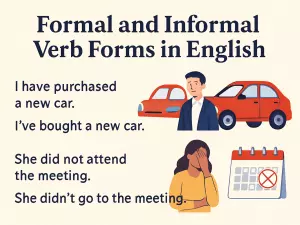
- Avoid informal verbs: replace “talk about” with discuss, “look at” with examine, “find out” with determine.
- Use the right preposition: ✅ “refer to”, “focus on”, “result in”, “contribute to”.
- Be precise with numbers: “increased by 10%” (change) vs. “increased to 10%” (new level).
Avoiding informal verbs in exams
Academic exam writing usually needs verbs that sound precise, neutral, and measurable. Many everyday verbs are not “wrong,” but they can feel too casual, vague, or emotional for formal answers. A good rule is to choose verbs that show clear reasoning (e.g., explain, justify), evidence handling (e.g., demonstrate, indicate), and careful evaluation (e.g., assess, critique).
Common informal verbs and stronger exam alternatives
| Informal / vague verb | More formal exam verb | Example upgrade (❌ → ✅) |
|---|---|---|
| get | obtain, receive, achieve | ❌ Students get better results. → ✅ Students achieve better results. |
| give | provide, offer, present | ❌ The graph gives information. → ✅ The graph provides information. |
| show | demonstrate, indicate, reveal | ❌ The data shows a change. → ✅ The data indicates a change. |
| tell | state, argue, explain | ❌ The author tells us that… → ✅ The author argues that… |
| talk about | discuss, examine, address | ❌ This essay talks about causes. → ✅ This essay examines causes. |
| think | consider, maintain, contend | ❌ I think this is important. → ✅ This is important because… / It can be argued that… |
| say | claim, assert, propose | ❌ Researchers say the method works. → ✅ Researchers claim the method works. |
| find out | determine, identify, establish | ❌ The study found out why it failed. → ✅ The study identified why it failed. |
| look at | analyse, evaluate, investigate | ❌ We look at the results. → ✅ We analyse the results. |
| deal with | address, consider, tackle | ❌ The paper deals with bias. → ✅ The paper addresses bias. |
| come up with | develop, devise, propose | ❌ They came up with a solution. → ✅ They devised a solution. |
| put | place, position, allocate | ❌ Put resources into training. → ✅ Allocate resources to training. |
| make | produce, create, generate | ❌ This makes problems. → ✅ This generates problems. |
| help | facilitate, enable, support | ❌ This helps learning. → ✅ This facilitates learning. |
| fix | resolve, remedy, rectify | ❌ Fix the issue. → ✅ Resolve the issue. |
| big / small change (with “get”) | increase, decrease, fluctuate | ❌ Prices get higher. → ✅ Prices increase. |
Patterns that sound more academic
- Use evidence verbs + noun: “The results indicate a decline,” “The figures suggest a link,” “The survey reveals a trend.”
- Prefer specific action verbs over general ones: replace “do” with “conduct (an experiment),” “perform (a procedure),” or “carry out (an analysis).”
- Choose evaluation verbs when judging: “assess,” “appraise,” “critique,” “compare,” “contrast,” “justify.”
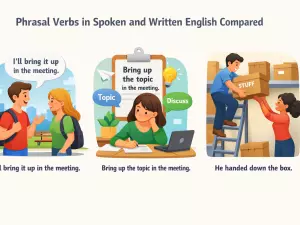
- Avoid phrasal verbs when a single verb is clearer: “set up” → “establish,” “bring up” → “raise,” “point out” → “highlight.”
- Reduce conversational stance markers: instead of “I think,” use “It can be argued that…,” “This suggests that…,” or “One explanation is that…”.
When informal verbs are acceptable
- Direct quotations: keep the original wording if you quote a source or a prompt.
- Personal reflection tasks: some exam questions ask for personal experience; informal verbs can fit, but keep the rest of the sentence controlled and clear.
- Simple process descriptions: in basic instructions, “use” may be fine, but “apply” or “employ” often reads more formal in extended answers.
Typical scoring problems with verbs
Exam answers often lose marks because the verb choice is slightly off: the tense doesn’t match the time reference, the verb pattern is wrong, or the form is too informal for academic writing. Fixing these issues usually means checking (1) time and aspect, (2) subject-verb agreement, (3) common verb + complement patterns, and (4) register.
Tense and aspect mismatches
- Using present simple for finished past events: ❌ In 2010 the company increases profits. → ✅ In 2010 the company increased profits.
- Overusing present continuous for general facts: ❌ People are needing clean water. → ✅ People need clean water.
- Confusing present perfect vs. past simple: use present perfect for an unfinished time period or life experience; use past simple for a finished time. ✅ Researchers have reported concerns this year. / ✅ Researchers reported concerns in 2019.
- Missing past perfect when sequencing matters: ❌ After she finished the test, she realized she forgot her ID. → ✅ After she had finished the test, she realized she had forgotten her ID.
- Incorrect future form after time clauses: ❌ When I will finish, I will submit it. → ✅ When I finish, I will submit it.
- Inconsistent tense across a paragraph: keep one timeline unless you clearly signal a shift (e.g., background in past, current implications in present).
Agreement and form errors that look “small” but cost marks
- Subject-verb agreement with complex subjects: ❌ The list of items are long. → ✅ The list of items is long.
- Agreement with “each/every/one”: ❌ Each student have a role. → ✅ Each student has a role.
- Singular/plural confusion with data and research nouns: in many academic contexts, data can be plural or treated as a mass noun depending on the style; choose one and stay consistent.
- Wrong verb form after modals: ❌ This can improves results. → ✅ This can improve results.
- Missing third-person -s: ❌ The author argue that… → ✅ The author argues that…
Frequent verb pattern mistakes (the “what comes next” problem)
- Verb + gerund vs. verb + infinitive: ❌ They suggested to reduce costs. → ✅ They suggested reducing costs.
- “Explain” without an object: ❌ The graph explains that sales rose. → ✅ The graph shows that sales rose. / ✅ The graph explains the rise in sales.
- “Discuss” without “about”: ❌ We will discuss about the causes. → ✅ We will discuss the causes.
- “Consider” + object + to be: often unnecessary. Prefer ✅ Many consider the policy ineffective. rather than ❌ Many consider the policy to be ineffective. (both can be grammatical, but the shorter form is usually stronger).
- “Allow/enable” patterns: ❌ This allows to reduce errors. → ✅ This allows us to reduce errors. / ✅ This enables error reduction.
- “Prevent/stop” patterns: ❌ This prevents to happen. → ✅ This prevents it from happening.
- “Depend” + preposition: ❌ It depends of the context. → ✅ It depends on the context.
- “Result” + preposition: ❌ This resulted to higher costs. → ✅ This resulted in higher costs.
- “Lack” as a verb vs. noun: ❌ They are lack of resources. → ✅ They lack resources. / ✅ They are lacking resources. (use the continuous form only when the shortage is temporary or developing).
Passive voice, clarity, and agent choice
- Overusing passive voice: passive is useful for methods and processes, but too much can hide responsibility. Prefer active when the agent matters: ✅ The researchers measured… rather than It was measured…
- Wrong passive form: ❌ The results were showed. → ✅ The results were shown.
- Missing agent where it is needed: ❌ It is believed that… can be vague; when appropriate, specify: ✅ Many economists argue that…
Register problems in formal exam writing
- Informal verbs that weaken academic tone: replace ❌ get, a lot, stuff, thing with ✅ obtain/receive, many/much, materials/factors, issue/aspect (choose the most precise option).
- Overstated certainty: ❌ This proves that… → ✅ This suggests/indicates that… unless the task truly involves proof.
- Vague reporting verbs: prefer specific choices such as argues, claims, observes, notes, demonstrates, compares based on what the source actually does.
When checking your final draft, scan each sentence for the main verb and confirm the timeline, the subject, and the complement pattern. Small verb fixes often improve both grammar accuracy and how convincing the argument sounds.
Strategies for precise verb choice
Choose verbs that match the task word in the prompt and the kind of evidence you are using. In exam and test writing, small shifts in verb meaning can change your claim from a description to an evaluation, or from a summary to an argument. The goal is to signal your thinking clearly and avoid verbs that are too vague for academic marking criteria.
1) Match the verb to the exam command word
- Describe → report observable features without judging: “The graph shows a steady rise.”
- Explain → give reasons/causes: “This trend results from increased demand.”
- Analyse → break into parts and connect patterns: “The data reveals two distinct phases.”
- Compare → highlight similarities and differences: “Group A differs from Group B in…”
- Evaluate → weigh strengths/limits using criteria: “This approach offers benefits but fails to address…”
- Argue → defend a position with support: “I contend that…”
- Discuss → consider multiple sides: “The evidence suggests…, yet critics maintain…”
- Justify → show why your choice is reasonable: “This decision is supported by…”
2) Replace vague verbs with specific academic actions
- ❌ “This shows the problem.” → ✅ “This highlights the main constraint.”
- ❌ “The author talks about pollution.” → ✅ “The author addresses pollution and emphasises its costs.”
- ❌ “The study looks at age.” → ✅ “The study examines age as a predictor.”
- ❌ “The results say…” → ✅ “The results indicate…”
- ❌ “This proves…” (often too strong) → ✅ “This supports / suggests…”
- ❌ “We did an experiment.” → ✅ “We conducted an experiment.”
3) Control strength: choose the right level of certainty
- High certainty (use only when evidence is decisive): demonstrates, establishes, confirms.
- Moderate certainty (common in essays): indicates, suggests, implies, points to.
- Low certainty (when evidence is limited): may indicate, appears to, could reflect.
- Pattern tip: combine a cautious verb with a clear reason: “This suggests X because…”
4) Use reporting verbs that fit your source use
- Neutral reporting: states, reports, notes, observes.
- Emphasis: emphasises, highlights, stresses.
- Argument/position: argues, contends, maintains, claims.
- Evidence-based framing: demonstrates, shows, finds (use when the source provides data).
- Critique: questions, challenges, criticises, rejects.
5) Choose verbs that match the type of evidence (data, text, logic)
- For data and visuals: illustrates, indicates, reveals, shows, correlates with, fluctuates, peaks, declines.
- For textual interpretation: portrays, depicts, implies, frames, positions.
- For reasoning: supports, undermines, follows from, leads to, contradicts.
6) Check grammar patterns that commonly cause errors
- Explain + noun clause: “This explains why…” (not “explains about”).
- Discuss + noun: “The essay discusses the causes…” (not “discusses about”).
- Compare A with B: “Compare A with B” (or “compare A to B” for analogy).
- Focus on: “The study focuses on…”
- Consist of: “The sample consists of…”
- Lead to: “This leads to…”
- Result in / result from: “X results in Y” vs. “Y results from X”.
7) Edit for precision: a quick verb checklist
- Does the verb match the task (describe vs. evaluate vs. argue)?
- Is the strength appropriate (suggests vs. proves)?
- Is the verb specific enough (examine/assess instead of do/make)?
- Does the verb fit the evidence (data reveals; author argues)?
- Is the grammar pattern correct (discuss + noun, not discuss about)?
- Can one stronger verb replace a verb + vague noun? (“analyse” instead of “do an analysis”).
Homework: exam-style verb practice
Use these tasks to build control of the verbs and verb patterns that appear in exam prompts and academic-style answers. Focus on (1) choosing the right reporting verb, (2) matching the correct grammar pattern (that-clause, noun phrase, -ing, infinitive), and (3) keeping tense and tone consistent.
Task 1: Choose the best exam verb
Complete each instruction with the most suitable verb from the box. Use each verb once.
Verbs: analyse, assess, compare, contrast, define, describe, discuss, evaluate, explain, illustrate, summarise
- ________ the term “opportunity cost” in one sentence.
- ________ the main stages of the water cycle.
- ________ why inflation can reduce purchasing power.
- ________ the key points of the passage in 3–4 sentences.
- ________ two theories of motivation, noting similarities and differences.
- ________ the two approaches by focusing on their differences.
- ________ the causes of the decline using evidence from the chart.
- ________ the strengths and weaknesses of the author’s argument.
- ________ whether the policy was effective, using criteria you choose.
- ________ the advantages and disadvantages before giving your view.
- ________ your point with one concrete example.
Show answers
- define
- describe
- explain
- summarise
- compare
- contrast
- analyse
- evaluate
- assess
- discuss
- illustrate
Task 2: Verb pattern accuracy (fix the grammar)
Rewrite each sentence so the verb pattern is correct. Keep the meaning.
- The data suggests to reduce costs in Q3.
- The author argues pollution is the main cause.
- This section will discuss about the impact of social media.
- The results indicate to a steady increase over time.
- We will compare between urban and rural outcomes.
- The study recommends implementing the policy immediately.
- The graph illustrates that to sales rose sharply in May.
- The evidence supports to the hypothesis.
- The paper aims explaining how memory works.
- The findings emphasise on the need for training.
Show answers
- The data suggests reducing costs in Q3. / The data suggests that costs should be reduced in Q3.
- The author argues that pollution is the main cause.
- This section will discuss the impact of social media.
- The results indicate a steady increase over time. / The results indicate that there was a steady increase over time.
- We will compare urban and rural outcomes.
- The study recommends that the policy should be implemented immediately. / The study recommends implementing the policy immediately.
- The graph illustrates that sales rose sharply in May.
- The evidence supports the hypothesis.
- The paper aims to explain how memory works.
- The findings emphasise the need for training.
Task 3: Upgrade weak verbs in an exam paragraph
Replace the repeated verb shows with a more precise option. Use an appropriate tense and pattern each time (for example: indicates that, demonstrates, highlights, suggests, reveals).
- The first chart shows that unemployment fell after 2015.
- The table shows a clear difference between the two groups.
- The evidence shows the policy had unintended effects.
- The final section shows why the conclusion matters.
- The results show a link, but not necessarily a cause.
- The interview data shows participants were concerned about privacy.
- The trend line shows a gradual recovery.
- The comparison shows the second method is more reliable.
Show answers
- The first chart indicates that unemployment fell after 2015.
- The table highlights a clear difference between the two groups.
- The evidence suggests that the policy had unintended effects.
- The final section explains why the conclusion matters.
- The results point to a link, but not necessarily a cause.
- The interview data reveals that participants were concerned about privacy.
- The trend line shows a gradual recovery. / The trend line demonstrates a gradual recovery.
- The comparison indicates that the second method is more reliable.
Task 4: Build exam sentences with “reporting + stance” verbs
Write one sentence for each prompt using the verb in brackets. Follow the pattern hints.
- Use argue + that-clause: (argue) The writer / social media / harm attention.
- Use claim + that-clause, then add a cautious adverb (e.g., partly, arguably): (claim) Some researchers / the effect / be small.
- Use suggest + -ing or that-clause: (suggest) The data / increase taxes / reduce consumption.
- Use acknowledge + noun phrase: (acknowledge) The study / limitations.
- Use conclude + that-clause: (conclude) We / the intervention / improve results.
- Use recommend + that-clause or -ing: (recommend) The report / invest / public transport.
- Use emphasise + noun phrase: (emphasise) The author / importance / early education.
- Use challenge + noun phrase: (challenge) The findings / common assumption.
Show answers
- The writer argues that social media harms attention.
- Some researchers claim that the effect is arguably small.
- The data suggests increasing taxes to reduce consumption. / The data suggests that higher taxes reduce consumption.
- The study acknowledges its limitations.
- We conclude that the intervention improved results.
- The report recommends investing in public transport. / The report recommends that governments invest in public transport.
- The author emphasises the importance of early education.
- The findings challenge a common assumption.
Task 5: Quick checklist for self-marking
- Did you choose a verb that matches the instruction (e.g., compare needs similarities and differences; contrast focuses on differences)?
- Did you use the correct pattern (that-clause vs. noun phrase vs. -ing vs. infinitive)?
- Did you avoid unnecessary prepositions (❌ discuss about → ✅ discuss; ❌ emphasise on → ✅ emphasise)?
- Did you keep your verbs consistent with your evidence (avoid over-certainty when the data is limited)?
- Did you vary reporting verbs to avoid repetition while keeping the tone formal?