Verb Frequency Lists by Level from A1 to C2

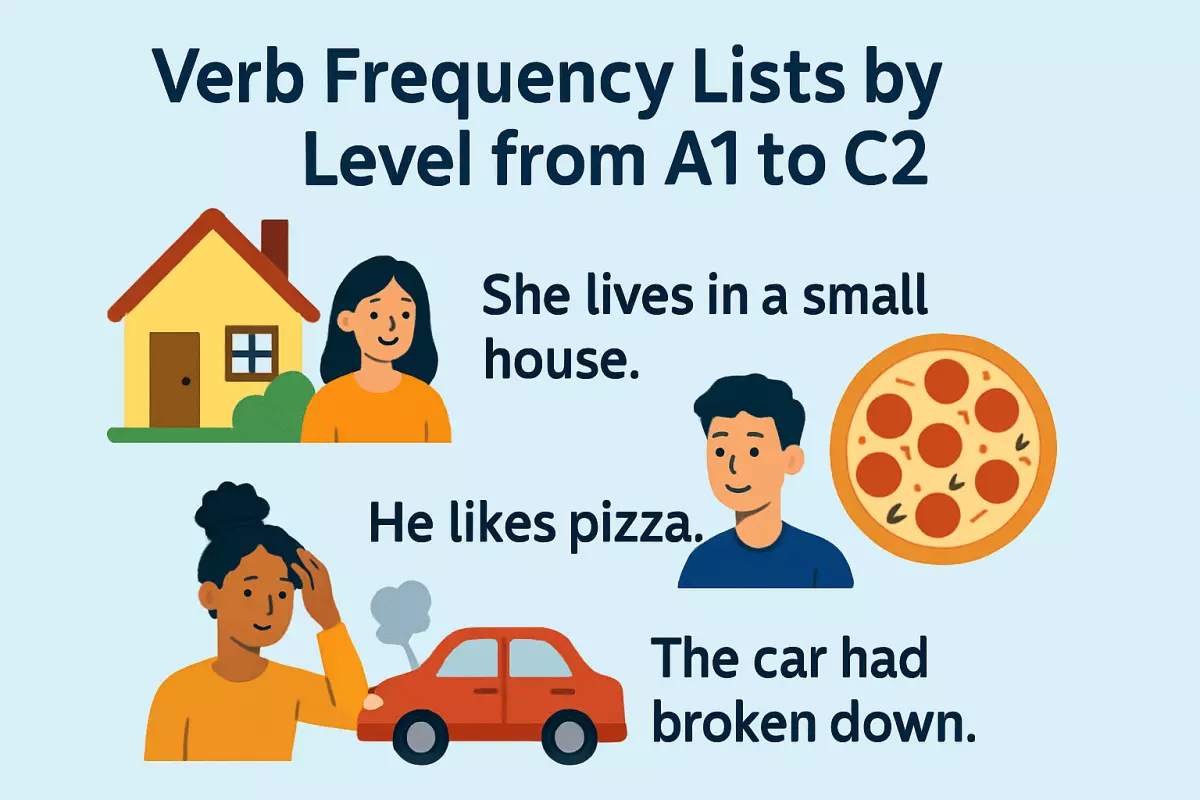 This article explains verb frequency, starting with core verbs for beginners and how to expand your verb range at intermediate level.
These graded verb-use lists, from A1 beginners to C2 advanced learners, help you focus on the actions people actually talk about every day. They show which verbs to learn first, which can wait, and how to use them naturally in real conversations. With clear levels and practical examples, you can build confidence step by step and choose the right words faster when speaking or writing.
What verb frequency means
Frequency in a verb list is a practical signal: it shows how often a verb appears in real English across many texts and conversations. A high-frequency verb is one you meet repeatedly, so learning it early gives more coverage when reading, listening, and speaking. A lower-frequency verb may be useful, but it tends to appear in narrower topics, specific registers, or fixed expressions.
How to interpret frequency in level-based lists
- Higher frequency → wider usefulness: verbs like go, make, and take support many everyday messages and combine with many nouns and particles.
- Lower frequency → narrower contexts: some verbs are common mainly in academic writing, professional settings, or particular genres.
- Level and frequency are related but not identical: a verb can be frequent yet still challenging because of irregular forms, multiple meanings, or complex patterns.
- Spoken vs. written differences matter: conversation favors short, flexible verbs; formal writing often uses more specific verbs and nominal style.
- Frequency counts are about forms in context: work as a verb, work as a noun, and working in different constructions may be counted separately depending on the source.
Why some very common verbs still feel difficult
- Many meanings: one frequent verb can cover several ideas (for example, get can mean receive, become, fetch, understand, arrive).
- Common phrasal partners: high-frequency verbs often form phrasal verbs that change meaning (take off, take on, take up).
- Grammar patterns vary by meaning: a verb may take different complements (verb + noun, verb + to-infinitive, verb + -ing, verb + clause).
- Collocations drive naturalness: learners may know the verb but not the typical pairing (say make a decision, not ❌ do a decision).
Patterns that frequency lists often highlight
- Light-verb combinations: make/take/have/do + noun (make a plan, take a break, have a look, do homework).
- Core reporting verbs: say, tell, ask, explain, suggest (often tied to clause patterns).
- Everyday action verbs: go, come, put, bring, leave (often used with location and direction phrases).
- Stance and thinking verbs: think, know, believe, feel, seem (frequent in conversation for opinions and uncertainty).
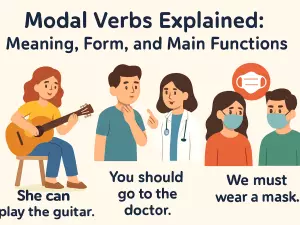
- Modal-like meanings: need, want, hope, plan, manage (frequent because they express goals and ability).
How to use frequency to study smarter
- Prioritize coverage: learn the most frequent verbs with their main meanings first, then add less common senses later.
- Learn verbs with their typical partners: store them as chunks (verb + object, verb + preposition, verb + particle).
- Track the top patterns per verb: focus on the 2–3 most common structures before rare ones.
- Separate “recognition” from “production”: you may understand a lower-frequency verb in reading before you can use it naturally in speaking.
- Use level lists as a guide, not a rule: if a verb is frequent in your work or studies, it can be worth learning earlier than the level suggests.
Core verbs for beginner levels
At A1–A2, the most useful verbs are the ones you need to talk about identity, daily routines, basic needs, and simple plans. Focus on high-frequency meanings first, then learn the most common patterns (verb + object, verb + preposition, and basic question forms) so you can reuse the same verb in many situations.
High-utility verb set (A1–A2)
- be (am/is/are): identity and description (I am a student. It is cold.)
- have: possession and relationships (I have a phone. We have a meeting.)
- do: actions and questions (Do you work here? I do my homework.)
- go: movement and routines (I go to school. We go home.)
- get: receive/obtain/arrive (I get an email. I get home at six.)
- make: create/prepare (I make dinner. She makes a cake.)
- take: carry/consume/transport (Take an umbrella. I take the bus.)
- come: movement toward the speaker (Come here. They come on Monday.)
- give: transfer (Give me the book. I give her a gift.)
- put: place (Put it on the table.)
- see: perception/meeting (I see a dog. See you tomorrow.)
- look: direct attention (Look at this. You look tired.)
- know: information/familiarity (I know the answer. I know him.)
- think: opinions (I think it’s good.)
- want: needs and preferences (I want water. I want to go.)
- need: necessity (I need help. We need to leave.)
- like: preferences (I like coffee. She likes music.)
- say / tell: speaking (Say it again. Tell me your name.)
- work / study: daily life (I work here. He studies English.)
- live: place and routine (I live in Madrid.)
Core patterns to learn early
- Verb + noun: have a car, make dinner, take a photo, need help.
- Verb + to + verb: want to go, need to study, like to read.
- Verb + -ing (common with like/love/hate): like reading, hate waiting.
- Verb + preposition (fixed combinations): listen to music, look at it, wait for the bus.
- There is/There are (with be): There is a problem. There are two chairs.
- Basic question building:
- With be: ✅ Are you ready? ❌ Do you are ready?
- With other verbs: ✅ Do you like tea? ❌ Like you tea?
Small but important contrasts
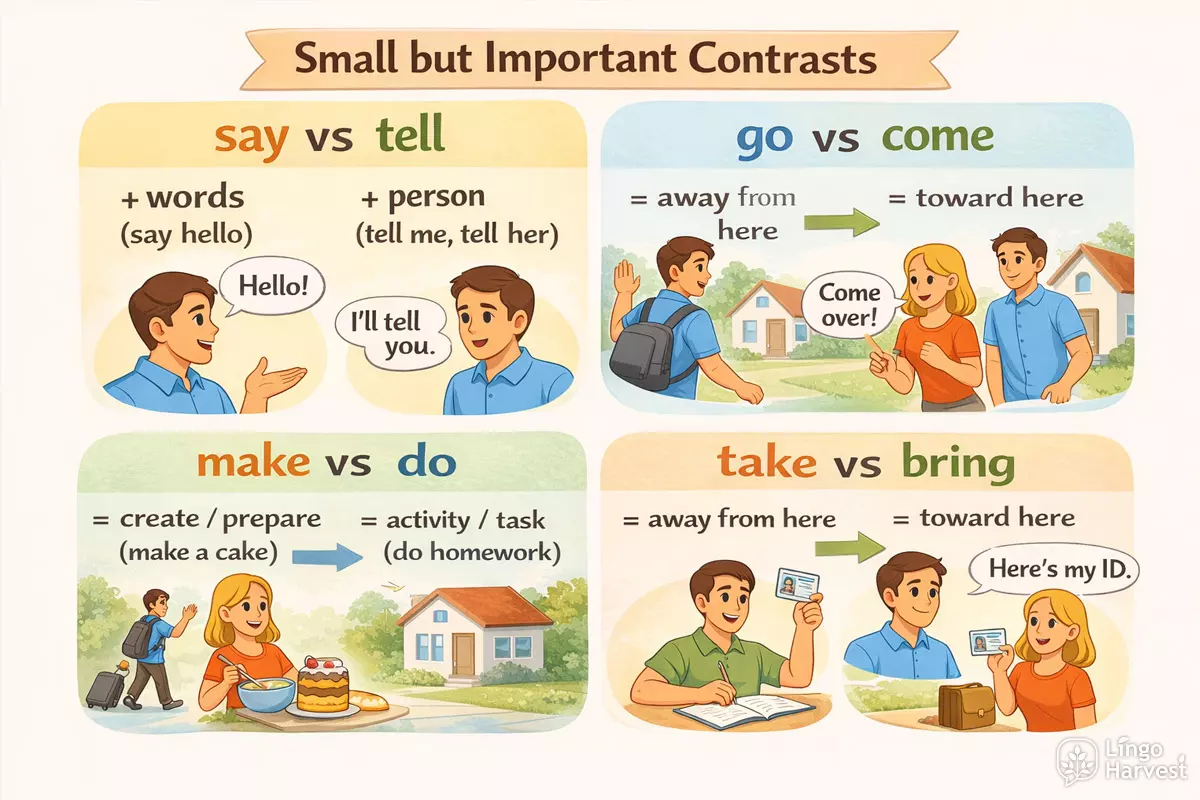
- say vs tell: say + words (say hello); tell + person (tell me, tell her).
- go vs come: go = away from here; come = toward here (Come to my house).
- make vs do: make = create/prepare (make a cake); do = activity/task (do homework).
- take vs bring: take = away from here; bring = toward here (Bring your ID).
When building your own frequency list for A1–A2, prioritize verbs that combine easily with many nouns and time expressions (today, tomorrow, every day). This gives you flexible sentences quickly, and it prepares you for the next levels where you add more specific verbs and more complex verb patterns.
Expanding verb range at intermediate level
At B1–B2, learners move beyond high-frequency “do/go/get” choices and start selecting verbs that show purpose, process, and attitude. The goal is not only to know more verbs, but to use them in reliable patterns: verb + object, verb + preposition, verb + infinitive, and verb + -ing. This is where accuracy with collocations and complementation makes writing and speaking sound more precise.
Core verb patterns to build
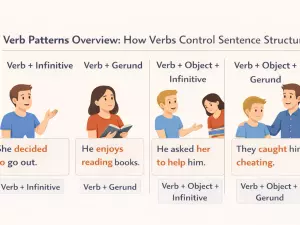
- Verb + to-infinitive (plans, decisions, willingness): decide to, manage to, refuse to, offer to, agree to.
- Verb + -ing (activities, avoidance, enjoyment): avoid -ing, consider -ing, suggest -ing, recommend -ing, admit -ing.
- Verb + object + to-infinitive (influence, permission, requests): persuade someone to, encourage someone to, allow someone to, remind someone to.
- Verb + preposition (fixed pairings): depend on, belong to, apologize for, succeed in, insist on.
- Verb + that-clause (reporting, stance): claim that, realize that, assume that, recommend that (often with a modal: recommend that you should…).
High-value intermediate verbs (grouped by function)
- Planning and progress: arrange, schedule, postpone, complete, improve, expand, reduce.
- Problem-solving: solve, handle, deal with, prevent, fix, repair, overcome.
- Communication: explain, mention, announce, complain, apologize, emphasize, persuade.
- Thinking and learning: realize, assume, recognize, research, revise, review, memorize.
- Work and study actions: apply, attend, participate, submit, organize, prepare, manage.
- Social and rules: allow, forbid, require, request, recommend, warn, remind.
- Change and results: increase, decrease, rise, drop, achieve, fail, succeed.
Common “upgrade” choices (avoid overusing basic verbs)
- get → receive, obtain, achieve, become, recover (choose by meaning)
- make → create, produce, cause, force, prepare
- do → carry out, perform, conduct, handle
- say → mention, explain, announce, admit, complain
- think → believe, assume, consider, doubt, realize
- help → support, assist, enable, encourage
- start → begin, launch, introduce, set up
- stop → quit, cancel, prevent, avoid
Usage checkpoints (patterns that often cause errors)
- Suggest / recommend: ✅ suggest doing / recommend doing ❌ suggest to do
- Explain: ✅ explain something to someone ❌ explain someone
- Discuss: ✅ discuss the problem ❌ discuss about the problem
- Depend: ✅ depend on (not depend of)
- Manage: ✅ manage to finish (successful result implied)
- Avoid: ✅ avoid making (use -ing or a noun)
- Prevent: ✅ prevent someone from doing
- Allow: ✅ allow someone to do (not allow someone do)
To make these verbs stick, practice them in short frames you can reuse: manage to + result, avoid + -ing, persuade someone to + action, depend on + factor. This kind of pattern-based learning improves both fluency and accuracy, and it prepares you for the more nuanced verb choices that appear at C1–C2.
Advanced and academic verb lists
At C1–C2, verb choice is less about “knowing a verb” and more about using it in the right pattern: the typical subject, the preposition that follows, the clause type, and the level of formality. Academic and professional writing also prefers verbs that clearly show relationships such as cause, contrast, evidence, and limitation.
Core C1–C2 verbs and the patterns they prefer
- assess + noun: assess the impact/risk/feasibility
- attribute + noun + to: attribute the change to policy shifts
- clarify + noun/wh-clause: clarify the criteria / clarify what counts as evidence
- compile + noun: compile data/a bibliography/a dataset
- constrain + noun: constrain growth/choice/interpretation
- contradict + noun: contradict earlier findings/assumptions
- corroborate + noun: corroborate the claim/the account
- deduce + noun + from: deduce a rule from the examples
- deem + noun + adjective/infinitive: deem it necessary / deem the method to be unreliable
- differentiate between A and B: differentiate between correlation and causation
- dispel + noun: dispel a myth/a misconception
- elicit + noun: elicit responses/feedback/a reaction
- entail + noun/-ing: entail costs / entail working overtime
- exert + noun: exert pressure/influence/control
- facilitate + noun: facilitate access/learning/coordination
- hamper + noun: hamper progress/analysis/implementation
- infer + noun + from: infer intent from wording
- justify + noun/-ing: justify the decision / justify using a smaller sample
- mitigate + noun: mitigate harm/risk/bias
- pose + noun: pose a challenge/a threat/a question
Useful verb families for academic argumentation
- Claiming and stance: argue, contend, maintain, posit, hypothesize, assert
- Evidence and support: demonstrate, indicate, suggest, substantiate, verify, validate
- Analysis and method: examine, evaluate, investigate, model, operationalize, replicate
- Limits and caution: qualify, delimit, concede, acknowledge, underestimate, overstate
- Linking ideas: contrast, reconcile, align, integrate, synthesize, contextualize
High-frequency academic patterns to practice
- Verb + that-clause (formal reporting): The results indicate that… / The author argues that…
- Verb + wh-clause (focus on the question): This section explains how… / The study examines why…
- Verb + noun + preposition (fixed collocation): contribute to growth; result in change; derive from theory
- Verb + -ing (process and consequences): This approach involves collecting… / The policy risks increasing inequality
- Verb + object + infinitive (evaluation/permission): The data allow us to… / The evidence leads us to conclude…
Common accuracy issues at C1–C2 (pattern-focused)
- ✅ attribute X to Y → ❌ attribute X with Y
- ✅ differentiate between A and B → ❌ differentiate with A and B
- ✅ infer X from Y → ❌ infer X to Y
- ✅ justify doing / justify something → ❌ justify to do
- ✅ mitigate a risk (reduce) → ❌ mitigate the risk happens (use: prevent/avoid)
When building your own C1–C2 verb frequency lists, group verbs by pattern (that-clause, preposition, -ing, infinitive) and by function (claim, evaluate, limit, connect). This makes it easier to choose a precise verb under time pressure and to keep register consistent in essays, reports, and presentations.
Using frequency data for learning
Frequency lists are most useful when they shape what you practice first and how you recycle it over time. A high-ranking verb is not just “common”; it tends to appear in many grammar patterns, collocations, and classroom tasks, so it repays repeated attention across levels.
How to turn frequency into a study plan
- Prioritise by payoff: learn the top verbs at your level with their most typical patterns (not only the base meaning). For example, “make” is less useful without “make + noun” (make a decision) and “make + object + adjective” (make it clear).
- Learn verbs as frames: store a verb together with 2–3 common complements (to-infinitive, -ing, that-clause, noun phrase). This reduces hesitation and improves accuracy in speaking and writing.
- Recycle across levels: when you move from A2 to B1, keep earlier high-frequency verbs but add new uses (phrasal verbs, more abstract meanings, and formal alternatives).
- Balance breadth and depth: use frequency to choose which verbs to learn (breadth), then use typical patterns to decide what to master (depth).
- Track “usefulness” signals: verbs that combine with many nouns (get, take, make, give, have) deserve extra time because they generate many natural sentences.
What to focus on for high-frequency verbs (patterns that repeat)
- Verb + noun (common objects): take a break, make a mistake, have an idea, give advice, do homework.
- Verb + preposition: depend on, belong to, listen to, agree with, worry about.
- Verb + to-infinitive: want to, need to, decide to, manage to, refuse to.
- Verb + -ing: enjoy -ing, avoid -ing, keep -ing, consider -ing, suggest -ing.
- Verb + that-clause: think that, say that, hope that, argue that, insist that.
- Reporting patterns: tell someone to, ask someone to, advise someone to, warn someone about.
- Passive-friendly verbs (common in B2–C2 writing): be considered, be expected, be required, be associated with.
- Linking uses: seem (to), appear (to), remain, become (useful for formal descriptions).
Common mistakes frequency data can help you avoid
- Overlearning rare synonyms too early: replacing “help” with “facilitate” before you can use “help + object + (to) verb” smoothly.
- Ignoring grammar load: a frequent verb may have irregular forms or tricky complements (e.g., “suggest + -ing/that”, not “suggest to do” ❌).
- Learning phrasal verbs as isolated items: focus on the most frequent particles and meanings first (get up, go on, find out, put off) and practise them in short contexts.
- Using one verb for everything: high-frequency verbs are flexible, but accuracy improves when you add a few mid-frequency alternatives at B1–B2 (e.g., “choose/select”, “start/begin”, “need/require”).
A practical routine for each level (A1 to C2)
- A1–A2: learn core verbs with present/past forms and 1–2 everyday objects (go to school, have breakfast, like music). Build quick sentence templates you can reuse.
- B1: expand complements and time expressions; add common phrasal verbs and reporting verbs (tell, ask, explain). Practise short narratives using past forms consistently.
- B2: add abstract meanings and more formal patterns (increase, reduce, affect; be required to). Practise paragraph writing with cause–effect verbs and linking structures.
- C1–C2: refine register and precision: stance verbs (maintain, contend), hedging (tend to, appear to), and passive/reporting patterns typical of academic and professional writing.
Common high-frequency mistakes
Errors with very common verbs usually come from a few repeatable patterns: tense choice (especially present perfect), missing auxiliaries, incorrect verb + preposition combinations, and overusing a “default” verb like do or make. Fixing these patterns improves accuracy across A1–C2 because the same verbs appear again and again in different structures.
1) Auxiliary verbs (be/do/have): missing, doubled, or in the wrong place
- ❌ “She not like it.” → ✅ “She doesn’t like it.” (use do for present simple negatives)
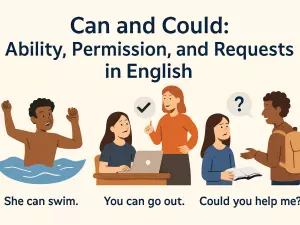
- ❌ “Do you can help?” → ✅ “Can you help?” (don’t add do with modal verbs)
- ❌ “I am agree.” → ✅ “I agree.” (many verbs don’t take be)
- ❌ “He didn’t went.” → ✅ “He didn’t go.” (after did, use base form)
- ❌ “I have saw it.” → ✅ “I have seen it.” (present perfect needs past participle)
- ❌ “Where you are going?” → ✅ “Where are you going?” (invert auxiliary + subject in questions)
2) Tense and time markers: choosing the “default” tense
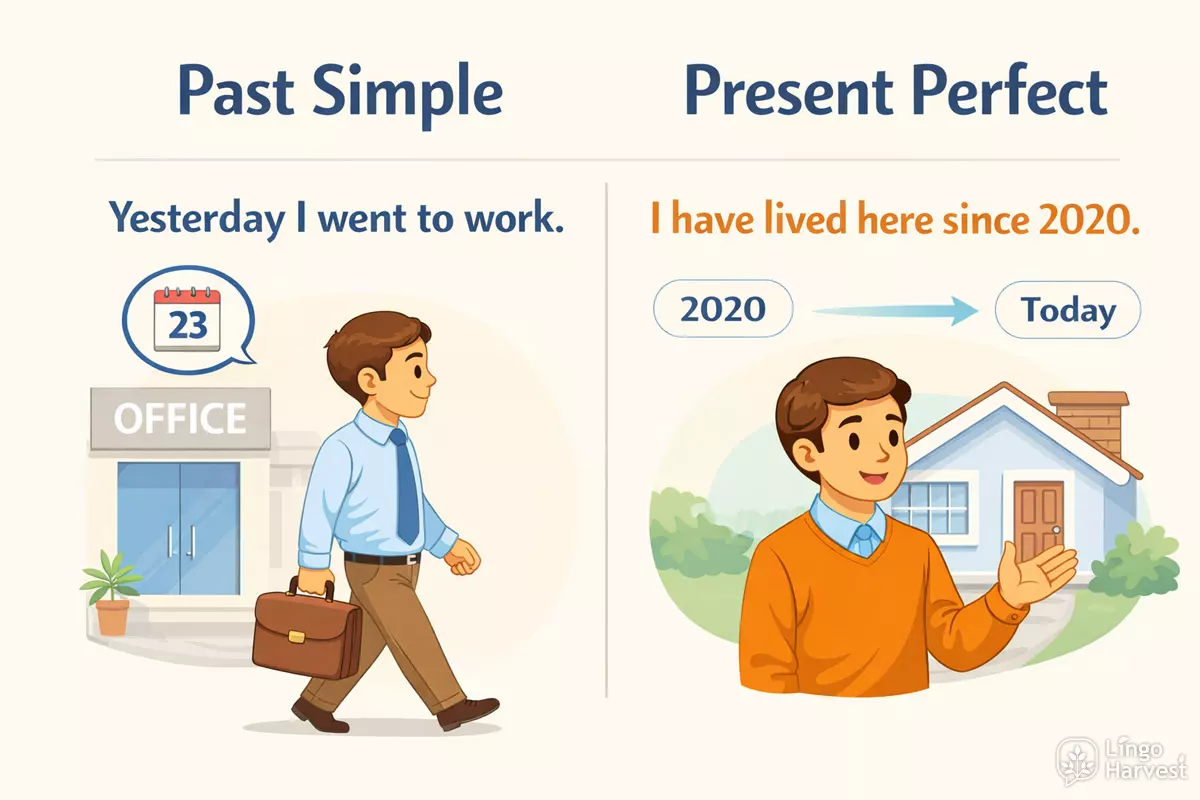
- ❌ “Yesterday I go to work.” → ✅ “Yesterday I went to work.” (finished past time → past simple)
- ❌ “I live here since 2020.” → ✅ “I have lived here since 2020.” (since/for + unfinished time → present perfect)
- ❌ “I’m knowing him for years.” → ✅ “I’ve known him for years.” (stative verbs usually avoid continuous)
- ❌ “When I will arrive, I call you.” → ✅ “When I arrive, I’ll call you.” (future meaning in time clauses uses present simple)
- ❌ “I have been to Paris last year.” → ✅ “I went to Paris last year.” (specific past time → past simple, not present perfect)
3) Verb + preposition patterns: small words, big meaning changes
- ❌ “Listen music.” → ✅ “Listen to music.”
- ❌ “Depend of.” → ✅ “Depend on.”
- ❌ “Married with someone.” → ✅ “Married to someone.”
- ❌ “Explain me the problem.” → ✅ “Explain the problem to me.” (common verb + object order)
- ❌ “Discuss about it.” → ✅ “Discuss it.” (no extra preposition)
- ❌ “Arrive to the station.” → ✅ “Arrive at the station.” (place point → at; cities/countries → in)
4) High-frequency verb collocations: do/make/take/give/get
- ❌ “Make homework.” → ✅ “Do homework.”
- ❌ “Do a decision.” → ✅ “Make a decision.”
- ❌ “Take a shower” used as “take a bath” in all contexts → ✅ choose the natural collocation for the meaning (shower vs bath)
- ❌ “Give an exam.” → ✅ “Take an exam” (student) / “Give an exam” (teacher/institution)
- ❌ “Get a baby.” → ✅ “Have a baby” / “have a child.”
- ❌ “Make a photo.” → ✅ “Take a photo.”
5) Verb forms after common verbs: to-infinitive vs -ing
- ❌ “I enjoy to read.” → ✅ “I enjoy reading.”
- ❌ “I want going.” → ✅ “I want to go.”
- ❌ “She suggested to meet.” → ✅ “She suggested meeting.”
- ❌ “He made me to do it.” → ✅ “He made me do it.” (make/let + object + base verb)
- ❌ “I look forward to meet you.” → ✅ “I look forward to meeting you.” (to here is a preposition)
6) Confusing high-frequency pairs: say/tell, speak/talk, borrow/lend
- ❌ “He said me the news.” → ✅ “He told me the news.” (tell + person)
- ❌ “She told that she’s late.” → ✅ “She said (that) she was late.” (say + clause)
- ❌ “Can you borrow me a pen?” → ✅ “Can you lend me a pen?”
- ❌ “I lent a pen from him.” → ✅ “I borrowed a pen from him.”
When building verb frequency lists by level, it helps to note these patterns next to each verb entry (auxiliary use, typical prepositions, and verb-form complements). Learners can then practice the most frequent verbs in the structures they most often appear in, rather than memorizing isolated base forms.
Learning strategies by level
Use verb frequency lists as a roadmap: learn the highest-utility verbs first, then add the patterns, collocations, and grammar frames that make those verbs usable in real sentences. The goal at each stage is not just recognition, but fast, accurate production in the contexts that match your level.
A1: Build survival verbs with one reliable frame each
- Prioritize the most common “do-everything” verbs and learn them with a single basic structure: I want + noun, I like + noun, I have + noun.
- Attach verbs to everyday topics (food, family, places) and practice short exchanges, not isolated words.
- Learn affirmative + negative + question together to avoid one-sided knowledge.
- Keep tense simple: present simple and “can” for ability; avoid overloading with rare forms.
- Make mini-dialogues with 2–3 turns (ask, answer, follow-up) using the same core verbs.
- Practice high-frequency chunks: I need to…, I want to…, I can’t…, I don’t know.
- Use substitution drills: swap objects and places while keeping the verb frame stable.
- Focus on pronunciation of endings that affect meaning (e.g., third-person -s in very common verbs).
A2: Expand to everyday actions and start linking ideas
- Add common past forms for frequent verbs and learn them as pairs: go → went, have → had, make → made.
- Learn verbs with their typical partners (collocations): make a mistake, take a photo, do homework.
- Build “verb + preposition” habits early: listen to, wait for, look at.
- Practice sequencing with connectors: then, after that, because to turn verb lists into stories.
- Use simple role-plays (shopping, travel, appointments) to recycle the same high-frequency verbs.
- Notice common question patterns: Do you…?, Did you…?, Can I…? and answer them with full clauses.
- Start a “verb notebook” with three lines per verb: meaning, one example, one common collocation.
- Correct typical frame errors explicitly: ✅ listen to music ❌ listen music
B1: Add verb patterns (gerunds/infinitives) and everyday nuance
- Group verbs by the structure they require, not only by meaning: enjoy + -ing, decide + to, suggest + -ing.
- Learn phrasal verbs selectively: choose those that appear often in conversation and news, then learn one meaning at a time.
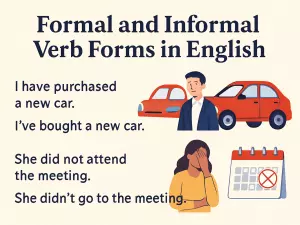
- Upgrade basic verbs with common alternatives and register awareness (neutral vs. informal): help vs. assist (recognition first).
- Practice “verb + object + infinitive” frames: ask someone to…, tell someone to…, need someone to….
- Use short writing tasks (80–120 words) where you must reuse 8–12 target verbs naturally.
- Train past narrative: mix past simple for events with past continuous for background using frequent verbs.
- Build automaticity with timed speaking: 60 seconds describing a routine, a past event, and a plan.
- Track errors by pattern (wrong preposition, wrong verb form, missing object) and fix the pattern, not just the sentence.
B2: Consolidate collocations, argument structure, and stance
- Study how verbs “take” information: explain something to someone, provide someone with something, prevent someone from doing something.
- Learn reporting and stance verbs with clause patterns: claim that…, argue that…, tend to…, appear to….
- Work with synonyms by context, not lists: choose the verb that fits the situation (formal, neutral, critical, cautious).
- Practice hedging and precision: seem, suggest, indicate for careful claims; avoid overusing think.
- Use “collocation mining” from texts: highlight verb + noun pairs and reuse them in your own sentences the same day.
- Refine phrasal verbs and idiomatic uses that are frequent in your input; keep a shortlist and recycle it.
- Do error-check passes focused only on verbs: tense consistency, agreement, prepositions, and missing complements.
- Build contrast drills: ✅ discuss the issue ❌ discuss about the issue
C1: Master academic/professional verb choices and complex frames
- Prioritize high-frequency verbs used to structure arguments: demonstrate, establish, evaluate, justify, highlight.
- Practice complex complementation: be assumed to, be expected to, allow for + noun, result in + noun.
- Develop control of voice and focus: choose active vs. passive based on what you want to emphasize.
- Learn discipline-neutral “research verbs” and their typical nouns: conduct research, draw conclusions, address limitations.
- Train paraphrase skill by replacing common verbs with precise alternatives while keeping meaning stable.
- Use editing routines: check verb tense logic across paragraphs (background, method, result, implication).
- Build a small bank of sentence stems for argumentation and reuse them until they feel automatic.
C2: Fine-tune nuance, idiomatic control, and rhetorical impact
- Focus on subtle meaning differences: imply vs. infer, assume vs. presume, maintain vs. insist.
- Practice register shifting: express the same idea in neutral, formal, and informal styles using appropriate verbs.
- Strengthen metaphorical and extended uses of common verbs (where advanced fluency often shows): drive change, shape policy, frame a debate.
- Work on rhythm and emphasis: vary verb choice to avoid repetition while keeping clarity.
- Study verb-driven cohesion: use verbs that signal relationships between ideas (contrast, reinforce, undermine).
- Use deliberate practice with feedback: rewrite the same paragraph three times, each time improving verb precision and naturalness.
- Check for overstatement and calibrate claims with appropriate verbs (suggest, support, confirm, rule out).
Homework: level-based verb practice
Use these tasks to turn level-based verb lists into automatic habits. Work from your current CEFR band, but occasionally include a few verbs from the next level to stretch your range. Focus on three things: the verb’s common partners (objects, prepositions), the tense that appears most naturally with it, and one reliable sentence frame you can reuse.
How to do the homework (simple routine)
- Choose 10 verbs from your level list (A1–C2). Mix action verbs and “thinking/communication” verbs.
- Write 2 sentence frames for each verb (e.g., “I usually ___ + object”, “Have you ever ___ + place/person?”).
- Add 1 collocation (a frequent partner) per verb (e.g., “make a decision”, “take responsibility”).
- Say it aloud twice, then write it once. This catches missing prepositions and unnatural word order.
- Upgrade one sentence by adding a reason, contrast, or condition (because, although, if).
Task set A (A1–A2): core verbs and basic patterns
Complete each sentence with a suitable verb. Use the base form or the correct present form (third person -s) where needed.
- I usually ______ breakfast at 7.
- She ______ to school by bus.
- We ______ English on Mondays.
- They ______ TV after dinner.
- My friend ______ in a small flat.
- I ______ a shower in the morning.
- He ______ coffee, not tea.
- Can you ______ me your phone?
- We ______ to the park on Sundays.
- I ______ this word. What does it mean?
Show answers
- have / eat
- goes
- study / have
- watch
- lives
- have / take
- likes
- help
- go
- don’t understand
Task set B (B1–B2): prepositions, objects, and common verb partners
Rewrite each line using the verb in brackets. Keep the meaning. Pay attention to prepositions and typical objects.
- I’m sorry, I can’t come. (manage)
- We talked about the plan for an hour. (discuss)
- She said yes to the offer. (accept)
- He started to learn Spanish last year. (take up)
- They cancelled the meeting because the client was ill. (call off)
- I think this decision is a mistake. (regret)
- Can you explain this idea in a simpler way? (put)
- He is responsible for the budget. (deal)
- We will continue after lunch. (carry)
- I waited until she finished. (hold)
Show answers
- I’m sorry, I can’t manage to come.
- We discussed the plan for an hour.
- She accepted the offer.
- He took up Spanish last year.
- They called off the meeting because the client was ill.
- I regret this decision.
- Can you put this idea more simply?
- He deals with the budget.
- We will carry on after lunch.
- I held on until she finished.
Task set C (C1–C2): stance, nuance, and academic-style control
Choose the best option to complete each sentence. In several items, more than one option is possible in general English, but only one fits the meaning and register best.
- The report ______ that the policy may increase inequality. (implies / orders / refuses)
- She ______ his argument as oversimplified. (dismissed / repaired / borrowed)
- The committee will ______ the proposal before voting. (scrutinise / whisper / decorate)
- He tried to ______ responsibility by blaming the team. (evade / inherit / applaud)
- The author ______ a clear distinction between correlation and causation. (draws / pours / folds)
- We should ______ the results cautiously given the small sample size. (interpret / ignite / sew)
- The speaker ______ the earlier claim with new evidence. (qualified / erased / boiled)
- This approach ______ the need for constant supervision. (reduces / invents / interrupts)
- The findings ______ with previous research in the field. (align / melt / gamble)
- The paper ______ several limitations in the methodology. (acknowledges / punishes / parks)
Show answers
- implies
- dismissed
- scrutinise
- evade
- draws
- interpret
- qualified
- reduces
- align
- acknowledges
Optional extension: accuracy checks (quick self-edit)
- Preposition check: if the verb often needs one (depend on, succeed in, object to), confirm it is present and correct.
- Object check: decide whether the verb is usually transitive (discuss the issue) or often intransitive (arrive at 8).
- Form check: confirm -ing vs. to-infinitive patterns (avoid doing, decide to do).
- Register check: keep informal phrasal verbs for casual writing and choose more formal verbs for academic or professional sentences when needed.