Adverb Placement for Tone and Precision in Advanced Writing

 This article explains where to place adverbs—front, mid, or end of a sentence—and how their position affects tone and meaning. It covers mid-position rules, confusing pairs like only and just, common mistakes, and offers practice for clarity.
Mastering the placement of modifiers in a sentence can significantly affect both the mood and clarity of your writing. For experienced writers, a strong grasp of how these seemingly minor words influence meaning allows for greater precision and subtlety in communication. By carefully choosing where to position modifiers, you can avoid ambiguity, enhance the flow of your sentences, and ensure that your intended message comes across exactly as you wish. This skill not only refines your style but also elevates the overall impact of your writing.
Positions of adverbs: front, mid, end
Understanding where to place adverbs in a sentence can subtly shift both tone and meaning, which is crucial in refined writing. Adverbs can appear at the beginning, in the middle, or at the end of a sentence, and each position has its own effect on emphasis and flow. Choosing the right spot for an adverb helps shape nuance, highlight details, or maintain a natural rhythm in advanced prose.
Front Position
Placing adverbs at the start of a sentence often sets the scene or provides context before the main action. This placement is common with adverbs of time, frequency, or comment, and it can add sophistication or drama to a statement.
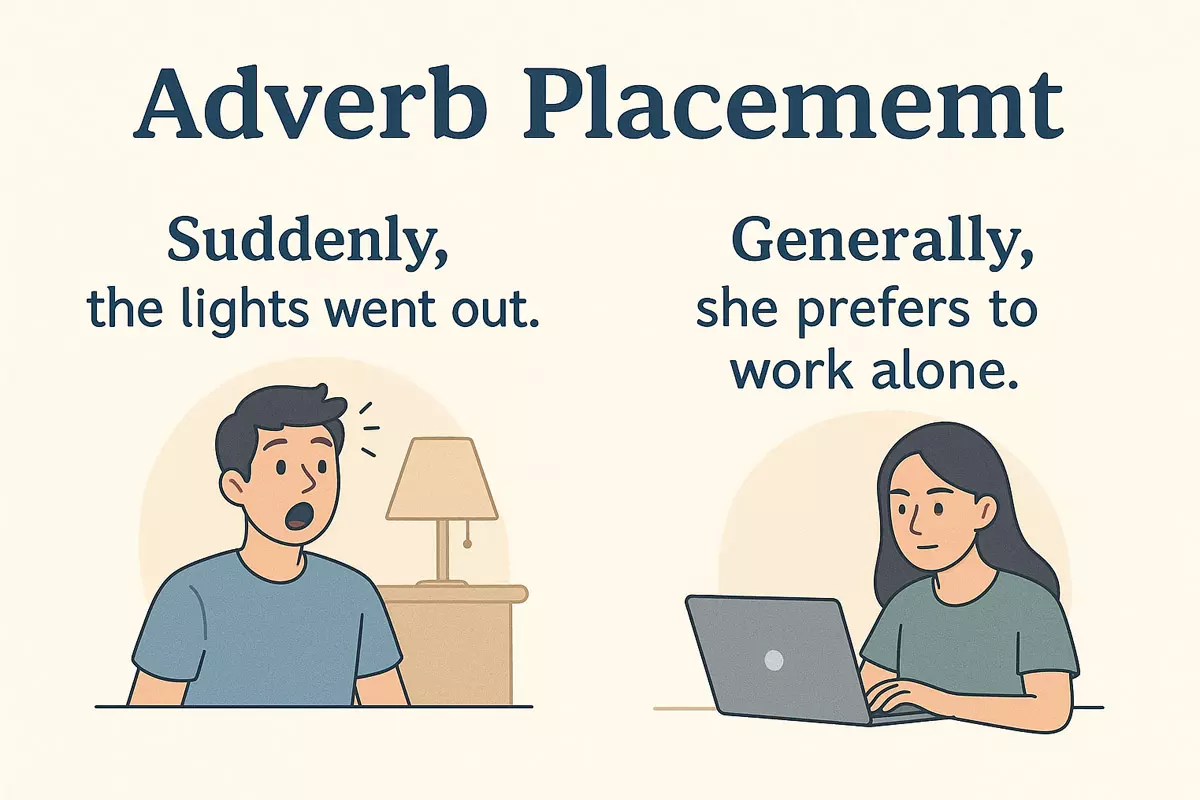
- Suddenly, the lights went out.
- Generally, she prefers to work alone.
- Unfortunately, the meeting was postponed.
- Yesterday, we completed the project.
- Quietly, he left the room.
Mid Position
When adverbs appear in the middle of a sentence, they typically sit before the main verb or after the first auxiliary. This placement is especially common with adverbs of frequency, degree, or certainty, and often sounds more neutral or objective.
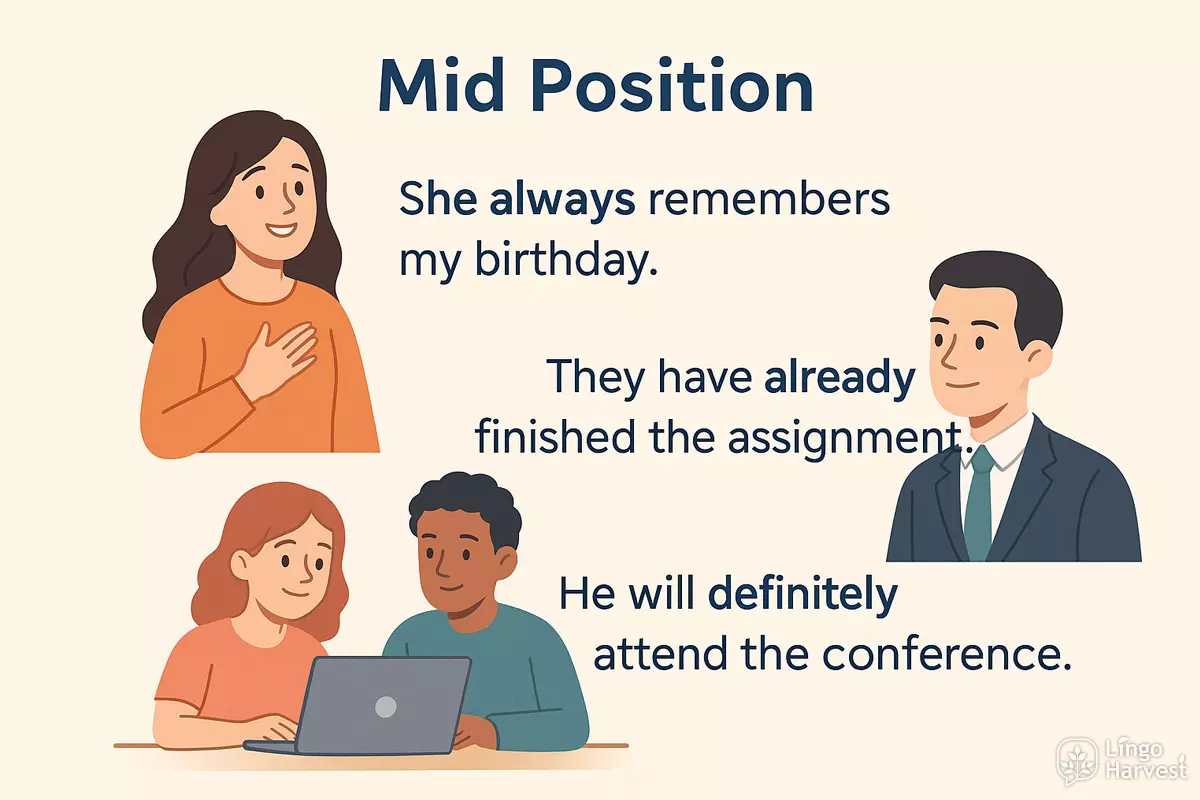
- She always remembers my birthday.
- They have already finished the assignment.
- He will definitely attend the conference.
- We can hardly believe the news.
- You must never ignore safety protocols.
End Position
Adverbs at the end of a sentence tend to modify the verb directly and often add detail about manner, place, or time. This position is natural for many adverbs and can help keep sentences clear and direct.
- The team worked efficiently.
- He will arrive soon.
- She spoke softly.
- They met us outside.
- We’ll discuss this later.
Comparison Table: Adverb Placement and Example Effects
| Adverb Placement | Example Sentence |
|---|---|
| Front | Honestly, I didn’t expect that outcome. |
| Mid | I honestly didn’t expect that outcome. |
| End | I didn’t expect that outcome, honestly. |
| Effect | Front: Sets tone or attitude; Mid: Neutral, subtle; End: Adds afterthought or emphasis |
Stylistic Considerations
The position you choose for an adverb can subtly color your writing. Leading with an adverb often highlights your attitude or the context. Mid-position tends to feel seamless and less obtrusive, ideal for academic or technical writing. Placing adverbs at the end often emphasizes the action or detail. Experimenting with placement lets you control emphasis and precision, making your writing more sophisticated and engaging.
Mid-position adverbs and their constraints
Positioning adverbs in the middle of a sentence often adds subtlety and control to your writing. These adverbs typically appear between the subject and the main verb, or after the first auxiliary verb, shaping the sentence’s meaning with precision. For example, words like always, never, often, just, and already are frequently placed in this slot. However, not all adverbs can occupy this position, and certain verbs or sentence structures may restrict their use.
Common types and placement patterns
Adverbs of frequency, probability, and degree are most often found in the mid-sentence slot. Here are some typical placements:
- She always arrives early.
- They usually eat lunch together.
- You probably know the answer.
- He just finished the report.
- We almost missed the train.
- I barely heard the announcement.
- The students rarely complain.
- It already started raining.
- She never forgets a birthday.
- The manager still hasn’t replied.
- You completely misunderstood me.
- He sometimes skips breakfast.
- We almost finished on time.
- I hardly recognized her.
- They certainly deserve praise.
- She partly agreed with the decision.
Key constraints and exceptions
While mid-sentence adverbs offer flexibility, there are important restrictions:
- Not all adverbs are permitted between the subject and main verb; for instance, adverbs of manner like quickly or carefully usually go at the end of the sentence.
- With modal or auxiliary verbs, the adverb comes after the first auxiliary: She has always been punctual.
- In questions, adverbs typically follow the subject: Have you ever visited Paris?
- Negative adverbs (e.g., never, rarely) can invert word order in formal contexts: Rarely have I seen such skill.
Comparing mid-position adverbs: frequency, probability, and degree
| Type | Typical Adverbs | Example in Mid-Position |
|---|---|---|
| Frequency | always, often, rarely, never, sometimes, usually | She often reads before bed. |
| Probability | probably, certainly, possibly, definitely, surely | He will definitely call you. |
| Degree | almost, barely, completely, hardly, just, nearly | We barely made the deadline. |
| Time (restricted) | already, still, yet (rarely mid-position) | She already knows the result. |
Summary
Using adverbs in the middle of a sentence can help you adjust tone and nuance, but it’s important to observe the rules around which types are allowed and where. Always check for verb type, sentence structure, and meaning to ensure your adverb placement is both natural and precise.
Changing tone and emphasis by moving adverbs
Writers often adjust the placement of adverbs to subtly shift the reader’s focus or to fine-tune the mood of a sentence. The position of an adverb can affect whether the action, the subject, or the manner of the action feels more important. This technique is especially valuable in advanced writing, where nuance and precision are essential.
For example, compare how the following sentences change in emphasis depending on where the adverb appears:
- She quietly left the room. (Highlights the manner of her departure)
- Quietly, she left the room. (Draws attention to the adverb, adding a contemplative or narrative tone)
- She left the room quietly. (Emphasizes the action, with the manner as an afterthought)
How Adverb Placement Influences Tone
Shifting adverbs can make statements sound more objective, more emotional, or more formal. Consider the following points:
- Adverbs at the beginning can sound reflective or emphasize the context.
- Placing adverbs before the verb often feels more immediate or subjective.
- Adverbs at the end generally sound neutral or understated.
Examples of Tone Variation by Adverb Movement
Here’s an expanded set of examples demonstrating how repositioning adverbs can subtly shift meaning or tone:
- Frankly, I disagree. → I frankly disagree. → I disagree, frankly.
- Fortunately, the team finished on time. → The team fortunately finished on time. → The team finished on time, fortunately.
- Sadly, he missed the opportunity. → He sadly missed the opportunity. → He missed the opportunity sadly.
- Honestly, she answered the question. → She honestly answered the question. → She answered the question honestly.
- Clearly, you misunderstood. → You clearly misunderstood. → You misunderstood clearly.
- Undoubtedly, this is her best work. → This is undoubtedly her best work. → This is her best work undoubtedly.
- Perhaps, we should reconsider. → We perhaps should reconsider. → We should reconsider, perhaps.
- Surprisingly, the results were positive. → The results were surprisingly positive. → The results were positive, surprisingly.
- Regrettably, the plan failed. → The plan regrettably failed. → The plan failed, regrettably.
- Sincerely, I wish you luck. → I sincerely wish you luck. → I wish you luck, sincerely.
- Actually, I finished early. → I actually finished early. → I finished early, actually.
- Luckily, the weather improved. → The weather luckily improved. → The weather improved, luckily.
- Eventually, we found a solution. → We eventually found a solution. → We found a solution, eventually.
- Gradually, the noise faded. → The noise gradually faded. → The noise faded, gradually.
- Hopefully, we will succeed. → We hopefully will succeed. → We will succeed, hopefully.
Choosing Placement for Your Purpose
Writers should consider their audience and intent when shifting adverbs. Opening with an adverb can sound formal or literary, while mid-sentence placement may feel more conversational. End placement is often the least intrusive, letting the main idea stand out. Experimenting with these patterns can help you achieve the effect you want, whether it’s to sound assertive, tentative, or simply clear.
Confusing pairs: only, just, even
Understanding the nuances between “only,” “just,” and “even” is essential for advanced writers who want to achieve precision and subtlety in tone. These adverbs often appear interchangeable at first glance, but their placement and usage can shift meaning in significant ways. Let’s look at how each functions and how careful positioning influences the message.
Subtle Differences in Meaning
“Only,” “just,” and “even” each add a specific shade of meaning to a sentence. Misplacing them can lead to ambiguity or unintended emphasis. Here’s how each typically works:
- Only restricts meaning, limiting the reference to a single element.
- Just suggests something is recent, minimal, or fair—often softer than “only.”
- Even highlights surprise, unexpectedness, or emphasis beyond the norm.
Placement and Its Impact
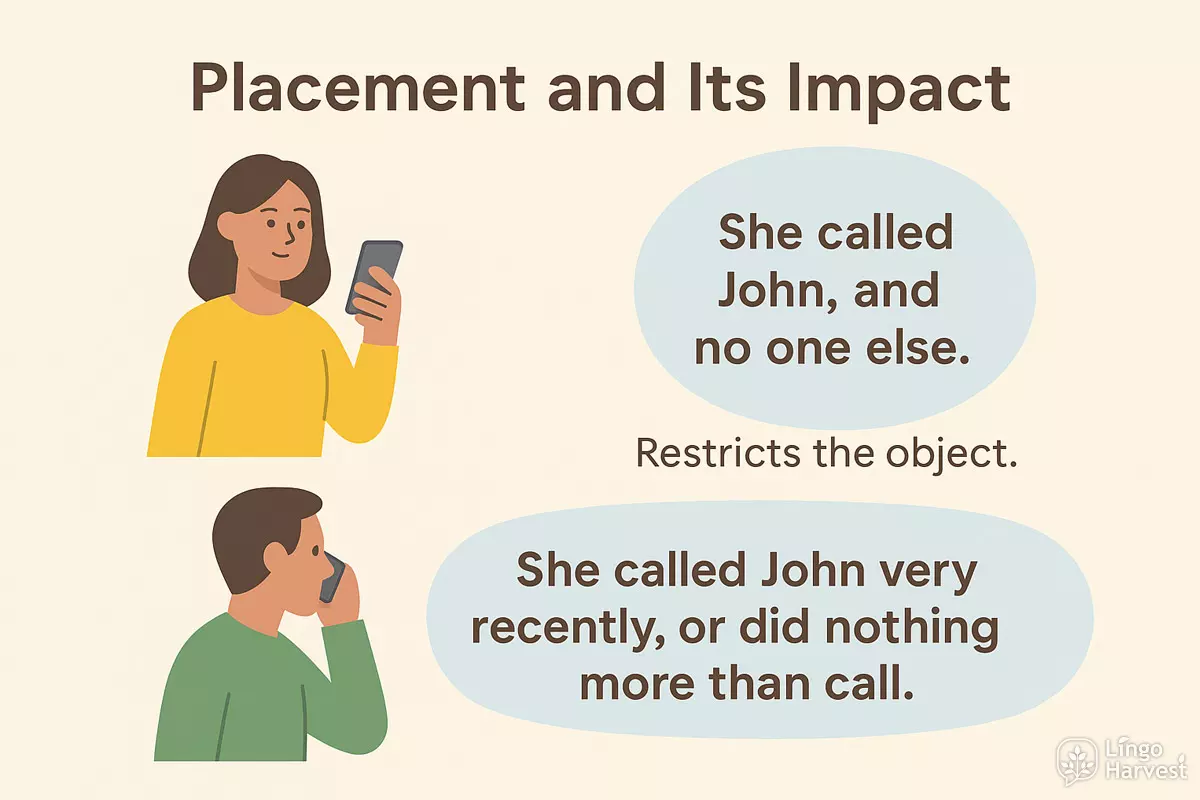
Moving these adverbs within a sentence can drastically alter interpretation. For instance, “only” directly before different sentence elements points restriction at those elements, while “just” often sounds more casual or temporal, and “even” signals emphasis or contrast.
| Adverb | Example Sentence | Effect on Meaning |
|---|---|---|
| Only | She only called John. | She called John, and no one else. Restricts the object. |
| Just | She just called John. | She called John very recently, or did nothing more than call. |
| Even | She even called John. | Calling John was surprising or unexpected. |
| Only | Only she called John. | No one except her called John. Restricts the subject. |
| Just | Just she called John. | Emphasizes that it was only her, sometimes informal or emphatic. |
| Even | Even she called John. | Unexpected that she, of all people, called John. |
Common Usage Patterns
Writers aiming for clarity should pay attention to where these adverbs are placed. Consider these typical patterns for each:
- “Only” before verbs: He only eats vegetables (he does nothing with them except eat).
- “Only” before nouns: He eats only vegetables (vegetables are all he eats).
- “Just” with time: I just arrived (I arrived a moment ago).
- “Just” for minimalism: It’s just a scratch.
- “Even” for surprise: Even the teacher was confused.
- “Even” before verbs: She can’t even swim (surprisingly, she can’t swim at all).
Tips for Advanced Precision
To avoid confusion, review your sentences for possible ambiguity caused by these adverbs. When editing, ask yourself what is being limited, emphasized, or minimized, and move the adverb accordingly. Reading aloud can help reveal unintended shifts in tone or focus. With practice, nuanced placement of “only,” “just,” and “even” can elevate your writing’s clarity and subtlety.
Typical placement errors at higher levels
Writers with advanced fluency often make nuanced mistakes in adverb positioning, especially when aiming for subtlety or precision. These missteps can shift the intended tone or obscure meaning, even in otherwise sophisticated prose. Unlike basic errors, higher-level issues tend to involve more complex sentence structures or attempts to achieve rhetorical effects.
Common advanced misplacements
Certain adverbs, particularly those expressing frequency, certainty, or attitude, are prone to being positioned awkwardly in intricate sentences. For example, inserting an adverb between the subject and a multi-word verb phrase can unintentionally create ambiguity or disrupt emphasis.
- Splitting verb phrases incorrectly (e.g., “She has quickly finished” instead of “She has finished quickly” in some contexts)
- Placing stance adverbs too far from the main clause (e.g., “Frankly, I do not believe, in this case, that he is correct”)
- Overusing initial adverbials, causing monotony or confusion (“Interestingly, Surprisingly, Clearly, every paragraph began this way”)
- Embedding adverbs deep within noun phrases (“The proposal, surprisingly, that was submitted yesterday”)
- Misplacing adverbs of certainty (“He will certainly not agree” vs. “He certainly will not agree”→ subtle nuance shift)
- Using adverbials before infinitives awkwardly (“To fully understand” vs. “To understand fully”)
- Interrupting parallelism with inconsistent adverb slots (“He quickly and efficiently completed the task” vs. “He completed the task quickly and efficiently”)
- Incorrectly separating negative adverbs (“Hardly ever he visits” instead of “He hardly ever visits”)
- Redundant adverb use (“She very nearly almost failed”)
- Stacking multiple adverbs together, muddling clarity (“He almost always nearly finishes early”)
- Shifting focus unintentionally by moving adverbs (“Only yesterday did she realize” vs. “She only realized yesterday”)
- Placing viewpoint adverbs too late (“He admitted, honestly, that he was wrong”)
- Disrupting flow with mid-clause adverbs (“The solution, perhaps, lies elsewhere” when “Perhaps the solution lies elsewhere” is clearer)
- Using adverbs of degree with wrong targets (“She is completely sure happy” instead of “completely happy”)
- Misaligning adverbs in reported speech (“He said quickly that he would help” vs. “He quickly said that he would help”)
Subtle differences in meaning and tone
Even minor shifts in adverb position can alter the nuance or focus of a sentence. Advanced writers often overlook how these placements affect reader interpretation, especially in persuasive or analytical contexts.
| Adverb Placement | Effect on Sentence |
|---|---|
| He only said he loved her. | Limits the action to “saying,” not feeling or acting. |
| He said he only loved her. | Implies exclusivity—he loves no one else. |
| He said only he loved her. | Suggests no one else loves her. |
| He said he loved her only. | Focuses on her as the sole object of affection. |
Strategies to avoid advanced placement pitfalls
Careful rereading and attention to how adverbs interact with verbs, subjects, and objects can help writers achieve the desired tone and clarity. Reading sentences aloud or reordering elements for emphasis are practical ways to catch subtle misplacements before finalizing a text.
Practice: adjust adverb position to refine meaning
Fine-tuning the placement of adverbs can significantly alter emphasis, nuance, or clarity in advanced written English. By experimenting with adverb location within a sentence, writers can highlight particular information, shift tone, or specify the scope of a statement. Below, you’ll find targeted exercises and structured examples to help you develop a more precise sense of how adverb position affects meaning.
Identify the effect of adverb shifts
Consider these sentences. Notice how the meaning changes based on where the adverb appears:
- Only she gave her approval. (No one else gave approval.)
- She only gave her approval. (She did nothing but give approval.)
- She gave only her approval. (She didn’t give anything else.)
Try the following: move the adverb in each sentence and note any change in meaning or tone.
- He quickly finished the assignment.
- She has always admired his dedication.
- We nearly missed the deadline.
- They clearly misunderstood the instructions.
- He quietly left the meeting.
- She rarely makes mistakes.
- They completely ignored the warning.
- He suddenly changed his opinion.
- We almost completed the task.
- She definitely supports the idea.
Show answers
- Quickly he finished the assignment. (Emphasizes the speed as the main point.)
- She admired his dedication always. (Less natural; “always” usually goes before the verb.)
- We missed nearly the deadline. (Awkward; “nearly” fits better before the verb.)
- They misunderstood clearly the instructions. (Less natural; “clearly” works best before the verb.)
- Quietly he left the meeting. (Adds emphasis to the manner.)
- Rarely she makes mistakes. (Front position adds emphasis.)
- They ignored completely the warning. (Less natural; better before “ignored.”)
- Suddenly he changed his opinion. (Emphasizes the suddenness.)
- We completed almost the task. (Awkward; “almost” should be before the verb.)
- Definitely she supports the idea. (Emphasizes certainty.)
Practice: Choose the most precise position
Select the best place for the adverb to clarify the intended meaning. Rewrite each sentence as needed.
- She answered the question (honestly).
- (Certainly) he will attend the conference.
- He (almost) finished the marathon.
- They completed the project (successfully).
- The team (rarely) disagrees on strategy.
- She (quietly) opened the door.
- (Probably) they will announce the results tomorrow.
- He solved the problem (easily).
- (Usually) the class begins on time.
- The manager reviewed the proposal (carefully).
Show answers
- She answered the question honestly.
- Certainly, he will attend the conference.
- He almost finished the marathon.
- They successfully completed the project.
- The team rarely disagrees on strategy.
- She quietly opened the door.
- Probably, they will announce the results tomorrow.
- He solved the problem easily.
- Usually, the class begins on time.
- The manager reviewed the proposal carefully.
Comparing adverb positions: structured examples
Below is a table illustrating how shifting adverbs can produce subtle changes in meaning or emphasis. Review each variation and consider which best matches a given context.
| Sentence Variant | Effect/Interpretation |
|---|---|
| He almost always agrees. | He agrees most of the time, but not always. |
| He always almost agrees. | He nearly agrees every time, but never fully does. |
| She barely noticed the mistake. | She noticed the mistake, but only just. |
| She noticed the mistake barely. | Unusual placement; draws attention to her minimal noticing, but sounds unnatural. |
| We simply cannot accept the offer. | Emphasizes the impossibility in a straightforward way. |
| We cannot simply accept the offer. | Implies that accepting is not straightforward; perhaps more is required. |
Challenge: Rewrite for precision and tone
Take these sentences and adjust the adverb’s position to strengthen the intended nuance:
- I have definitely never seen such results.
- She only almost passed the final exam.
- They completely misunderstood the proposal.
- He truly appreciated your help.
- We barely managed to finish on time.
Show answers
- I have never definitely seen such results. (Alters certainty; original is clearer.)
- She almost passed only the final exam. (Now, only the final was almost passed.)
- They misunderstood the proposal completely. (Emphasizes total misunderstanding.)
- He appreciated your help truly. (Less natural; original is better for tone.)
- We managed to finish on time barely. (Less natural; original is preferred.)
Careful adverb placement distinguishes advanced writing by sharpening meaning and guiding the reader’s interpretation. Practice by experimenting with different positions and reflecting on the resulting nuances.