Rephrasing for Academic Strength: Reduce Filler, Tighten Structure

 Here we how to spot and revise weak or wordy sentences, replace vague verbs and nouns with stronger alternatives, and rephrase for better cohesion and logic. It also addresses balancing complexity with readability and includes practice exercises.
Improving your academic writing goes beyond simply fixing grammar mistakes; it also requires removing redundant words and enhancing the clarity of your arguments. By focusing on streamlining your sentences and organizing your ideas more effectively, you can present your research in a more convincing and impactful way. Careful editing helps ensure that your message is communicated clearly and that your work stands out to readers, making your arguments not only easier to follow but also more compelling overall.
Identifying weak and wordy constructions
Academic writing often suffers from indirect phrasing and unnecessary words, which can dilute the intended message. Recognizing these weak spots is the first step to making your prose more concise and impactful. Instead of relying on vague or inflated expressions, focus on clarity and precision.
Common Signs of Weakness and Wordiness
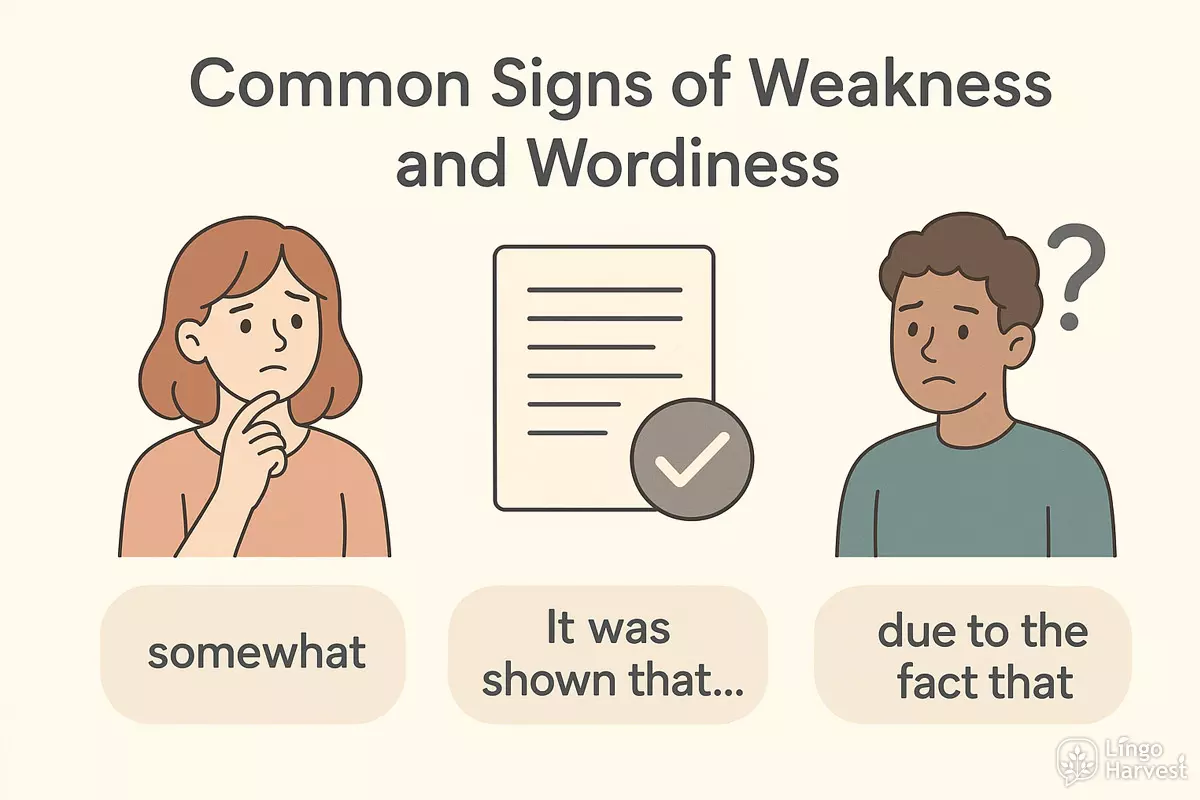
- Overuse of vague qualifiers (e.g., "somewhat," "in a way," "rather")
- Excessive passive voice ("It was shown that...")
- Redundant phrases ("in order to," "due to the fact that")
- Unnecessary introductions ("It is important to note that")
- Empty intensifiers ("very," "really," "quite")
- Wordy prepositional phrases ("at this point in time" instead of "now")
- Nominalizations (turning verbs into nouns, e.g., "make an analysis of" vs. "analyze")
- Strings of modifiers ("highly significant and extremely important results")
- Filler verbs ("there is," "there are," "it is")
- Unnecessary repetition ("the reason is because")
Examples of Wordy vs. Strong Academic Phrasing
| Wordy Construction | Stronger Alternative |
|---|---|
| In order to | To |
| Due to the fact that | Because |
| It is important to note that | (Omit or state directly) |
| At this point in time | Now |
| There are many students who | Many students |
| He made a decision to | He decided to |
| The reason is because | Because |
| Has the ability to | Can |
| Despite the fact that | Although |
| It was demonstrated that | (Use active voice: “Smith demonstrated that…") |
Quick Strategies to Spot Flabby Sentences
- Read sentences aloud: awkwardness often signals excess words.
- Highlight all forms of "be" and check if active verbs can replace them.
- Scan for multi-word phrases that can be condensed.
- Ask if each word adds meaning or clarity; delete if it doesn't.
- Replace nominalizations with direct verbs.
Strengthening your academic writing starts with vigilance for these patterns. By trimming bloated phrases and favoring direct language, your arguments become clearer and more persuasive. Aim for precision and economy, ensuring every word carries weight.
Replacing vague verbs and nouns
Clear academic writing relies on precise word choices. When verbs and nouns are too general, they weaken arguments and obscure meaning. Instead of relying on generic terms, select language that conveys exact actions, processes, or concepts. This shift not only improves clarity but also demonstrates a deeper engagement with the subject matter.
Why avoid general language?
Overly broad words like "do," "make," or "thing" can make academic work sound imprecise. Readers may struggle to understand your intent or the specifics of your analysis. Replacing these with more specific alternatives supports stronger, more persuasive writing.
Common vague words and their alternatives
Using targeted vocabulary can transform bland statements into authoritative claims. Consider the following examples for frequent offenders:
- Do → conduct, perform, execute, implement, carry out
- Make → create, generate, produce, formulate, construct
- Get → obtain, acquire, receive, secure, achieve
- Thing → factor, element, aspect, component, issue
- Stuff → material, substance, content, data, resources
- Go → proceed, advance, progress, move, travel
- Put → place, position, insert, establish, assign
- Show → demonstrate, illustrate, reveal, indicate, exhibit
- Say → state, assert, claim, argue, suggest
- Use → employ, utilize, apply, implement, deploy
- Help → facilitate, assist, support, enable, promote
- Problem → challenge, obstacle, issue, complication, difficulty
- Result → outcome, consequence, effect, impact, finding
- Idea → concept, notion, perspective, hypothesis, viewpoint
Practical strategies for revision
When you review your work, highlight non-specific terms and ask yourself: "What exactly do I mean here?" Replace broad words with ones that directly express your intended meaning. This process not only tightens your arguments but also builds credibility.
Impact of precision in academic writing
Specific verbs and nouns foster clear, concise communication. They help readers follow complex reasoning and signal your grasp of the topic. Careful word selection is a hallmark of academic rigor and professionalism.
Using stronger, more specific structures
Academic writing gains clarity and authority when sentences follow precise, logical frameworks. Rather than relying on vague phrasing or loosely connected ideas, it’s helpful to build statements with carefully chosen structures that foreground relationships and evidence.
Why structure matters in academic writing
Well-organized sentences and paragraphs make arguments easier to follow and help readers understand the significance of your claims. Weak or generic forms—such as “there are many reasons…” or “it is believed that…”—often obscure meaning and add unnecessary length. Instead, using targeted constructions improves both flow and impact.
Examples of stronger academic structures
Consider replacing broad, filler-heavy sentences with more direct and specific alternatives. Here are several patterns that can tighten your writing:
- Cause and effect: “X leads to Y because…” instead of “Y happens for many reasons.”
- Comparison: “Unlike X, Y demonstrates…” rather than “There are differences between X and Y.”
- Evidence-based claims: “According to Smith (2020),…” instead of “It is thought that…”
- Purpose statements: “This study investigates…” rather than “The purpose of this paper is to look at…”
- Explicit definitions: “Z is defined as…” in place of “Z can be seen as…”
- Transitions with logic: “Furthermore,” “In contrast,” or “Consequently,” instead of “Also” or “But.”
- Quantified claims: “Ninety percent of participants…” rather than “Most people…”
- Action verbs: “Demonstrates,” “analyzes,” “reveals” instead of “is,” “has,” “shows.”
- Specificity in examples: “For example, in the 2015 case study…” versus “For example, sometimes…”
- Conditional logic: “If X occurs, then Y is likely…” rather than “Y might happen.”
- Clear attribution: “Research by Lee (2018) suggests…” instead of “It has been suggested…”
- Direct contrast: “While X supports this view, Y contradicts it,” rather than “Some agree, some disagree.”
- Hierarchical organization: “Firstly… Secondly… Finally…” for ordered arguments.
- Concision in reporting: “Participants reported increased satisfaction,” instead of “There was an increase in the satisfaction that was reported by participants.”
Common pitfalls and alternatives
Writers often default to passive constructions or general statements. These choices can weaken analysis and make arguments less persuasive. Consider the following alternatives for frequently used, less effective structures:
- Instead of: “It is important to note that…” → Use: “Notably,” or omit entirely if redundant.
- Instead of: “There are several factors that…” → Use: “Several factors influence…”
- Instead of: “This can be seen in…” → Use: “This appears in…” or specify the example directly.
Structural patterns for academic clarity
Choosing the right pattern depends on your purpose—whether you’re comparing, defining, analyzing, or arguing. The following table illustrates some common academic structures and their typical use cases:
| Structure Pattern | Typical Use Case |
|---|---|
| “According to [Author] (Year), …” | Citing sources and grounding arguments in evidence |
| “Unlike X, Y …” | Drawing direct comparisons or contrasts |
| “If … then …” | Expressing conditional relationships or hypotheses |
| “This study demonstrates that …” | Stating findings and emphasizing results |
| “Firstly, … Secondly, … Finally, …” | Organizing multi-part arguments or lists |
Summary
By favoring precise, logical constructions over vague or repetitive forms, academic writers can present arguments with greater authority and clarity. Careful attention to sentence structure not only reduces filler but also strengthens the overall impact of scholarly communication.
Rephrasing to improve cohesion and logic
Strengthening academic writing often depends on how well sentences and ideas connect. By revising sentences for clarity and flow, you help readers follow arguments with less effort. Logical transitions and varied sentence structures aid in guiding your audience through complex points. Instead of simply replacing words, effective rewriting considers the relationships between ideas, ensuring each statement naturally leads to the next.
Strategies to Strengthen Connections
- Combine short, choppy sentences to show relationships.
- Replace vague pronouns (like "this" or "it") with specific nouns for clarity.
- Use transitional phrases (e.g., "however," "in contrast," "as a result") to signal shifts or continuations.
- Eliminate repetitive or redundant statements.
- Break up overly long sentences to prevent confusion.
- Align verb tenses to maintain a consistent timeline.
- Balance active and passive voice for emphasis and readability.
- Group similar ideas together and re-order sentences for logical progression.
- Clarify cause-and-effect relationships with precise wording.
- Use parallel structure for lists or repeated patterns.
- Replace filler words (such as "basically," "sort of," "actually") with concise alternatives or remove them entirely.
- Check for ambiguous references and revise for specificity.
- Introduce definitions or background information before using technical terms.
- Summarize sections before moving to new arguments.
- Vary sentence openings to avoid monotony.
- Integrate evidence smoothly, linking it to your main claim.
- End paragraphs with sentences that point ahead or wrap up key ideas.
- Ensure pronoun references are clear and unambiguous.
Common Issues and Effective Alternatives
| Common Problem | Improved Approach |
|---|---|
| Choppy, disconnected sentences | Combine related ideas into compound or complex sentences to show logical links. |
| Overuse of vague transitions ("also", "then") | Use specific transitional phrases that clarify relationships (e.g., "consequently", "for example", "in contrast"). |
| Ambiguous pronoun use | Replace pronouns with the actual subject or object for clarity. |
| Redundant wording or repetition | Edit sentences to remove unnecessary duplication and tighten the focus. |
| Disorganized sequence of ideas | Reorder sentences or paragraphs to create a logical progression from one idea to the next. |
| Unclear cause and effect | Explicitly state the relationship using words like "because," "therefore," or "as a result." |
| Inconsistent verb tense | Revise sentences to maintain the same tense throughout a passage. |
| Overly long or convoluted sentences | Break up complex sentences or restructure them for clarity and ease of reading. |
Careful reworking of sentences and paragraphs not only clarifies your message but also makes your writing more persuasive. Each revision should strive to connect points smoothly, guiding the reader logically from introduction to conclusion.
Balancing complexity and readability
Achieving clarity in academic writing often involves finding the right mix of sophisticated ideas and accessible language. Overly complex sentences can obscure meaning, while excessive simplification may undercut the depth of your analysis. Writers must decide when to employ advanced terminology and when to prioritize directness, always considering their audience’s familiarity with the topic.
When to simplify language
In academic contexts, simplifying is not about dumbing down content but about making ideas accessible. Consider reducing complexity when:
- Introducing new or foundational concepts
- Explaining methodology or experimental design
- Summarizing results or key findings
- Addressing interdisciplinary or non-specialist readers
When complexity is valuable
There are moments when nuanced or technical language is justified, especially to convey precise distinctions or to engage with scholarly debates. Use more complex structures when:
- Discussing specialized theories or frameworks
- Engaging with literature that demands precise terminology
- Analyzing subtle differences in data or interpretation
- Contributing original insights that require careful qualification
Strategies for maintaining clarity
Writers can preserve both sophistication and readability by applying a few practical techniques:
- Break up long sentences into two or more shorter ones
- Replace jargon with plain language where possible
- Define technical terms upon first use
- Use active voice to clarify agency
- Limit the use of nested clauses
- Employ transition words for logical flow
- Revise redundant phrases
- Use concrete examples to illustrate abstract points
- Favor verbs over nominalizations (e.g., "analyze" over "analysis of")
- Read sentences aloud to check for awkwardness
- Seek peer feedback for unclear passages
- Utilize bullet points or tables for dense information
Comparing sentence approaches
Below is a comparison of two ways to express the same idea, highlighting how to preserve meaning while improving accessibility:
| Original Complex Sentence | Revised for Readability |
|---|---|
| The implementation of the aforementioned methodology facilitated the elucidation of significant discrepancies within the dataset. | Using this method helped reveal important differences in the data. |
| Subsequent investigations yielded results that were not entirely congruent with the initial hypothesis, necessitating further inquiry. | Later studies produced results that didn’t fully match the original hypothesis, so more research was needed. |
| In light of the multifaceted nature of the subject, a comprehensive review of extant literature was deemed indispensable. | Because the topic is complex, a thorough review of existing research was necessary. |
| The utilization of ambiguous terminology can obfuscate rather than clarify scholarly arguments. | Vague language can make academic arguments less clear. |
Ultimately, the goal is to convey sophisticated ideas without sacrificing reader comprehension. By consciously adjusting sentence structure, vocabulary, and organization, writers can achieve both intellectual rigor and accessibility.
Practice: rework weak sentences into stronger versions
Improving academic writing often means transforming vague, wordy statements into precise, impactful sentences. This section gives you the opportunity to identify weak constructions and practice rewriting them for clarity and strength. By reducing filler words and tightening structure, you can make your points more effectively.
Common Weak Sentence Patterns
- Overuse of passive voice
- Excessive hedging (e.g., "it seems that," "in some ways")
- Redundant phrases or unnecessary qualifiers
- Lengthy nominalizations (turning verbs into nouns)
- Unfocused introductory clauses
- Wordy transitions (e.g., "due to the fact that")
- Ambiguous or generic word choices
- Sentences starting with "There is/are" or "It is/was"
- Empty phrases (e.g., "the fact that," "in terms of")
- Excessive repetition of ideas within a sentence
- Unnecessary adverbs (e.g., "really," "very")
- Weak verbs (e.g., "is," "has") instead of stronger action verbs
Exercise: Strengthen These Sentences
- There are many reasons that explain why students often do not submit assignments on time.
- It is important to note that the results seem to suggest a possible correlation between sleep and performance.
- The use of technology is becoming more and more common in classrooms these days.
- In terms of the data, it was shown that there was an increase in sales.
- Due to the fact that the experiment failed, the researchers had to start again.
- At this point in time, the committee is considering several different options.
- There are some people who believe that climate change is not real.
- The results that were obtained from the survey were very surprising to the researchers.
- It has been shown by many studies that exercise improves health.
- The book provides an overview of the history of the development of the theory.
Show answers
- Many factors contribute to students' late assignment submissions.
- The results indicate a possible correlation between sleep and performance.
- Technology is increasingly common in classrooms.
- The data showed an increase in sales.
- Because the experiment failed, the researchers restarted it.
- The committee is currently considering several options.
- Some people deny climate change.
- The survey results surprised the researchers.
- Many studies show that exercise improves health.
- The book overviews the theory’s historical development.
Quick Reference: Weak vs. Strong Academic Sentences
| Weak Sentence | Stronger Version |
|---|---|
| There are several ways in which this issue can be addressed. | This issue can be addressed in several ways. |
| It is clear that the policy did not achieve its intended goals. | The policy failed to achieve its intended goals. |
| The results that were obtained were quite significant in nature. | The results were significant. |
| In terms of methodology, the researchers used a qualitative approach. | The researchers used a qualitative approach. |
| Due to the fact that resources were limited, the sample size was small. | Because resources were limited, the sample size was small. |
| There are many scholars who have argued that this theory is outdated. | Many scholars argue that this theory is outdated. |
| The data was analyzed by the team in order to find patterns. | The team analyzed the data to find patterns. |
| At this point in time, further research is being conducted. | Researchers are currently conducting further studies. |
Use these examples and exercises to sharpen your ability to identify and revise weak academic sentences. Practice regularly to internalize concise, direct writing habits.