Using Prepositions Effectively in IELTS Writing Tasks and Essays

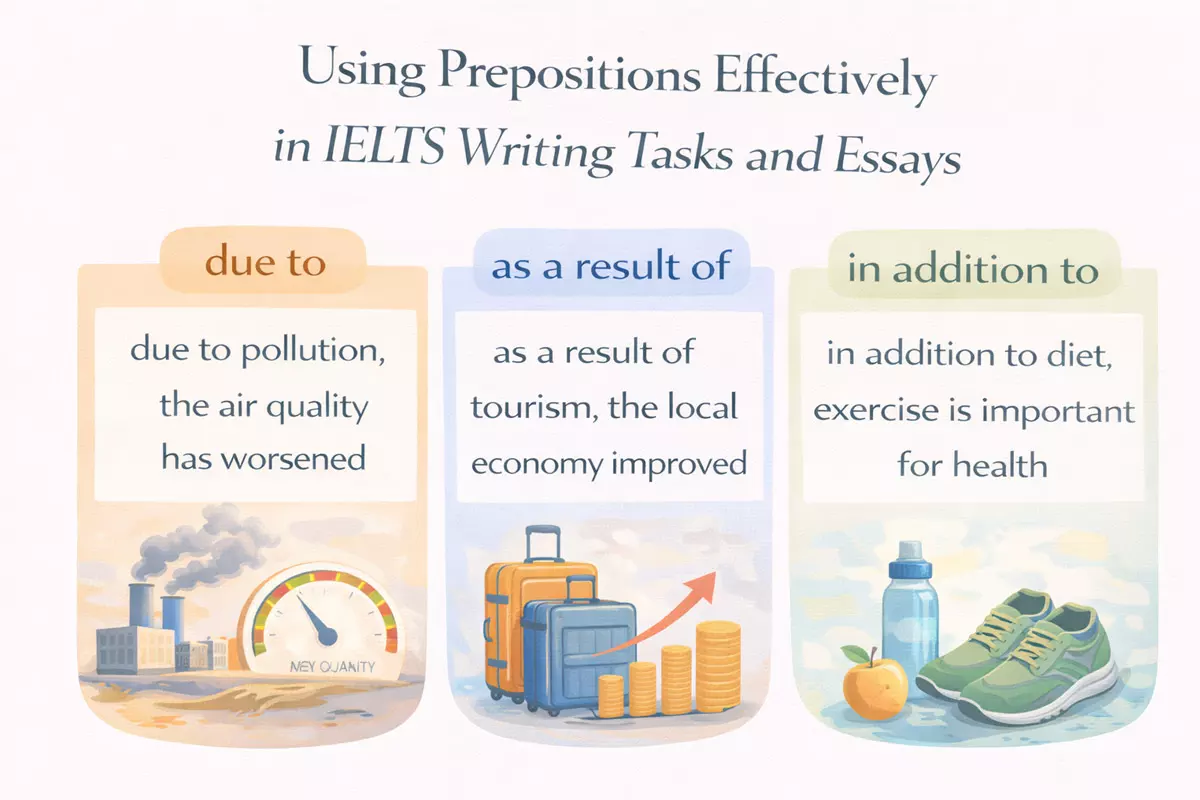 This article explains how accurate preposition use affects your IELTS Writing scores for Lexical Resource and Cohesion.
- Band descriptors analysis: How prepositional precision impacts Lexical Resource and Cohesion scores
- Task 1 Specifics: Prepositions for trends (increase by, peak at) and proportions (a share of)
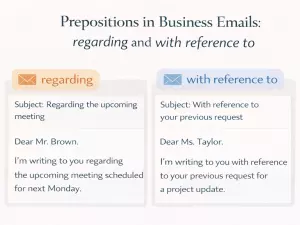
- Task 2 Argumentation: Using 'in spite of', 'to what extent', and 'with regard to' in academic essays
- Noun phrase expansion: Using prepositions to create complex, high-level subject structures
- Cohesion mechanics: Fronting prepositional phrases for smoother paragraph transitions
- Common 'Band 6' pitfalls: Misuse of 'discuss about', 'reach to', and preposition omission
- Register control: Avoiding informal phrasal verbs in favor of formal prepositional combinations
- Band 9 Sentence Models: Analyzing sophisticated prepositional density in examiner samples
- Practice: Error correction and rewriting tasks based on real IELTS candidate responses
Using small connecting words accurately is crucial for achieving clarity and coherence in your IELTS writing. Many test-takers tend to overlook these important elements, but they play a significant role in ensuring that ideas flow smoothly and are easily understood by examiners. By focusing on improving your use of connectors, you can make your arguments more precise and logical, which not only strengthens your writing but also enhances your chances of obtaining a higher band score.
Band descriptors analysis: How prepositional precision impacts Lexical Resource and Cohesion scores
Understanding how precise use of prepositions affects your IELTS writing score is essential for students aiming for higher bands. Two major criteria—Lexical Resource and Cohesion & Coherence—are both closely linked to how well you handle prepositions in essays and reports.
Lexical Resource: Range and Accuracy of Prepositions
Lexical Resource evaluates your ability to use a wide variety of vocabulary accurately and appropriately. Mastery of prepositions demonstrates both range and precision, as even small errors can change meanings or make sentences awkward. Examiners look for:
- Correct choice of prepositions in common collocations (e.g., “interested in,” not “interested on”)
- Effective use of less common or more complex prepositional phrases (e.g., “in light of,” “with regard to”)
- Natural combinations with verbs, adjectives, and nouns (“rely on,” “capable of,” “increase in”)
- Flexibility in using prepositions to express time, place, cause, and comparison (“at night,” “due to,” “in contrast to”)
- Absence of repetitive or basic preposition errors
Consistent mistakes, such as “depend of” or “in the other hand,” can limit you to Band 6 or below, as these errors show a lack of control over vocabulary.
Cohesion & Coherence: Linking Ideas with Prepositions
Cohesion & Coherence focuses on how logically and smoothly your ideas are connected. Prepositions play a subtle but crucial role here. Effective use enables you to:
- Join clauses and sentences smoothly (“In addition to this, …” “With respect to pollution, …”)
- Clarify relationships between points (“contrary to,” “according to,” “because of”)
- Guide the reader through your argument or description (“at the beginning,” “by contrast,” “under these circumstances”)
- Avoid confusion that arises from missing or incorrect prepositions
Errors in prepositional linking phrases can disrupt the flow and make your argument hard to follow, which lowers your score.
Prepositional Precision and Band Levels
To see how prepositional accuracy impacts scores, compare typical features at different band levels:
| Band Level | Prepositional Use | Effect on Score |
|---|---|---|
| Band 5 | Frequent errors; limited range; basic prepositions (“on the school,” “in last week”) | Weak control affects clarity; meaning sometimes unclear |
| Band 6 | Some errors persist; attempts more varied phrases (“in addition of,” “according with”) | Occasional awkwardness; impacts naturalness and flow |
| Band 7 | Generally accurate; some complex forms (“in comparison with,” “due to”); rare slips | Ideas are clear and well-linked; minor errors don’t impede understanding |
| Band 8+ | Wide, precise range; natural, idiomatic use (“by means of,” “in the aftermath of”) | Very smooth, sophisticated connections; enhances argument and coherence |
Common Problem Areas in IELTS Essays
Several preposition-related mistakes recur among test-takers:
- Confusing “in” and “on” with time expressions (“on 2019” ❌ → “in 2019” ✅)
- Using “to” after “discuss” (“discuss about” ❌ → “discuss” ✅)
- Wrong preposition after adjectives (“good in” ❌ → “good at” ✅)
- Forgetting required prepositions (“responsible manage” ❌ → “responsible for managing” ✅)
- Inappropriate prepositions in linking phrases (“in the other hand” ❌ → “on the other hand” ✅)
- Mixing up cause/effect prepositions (“because of” vs. “because”)
- Overusing basic prepositions (“for example, for instance, in conclusion” only)
- Literal translations from native language structures
Conclusion: Why Prepositional Precision Matters
Accurate and flexible use of prepositions directly supports both your vocabulary score and the logical flow of your writing. Focusing on common collocations, linking phrases, and advanced prepositional structures gives you a clear advantage in achieving higher bands for Lexical Resource and Cohesion.
Task 1 Specifics: Prepositions for trends (increase by, peak at) and proportions (a share of)
In IELTS Academic Writing Task 1, describing graphs and charts clearly depends on selecting the right prepositions. These small words express changes, comparisons, and proportions with precision. Mastering them not only improves accuracy but also helps you avoid common mistakes that can lower your score.
Describing Trends: Movement and Change
When you write about how data rises, falls, or fluctuates, you need specific prepositions to show the type and direction of change. For example, "increase by" gives the amount of change, while "increase to" or "peak at" shows the final value reached. Using the correct word for each situation ensures your descriptions are both clear and concise.
- increase by (amount): "Sales increased by 20%."
- rise to (final value): "Unemployment rose to 10% in 2010."
- peak at (highest point): "The number of visitors peaked at 1,000 in July."
- decrease by (amount): "The population decreased by 5,000."
- fall to (lowest value): "Profits fell to $200,000."
- drop by (amount): "Attendance dropped by 15%."
- reach (a point): "The figure reached 75 units."
- fluctuate between (range): "Temperatures fluctuated between 15°C and 25°C."
- remain at (constant value): "The rate remained at 5%."
- recover to (return to a previous value): "Production recovered to its 2015 level."
Expressing Proportions and Shares

In Task 1, you often need to compare categories as parts of a whole. Prepositions such as "a share of," "account for," and "make up" help express proportions and percentages. Using them correctly makes your statistical descriptions sound natural and accurate.
- a share of: "Females had a share of 60% in the workforce."
- account for: "Cars accounted for 50% of the total sales."
- make up: "Renewable sources made up one third of energy use."
- represent: "Exports represented 25% of GDP."
- comprise: "The elderly comprised 15% of the population."
- constitute: "Students constituted a quarter of the attendees."
- be responsible for: "Industry was responsible for 40% of emissions."
- out of: "Three out of ten people preferred tea."
- proportion of: "The proportion of men increased."
- percentage of: "The percentage of graduates rose."
Common Preposition Patterns in Task 1
| Preposition Pattern | Example Sentence |
|---|---|
| increase by + amount | The number of users increased by 5,000. |
| peak at + value | Attendance peaked at 120,000 in August. |
| a share of + percentage | Adults held a share of 70% in the sample. |
| account for + proportion | Exports accounted for one fifth of revenue. |
| fall to + value | Sales fell to their lowest point in December. |
Practice: Choose the Correct Preposition
- The unemployment rate ________ 8% in 2019. (rose / rose to / rose by)
- In 2021, renewable energy sources ________ 30% of electricity production. (accounted for / made up / rose by)
- The number of visitors ________ 2,000 in July, the highest point of the year. (peaked at / peaked by / peaked to)
- Women had ________ 40% in the management sector. (a share of / a share in / a share at)
- Sales ________ 15% compared with the previous quarter. (increased by / increased to / increased at)
- The population ________ nearly 5 million by 2020. (reached / reached to / reached at)
- Online purchases ________ sharply during the lockdown period. (rose / rose to / rose by)
- Unemployment figures ________ their lowest level in a decade. (fell to / fell by / fell at)
- Transport costs ________ 10% due to rising fuel prices. (increased by / increased to / increased at)
- Exports ________ a significant portion of national income. (accounted for / accounted to / accounted by)
Show answers
- rose to
- accounted for / made up
- peaked at
- a share of
- increased by
- reached
- rose
- fell to
- increased by
- accounted for
Choosing the appropriate prepositions for describing trends and proportions in IELTS Task 1 is essential for accuracy and clarity. Practice using these patterns in your own sentences to develop confidence and fluency.
Task 2 Argumentation: Using 'in spite of', 'to what extent', and 'with regard to' in academic essays
Academic writing in IELTS Task 2 often requires candidates to present nuanced arguments clearly. Mastering prepositional phrases such as in spite of, to what extent, and with regard to can help you articulate concessions, qualifications, and specific focuses within your essay. Each of these expressions plays a distinct role in structuring complex ideas and strengthening your argumentation.
Using in spite of to Express Contrast
The phrase in spite of introduces a contrast by acknowledging an obstacle or opposing fact. It is typically followed by a noun, noun phrase, or gerund.
- In spite of the high cost, many students choose to study abroad.
- In spite of having little experience, she performed exceptionally well.
- In spite of the risks involved, some people still support nuclear energy.
Be careful not to use a full clause after in spite of (avoid: in spite of he was tired ❌).
Approaching Essay Questions with to what extent
To what extent typically appears in IELTS prompts, asking candidates how much they agree or disagree, or how significant a factor is. This phrase helps you frame your thesis and organize your argument.
- To what extent do you agree that technology improves education?
- One can argue that, to some extent, advertising influences consumer behavior.
- It is necessary to consider to what extent government intervention is beneficial.
When responding, make sure to clearly state your position and qualify your agreement or disagreement.
Focusing Ideas with with regard to
With regard to is used to specify the aspect or topic you are discussing. It is particularly useful for organizing body paragraphs or clarifying your focus within a broader topic.
- With regard to environmental policies, stricter regulations are required.
- There are several concerns with regard to public transportation in cities.
- With regard to health benefits, a balanced diet is essential.
Comparing Functions and Forms
Below is a structured comparison of these phrases, highlighting their grammatical usage and argumentative role:
| Phrase | Typical Use | Example | Common Errors |
|---|---|---|---|
| in spite of | Expressing contrast or concession | In spite of the rain, the match continued. | Using a full clause instead of a noun/gerund |
| to what extent | Framing thesis or degree of agreement | To what extent do you agree? | Forgetting to qualify/quantify your answer |
| with regard to | Focusing on a specific aspect | With regard to costs, the plan is feasible. | Overusing or misplacing the phrase |
Practice: Identify and Correct Errors
Find and correct the mistakes in the following sentences:
- In spite of he was tired, he finished the assignment.
- To what extent you agree with this statement?
- With regard to, many people prefer online shopping.
- Despite of the high cost, the project was approved.
- According experts, the situation will improve.
- There is a strong relationship among stress and sleep quality.
- The results were different comparing to previous studies.
- In terms the methodology, the research was limited.
- She is responsible of managing the department.
- The policy was implemented due to the fact the economy was declining.
Show answers
- Correct: In spite of being tired, he finished the assignment.
- Correct: To what extent do you agree with this statement?
- Correct: With regard to online shopping, many people prefer it.
- Correct: Despite the high cost, the project was approved.
- Correct: According to experts, the situation will improve.
- Correct: There is a strong relationship between stress and sleep quality.
- Correct: The results were different compared to previous studies.
- Correct: In terms of methodology, the research was limited.
- Correct: She is responsible for managing the department.
- Correct: The policy was implemented due to the fact that the economy was declining.
Expanded Examples for Academic Essays
- In spite of economic difficulties, the government increased spending on healthcare.
- Many believe that, to some extent, social media enhances communication.
- With regard to climate change, urgent measures are needed.
- In spite of criticism, the policy was implemented nationwide.
- To what extent does globalization benefit developing countries?
- With regard to education, digital resources are increasingly important.
- In spite of the lack of evidence, the theory gained popularity.
- To what extent can renewable energy replace fossil fuels?
- With regard to safety, stricter regulations should be enforced.
- In spite of the challenges, the project succeeded.
- To what extent is individual effort responsible for academic success?
- With regard to public opinion, the proposal received support.
Using these phrases accurately will make your essays more precise, organized, and persuasive, which is essential for achieving a higher IELTS writing band score.
Noun phrase expansion: Using prepositions to create complex, high-level subject structures
Building more sophisticated noun phrases is a practical way to make your IELTS writing stand out. By integrating prepositions, you can transform simple subjects into detailed, academic-sounding structures that clearly express complex relationships and ideas. This technique not only demonstrates grammatical range, but also allows for greater precision and depth in your arguments.
Why expand noun phrases with prepositions?
Adding prepositional phrases to your subjects helps you specify exactly what you mean. Instead of basic nouns, these expanded forms pinpoint the relationships between people, things, and ideas—making your writing more nuanced and formal, which examiners appreciate.
Common patterns for noun phrase expansion
Writers often use prepositions such as of, in, for, with, to, and about to add layers of meaning to their subjects. Here are some typical structures:
- The impact of social media on communication
- The benefits of regular exercise for mental health
- Trends in global employment
- Challenges faced by young graduates in the job market
- Factors contributing to climate change
- Solutions for urban congestion
- The role of education in economic development
- Consequences of overconsumption of resources
- The increase in remote working opportunities
- Effects of technology on traditional industries
- Support from governmental organizations
- The importance of sustainable energy sources
- Access to quality healthcare
- Barriers to higher education
How expanded noun phrases improve your writing
Using more detailed noun phrases at the start of your sentences can make your arguments clearer and more persuasive. They also allow you to condense information, reducing the need for long explanations. For example, instead of writing "People who live in cities often experience stress," you might write "Urban residents under stress due to overcrowding," which is more concise and advanced.
Comparison of simple vs. expanded noun phrases
| Simple Noun Phrase | Expanded Noun Phrase with Preposition |
|---|---|
| Technology | Advancements in technology |
| Pollution | Levels of air pollution in cities |
| Young people | Opportunities for young people in rural areas |
| Education | Access to quality education for all |
| Government | Policies of the government regarding healthcare |
Tips for effective use in IELTS essays
- Vary your structures: Don’t rely on just one preposition, such as of; experiment with different ones for variety.
- Keep clarity: Ensure your expanded noun phrase is not overly complicated or ambiguous.
- Practice rewriting basic nouns into expanded forms before your exam.
- Use these structures especially in thesis statements and topic sentences to show range.
Ultimately, mastering the art of building complex noun phrases with prepositions can help you write more academic, precise, and impressive essays in the IELTS exam.
Cohesion mechanics: Fronting prepositional phrases for smoother paragraph transitions
Achieving natural flow between ideas is a crucial skill in IELTS writing. One effective technique for connecting sentences and paragraphs is to place prepositional phrases at the beginning of a sentence. This stylistic choice helps guide readers smoothly from one point to the next, clarifying relationships between ideas and signaling shifts in focus.
Why front prepositional phrases?
Moving a prepositional phrase to the start of a sentence emphasizes context, time, contrast, or cause, which can make your writing more cohesive. This approach also avoids repetitive sentence structures, such as always starting with the subject, which can sound monotonous.
- For contrast: In contrast to previous studies, this essay argues that…
- To show time: In recent years, there has been a rise in…
- For cause/effect: As a result of this policy, many people have…
- To provide examples: For instance, many cities have adopted…
Common prepositional patterns for transitions
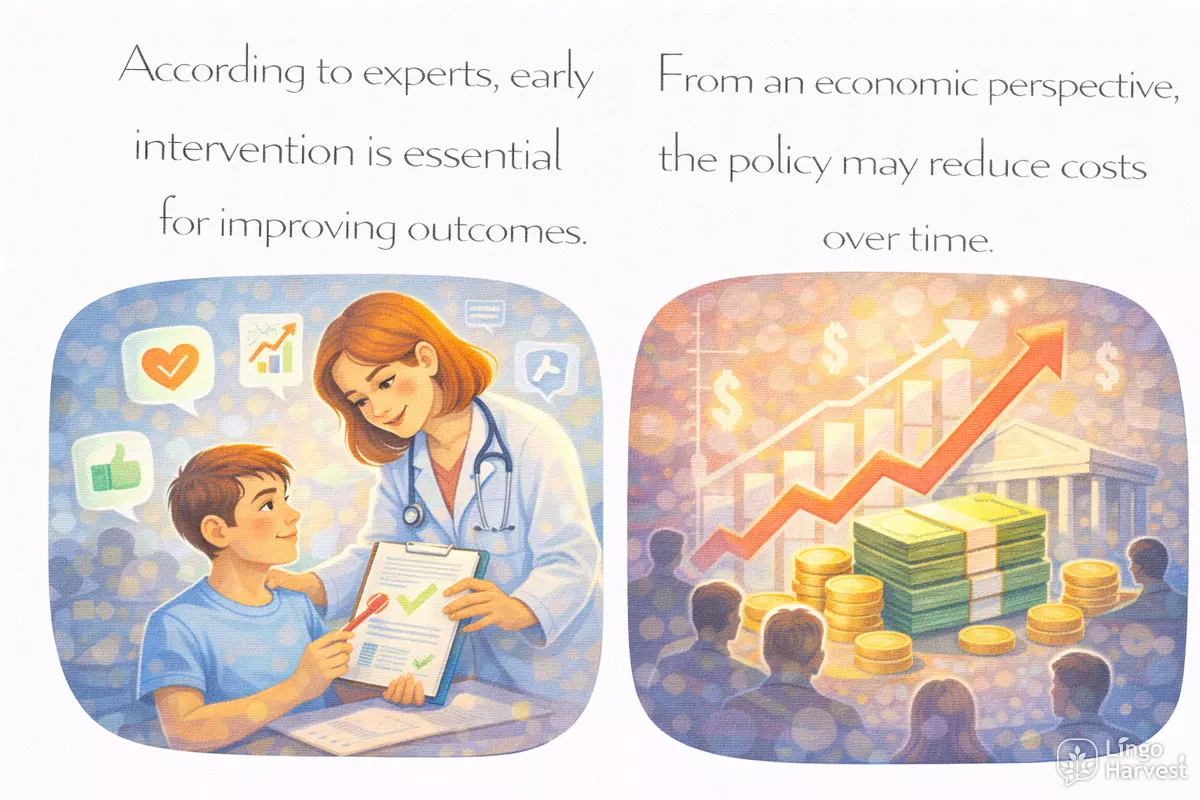
Using a variety of these introductory phrases can elevate your writing:
- In addition to this, the lecture provides further evidence to support the main claim.
- On the other hand, the reading suggests that the proposed solution may create new challenges.
- With regard to health, regular physical activity is associated with lower long-term risk.
- According to experts, early intervention is essential for improving outcomes.
- In comparison with previous years, the latest data shows a noticeable increase in participation.
- Under these circumstances, a cautious interpretation of the results is necessary.
- In the case of developing countries, limited infrastructure can affect implementation.
- From an economic perspective, the policy may reduce costs over time.
- By contrast, the lecture emphasizes practical constraints rather than theoretical benefits.
- In the context of education, digital tools can enhance engagement when used effectively.
- For this reason, the study recommends additional controls in future research.
- On balance, the evidence supports a moderate revision of the original approach.
- In summary, both sources highlight the importance of reliable evidence.
- In conclusion, the argument is persuasive despite several limitations.
- For example, one trial demonstrated measurable improvement after a short intervention.
- As a consequence of reduced funding, the program was scaled back.
- In light of these findings, the hypothesis should be refined and tested again.
- On the contrary, the speaker argues that the results are consistent with earlier research.
Comparing sentence structures
Fronting prepositional phrases versus standard word order can impact style and clarity. See how shifting the phrase affects cohesion and emphasis:
| Standard Structure | Fronted Prepositional Phrase |
|---|---|
| People have become more health-conscious in recent years. | In recent years, people have become more health-conscious. |
| This essay will discuss the advantages of online learning. | In this essay, the advantages of online learning will be discussed. |
| Many cities have adopted public bike schemes as a result of environmental concerns. | As a result of environmental concerns, many cities have adopted public bike schemes. |
| Technology has changed communication according to experts. | According to experts, technology has changed communication. |
Tips for effective use
- Use fronted prepositional phrases to clarify connections between paragraphs or ideas.
- Vary your sentence openings to avoid repetitive structure.
- Don’t overuse this technique—balance is key for natural flow.
- Choose phrases that genuinely reflect the logical relationship you want to express.
By mastering the placement of prepositional phrases, you can create more coherent, engaging, and logically connected essays—an essential skill for higher IELTS writing scores.
Common 'Band 6' pitfalls: Misuse of 'discuss about', 'reach to', and preposition omission
Many IELTS candidates lose marks in writing tasks due to small, persistent mistakes with prepositions, especially in academic contexts. Two frequent errors include adding unnecessary prepositions—such as saying "discuss about" instead of simply "discuss"—and misusing them, as in "reach to" when "reach" alone is correct. These slip-ups can make your writing sound less natural and prevent you from achieving higher bands.
Typical Misuses: What to Watch For
It's easy to slip into incorrect patterns, especially if your native language uses prepositions differently. Here are some of the most common trouble spots:
- Incorrect: discuss about the issue ❌ Correct: discuss the issue ✅
- Incorrect: reach to a conclusion ❌ Correct: reach a conclusion ✅
- Incorrect: emphasize on the importance ❌ Correct: emphasize the importance ✅
- Incorrect: consider about moving abroad ❌ Correct: consider moving abroad ✅
- Incorrect: enter to the market ❌ Correct: enter the market ✅
- Incorrect: lack of sleep (when used as a verb: "He lacks of sleep") ❌ Correct: He lacks sleep ✅
- Incorrect: discuss on the topic ❌ Correct: discuss the topic ✅
- Incorrect: approach to a problem ❌ Correct: approach a problem ✅
- Incorrect: affect on the result ❌ Correct: affect the result ✅
- Incorrect: comprise of three parts ❌ Correct: comprise three parts ✅
- Incorrect: request for information ❌ Correct: request information ✅
- Incorrect: discuss about environmental issues ❌ Correct: discuss environmental issues ✅
- Incorrect: mention about the solution ❌ Correct: mention the solution ✅
- Incorrect: investigate about the matter ❌ Correct: investigate the matter ✅
Preposition Omission and Addition
Sometimes, the error is not adding a preposition, but leaving one out. For example, "listen music" instead of "listen to music." These missing words disrupt flow and clarity.
- listen to music (not "listen music")
- apply for a job (not "apply a job")
- participate in a contest (not "participate a contest")
- rely on others (not "rely others")
- agree with someone (not "agree someone")
Summary Table: Common Verbs and Preposition Use
| Verb/Phrase | Correct Usage | Incorrect Usage |
|---|---|---|
| discuss | discuss the issue | discuss about the issue |
| reach | reach a conclusion | reach to a conclusion |
| listen | listen to music | listen music |
| emphasize | emphasize the point | emphasize on the point |
| apply | apply for a job | apply a job |
| participate | participate in the event | participate the event |
Practical Tips for Avoiding These Errors
- Memorize common verb-preposition patterns, especially for academic verbs.
- Read model essays to see how native speakers structure sentences.
- After writing, check for extra or missing prepositions, especially after verbs.
- When in doubt, look up the verb in a dictionary to check its typical prepositions.
- Practice rewriting sentences with and without prepositions to identify any differences in meaning or correctness.
Getting prepositions right is a quick way to make your writing sound more natural and accurate. Focusing on these high-frequency mistakes can help you move from Band 6 to a higher score.
Register control: Avoiding informal phrasal verbs in favor of formal prepositional combinations
Understanding how to manage tone and formality is essential for higher IELTS writing scores. In academic and formal essays, informal phrasal verbs (like "put off," "find out," or "bring up") can make your writing appear too casual. Instead, using more formal structures—often involving prepositional combinations—raises the register and demonstrates your language control.
Why avoid informal phrasal verbs?
Phrasal verbs are commonly used in everyday speech and informal writing, but they can weaken the academic tone required in IELTS essays. Examiners look for a formal, precise style, so replacing these expressions with their formal equivalents can significantly improve your score for Lexical Resource and Task Achievement.
Common informal phrasal verbs and their formal alternatives
Below is a comparison of informal expressions alongside more formal prepositional combinations. Notice how the alternatives often use a single verb with a preposition or a prepositional phrase, which is more appropriate for academic contexts.
| Informal Phrasal Verb | Formal Prepositional Combination |
|---|---|
| find out | ascertain / discover |
| put off | postpone / delay |
| bring up | raise (an issue) / mention |
| look into | investigate / examine |
| give up | cease / relinquish |
| deal with | address / handle / manage |
| come up with | devise / propose / formulate |
| carry out | conduct / perform |
| turn down | reject / decline |
| set up | establish / arrange |
| point out | indicate / highlight |
| go on | continue / proceed |
| run into | encounter |
| show up | appear / attend |
| make up | constitute / comprise |
| bring about | cause / result in |
| look for | seek / search for |
| take part in | participate in |
| put up with | tolerate / endure |
| back up | support / substantiate |
Tips for maintaining an academic tone
- Always consider if a more formal verb or prepositional phrase can replace a casual phrasal verb.
- Review your writing for expressions that sound conversational and substitute them with precise, academic vocabulary.
- Practice rewriting sentences using the formal alternatives listed above.
- Remember, some phrasal verbs are acceptable in academic writing, but overuse can lower your score.
Being mindful of the language register will help you produce essays that sound polished and professional, which is exactly what examiners expect in IELTS Writing Tasks.
Band 9 Sentence Models: Analyzing sophisticated prepositional density in examiner samples
Understanding how high-scoring IELTS essays use prepositions can make a significant difference in your writing. Instead of relying on basic structures, advanced candidates often demonstrate a remarkable command of prepositional phrases, layering them to add detail and nuance. Let’s break down how this “prepositional density” shows up in actual examiner-approved samples and what you can learn from these patterns.
What is Prepositional Density?
Prepositional density refers to the number and variety of prepositional phrases within a sentence or paragraph. In Band 9 writing, sentences often contain multiple prepositional phrases that clarify relationships, add context, or enhance precision. This density is not about overloading your writing, but about skillfully embedding information to achieve clarity and sophistication.
Common Band 9 Prepositional Patterns
Candidates aiming for the highest scores frequently use a diverse range of prepositions and complex phrase structures. Here are some patterns and examples found in examiner samples:
- In addition to environmental concerns, governments must consider economic implications.
- The effects of urbanisation on wildlife are often underestimated.
- By implementing stricter regulations, authorities can reduce air pollution.
- Many people in favor of renewable energy argue it is more sustainable.
- Despite the high costs, investment in public transport is essential.
- According to recent studies, obesity rates are increasing globally.
- There are several reasons for the rise in remote working.
- With the advent of new technologies, communication has become more efficient.
- In contrast to previous generations, young people today value flexibility.
- Owing to the lack of affordable housing, many struggle financially.
- As a result of climate change, weather patterns are becoming unpredictable.
- Policies in place to protect endangered species have proven effective.
- From the perspective of public health, vaccination is crucial.
- In response to growing demand, companies have expanded their services.
- Through the use of incentives, governments can influence consumer choices.
- Prior to the introduction of the internet, information was less accessible.
Comparison: Basic vs. Advanced Use of Prepositions
To further illustrate, here’s a side-by-side look at simple versus sophisticated prepositional usage in typical essay sentences:
| Basic Prepositional Sentence | Advanced Prepositional Sentence |
|---|---|
| People travel by car. | In response to increasing congestion, many commuters prefer to travel by car instead of public transport. |
| Students learn in school. | Through participation in extracurricular activities at school, students develop essential skills. |
| Pollution is harmful to people. | Owing to the high levels of pollution in urban areas, residents are exposed to significant health risks. |
| Technology is useful for communication. | With the advancement of technology, communication across borders has become seamless. |
Tips for Integrating Prepositional Variety
To achieve a sophisticated style, try these strategies:
- Combine multiple prepositional phrases thoughtfully in a single sentence.
- Vary your position of prepositional phrases (beginning, middle, end of sentences).
- Use less common prepositions and structures (e.g., in light of, by means of, in terms of).
- Balance complexity with clarity—avoid excessive chaining that makes sentences hard to follow.
Mastering prepositional density is not just about adding more phrases, but about using them to clarify relationships, support arguments, and create precise, elegant prose that stands out in IELTS Writing Task 1 and Task 2 essays.
Practice: Error correction and rewriting tasks based on real IELTS candidate responses
Improving your use of prepositions in IELTS writing often requires more than memorizing rules. One of the most effective strategies is to analyze and rewrite sentences from actual test-takers, focusing on typical mistakes and how to correct them. Below, you’ll find examples of common preposition errors, rewriting tasks, and targeted exercises to help you master this tricky aspect of English grammar.
Spot the Preposition Error
Read each sentence. Identify the incorrect preposition and suggest a better alternative.
- People are concerned about the increase on crime in cities.
- The government invested for education and healthcare.
- In my opinion, the benefits outweigh from the drawbacks.
- He succeeded on passing the test because of hard work.
- Many people are interested on learning foreign languages.
- There has been a rise of unemployment in recent years.
- The study focuses in environmental policy.
- She is responsible of organizing the conference.
- The results are consistent to previous findings.
- We discussed about the issue in detail.
Show answers
- "on crime" → in crime
- "invested for" → invested in
- "outweigh from" → outweigh (no preposition needed)
- "succeeded on" → succeeded in
- "interested on" → interested in
- "rise of unemployment" → rise in unemployment
- "focuses in" → focuses on
- "responsible of" → responsible for
- "consistent to" → consistent with
- "discussed about" → discussed (no preposition needed)
Rewrite for Accuracy
Rewrite these sentences to correct the preposition mistakes and improve clarity:
- We must focus in reducing waste in our community.
- There has been a rise of prices during the last year.
- Students can benefit by participating to group projects.
- My opinion is similar with yours.
- The study is based in a small sample size.
- She is responsible of managing the team.
- There is a strong relationship among stress and sleep quality.
- The results were different comparing to earlier studies.
- He is interested on learning new programming languages.
- The policy was implemented due the fact that costs increased.
Show answers
- We must focus on reducing waste in our community.
- There has been a rise in prices during the last year.
- Students can benefit from participating in group projects.
- My opinion is similar to yours.
- The study is based on a small sample size.
- She is responsible for managing the team.
- There is a strong relationship between stress and sleep quality.
- The results were different compared to earlier studies.
- He is interested in learning new programming languages.
- The policy was implemented due to the fact that costs increased.
Common Preposition Collocations in IELTS Writing
Certain noun, verb, and adjective combinations regularly pair with specific prepositions. Mastering these collocations can help avoid frequent mistakes. Here are some high-frequency examples:
- Responsible for → She is responsible for coordinating the entire project.
- Depend on → The final outcome depends on accurate data.
- Increase in → There has been a significant increase in demand.
- Solution to → This proposal offers a practical solution to the problem.
- Interested in → Many students are interested in environmental studies.
- Apply for (a job) → She decided to apply for the position.
- Contribute to → Regular practice contributes to long-term improvement.
- Result in → Poor planning can result in serious delays.
- Similar to → This approach is similar to earlier methods.
- Participate in → Employees are encouraged to participate in training sessions.
- Focus on → The discussion focused on key policy issues.
- Concerned about → Parents are concerned about online safety.
- Difference between → There is a clear difference between theory and practice.
- Effect on → The changes had a positive effect on productivity.
- Advantage of → One advantage of remote work is flexibility.
- Provide with → The guide provides users with clear instructions.
- Good at → He is good at explaining complex ideas.
- Famous for → The city is famous for its historical landmarks.
- Agree with → Most experts agree with this conclusion.
- Insist on → She insisted on completing the task on time.
Transform Candidate Sentences
Below is a set of sentences from IELTS candidates. Each contains one or more preposition errors. Try to correct and rewrite each sentence.
- He is married with a doctor.
- We discussed about the problem at length.
- The demand of electric cars is increasing.
- She is good in mathematics and science.
- They are responsible of managing the project.
- He is interested on learning new skills.
- The results are similar with those of the previous study.
- There has been a rise of unemployment this year.
- She insisted for paying the bill.
- The solution of the problem was effective.
Show answers
- He is married to a doctor.
- We discussed the problem at length. (Remove about)
- The demand for electric cars is increasing.
- She is good at mathematics and science.
- They are responsible for managing the project.
- He is interested in learning new skills.
- The results are similar to those of the previous study.
- There has been a rise in unemployment this year.
- She insisted on paying the bill.
- The solution to the problem was effective.
Preposition Correction Table: Before and After
Compare incorrect and corrected versions of typical candidate sentences:
| Original Sentence | Corrected Sentence |
|---|---|
| They are waiting for reply of the manager. | They are waiting for a reply from the manager. |
| We must deal about this issue immediately. | We must deal with this issue immediately. |
| There was a lack for resources during the project. | There was a lack of resources during the project. |
| The company is famous about its innovation. | The company is famous for its innovation. |
By regularly reviewing real-world mistakes and practicing corrections, you can develop greater confidence and accuracy in using prepositions in your IELTS essays and reports. Try creating your own sentences and checking them against trusted sources for further progress.