A or An? Easy Rules for Beginners

 The article explains how to use 'a' and 'an' based on sound, discusses words starting with vowels and consonants, covers tricky exceptions, points out common beginner mistakes, and includes short practice exercises.
Choosing between the two simplest English articles, "a" and "the," can sometimes confuse new learners, but understanding their basic uses makes it much easier. Use "a" when talking about any single, non-specific item, such as "a book" or "a cat." In contrast, "the" is used when referring to a specific item that is known to both the speaker and the listener, like "the book on the table." Remembering these basic rules will help you select the correct article in most situations and improve your overall English fluency.
The sound rule explained
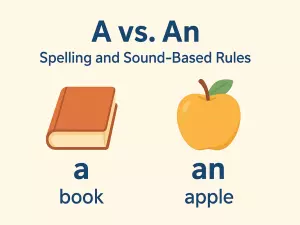
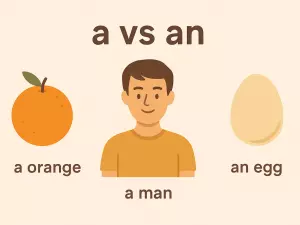
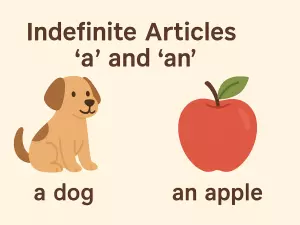
Choosing between a and an in English depends on the first sound of the following word—not the first letter. This means you use a before a word that starts with a consonant sound, and an before a word that begins with a vowel sound. The spelling can be misleading, so always listen for the initial sound, not just look at the letter.
Why sound matters more than spelling
Some English words start with a silent letter or a letter that doesn't match its usual sound. For example, hour starts with a silent "h," so we say an hour. By contrast, university starts with a "yoo" sound, so it takes a university.
Common examples and tricky cases
- a cat (starts with the consonant sound "k")
- an apple (starts with the vowel sound "a")
- a user (starts with the "y" consonant sound as in "you")
- an hour (the "h" is silent, so it begins with the vowel sound "ow")
- a European trip (starts with "y" sound, not "e")
- an honest person (silent "h"; starts with "o" sound)
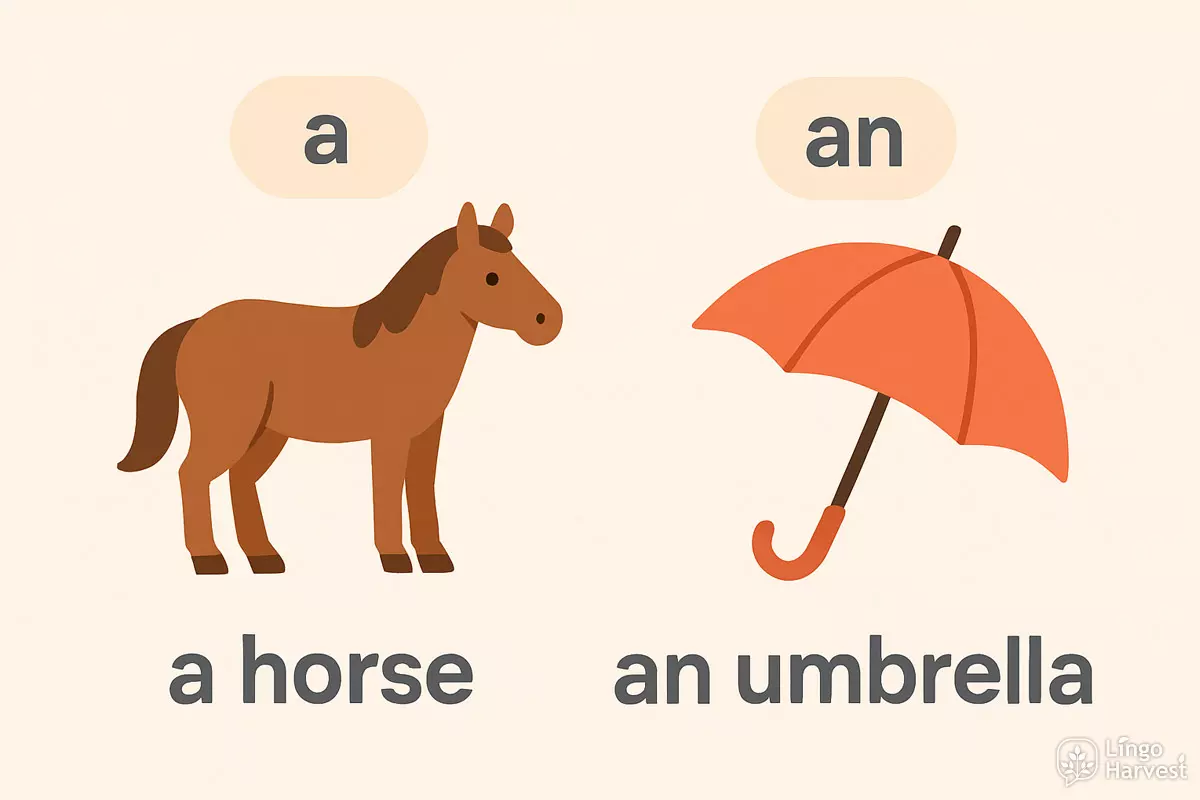
- a horse (starts with "h" sound)
- an umbrella (begins with a clear "u" vowel sound)
- a one-way street (the "o" in "one" sounds like "w")
- an FBI agent (the spoken "F" is "ef": a vowel sound)
- a hotel (the "h" is pronounced)
- an heir (silent "h," so vowel sound at the start)
- a unicorn (starts with "yoo" sound)
- an MBA (the spoken "M" is "em": vowel sound)
- a university ("yoo" sound at the beginning)
- an egg (starts with "e" sound)
- a euro ("y" sound)
Quick reference for sound-based choice
| Starts with | Use | Example |
|---|---|---|
| Vowel sound (a, e, i, o, u, or similar) | an | an apple, an hour, an FBI agent |
| Consonant sound (b, c, d, f, etc., or "yoo" as in "university") | a | a cat, a user, a unicorn |
| Silent first letter (silent "h" or "u") | Depends on the next sound | an honest person, a hotel |
| Initialisms/acronyms (spoken as letters) | Check first spoken sound | an MBA, a UFO |
To sum up, always listen to the initial sound of the next word, not just its spelling, when deciding whether to use a or an. This approach will help you avoid common mistakes and sound more natural in English conversations.
Words starting with vowels
When a word begins with a vowel sound, English speakers use an instead of a. This makes sentences easier to say and smoother to understand. Vowel sounds are typically made by the letters a, e, i, o, u, but what matters is the sound, not just the first letter. For example, “an apple” and “an umbrella” both start with a vowel sound, so “an” is the correct choice.
Examples of using “an” with vowel beginnings
Here are some common cases where you use “an” because the word starts with a vowel sound:
- an apple
- an elephant
- an orange
- an umbrella
- an idea
- an owl
- an hour (the “h” is silent, so the first sound is a vowel)
- an egg
- an uncle
- an airport
- an artist
- an ant
- an engineer
- an octopus
- an honest person (again, the “h” is silent)
- an invite
- an heir (the “h” is silent)
Common mistakes with vowel sounds
Not every word that starts with a vowel letter uses “an.” The deciding factor is the first sound, not the spelling. For instance:
- a university (the “u” is pronounced “you,” which starts with a consonant sound)
- a European trip (the “e” sounds like “you”)
- a one-way ticket (the “o” is pronounced “w”)
These exceptions show why pronunciation is more important than spelling when deciding between “a” and “an.”
Comparison: Correct and incorrect usage
| Correct Form ✅ | Incorrect Form ❌ |
|---|---|
| an apple | a apple |
| an umbrella | a umbrella |
| an hour | a hour |
| a university | an university |
| a European city | an European city |
In summary, use “an” before words that begin with a vowel sound, regardless of the letter. Always listen to the pronunciation when you are unsure, and remember that some words with silent letters or unique sounds can be exceptions to the general rule.
Words starting with consonants
When using “a” or “an,” the first sound of the next word matters most. If the word begins with a consonant sound, you should use “a.” This rule applies even if the spelling starts with a vowel but the pronunciation begins with a consonant sound (like “university”). The key is to listen to how the word is said, not just how it is spelled.
How to identify consonant sounds
Most English consonant sounds are easy to recognize: b, c, d, f, g, h, j, k, l, m, n, p, q, r, s, t, v, w, x, y, z. If the first letter makes any of these sounds, “a” is the correct choice.
- a book
- a dog
- a cat
- a house
- a phone
- a university (“university” starts with a “yoo” sound)
- a European country (“European” starts with a “y” sound)
- a car
- a lamp
- a zoo
- a table
- a horse
- a one-way street (“one” starts with a “w” sound)
- a year
- a user (“user” starts with a “y” sound)
- a uniform (“uniform” starts with a “y” sound)
Common mistakes to avoid
- Don’t rely only on spelling; check the first sound.
- Words like “hour” use “an” because the “h” is silent (sounds like “our”).
- Words like “honor” and “honest” also have a silent “h.”
- For abbreviations, say the letters out loud. For example, “an MBA” (starts with “em” sound), but “a UFO” (starts with “you” sound).
Quick reference: “a” before consonant sounds
| Example Word | Why we use “a” |
|---|---|
| a cat | Begins with the /k/ sound (a consonant) |
| a university | Starts with a “yoo” sound, not a vowel sound |
| a one-time event | “One” begins with “w” sound |
| a user | Pronounced “yoo-zer” (consonant sound at the start) |
| a lamp | Starts with the /l/ sound (a consonant) |
Special tricky cases
Choosing between a and an is usually straightforward, but English has some exceptions that can confuse learners. Here are some patterns and examples where the usual rules might not apply, or where pronunciation plays a bigger role than spelling.
Words starting with a silent 'h'
Some words begin with an 'h' that isn’t pronounced, making them sound like they start with a vowel. In these cases, use an:
- an hour
- an honest person
- an heir
- an honor
Words that begin with a pronounced 'h'
When the ‘h’ is pronounced, use a:
- a house
- a hotel
- a history book
- a hero
Words starting with vowels but sounding like consonants
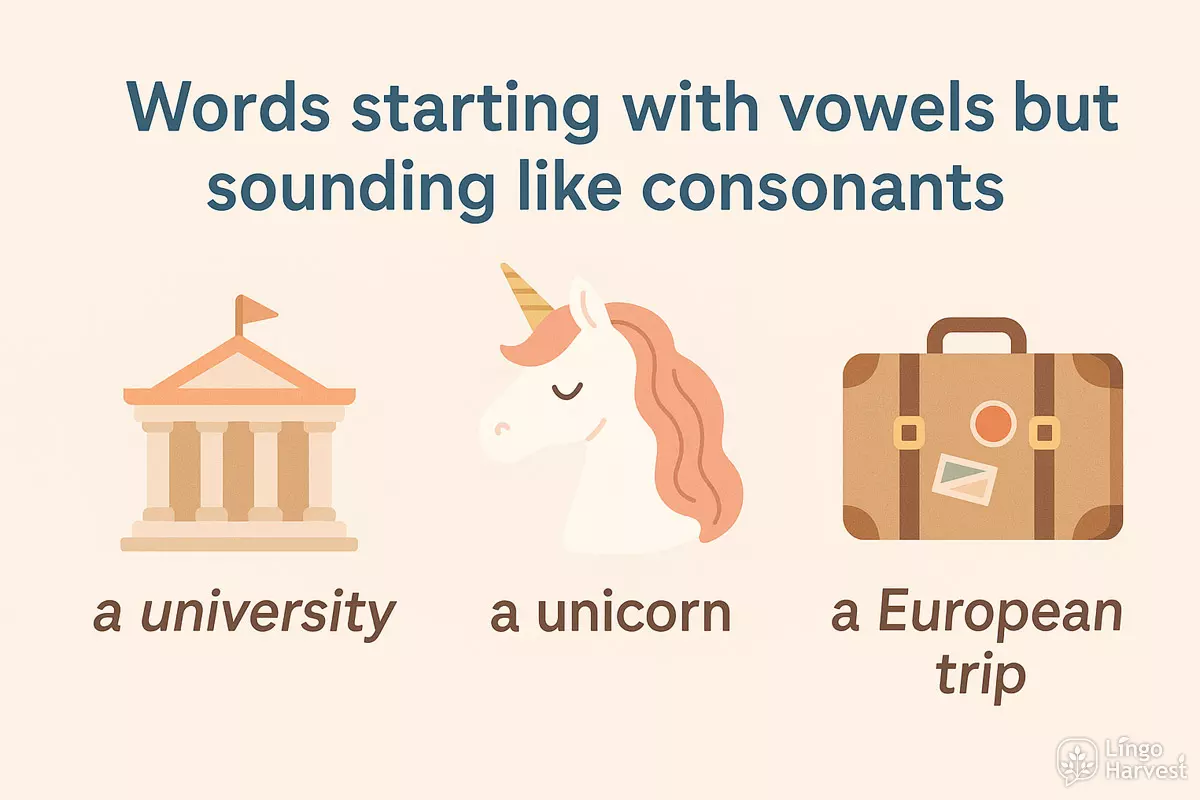
Not every word that starts with a vowel letter begins with a vowel sound. If the initial sound is a consonant (like “you” in “unicorn”), use a:
- a university
- a unicorn
- a European trip
- a one-way ticket
- a U.S. citizen
Acronyms and abbreviations
Decide between a and an based on the first sound of the abbreviation, not the first letter.
| Abbreviation | Correct Article |
|---|---|
| an MRI | Sounds like "em-ar-eye" (vowel sound) |
| a USB drive | Sounds like "you-es-bee" (consonant sound) |
| an FBI agent | Sounds like "ef-bee-eye" (vowel sound) |
| a NASA engineer | Sounds like "nasa" (consonant sound) |
Other uncommon exceptions
Occasionally, regional accents or borrowed words may affect which article is natural. If you’re unsure, say the word out loud and listen for the first sound. Here are a few more unusual cases:
- an SOS call (starts with "ess" sound)
- a historic event (some speakers may say "an historic", but "a historic" is more common in modern English)
- an MBA (starts with "em" sound)
- a euro (starts with "y" sound)
Remember, the main guideline is to listen to the sound at the beginning of the word, not just look at the spelling. This will help you use articles correctly in even the trickiest situations.
Mistakes beginners often make
New English learners often struggle with choosing between “a” and “an,” leading to common errors in both speaking and writing. These mix-ups usually happen because of confusion about pronunciation, spelling, or exceptions to the basic rules. Below are frequent pitfalls to watch out for and tips to avoid them.
Confusing Spelling with Pronunciation
Many people look at the first letter of a word instead of listening to the sound. For instance, “an hour” is correct because “hour” starts with a vowel sound, not a consonant. On the other hand, “a university” is correct since “university” begins with a you sound, which is a consonant sound.
- Incorrect: a apple ❌ Correct: an apple ✅
- Incorrect: an university ❌ Correct: a university ✅
- Incorrect: a honest person ❌ Correct: an honest person ✅
- Incorrect: an house ❌ Correct: a house ✅
Overgeneralizing the Rule
Some learners think “an” is always used before any vowel letter, but that’s not always true. The real rule is about the sound at the beginning of the next word, not the written letter.
Forgetting About Silent Letters
Words with silent first letters can be confusing. For example, “herb” (in American English) is pronounced “erb,” so it’s “an herb.”
Exceptions with Acronyms and Abbreviations
The choice between “a” and “an” depends on how the acronym or letter is pronounced:
| Acronym/Abbreviation | Correct Article |
|---|---|
| an MBA | Starts with “em” sound |
| a UFO | Starts with “you” sound |
| an FBI agent | Starts with “ef” sound |
| a URL | Starts with “you” sound |
List of Commonly Confused Examples
- a euro (sounds like “y”)
- an umbrella (starts with vowel sound)
- a one-way street (sounds like “w”)
- an honor (silent “h”)
- a hotel (pronounced “h”)
- an hour (silent “h”)
- a unicorn (sounds like “you”)
- an MP3 (starts with “em” sound)
- a user (sounds like “you”)
- an SOS (starts with “es” sound)
- a uniform (sounds like “you”)
- an X-ray (starts with “ex” sound)
Short practice exercises
To get comfortable choosing between "a" and "an," try these beginner-friendly tasks. Focus on the sound that starts the next word, not just the spelling. Practice will help you remember which article to use in real situations.
Fill in the blanks
Decide whether "a" or "an" fits best in each sentence:
- I have ___ apple in my bag.
- She wants ___ orange notebook.
- He saw ___ cat on the street.
- They found ___ umbrella under the table.
- We need ___ hour to finish.
- Can you give me ___ pencil?
- It’s ___ unusual day.
- He is ___ honest person.
- She adopted ___ dog yesterday.
- Do you see ___ elephant?
Show answers
- an
- an
- a
- an
- an
- a
- an
- an
- a
- an
Choose the correct article
Pick the right word for each noun below. Remember, say the word out loud to help decide!
- ___ egg
- ___ bike
- ___ hour
- ___ unicorn
- ___ elephant
- ___ university
- ___ owl
- ___ house
- ___ apple
- ___ car
Show answers
- an egg
- a bike
- an hour
- a unicorn
- an elephant
- a university
- an owl
- a house
- an apple
- a car
Common mistakes: article choice with tricky words
Some English words look like they start with a vowel but sound like a consonant, and vice versa. Study these examples:
| Word | Correct article |
|---|---|
| hour | an hour |
| unicorn | a unicorn |
| honest man | an honest man |
| European city | a European city |
| apple | an apple |
| umbrella | an umbrella |
| one-way street | a one-way street |
| FBI agent | an FBI agent |
Notice how the article depends on the sound at the beginning of the following word. This is especially important with words like "hour" (silent 'h') or "university" (starts with 'ju:' sound).