Indefinite Articles “a” and “an”: Grammar Theory

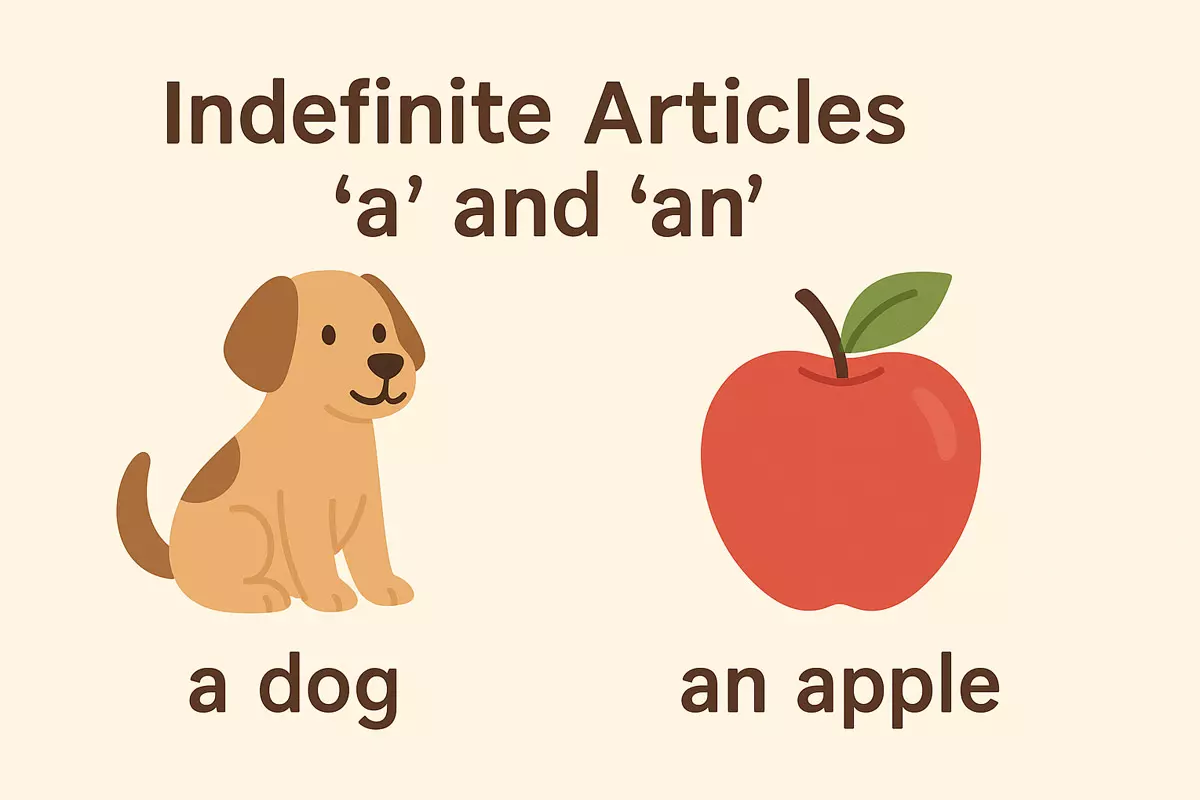 This article explains what a and an mean, when to use each, the rule that limits them to singular nouns, and how they introduce general or new information. It also covers exceptions and includes a brief practice section.
Mastering the basics of English grammar can be challenging, particularly when it comes to selecting the correct articles that indicate something nonspecific. Knowing when to use “a” or “an” is crucial for clear and effective communication. The choice depends on the sound that begins the next word: use “a” before words that start with a consonant sound and “an” before words that start with a vowel sound. Developing this skill helps ensure your speech and writing are both accurate and easily understood.
What a/an Means
The words “a” and “an” are known as indefinite articles in English grammar. They signal that the noun being mentioned is not specific or previously identified. When you use “a” or “an,” you’re talking about a single, non-specific member of a group. For example, if you say, “I saw a cat,” it means any cat, not a particular one you or your listener already know.
These articles are used only with singular, countable nouns—words you can count individually, like “book,” “apple,” or “idea.” If you’re referring to something unique or already mentioned, you would use “the” instead, which is the definite article.
How to Choose Between “a” and “an”
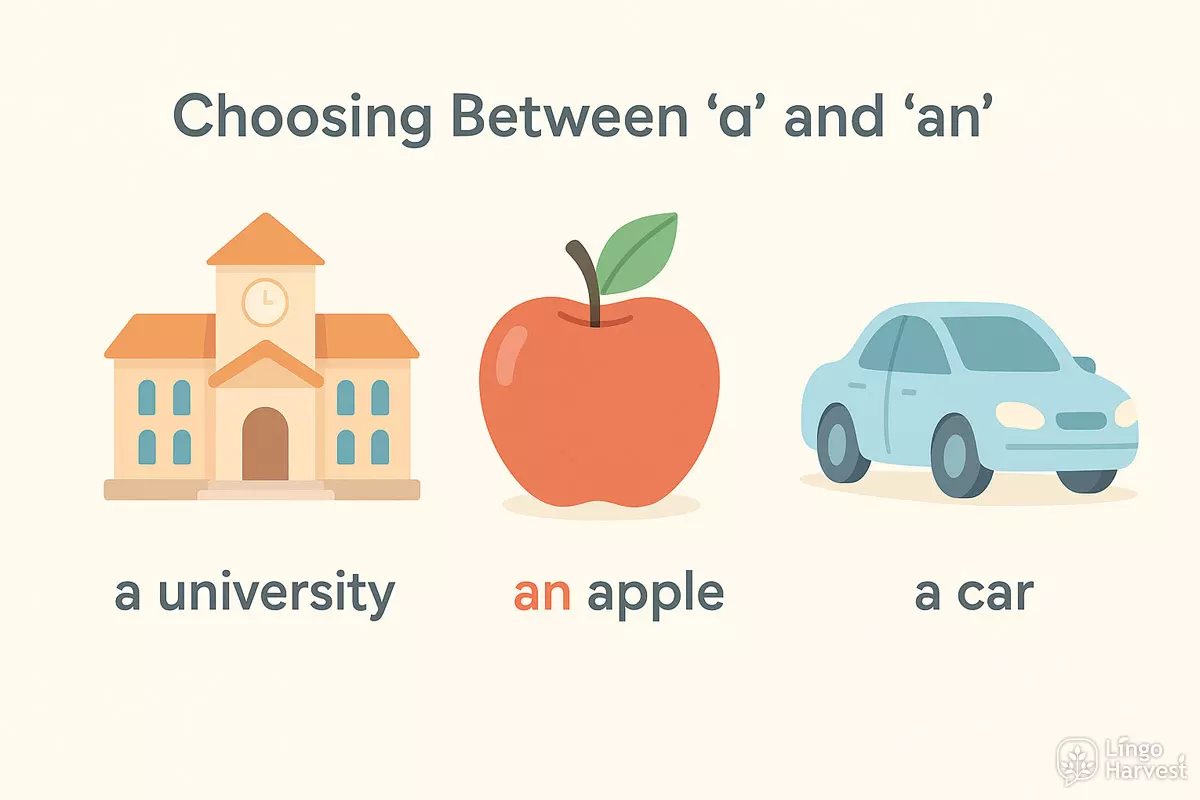
The choice depends on the sound that begins the next word, not the spelling. Use “a” before words that start with a consonant sound, and “an” before words that start with a vowel sound. This rule helps speech flow more smoothly.
- a dog
- a university (because it begins with a “yoo” sound)
- an apple
- an hour (the “h” is silent, so it begins with a vowel sound)
- a car
- an umbrella
- a house
- an honest person
- a European country
- an egg
- a banana
- an uncle
- a bike
- an elephant
- a horse
- an idea
- a user (pronounced “yoo-zer”)
- an heir
When to Use Indefinite Articles
Indefinite articles appear in several situations:
- Introducing something for the first time: “She bought a laptop.”
- Describing one of many: “He wants to eat an orange.”
- Talking about someone’s profession: “She is a teacher.”
- Expressing frequency, speed, or price: “I go to the gym twice a week.”
Summary Table: “a” vs. “an”
| Article | Use Before | Example |
|---|---|---|
| a | Consonant sounds | a car, a university, a dog |
| an | Vowel sounds | an apple, an hour, an honest person |
In summary, “a” and “an” help speakers and writers refer to singular, unknown items in a way that is natural and clear. The choice between them is based on sound, not spelling, and their use is a key part of English grammar for everyday communication.
When to Choose a or an
Choosing between “a” and “an” in English depends on the sound that begins the next word, not simply the first letter. The main idea is that “a” is used before words that start with a consonant sound, while “an” comes before words that start with a vowel sound. This rule helps sentences flow smoothly and naturally.
Basic Principle
The indefinite article “a” precedes words that begin with a consonant sound (like “cat,” “house,” or “dog”). Conversely, “an” is placed before words that start with a vowel sound (such as “apple,” “engineer,” or “hour”). It’s the sound—not always the letter—that determines the correct article.
- a car
- a university (pronounced “you-niversity”)
- a banana
- an orange
- an honest person (the “h” is silent: “onest”)
- an umbrella
- an hour
- a European trip (“you-ropean”)
- a one-way street (“w” sound)
- an MBA (“em” sound)
- a unicorn (“you” sound)
- an FBI agent (“ef” sound)
- a hotel (if the “h” is pronounced)
- an heirloom (“air” sound)
- a historic event (if “h” is pronounced; “an” is also sometimes heard)
- an SOS (“es” sound)
- a user (“you” sound)
- an octave (“ok-tave”)
- a useful tool (“you” sound)
- an honor (“on-er”)
Special Cases and Common Mistakes
Some words may look like they start with a vowel but actually begin with a consonant sound. For example, “eulogy” starts with a “y” sound (“you-logy”), so “a” is correct: “a eulogy.” Similarly, abbreviations and acronyms depend on pronunciation: “an MRI” (pronounced “em-ar-eye”), “a UFO” (pronounced “you-eff-oh”).
Quick Reference Table
| Article | When to Use | Example | Sound |
|---|---|---|---|
| a | Before words with a consonant sound | a book, a user, a horse | /b/, /j/, /h/ |
| an | Before words with a vowel sound | an apple, an hour, an MBA | /æ/, /aʊ/, /ɛm/ |
| a | Before words starting with “u” or “eu” pronounced “you” | a university, a European | /juː/ |
| an | Before silent “h” words | an honor, an heir | /ˈɒnə/, /eə/ |
Paying attention to the spoken sound is the most reliable way to select the correct indefinite article. This approach avoids common pitfalls and ensures your English sounds natural and clear.
Singular-Only Rule
When using “a” and “an,” these words always appear with singular, countable nouns. You cannot use them with plural nouns or with uncountable concepts. For example, you can say “a book” or “an apple,” but not “a books” or “an information.” This rule is absolute in standard English grammar.
When to Use “a” or “an”
The indefinite articles “a” and “an” are placed before nouns that are both singular and countable. Their use depends on the sound that follows:
- “a” before words beginning with a consonant sound: a dog, a university, a house
- “an” before words beginning with a vowel sound: an umbrella, an hour, an honest mistake
Notice that the choice is based on pronunciation, not spelling: an honor (because the “h” is silent), a unicorn (because it starts with a “y” sound).
Examples of Correct and Incorrect Usage
To clarify how this restriction works, here’s a quick breakdown of possible and impossible combinations:
- ✅ a cat
- ✅ an idea
- ❌ a cats (error: article with plural; correct: "a cat" or "cats")
- ❌ an ideas (error: article with plural; correct: "an idea" or "ideas")
- ❌ a water (error: "water" is uncountable; correct: "water" or "a glass of water")
- ❌ an advice (error: "advice" is uncountable; correct: "advice" or "a piece of advice")
- ✅ a student
- ✅ an orange
- ❌ a children (error: "children" is plural; correct: "a child" or "children")
- ❌ an apples (error: article with plural; correct: "an apple" or "apples")
- ❌ a information (error: "information" is uncountable; correct: "information" or "a piece of information")
- ❌ an furniture (error: "furniture" is uncountable; correct: "furniture" or "a piece of furniture")
- ✅ an egg
- ✅ a phone
- ❌ a eggs (error: article with plural; correct: "an egg" or "eggs")
- ❌ a sugar (error: "sugar" is uncountable; correct: "sugar" or "some sugar")
Indefinite Articles and Plurals/Uncountables
English does not allow “a” or “an” before plural or uncountable nouns. Instead, for plurals, use no article or a different determiner (like “some” or numbers). For uncountables, words like “some,” “much,” or “a piece of” are used when needed.
Summary Table: Correct Usage
| Article + Noun | Is it correct? |
|---|---|
| a dog | Yes (correct: singular noun after "a") |
| an umbrella | Yes (correct: vowel sound → "an") |
| a elephants | No (should be plural without article, or singular: "an elephant") |
| an homework | No ("homework" is uncountable; correct: "homework" or "a piece of homework") |
| a university | Yes (starts with /juː/ consonant sound → "a university") |
| an hour | Yes (silent "h" → vowel sound → "an hour") |
| a children | No (incorrect plural; correct: "a child" or "children") |
| an advices | No ("advice" is uncountable; correct: "advice" or "a piece of advice") |
| a milk | No ("milk" is uncountable; correct: "milk" or "some milk") |
| an MP3 player | Yes (letter "M" begins with vowel sound → "em") |
| a knives | No (plural; correct: "a knife" or "knives") |
| an honest person | Yes (silent "h" → vowel sound → "an honest") |
| a ideas | No (plural; correct: "an idea" or "ideas") |
| a piece of cake | Yes (correct with uncountable nouns) |
In summary, “a” and “an” are used exclusively with singular, countable nouns. If the noun is plural or uncountable, a different word or no article is needed. This is a fixed rule in English grammar that helps avoid ambiguity and confusion.
General vs New Information
When choosing between “a” and “an,” it’s not just about the sound at the start of the word. Indefinite articles also help signal whether you’re talking about something for the first time (new information) or referring to something in a general sense. This distinction often guides how sentences are structured and how details are introduced in conversation or writing.
Introducing Something for the First Time
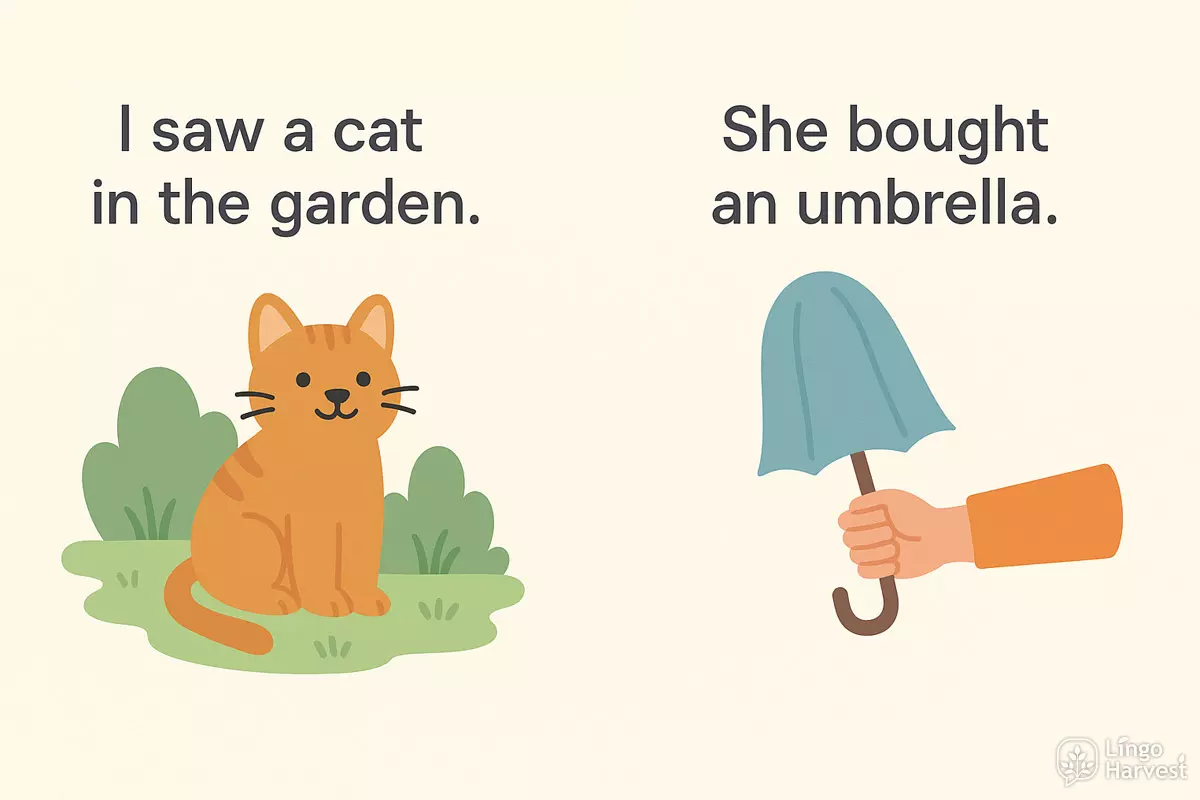
Use “a” or “an” when mentioning something that hasn’t been previously identified in the conversation. This usage tells your listener or reader that the thing is not specific or familiar yet. For example:
- I saw a cat in the garden. (First mention; the listener doesn’t know which cat.)
- She bought an umbrella. (The umbrella hasn’t been referenced before.)
Referring to Any Member of a Group
Indefinite articles also indicate general membership in a category, rather than a specific item. They’re used to talk about any single example of a group, not a unique or previously mentioned one:
- A doctor can help you. (Any doctor, not a specific one.)
- He wants to be an astronaut. (Any astronaut, not a particular person.)
Contrast with Definite Information
Once something has been introduced with “a” or “an,” further mentions often use “the” to indicate it’s now known information. This shift from indefinite to definite marking helps keep communication clear:
- I saw a bird. The bird was singing.
- She found an old coin. The coin was valuable.
Common Examples of Indefinite Article Use
- He has a meeting at noon.
- They adopted an animal from the shelter.
- Would you like a cup of tea?
- I need an answer by tomorrow.
- She saw a movie last night.
- He ate an apple for breakfast.
- Is there a problem?
- We stayed in a hotel.
- He bought an interesting book.
- She became a teacher.
- He’s looking for an apartment.
- I’d like a sandwich, please.
Summary Table: When to Use Indefinite Articles
| Usage Situation | Example Sentence |
|---|---|
| First mention of something | She saw a dog in the park. |
| Any member of a group | He wants to be an engineer. |
| Unknown or unspecified item | Can I have a pen? |
| Professions and roles | She is an artist. |
| General statements | A good book can change your life. |
In summary, “a” and “an” are used to introduce new or non-specific information and to talk about things in a general sense. Recognizing when information is new or general helps you decide when to use indefinite articles naturally in English.
Exceptions and Edge Cases
Not every use of “a” and “an” follows the simple rule about the next word’s first letter. English contains plenty of situations where pronunciation, not spelling, dictates which article is correct, and a few rare cases where usage is debated or in transition.
Words Beginning with Silent Letters
When a word starts with a silent consonant, the choice depends on the first pronounced sound. For example, “an hour” (silent “h”) but “a house” (pronounced “h”). This can seem counterintuitive, especially for learners who are reading rather than listening.
Initialisms, Acronyms, and Letters
With abbreviations, the decision is about the sound, not the letter. For instance, we say “an FBI agent” because “F” is pronounced “ef,” a vowel sound. Similarly, “a NASA scientist” uses “a” because “N” in NASA is vocalized as “næ,” a consonant sound.
| Example | Reasoning |
|---|---|
| an MBA | “M” pronounced “em,” starts with a vowel sound |
| a UFO | “U” in “UFO” is “you,” a consonant sound |
| an hour | Silent “h,” begins with “ow” sound |
| a university | “U” pronounced “you,” not a vowel sound |
| an honest answer | Silent “h,” starts with “on” sound |
| a historian | “H” pronounced, so “a” is used (in American English) |
Words with “H” at the Start
Some words beginning with “h” are tricky. In American English, “a historic event” is more common, while British English sometimes prefers “an historic event.” The difference often comes down to whether the “h” is aspirated or not.
Unusual Vowel Sounds
Even when a word starts with a vowel letter, it might sound like a consonant. For instance, “a European trip” uses “a” because “European” starts with a “y” sound (“you-ropean”). Other examples include:
- a one-time event (starts with “w” sound)
- a unicorn (starts with “you” sound)
- an umbrella (begins with “uh” sound)
- a user (starts with “you” sound)
- an honor (silent “h”)
- an heir (silent “h”)
- a uniform (starts with “you” sound)
- an apple (begins with “a” sound)
- a euro (starts with “y” sound)
- an SOS call (starts with “es” sound)
- a hotel (pronounced “h” in American English)
- an X-ray (starts with “ex” sound)
Regional and Historical Variation
Usage has shifted over time and varies by dialect. Some older or British forms use “an” before words like “hotel” or “herb,” but this is now rare in American English. Such differences can be found in literature or formal speech.
Summary
In summary, selecting “a” or “an” isn’t always as straightforward as looking at the first letter. Listening for the actual opening sound is key, and being aware of exceptions—especially with abbreviations, silent letters, or regional variations—will help you choose correctly.
Mini Practice
Ready to reinforce your understanding of how to use “a” and “an”? Try the following exercises and examples to check your grasp on indefinite articles in English.
Quick Fill-in-the-Blank Exercise
Choose the correct article (“a” or “an”) for each phrase:
- ___ apple
- ___ university
- ___ honest person
- ___ book
- ___ hour
- ___ cat
- ___ orange umbrella
- ___ European city
- ___ elephant
- ___ useful tool
Show answers
- an apple
- a university
- an honest person
- a book
- an hour
- a cat
- an orange umbrella
- a European city
- an elephant
- a useful tool
Spot the Error
Identify and correct the mistakes in the following sentences:
- She is an teacher.
- He found a interesting coin.
- I saw an unicorn in my dream.
- We need a umbrella for the rain.
Show answers
- She is a teacher.
- He found an interesting coin.
- I saw a unicorn in my dream.
- We need an umbrella for the rain.
Common Noun Patterns
Here are some common nouns and their correct indefinite article usage. Notice the difference based on the sound, not just spelling:
| Article + Noun | Explanation |
|---|---|
| a house | Starts with a consonant sound |
| an hour | Silent “h”; starts with a vowel sound |
| a university | “u” pronounced as “ju:” (consonant sound) |
| an apple | Starts with a vowel sound |
| a one-way street | “one” pronounced with “w” sound |
| an honest answer | Silent “h”; vowel sound at the start |
| an umbrella | Starts with a vowel sound |
| a European country | “Eu” pronounced “ju:” (consonant sound) |
Challenge: Make Your Own Examples
Write five original sentences using “a” and “an” correctly. Try to include both easy and tricky cases (such as words starting with “u” or silent “h”).
Show answers
- I saw a unicorn at the museum.
- She gave me an orange.
- He is an honest man.
- They visited a university in London.
- We waited for an hour.
Practicing with both common and unusual examples will help you master the subtle rules for choosing between “a” and “an”. Focus on the initial sound of the word that follows—not just the first letter—to make the correct choice every time.