A vs An: Spelling and Sound-Based Rules

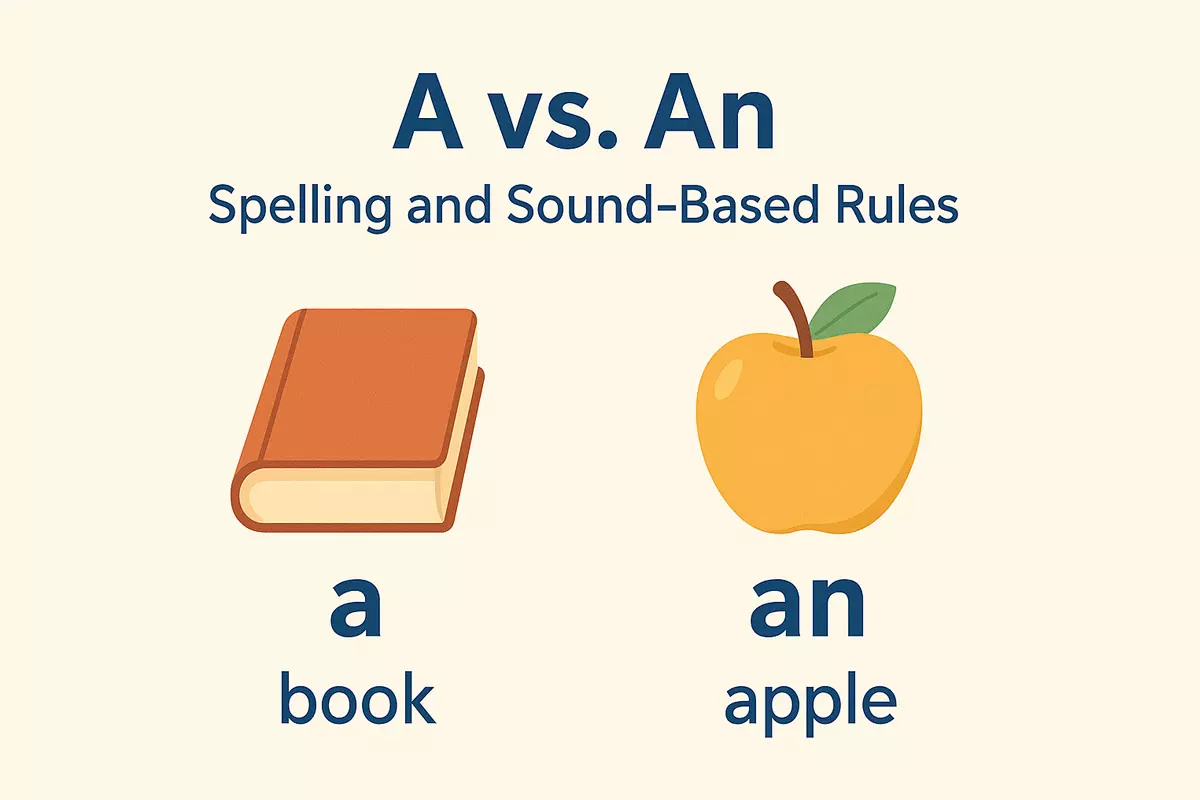 This article explains how to choose a or an based on the following word’s sound, not spelling. It covers the basic rule, tricky exceptions like hour and MBA, common errors, and includes practice with real examples to test your understanding.
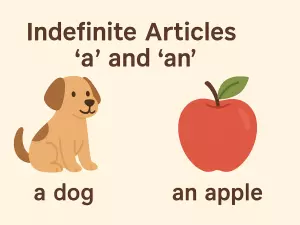
Deciding between “a” and “an” before a word depends not on the initial letter, but on the sound that follows. Use “a” before words that begin with a consonant sound, such as “a cat” or “a university” (because “university” starts with a “yoo” sound). Use “an” before words that begin with a vowel sound, like “an apple” or “an hour” (“hour” starts with a silent “h,” so the first sound is a vowel). Focusing on pronunciation rather than spelling ensures your writing is both grammatically correct and easy to read.
Why article choice depends on sound
English articles "a" and "an" are chosen based on the way a word sounds at the beginning, not how it is spelled. This means you need to listen for the initial sound, not just look at the first letter. The main goal is to make speech flow smoothly and avoid awkward pauses or stops between words.
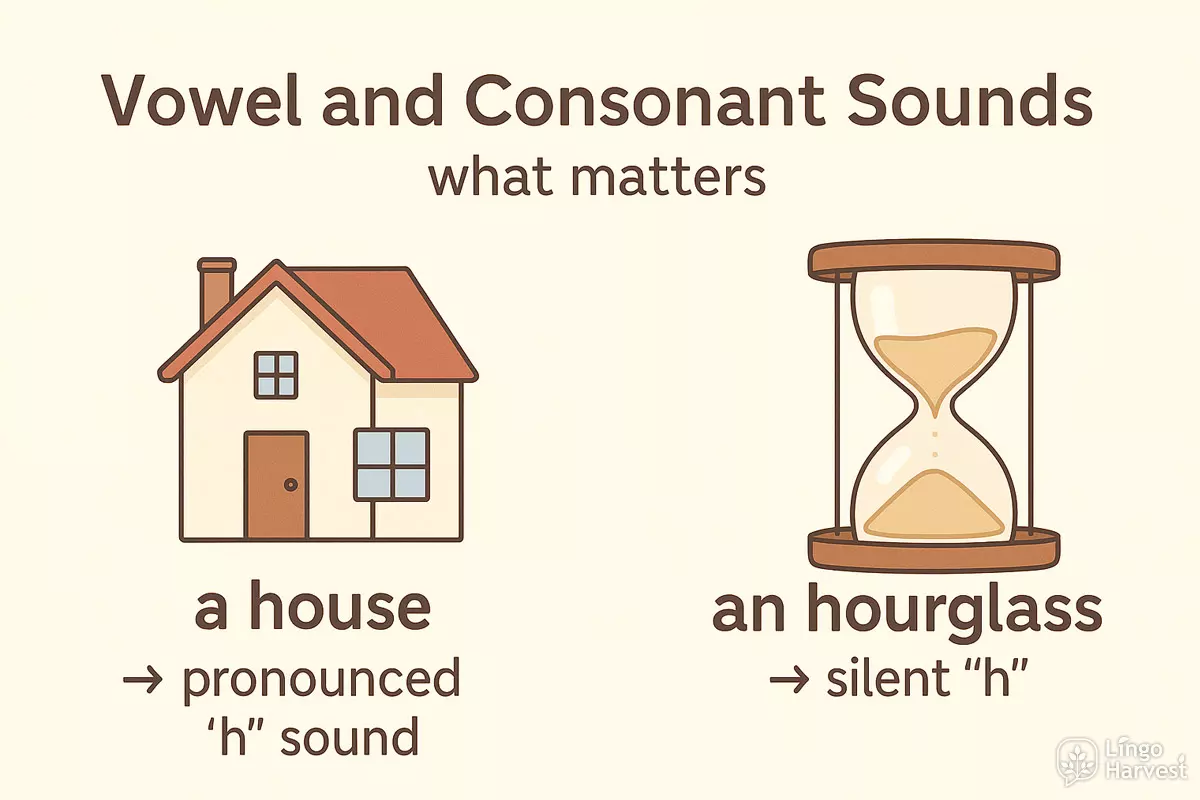
Vowel and consonant sounds: what matters
Use "an" before words starting with a vowel sound (not just a vowel letter). Use "a" before words that begin with a consonant sound. This rule applies regardless of spelling. For example, we say "an hour" (because the "h" is silent, so it sounds like "our") but "a university" (because "university" starts with a "y" sound, which is a consonant sound).
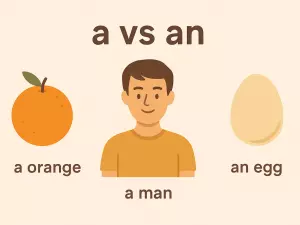
- an apple → vowel sound /æ/
- a cat → consonant sound /k/
- an honor → silent "h", vowel sound /ɒ/
- a house → pronounced "h" sound
- an MBA → pronounced "em", vowel sound /ɛm/
- a unicorn → "yu" sound, consonant /j/
- an hourglass → silent "h"
- a euro → "yu" sound, consonant /j/
- an SOS → pronounced "es", vowel sound /ɛ/
- a one-way street → "w" sound, consonant /w/
- an FBI agent → "ef" sound, vowel /ɛ/
- a US citizen → "yu" sound, consonant /j/
Common tricky cases
Some words can be confusing because the written form doesn't match the spoken sound. Here are examples where the article choice may surprise you:
- an honest person (silent "h")
- a hotel (pronounced "h")
- an heir (silent "h")
- a historic event (pronounced "h")
- a European country ("y" sound)
- an MRI scan (starts with "em")
In summary, always pay attention to the initial sound of the word following the article. Spelling can be misleading, so listening or saying the word out loud is often the best way to choose correctly.
Basic rule: consonant sound vs vowel sound
When choosing between “a” and “an,” the decision depends on the first sound of the word that follows, not just the first letter. Use “a” before words starting with a consonant sound, and “an” before words that begin with a vowel sound. This rule applies regardless of spelling, so it’s the pronunciation that matters.
How to tell which article to use
Think about how the next word sounds when spoken aloud. If it begins with a sound like "b", "k", "y", or any other consonant, use “a.” If it begins with a sound like "a", "e", "i", "o", or "u", use “an.” This is why we say “an hour” (because the “h” is silent, so it sounds like “our”) and “a university” (because “university” starts with a “yoo-” sound).
- a book (starts with /b/ sound)
- a dog (starts with /d/ sound)
- a university (starts with /juː/ sound)
- a European country (starts with /j/ sound)
- an apple (starts with /æ/ sound)
- an hour (starts with /aʊ/ sound; “h” is silent)
- an honest person (starts with /ɒ/ sound; “h” is silent)
- an umbrella (starts with /ʌ/ sound)
- an FBI agent (starts with /ɛf/ sound; “F” is pronounced “ef”)
- a one-time event (starts with /w/ sound; “one” sounds like “won”)
Common mistakes and tricky cases
Some words look like they should use one article, but sound requires the other. Silent letters and acronyms often cause confusion. For example:
- an hour (not “a hour”)
- a hotel (the “h” is pronounced in most accents)
- an MBA (pronounced “em-bee-ay”)
- a unicorn (starts with consonant “y” sound)
Quick reference: article choice by initial sound
| Sound at Start | Correct Article | Example |
|---|---|---|
| Vowel sound (a, e, i, o, u) | an | an apple, an hour, an honest man |
| Consonant sound (b, d, j, k, y, w, etc.) | a | a cat, a university, a one-way street |
| Acronyms (depends on pronunciation) | a/an | an FBI agent, a NASA scientist |
| Words with silent first letter | a/an | an hour, a hotel |
Remember, the focus should always be on the first sound, not just the first letter. Listening for the initial pronunciation will guide you to the right choice every time.
Tricky words: hour, university, European, MBA
Some English nouns seem to break the usual “a vs an” rules. The confusion often comes from how a word is pronounced, not how it is spelled. Let’s look at some of these commonly misunderstood examples and explain why they behave differently.
Why pronunciation matters
The choice between “a” and “an” depends on the initial sound of the next word. If the word starts with a vowel sound, use “an.” If it starts with a consonant sound, use “a.” This rule is about sound, not just spelling, which is why words like “hour” and “university” can be tricky.
Examples and explanations
- hour — The “h” is silent, so it starts with an “ow” (vowel) sound: an hour.
- university — The “u” sounds like “you” (a consonant “y” sound): a university.
- European — The “Eu” at the start sounds like “you”: a European.
- MBA — The letters are pronounced “em-bee-ay,” beginning with a vowel sound: an MBA.
Other commonly confused cases
Here are more examples where the choice depends on pronunciation rather than spelling:
- a uniform
- an honest person
- a one-way street
- an FBI agent
- a hotel (in American English)
- an heir
- a U-turn
- an SOS call
- a historic event (usage varies, but “a” is standard in American English)
- an hourglass
- a unicorn
- an X-ray
Quick reference: sound vs. spelling
To help clarify, here’s a summary for these words and similar cases:
| Word | Correct Article | Sound at Start | Example |
|---|---|---|---|
| hour | an | Vowel (ow-) | an hour late |
| university | a | Consonant (you-) | a university campus |
| European | a | Consonant (you-) | a European city |
| MBA | an | Vowel (em-) | an MBA course |
| honest | an | Vowel (on-) | an honest answer |
| uniform | a | Consonant (you-) | a uniform policy |
| heir | an | Vowel (air-) | an heir to the throne |
| FBI agent | an | Vowel (ef-) | an FBI agent |
In summary
Always listen for the first sound of the next word. If it’s a vowel sound, use “an.” If it’s a consonant sound (even if the spelling starts with a vowel), use “a.” This approach helps avoid mistakes with challenging words and acronyms.
A vs an before acronyms and numbers
When it comes to using the right article before acronyms, initialisms, or numbers, the choice depends on the sound that follows the article, not necessarily on the first letter. This can be confusing because sometimes an acronym begins with a consonant letter but is pronounced with a vowel sound, or vice versa.
Sound matters most
The key is to listen to how the acronym or number is spoken aloud. For example, "FBI" starts with an "F," but since the pronunciation is "eff-bee-eye," it begins with a vowel sound. So, you would say "an FBI agent." On the other hand, "NASA" is pronounced "nass-uh," starting with a consonant sound, so you’d say "a NASA scientist."
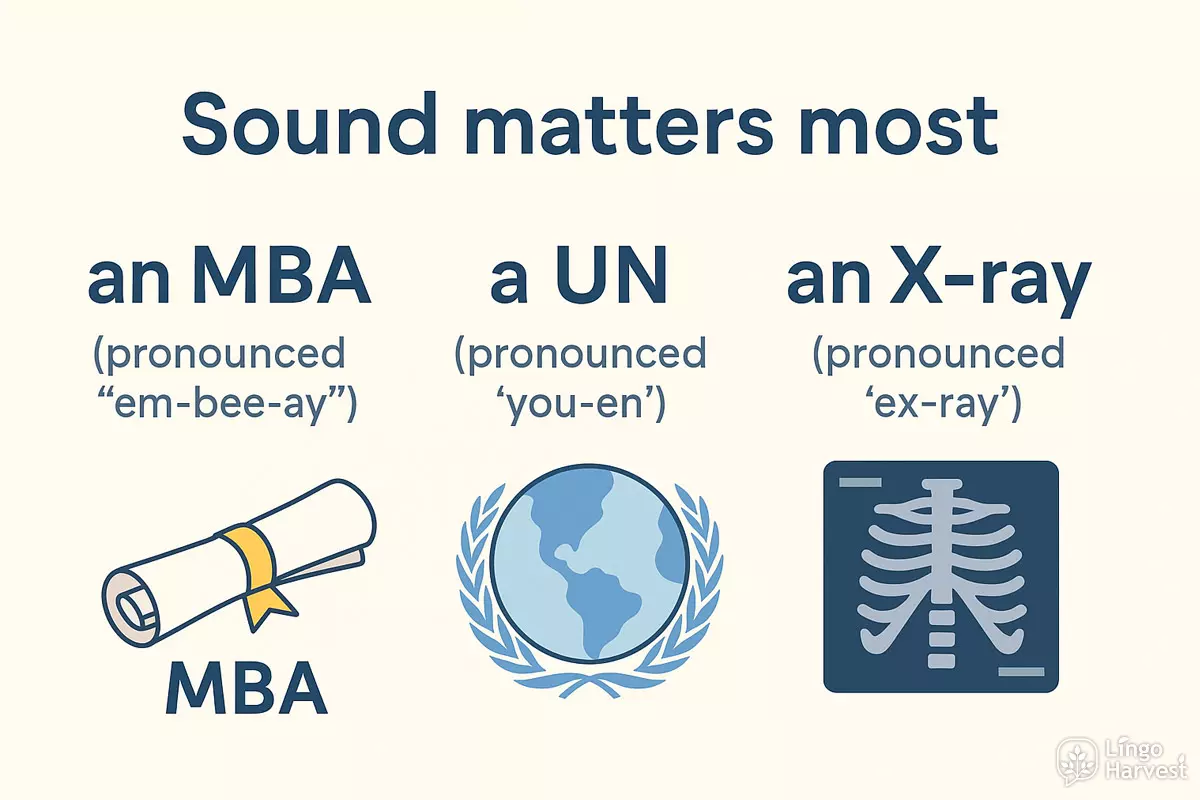
- an MBA (pronounced "em-bee-ay")
- a UN representative (pronounced "you-en")
- an X-ray (pronounced "ex-ray")
- a URL (pronounced "you-are-ell")
- an SOS signal (pronounced "ess-oh-ess")
- a NATO member (pronounced "nay-toh")
- an 18-year-old (pronounced "eighteen")
- a 1-year plan (pronounced "one")
- an MRI scan (pronounced "em-ar-eye")
- a USB drive (pronounced "you-es-bee")
- an LED display (pronounced "el-ee-dee")
- a Wi-Fi device (pronounced "why-fye")
- an honor (pronounced "on-er") — though not an acronym, this shows the same sound-based rule
Numbers and years
Articles before numbers also follow pronunciation. If a number is read with an initial vowel sound, use "an." If it begins with a consonant sound, use "a."
- an 8-hour shift (pronounced "eight-hour")
- a 10-day trip (pronounced "ten-day")
- an 11-year-old (pronounced "eleven-year-old")
- a 100-meter race (pronounced "hundred-meter")
Quick reference: Common acronyms and numbers
| Example | Correct Article | Pronunciation Start |
|---|---|---|
| FBI agent | an | Vowel sound ("eff") |
| UN meeting | a | Consonant sound ("you") |
| 8-year-old | an | Vowel sound ("eight") |
| 1-time event | a | Consonant sound ("one") |
| LED lamp | an | Vowel sound ("el") |
| USB port | a | Consonant sound ("you") |
Remember, the rule is all about how the following word sounds, not how it is spelled. This helps avoid awkward phrasing and ensures your speech and writing sound natural.
Common learner mistakes with a/an
Many English learners get tripped up by the rules for using “a” and “an,” especially when words don’t behave the way they expect. The most frequent error is choosing the article based only on spelling, not on the way the word sounds.
Confusing spelling with sound
It’s easy to think that “a” goes with words starting with consonants and “an” with vowels. However, the real rule is about the first sound, not the first letter. For example, “an hour” is correct because “hour” starts with a vowel sound, even though it begins with “h.”
- a university (sounds like “you-niversity”)
- an honest person (the “h” is silent)
- a European country (“Eu-” sounds like “you”)
- an umbrella (“um-” is a vowel sound)
- a house (“h” is pronounced)
- an hour (“h” is silent)
- a user (“user” starts with a “y” sound)
- an MBA (“MBA” starts with “em-” sound)
- a one-time event (“one” starts with a “w” sound)
- an SOS (“S” is pronounced “es”)
- a hotel (“h” is pronounced)
- an honor (“h” is silent)
- a uniform (“u” sounds like “you”)
- an apple (“a” is a vowel sound)
- a UFO (sounds like “you-eff-oh”)
- an F.A.Q. (“F” is pronounced “ef”)
- a euro (“eu” sounds like “you”)
- an heir (“h” is silent)
Mix-ups with abbreviations and acronyms
Initialisms and acronyms are common sources of confusion. The choice depends on the spoken first letter, not the written one. For example, “an MRI” (pronounced “em-are-eye”) but “a NASA scientist” (pronounced as a word).
| Incorrect | Correct |
|---|---|
| a hour | an hour |
| an university | a university |
| a MBA | an MBA |
| an one-time event | a one-time event |
| an euro | a euro |
| a SOS | an SOS |
Tips to avoid mistakes
Always say the word out loud and listen to the first sound. If it starts with a vowel sound, use “an.” If it starts with a consonant sound, use “a.” This works for both words and abbreviations. Remember, pronunciation guides your choice—not spelling.
Practice: choose a or an in real examples
Understanding when to use “a” and “an” becomes second nature with authentic examples. Below, you’ll find sentences that reflect real-life English usage. Each sentence has a blank space—your task is to decide which article fits best, based on the rules of spelling and pronunciation.
Fill in the blank: “a” or “an”?
- She adopted ___ adorable kitten from the shelter.
- He is ___ honest person who always tells the truth.
- We need ___ umbrella because it’s raining.
- They saw ___ university in the city center.
- Could you hand me ___ pencil from the desk?
- I’d like ___ apple for a snack.
- He wants to be ___ astronaut when he grows up.
- That’s ___ unusual idea, but it might work.
- There is ___ one-eyed cat in the garden.
- She bought ___ European painting at the auction.
- He made ___ mistake on his homework.
- We watched ___ hour-long documentary last night.
- There’s ___ hotel near the station.
- She is ___ MBA student at Harvard.
- I saw ___ owl in the woods.
- He wrote ___ essay for his English class.
- This is ___ unique opportunity.
- We need ___ electrician for the new house.
- She wants ___ orange juice, please.
- He is ___ FBI agent.
Show answers
- an
- an
- an
- a
- a
- an
- an
- an
- a
- a
- a
- an
- a
- an
- an
- an
- a
- an
- an
- an
Quick Reference: Common Tricky Cases
Some words can be confusing because their spelling and sound don’t match the expected rule. Here’s a handy comparison:
| Word | Correct article |
|---|---|
| hour | an hour |
| university | a university |
| honest | an honest |
| European | a European |
| FBI agent | an FBI agent |
Grasping these exceptions will help you avoid common mistakes. Try reading sentences aloud to focus on the initial sound, not just the first letter. This approach will reinforce your understanding of article usage in natural English.