a vs an: The Easiest Rule You'll Ever Learn

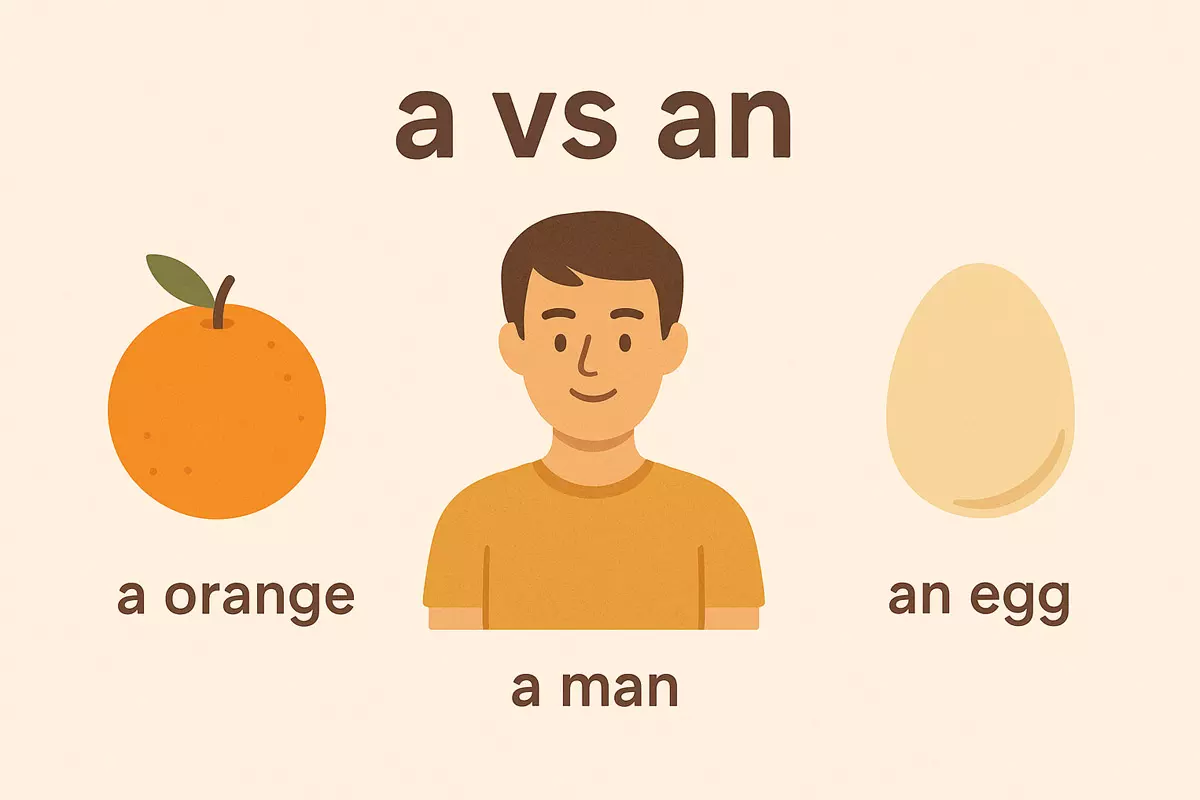 Here we how to choose a or an based on vowel and consonant sounds, discusses exceptions like hour and university, explains rules for acronyms, warns against direct translation, and provides quick tips and practice exercises.
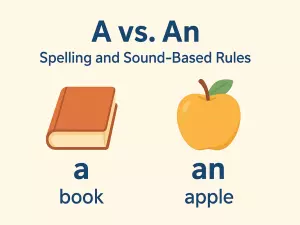
Choosing between “a” and “an” depends on the sound that begins the next word. Use “a” before words that start with a consonant sound, such as “a book” or “a car.” Use “an” before words that start with a vowel sound, like “an apple” or “an hour.” The key is the sound, not just the letter; for example, “an honor” uses “an” because the “h” is silent, creating a vowel sound. Remembering this simple rule will help you avoid common mistakes and make your English sound more natural.
The Sound Rule (vowel vs consonant sounds)
When deciding between “a” and “an,” what matters is the first sound of the following word, not just the first letter. If the word begins with a vowel sound, use “an.” If it starts with a consonant sound, use “a.” This is why we say “an hour” (the ‘h’ is silent, so it sounds like a vowel) but “a university” (the ‘u’ sounds like “you,” a consonant sound).
Understanding Vowel and Consonant Sounds
It’s easy to assume that “an” always comes before words starting with A, E, I, O, or U, but in English, pronunciation is key. The letter “h” can be silent, and vowels like “u” and “o” sometimes sound like consonants. What you hear is more important than what you see.

- a cat (consonant sound “k”)
- a dog (consonant sound “d”)
- an apple (vowel sound “a”)
- an hour (silent “h”—starts with “ow”)
- a university (sounds like “you”)
- an honest person (silent “h”—starts with “on”)
- a European trip (sounds like “you”)
- an umbrella
- a one-way street (sounds like “w”)
- an FBI agent (pronounced “ef”—starts with a vowel sound)
- a house
- an egg
- a unicorn (sounds like “you”)
- an honor (silent “h”—starts with “on”)
- an MBA (pronounced “em”—starts with a vowel sound)
- an heir (silent “h”)
- a hotel (in most dialects, the “h” is pronounced)
Common Mistakes to Watch For
Writers often get tripped up with abbreviations and words with silent letters. Always say the word out loud or think about its first sound. For example, “an MRI” (because it starts with “em”), but “a UFO” (because it starts with “you”).
Quick Reference Table
| Word | Correct Form | Reason |
|---|---|---|
| hour | an hour | Silent “h,” starts with vowel sound |
| university | a university | “u” pronounced “you,” a consonant sound |
| FBI agent | an FBI agent | “F” pronounced “ef,” a vowel sound |
| one-way street | a one-way street | “one” starts with “w” sound, a consonant |
| honest person | an honest person | Silent “h,” starts with vowel sound |
| umbrella | an umbrella | “u” pronounced “uh,” a vowel sound |
In summary, always pay attention to the way the next word sounds, not just the spelling. This approach helps you choose the right article every time, even with tricky cases and abbreviations.
Common Exceptions (hour, university)
Some words break the usual “a” versus “an” rule because their spelling and pronunciation don’t match up. This often happens when a word starts with a silent consonant or a vowel letter that sounds like a consonant. Two classic examples are “hour” and “university.”
The word hour begins with the letter “h,” but the “h” is silent. You pronounce it as if it starts with a vowel sound: “our.” That’s why we say an hour, not a hour. On the other hand, university starts with “u,” which is a vowel, but it sounds like “you” (a consonant sound). So, you use a university, not an university.
Here’s a breakdown of some common words that don’t follow the expected pattern:
- an hour ✅ (silent “h”)
- a university ✅ (“u” sounds like “you”)
- an honest person (silent “h” in “honest”)
- a European country (“Eu” sounds like “you”)
- an heir (silent “h” in “heir”)
- a unicorn (“u” sounds like “you”)
- an honor (silent “h” in “honor”)
- a uniform (“u” sounds like “you”)
- an MBA (“M” sounds like “em”—a vowel sound)
- a one-way street (“one” starts with a “w” sound)
- an FBI agent (“F” sounds like “ef”—a vowel sound)
- a UFO (“U” sounds like “you”)
- an SOS (“S” sounds like “es”—a vowel sound)
Why Do These Exceptions Happen?
It all comes down to pronunciation, not spelling. The rule is based on the sound that follows the article. If the next sound is a vowel, use “an.” If it’s a consonant sound, use “a.” This is why it’s an hour but a university—even though both words start with a vowel letter, only one begins with a vowel sound.
Quick Reference
If you’re ever unsure, say the word out loud. Does it start with a vowel sound? Go with “an.” If it starts with a consonant sound, use “a.” Most exceptions are familiar words, but it’s always good to check when you come across something new.
Acronyms and Abbreviations
When dealing with shortened forms of words—like NASA or MRI—the choice between "a" and "an" depends on pronunciation, not spelling. This means you should listen to how the acronym or abbreviation sounds at the start, rather than looking at the first letter. If it begins with a vowel sound, use "an"; if it starts with a consonant sound, use "a." This rule applies even if the written letter is a consonant, like "F" in "FBI," which is pronounced "ef," starting with a vowel sound.
Common Examples
Here are some everyday initialisms and acronyms, with the appropriate article for each:
- an FBI agent (F is pronounced "ef")
- a NASA engineer (N is pronounced "n")
- an MRI scan (M is pronounced "em")
- a URL (U is pronounced "you")
- an SOS call (S is pronounced "es")
- a CEO (C is pronounced "see")
- an NBA player (N is pronounced "en")
- a USB drive (U is pronounced "you")
- an ATM (A is pronounced "ay")
- a PhD (P is pronounced "pee")
- an SUV (S is pronounced "es")
- a JPEG file (J is pronounced "jay")
- an X-ray (X is pronounced "ex")
- a GPS device (G is pronounced "jee")
- an MBA (M is pronounced "em")
Quick Reference Table
| Abbreviation | Correct Article | Spoken Initial Sound | Example Phrase |
|---|---|---|---|
| FBI | an | vowel ("ef") | an FBI investigation |
| UN | a | consonant ("you") | a UN resolution |
| NBA | an | vowel ("en") | an NBA game |
| URL | a | consonant ("you") | a URL address |
| MRI | an | vowel ("em") | an MRI appointment |
| USB | a | consonant ("you") | a USB port |
| SUV | an | vowel ("es") | an SUV |
| CEO | a | consonant ("see") | a CEO decision |
Tips for Choosing the Right Article
- Say the abbreviation aloud—focus on the initial sound.
- If it sounds like a vowel, use "an"; if it sounds like a consonant, use "a."
- This principle applies to both initialisms (letters pronounced separately) and acronyms (pronounced as words).
- Exceptions are rare, but always double-check if the abbreviation is unfamiliar.
In short, the trick is to trust your ear—how you say the abbreviation matters more than how it looks on the page. This keeps your sentences smooth and clear, whether you’re talking about an MRI or a USB device.
Avoid Translating from Native Language
Thinking in your first language when using "a" or "an" can lead to small but persistent mistakes. English articles work differently from those in many other languages, so relying on word-for-word translation may confuse you, especially with the "a/an" rule. Instead of translating, focus on the English sound that starts the next word.
Why Direct Translation Causes Errors
Some languages don’t have articles at all, while others use them based on different rules (like gender, case, or definiteness). In English, the choice between "a" and "an" depends solely on pronunciation, not spelling or grammar rules from your language. For example, many learners mistakenly use "an" before words that look like they start with a vowel, even if they sound like a consonant (e.g., "a university," not "an university").
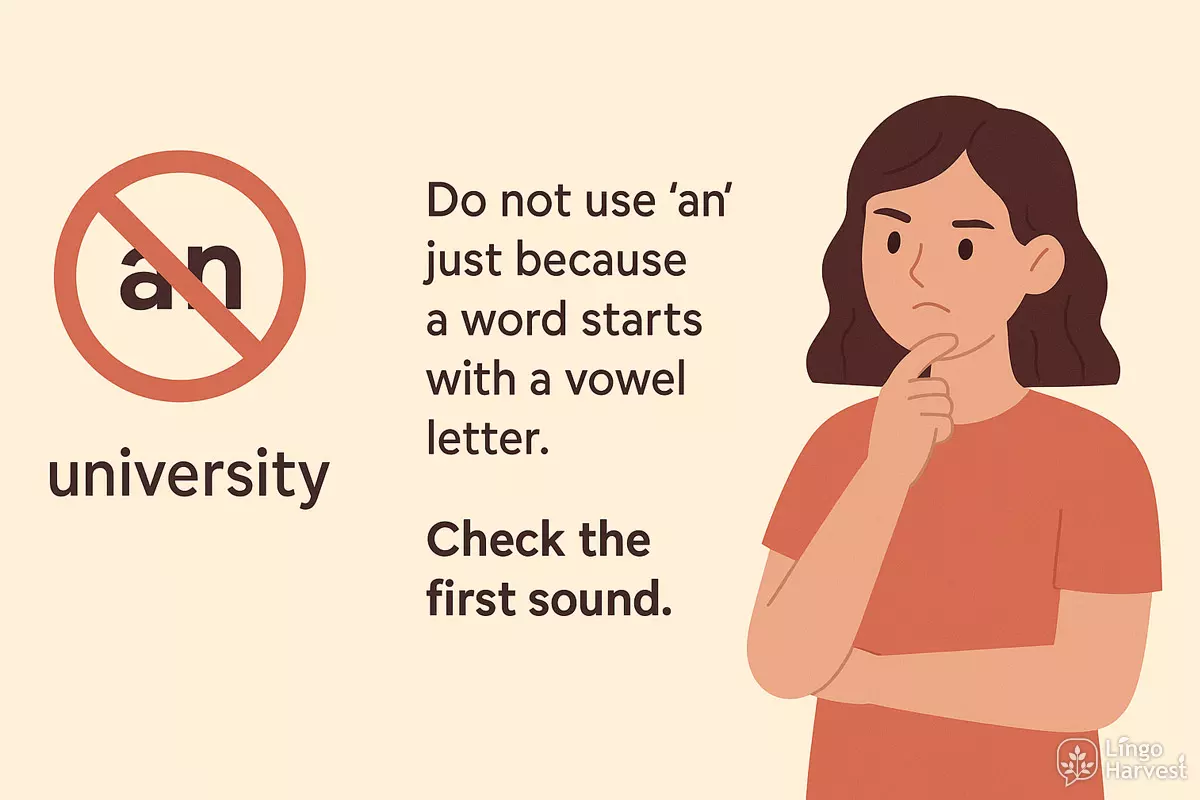
- Do not use "an" just because a word starts with a vowel letter. Check the first sound.
- Don’t rely on your native language’s article or number rules—they rarely match English.
- Remember: English cares about sound, not spelling, for this rule.
Common Traps When Translating
- Using "an" before "user" (should be a user ❌ because "user" starts with a "y" sound)
- Saying "an euro" (should be a euro ❌ because "euro" starts with a "y" sound)
- Choosing "a hour" (should be an hour ✅ because "hour" starts with a silent "h")
- Adding an article where English doesn’t need one (e.g., "I have a hunger" instead of "I am hungry")
- Leaving out articles entirely, which can make speech sound unnatural
Practice: Listen, Don’t Translate
To master the use of "a" and "an," train your ear to notice the first sound of the next word. Practice with these examples:
- a cat
- an apple
- a university
- an hour
- a one-way street
- an honest mistake
- a unicorn
- an umbrella
- a European city
- an MBA
- a hotel
- an egg
- a useful idea
- an SOS
- a U-turn
- an heir
- a historic event
- an honor
- a NASA scientist
- an FBI agent
By focusing on how the word sounds at the start, not how it’s spelled or how your native language might handle articles, you'll find this rule becomes second nature.
Quick Check Tricks
Knowing when to use “a” or “an” is all about sound, not just spelling. To instantly choose the right article, focus on the first sound of the next word—not just the letter it starts with. Here's how you can spot which one to use almost every time.
Listen for the First Sound
If the word begins with a vowel sound (like “apple” or “hour”), use “an.” If it starts with a consonant sound (like “dog” or “university”), go with “a.” This rule covers almost every situation, even when spelling can be deceiving.
Common Examples
- an apple ✅
- an hour ✅ (because the “h” is silent, so it sounds like “our”)
- a university ✅ (the “u” sounds like “you”)
- a car ✅
- an honest person ✅ (“h” is silent)
- a European trip ✅ (“Eu” sounds like “you”)
- an umbrella ✅
- a house ✅
- an egg ✅
- a one-way street ✅ (“one” starts with a “w” sound)
- an MBA ✅ (pronounced “em-B-A”)
- a unicorn ✅ (“u” sounds like “you”)
- an SOS call ✅ (pronounced “es-O-S”)
- an honor ✅
- a hotel ✅ (when “h” is pronounced)
- an heir ✅ (“h” is silent)
- a user ✅ (“u” as “you”)
- an owl ✅
Fast Decision Table
| First Sound | Use | Example |
|---|---|---|
| Vowel sound (a, e, i, o, u) | an | an elephant, an hour, an MBA |
| Consonant sound | a | a cat, a unicorn, a hotel |
| “H” is silent | an | an honor, an heir |
| “U” or “Eu” with “you” sound | a | a user, a European |
When in doubt, say the phrase out loud or in your head. If it flows naturally, you likely made the right choice. These patterns cover nearly all tricky situations, so you can confidently pick the correct article in everyday conversation and writing.
Practice: Choose the Correct Article
Applying the rule for "a" vs "an" becomes second nature with a little hands-on experience. Below you'll find a variety of sentences and phrases where you need to select the correct indefinite article. Remember: use "a" before words that begin with a consonant sound, and "an" before those that start with a vowel sound, regardless of spelling.
Fill in the Blank
For each sentence, decide which article fits best:
- She is ____ honest person.
- He bought ____ umbrella at the store.
- We saw ____ movie last night.
- They adopted ____ cat from the shelter.
- He is ____ engineer by profession.
- Please give me ____ orange.
- It was ____ unique experience.
- She wants ____ university degree.
- He is ____ hour late.
- Do you have ____ euro?
Show answers
- an honest person
- an umbrella
- a movie
- a cat
- an engineer
- an orange
- a unique experience
- a university degree
- an hour
- a euro
Common Mistakes: Test Yourself
Some words trick learners because their spelling doesn’t match their pronunciation. Try these:
- ____ honor
- ____ uniform
- ____ apple
- ____ hotel
- ____ NBA player
Show answers
- an honor
- a uniform
- an apple
- a hotel
- an NBA player
Quick Reference: Article Choice by Sound
If you're unsure, check the first sound, not just the letter. Here's a mini-guide for quick review:
| First Sound | Correct Article |
|---|---|
| Vowel sound (e.g., apple, hour, MBA) | an apple, an hour, an MBA |
| Consonant sound (e.g., car, university, euro) | a car, a university, a euro |
| Silent "h" (e.g., honest, honor) | an honest man, an honor |
| "U" as "you" (e.g., uniform, user) | a uniform, a user |
Challenge: Write Your Own
Try making five sentences using each article correctly. Focus on tricky words or those you often hesitate with. Practice is the best way to build confidence and speed.