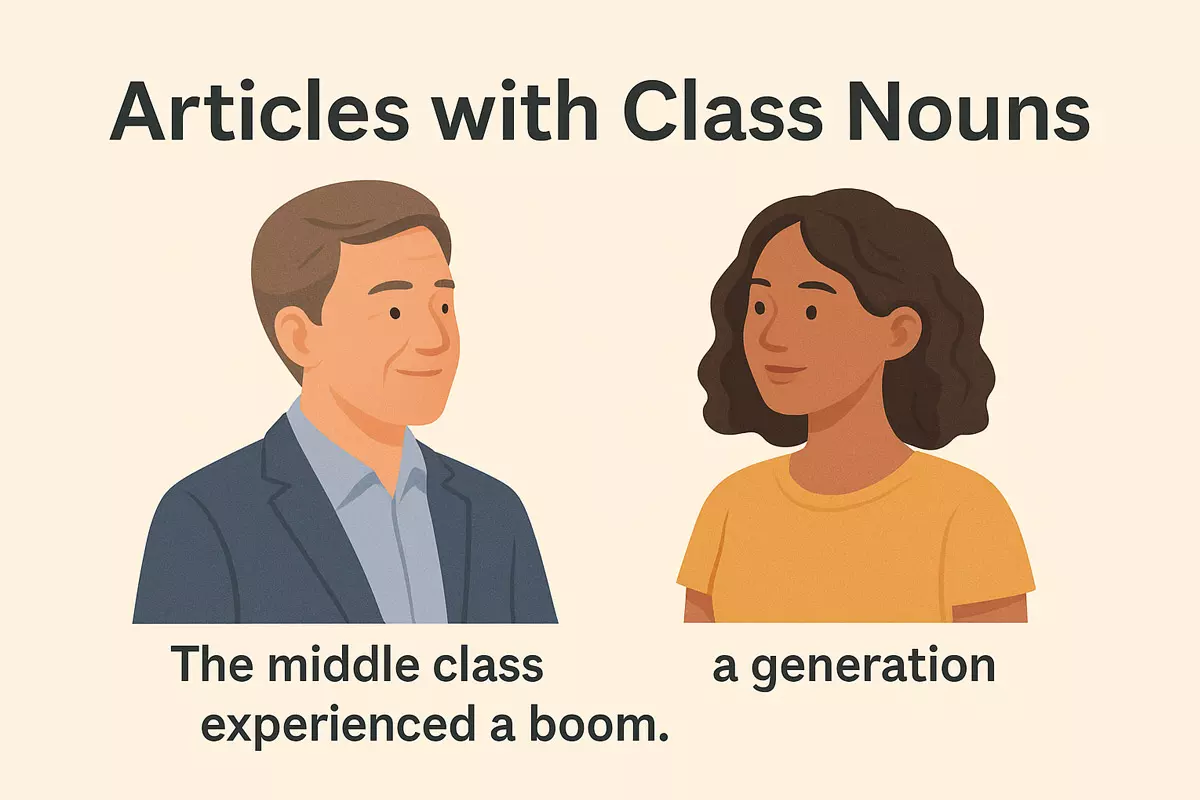
Articles with Class Nouns: the middle class, a generation

 This article explains how to use articles with class nouns like the poor and a generation. It covers when to use the, a/an, or no article for social groups, discusses political and media usage, and offers practice sentences.
Examining the use of articles with collective terms such as social groups or age cohorts uncovers subtle patterns in English that can influence meaning and clarity. By paying attention to when we use or omit articles with words like "the youth," "adolescents," or "the elderly," we can communicate more precisely about different communities or generations. Mastering these nuances not only improves our language skills but also allows us to convey ideas about various groups in society with greater accuracy and effectiveness.
What class nouns are in discourse
Class nouns are words that describe groups, categories, or sets of people or things sharing a defining characteristic. In actual usage, these nouns often refer to social groups, generations, or collective identities, such as the middle class, a generation, or the elite. Their role in communication is to organize complex realities into more manageable concepts, helping speakers and writers discuss trends, issues, or shared experiences.
Common Types of Class Nouns
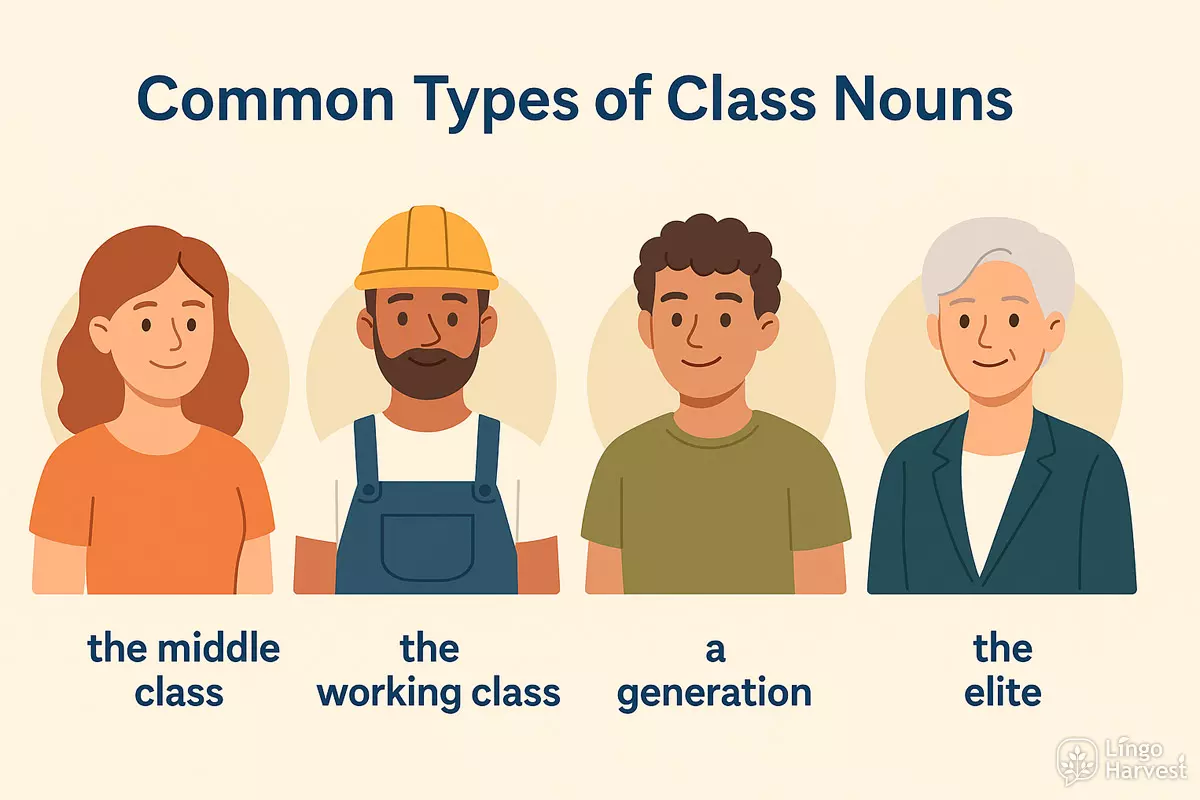
You’ll often find class nouns in discussions about society, culture, or economics. They can refer to social strata, age cohorts, professional groups, and more. Here are some frequent examples:
- the middle class
- the working class
- a generation
- the elite
- a community
- the youth
- the elderly
- the intelligentsia
- a nation
- the aristocracy
- the workforce
- a species
- the clergy
- the opposition
- the audience
- a population
- the public
- the establishment
- an age group
- the majority
How Class Nouns Function in Context
These nouns can be used with or without articles, depending on whether a specific or general meaning is intended. For example, “the middle class” refers to a recognized social group, while “a generation” could mean any generation, not necessarily a particular one. The choice of article shapes how inclusive or exclusive the reference is.
Examples from Discourse
Writers and speakers use class nouns to generalize or highlight characteristics of a group. Consider these uses:
- “The middle class is feeling the pressure of rising costs.”
- “A generation grew up with the internet.”
- “The workforce is adapting to new technologies.”
- “The elderly often face unique healthcare challenges.”
Article Usage with Class Nouns
The choice between definite, indefinite, or zero article can subtly shift meaning. Here’s a structured look at common patterns:
| Form | Typical Meaning/Example |
|---|---|
| the + class noun | Refers to a specific, recognized group e.g., the middle class means a particular social stratum |
| a + class noun | Refers to any one group of the kind, not a unique set e.g., a generation = any generation, not a specific one |
| zero article + class noun | Often used in headlines or when the noun functions almost adjectivally e.g., Middle class spending rises |
| plural class noun (no article) | Generalizes across all such groups e.g., Generations adapt differently to change |
Understanding how these collective terms function helps clarify discussions about social issues or demographic changes. Their flexible use with articles allows for nuance and precision in both spoken and written discourse.
Using the with social groups: the poor, the middle class
When referring to groups in society, English often uses "the" plus a class noun to indicate an entire category of people. This form is especially common with terms like "the poor," "the rich," "the elderly," and "the middle class." Here, "the" does not refer to a specific individual or a particular group, but to the whole group as a concept or collective.
How "the" Functions with Social Class Nouns
Adding "the" before certain nouns transforms them into collective terms representing all members of a group. For example, "the poor" means all people who are poor, not just a particular subset. This construction is widely used in both formal and informal English.
- The poor need more support from the government.
- The middle class is feeling financial pressure.
- The unemployed are seeking new opportunities.
- The young face different challenges today.
- The elderly require special care.
- The rich often have access to better healthcare.
- The working class has a long history of labor organizing.
- The disabled have unique needs in society.
- The homeless are vulnerable during winter.
- The educated tend to have higher incomes.
- The sick need adequate treatment.
- The oppressed have fought for their rights.
- The upper class lives in affluent neighborhoods.
- The marginalized often lack representation.
- The hungry rely on food banks.
- The privileged may take opportunities for granted.
- The youth are the future of any nation.
- The underprivileged require additional resources.
Common Patterns and Notes
This usage is not limited to economic classes. It can refer to age groups, health status, or other collective characteristics. In these cases, the noun is typically singular and uncountable, yet it refers to a plural group. - "The" + adjective (e.g., the young, the elderly) - "The" + noun phrase (e.g., the working class, the middle class) - Used for generalizations about groups, not specific individuals
Comparison: "The" vs. "A"
It’s important to distinguish between "the" (for collectives) and "a" (for individuals or one example). For instance, "the middle class" refers to the entire social group, while "a middle-class family" identifies a single representative.
| Collective (with "the") | Individual Example (with "a/an") |
|---|---|
| The poor face many challenges. | A poor person might struggle with healthcare costs. |
| The middle class is shrinking in many countries. | A middle-class household often owns a car. |
| The elderly benefit from community programs. | An elderly woman lives next door. |
| The unemployed need more job training. | An unemployed worker is looking for a new job. |
In summary, English uses "the" plus a class or descriptive noun for referring to broad social groups collectively. This approach highlights shared experiences or characteristics and is a key pattern for anyone aiming to write or speak about societal topics with clarity.
A/an with countable class nouns: a generation, a culture
When discussing groups or categories in English, we often use the indefinite article "a" or "an" with singular, countable class nouns. These nouns refer to a specific example or representative of a broader class, rather than the whole group as a mass. For instance, saying "a generation" means any one generation, not all generations throughout history. Similarly, "a culture" refers to one type or example of culture.
How "a" and "an" function with class nouns
The indefinite articles help generalize about members of a social or cultural group. This is especially common when talking about trends, characteristics, or experiences associated with these groups. Using "a" or "an" signals that you are talking about one instance, not the entire category.
- a generation shaped by technology
- a culture of innovation
- a community that values tradition
- a family with strong ties
- a society in transition
- a class of entrepreneurs
- a movement for change
- a nation at a crossroads
- a team with ambition
- a minority facing challenges
- a population at risk
- a tribe with unique customs
- a workforce adapting to automation
- a religion with ancient roots
- a language spoken worldwide
- a party in decline
- a club for enthusiasts
- a tradition passed down
- a style that defines an era
Choosing between "a" and "an"
Select "a" before words starting with a consonant sound, and "an" before words starting with a vowel sound:
- a generation, a tradition, a class
- an organization, an era, an idea
Contrast: Indefinite vs. Definite Article with Class Nouns
Compare how meaning shifts with the definite article ("the") versus the indefinite:
| Indefinite Article | Definite Article |
|---|---|
| a generation facing new challenges (any one generation, not specified) |
the generation born after 2000 (a specific, identified group) |
| a culture of sharing (any example of such a culture) |
the culture of Japan (one specific culture) |
| a class of artists (any group or type of artists) |
the class of 2020 (one definite, named group) |
| a family that immigrated (any single family) |
the family next door (a particular, known family) |
Zero article in generalizations about groups
When we talk about groups or classes of people in general, English often omits articles entirely. This is especially common with plural nouns that refer to whole categories or social groups, such as "students," "doctors," or "young people." In these cases, leaving out "the" or "a" signals that you mean all members of the group, not specific individuals or a defined subset. For example, compare these sentences:
- Middle-class people often value education. (general statement, zero article)
- The middle class has played a major role in history. (specific group, definite article)
- Generations differ in their attitudes toward technology. (generalization, zero article)
- A generation that grew up with the internet sees the world differently. (single, unspecified group)
When to Use Zero Article with Class Nouns
The absence of an article is typical in these situations:
- Referring to people by profession: Teachers are underpaid.
- Discussing social classes in general: Working-class families face many challenges.
- Talking about generations or age groups: Teenagers often rebel against authority.
- Describing nationalities as a group: Canadians love hockey.
- Generalizations about categories: Artists can be unpredictable.
- Types of organizations: Unions protect workers’ rights.
- Animal groupings: Lions live in prides.
- Populations by gender: Women live longer than men.
- Describing social roles: Parents worry about their children.
- Economic classes: Entrepreneurs drive innovation.
Zero Article vs. Definite Article with Class Nouns
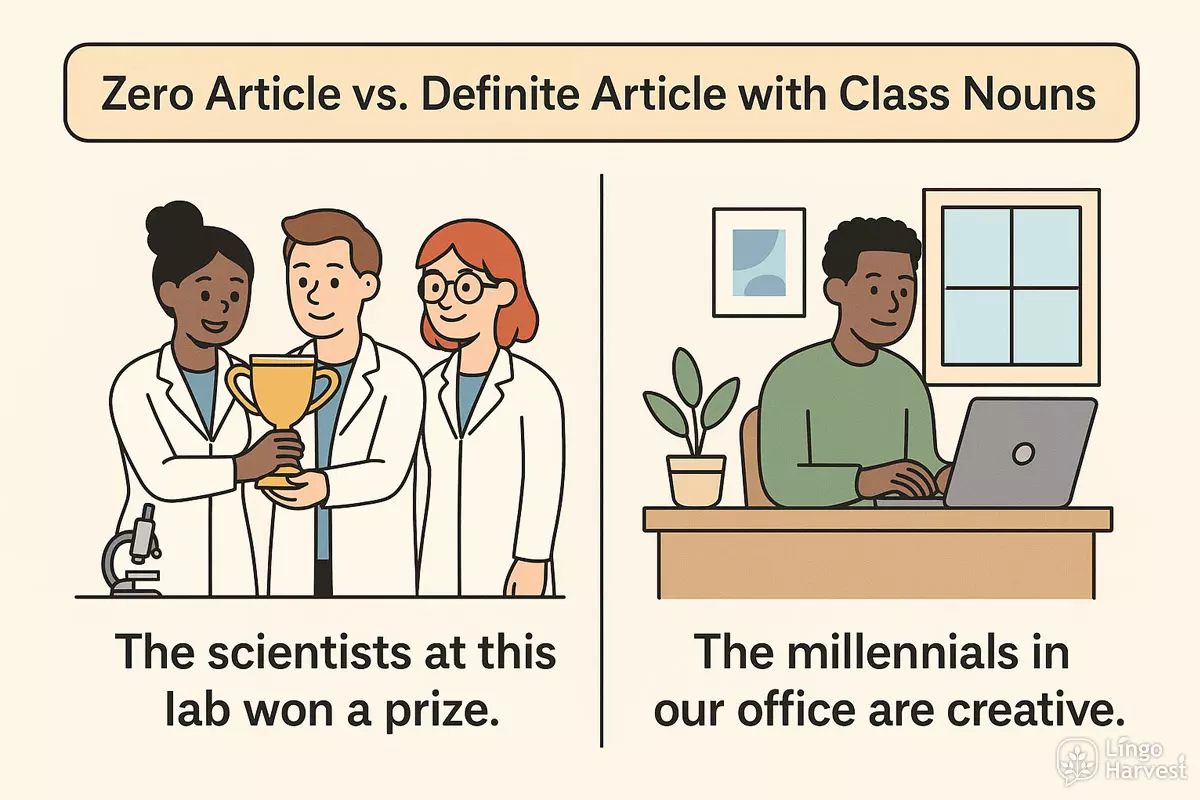
The choice between using no article and "the" changes the meaning. With "the," you refer to the class as a single, unified entity; with zero article, you speak about the members generally. Notice the distinction in these patterns:
| Zero Article (Generalization) | Definite Article (Specific group/entity) |
|---|---|
| Scientists make discoveries every day. | The scientists at this lab won a prize. |
| Millennials value flexibility. | The millennials in our office are creative. |
| Doctors save lives. | The doctors you met are specialists. |
| Artists challenge norms. | The artists at the gallery are famous. |
Understanding when to drop the article is key for expressing broad truths or trends about social groups, professions, or generations. This pattern is common in academic, journalistic, and everyday English, helping speakers convey generalizations clearly and efficiently.
Political and media uses of class nouns
Class nouns like “the middle class,” “a generation,” or “the elite” are central to political speeches, news reporting, and commentary. These terms serve as shorthand for large social groups, often used to frame issues, appeal to audiences, or simplify complex realities. By invoking such nouns, politicians and journalists can quickly evoke shared experiences, aspirations, or anxieties.
Framing and Persuasion
Writers and speakers choose class nouns to highlight particular viewpoints or to direct attention. For instance, calling a policy “beneficial to the working class” positions it as supportive of ordinary people, while referring to “the wealthy elite” may carry a negative connotation. These choices are rarely neutral; they reflect underlying attitudes, intended messages, or audience expectations.
- “The middle class is shrinking.”
- “A generation faces unprecedented challenges.”
- “The lower class suffers disproportionately.”
- “The upper class reaps the benefits.”
- “A nation divided by class.”
- “The youth are demanding change.”
- “An entire generation saddled with debt.”
- “The political elite ignore the masses.”
- “The senior generation remembers differently.”
- “A working class community hit hardest.”
- “The creative class drives innovation.”
- “A new generation enters the workforce.”
- “The ruling class resists reform.”
- “A class of entrepreneurs emerges.”
- “The immigrant community faces barriers.”
- “The next generation of leaders.”
Definite and Indefinite Articles in Context
Article choice (the/a/an) with class nouns shapes meaning. Using “the” suggests a specific, known group—often with collective traits. “A” or “an” introduces one among many, or a new, previously unmentioned group. In headlines and broadcasts, the definite article is common for groups seen as established or widely recognized, while the indefinite article adds nuance or generality.
| Pattern | Typical Media Example |
|---|---|
| The + class noun | The middle class demands relief |
| A + class noun | A generation struggles with student debt |
| The + adjective + class noun | The rising creative class shapes cities |
| A + descriptive phrase + class noun | A new class of voters emerges |
Implications and Reception
Using class nouns can foster solidarity or deepen divisions, depending on context and intent. Media outlets might choose “the working class” to express empathy, or “the elite” to critique. These choices influence public perception, turning abstract groups into concrete actors in political and cultural narratives. In summary, the strategic use of class-based terms and their articles is a powerful tool for shaping discourse, influencing opinion, and defining group identities in public life.
Practice: write sentences using class nouns with correct articles
Understanding how to use articles with class nouns like "the middle class" or "a generation" is essential for precise communication. Class nouns often refer to groups or categories, and the choice of article ("the," "a," or none) can change the meaning. Below, you'll find a range of practice activities to help you master these patterns.
Choose the correct article
Read each sentence and decide which article fits best—"a," "the," or no article at all. Write your answer in the blank.
- ________ elderly often require special care and attention.
- He is part of ________ generation that grew up with the internet.
- ________ working class has faced many challenges in recent decades.
- It’s common for ________ family to have both parents working.
- ________ youth is full of energy and potential.
- She belongs to ________ upper class.
- ________ society is constantly changing.
- He dreams of joining ________ middle class.
- ________ government must address the needs of all citizens.
- It was ________ era of rapid technological change.
Show answers
- The elderly
- a generation
- The working class
- a family
- Youth
- the upper class
- Society
- the middle class
- The government
- an era
Expand your vocabulary: Common class nouns with articles
Here are some class nouns frequently used with definite or indefinite articles. Notice how the choice of article can change the meaning or refer to a specific group versus a general idea.
- the middle class
- a generation
- the working class
- the upper class
- the lower class
- a society
- the government
- an era
- a nation
- the elderly
- the youth
- a community
- the population
- the public
- a family
- the elite
- the poor
- the rich
- the military
- a tribe
Writing task: Create your own sentences
Practice by writing original sentences using the class nouns above. Make sure to use appropriate articles. Try to vary your sentence structure and context.
- Example: The middle class is shrinking in some countries.
- Example: A generation of students is entering the workforce.
Write at least five sentences of your own using different class nouns and correct articles.
Show answers
- The elderly need better access to healthcare.
- A nation must invest in education to thrive.
- The elite often have different priorities from the general public.
- The working class struggles with rising costs.
- A community can make a big difference through volunteer work.