Most vs Majority: Understanding Quantity vs Proportion

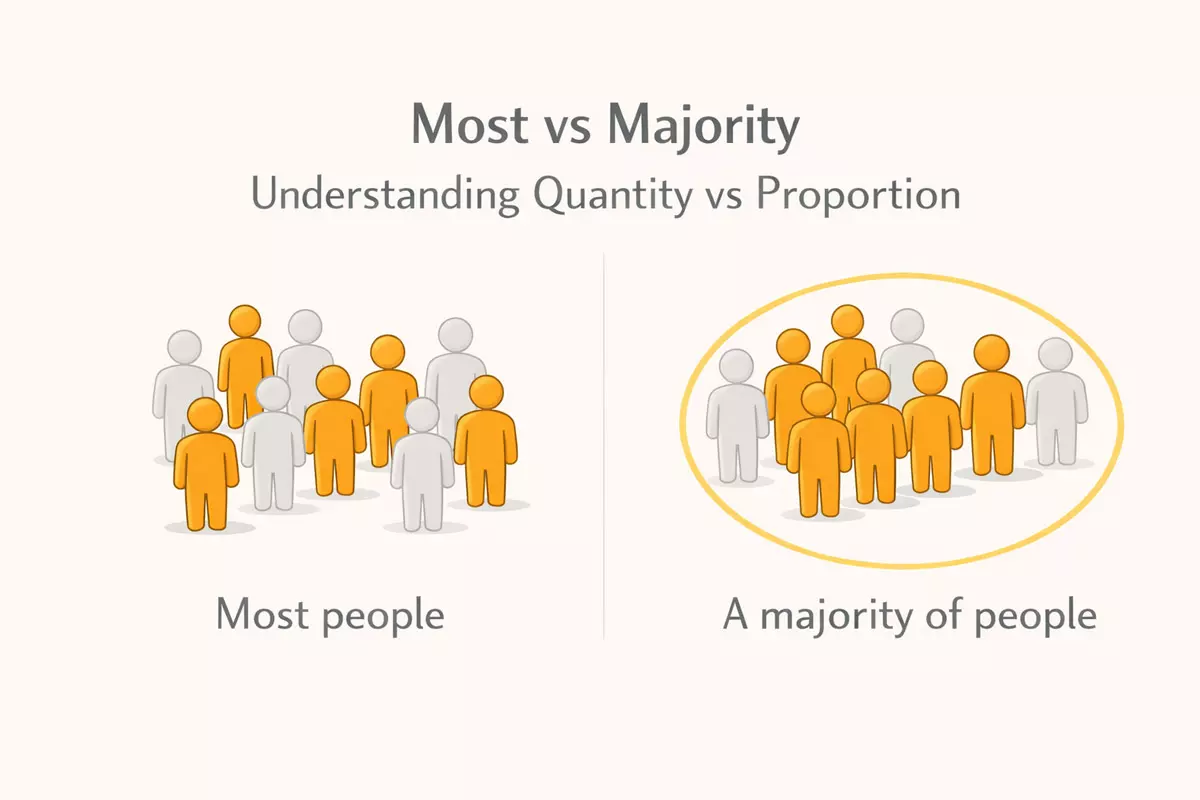 Here we the difference between grammatical quantifiers and noun forms, explains how most and majority are used with nouns and verbs, highlights contexts where they can't be substituted, and provides examples and practice to avoid common mistakes.
- Difference between grammatical quantifier and noun form
- How most expresses general quantity
- How majority expresses proportion within a group
- Use with countable and uncountable nouns
- Verb agreement and sentence structure
- Contexts where substitution is not possible
- Common learner mistakes and misinterpretations
- Examples comparing natural usage
- Practice: choosing most or majority correctly
Distinguishing between words that refer to quantity and those that indicate proportion is important for clear communication, especially when counting people or things. For example, terms like "many" or "numerous" suggest a large number but do not specify whether it is more than half, while expressions such as "most" or "the majority" clearly indicate that more than half are involved. Using the correct term helps ensure your statements are both accurate and easily understood by your audience.
Difference between grammatical quantifier and noun form
In English, words like most and majority both express ideas about quantity, but they play different grammatical roles. Understanding how these terms function in sentences helps avoid ambiguity and awkwardness, especially when discussing numbers, proportions, or groups.
Quantifier: How "most" works in grammar
"Most" acts as a quantifier. This means it modifies nouns directly, indicating a large portion or the greater part of something. It does not stand alone as a subject or object; instead, it tells us how much or how many of a noun we're talking about. For example:
- Most people agree with the decision.
- Most of the cake was eaten.
- Most students passed the exam.
Notice how "most" comes before the noun or noun phrase and directly quantifies it.
Noun form: The role of "majority"

By contrast, "majority" is a noun. It refers to the greater part or more than half of a group, but it generally requires a prepositional phrase ("of...") or a definite article ("the") to clarify what group is being discussed. For example:
- The majority of people agree with the decision.
- A majority of the cake was eaten.
- The majority of students passed the exam.
Here, "majority" functions as the subject or object, and the actual group is specified with "of."
Key distinctions at a glance
| Grammatical Role | Example Usage |
|---|---|
| Quantifier ("most") | Most birds migrate in winter. |
| Noun ("majority") | The majority of birds migrate in winter. |
| Placement | Quantifier comes before the noun; noun form uses "of" + group. |
| Formality | "Most" is more common in everyday speech; "majority" is often found in formal or statistical writing. |
Summary: When to use each
If you want to quickly express a large, indefinite portion of a group, especially in conversation, use "most" as a quantifier. For more formal contexts, or when you need to emphasize a mathematical or statistical sense of "more than half," "majority" as a noun is often more precise. Choosing between these forms depends on your sentence structure and the tone you want to convey.
How most expresses general quantity
When speakers use most, they're referring to a large, unspecified portion of a group or category—typically more than half, but without precise measurement. Unlike terms that specify a strict proportion, most signals a general sense of "the greater part" or "almost all," but allows for some exceptions. This makes it especially useful in everyday speech and writing when exact numbers are unknown or unimportant.
Typical ways "most" is used to convey general quantity
- General statements: "Most people enjoy music."
- Describing habits: "Most birds migrate during winter."
- Expressing trends: "Most cars today are fuel-efficient."
- Talking about preferences: "Most kids prefer ice cream over vegetables."
- Referring to frequency: "Most days, I walk to work."
- Describing majority experiences: "Most students passed the exam."
- Implying widespread presence: "Most shops are closed on Sundays."
- Summarizing survey data (informally): "Most respondents agreed with the statement."
- Generalizing from observation: "Most cats dislike water."
- Describing typical outcomes: "Most attempts succeed on the first try."
Comparing "most" with precise quantifiers
While most communicates a broad sense of quantity, it's less exact than words like "majority" or specific percentages. The term is flexible, allowing for nuance and context, and often appears in conversation, journalism, and informal analysis.
| Expression | How much is implied? |
|---|---|
| Most | More than half, but not necessarily a specific proportion; can mean "almost all" or simply "the greater part" |
| Majority | Strictly more than 50%, often used for votes or countable groups |
| Almost all | Very close to 100%, but not every single instance |
| Some | An unspecified, smaller portion; less than half implied |
| Many | A large number, but not necessarily more than half |
In summary, "most" is a practical way to refer to a dominant but indefinite quantity. Its flexibility makes it suited for generalizations, trends, and observations where precision is less important than conveying a broad pattern.
How majority expresses proportion within a group
When we talk about a “majority,” we’re focusing on the idea that more than half of a group shares a particular characteristic or viewpoint. This term doesn’t give an exact number, but it always signals that over 50% of the members fall into the specified category. Unlike words like “most,” which can sometimes be interpreted more loosely, “majority” is precise in its threshold: it indicates more than half, but not necessarily all.
Understanding the threshold
To clarify, “majority” starts at just over 50%. If a group has 100 members, the smallest majority possible is 51. This concept holds regardless of group size, whether it’s a small committee or an entire population. It’s about proportional representation, not absolute figures.
Common contexts for using “majority”
You’ll often see the term in voting, decision-making, and statistical summaries. For example, a “simple majority” means more than half, while a “supermajority” might require a higher percentage, such as two-thirds.
- In elections: “The candidate won by a majority of votes.”
- In surveys: “A majority of respondents preferred option A.”
- In legislative bodies: “A bill passes with a majority vote.”
- In committees: “A majority of members agreed to the proposal.”
- In statistical reports: “The majority of incidents occurred in July.”
- For organizational decisions: “A majority must approve changes.”
- During meetings: “The motion carried by majority.”
- In group projects: “A majority contributed to the final report.”
- In demographic studies: “The majority of the population lives in urban areas.”
- In social research: “A majority identified as being in favor of the policy.”
Majority vs. minority
The concept is always relative. If 60% of a group supports something, they form the majority; the other 40% make up the minority. This split is crucial in democratic processes and group decisions, as it determines outcomes and directions.
Comparing “majority” to “most”
While “majority” is strictly more than half, “most” can sometimes suggest a larger, less defined portion. For instance, “most people” might mean 70% or 80%, but “majority” could be as slim as 51%. This distinction is important for clarity in formal contexts.
| Term | Proportion Indicated | Example Usage |
|---|---|---|
| Majority | More than 50% | “A majority of voters supported the amendment.” |
| Supermajority | Usually 67% or 75% | “A supermajority is needed to amend the constitution.” |
| Plurality | Largest share, but not necessarily over 50% | “The candidate won a plurality, but not a majority.” |
| Most | Largest part, often not precisely defined | “Most employees arrived on time.” |
In summary, “majority” expresses a clear, mathematical proportion: more than half of a defined group. This precision is why it’s favored in formal rules, voting, and statistics, where every percentage point can matter.
Use with countable and uncountable nouns
When discussing quantities in English, the choice between "most" and "majority" often depends on whether the noun you’re talking about is countable (like "books" or "students") or uncountable (like "water" or "information"). Understanding this distinction helps you sound more natural and precise.
How "most" works
Most is flexible: it can describe both countable and uncountable nouns. You might say, "Most people agree," or "Most information is available online." It doesn’t matter whether the thing being measured is singular or plural, as long as you’re referring to the largest part or amount.
- Most dogs love to play. (countable)
- Most sugar dissolves quickly. (uncountable)
- Most advice was helpful. (uncountable)
- Most students finished early. (countable)
- Most homework is easy. (uncountable)
- Most water evaporated. (uncountable)
- Most cars are fuel-efficient. (countable)
- Most bread is fresh. (uncountable)
- Most ideas are interesting. (countable)
- Most equipment is expensive. (uncountable)
How "majority" works
Majority is used almost exclusively with countable nouns, especially when talking about people or things that can be counted as individual units. For example, you’d say "the majority of voters supported the proposal," but not "the majority of water evaporated." When using "majority," it’s common to follow it with "of" plus a plural noun.
- The majority of students passed the test. (countable)
- The majority of apples were ripe. (countable)
- The majority of employees agreed. (countable)
- The majority of books are fiction. (countable)
- The majority of birds migrate south. (countable)
- The majority of members voted yes. (countable)
- The majority of cities have parks. (countable)
- The majority of answers were correct. (countable)
Using "majority" with uncountable nouns is almost always incorrect: ❌ "the majority of information" or "the majority of water" is not standard English. In those cases, "most" is the right word.
| Expression | Works with countable or uncountable nouns? |
|---|---|
| Most + plural countable noun | ✅ (e.g., Most cats...) |
| Most + uncountable noun | ✅ (e.g., Most water...) |
| The majority of + plural countable noun | ✅ (e.g., The majority of students...) |
| The majority of + uncountable noun | ❌ (not standard, e.g., The majority of information...) |
In summary, "most" is generally the safer and more versatile choice, working with both types of nouns, while "majority" is reserved for countable, usually plural, subjects. If you’re unsure which to use, consider whether you can count the noun—if not, "most" is almost always correct.
Verb agreement and sentence structure

The way you use "most" and "majority" in sentences affects which verbs you choose and how you structure your statements. Both expressions refer to large quantities, but their grammatical roles and preferred constructions differ. Understanding these distinctions helps your writing remain clear and grammatically correct.
How "most" fits into sentences
"Most" is typically used as a determiner or pronoun, often followed by a plural noun or an uncountable noun. When "most" refers to countable plural nouns, use a plural verb. With uncountable nouns, pair it with a singular verb.
- Most students are present.
- Most of the information is accurate.
- Most water contains minerals.
- Most teachers prefer quiet classrooms.
- Most of the cake was eaten.
Using "majority" correctly
"Majority" is a singular noun and is often followed by "of" plus a plural noun. The verb agreement depends on whether you treat "majority" as a group acting as one (singular) or as individuals within the group (plural). In everyday English, the singular is more common, especially in formal writing.
- The majority of voters is in favor. (formal, singular group)
- The majority of students are working on their projects. (focus on individuals)
- The majority decides the outcome.
- The majority of the milk has been consumed.
- A majority was achieved.
Common patterns and pitfalls
Writers sometimes confuse which verb form to use after these terms. Here’s a handy comparison of typical sentence structures:
| Expression | Example Sentence |
|---|---|
| Most + plural noun | Most employees work remotely. |
| Most + uncountable noun | Most furniture is expensive. |
| The majority of + plural noun | The majority of birds are migratory. |
| The majority + singular verb | The majority agrees on the proposal. |
| The majority + plural verb (informal) | The majority of participants have finished. |
Quick guidelines
- Use a plural verb with "most" and plural nouns.
- Pair "most" with a singular verb for uncountable nouns.
- "Majority" is singular, but context may allow a plural verb when focusing on individuals.
- Check whether you’re emphasizing the group as a whole or its members when choosing your verb.
- Be consistent within your sentence structure for clarity.
Mastering these patterns will make your writing about quantities and proportions more precise and natural.
Contexts where substitution is not possible
There are situations where “most” and “majority” cannot be swapped without changing the meaning or making the sentence ungrammatical. This often comes down to the difference between quantity (most) and strict proportion (majority), as well as the specific grammatical patterns each word allows.
Grammatical Limitations
“Most” can function as a determiner before nouns (“most people”), while “majority” nearly always requires the definite article and a prepositional phrase (“the majority of people”). Attempting to interchange them directly often results in awkward or incorrect sentences.
- “Most” can be used without “of” before plural or uncountable nouns: Most students enjoy the class.
- “Majority” needs “the” and “of”: The majority of students enjoy the class.
- “Majority” cannot directly modify a noun: ❌ Majority students (incorrect)
- “Most” can modify adjectives or adverbs: Most interestingly, the results were clear. (not possible with “majority”)
- “Majority” is used only with countable groups or sets, not with uncountable nouns: ❌ The majority of water (incorrect)
Semantic Boundaries
There are also cases where only one term fits the context due to its meaning:
- When referring to a vague or general large part, “most” is preferred: Most advice is helpful.
- For formal votes or statistics, “majority” is required: The law passed by a simple majority.
- “Most” can express superlative degree: She is the most talented musician.
- “Majority” cannot be used for superlatives.
- With percentages: “majority” often means over 50%, but “most” can be used even if the exact proportion isn’t specified.
Common Usage Patterns
| “Most” Usage | “Majority” Usage |
|---|---|
| Most people agree. ✅ | The majority of people agree. ✅ |
| Most water evaporated. ✅ | The majority of water evaporated. ❌ |
| Most talented student. ✅ | Majority talented student. ❌ |
| Most importantly, we learned a lot. ✅ | Majority importantly, we learned a lot. ❌ |
In summary, “most” and “majority” are not interchangeable in cases involving uncountable nouns, superlatives, adverbial use, or when grammatical structure requires a specific form. Recognizing these boundaries helps avoid awkward or incorrect phrasing.
Common learner mistakes and misinterpretations
A frequent challenge for English learners is distinguishing when to use "most" versus "majority." The confusion often arises because both words relate to quantities, but they function differently in terms of grammar and meaning. Let’s break down the typical pitfalls and misunderstandings that can occur.
Mixing up meaning: quantity vs. proportion
One of the most widespread issues is thinking that "most" and "majority" are always interchangeable. While both refer to more than half, "most" often means the largest portion in a general sense, whereas "majority" specifically refers to more than 50% of a defined group. This subtlety can lead to inaccurate statements, especially in formal or statistical contexts.
Common errors in usage
- Using "majority" with uncountable nouns: Incorrect: The majority of water is clean. ❌
- Applying "most" when precise numbers are needed: Incorrect: Most of the voters (when the exact percentage is relevant).
- Assuming "majority" always implies a large difference: Sometimes, a majority can be just over half.
- Forgetting the article "the" before "majority": Incorrect: Majority of people think... ❌
- Using "majority" in casual speech where "most" is more natural: Incorrect: The majority of my friends like pizza (instead of "Most of my friends...").
- Confusing "most" with "almost all": "Most" does not necessarily mean "almost everyone/everything."
- Overusing "majority" to sound formal: This can make writing sound awkward or unnatural.
- Neglecting subject-verb agreement: "The majority is/are..." (depends on whether you mean the group as a whole or the individuals).
- Using "majority" with plural verbs incorrectly: Incorrect: The majority are happy (when referring to the group as a single entity).
- Misplacing "of" after "most": Incorrect: Most of people enjoy music. ❌
Side-by-side comparison of correct contexts
| Expression | Typical Correct Usage |
|---|---|
| Most | Can be used with both countable and uncountable nouns. E.g., Most people agree. Most water is clean. |
| The majority | Only with countable, plural nouns, usually referring to members of a defined group. E.g., The majority of students passed. |
| Most of | Used before pronouns, demonstratives, or definite articles. E.g., Most of the cake is gone. Most of them arrived. |
| The majority of | Used before plural countable nouns. E.g., The majority of employees support the change. |
Misinterpretations in context
A subtle misunderstanding occurs when learners read or hear statistics. For example, "the majority of respondents" might be only 51%, but "most respondents" could feel like a much larger proportion. In academic or legal writing, this distinction matters, as "majority" is a technical term, while "most" is more flexible.
To sum up, being aware of the differences in usage and meaning can help avoid awkward or misleading statements. Paying close attention to the noun type, context, and formality will make your sentences both accurate and natural.
Examples comparing natural usage
Understanding how "most" and "majority" are used in real sentences helps clarify the subtle differences between them. Both terms refer to large amounts, but their application in natural language varies depending on context, formality, and the structure of the group being described. Below, you'll find illustrative sentences and a structured comparison to highlight these nuances.
Common Patterns in Sentences
- Most is often used informally and can refer to an unspecified large portion: Most people like ice cream.
- Majority typically appears in more formal or technical contexts, often with "the": The majority of voters supported the proposal.
- "Most" can stand alone as a determiner, while "majority" usually needs "the" and "of": Most birds migrate south. vs. The majority of birds migrate south.
- Majority emphasizes a countable, often measurable, proportion; "most" is vaguer and may not imply more than half in casual speech.
- Negative forms differ: Most people didn’t agree. vs. A minority disagreed.
- Plural vs. singular verbs: Most of the team is/are… (both possible, depending on dialect); The majority is… (singular verb preferred).
- "Most" can describe qualities: Most delicious cake; "majority" cannot.
- With percentages, "majority" is clearer: The majority (65%) voted yes.
- For emphasis, "overwhelming majority" is common, but "overwhelming most" is ungrammatical.
- In questions, "most" is more natural: Do most students pass? vs. Does the majority of students pass?
- "Majority" is rarely used without "of": The majority of respondents…
- For uncountable nouns: Most water evaporates. "Majority" is not used with uncountables.
- In headlines: Most approve new law (informal); Majority backs new law (more formal).
- Legal and official contexts prefer "majority": The majority required to pass the bill…
- "Most" can refer to frequency: I visit most weekends. "Majority" cannot.
Side-by-Side Comparison
| Sentence Using "Most" | Equivalent with "Majority" |
|---|---|
| Most employees arrived early. | The majority of employees arrived early. |
| Most of the cake was eaten. | The majority of the cake was eaten. ❌ (awkward/uncommon) |
| Most children like cartoons. | The majority of children like cartoons. |
| Most advice is helpful. | The majority of advice is helpful. ❌ (not natural) |
| Most weekends are quiet. | A majority of weekends are quiet. ❌ (rarely used) |
| Most voted in favor. | The majority voted in favor. |
| Do most people agree? | Does the majority of people agree? |
| Most of us have been there. | The majority of us have been there. |
These examples show that while both expressions can sometimes be swapped, "most" is more flexible and informal, and "majority" is more restricted and formal. The choice depends on what you want to emphasize: an undefined large portion, or a specific, countable proportion.
Practice: choosing most or majority correctly
Understanding the difference between “most” and “majority” can be tricky. Try the exercises below to reinforce your grasp of which term to use, and why. Remember: “most” often refers to the greatest number or amount (not always more than half), while “majority” specifically means more than 50% of a group.
Quick identification practice
Read each sentence and decide which word fits best: “most” or “majority.”
- ________ of the students arrived before 8 AM.
- The __________ of the committee members voted in favor of the proposal.
- ________ people prefer coffee over tea in this office, but not everyone.
- The __________ of respondents selected option C, so it was implemented.
- ________ of my friends enjoy hiking, although a few dislike it.
- The __________ of the population is under 30 years old.
- ________ cakes at the bakery are sold before noon.
- The __________ of tickets were purchased online.
- ________ employees agreed with the new policy.
- The __________ of voters supported the reform.
- ________ customers choose the basic plan.
- The __________ of participants completed the survey.
Show answers
- Most
- Majority
- Most
- Majority
- Most
- Majority
- Most
- Majority
- Most
- Majority
- Most
- Majority
Common usage patterns
Here are some typical contexts where each term is preferred. Review these to solidify your understanding.
- “Most” is often used with uncountable nouns or in general statements: Most water is safe to drink here.
- “Majority” is reserved for groups where a countable, more-than-half share is clear: The majority of voters supported the new law.
- “Most” can mean the largest portion, but not necessarily over half: Most of my socks are blue (but not all, and possibly not over 50%).
- “Majority” always means over 50%: The majority of the class passed the exam (more than half).
- “Most” is rarely followed by “of the people who…” but “majority” commonly is: The majority of the people who responded…
- “Majority” is usually followed by “of” + a definite group: the majority of employees.
- “Most” can stand alone: Most agree.
- “Majority” almost never stands alone: you need to specify the group.
- “Most” is more flexible in informal speech and writing.
- Use “majority” when you want to emphasize a numerical threshold has been crossed.
Comparison table: choosing the right term
- ________ of the apples were eaten by lunchtime.
- The __________ of board members approved the merger.
- ________ of the information was outdated.
- The __________ of survey responses favored option A.
- ________ of the time, the bus runs late.
- The __________ of votes were cast in person.
- ________ of her advice was helpful.
- The __________ of attendees left early.
- ________ of the students passed the final exam.
- The __________ of residents support the new policy.
- ________ of the work was completed ahead of schedule.
- The __________ of applications were submitted online.
Show answers
- Most
- Majority
- Most
- Majority
- Most
- Majority
- Most
- Majority
- Most
- Majority
- Most
- Majority
Tips for real-world usage
- When talking about a proportion over half of a specific, countable group, consider “majority.”
- For less specific, largest-share statements, “most” is generally better.
- Avoid using “majority” with uncountable nouns or when the group isn’t clear.
- If you’re unsure whether the amount is over 50%, use “most.”