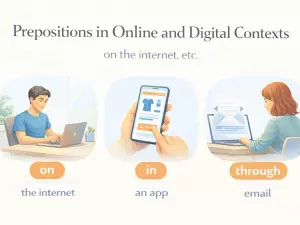
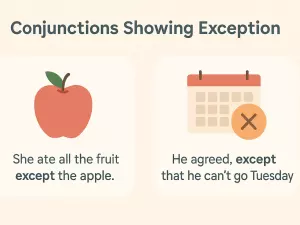
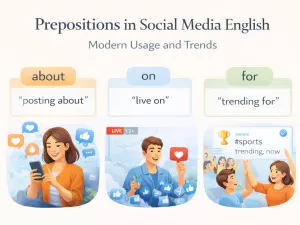
Articles with Media and Technology: on the radio, on the internet

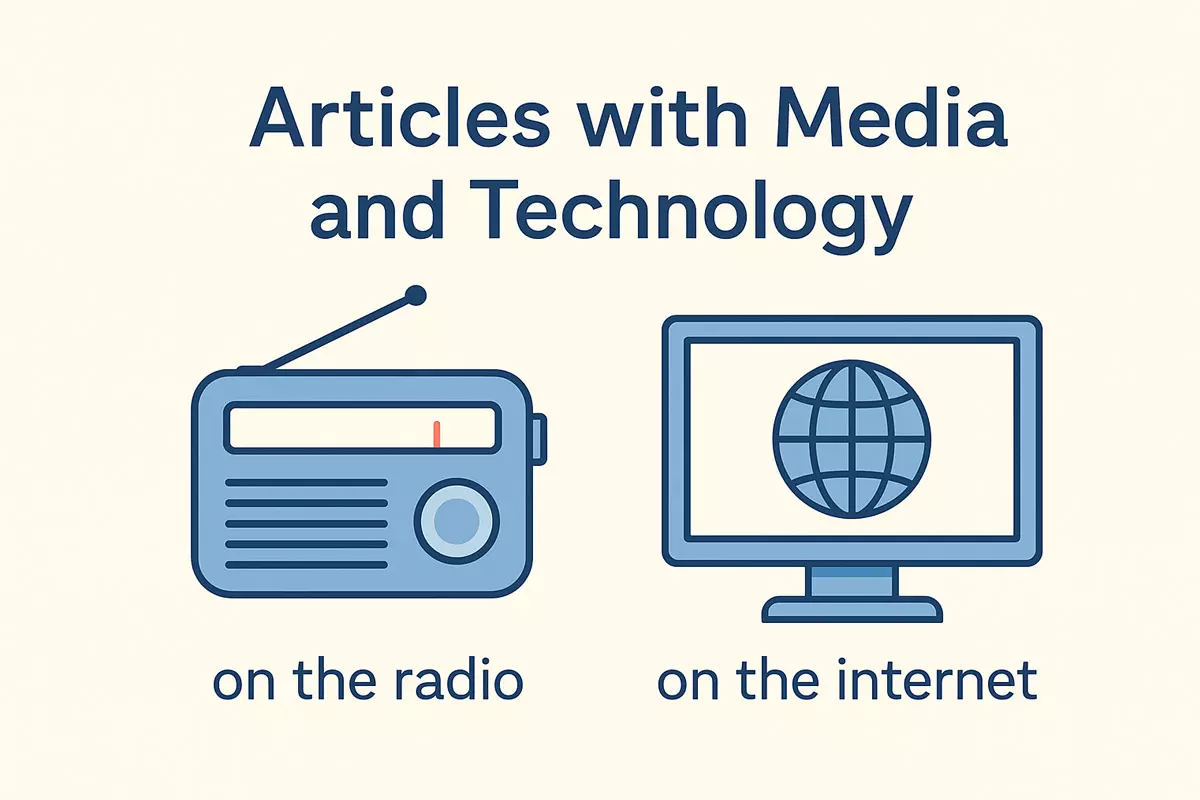 This article explains when to use or omit articles with media terms like on the radio, on television, and on the internet. It covers new versus old media usage, special tech nouns, common mistakes, and includes practice sentences.
Accessing information and entertainment has changed significantly, moving from traditional live radio broadcasts to a wide range of digital platforms. This evolution reflects how media consumption habits adapt to new technologies, with audiences now able to engage with content anytime and anywhere. Examining how articles and stories circulate across both classic radio and modern online spaces highlights the dynamic relationship between established and emerging forms of media, illustrating broader trends in how people seek and share information today.
Fixed expressions: on the radio, on television, on the internet
Some English phrases have become standard when referring to different forms of media and technology. For example, native speakers always say on the radio, on television, and on the internet, rather than using other prepositions. These set expressions do not follow the usual rules for articles and prepositions, and using them correctly helps your English sound more natural.
How these expressions are used
When talking about listening, watching, or finding something via broadcast or digital media, English consistently uses the preposition on without an article (except for "on the radio" and "on the internet," which take "the"). For instance, we say, "I heard the news on the radio," not "in the radio" or "at the radio." Similarly, "I saw it on television" is preferred over "in television."
Common fixed media and technology phrases
- on the radio → She heard the interview on the radio.
- on television → The documentary was shown on television.
- on TV → I watched the match on TV.
- on the internet → He found the article on the internet.
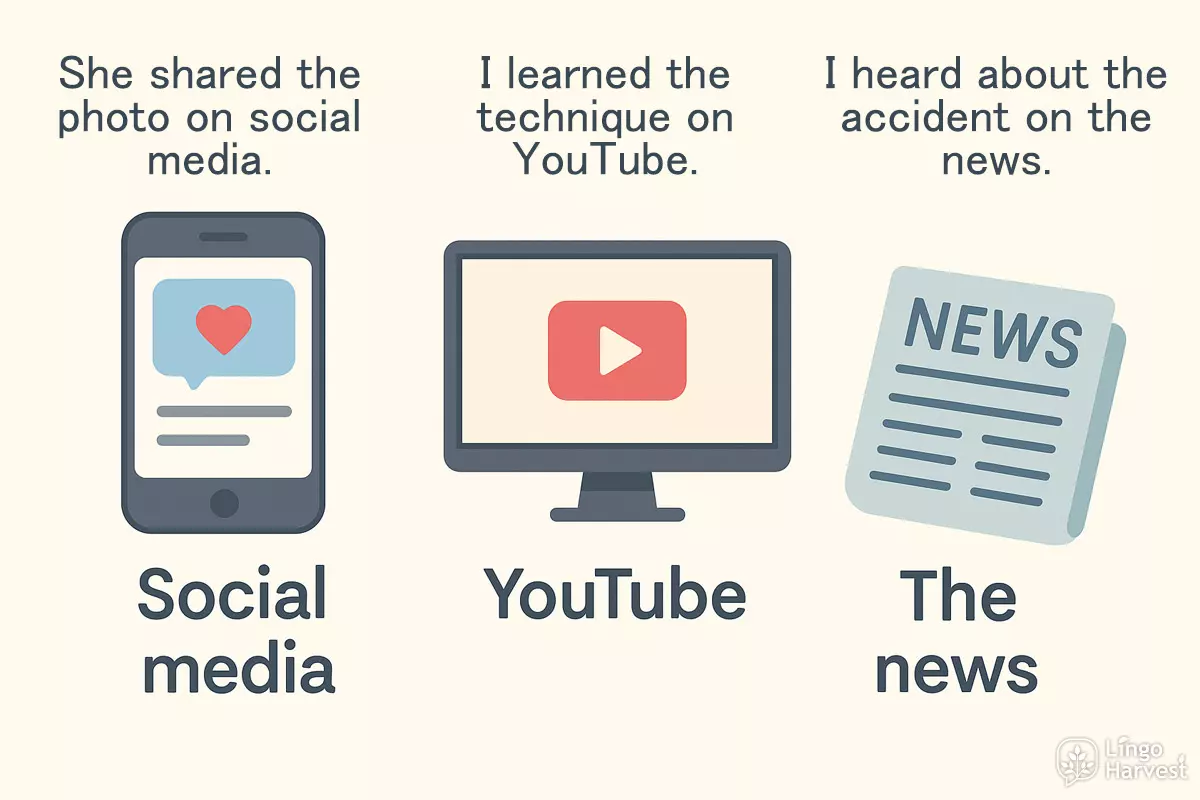
- on social media → She shared the photo on social media.
- on YouTube → I learned the technique on YouTube.
- on the news → I heard about the accident on the news.
- on a website → The instructions are available on a website.
- on a podcast → I heard an interview on a podcast.
- on the phone → She spoke to her manager on the phone.
- on the screen → The message appeared on the screen.
- on air → The show is live on air right now.
- on a call → We discussed the issue on a call.
- on Zoom → The class meets every Monday on Zoom.
- on Skype → We talked for an hour on Skype.
- on a channel → The series airs on a channel you probably know.
- on a streaming service → The film is available on a streaming service.
- on the front page → The story appeared on the front page.
Exceptions and patterns
Notice that some expressions use "the" (on the radio, on the internet), while others do not (on television, on YouTube). This is mostly due to convention rather than strict grammar rules. For specific websites or platforms, the article is usually dropped: "on Facebook," "on Twitter," "on Instagram."
Comparison of common prepositions with media
| Medium | Correct Expression ✅ | Incorrect Example ❌ |
|---|---|---|
| Radio | on the radio | in the radio |
| Television | on television / on TV | in the television |
| Internet | on the internet | in the internet |
| Phone | on the phone | in the phone |
| Website | on a website | in a website |
| Social media | on social media | in social media |
Quick tips for using these phrases
- Always use on for media platforms and broadcasts.
- Add "the" for "radio" and "internet," but not for specific platforms like "YouTube" or "Facebook."
- Practice with real-life sentences: "I read it on the internet," "She appeared on television," "We talked on the phone."
When media terms take zero article
Some words related to media and technology are used without "the," "a," or "an." This often happens when we talk about media in a general sense or refer to certain platforms and formats as concepts, rather than specific instances. For example, we say "watch TV" or "listen to radio" in some contexts, dropping the article entirely. This can feel unnatural for learners who expect every noun to need an article.
Common media terms that usually have zero article
Many media and technology terms follow this pattern, especially in idiomatic phrases. Here are some frequent cases:
- watch TV
- listen to radio (mainly in British English)
- read newspapers (when referring generally)
- read magazines
- use email
- surf internet (rare, but possible in informal speech)
- download software
- play video games
- stream music
- watch movies
- post on social media
- watch news (when talking generally: "I watch news every morning")
- publish content
- access websites
- visit forums
- read blogs
- join chat rooms
- check notifications
Zero article vs. definite/indefinite article
The absence of an article often depends on whether you mean something in general or something specific. For instance, "I listen to radio" (general medium) versus "I listen to the radio" (a specific device or station). Here's how the choice changes meaning:
| Form | Meaning / Usage |
|---|---|
| listen to radio | General medium (especially British English); the activity itself. |
| listen to the radio | Specific device, station, or broadcast; more common in American English. |
| watch TV | General activity of viewing television as a medium. |
| watch the TV | Refers to a particular television set (physical object). |
| use email | Email as a system or technology; general use. |
| use the email | A specific email message or account. |
When to avoid the zero article
Articles are needed when you refer to a specific item, message, or instance. For example, "I read the newspaper" means one particular newspaper, possibly today's edition. Similarly, "I posted a message on the forum" points to one message, not the concept of posting. Understanding these patterns helps with natural-sounding English, especially when discussing technology and media in everyday conversation. Pay attention to context to decide whether to include an article, and remember that idiomatic expressions often break the standard rules.
New vs old media: usage trends and variation
Media consumption habits have shifted dramatically in recent decades, with digital platforms steadily eclipsing traditional sources like radio and print. People now rely on a blend of classic and emerging channels for news, entertainment, and communication, but the balance between them varies widely by age, region, and personal preference. Understanding these evolving patterns helps explain why certain formats remain resilient while others transform or decline.
Shifts in Media Preferences
While radio, television, and newspapers once dominated, the rise of the internet, podcasts, and streaming services has diversified how audiences engage with content. Some notable trends include:
- Streaming audio and video overtaking live broadcasts in many demographics
- Podcasts providing on-demand talk and news, rivaling traditional radio shows
- Social media platforms becoming primary sources for breaking news and viral stories
- Print newspapers experiencing a steady decline in circulation
- Radio maintaining popularity in cars and certain regions, especially for local content
- On-demand access replacing fixed schedules for many listeners and viewers
- Mobile devices becoming the main gateway for internet-based media
- Algorithm-driven recommendations shaping what content people encounter
- Interactive and participatory formats (comments, live chats) engaging audiences in new ways
- Generational divides: older adults often stick with familiar formats, while younger users gravitate toward digital-first options
Comparing Old and New Media Forms
| Traditional Media | Digital Media | Key Differences |
|---|---|---|
| Radio broadcasts | Podcasts, streaming audio |
|
| Print newspapers | News websites, social feeds |
|
| Television | Streaming video, YouTube |
|
| Magazines | Blogs, digital magazines |
|
Variation Across Audiences
Access to technology, cultural habits, and personal interests all shape how people use different forms of media. For instance, rural areas may still favor radio due to limited internet coverage, while urban youth typically adopt the latest digital services first. Accessibility features and language options also influence which platforms are most inclusive and widely used. As technology continues to evolve, these patterns are likely to keep shifting, with hybrid models and new formats emerging to meet diverse needs.
Technology nouns that behave like proper names
Some words for media and technology act differently from typical common nouns. In English, we sometimes treat certain devices, platforms, or networks almost like unique entities. This means we use them without an article (“the,” “a,” or “an”)—similar to how we refer to personal names or countries. Understanding which terms follow this pattern helps you sound more natural and avoid common mistakes.
Common examples of technology nouns used without articles
- radio → She heard the news on radio.
- television → The interview was broadcast on television.
- Skype → We talked for an hour on Skype.
- Zoom → The class meets weekly on Zoom.
- WhatsApp → Send me the details on WhatsApp.
- Messenger → I’ll message you on Messenger.
- Facebook → She posted the update on Facebook.
- YouTube → I found the tutorial on YouTube.
- Twitter → He shared his opinion on Twitter.
- Netflix → We watched the series on Netflix.
- Instagram → She uploaded new photos on Instagram.
- Slack → The team communicates mostly on Slack.
- Google Meet → The interview was held on Google Meet.
- Spotify → I listen to podcasts on Spotify.
- Teams → The meeting took place on Teams.
- Internet → Information spreads quickly on the Internet.
- Email → Please send your application by email.
- Telegram → Contact me on Telegram.
When do we use or drop the article?
The choice to use an article often depends on whether you mean the technology in general, a specific instance, or the physical device. For example, “I heard it on radio” (broadcast medium, no article), but “I bought a radio” (the device, article needed). Similarly, “I’ll call you on Skype” (service, no article), but “Open the Skype app” (specific app, article used).
| Expression | Typical Article Usage |
|---|---|
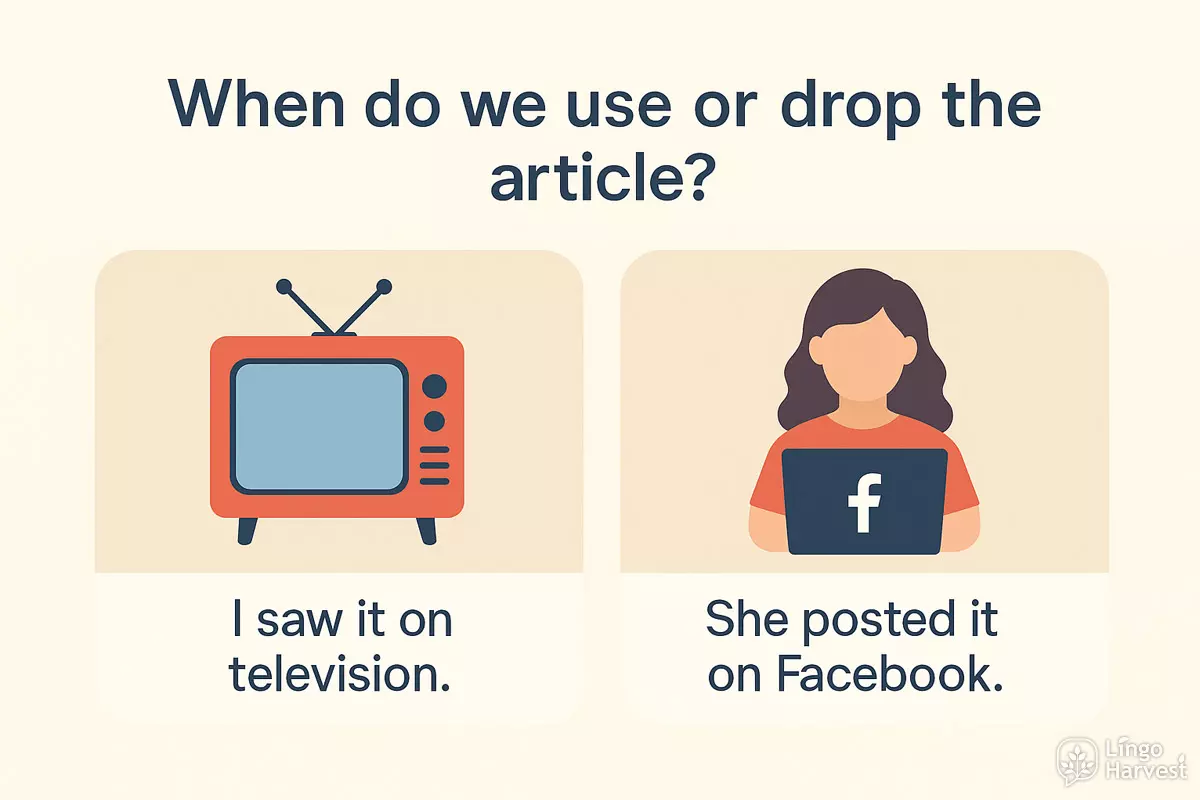
| on television | No article for the medium ✅ “I saw it on television.” |
| on the radio | “the” is common for radio ✅ “I heard it on the radio.” |
| on Facebook | No article for the platform ✅ “She posted it on Facebook.” |
| by email | No article for communication method ✅ “Send it by email.” |
| on the internet | “the” is used ✅ “Look it up on the internet.” |
| on YouTube | No article for the website ✅ “Watch it on YouTube.” |
| via Messenger | No article for the service ✅ “Contact me via Messenger.” |
Key patterns to remember
- Media platforms and communication apps rarely take an article when you refer to the service itself.
- When you refer to the device or a specific app, use an article: “a radio,” “the Skype app.”
- Some words, like “internet” and “radio,” have set phrases where “the” is expected (“on the radio,” “on the internet”).
- Brand names and proprietary services (WhatsApp, Zoom, Twitter) are treated like personal names—no article.
By recognizing these patterns, you’ll avoid awkward phrasing and communicate more fluently about digital tools and media.
Common learner errors with media-related articles
Understanding which article or preposition to use with media and technology terms can be tricky for English learners. Many mix up the set expressions, especially when talking about radio, internet, TV, and similar mediums. Below are some of the most frequent mistakes and how to avoid them.
Typical mix-ups with "the" and "a/an"
Learners often use the wrong article or omit it where English requires a specific set phrase. For example, we say "on the radio" (not "on radio"), but just "on TV" (not "on the TV" when referring to television as a medium). These patterns don’t always follow the logic of other nouns.
- ❌ on radio → ✅ on the radio
- ❌ on the internet and on internet are both heard, but only on the internet is standard in most varieties of English.
- ❌ in the TV → ✅ on TV
- ❌ on the television (when talking about the medium) → ✅ on television
- ❌ on a radio (when referring to broadcasting) → ✅ on the radio
- ❌ in radio (for listening) → ✅ on the radio
Confusing prepositions and set phrases
Prepositions with media terms can also cause confusion. English uses “on” for most media (on TV, on the radio, on the internet), but “in” for print (in the newspaper, in a magazine).
| Incorrect Form ❌ | Correct Form ✅ |
|---|---|
| in the radio | on the radio |
| on the newspaper | in the newspaper |
| at the internet | on the internet |
| in TV | on TV |
| in the website | on the website |
Summary of main pitfalls
Misusing articles and prepositions with media expressions can make speech sound unnatural. Key challenges include:
- Forgetting "the" with "radio" and "internet"
- Adding "the" unnecessarily with "TV" or "television" (as a medium)
- Using "in" instead of "on" for electronic media, and vice versa for print
- Overgeneralizing rules from one media type to another
Pay attention to fixed expressions: "on the radio," "on the internet," "on TV," and "in the newspaper." Learning these as set phrases helps avoid the most common errors with media-related language.
Practice: correct article use in media and tech sentences
Understanding the correct use of articles ("the", "a", "an", or no article) is especially important when talking about media and technology. Common phrases like "on the radio" or "on the internet" use articles in ways that are not always intuitive. Let's explore how articles are used with various media and tech terms, then try some exercises to reinforce your understanding.
Common phrases with articles in media and technology
- on the radio → She heard the story on the radio.
- on the internet → I found the article on the internet.
- on television → The event was shown on television.
- on the phone → He spoke to his manager on the phone.
- on a website → I read the review on a website.
- in the newspaper → She saw the announcement in the newspaper.
- on YouTube → I learned that recipe on YouTube.
- on the computer → The document is saved on the computer.
- by email → Please send your questions by email.
- on an app → You can track your progress on an app.
- on the news → I heard it on the news yesterday.
- on social media → She shared her thoughts on social media.
- on the screen → The message appeared on the screen.
- on a podcast → I heard an interview on a podcast.
- on the platform → The update is available on the platform.
- on a device → You can install the tool on a device.
- in a blog post → He explained the method in a blog post.
- on the homepage → The announcement was placed on the homepage.
- on an online forum → I asked the question on an online forum.
Mini-quiz: Choose the correct article
- I heard the song ___ radio this morning.
- She read the article ___ internet.
- We talked ___ phone for an hour.
- He watched the show ___ television.
- They posted the news ___ website.
- The interview was broadcast ___ YouTube.
- I found the tutorial ___ social media.
- She sent me the file ___ email.
- He wrote a comment ___ online forum.
- The homepage opened ___ computer screen.
Show answers
- on the
- on the
- on the
- on (no article)
- on a
- on (no article)
- on (no article)
- by (no article)
- on an
- on the
Spot the mistake: Correct the article usage
Read each sentence. If the article use is incorrect, rewrite it with the correct form.
- She listened to music on radio.
- I saw the news on a internet.
- We met on the social media.
- The video is available on the YouTube.
- She called me on a phone.
- I watched the interview on the television.
- They posted it on the Facebook page.
- I will send you the details by an email.
- He found the course in the internet.
- We chatted in the WhatsApp.
Show answers
- She listened to music on the radio.
- I saw the news on the internet.
- We met on social media.
- The video is available on YouTube.
- She called me on the phone.
- I watched the interview on television.
- They posted it on Facebook.
- I will send you the details by email.
- He found the course on the internet.
- We chatted on WhatsApp.
Quick reference: Article use with common media/tech terms
| Media/Tech Phrase | Correct Article Use |
|---|---|
| radio | on the radio |
| internet | on the internet |
| television | on television (no article) |
| website | on a website |
| phone | on the phone |
| by email (no article) | |
| social media | on social media (no article) |
| computer | on the computer |
When in doubt, check for established patterns. Some media and technology terms always use "the" (like "the internet"), some use "a/an", and others require no article at all. Exposure to authentic examples is the best way to master these patterns.