Conjunctions Showing Exception: except, except that

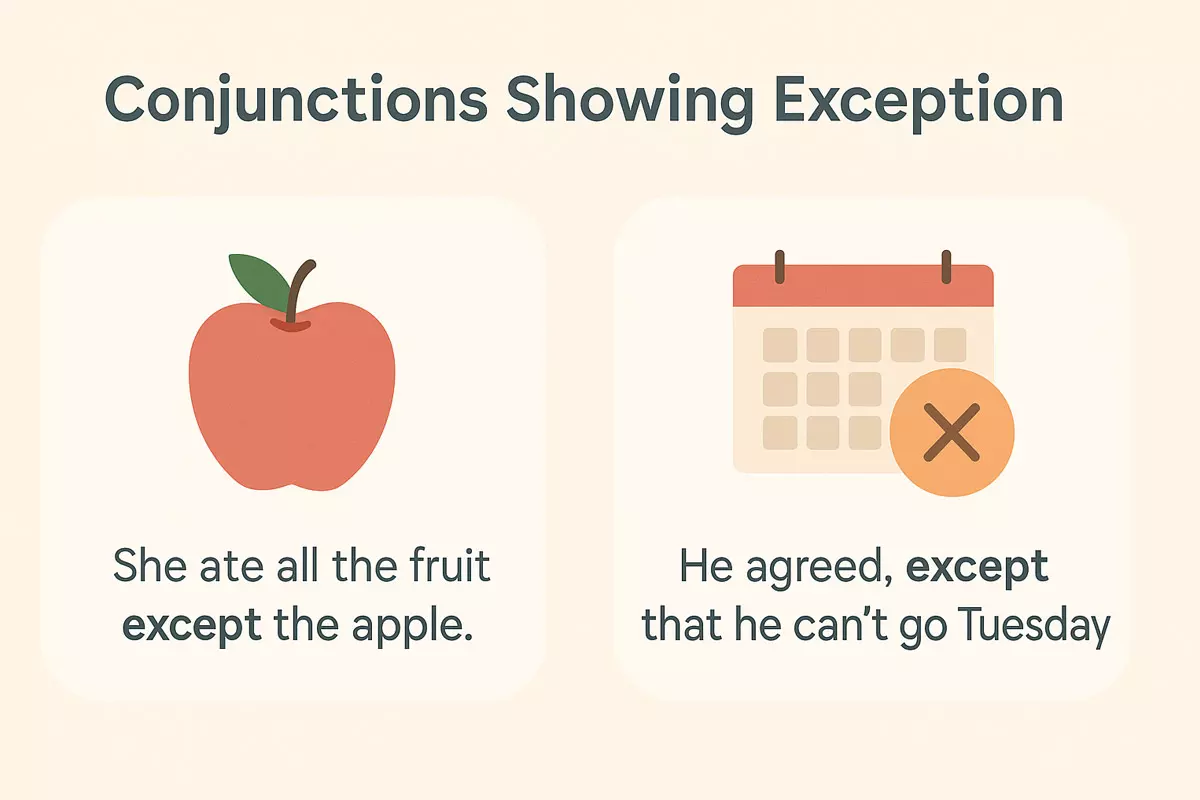 Here we the meaning of exceptions in grammar, explains how to use except and except that for different types of exclusions, highlights common mistakes with except and besides, and provides examples and practice sentences for clarity.
- What an exception is in grammar and meaning
- Using except to show a simple exclusion
- Using except that to introduce a full clause as an exception
- Pattern differences: noun phrase vs full clause
- Examples in descriptions, rules, and everyday sentences
- Common mistakes with except and besides in learner writing
- Practice: complete sentences to show correct exceptions
In English, it is often necessary to highlight something that does not fit the usual pattern or to draw attention to an outlier. Using specific words and phrases to signal exceptions helps make our communication clearer and more precise. These expressions, some of which are discussed Here, allow us to indicate when a rule does not apply or when something stands apart from the norm. Mastering the use of such exception markers is important for effective writing and speaking, ensuring that our intended meaning is accurately conveyed.
What an exception is in grammar and meaning
In English grammar, an "exception" refers to something or someone that does not fit a general rule or statement. When we use exception words or phrases, we indicate that a part of a group, idea, or statement is excluded. This is essential for accuracy, as it helps clarify exactly which elements are included and which are not.
How exceptions work in language
When expressing exceptions, speakers signal that one or more items are not covered by a general statement. For example, in the sentence "Everyone went to the party except John," the word "except" highlights that John is not part of the group who attended. This use of exception words prevents overgeneralization and ensures the message is precise.
Common exception indicators
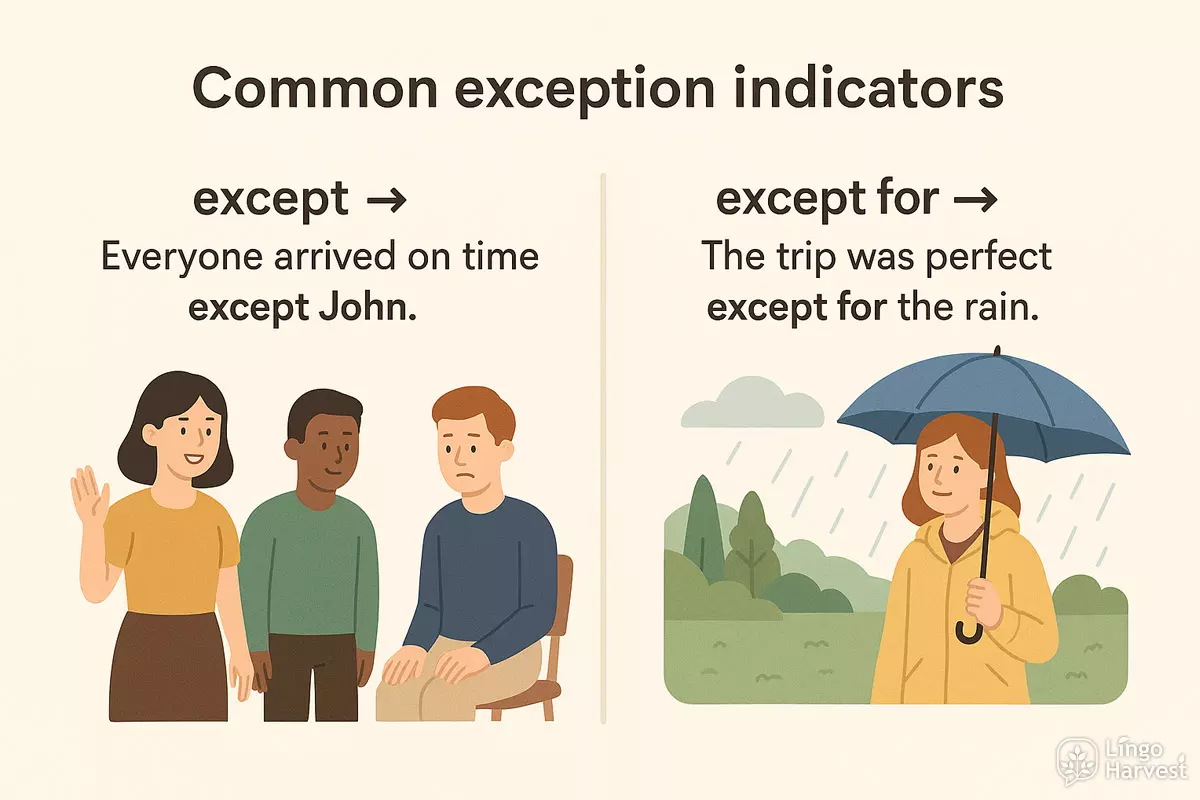
Some of the most frequent words and phrases that show exceptions include:
- except → Everyone arrived on time except John.
- except for → The trip was perfect except for the rain.
- except that → I liked the movie except that it was too long.
- but (meaning “except”) → Nobody knew the answer but Sarah.
- other than → I don’t drink anything other than water.
- apart from → Apart from one mistake, your essay is excellent.
- excluding → The price is $50, excluding taxes.
- save (formal) → All were silent save the wind.
- with the exception of → With the exception of Paul, everyone agreed.
- unless (used for exceptions) → I never eat sweets unless it’s a special occasion.
- bar (informal) → Bar one student, everyone passed the test.
- besides (in negative meaning) → I have nothing to wear besides this old jacket.
Exception vs. generalization
When a general statement is made, exception words help define the boundaries. Consider these examples:
- All the cookies are gone except the chocolate ones.
- No one knew the answer except for Maria.
- Everyone passed the test except that a few struggled with the last question.
In each case, the exception word or phrase separates what is included from what is left out.
Types of exception structures
Exception can be shown with single words, prepositional phrases, or entire clauses, depending on how much information is being excluded. For example:
- Single word: "Everyone except Tom"
- Prepositional phrase: "Except for the rain, the event was perfect."
- Clause: "I would have gone, except that I was ill."
Why understanding exceptions matters
Recognizing exception structures is useful for both comprehension and communication. It helps you interpret the exact meaning in reading and listening, and lets you express yourself more precisely in writing and speech.
Using except to show a simple exclusion
The word except is commonly used to indicate that one or more items are not included within a group or general statement. This conjunction helps clarify statements by highlighting the specific things or people that do not belong to a particular set. Typically, except comes after statements about groups, rules, or generalizations, and signals what is left out.
Common patterns with "except"
Here are some typical sentence structures that use except for exclusion:
- Everyone except John arrived on time.
- All the stores are closed except the bakery.
- I eat everything except mushrooms.
- No one knows the answer except Maria.
- The museum is open every day except Monday.
- We finished every task except the last one.
- They invited everyone except me.
- He visits every country except Japan.
- The office is quiet except during lunch.
- She likes all sports except football.
- No pets are allowed except guide dogs.
- Nothing changed except the weather.
Usage notes
In most cases, except directly follows the statement it modifies, and does not require a comma unless it interrupts the sentence flow or adds additional information. It is important not to confuse except with "accept," which has a completely different meaning.
Examples in context
Below is a table illustrating how except can be used to exclude specific items or people from a general statement:
| General Statement | Exclusion with "except" |
|---|---|
| Everyone was at the party. | Everyone was at the party except Tom. |
| All the books are new. | All the books are new except this one. |
| She eats every fruit. | She eats every fruit except bananas. |
| The building is empty. | The building is empty except for the security guard. |
| Nothing was missing. | Nothing was missing except my keys. |
By learning these structures and examples, it becomes easier to use except accurately when you want to specify exceptions in English sentences.
Using except that to introduce a full clause as an exception
When you want to point out a single detail that makes a statement not entirely true, except that is the tool for the job. This conjunction lets you attach a whole clause containing a subject and verb, rather than just a phrase. It’s especially useful when the exception is more complex and cannot be expressed with just a word or a short phrase.
How it works in sentences
Except that connects two clauses, where the second clause gives an exception or contrast to the first. The main clause states the general idea, and the clause after except that introduces the specific difference or limitation.
- She would have passed the exam, except that she missed one question.
- The plan is perfect, except that it’s too expensive.
- Everything went smoothly, except that the weather turned bad.
- I’d love to join you, except that I have to work late.
- The movie was great, except that it was a bit too long.
- He’s always polite, except that he interrupts sometimes.
- The instructions were clear, except that one step was missing.
- We almost won, except that our last player was injured.
- They agreed on everything, except that they disagreed about the budget.
- The room was clean, except that the window wouldn’t open.
Comparing "except" and "except that"
It’s important to distinguish between except (used before nouns, pronouns, or short phrases) and except that (used before full clauses). The table below highlights the difference:
| Form | Example |
|---|---|
| Except + noun/pronoun/phrase | Everyone left except John. |
| Except that + subject + verb | Everyone left, except that John stayed to help. |
| Except + prepositional phrase | The building is open except on Sundays. |
| Except that + full clause | The building is always open, except that it closes early on Sundays. |
Usage notes ✅
- Use except that for exceptions that need a full sentence or idea.
- Avoid using except that with just nouns or simple objects; use except instead.
- In formal writing, this construction is clear and precise for showing contrasts or limitations.
- Don’t confuse except that with but or although; it specifically marks an exception to the statement in the main clause.
In summary, except that is your go-to conjunction when you need to introduce a detailed exception using a full clause, making your statements more nuanced and accurate.
Pattern differences: noun phrase vs full clause
Understanding how "except" and "except that" function in sentences involves recognizing their grammatical patterns. "Except" is typically followed by a noun phrase or pronoun, while "except that" introduces a full clause. This distinction changes both the structure and meaning of the sentence. When you use "except" on its own, it usually connects a statement with a single word or short phrase that serves as an exception. In contrast, "except that" allows you to introduce a complete idea, including a subject and verb, providing more detailed information about the exception.
Noun phrase pattern with "except"
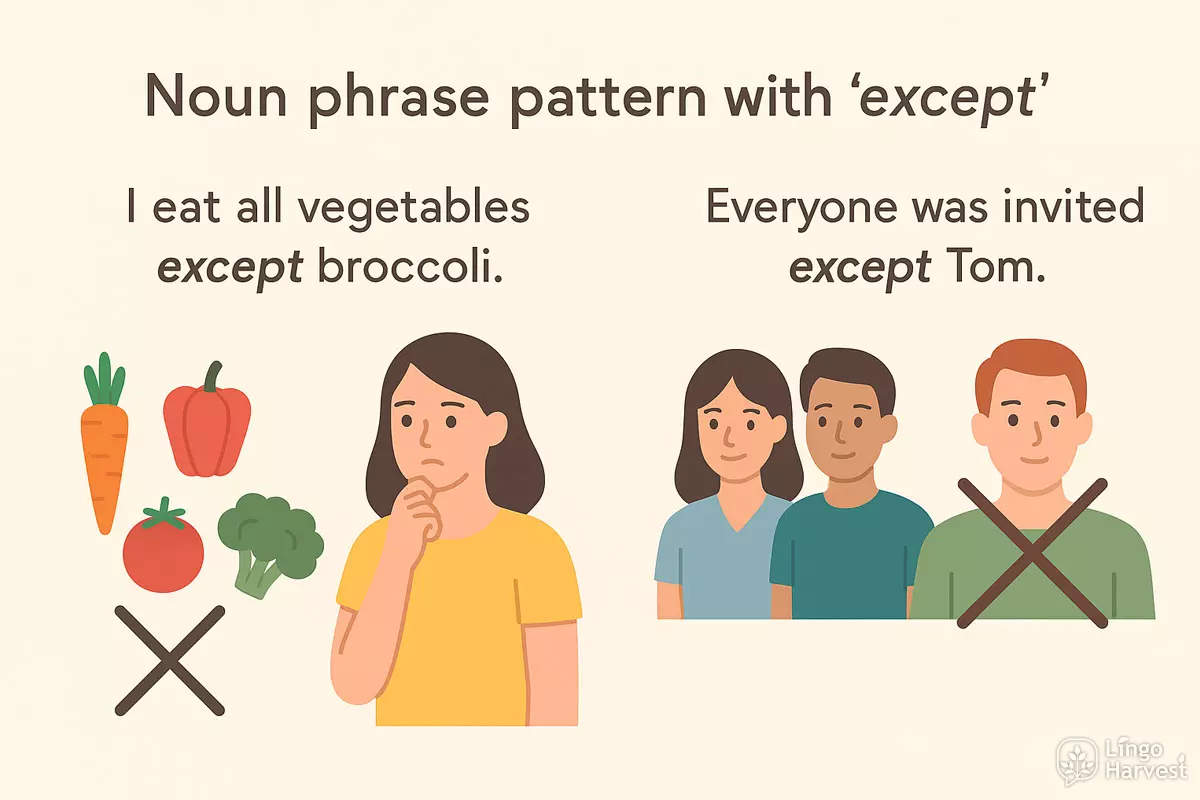
"Except" often appears after statements to show exclusion. Here are some typical patterns:
- I eat all vegetables except broccoli.
- Everyone was invited except Tom.
- She answered all the questions except the last one.
- The store is open daily except Sundays.
- You can use any color except red.
- He knows nothing about it except what I told him.
- We finished everything except the paperwork.
- No one complained except the manager.
- All the tickets are sold except one.
- She has visited every continent except Antarctica.
Full clause pattern with "except that"
When you need to add a full statement as an exception, "except that" is used. This allows you to include a subject and verb, making the exception more specific or nuanced.
- He agreed to help, except that he was busy on Monday.
- The plan is perfect, except that it’s too expensive.
- I would go, except that I have to work late.
- The movie was enjoyable, except that it was a bit too long.
- She’s always friendly, except that she can be impatient sometimes.
- The weather was good, except that it rained in the evening.
- Everything is ready, except that we forgot the drinks.
- The solution works, except that it requires more resources.
- I like the idea, except that it needs some changes.
- The house is nice, except that it’s far from the city.
Comparing "except" and "except that"
The following table summarizes the core differences in how these two forms are used:
| Form | Pattern & Example |
|---|---|
| except + noun phrase/pronoun | Everyone left except Sarah. (noun phrase) |
| except that + clause | Everyone left, except that Sarah stayed behind. (full clause with subject and verb) |
| except + gerund/infinitive (rare) | He did nothing except complain. (verb acting as a noun) |
| except + prepositional phrase | All days are busy except for Saturday. (prepositional phrase) |
In summary, use "except" for short exceptions (nouns, pronouns, gerunds), and "except that" for exceptions that need a full explanation with their own subject and verb. This choice keeps your sentence clear and grammatically accurate.
Examples in descriptions, rules, and everyday sentences
Understanding how to use "except" and "except that" can make your English much clearer, especially when you need to talk about exceptions to general statements or rules. These conjunctions help you point out exclusions or special cases with precision.
Usage in Descriptions and Definitions
When describing objects, situations, or people, "except" is commonly used to note what is not included. "Except that" introduces a clause, often giving a contrasting detail or minor exception.
- All the buses arrive on time except the last one.
- The museum is open daily except Mondays.
- The cake looked perfect, except that it was slightly burnt on the bottom.
- Everyone agreed with the decision, except that some wanted more discussion.
Rules and Instructions
Rules and instructions often rely on these conjunctions to specify exceptions. Here are some practical patterns:
- No one is allowed in the lab except authorized personnel.
- Do not use your phone during the exam, except in emergencies.
- All fields must be completed, except that the comments section is optional.
- Visitors are welcome any day, except public holidays.
Everyday Sentences: Patterns and Variations
In daily conversation, these words show up in plenty of ways. Notice how they clarify what is included or excluded.
- I like all fruits except bananas.
- He remembers everything except where he left his keys.
- She would have come to the party, except that she was feeling ill.
- There's nothing to worry about, except that we might be late.
- They finished all the tasks, except the last one.
- Everyone passed the test except Tom.
- The store is always busy, except early in the morning.
- He wore everything as required, except that he forgot his tie.
- The plan is perfect, except that it’s a bit expensive.
- She answered every question, except the final one.
Comparison: "except" vs. "except that"
| "except" (preposition/conjunction) | "except that" (conjunction) |
|---|---|
| Everyone can come except Sam. | I would join you, except that I have to work late. |
| All stores are open except the bakery. | The day was perfect, except that it rained in the afternoon. |
| No one knew the answer except Jane. | I liked the movie, except that it was too long. |
| You can eat anything except nuts. | He did a great job, except that he missed the deadline. |
These examples should help you recognize and use "except" and "except that" naturally in a variety of contexts, from formal rules to casual speech.
Common mistakes with except and besides in learner writing
Learners often confuse “except” and “besides” because both can indicate exclusion or addition, but they function differently in English sentences. Choosing the wrong word or incorrect structure can result in awkward or unclear writing. Here are some of the most frequent pitfalls and tips for avoiding them.
Mixing up meanings: exclusion vs. addition
Many students use “except” and “besides” interchangeably, but their meanings are quite distinct:
- Except means “not including” or “with the exception of.”
- Besides usually means “in addition to.”
For example:
- ✅ Everyone came to the party except John. (John did not come.)
- ✅ Besides John, everyone came to the party. (John and others came.)
- ❌ Except John, everyone came to the party. (This can be ambiguous or incorrect.)
Incorrect sentence placement and structure
Learners sometimes use the wrong structure after “except” or “besides.” Here are common errors:
- Placing “except” at the start of a sentence without proper context.
- Using “besides” to mean “except” (exclusion) instead of “in addition to.”
- Following “except” with a full clause, where only a noun or pronoun is correct.
- Using “besides” without a comma when it’s used as an adverb at the start of a sentence.
Common learner errors: sample sentences
Below are examples of mistakes and corrections to clarify usage:
- ❌ Everyone except of John was invited. → Everyone except John was invited.
- ❌ I don’t like any fruits besides apples. (if you mean “except apples”) → I don’t like any fruits except apples.
- ❌ She finished all the homework, except she didn’t do the last exercise. → She finished all the homework except the last exercise.
- ❌ There is nobody here except of me. → There is nobody here except me.
- ❌ Besides Monday, I’m free every day. (if you mean “except Monday”) → Except for Monday, I’m free every day.
- ❌ Except Tom, everyone enjoyed the movie. (should be “Everyone except Tom enjoyed the movie.”)
- ❌ Besides for the rain, the trip was perfect. → Except for the rain, the trip was perfect.
- ❌ I have nothing to do except of reading. → I have nothing to do except read.
- ❌ Except than Anna, everyone passed. → Except Anna, everyone passed.
- ❌ Besides that he is late, he is not prepared. → Besides being late, he is not prepared.
Comparison: except vs. besides
| Function | Example |
|---|---|
| “Except” (excluding) | All the stores are closed except the bakery. |
| “Besides” (in addition to) | Besides English, he speaks Spanish and German. |
| “Except that” (with a clause) | The film was good, except that it was too long. |
| “Besides” (adverb: also, moreover) | Besides, we don’t have enough time. |
Quick tips to avoid confusion
- Use “except” for things or people not included.
- Use “besides” when adding information or items.
- Do not use “except of” or “except than.”
- Check if you need a clause (“except that”) or just a noun (“except John”).
- Remember “besides” can mean “also” at the start of a sentence, but “except” cannot.
Understanding these distinctions will help make your writing clearer and more accurate.
Practice: complete sentences to show correct exceptions
One effective way to master conjunctions of exception like except and except that is by practicing with real sentence structures. Below, you’ll find exercises and example patterns to help you identify and use these exception conjunctions accurately in context.
Complete the sentences using except or except that
- Everyone arrived on time, __________ Mark, who was late.
- The movie was good, __________ the ending was a bit confusing.
- I have visited every European country __________ Iceland.
- She liked all the dishes __________ the soup.
- Nothing has changed __________ we now have new chairs.
- No one knew the answer __________ Julia.
- The report is complete __________ it still needs a summary page.
- All the students passed the exam __________ Tom.
- He would have come to the party __________ he was feeling ill.
- The room was quiet __________ for the ticking of a clock.
Show answers
- except
- except that
- except
- except
- except that
- except
- except that
- except
- except that
- except
Common patterns for exception conjunctions
- except + noun/pronoun: "Everyone except John..."
- except + clause (with for): "The room was empty except for a chair."
- except that + full clause: "I would go, except that I have work."
- except after negatives: "I didn't eat anything except an apple."
- "Nothing/no one/nobody/nowhere" + except: "Nobody called except Anna."
- With adjectives: "The test was easy except for the last question."
- With time: "Every day except Sunday."
- With places: "All rooms except the kitchen."
- After prepositions: "They work every day except on holidays."
- With verbs: "He does nothing except complain."
- After "would" for hypothetical: "I would join you except that I am busy."
- For contrast: "She agreed, except that she wanted more details."
- With lists: "I like all fruits except bananas."
- With "for": "They were silent except for a few whispers."
- For restrictions: "You can choose any color except red."
Spot the error: choose the correct form
Identify if the sentence correctly uses the exception conjunction, and if not, correct it.
- He passed all his exams except he failed math.
- I would have gone, except that I was tired.
- They invited everyone except for me.
- The book was interesting except the ending was predictable.
- We took everything on the list except we forgot the tent.
- She likes all fruits except for bananas.
- He answered every question except the last one.
- They accept all applications except those submitted late.
- The trip was perfect except the weather was cold.
- Everyone agreed except for John.
Show answers
- Incorrect. Correct: He passed all his exams except math. OR He passed all his exams except for math.
- Correct.
- Correct.
- Incorrect. Correct: The book was interesting except that the ending was predictable.
- Incorrect. Correct: We took everything on the list except the tent. OR except for the tent.
- Correct.
- Correct.
- Correct.
- Incorrect. Correct: The trip was perfect except that the weather was cold.
- Correct.