Prepositions in Social Media English: Modern Usage and Trends

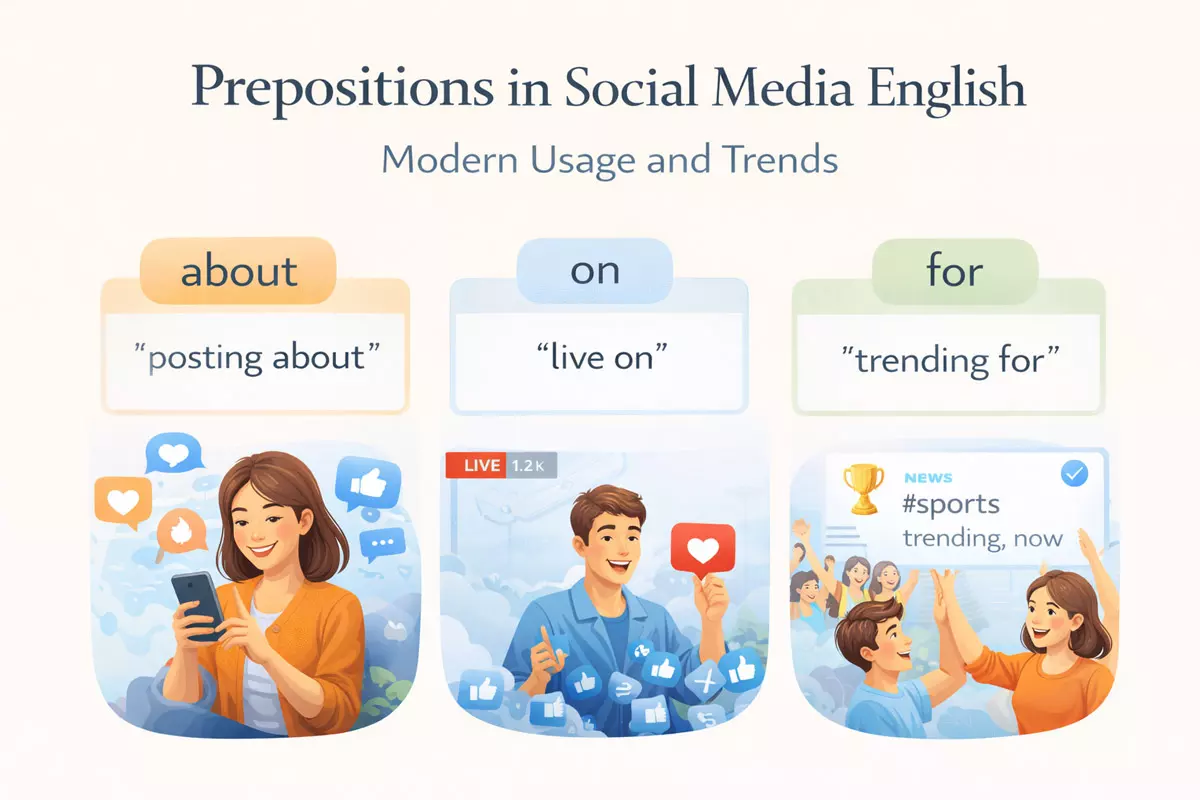 Here we how X, TikTok, and Instagram users adapt prepositions in captions, hashtags, and slang. It covers platform syntax, shorthand like w/, viral phrases, emoji use, branded versus casual tone, and tips for auditing captions.
- Platform-specific Syntax: Comparing prepositional use on X (Twitter), TikTok, and Instagram
- Character Limit Optimization: Strategic omission and the rise of shorthand (e.g., 'w/', 'w/o')
- Hashtag Grammar: How prepositions function within tagged phrases and viral challenges
- Branded Voice vs. Casual Peer Speak: Register shifts in corporate social media captions
- Viral Idiomaticity: Analyzing 'it's giving...', 'living for...', and other prepositional slang
- Emoji as Prepositions: Cases where visual icons replace spatial and directional words
- Practice: Auditing social media captions for tone, engagement, and grammatical intent
From trending tweets to viral posts, the way we use small connecting words has changed significantly in the online world. Analyzing how these words function in digital conversations uncovers new patterns and inventive uses that are unique to social media platforms. As people communicate faster and often with limited characters, connectors like and, but, or so take on new roles, helping to shape tone, add emphasis, and even convey humor or sarcasm. These subtle shifts highlight the ongoing evolution of language in our digital age.
Platform-specific Syntax: Comparing prepositional use on X (Twitter), TikTok, and Instagram
The way English speakers use prepositions shifts noticeably depending on which social media platform they're using. Each network’s unique format and culture encourages slightly different choices and patterns when it comes to phrasing updates, captions, and hashtags. This section explores how prepositions like “on,” “in,” and “at” appear in posts, bios, and user interactions across X (formerly Twitter), TikTok, and Instagram, and highlights emerging conventions.
Common Prepositional Patterns Across Platforms
Writers on each platform have developed preferred constructions for talking about actions, content, and engagement. For example, users are more likely to say they “saw it on X,” “posted on Instagram,” or “went viral on TikTok.” But subtle differences emerge in other contexts, especially when describing participation, location, or trends.

- “on X” (referring to the platform itself: “I saw it on X”)
- “in a thread” (specific to X, for multi-post conversations)
- “on TikTok” (general reference: “This is trending on TikTok”)
- “in a TikTok” (referring to a specific video: “She danced in a TikTok”)
- “on Instagram” (platform-wide: “Found this on Instagram”)
- “in my Story” (Instagram, referencing ephemeral content: “I shared it in my Story”)
- “at 2k followers” (user milestones: “at 10k, I’ll do a giveaway”)
- “with #fyp” (using hashtags: “with #fyp for more reach”)
- “by DM” (contact method: “Contact me by DM”)
- “over FaceTime” (cross-platform reference: “We chatted over FaceTime”)
- “from TikTok” (source of content: “Audio from TikTok”)
- “to my feed” (posting destination: “Uploaded to my feed”)
- “under this post” (comments: “Reply under this post”)
- “about this trend” (topic: “Talking about this trend”)
- “for you page” (TikTok’s FYP, sometimes as “on the FYP”)
- “via Reels” (Instagram’s video format: “Shared via Reels”)
- “with @username” (tagging: “with @alex”)
- “across platforms” (cross-posting: “Shared across platforms”)
Comparative Table: Prepositions in Social Media Contexts
| Platform | Common Prepositional Phrases | Typical Usage/Context |
|---|---|---|
| X (Twitter) | on X in a thread by DM under this post |
Referring to tweets, discussions, private messages, or replies. |
| TikTok | on TikTok in a TikTok for you page (FYP) with #fyp |
Talking about viral videos, specific clips, and algorithm-driven feeds. |
| on Instagram in my Story via Reels to my feed |
Relating to posts, Stories, Reels, and content destinations. |
Platform Influence on Prepositional Trends
Short-form, rapid interactions on X often favor “on” and “in” to keep phrasing concise. TikTok’s video-centric environment drives expressions like “in a TikTok” for participation or “on the FYP” for discoverability. Instagram users frequently refer to content “in Stories,” “on my grid,” or “via Reels,” reflecting the app’s visual and categorization features. These evolving syntactic habits not only signal platform familiarity but also shape digital English as a whole.
Emerging and Hybrid Constructions
As users cross-post and blend features, hybrid prepositional uses appear, such as “shared on TikTok and in my Instagram Story,” or “viral across platforms.” These combinations reflect both the interconnectedness of social spaces and the adaptability of English grammar in digital life.
Character Limit Optimization: Strategic omission and the rise of shorthand (e.g., 'w/', 'w/o')
On platforms where brevity is essential, such as Twitter or Instagram captions, users have developed inventive ways to condense language. Many traditional prepositions and function words are now routinely omitted or replaced with compact shorthands. This approach lets users fit more information or expression into tight space constraints, often at the cost of grammatical completeness.
Shorthand Substitutes for Prepositions
Instead of writing out full prepositional phrases, social media users often prefer abbreviations or symbolic representations. The most common forms include slashes, single letters, and numerals, especially for words like "with," "without," "before," and "to." Here are some widely used examples:
- w/ — with
- w/o — without
- b/c — because
- btw — by the way
- re: — regarding/about
- vs. — versus
- 2 — to/too/two (context dependent)
- 4 — for/four
- @ — at
- & — and
- re: — regarding
- n/a — not applicable
- idk — I don’t know
- afaik — as far as I know
- imo — in my opinion
- ttyl — talk to you later
- tbh — to be honest
- ICYMI — in case you missed it
Strategic Omission in Sentence Structure
Often, users drop prepositions or articles altogether to save space. For example, “Going store” instead of “Going to the store,” or “Lunch w/ Sarah” rather than “Having lunch with Sarah.” The context and shared conventions of each platform usually make these omissions understandable, even if the sentences are technically incomplete.
Comparing Full and Abbreviated Forms
To illustrate the shift, compare the following examples:
| Full Expression | Condensed Version |
|---|---|
| Hanging out with friends tonight | Hanging out w/ friends tonight |
| Going to the gym after work | Going 2 gym after work |
| Meeting at 5pm | Meeting @ 5pm |
| Without a doubt, best show | w/o a doubt, best show |
| Thanks for the info | Thx 4 info |
Impact on Communication and Language Trends
While these shortcuts make posts more concise, they can also challenge readers unfamiliar with online conventions. However, for most digital natives, such forms have become second nature. This trend reflects not just a response to technical limitations but a broader shift towards efficiency and immediacy in online interaction. As social media evolves, these patterns continue to influence wider English usage, especially among younger speakers.
Hashtag Grammar: How prepositions function within tagged phrases and viral challenges
Prepositions in social media hashtags behave differently than in formal written English. Their placement, omission, or creative use can change the meaning or impact of a tag, especially in the context of trending phrases and interactive online challenges. Users often adapt prepositions to fit the fast-paced, character-limited, and visually-driven world of platforms like Twitter, Instagram, and TikTok.
Common Patterns in Hashtag Preposition Usage
On social platforms, prepositions are sometimes included, omitted, or even repurposed in hashtag phrases. Here are some typical ways people handle them:
- Included for clarity: #OutOfOffice, #BackToSchool
- Omitted for brevity or style: #ThrowbackThursday (instead of "on Thursday")
- Combined with verbs or adjectives: #RunForFun, #GoodAtMath
- Used to indicate participation: #InMyFeelingsChallenge
- Stacked prepositions: #FromWithin, #UpAndOver
- Swapped for similar-sounding words: #ToCoolForSchool (intentional misspelling for effect)
- Used to signal movement or change: #FromZeroToHero
- Reflecting trends or memes: #OnFleek, #OffTheCharts
- Indicating time frames: #ForTheWeekend, #UntilTomorrow
- Collapsing phrases: #OuttaThisWorld (shortened "out of")
- Used for comparison: #LikeABoss, #AsIf
- Highlighting causes or support: #ForUkraine, #WithRefugees
- Participating in challenges: #UnderTheTableChallenge
- Describing locations or events: #AtTheBeach, #InTheStudio
- Used with numbers: #OneForTheBooks, #TwoByTwo
Prepositions in Viral Challenges and Memes
Viral challenges often rely on fixed prepositional patterns for instant recognition and participation. The preposition helps set the rules or context. For example, #InMyFeelingsChallenge uses "in" to connect the challenge to the song's theme. Similarly, #UnderTheDeskChallenge makes the prepositional phrase central to the activity. Sometimes, the preposition becomes the hook that distinguishes one trend from another.
Comparison: Standard English vs. Hashtag Usage
| Standard Phrase | Hashtag Version |
|---|---|
| Back to school | #BackToSchool |
| Throwback on Thursday | #ThrowbackThursday |
| Out of office | #OutOfOffice |
| Good at math | #GoodAtMath |
| For the weekend | #ForTheWeekend |
| With refugees | #WithRefugees |
| From zero to hero | #FromZeroToHero |
| Under the desk challenge | #UnderTheDeskChallenge |
Why Do Users Bend Prepositional Rules?
Length restrictions, clarity, and catchy phrasing all drive the way prepositions appear in hashtags. Social media users prioritize memorability and shareability, sometimes at the expense of traditional grammar. As a result, hashtags become both a linguistic shortcut and a creative playground for prepositional phrases.
In sum, prepositions are flexible building blocks in the grammar of hashtags, helping users express nuance, join trends, and participate in viral moments with just a few words—or sometimes, just one.
Branded Voice vs. Casual Peer Speak: Register shifts in corporate social media captions
Corporate social media captions often fluctuate between polished, on-brand messaging and a more relaxed, conversational tone that mimics peer-to-peer exchanges. This shift in register is not just a stylistic choice—it’s a strategic approach to audience engagement, especially when it comes to the use of prepositions and colloquial phrasing. Brands may alternate between formal constructions and casual shortcuts, depending on context, audience, and platform.
Patterns in Prepositional Usage
The prepositional choices in captions can signal a brand’s tone and intent. Traditional, branded language tends to use full prepositional phrases (“in collaboration with,” “on behalf of”), while a peer-inspired register may drop prepositions or use them in nonstandard positions (“hanging with our crew,” “check this out for more”). These shifts are subtle yet significant for how messages are received.
- Branded: “Join us at our event on Friday”
- Casual: “See you Friday!”
- Branded: “Available in stores and online”
- Casual: “In stores & online now”
- Branded: “Connect with us on LinkedIn”
- Casual: “Let’s link up LinkedIn?”
- Branded: “Launching in collaboration with…”
- Casual: “Collab drop with…”
- Branded: “For more info, visit our website”
- Casual: “More info? Hit the link!”
- Branded: “Thanks for joining us at the event”
- Casual: “Thanks for coming out!”
- Branded: “Share your story with us”
- Casual: “Tell us your story!”
Comparing Register: Structured Examples
| Branded Register | Peer Register |
|---|---|
| Proud to announce our new product in partnership with ABC Corp. | New drop with @abc_corp—so hyped! |
| Find out more about our initiative on our website. | Want more? Click the link! |
| Stay tuned for updates on our latest campaign. | Keep an eye out—we’ve got news! |
| We appreciate your feedback on our services. | Tell us what you think! |
Why Register Shifts Matter
Switching tone in captions helps companies connect with diverse audiences. A formal voice signals professionalism and reliability, while informal, peer-style captions foster relatability and approachability. The way prepositions are used—or omitted—serves as a linguistic marker for these shifts. Social media managers must balance clarity with trendiness, ensuring that register changes support brand identity without sacrificing communication effectiveness.
Viral Idiomaticity: Analyzing 'it's giving...', 'living for...', and other prepositional slang
Social media English has produced a wave of fresh idiomatic expressions, many of which hinge on creative uses of prepositions. These phrases often start as niche slang and quickly become mainstream, reshaping the tone and style of online communication. Rather than following traditional grammar rules, these constructions prioritize expressiveness and shared context, making them ideal for fast-paced, meme-driven platforms.
How Prepositions Power Modern Slang
Contemporary idioms like "it's giving..." and "living for..." show how prepositions are repurposed to create punchy, flexible statements. In these constructions, prepositions such as "for," "of," "on," and "with" are often detached from their original literal meanings and instead convey attitude or emotional stance. This shift allows users to express approval, enthusiasm, critique, or identity with just a few words.
Popular Prepositional Slang Patterns
Consider the following list of current idiomatic expressions where prepositions play a starring role:
- it's giving... (e.g., "it's giving vintage vibes")
- living for... ("living for this moment")
- here for... ("here for the drama")
- over it ("I'm over it")
- on brand ("That's so on brand for her")
- out of pocket ("That comment was out of pocket")
- down for... ("I'm down for anything")
- with the vibes ("She's really with the vibes today")
- off the charts ("Excitement is off the charts")
- about that life ("Not about that life")
- in my feels ("I'm in my feels tonight")
- under the radar ("Keeping it under the radar")
- on point ("Your style is on point")
- for the win ("Coffee for the win")
- at it again ("He's at it again")
- off the grid ("Going off the grid this weekend")
- in the zone ("She's really in the zone")
- by my side ("Always by my side")
- over the top ("That was over the top")
- into it ("I'm so into it")
Comparing Function and Tone
The table below contrasts two of the most viral prepositional slang forms, highlighting their function and tone in digital contexts.
| Expression | Usage & Typical Meaning | Sample Context | Tone/Effect |
|---|---|---|---|
| it's giving... | Signals resemblance, vibe, or mood; often humorous or approving | "It's giving main character energy." | Playful, evaluative, often positive or ironic |
| living for... | Expresses strong enthusiasm or enjoyment of something | "Living for these summer sunsets." | Excited, supportive, celebratory |
| here for... | Shows presence and approval, or anticipation for an event/trend | "Here for the chaos." | Engaged, supportive, sometimes tongue-in-cheek |
| over it | Indicates boredom, frustration, or annoyance with something | "Honestly, I'm over it." | Dismissive, fatigued, sometimes blunt |
Why These Patterns Stick
These idiomatic prepositional forms thrive because they are adaptable and instantly convey complex social cues. Their brevity and relatability make them ideal for posts, comments, and memes. As language on social media continues to evolve, expect prepositions to remain at the center of emerging slang, driving new ways to express identity, mood, and community.
Emoji as Prepositions: Cases where visual icons replace spatial and directional words
Social media users often swap out traditional prepositions for emoji, relying on visual context to convey meaning. Instead of typing words like “to,” “from,” or “between,” people might use arrows, location pins, or other icons. This trend reflects both a desire for brevity and the playful, image-driven nature of online conversations.
How Emoji Stand In for Prepositions
Replacing prepositions with emoji is most common in settings like Twitter threads, Instagram captions, and group chats. The visual nature of emoji can make messages more engaging, but also relies on shared understanding. Some icons have become shorthand for relationships or directions between people, places, or events.
- → for “to” or “toward” (e.g., “NYC → LA” = from NYC to LA)
- 🏠 for “at” (e.g., “party 🏠” = party at home)
- 📍 for “in” or “at” a location (e.g., “meet 📍 Starbucks”)
- ✈️ for “by” plane, indicating travel method
- 🤝 for “with” (e.g., “brunch 🤝 mom”)
- ❤️ for “with love” or “for” someone
- ↔ for “between” (e.g., “work ↔ home”)
- 🕐 for “at” a certain time (e.g., “call 🕐 8pm”)
- ↑ for “up” or “above”
- ↓ for “down” or “below”
- ← for “from” or “left of”
- 🚌 for “by bus” (travel method)
- 🌎 for “around” the world
- 🔗 for “connected to” or “with”
- ⛰ for “on” the mountain
- 🏰 for “over” (e.g., “walk 🏰 river” = walk over river)
- 🔥 for “on fire” or “with energy”
- ☀️ for “under the sun” or “in the sun”
- 💦 for “across” water
- ⭐ for “among” stars
Interpreting Emoji-Based Prepositions
Understanding these icons as substitutes for prepositions often depends on context and cultural familiarity. While an arrow may universally mean movement or direction, other symbols can be ambiguous or interpreted differently across groups. For instance, a pin might mean “at” or “in,” but not everyone will read it the same way.
Advantages and Challenges
Using emoji in place of prepositions can make messages feel more dynamic and save space, especially on platforms with character limits. However, this approach can also introduce ambiguity, especially for those unfamiliar with the conventions or for non-native English speakers.
| Emoji/Icon | Common Prepositional Meaning | Example Usage |
|---|---|---|
| → | to, toward | London → Paris |
| 📍 | at, in | Coffee 📍 Central Perk |
| 🤝 | with | Dinner 🤝 friends |
| ↔ | between | Work ↔ Home |
| 🏰 | over | Walk 🏰 river |
| 🚌 | by (bus) | School 🚌 |
| ☀️ | under, in | Picnic ☀️ |
| 🔗 | with, connected to | Project 🔗 team |
Conclusion
The replacement of traditional function words with emoji is a hallmark of digital communication’s evolution. While it offers creative expression and brevity, it also demands shared understanding and context. As emoji continue to shape how we indicate relationships and directions, their role as visual stand-ins for prepositions is likely to expand, especially among younger and global online communities.
Practice: Auditing social media captions for tone, engagement, and grammatical intent
Reviewing captions on social platforms is about more than just correcting spelling and punctuation. It involves checking how prepositions are used to convey meaning, set the mood, and encourage interaction. Understanding the current trends in prepositional usage can help your posts feel both modern and natural, while still maintaining grammatical clarity.
Checklist: What to look for when auditing captions
- Does the caption use prepositions in a way that fits current informal English?
- Are any prepositions missing or misplaced, making the message unclear?
- Is the overall tone (friendly, professional, playful, etc.) consistent with your brand or intent?
- Do prepositional phrases help or hinder engagement (e.g., “in the comments,” “on our story,” “with us”)?
- Are there any awkward or outdated prepositional choices?
Examples: Common prepositional phrases in captions
- “Join us on Friday for a live Q&A.”
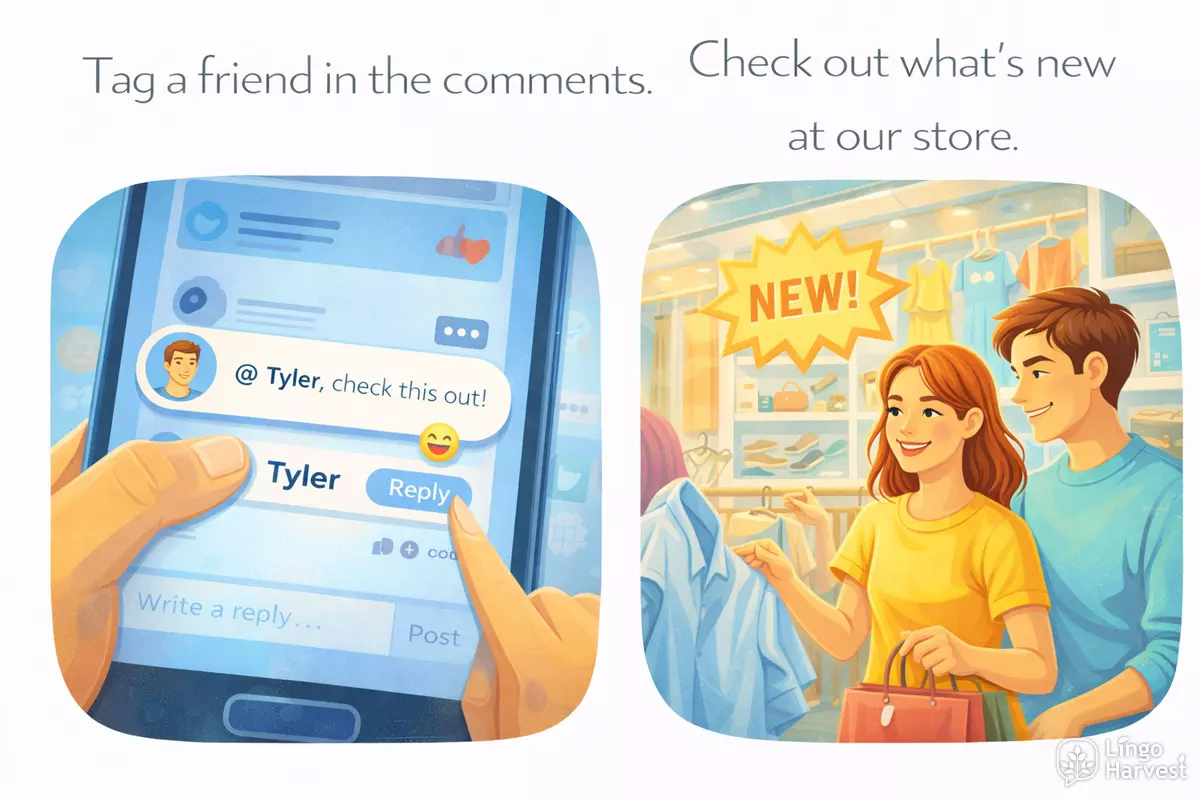
- “Tag a friend in the comments.”
- “Check out what’s new at our store.”
- “We’re excited about our latest update!”
- “Message us with your questions.”
- “See more on our story.”
- “Thanks for following along.”
- “Available in select locations.”
- “Swipe up for details.”
- “Follow us for updates.”
- “Behind the scenes with our team.”
- “New arrivals at midnight.”
- “Share your thoughts in the poll.”
- “On sale for a limited time.”
- “Vote in our poll!”
- “Let us know about your experience.”
- “Get started with our guide.”
- “See you at the event!”
- “DM us for more info.”
- “Stay tuned for updates.”
Quick Audit Practice: Spot the issue
Read the following captions. Decide if the preposition is correct, missing, or could be improved for tone or clarity.
- “Connect us on Instagram!”
- “See you in our next post.”
- “Share your story with us in #MyJourney.”
- “We’re live at 6PM!”
- “Thanks for all the support!”
- “Read more details in our website.”
- “Join the discussion at the comments.”
- “Follow us in Twitter for updates.”
- “We’ll announce the winners on Friday.”
- “Watch the full video in YouTube.”
Show answers
- ❌ Should be: “Connect with us on Instagram!” — Use with for connections between people.
- ⚠️ Acceptable, but more natural: “See you on our next post.” — On is more common for content.
- ✅ Correct. “Share your story with us in #MyJourney.” — Both prepositions fit the context.
- ✅ Correct. “We’re live at 6PM!” — At is used for exact times.
- ✅ Correct. “Thanks for all the support!” — Standard and natural.
- ❌ Should be: “Read more details on our website.” — On is used for websites.
- ❌ Should be: “Join the discussion in the comments.” — In is standard for comment sections.
- ❌ Should be: “Follow us on Twitter for updates.” — Social media platforms use on.
- ✅ Correct. “We’ll announce the winners on Friday.” — On is correct for days.
- ❌ Should be: “Watch the full video on YouTube.” — On is used with platforms.
Modern vs. Traditional: Prepositional trends in captions
| Traditional Usage | Modern/Trending Usage | Effect on Engagement |
|---|---|---|
| “Comment on this post” | “Comment below” | Simplifies the call-to-action; feels more direct |
| “Contact us by DM” | “DM us” | Removes preposition for brevity; feels more conversational |
| “Participate in the poll” | “Vote in our poll” / “Vote below” | Retention of “in” is common, but “below” is trending for clarity |
| “Follow us for updates” | Unchanged (“for” is still standard) | Clear purpose remains important for engagement |
Self-check: Revise these captions
Rewrite the following to improve prepositional use or engagement, if possible:
- “Find more about us in our bio.”
- “Share your thoughts at the comments.”
- “We’re open from 8AM to 6PM at weekdays.”
- “Get inspired with our stories.”
- “You can read more details on our website.”
- “Follow us in Instagram for updates.”
- “Contact us on email if you have questions.”
- “The offer is valid until Friday at the website.”
- “She posted the announcement on the group chat.”
- “I saw the notice at the homepage.”
Show answers
- “Find out more about us in our bio.” (Add “out” for natural phrasing.)
- “Share your thoughts in the comments.” (“In” is the standard preposition.)
- “We’re open from 8AM to 6PM on weekdays.” (“On” is used with days.)
- “Get inspired by our stories.” (“By” is more traditional than “with.”)
- “You can read more details on our website.” (“On” is standard for websites.)
- “Follow us on Instagram for updates.” (“On” is used with social media platforms.)
- “Contact us by email if you have questions.” (“By” is used for methods of communication.)
- “The offer is valid until Friday on the website.” (“On” fits online platforms.)
- “She posted the announcement in the group chat.” (“In” is correct for chats.)
- “I saw the notice on the homepage.” (“On” is used for pages and screens.)