Prepositions in Online and Digital Contexts: on the internet, etc.

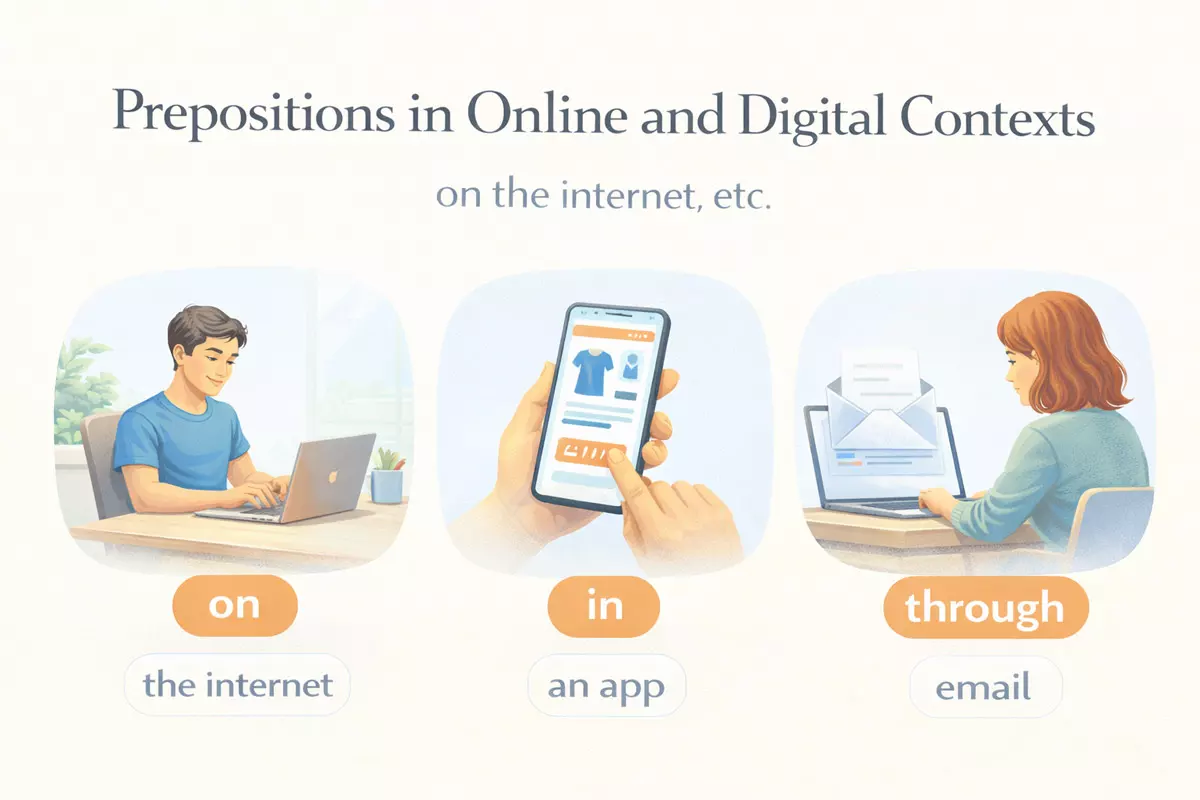 The article explains standard prepositions for internet and web use, compares on and in with platforms and apps, covers prepositions for posts and messages, outlines typical patterns in email and chat, and provides examples for practice.
In today's digital world, it is essential to use language that precisely reflects our activities in online spaces. Selecting appropriate connecting words for digital communication not only clarifies our messages but also makes our interactions more natural and effective. As we engage on various platforms, from social media to collaborative tools, understanding how to express our actions and intentions accurately can help prevent misunderstandings and foster better connections with others in virtual environments.
Standard prepositions for internet and web use
When communicating about digital activities, certain prepositions are commonly used to describe actions, locations, and interactions online. These choices often differ from their usage in physical contexts, so understanding which prepositions fit with digital terms is essential for clarity and natural phrasing.
Common prepositions in digital settings
In online communication, "on," "in," and "at" are frequently chosen, each serving specific contexts. Here’s an overview of how these prepositions typically pair with internet-related terms:
- on the internet → You can find this information on the internet.
- on a website → The article is published on a website.
- on social media → The announcement was shared on social media.
- on Facebook/Twitter/Instagram → She posted the photo on Instagram.
- on a forum → I asked the question on a forum.
- on a call (video/voice) → We discussed the details on a call (video/voice).
- on a live stream → Thousands of viewers watched the event on a live stream.
- in a chat (or group chat) → I sent the link in a chat (or group chat).
- in an app → You can change these settings in an app.
- in an email → The instructions were written in an email.
- in a document (online) → The comment appears in a document (online).
- in a message thread → She replied in a message thread.
- at a website address (e.g., at www.example.com) → More details are available at www.example.com.
- at a webinar → He asked a question at a webinar.
- at an online event → We met several speakers at an online event.
Patterns and exceptions
The preposition "on" is the default for most platforms and general internet usage, indicating a surface or platform. "In" is preferred for things that feel like containers or spaces—such as chats, apps, or inboxes. "At" is less common but used for specific addresses, events, or precise locations.
Comparison of prepositions with digital terms
| Phrase | Correct Preposition | Example Sentence |
|---|---|---|
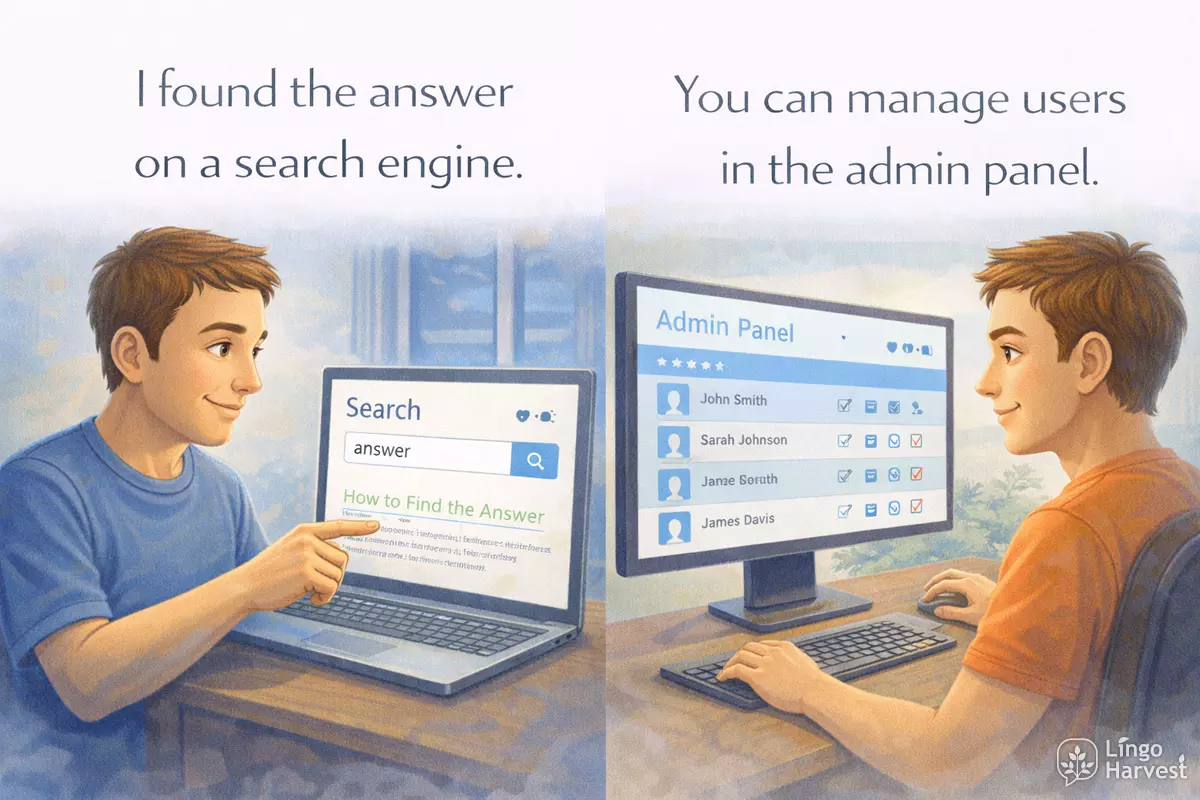
| ___ a search engine | on | I found the answer on a search engine. |
| ___ a landing page | on | The signup form is on the landing page. |
| ___ a video platform | on | The tutorial is available on a video platform. |
| ___ a user profile | on | You can update your photo on your user profile. |
| ___ a public page | on | The announcement is posted on a public page. |
| ___ a checkout page | on | The discount code is entered on the checkout page. |
| ___ an online form | on | Please enter your details on the online form. |
| ___ the admin panel | in | You can manage users in the admin panel. |
| ___ the platform dashboard | in | The statistics are shown in the platform dashboard. |
| ___ the settings menu | in | You can disable notifications in the settings menu. |
| ___ a mobile interface | in | The button appears only in the mobile interface. |
| ___ an attachment | in | The invoice is in the attachment. |
| ___ the subject line | in | Please write the order number in the subject line. |
| ___ an online conference | at | She spoke at an online conference last week. |
| ___ a virtual meeting | at | We agreed on the timeline at the virtual meeting. |
| ___ a live workshop | at | He asked a great question at the live workshop. |
Some expressions may sound odd if the wrong preposition is chosen. For example, we say "on the internet" ✅ but not "in the internet" ❌. For digital addresses or events, "at" is sometimes appropriate, as in "at the online seminar."
Tips for choosing the right preposition
- Use on for platforms, general web locations, and public spaces.
- Use in for contained experiences or private spaces, such as chats or apps.
- Use at for specific addresses, scheduled digital events, or pinpointed locations.
Understanding these patterns helps your digital communication sound more natural and accurate.
On vs in with platforms, apps and services
When talking about digital spaces, choosing between "on" and "in" can be confusing. The right preposition often depends on whether you view the platform or app as a surface you interact with, or a space you participate within. English speakers tend to use "on" for services or sites seen as platforms or channels, and "in" for those experienced more like contained environments or communities.
Common Usage Patterns
Generally, we say "on" for social media platforms, websites, and services that act like virtual noticeboards or stages. In contrast, "in" is used when describing participation inside specific groups, games, or closed environments.
- on Facebook → I saw the announcement on Facebook.
- on Twitter/X → He shared the news on Twitter/X.
- on Instagram → She posted the photo on Instagram.
- on YouTube → The tutorial is available on YouTube.
- on Zoom (for a call or meeting) → We will discuss the project on Zoom.
- on LinkedIn → She updated her profile on LinkedIn.
- on WhatsApp (when referring to the platform generally) → I contacted him on WhatsApp.
- in a Facebook group → The question was answered in a Facebook group.
- in a WhatsApp chat → He explained the issue in a WhatsApp chat.
- in an app (general use: "in the app") → You can change the settings in the app.
- in a Zoom meeting (the event itself) → She asked the question in the Zoom meeting.
- in a game (e.g., "in Minecraft") → I built a house in the game.
- in Google Docs → The document is stored in Google Docs.
- on Google Drive (the platform) → The file is saved on Google Drive.
- in the cloud → All backups are stored in the cloud.
- on the cloud platform → The service runs on the cloud platform.
Comparing Usage: Platform vs. Space
Sometimes, both prepositions are possible, but the meaning shifts slightly. For example, "on Slack" (using the platform) vs. "in a Slack channel" (inside a specific space). Here’s a comparison to clarify:
| Preposition | Typical Usage Example |
|---|---|
| on | on Instagram, on YouTube, on LinkedIn, on Reddit |
| in | in a group chat, in a subreddit, in a Zoom meeting, in Discord |
| on | on a website, on a forum, on Spotify |
| in | in an app, in a shared document, in a playlist |
Tips for Choosing the Right Preposition
Think about whether you’re talking about the overall service (use "on") or a specific part or feature where interaction happens (use "in"). For example:
- “I saw it on Reddit” → refers to the platform.
- “We chatted in a subreddit” → refers to a specific community.
- “I’m on WhatsApp” → means you use the app.
- “I sent it in the WhatsApp group” → a particular conversation.
Remember, usage can shift as platforms evolve or depending on regional preferences, but these guidelines will cover most everyday digital contexts.
Prepositions with posts, messages and comments
When interacting online—whether you’re sharing an update, replying to a message, or reacting to someone’s comment—certain prepositions tend to appear repeatedly. Choosing the right preposition helps clarify what you’re doing and where your action is directed. Let’s look at common patterns and how prepositions function in these digital contexts.
Typical Prepositions Used in Digital Communication
To see how message-based language shifts between interaction and explanation, try a text interaction vs description analyzer and examine how your online writing balances dialogue and narration.
- on: on Facebook, on Twitter, on a forum, on a post, on a thread
- in: in a group, in a chat, in a discussion, in a comment section
- to: reply to a comment, send a message to someone, write to a user
- about: comment about a topic, post about an event
- under: comment under a post, reply under a thread
- at: mention someone at their handle (e.g., @username)
- for: write a message for someone, leave feedback for a service
- with: chat with friends, share a post with a group
- by: post by an author, comment by a user
- from: message from a friend, comment from a moderator
- via: send via messenger, reply via email
- over: argue over comments, discuss over messages
Common Patterns and Examples
The choice of preposition often depends on the platform and the action. Here are some frequent combinations:
- Leave a comment on a video.
- Post a question in the forum.
- Send a message to your colleague.
- Discuss the topic in the comments section.
- Reply to the last message.
- Tag someone in a photo.
- Mention a user with @.
- Receive feedback from the admin.
- Write a review about your experience.
- Share a link via direct message.
Quick Reference: Prepositions by Action
| Action | Preposition(s) & Example |
|---|---|
| Post | on (on Instagram), in (in a group) |
| Comment | on (on a blog), under (under a post) |
| Message | to (to a friend), via (via chat) |
| Reply | to (to a comment), in (in a thread) |
| Share | with (with followers), via (via messenger) |
| Mention | at (@username), in (in a comment) |
Remember, digital communication evolves quickly, so you might see new patterns emerge. However, these prepositions cover the vast majority of everyday online exchanges, helping you communicate clearly and naturally in digital spaces.
Email and chat-related preposition patterns
When communicating through email and instant messaging, certain prepositions appear more frequently or take on slightly different meanings than in traditional writing. Recognizing these patterns helps users express themselves more clearly and understand digital etiquette. The context of online correspondence often shapes which prepositions are preferred, especially when referring to attachments, replies, or message timing.
Common prepositions in digital messaging
Some prepositions are especially common when discussing actions or elements related to emails and chats. Here are typical uses:
- In – in an email, in a message, in the chat
- On – on WhatsApp, on Messenger, on Slack
- By – by email (method of communication)
- At – at 10:00 (time), at [email protected] (email address)
- To – send to, reply to, forward to
- With – with an attachment, with a link
- About – about the meeting, about your question
- From – from John, from the support team
- For – for your information, for review
- Regarding – regarding your request
- Over – over email (less common, but used in business English)
- Between – between us, between team members
- Under – under the subject line, under your message
- After – after your reply, after our call
- Before – before sending, before the meeting
- Within – within the chat, within the email thread
- Through – through email, through this channel
- Via – via email, via direct message
Prepositions and digital actions
Certain verbs in online communication naturally pair with specific prepositions. For example, you “reply to” a message, but “follow up on” a previous email. Getting these combinations right makes messages clearer and more professional.
| Action | Typical Prepositional Pattern |
|---|---|
| Reply | reply to a message |
| Forward | forward to a colleague |
| Attach | attach to an email / with an attachment |
| Send | send by email / send to someone |
| Discuss | discuss in a chat / about a topic |
| Follow up | follow up on an issue |
| Join | join in a conversation / on a call |
| Log in | log in to your account |
| Sign off | sign off on a thread |
| Refer | refer to a message |
Quick tips for digital prepositions
- Use in for the container: “in the chat,” “in the thread.”
- Use on for platforms: “on Skype,” “on Teams.”
- Use to for recipients: “send to John,” “reply to all.”
- Use by or via for channels: “by email,” “via Slack.”
- Use about or regarding for topics: “about your order,” “regarding the deadline.”
Mastering these small, context-driven differences helps your online communication sound natural and clear, making digital interactions smoother and more effective.
Examples from typical online communication
When interacting in digital spaces, English speakers use certain prepositions to describe actions, locations, and communication methods unique to the internet and technology. These patterns often differ from traditional offline usage, reflecting new habits and tools. Below are some common phrases and expressions that illustrate how prepositions adapt to the online world.
Common Phrases and Usage Patterns

- on the internet – “I read it on the internet.”
- in a chat – “Let’s discuss this in a chat.”
- on social media – “She posted it on social media.”
- at a website – “You can find it at our website.”
- by email – “Please send your feedback by email.”
- via Zoom – “We’ll meet via Zoom tomorrow.”
- through an app – “He booked the tickets through an app.”
- on a forum – “I asked a question on a forum.”
- in a group – “She shared the file in a group chat.”
- over text – “Let’s confirm over text.”
- on a call – “We talked on a call last night.”
- with emojis – “He responded with emojis.”
- from my phone – “I’m replying from my phone.”
- across platforms – “The event was promoted across platforms.”
- within a thread – “Please reply within the thread.”
- to a message – “She replied to a message quickly.”
- about the topic – “They chatted about the topic online.”
- between users – “The file was shared between users.”
Comparison of Prepositions in Digital vs. Offline Contexts
| Digital Context | Traditional Context |
|---|---|
| on the internet | in the library |
| in a chat | in a meeting |
| on a website | at a store |
| via email | by letter |
| on social media | in the newspaper |
Quick Tips
The choice of preposition can depend on the digital tool or platform. For example, “on” is most common with platforms and websites, while “in” is used for groups or chats. “Via” and “through” often signal the channel or medium. These patterns are now standard in online communication, so understanding them helps you sound natural and clear in digital conversations.
Practice: edit digital sentences to fix preposition errors
Editing sentences for preposition accuracy is an essential skill, especially when communicating in online and digital environments. Many learners confuse common digital prepositions, such as “on the internet,” “at a website,” or “in a chat,” which can lead to misunderstandings or awkward phrasing. Here, you’ll find exercises focusing on correcting these typical mistakes in the context of digital communication.
Common Preposition Mistakes in Digital Communication
Below are sentences with incorrect prepositions. Read each sentence and identify the preposition error. Rewrite the sentence with the correct preposition. This will help you internalize frequent patterns used in emails, forums, social media, and other digital platforms.
- I saw your message in Facebook yesterday.
- Can you find this article at the internet?
- She posted a photo in Instagram.
- Let’s meet in Zoom at 3 PM.
- He read the news on the his phone.
- I sent you the document on email.
- There’s a new update in the website.
- We chatted at WhatsApp last night.
- She commented at my post.
- He shared the file at Google Drive.
Show answers
- I saw your message on Facebook yesterday.
- Can you find this article on the internet?
- She posted a photo on Instagram.
- Let’s meet on Zoom at 3 PM.
- He read the news on his phone.
- I sent you the document by email.
- There’s a new update on the website.
- We chatted on WhatsApp last night.
- She commented on my post.
- He shared the file on Google Drive.
Spot the Error: Digital Preposition Quiz
Identify and correct the preposition mistakes in the following digital sentences:
- Let’s connect in LinkedIn.
- I found the answer in the website’s FAQ page.
- He joined the meeting at Teams.
- She watched the video in YouTube.
- I sent you the file in Google Drive.
- They discussed the issue at Zoom.
- She posted the announcement in Twitter.
- The photos are stored on the cloud server.
- He shared the link in Facebook.
- We talked about it at WhatsApp.
- The tutorial is available in the company website.
- I joined the conversation on a private chat.
- She left a comment in YouTube.
- The document is saved in Google Docs.
- They announced the update at LinkedIn.
Show answers
- Let’s connect on LinkedIn.
- I found the answer on the website’s FAQ page.
- He joined the meeting on Teams.
- She watched the video on YouTube.
- I sent you the file on Google Drive.
- They discussed the issue on Zoom.
- She posted the announcement on Twitter.
- The photos are stored in the cloud server.
- He shared the link on Facebook.
- We talked about it on WhatsApp.
- The tutorial is available on the company website.
- I joined the conversation in a private chat.
- She left a comment on YouTube.
- The document is saved in Google Docs.
- They announced the update on LinkedIn.
Practicing with real digital examples will help you avoid common preposition errors and communicate more naturally in online settings. Return to these exercises whenever you need a refresher.