Articles with Unique Situations and Context-Dependent “the”

 This article explains how the definite article the is used with unique contexts, local places, time expressions, and situations, plus when to omit it. Practice with context-based examples to improve your article usage in English.
- When context makes something unique
- Local shared knowledge: the station, the shop, the park
- Situational the in meetings, families, and workplaces
- The with time and setting: the weekend, the morning
- Recognizing when zero article is more natural
- Practice: choose or remove the in context-based examples
Knowing when to use the definite article is often more complicated than it appears, as context and unique situations can influence the correct choice. Mastering these subtle differences not only improves your command of English but also allows you to express yourself more clearly and accurately. By paying attention to how articles function in different contexts, you can develop a more nuanced understanding of the language and enhance your overall communication skills.
When context makes something unique
In English, the definite article “the” is often used not because something is universally one-of-a-kind, but because a particular situation or shared knowledge singles it out. The surrounding circumstances and what speakers know or assume play a crucial role. This means that even very common nouns can suddenly become specific, all thanks to context.
How shared understanding shapes usage
Speakers frequently rely on background information—either from previous conversation or from the environment—to decide when to use “the.” If both parties know which item is meant, “the” is appropriate, even if there are many such items in the world. For example, at a dinner table, “Pass the salt” refers to the specific salt shaker present, not salt in general.
Typical scenarios where context determines uniqueness
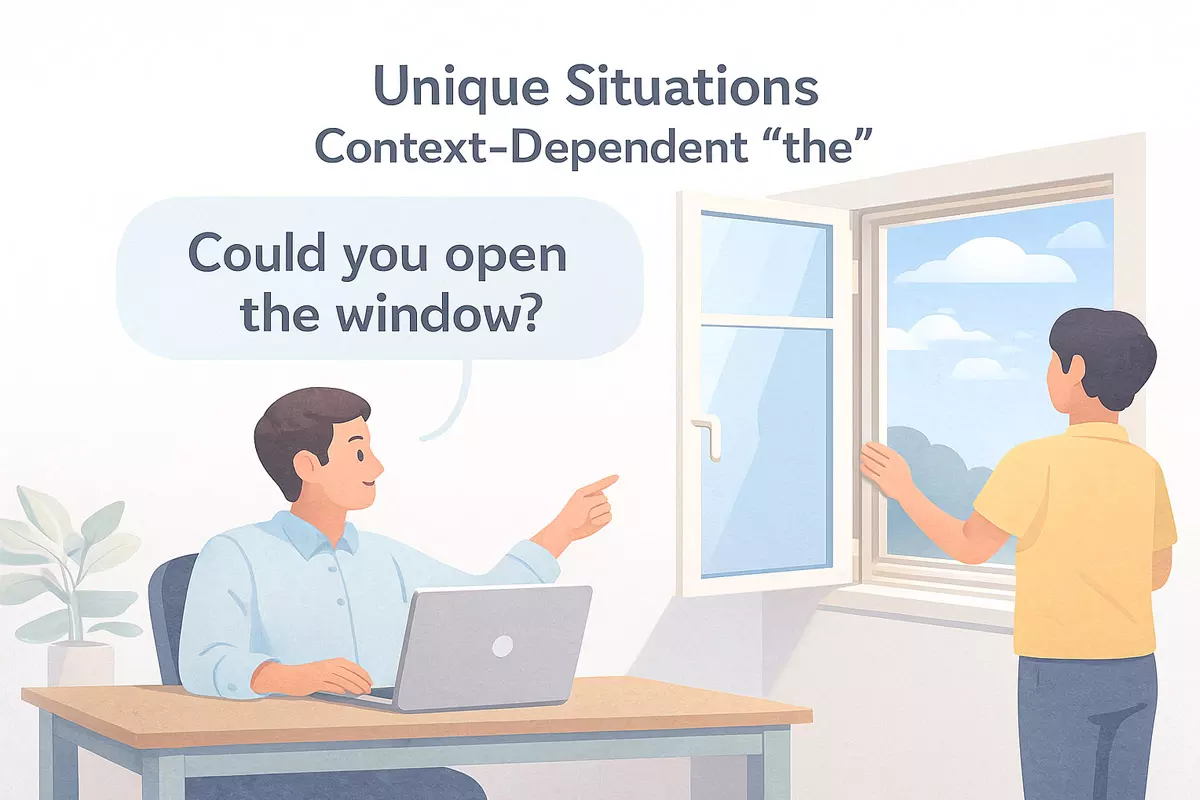
- In a room: “Could you open the window?” (the only window in that room)
- Shared experiences: “Remember the movie we saw last week?” (both know which movie)
- At work: “I left the file on your desk.” (a particular file both are aware of)
- Family context: “Call the doctor.” (the family’s usual doctor)
- Within an institution: “She’s at the hospital.” (the local or relevant hospital)
- Meals: “Dinner is on the table.” (the current meal in progress)
- Events: “Did you enjoy the concert?” (the one just attended)
- Household items: “The fridge is broken.” (the primary fridge in the household)
- Travel: “He missed the train.” (the scheduled train he was supposed to take)
- Documents: “Sign the contract.” (the specific contract under discussion)
- “The boss wants to see you.” (the person in charge at this workplace)
- “The kids are in the garden.” (the children both know about)
- “Turn off the light.” (the relevant light in the room)
- “The bus is late.” (the bus expected at this stop/time)
- “She’s reading the newspaper.” (the newspaper available today or in the room)
Comparing context-dependent and universal uniqueness
| Context-Dependent “the” | Universally Unique “the” |
|---|---|
| “Close the door” (the one in this room) | “The sun rises in the east” (only one sun for Earth) |
| “Where’s the car?” (the family’s car) | “The Moon orbits the Earth” (Earth’s only moon) |
| “Meet me at the station” (the local station) | “The internet has changed society” (refers to the global system) |
| “Turn on the TV” (the television in this room) | “The North Pole is cold” (only one North Pole) |
Understanding how situational factors influence the use of “the” helps learners grasp why the same object may or may not require the article, depending on what’s assumed to be unique in a given moment. This flexibility is a hallmark of real English communication.
Local shared knowledge: the station, the shop, the park
English speakers often use the definite article “the” with places such as “station,” “shop,” or “park” even when these locations haven’t been mentioned before. This happens when both the speaker and listener share an understanding of which specific place is meant, based on context or local knowledge. The article signals that the place is unique or obvious in the situation, not just any random one.
Shared context and the definite article
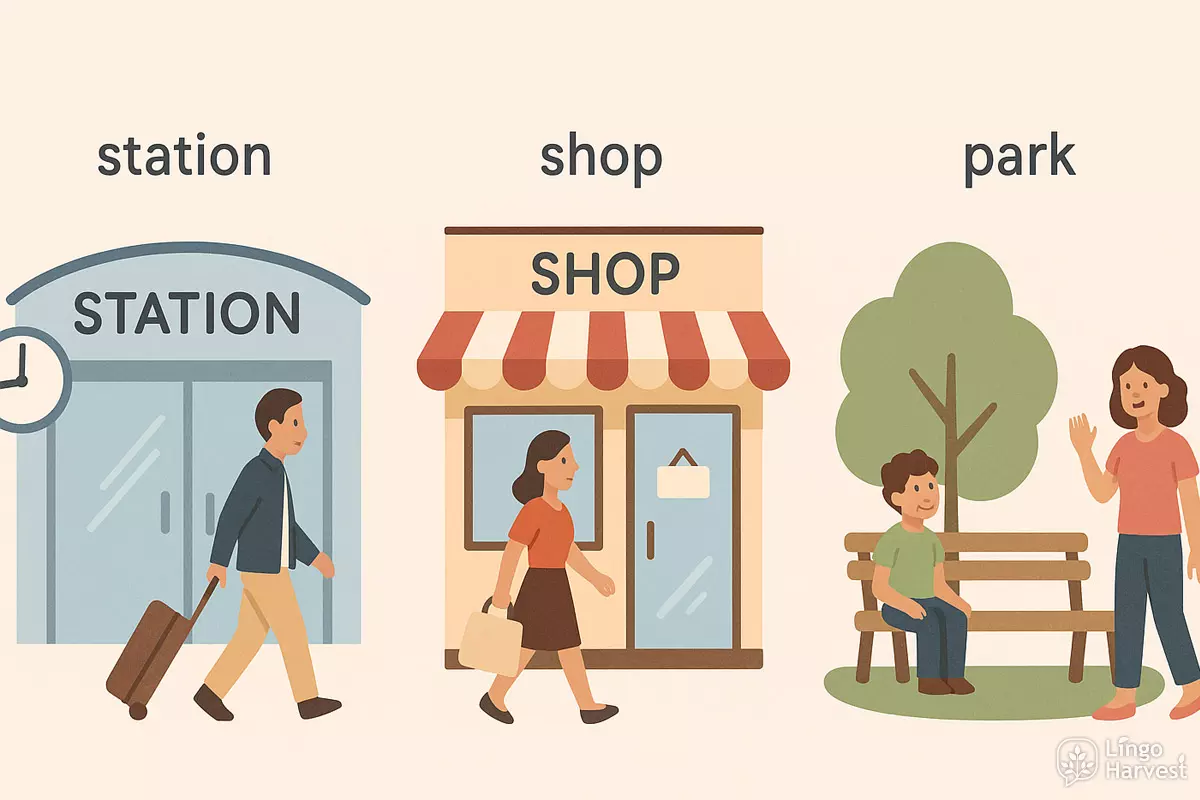
If you’re in a small town with only one railway station, saying “I’m going to the station” is clear. No one needs to specify which station—it’s the one everyone uses. The same logic applies to “the shop” (the main local store) or “the park” (the usual public green space nearby).
- Let’s meet at the station at 6.
- I’ll see you in the park after lunch.
- She’s gone to the shop for some bread.
- He’s at the post office.
- We had coffee at the café on the corner.
- The children are in the playground.
- Meet me at the bus stop.
- They went to the hospital.
- I’ll wait at the entrance.
- Let’s walk to the river.
- The cinema is showing a new film.
- The library closes at 5.
- We saw each other at the market.
- The bakery has fresh bread today.
Why does this happen?
This pattern relies on what’s known or assumed in the local context. Even if there are technically several parks or shops in a city, “the” refers to the one both people expect. This is different from using “a” or no article, which would refer to any park or shop, not a particular, shared one.
Comparing usage: definite vs. indefinite
| Definite Article (“the”) | Indefinite/No Article |
|---|---|
| I’m going to the shop (the usual one we both know). | I’m going to a shop (any shop, not specified). |
| Let’s meet at the station (the main one in town). | Let’s meet at a station (any station, not clear which one). |
| The children are in the park (the local park everyone uses). | There’s no article in “Children love parks” (parks in general). |
| She’s at the hospital (the one nearby). | She works in a hospital (any hospital, not specified). |
Recognizing when “the” refers to shared or local knowledge is crucial for sounding natural in English. This context-dependent use of the definite article is a subtle but important aspect of fluent communication.
Situational the in meetings, families, and workplaces
The definite article “the” often takes on unique roles depending on the context—especially in group settings such as office meetings, family conversations, and workplace interactions. Its use can signal shared understanding, highlight specific objects or people, or mark a concept as unique within the group’s experience. These nuances sometimes confuse learners, but understanding the social dynamics at play can help clarify when “the” is required.
Contextual Examples in Group Settings
- During a meeting: “Let’s discuss the proposal.” (Refers to the proposal everyone just read or has in mind.)
- Within families: “Can you pass the salt?” (Implies the salt on the table right now.)
- At work: “Have you seen the new guidelines?” (Refers to a specific set of guidelines everyone is expected to know.)
- Project teams: “Did you update the spreadsheet?” (There’s only one spreadsheet relevant for this task.)
- Among friends: “Who brought the cake?” (The cake known to all present.)
- Family routines: “I’ll take the car.” (The only car or the one usually shared.)
- Meetings: “Let’s move to the next item.” (The agreed-upon agenda.)
- Office life: “Where’s the coffee machine?” (The main or only coffee machine everyone uses.)
- School: “He’s the teacher.” (The teacher for this class.)
- Daily chores: “Who took out the trash?” (The household trash everyone contributes to.)
- Shared tools: “I need the stapler.” (The one stapler commonly used.)
- Family pets: “Feed the dog.” (The family’s only dog.)
How Context Shapes “the”
Usage of “the” in such settings depends on whether the item, person, or topic is understood as unique or previously mentioned within the group. For example, “the agenda” refers to the specific list everyone is following, while “the room” might mean the meeting room everyone knows. Omitting “the” here would make the sentences less precise or even confusing.
Comparison Table: How “the” Functions in Different Settings
| Setting | Purpose of “the” |
|---|---|
| Meetings | Refers to shared documents, agenda, or topics everyone is aware of. |
| Family | Identifies household items, routines, or family members commonly known. |
| Workplace | Points to tools, spaces, or policies familiar to the group. |
| Social Gatherings | Highlights objects or people relevant to the current situation. |
The with time and setting: the weekend, the morning
English often uses the definite article “the” with certain time expressions and settings, especially when referring to familiar periods or shared experiences. This is common with phrases like “the weekend” or “the morning,” where the reference is either specific or contextually understood. The article helps listeners and readers recognize these periods as defined, even if the exact time isn’t stated.
Common expressions with “the” and time or setting
When describing times of day, parts of the week, or recurring settings, “the” signals that both speaker and listener know which period is meant. Here are some frequent examples:
- the afternoon
- the evening
- the night
- the weekend
- the holidays
- the past (week/month/year)
- the future
- the present
- the middle of the night
- the start of the day
- the end of the week
- the spring
- the winter
- the summer holidays
- the early morning
- the late afternoon
- the morning rush
- the lunchtime break
- the school year
- the exam period
- the weekend shift
- the workday
- the rush hour
- the beginning of the month
- the middle of the week
- the end of the month
- the whole day
- the next morning
- the previous night
- the coming week
- the rainy season
- the dry season
- the cold months
- the heat of the day
- the first half of the year
Why use “the” with these times?
The definite article is used because the period is understood or unique in context. For example, “the morning” refers to the morning of the day being discussed, not just any morning. Similarly, “the weekend” typically means the upcoming or most recent weekend that both people know about.
Comparing usage: with and without “the”
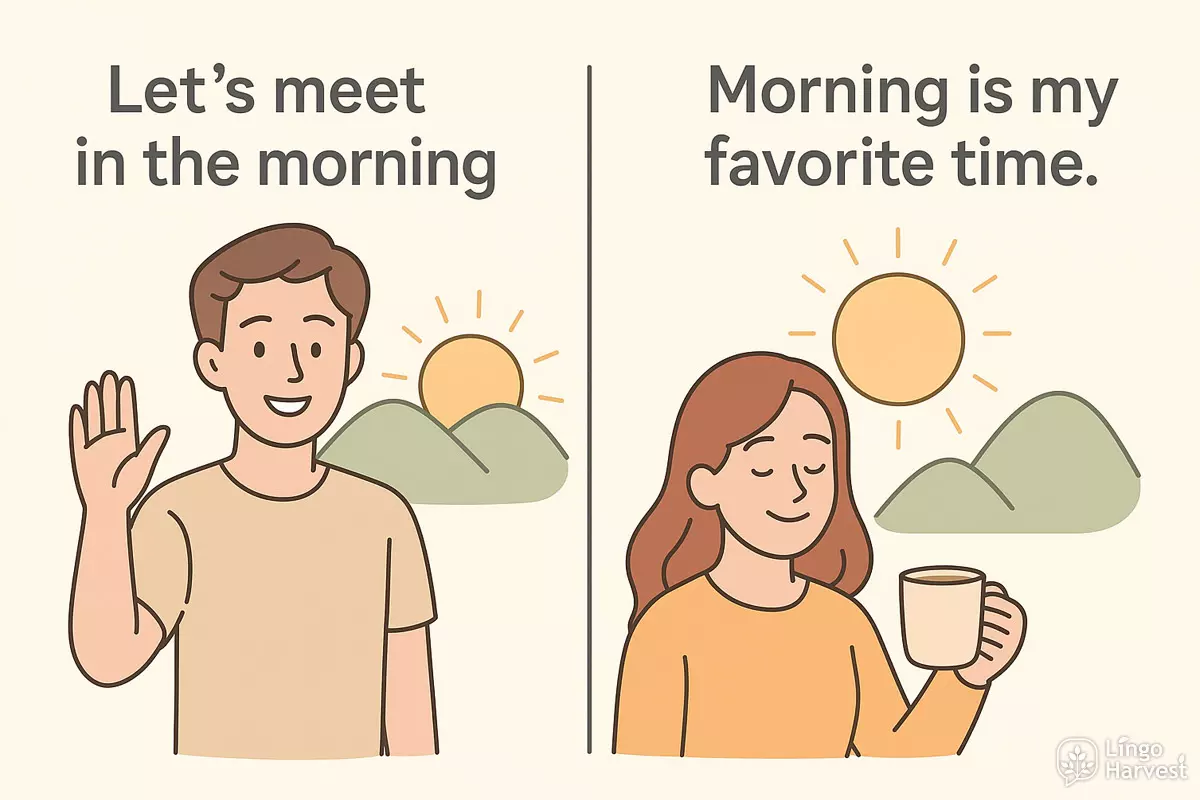
Some time expressions can appear both with and without the article, depending on whether the speaker means a general concept or a specific instance.
| With “the” | Without “the” |
|---|---|
| Let’s meet in the morning. (the next morning or a known morning) |
Morning is my favorite time. (in general, any morning) |
| I’ll see you at the weekend. (the coming or last weekend) |
Weekends are usually quiet. (all weekends in general) |
| She enjoyed the holidays. (a specific holiday period) |
Holidays are important for rest. (all holidays, generally) |
| He works best in the evening. (the evening of a certain day) |
Evening is a peaceful time. (evenings in general) |
Special notes and exceptions
Some expressions never take the article, such as days of the week (“on Monday”), months, or “at night” (which is a set phrase). However, when specifying a particular period, “the” becomes necessary: “the Monday before Christmas,” “the night we met.”
In summary, using “the” with time and setting expressions helps clarify which period or context is meant, especially when both parties share an understanding of the reference.
Recognizing when zero article is more natural
In English, omitting articles—using what’s called the “zero article”—often sounds more natural in specific situations. This typically happens with generalizations, certain proper nouns, and when discussing things in an abstract or categorical way. Understanding these patterns helps you choose between “the,” “a/an,” and no article at all.
Common contexts for zero article usage
- Talking about things in general: Books are expensive. (Not The books unless you mean specific ones.)
- Meals and times of day: We have breakfast at sunrise.
- Languages and subjects: She speaks French. He studies biology.
- Most countries, cities, and continents: Canada, London, Asia (but the Netherlands, the United States)
- Names of people and companies: Microsoft released a new product.
- Sports and games: They play tennis on weekends.
- Modes of transport (with “by”): I go to work by train.
- Abstract nouns used in a general sense: Freedom is important.
- Plural and uncountable nouns when talking about things in general: Apples are healthy. Information travels fast.
- Days, months, holidays: She left on Monday. We celebrate Christmas.
- Most illnesses: He has flu. (But a cold.)
- Routines and institutions (school, prison, hospital): She’s in school. He’s in prison.
- With “home,” “work,” “bed”: He went home early. She’s at work.
Comparing “zero article” and “the”
| Zero Article Example | “The” Example |
|---|---|
| Children need love. ✅ | The children in this room need love. → Specific group |
| Music relaxes me. ✅ | The music you played was beautiful. → Specific music |
| She’s in hospital. ✅ (UK English) | She’s in the hospital. → Refers to a specific hospital |
| He studies history. ✅ | He read the history of Rome. → Specific history |
| Water is essential. ✅ | The water in this bottle is cold. → Specific water |
It’s useful to notice that using no article often signals you are talking about things as categories, concepts, or in their most general sense. When you specify or limit the meaning, “the” becomes necessary. Paying attention to these patterns will help your English sound more fluent and natural in both spoken and written contexts.
Practice: choose or remove the in context-based examples
Understanding when to include or omit “the” depends on context, specific meaning, and whether you’re referring to something unique or general. Let’s apply this with targeted exercises and real-world scenarios. Read each sentence or phrase below and decide: should “the” stay, be removed, or added for correct usage? Pay attention to how context changes the need for “the.”
Choose or remove “the” in these sentences
- ___ Mount Everest is the highest mountain in the world.
- I went to ___ hospital to visit my friend.
- Paris is ___ capital of France.
- ___ water in this glass is cold.
- She studies at ___ university in London.
- ___ sun rises in the east.
- He’s listening to ___ music you recommended.
- ___ life can be unpredictable.
- My brother works in ___ bank on Main Street.
- ___ apples are my favorite fruit.
- We saw ___ Queen when we visited England.
- ___ Amazon is the largest rainforest on Earth.
- ___ students in this class are very motivated.
- She loves ___ chocolate more than anything.
- ___ internet has changed how we communicate.
- He went to ___ school to pick up his sister.
- ___ dogs are loyal animals.
- ___ air in this room feels fresh.
- ___ Lake Baikal is in Russia.
- ___ patience is a virtue.
Show answers
- The Mount Everest is the highest mountain in the world. ✅ (keep “the”)
- I went to the hospital to visit my friend. ✅ (add “the”)
- Paris is the capital of France. ✅ (add “the”)
- The water in this glass is cold. ✅ (keep “the”)
- She studies at a university in London. ❌ (remove “the”; use “a” for general reference)
- The sun rises in the east. ✅ (keep “the”)
- He’s listening to the music you recommended. ✅ (keep “the”)
- Life can be unpredictable. ❌ (remove “the”; general concept)
- My brother works in the bank on Main Street. ✅ (add “the”)
- Apples are my favorite fruit. ❌ (remove “the”; general category)
- We saw the Queen when we visited England. ✅ (keep “the”)
- The Amazon is the largest rainforest on Earth. ✅ (keep “the”)
- The students in this class are very motivated. ✅ (keep “the”)
- She loves chocolate more than anything. ❌ (remove “the”; general)
- The internet has changed how we communicate. ✅ (keep “the”)
- He went to the school to pick up his sister. ✅ (add “the”)
- Dogs are loyal animals. ❌ (remove “the”; general category)
- The air in this room feels fresh. ✅ (keep “the”)
- Lake Baikal is in Russia. ❌ (remove “the”; most lakes do not use “the”)
- Patience is a virtue. ❌ (remove “the”; general concept)
Patterns and Context Clues
- Use “the” with unique objects: the sun, the internet, the Queen.
- Omit “the” for general categories: Dogs are loyal, Apples are healthy.
- Include “the” for specific, previously mentioned, or defined items: the water in this glass, the students in this class.
- Avoid “the” with most proper nouns (cities, most countries, lakes): Paris, Lake Baikal.
- Use “the” with superlatives and ordinal numbers: the highest mountain, the first time.
- Don’t use “the” before meals, languages, or academic subjects: She speaks French. I had breakfast.
- Use “the” with names of oceans, rivers, and mountain ranges: the Amazon, the Alps.
- Omit “the” before most street names: Main Street.
- Include “the” with organizations when the name requires it: the United Nations.
- Don’t use “the” with general ideas or abstract concepts: Life is beautiful. Patience is important.