Can vs Could: Ability and Possibility Differences

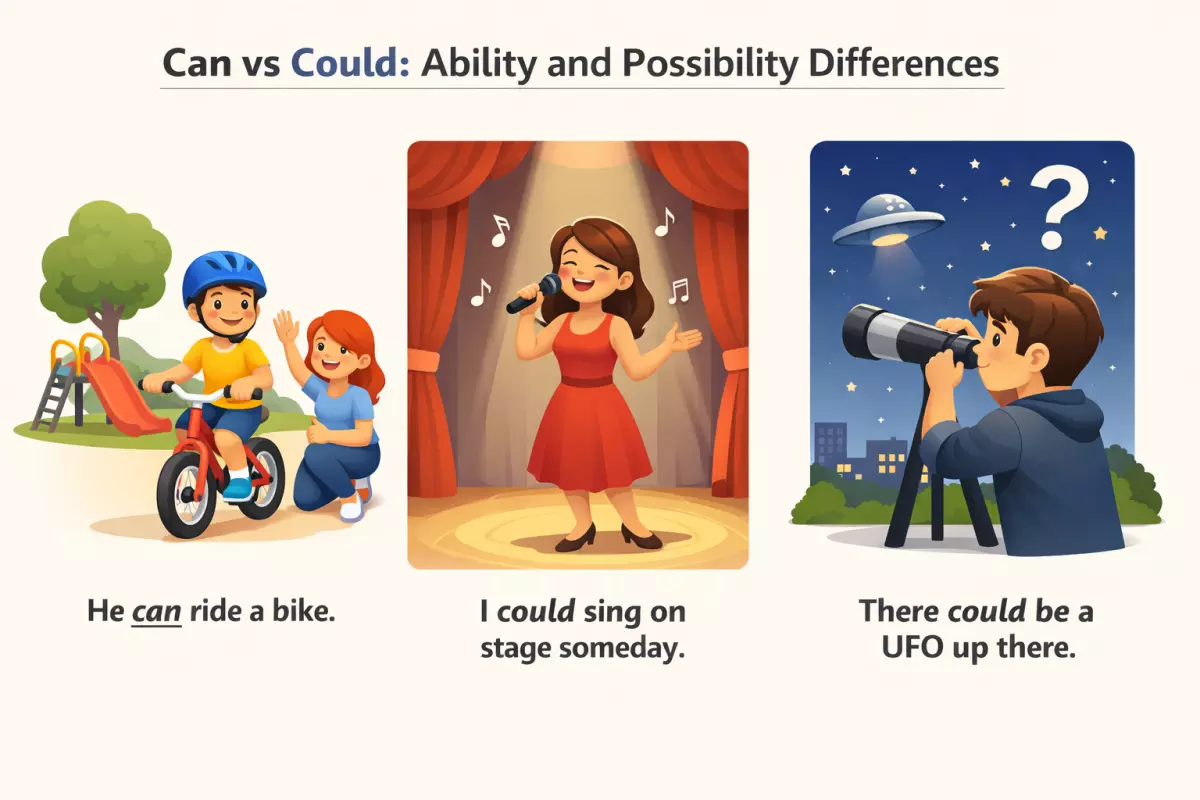 This article explains the key difference between can and could, showing can for present ability and could for past ability, how both express possibility, and how could sounds more polite in requests and offers. It also covers cases where only can fits, common learner mix-ups, and practice exercises.
- The basic meaning difference between can and could in English
- How can expresses present ability while could often refers to past ability
- Using can and could to talk about possibility in different situations
- How both verbs appear in polite requests and everyday offers
- How tone and politeness change when could replaces can
- Situations where only can sounds natural in modern speech
- Typical learner confusion when choosing between can and could
- Exercises and practice activities comparing can and could usage
Many learners confuse can and could because both relate to ability or possibility. In everyday speech, the choice often shows time and tone: can usually refers to a current, direct skill or option, while could sounds more tentative or polite, or points to an earlier situation. Noticing these cues helps your sentences sound more natural and confident.
The basic meaning difference between can and could in English
Can most often presents something as real, available, or generally true now, while could usually adds distance: it can sound more tentative, more polite, more hypothetical, or tied to the past. The choice is less about “grammar rules” and more about the speaker’s stance—how certain, direct, or immediate they want to be.
Core contrast: direct vs. distanced meaning
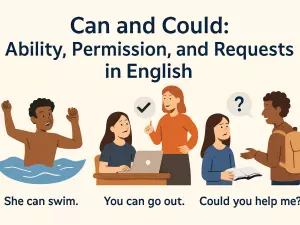
- Current ability: can = ability is true now. “I can swim.”
- Past ability (general): could = ability existed in the past. “When I was a kid, I could swim for hours.”
- Possibility (stronger / more immediate): can = something is possible in a practical sense. “It can get cold here at night.”
- Possibility (weaker / more tentative): could = something is possible but less certain. “It could get cold later.”
- Polite requests: could is usually softer than can. “Could you open the window?” (more courteous than “Can you…?”)
- Permission (informal): can often gives/asks permission in everyday speech. “You can leave early.” / “Can I sit here?”
- Permission (more formal/indirect): could can sound more respectful or cautious. “Could I speak with you for a moment?”
- Hypothetical situations: could fits imagined conditions. “If we left now, we could catch the earlier train.”
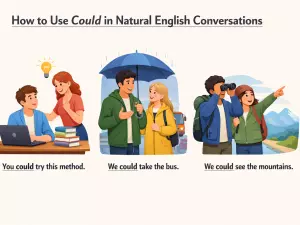
- Suggestions and options: could proposes one possibility among others. “We could try a different route.”
- Offers (gentler tone): could often reduces pressure. “I could help you after lunch, if you want.”
- Ability vs. successful action: could for a one-time past event can be ambiguous; for a successful result, English often prefers “was able to” or “managed to.” ✅ “I managed to fix it.” / ❌ “I could fix it” (if you mean you actually fixed it once).
- Negative forms: “can’t” commonly expresses strong impossibility or certainty. “That can’t be right.” “couldn’t” often sounds less absolute or refers to past limits. “I couldn’t reach you yesterday.”
Useful patterns to notice
- Can + base verb for present ability/permission: “She can drive.” “You can use my phone.”
- Could + base verb for past ability or polite distance: “She could drive at 16.” “Could you repeat that?”
- Could commonly appears with conditional language: “If… we could…” / “We could, but…”
- Could often pairs with “maybe” or “possibly” to signal uncertainty: “It could possibly rain.”
- Can often pairs with “always/never” for general truths: “Kids can be impatient.”
Quick example set (same situation, different meaning)
- “I can meet at 3.” (3:00 works; confident/straightforward)
- “I could meet at 3.” (3:00 is an option; slightly tentative or conditional)
- “Can you send the file today?” (direct request)
- “Could you send the file today?” (more polite/less forceful)
- “It can be dangerous.” (general possibility)
- “It could be dangerous.” (this specific case might be risky)
How can expresses present ability while could often refers to past ability
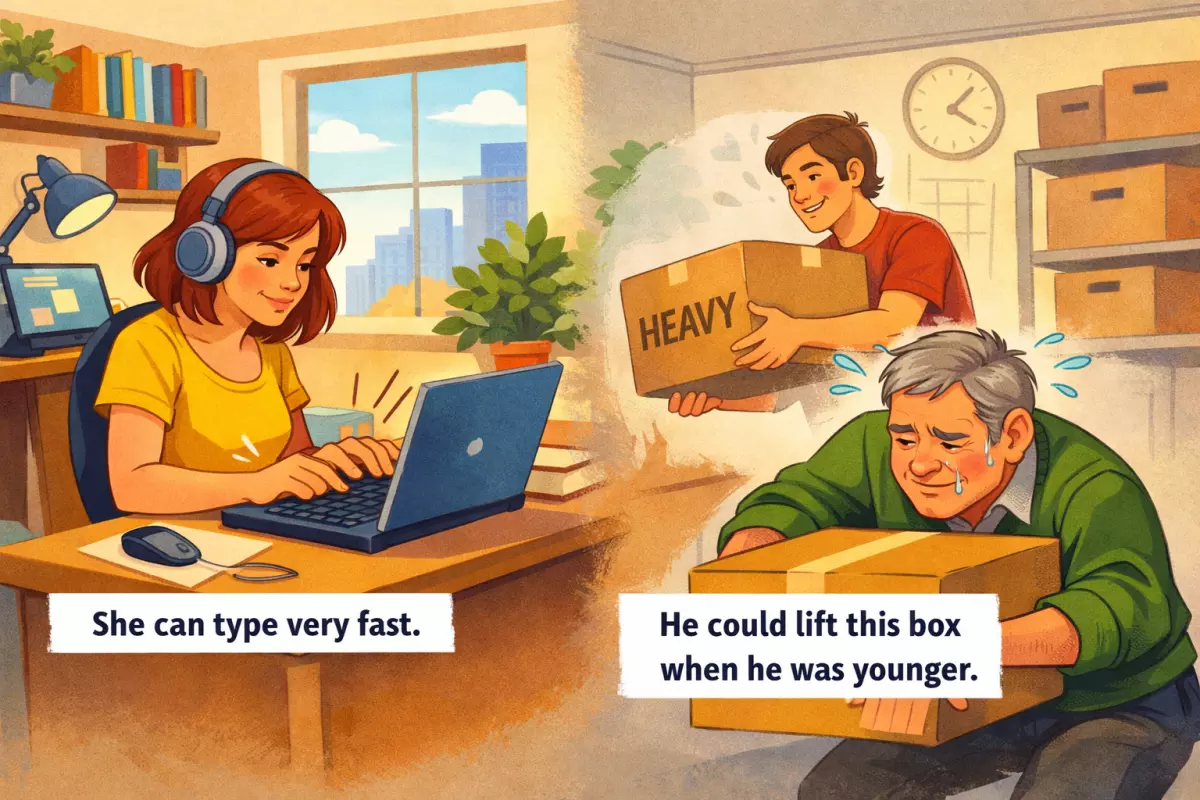
Can is the usual choice for ability that is true now or generally true. Could commonly points to ability in the past, especially when you are describing what someone was capable of at a particular earlier time. The difference is less about “strength” and more about the time frame and the speaker’s distance from the situation.
Typical patterns for present or general ability with can
- General skill: “She can type very fast.”
- Current capacity: “I can lift this box.”
- Learned ability: “He can read music.”
- Language ability: “They can speak Korean.”
- Physical ability (now): “I can run 5 km without stopping.”
- Mental ability (now): “I can concentrate better in the morning.”
- With negatives: “She can’t hear you from here.”
- With questions: “Can you swim?”
- With adverbs: “He can easily solve these puzzles.”
- With “be able to” as an alternative: “I can / am able to meet at 3.”
Typical patterns for past ability with could
- General past skill: “When I was a child, I could climb trees all day.”
- Past capacity: “After the operation, he could walk again.”
- Past language ability: “She could understand French, but she rarely spoke it.”
- Past permission/ability blend in context: “At that school, students could use the library until 8.”
- Negative past ability: “I couldn’t open the jar.”
- Past questions: “Could you read without glasses back then?”
- With time markers: “In 2019, we could work remotely only once a week.”
- With “never”: “He could never remember names.”
- With gradual change: “Over time, she could see the pattern more clearly.”
- With “be able to” for emphasis: “We could / were able to finish before dark.”
A key usage note: “could” for general past ability vs. one successful event
For a general ability in the past, could is natural: “I could swim when I was six.” But when you mean a single completed achievement (one specific occasion where it happened), English often prefers was/were able to rather than could, especially in affirmative sentences.
- ✅ General past ability: “I could swim when I was six.”
- ✅ One successful event: “I was able to swim across the river yesterday.”
- ❌ Less natural for one success: “I could swim across the river yesterday.”
- Negative is different: “I couldn’t find my keys” is fine for a single event (it means it did not happen).
Choosing quickly in real sentences
- Use can for what is true now: “I can’t talk right now.”
- Use could for what was true then: “I couldn’t drive before I took lessons.”
- If the context is “one time, and it worked,” consider was/were able to: “We were able to get tickets at the last minute.”
- Keep time words in mind (now, today, these days → can; back then, when I was…, in 2005 → could).
Using can and could to talk about possibility in different situations
When you talk about what is possible, can often points to a real, general, or present possibility, while could commonly signals a weaker, more uncertain, or more hypothetical one. The choice depends on how confident you are, whether the situation is real or imagined, and how polite or indirect you want to sound.
Common patterns and what they suggest
- General possibility (something is sometimes true): Use can to say a situation happens in general.
Example: “It can get noisy here on weekends.” - Weaker possibility (less certain): Use could when you mean “maybe” and want to sound less definite.
Example: “It could rain later.” - Future options and outcomes: Could is common for possible future results, especially when several outcomes are open.
Example: “If we leave now, we could catch the earlier train.” - Conditional possibility: In if-clauses and results, could often appears to show a potential result rather than a sure one.
Example: “If you adjust the settings, it could work better.” - Real-time ability vs. possible outcome: Can can mean “it is possible for me/you to do it now,” while could can shift focus to the outcome as only one possibility.
Example: “I can meet at 3.” / “I could meet at 3, but I’m not sure yet.” - Polite suggestions framed as possibility: Could often sounds softer than can when offering an idea.
Example: “We could try a different approach.” - Permission-based possibility: Can may imply permission in some contexts; could makes it more tentative or polite.
Example: “Can we park here?” / “Could we park here?” - Negative possibility (something is not possible): Can’t is strong (“impossible”); couldn’t can be either past impossibility or a softer claim depending on context.
Example: “That can’t be right.” / “That couldn’t be right.” - Logical conclusions: Can’t is common for strong deductions; could is used to keep the conclusion open.
Example: “She can’t be at work; it’s Sunday.” / “She could be at home.” - Speculating about causes: Could works well when you are guessing reasons without proof.
Example: “It could be a wiring issue.”
Useful sentence frames (with examples)
- It can + verb (general possibility): “This app can crash if the memory is low.”
- It could + verb (uncertain possibility): “This app could crash if the update didn’t install correctly.”
- There can be + noun (sometimes exists): “There can be delays during peak hours.”
- There could be + noun (maybe exists): “There could be a mistake in the report.”
- Can + subject + verb? (asking about possibility/permission): “Can the system handle more users?”
- Could + subject + verb? (more tentative question): “Could the system handle more users if we upgrade?”
- Subject can’t + verb (strong impossibility): “The file can’t open without the password.”
- Subject couldn’t + verb (past impossibility or cautious tone): “The file couldn’t open yesterday.” / “It couldn’t be that simple.”
- Could + verb (suggestion): “We could restart the router.”
- Could + have + past participle (past possibility): “They could have missed the email.”
- Can + have + past participle is usually not used for possibility in standard modern English (use could have, may have, or might have instead). ✅ “He could have forgotten.” ❌ “He can have forgotten.”
Choosing the right level of certainty
- Use can when you mean a realistic, present, or generally true possibility: “Prices can change without notice.”
- Use could when you want to keep options open, sound less certain, or talk about a hypothetical result: “Prices could change if demand increases.”
- Use can’t when you want to say something is not possible or you strongly doubt it: “That can’t be the correct address.”
- Use couldn’t when referring to past impossibility or when you want a slightly softer deduction: “That couldn’t be the correct address, could it?”
How both verbs appear in polite requests and everyday offers
In requests and small offers, can and could often refer less to literal ability and more to social tone. Can typically sounds direct and practical, while could adds distance that many speakers interpret as more polite, more tentative, or more considerate.
Polite requests: common patterns
Use these structures to ask for help, permission, or action. The choice mainly changes the level of softness, not the basic meaning.
- Can you + base verb for straightforward requests: “Can you email me the file?”
- Could you + base verb for a gentler request: “Could you email me the file?”
- Can I + base verb to ask permission in an informal way: “Can I leave a bit early?”
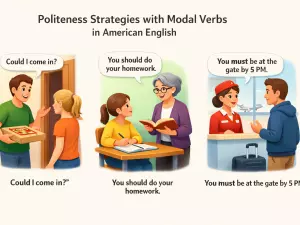
- Could I + base verb to sound more formal or cautious: “Could I leave a bit early?”
- Can you please + base verb to add courtesy while staying direct: “Can you please speak more slowly?”
- Could you please + base verb for extra politeness: “Could you please speak more slowly?”
- Can you + base verb + for me when the favor is personal: “Can you hold the door for me?”
- Could you + base verb + when you have a moment to reduce pressure: “Could you call me when you have a moment?”
- Can you + base verb + today when timing matters and urgency is acceptable: “Can you send it today?”
- Could you + base verb + by (time) for deadlines that still sound respectful: “Could you send it by 3 p.m.?”
- Can I just + base verb for quick, minor requests: “Can I just ask one question?”
- Could I possibly + base verb to sound very tentative (useful for bigger favors): “Could I possibly reschedule?”
Everyday offers: common patterns
With offers, can often signals readiness (“I’m able and willing”), while could often signals a suggestion or option (“this is available if you want it”).
- I can + base verb to offer help confidently: “I can carry that for you.”
- I could + base verb to offer help without assuming it’s needed: “I could carry that for you, if you like.”
- Can I + base verb to offer assistance by asking first: “Can I help you with that?”
- Could I + base verb to sound more formal or careful: “Could I help you with that?”
- I can + base verb + if you want to keep it casual: “I can drive, if you want.”
- I could + base verb + if that helps to frame it as an option: “I could take notes, if that helps.”
- We can + base verb for practical planning: “We can meet at 6.”
- We could + base verb for suggestions and alternatives: “We could meet at 6, or later.”
- You can + base verb to grant permission or make something available: “You can use my charger.”
- You could + base verb to suggest a possible choice (not permission-focused): “You could use my charger if yours is dead.”
Choosing the right level of politeness
- Use can when the situation is informal, the request is small, or directness is expected (friends, quick tasks, routine workplace messages).
- Use could when you want to reduce pressure, when you are speaking to a customer/stranger, or when the favor is larger.
- In very direct contexts, could can sound overly cautious; in very formal contexts, can can sound abrupt.
- For clarity, keep the verb in base form after both modals: ✅ “Could you send it?” ❌ “Could you sent it?”
- Add softeners to either modal when needed: “please,” “when you have a chance,” “if it’s not too much trouble,” or “whenever you’re ready.”
How tone and politeness change when could replaces can
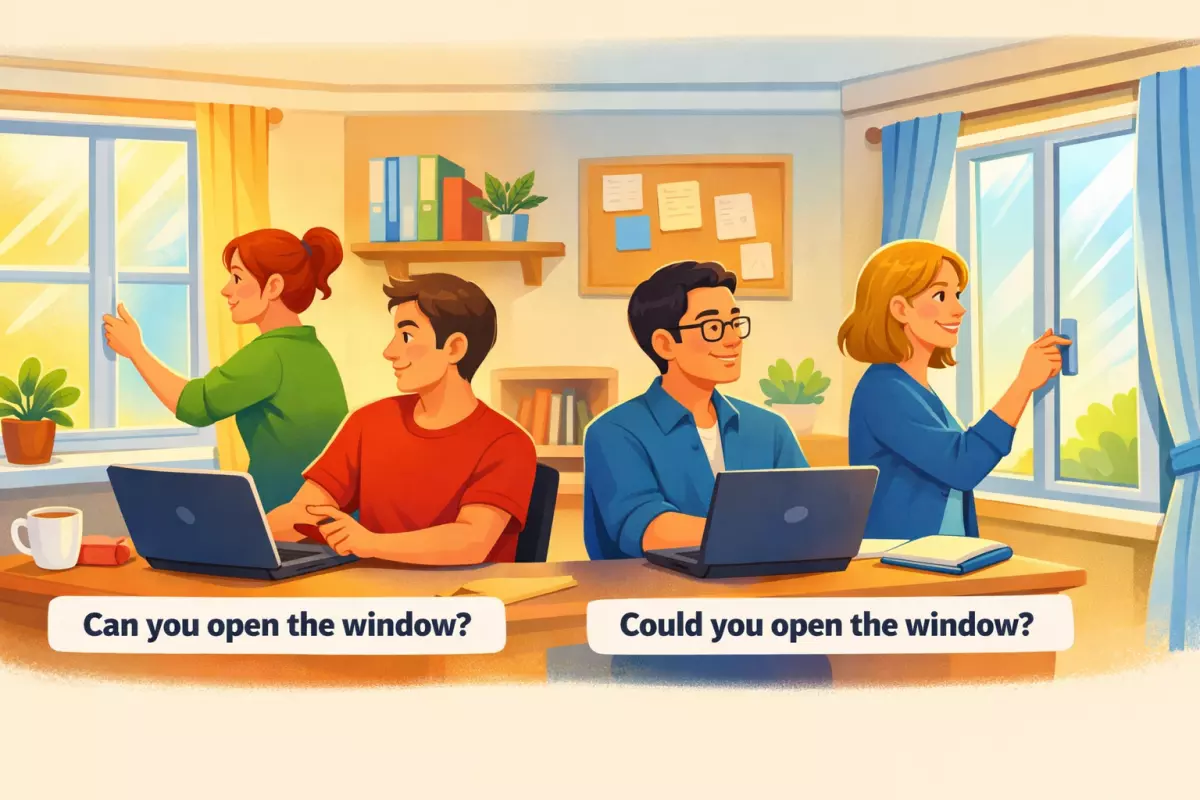
Switching from can to could often makes a sentence sound less direct. It can signal extra respect, soften a request, or create polite distance. In many contexts, the meaning stays similar (a request or a possibility), but the listener hears a different attitude: can tends to sound straightforward, while could tends to sound more tentative or considerate.
Common tone shifts when you choose could
- More polite requests: “Could you open the window?” usually sounds more courteous than “Can you open the window?”
- Less pressure: “Could you send it today?” can feel like a preference, not a demand.
- More formal or professional: In emails and service situations, could often fits better than can.
- More indirect (softer) questions: “Could I ask a question?” sounds like you’re checking permission gently.
- More tentative suggestions: “We could meet earlier” feels less forceful than “We can meet earlier.”
- More diplomatic disagreement: “That could be difficult” sounds less blunt than “That can be difficult.”
- More cautious possibility: “It could rain later” often implies uncertainty more than “It can rain later.”
- More respectful offers: “I could help if you’d like” feels less intrusive than “I can help.”
- More tactful instructions: “You could try restarting the app” sounds like advice, not an order.
- More “optional” framing: “Could you join us?” can suggest it’s okay to say no.
- More patient tone with reminders: “Could you take a look when you have time?” reduces urgency.
- More careful wording with sensitive topics: “Could we talk about the schedule?” feels gentler than “Can we talk about the schedule?”
Patterns that create politeness with could
- Could you + verb for requests: “Could you review this?” “Could you hold the door?”
- Could I + verb for permission: “Could I leave early?” “Could I use your phone?”
- Could we + verb for group proposals: “Could we reschedule?” “Could we clarify the plan?”
- Could you please + verb for extra courtesy: “Could you please confirm?” (Often used in writing.)
- Could you possibly + verb to soften further: “Could you possibly send the file again?” (Use sparingly; it can sound overly formal.)
- Would you be able to + verb as an even more indirect alternative when needed: “Would you be able to join the call?”
When can sounds better than could
- Simple ability (clear fact): “I can swim” states a straightforward skill; “I could swim” may sound hypothetical or past-related.
- Direct, efficient coordination: “Can you meet at 3?” is normal among friends or close teammates when brevity matters.
- Rules and permission statements: “You can park here” communicates allowed action clearly; “You could park here” can sound like a suggestion instead of permission.
- General truths: “It can get cold here” describes a common possibility; “It could get cold here” may imply a specific situation or forecast.
Avoiding common misunderstandings
- ✅ “Could you help me?” (polite request) → ❌ “Could you help me yesterday?” (time mismatch; use “Could you have helped…?” or “Could you help me now?”)
- ✅ “I could help later.” (availability/offer) → If you mean ability, use “I can help later” to sound more definite.
- ✅ “Could I speak to Jordan?” (polite permission/request) → In very casual settings, “Can I speak to Jordan?” is also acceptable and often more natural.
Situations where only can sounds natural in modern speech
In many everyday contexts, can is the default choice because the speaker is talking about a real, present possibility or a straightforward ability. Using could in these cases often adds an unintended layer of distance, tentativeness, or “not sure if it’s true,” which can sound off in modern, casual speech.
1) Stating a current, real ability (not hypothetical)
When the ability is true right now, can is usually the natural form. Could often shifts the meaning toward past ability or a conditional situation.
- ✅ I can swim. → a present ability
- ❌ I could swim. → often heard as “in the past” or “if needed”
- ✅ She can read music.
- ✅ They can speak Spanish pretty well.
- ✅ I can’t hear you—your mic is muted.
- ✅ He can’t come today; he’s sick.
2) Talking about what is possible right now (immediate situation)
For real-time options and practical possibilities in the present, can is typically preferred. Could
- ✅ We can meet at 3.
- ✅ You can park here after 6.
- ✅ I can do it today, but not tomorrow.
- ✅ We can’t start yet—the file isn’t ready.
- ✅ You can take the next train; it leaves in ten minutes.
- ✅ This phone can’t connect to Wi‑Fi right now.
3) Asking about permission in informal, modern usage
In everyday conversation, Can I…? is the common permission question. Could I…? is still correct, but it often sounds more formal, cautious, or polite.
- ✅ Can I borrow your charger?
- ✅ Can we leave a little early?
- ✅ Can I use your bathroom?
- ✅ Can I ask you something?
- ✅ Can we switch seats?
4) Offering help and making quick suggestions
When the speaker is proposing a simple, direct action, can sounds efficient and natural. Could may sound more tentative, which is not always the intended tone.
- ✅ I can help you with that.
- ✅ We can try restarting it.
- ✅ You can check the settings.
- ✅ I can call them and confirm.
- ✅ We can talk after lunch.
5) Stating rules, instructions, and allowed actions
Rules and instructions often use can to describe what is allowed or possible within a system (websites, devices, buildings, policies). Could usually weakens the instruction or makes it sound like a suggestion rather than a rule.
- ✅ You can reset your password in the account menu.
- ✅ Guests can enter through the side door.
- ✅ You can’t bring food into the lab.
- ✅ Students can submit late work with a penalty.
- ✅ You can view your invoice in the app.
6) “Can’t” for confident impossibility (strong conclusion)
Can’t is common when the speaker is sure something is impossible or not true based on evidence. Couldn’t is possible, but it can sound more context-dependent (past situation or conditional framing).
- ✅ That can’t be right—the totals don’t match.
- ✅ He can’t be serious.
- ✅ This can’t be the same model; the ports are different.
- ✅ You can’t mean Monday—we’re closed then.
7) Common fixed patterns where “could” changes the meaning
Some everyday phrases strongly prefer can because they refer to a direct sense, perception, or immediate reaction. Switching to could often shifts the time frame or makes it sound less immediate.
- ✅ I can see what you mean. (immediate understanding)
- ✅ I can tell you’re tired. (present evidence)
- ✅ I can hear music from next door. (right now)
- ✅ I can’t believe it. (strong reaction)
- ✅ I can’t wait. (impatience/excitement)
Typical learner confusion when choosing between can and could
Many mistakes come from mixing up time (present vs. past), politeness (direct vs. softened), and meaning (real ability vs. theoretical possibility). The forms look similar, but they signal different relationships to the situation: what is true now, what was true then, or what is only imagined.
1) Treating could as simply the past of can in every context
- Past ability (general): “When I was younger, I could run 10 km.” (general ability in the past)
- Single past success: learners often say “I could fix it yesterday” when they mean a one-time achievement. Prefer: “I was able to fix it yesterday.”
- Negative single event is different: “I couldn’t open the jar” is fine for a single attempt (failure is clear either way).
- Past permission is possible but context-dependent: “We could stay up late” can mean permission in the past, but it may also sound like “it was possible.” Add clarity if needed: “We were allowed to stay up late.”
2) Confusing ability with permission
- Ability: “I can swim.” (skill)
- Permission: “Can I leave early?” (allowed?)
- Polite permission: “Could I leave early?” (more tentative)
- Common mismatch: “I can go to the bathroom?” is often intended as permission; in formal settings, “May I…?” or “Could I…?” fits better.
- Answer patterns: “Yes, you can.” / “Yes, you may.” (In everyday speech, “can” is common; in formal rules, “may” is clearer.)
3) Using could for present ability (when it actually signals uncertainty or politeness)
- Present ability (straight): “I can help you today.”
- Present possibility (weaker): “I could help you today.” (maybe; depends on conditions)
- Polite offer: “I could help, if you’d like.” (softened)
- Common confusion: “I could speak English” may sound like “I’m not sure / only in theory” unless the past is clear.
4) Mixing up probability: can (general possibility) vs. could (less certain / conditional)
- General truth: “It can get very cold here in winter.” (sometimes happens)
- Specific, uncertain prediction: “It could get cold tonight.” (possible, not guaranteed)
- Conditional possibility: “If we leave now, we could catch the earlier train.”
- Overstating with can: “We can be late” often sounds like “it is possible in general,” not “we might be late today.”
5) Confusion in requests: directness vs. politeness, not time
- Direct request: “Can you send the file?” (common, neutral)
- More polite/soft: “Could you send the file?” (less pressure)
- Not past time: “Could you…?” usually refers to now/soon, not to the past.
- Very polite form: “Could you possibly…?” (extra softening; use when you need to be careful)
6) Missing the “unreal/imagined” meaning of could
- Suggestions: “You could try restarting your phone.” (one option, not a command)
- Hypotheticals: “I could move abroad if I found a job.” (not decided; depends)
- Wishes/regrets (with perfect): “I could have called you.” (but I didn’t)
- Criticism/regret: “You could have told me.” (you didn’t, and that’s the problem)
7) Form errors that create meaning errors
- ✅ “I can’t come.” → present inability / not possible now
- ✅ “I couldn’t come.” → past inability, or polite refusal in some contexts
- ❌ “I can to go.” → modals don’t take “to” before the verb (use “can go”)
- ❌ “I could went.” → use base verb after modals (“could go”)
- ✅ “I can go.” / “I could go.” → base verb pattern stays the same
A practical check is to ask what you mean: a real skill right now (use can), a past general ability (use could), a polite request (often could), or a possibility that depends on conditions (often could). This meaning-first approach prevents many of the common mix-ups.
Exercises and practice activities comparing can and could usage
Choose between can and could by checking the time reference (now vs. past), the meaning (ability, permission, possibility), and the level of politeness. The activities below focus on common patterns learners use in everyday speaking and writing.
1) Quick choice: fill in the blank
Complete each sentence with can or could. Use only one word.
- I ______ swim, but I’m not very fast.
- When I was five, I ______ ride a bike.
- ______ you open the window, please?
- It ______ rain later, so bring a jacket.
- He ______ be at the office; his car is outside.
- She ______ speak three languages when she lived abroad.
- ______ I leave early today?
- We ______ meet tomorrow if you’re free.
- They ______ hear the announcement from the back of the room.
- You ______ try restarting your phone if the app freezes.
- I ______ help you now, but I’ll be free after lunch.
- My grandparents ______ use a computer, but they prefer tablets.
Show answers
- can
- could
- could
- could
- could
- could
- can
- can
- could
- could
- can
- can
2) Meaning check: identify the function
For each sentence, decide what the modal is doing: ability, permission, request, possibility/guess, or suggestion.
- Could you send me the file by 3 p.m.?
- I can’t come tonight; I have a deadline.
- It could be a scam, so don’t click the link.
- Can I borrow your charger for a minute?
- She could read at age four.
- You could ask the receptionist for directions.
- He can run 10 km without stopping.
- We could be late if traffic is heavy.
Show answers
- request
- ability (negative ability / inability in the present)
- possibility/guess
- permission
- ability (past ability)
- suggestion
- ability
- possibility
3) Rewrite practice: adjust politeness or time
Rewrite each sentence as instructed. Keep the meaning as close as possible.
- Make this request more polite: “Can you wait here?”
- Change to past ability: “I can read this handwriting.”
- Make the possibility less certain: “It can be dangerous at night.”
- Ask for permission more formally: “Can I use your phone?”
- Change to present ability: “When I was younger, I could stay up late.”
- Turn this into a suggestion: “You can take the train.”
- Make this sound like a stronger present conclusion: “He could be at home.”
- Change to a polite request: “Can you repeat that?”
Show answers
- Could you wait here?
- I could read this handwriting.
- It could be dangerous at night.
- Could I use your phone?
- Now I can stay up late.
- You could take the train.
- He can be at home. (or: He must be at home, if “stronger” is needed beyond can/could)
- Could you repeat that?
4) Error correction: fix the modal choice
Each sentence has one issue with can/could for the intended meaning. Rewrite it correctly.
- Could I leave now? (teacher to student, informal, friendly)
- When I was a child, I can climb trees very easily.
- Can you possibly help me with this form? (very polite tone)
- It can snow tomorrow, so the roads might close. (uncertain forecast)
- Sorry, I couldn’t come right now. (present-time refusal)
- Could you hear me now? (asking about current audio connection)
- He can be sick; he has a fever. (speaker is not fully sure)
- Can you mind if I sit here? (permission pattern)
Show answers
- Can I leave now?
- When I was a child, I could climb trees very easily.
- Could you possibly help me with this form?
- It could snow tomorrow, so the roads might close.
- Sorry, I can’t come right now.
- Can you hear me now?
- He could be sick; he has a fever.
- Do you mind if I sit here? (or: Can I sit here?)
5) Pattern drill: build sentences from prompts
Create complete sentences using the prompt. Use can or could to match the cue in parentheses.
- (present ability) / I / finish / this in ten minutes
- (past ability) / she / play the piano / at six
- (polite request) / you / speak more slowly
- (permission) / we / park / here
- (uncertain possibility) / the meeting / start late
- (suggestion) / you / check / the spam folder
- (present inability) / I / not / access / the website
- (general possibility) / too much sun / cause / burns
Show answers
- I can finish this in ten minutes.
- She could play the piano at six.
- Could you speak more slowly?
- Can we park here?
- The meeting could start late.
- You could check the spam folder.
- I can’t access the website.
- Too much sun can cause burns.
- ✅ Use can for present ability and straightforward permission: “I can drive.” / “Can I sit here?”
- ✅ Use could for past ability, polite requests, and weaker possibility: “I could swim at six.” / “Could you help?” / “It could rain.”
- ❌ Avoid mixing time signals: “When I was young, I can …” → “When I was young, I could …”
- ❌ Avoid using can when you clearly mean uncertainty: “It can rain tomorrow” (forecast) → “It could rain tomorrow.”