Articles in Idiomatic Expressions and Fixed Phrases

 The article defines fixed phrases and idioms, shows how some require or omit articles, compares zero-article idioms and those with the, explains why article use in idioms breaks rules, and suggests learning articles through memorizing set phrases.
Mastering the use of small words like "a," "an," and "the" in set expressions can be challenging, regardless of your English proficiency. These articles often appear in established phrases and common sayings in ways that do not always follow standard grammar rules, making them difficult to predict or use correctly. Understanding how and why articles are included or omitted in such expressions requires not just knowledge of grammar, but also familiarity with idiomatic usage and exposure to authentic language in context.
What fixed phrases and idioms are
Fixed phrases and idiomatic expressions are combinations of words with meanings not always predictable from their individual parts. These language units are often used by native speakers to convey ideas efficiently, colorfully, or in a way that reflects cultural nuances. Unlike regular word combinations, their structure and wording tend to remain the same, making them recognizable as set expressions.
Defining features
- Stability: The wording in these expressions rarely changes. For example, "kick the bucket" always uses "kick" and "bucket" in this order.
- Non-literal meaning: The overall meaning is often different from the sum of the words. "Break the ice" does not involve actual ice.
- Common usage: These expressions are widely understood within a language community, even if their origins are obscure.
- Memorization: Learners often need to remember them as whole units, since translating word by word can lead to confusion.
Types of fixed expressions
There are several types of set expressions, including idioms, collocations, proverbs, and phrasal verbs. Each type has its own characteristics, but all are considered “fixed” to some degree.
- Idioms: Phrases with figurative meanings, like "spill the beans" (reveal a secret).
- Collocations: Words that naturally go together, such as "make a decision" or "heavy rain."
- Proverbs: Traditional sayings that express general truths, e.g., "Actions speak louder than words."
- Phrasal verbs: Verbs combined with prepositions or adverbs, such as "give up" or "look after."
Examples of idiomatic and fixed phrases
- Let the cat out of the bag
- Piece of cake
- Under the weather
- Once in a blue moon
- Hit the nail on the head
- By and large
- Out of the blue
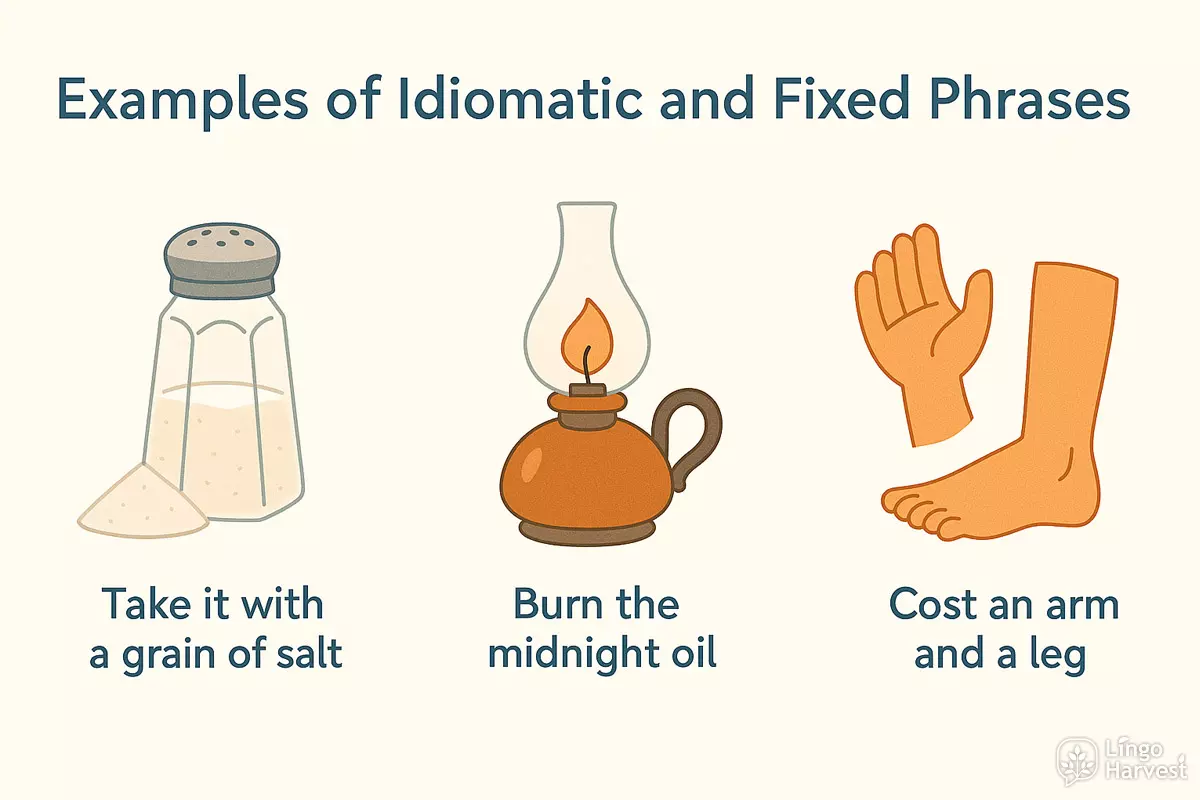
- Take it with a grain of salt
- Burn the midnight oil
- Cost an arm and a leg
- See eye to eye
- Bite the bullet
- On the same page
- Jump the gun
- Go the extra mile
- Back to the drawing board
- Let sleeping dogs lie
- Cut corners
- Break the bank
- Call it a day
Why do these expressions matter?
Using set phrases and idioms can make speech or writing sound more natural and fluent. They help express complex ideas succinctly and often add a touch of humor or vividness. For language learners, recognizing and understanding these expressions is crucial for comprehension and effective communication.
Expressions with frozen article use
Many fixed phrases and idioms in English contain articles that cannot be changed or omitted without altering the meaning or making the phrase ungrammatical. These are often called “frozen” uses because the article is an inseparable part of the expression, regardless of the usual grammar rules for articles in other contexts. Learners should pay attention to these set phrases, as trying to adjust the article can result in confusion or error.
Common idioms and set phrases with fixed articles
The following are widely used expressions where the definite or indefinite article is an essential part of the phrase. Memorizing these as whole units is often more effective than trying to analyze them word by word.
- in the morning / in the afternoon / in the evening
- on the whole
- in the long run
- in the meantime
- in the first place / in the second place
- at the moment
- to tell the truth
- on the other hand
- in the end
- by the way
- in the meantime
- on the contrary
- in a hurry
- have a good time
- take a seat
- make a mistake
- as a rule
- in a nutshell
- for the time being
- out of the question
How frozen articles affect meaning
Changing or omitting the article in these idioms usually makes the phrase incorrect or changes its meaning. For instance, “in morning” or “on whole” are not standard English, while “make mistake” sounds awkward and non-native.
Comparison of expressions with fixed and variable article use
Below is a table comparing phrases where the article is fixed (cannot be changed) with similar structures where the article is variable or omitted, highlighting the importance of memorizing these as set forms.
| Expression (Fixed Article) | Similar Structure (Variable or No Article) |
|---|---|
| in the morning | at sunrise |
| on the whole | generally |
| in a hurry | quickly |
| make a mistake | err |
| in the end | finally |
| have a good time | enjoy yourself |
| in the meantime | meanwhile |
| on the other hand | alternatively |
| take a seat | sit down |
| for the time being | temporarily |
Mastering these expressions with unchangeable articles is key to sounding natural in English. They often appear in both spoken and written language, and their fixed structure means learners should treat them as single lexical units. Practice using them in context to develop fluency and avoid common mistakes.
Zero-article idioms vs the-phrases
Many fixed expressions in English either omit the article entirely or require the definite article "the" as part of their idiomatic structure. Understanding which idioms use no article and which always take "the" helps learners sound more natural and avoid common grammatical mistakes.
Idioms without articles
Some set phrases and idioms never use an article, even though one might seem necessary based on literal meaning. These zero-article expressions often refer to common activities, locations, or routines. For example:
- go home
- at school
- be in hospital (BrE)
- by car
- go to bed
- at work
- on foot
- from start to finish
- go to prison
- in town
- take place
- have breakfast
- fall in love
- go abroad
- lose track
- make progress
- go to church
- play chess
These expressions typically refer to activities in a general sense, not to a specific instance or object.
Fixed phrases with "the"
In contrast, some idiomatic expressions always require "the," regardless of whether a specific object is meant. These often refer to things that are unique, understood by context, or institutionalized in meaning. Here are some common patterns:
- in the morning
- on the whole
- in the end
- on the other hand
- in the long run
- in the meantime
- in the same boat
- under the weather
- hit the nail on the head
- break the ice
- see the light
- on the spot
- read between the lines
- by the way
- take the plunge
- in the spotlight
- in the dark
- face the music
The article "the" is an essential part of these phrases and cannot be omitted without changing the meaning or making the expression unidiomatic.
Comparison: Patterns and Usage
| Zero-article Idioms | Idioms with "the" |
|---|---|
| go to bed | in the end |
| at work | on the whole |
| by car | under the weather |
| take place | break the ice |
| have breakfast | see the light |
| go to prison | by the way |
Practical tips
When in doubt, check if an idiom is a set phrase with its own grammatical rules. Memorizing common groups—such as daily routines without articles and expressions with "the"—will help you avoid errors. Not every noun will follow the same pattern in every context, so exposure and practice remain key.
Why idiomatic article choice often breaks rules
Idiomatic expressions and fixed phrases in English frequently ignore the usual grammar guidelines for articles (“a,” “an,” and “the”). Instead of following the typical logic, these set phrases preserve older patterns, borrow from other languages, or simply fossilize unusual usage. This means that even advanced learners can feel confused when a phrase seems to “break” the normal rules.
How idioms resist article logic
Many fixed expressions are used so often that their structure becomes fixed—even if it clashes with modern grammar. For example, we say “in hospital” (British English) instead of “in the hospital,” or “at sea” rather than “at the sea.” These forms are accepted simply because they have been repeated for generations.
Common patterns in article usage for idioms
- Some idioms drop the article entirely: go to bed, at school, on foot.
- Others use “the” where you might not expect it: in the long run, in the know.
- A few always use “a/an”: make a decision, take a break.
- Some phrases use articles differently in British and American English: in hospital (UK) vs. in the hospital (US).
Examples of idiomatic article choices
Notice how these set expressions handle articles in ways that may seem unpredictable:
- in a hurry
- by the way
- on the other hand
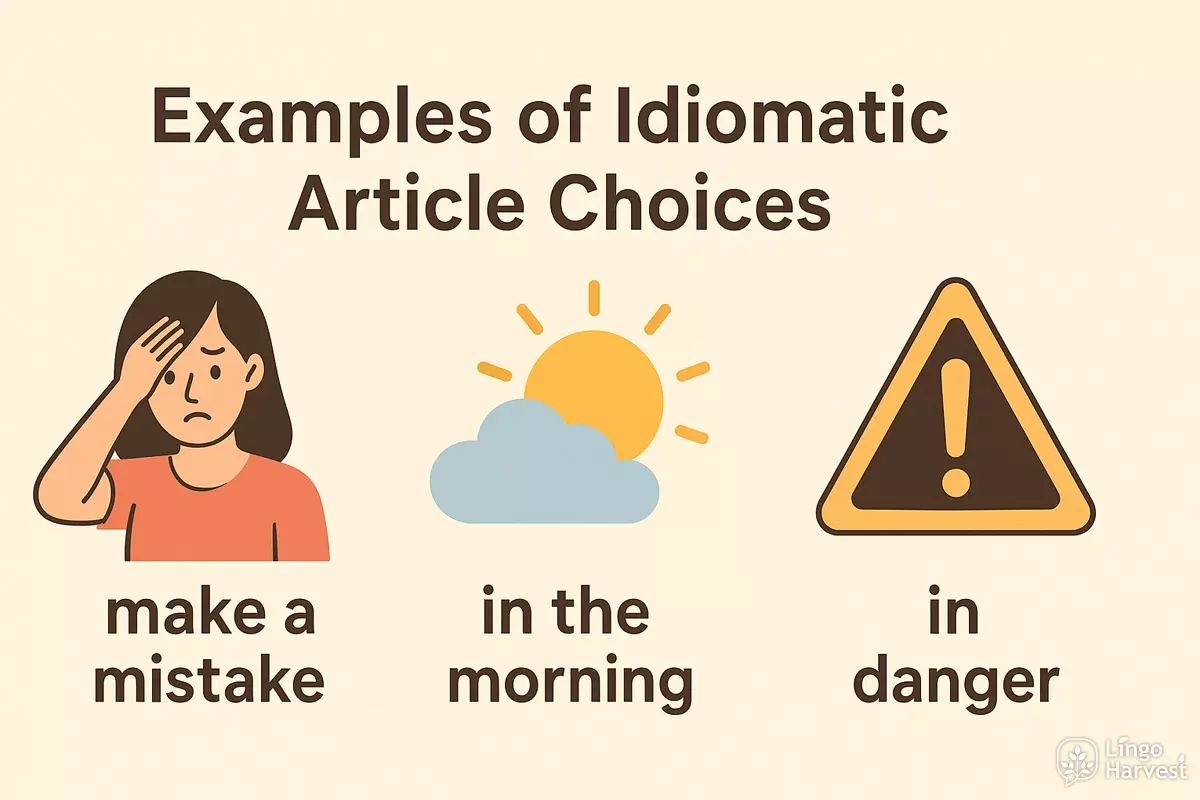
- make a mistake
- in the morning
- in danger
- at a loss
- take the lead
- on a roll
- in a nutshell
- under the weather
- for a change
- on the move
- give a hand
- on the whole
- in the spotlight
- have a good time
- in the blink of an eye
Why do these exceptions persist?
Set phrases often reflect historical usage, translation patterns, or even regional habits. Once a phrase becomes “fixed,” speakers rarely question its structure. Learning these as whole units is more effective than trying to analyze them by modern grammar rules.
| Idiom | Article Pattern |
|---|---|
| on the whole | Always uses “the” |
| in a hurry | Always uses “a” |
| go to bed | No article |
| in hospital / in the hospital | Varies by dialect |
| by the way | Always uses “the” |
| on foot | No article |
Because idiomatic phrases are learned as units, their article usage is best memorized along with the whole expression. This helps avoid confusion and allows for more natural, idiomatic English in both writing and speech.
How to learn article use with chunks, not rules
Instead of memorizing complex grammar explanations for articles in idiomatic expressions, it’s far more effective to learn them as ready-made word groups, or “chunks.” Native speakers rarely think about rules when using phrases like in a hurry or on the whole; they simply remember the entire phrase. By focusing on these natural combinations, you can sound more fluent and avoid common mistakes.
Why chunks help with article use in fixed phrases
Articles often behave unpredictably in idioms and set expressions. For example, we say in the morning but at night, or have a good time but take the plunge. Trying to deduce a rule for each can be confusing and unreliable. Learning common expressions as wholes allows you to internalize correct patterns naturally.
Practical ways to master articles through chunks
- Collect and review lists of idiomatic expressions with articles.
- Practice using these expressions in sentences or dialogues.
- Notice the article choices when you read or listen to English.
- Repeat and shadow full phrases, not just single words.
- Test yourself by covering the article and trying to recall it.
Common idiomatic chunks with articles
Here are some useful expressions where the article is an essential part of the phrase:
- in the end
- in a hurry
- on the whole
- in the meantime
- have a look
- make the bed
- tell the truth
- take a seat
- go to the dentist
- in a while
- on the right/left
- in the dark
- have a headache
- by the way
- for a change
- at the moment
- on the one hand / on the other hand
- in a sense
- in the long run
- take the lead
Chunk learning vs. rule-based learning: a quick comparison
| Chunk Learning | Rule-Based Learning |
|---|---|
| Focuses on memorizing whole expressions | Focuses on abstract grammar rules |
| Reflects real usage and native patterns | May not match actual idiomatic usage |
| Reduces mistakes in set phrases | Often leads to overthinking and errors |
| Builds confidence for speaking and writing | Can slow down fluency and naturalness |
To sum up, treating idiomatic expressions as fixed chunks—including their articles—helps you avoid confusion and boosts your confidence. Over time, you’ll start to “feel” which article belongs, just like a native speaker.
Practice: complete and memorize key idiomatic phrases
Understanding idioms and fixed phrases is essential for sounding natural in everyday conversation. Below are targeted exercises and tips to help you internalize these expressions and use them accurately. Start by reading through the examples, then try the completion tasks and mini-quizzes to reinforce your memory.
Common Idiomatic Expressions with Articles
- in the nick of time
- on the whole
- at a loss
- in the long run
- by the way
- in a hurry
- have a good time
- in the end
- take the lead
- make a difference
- on the one hand / on the other hand
- in a nutshell
- at the moment
- for the time being
- as a rule
- on the spot
- in the same boat
- out of the question
- in the dark
- under the weather
Fill-in-the-Blank Practice
Complete each phrase with the correct article ("a" or "the") where needed:
- She arrived just in ___ nick of time.
- Let’s discuss this in ___ nutshell.
- He was ___ loss for words.
- We’re all in ___ same boat.
- This is ___ rule in our office.
- It was ___ waste of time.
- This is ___ last straw for me.
- They did it at ___ last minute.
- She was on ___ verge of tears.
- He made it in ___ end.
Show answers
- the
- a
- at a
- the
- a
- a
- the
- the
- the
- the
Matching Idioms to Meanings
Match each phrase to its meaning:
- 1. in the dark
- 2. at the moment
- 3. under the weather
- 4. on the spot
- 5. behind the scenes
- 6. on the horizon
- 7. in hot water
- 8. over the moon
- 9. on thin ice
- 10. in the long run
- a. Immediately, right there
- b. Not feeling well
- c. Right now
- d. Uninformed, not knowing
- e. Secretly, out of public view
- f. Likely to happen soon
- g. In trouble
- h. Extremely happy
- i. In a risky situation
- j. Over a long period; eventually
Show answers
- 1-d
- 2-c
- 3-b
- 4-a
- 5-e
- 6-f
- 7-g
- 8-h
- 9-i
- 10-j
Quick Reference Table: Idiomatic Phrases with Articles
| Idiom | Meaning |
|---|---|
| in the long run | eventually, over a long period |
| at a loss | unable to decide or understand |
| by the way | incidentally, changing the topic |
| in a hurry | quickly, without delay |
| out of the question | impossible, not allowed |
Tips for Memorizing Idiomatic Phrases
- Group expressions by article ("a" vs. "the") for faster recall.
- Write out full sentences using each phrase in context.
- Say idioms aloud to help auditory memory.
- Use flashcards, focusing on the article and the overall meaning.
- Notice these phrases in authentic texts or conversations and jot them down.
With regular practice and mindful repetition, these fixed expressions will become a natural part of your active vocabulary.