Phrasal Verbs in Spoken and Written English Compared

 Learn why phrasal verbs are so common in spoken English, why formal writing often avoids them, and how to replace them in academic style. It also covers register and tone, spoken-only phrasal verbs, learner mistakes, choosing verbs by context, and rewrite homework.
Phrasal verbs often sound different in everyday speech than in formal writing. In conversation, they help you sound quick, friendly, and natural, but in formal texts writers may prefer precise single-word verbs or a more neutral tone. This article explains which choices suit each setting, how context can change meaning, and how to pick the best option with confidence.
Why phrasal verbs dominate spoken English
Everyday conversation tends to favor short, flexible verb phrases that can be produced quickly and adjusted on the fly. Verb + particle combinations (like pick up, run into, find out) fit that need: they are easy to slot into common sentence frames, they sound natural in informal settings, and they often let speakers stay vague or polite without long, technical wording.
Usage patterns that make them feel “spoken”
- They match real-time speaking: the main verb comes first, and the particle can be added after a short pause (for example, “I’ll call… back”). This mirrors how speakers plan sentences while talking.
- They support quick interaction: many are built for turn-taking and responses: “Hold on,” “Come on,” “Go on,” “Back up.”
- They keep tone informal and friendly: “help out” often sounds warmer than “assist,” and “talk over” can sound less confrontational than “discuss in detail.”
- They allow strategic vagueness: “sort out the problem” or “deal with it” avoids specifying a method, which is useful when details are unknown or sensitive.
- They are highly reusable across topics: a small set covers many situations (work, family, errands, tech), so speakers rely on them as default choices.
- They package meaning into common chunks: frequent combinations become “ready-made” units in memory, which speeds up production and comprehension.
Common conversational functions (with typical examples)
- Starting, continuing, or stopping: start up, carry on, stop by, wrap up.
- Managing time and plans: put off, set up, move up, run over (time).
- Social contact and relationships: catch up, hang out, run into, get along.
- Problem-solving and decisions: figure out, work out, sort out, rule out.
- Information and discovery: find out, look up, check out, point out.
- Emotions and reactions: calm down, freak out, cheer up, get over.
- Negotiation and persuasion: bring up (a topic), talk into, talk out of, back down.
- Everyday actions and errands: pick up, drop off, take out, fill in.
- Technology and modern routines: log in, sign up, scroll down, shut down.
- Repairing misunderstandings: clear up, straighten out, go over (again).
Word order choices speakers rely on
- Pronoun objects usually go in the middle: ✅ “Turn it off.” ❌ “Turn off it.”
- Noun objects can often go either place (when the verb is separable): “Turn off the lights” / “Turn the lights off.” In fast speech, the split form is common because it keeps the object close to the verb.
- Long objects often go after the particle: “She put off the meeting we scheduled for next week.” This avoids heavy phrasing in the middle of the verb phrase.
- Many high-frequency items are inseparable: “run into someone,” “look after someone,” “get over something.” In conversation, these fixed patterns reduce decision-making.
Spoken English also rewards expressions that sound natural at different levels of certainty. Phrases like “I’ll look into it,” “Let’s go over that,” or “Can you check on them?” are efficient because they convey action without locking the speaker into a formal register or overly precise wording.
Formal writing and verb choice

In academic and professional contexts, writers often reduce the number of phrasal verbs and choose single-word verbs that sound more precise, neutral, and easy to interpret across audiences. This is not because multi-word verbs are “wrong,” but because some of them feel informal, ambiguous, or overly conversational on the page.
Common patterns in formal registers
- Preference for Latinate verbs: Many texts in business, law, and academia favor verbs of Latin/French origin because they are conventional in those genres (for example, “investigate” rather than “look into”).
- Lower tolerance for vagueness: Phrasal verbs can be broad in meaning (“set up,” “work out,” “sort out”), while formal writing often needs a narrower verb that signals the exact action.
- Reduced idiomaticity: Highly idiomatic items (“brush up on,” “chime in,” “zero in on”) can distract readers who are not native speakers or who expect standardized phrasing.
- More explicit objects: When a multi-word verb is used, formal writing typically supplies a clear object and avoids “dangling” uses (for example, “carry out the audit,” not just “carry out”).
- Care with separable forms: Separable phrasal verbs can produce awkward long-distance splits in formal sentences; writers often avoid them or keep the particle close to the verb.
- Consistency over variety: Reports and research papers tend to repeat the same verb for the same process (for example, always “conduct,” not alternating among “carry out,” “do,” and “run”).
Practical substitutions that often read more formal
| More conversational phrasal verb | Common formal alternative |
|---|---|
| look into | investigate / examine |
| find out | determine / ascertain |
| point out | note / highlight |
| set up | establish / arrange / configure |
| carry out | conduct / implement / perform |
| deal with | address / handle / manage |
| come up with | develop / propose / devise |
| go over | review / examine |
| put off | postpone / defer |
| bring up | raise / introduce |
| cut down on | reduce / decrease |
| rule out | exclude / eliminate |
| put forward | propose / submit |
| sum up | summarize / conclude |
When multi-word verbs are still appropriate
- Established technical phrasing: Some fields use specific combinations as standard terms (for example, “carry out” is common in lab and audit contexts).
- Clear, literal meanings: Items with straightforward spatial or procedural meanings can read neutrally (“log in,” “shut down,” “back up” in computing contexts).
- Process descriptions: In methods and procedures, a familiar multi-word verb may be the most natural choice if it is unambiguous and consistently used.
- Reader-focused clarity: If the single-word verb is rare or overly abstract, a plain phrasal verb can be clearer for a general audience.
Editing checks for a more formal tone
- ✅ Replace broad verbs with specific actions: “sort out the issue” → “resolve the discrepancy” or “reconcile the figures.”
- ✅ Prefer consistent terminology in repeated steps: choose one verb for the same operation throughout a document.
- ✅ Avoid colloquial particles that add attitude: “mess up,” “freak out,” “cheer up” usually do not fit reports or academic prose.
- ✅ Watch for unintended informality in conclusions: “wrap up” often reads more casual than “conclude” or “summarize.”
- ✅ Keep separable forms tight when you use them: long insertions between verb and particle can make sentences harder to scan.
Replacing phrasal verbs in academic style
In formal writing, multi-word verbs are often replaced with single-word verbs or more explicit verb–noun combinations. The goal is not to “ban” phrasal verbs, but to choose wording that sounds precise, objective, and consistent with academic conventions.
A useful pattern is to identify the core meaning (increase, investigate, reject, continue) and then select a verb that matches the register. Pay attention to whether the phrasal verb is literal (e.g., “sit down”) or idiomatic (e.g., “carry out” meaning “conduct”), because idiomatic items are the ones most commonly revised in research papers and reports.
Common academic alternatives (side-by-side)
| Phrasal verb (more conversational) | Academic alternative (more formal) |
|---|---|
| carry out (a study) | conduct (a study) |
| find out | determine / ascertain |
| look into | investigate / examine |
| point out | note / highlight / indicate |
| set up (an experiment) | establish / design |
| deal with (an issue) | address / consider |
| go up / go down | increase / decrease |
| bring about | cause / lead to |
| come up with (an idea) | propose / develop |
| leave out | omit / exclude |
| put off | postpone / delay |
| rule out | exclude / eliminate |
| show up (in results) | appear / emerge |
| sum up | summarize |
| turn down (a request) | reject / decline |
| use up | consume / deplete |
Usage patterns that keep the meaning accurate
When revising, match the grammar as well as the meaning. Some replacements require a different structure (for example, a direct object, a preposition, or a noun phrase). The checks below help avoid awkward or incorrect rewrites.
- Prefer precise verbs over vague ones. “deal with” can mean analyze, solve, discuss, or manage; choose the verb that matches the intended action (e.g., “analyze the data,” “address the limitation”).
- Keep the same level of certainty. “find out” may imply discovery; “determine” can sound stronger. If the evidence is limited, “suggest” or “indicate” may be a better fit.
- Check transitivity (object requirements). “carry out” needs an object (carry out a test). “occur” does not take a direct object, so “occur the change” is ❌; use “the change occurred” ✅.
- Maintain the original time and voice. “The team carried out the survey” → “The team conducted the survey” (same tense/voice). If you switch to passive, do it for a reason, not by accident.
- Replace “verb + up/down” with measurable language. Instead of “went up a lot,” use “increased substantially” or, better, report the figure (“increased by 18%”).
- Use verb–noun combinations when they are standard in the field. “look at” often becomes “conduct an analysis of” or “perform an evaluation of” when that phrasing is conventional in a discipline.
- Avoid over-formal substitutions that distort tone. Replacing every multi-word verb with Latinate vocabulary can make prose heavy; keep straightforward options like “use,” “help,” “show,” and “need” when they are already appropriate.
- Watch for meaning shifts with near-synonyms. “set up” (establish/design) is not always “install.” Choose “establish a framework,” “design a protocol,” or “install equipment” depending on context.
- Keep collocations natural. “conduct research,” “pose a question,” and “draw a conclusion” are common pairings; forcing unusual combinations can sound non-native or unclear.
- Revise for clarity, not just formality. Sometimes the best edit is expanding the idea: “point out” → “The authors note that X may be explained by Y.”
Register differences and tone
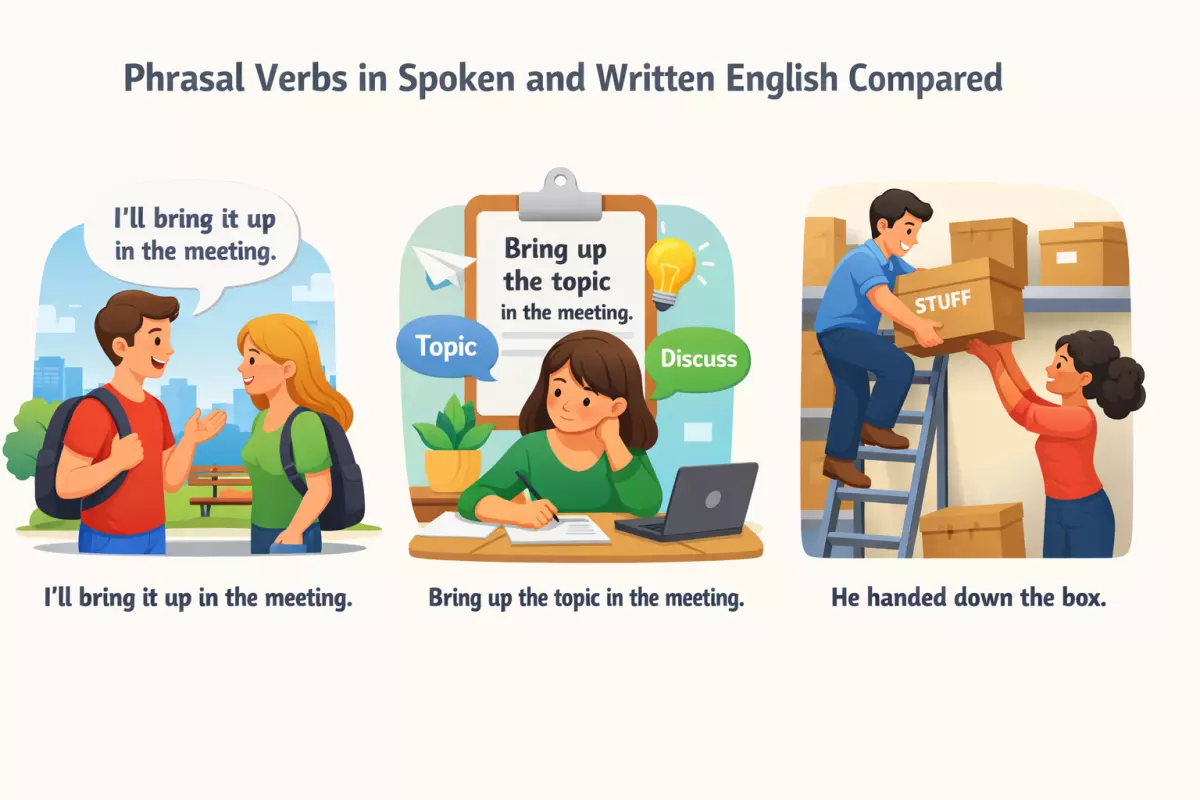
Choice of phrasal verbs often signals how formal, direct, or approachable a text sounds. In conversation, speakers tend to prefer shorter, more idiomatic verb + particle combinations because they are quick, flexible, and socially natural. In many kinds of writing, especially academic or legal contexts, writers often select single-word verbs or more explicit phrasing to keep the tone precise and less colloquial.
Typical patterns in spoken English
- Higher frequency of everyday phrasal verbs in casual talk: come over, hang out, pick up, find out.
- More interpersonal “softening”: Could you look into it? sounds less heavy than Could you investigate it? in a friendly exchange.
- More particles for emphasis and clarity when speaking fast: write it down, read it over, check it out.
- More ellipsis and pronouns: bring it up, sort it out, put it off (the object is often “it/this/that”).
- More stance and reaction verbs: calm down, cheer up, back off, shut up (tone can quickly become blunt).
- More “phrasal chunks” that function like routines: Let’s move on, Hold on, Come on, Go on.
- More informal intensifiers around them: totally messed up, really blown up, so fired up.
Typical patterns in written English
- Greater sensitivity to formality: informal items like freak out or mess up are often replaced by panic or make an error in formal prose.
- Preference for precision in technical writing: carry out may be acceptable, but conduct can sound more exact in methodology sections.
- More planning and fewer “reaction” phrasals: writing tends to avoid abrupt commands like back off unless reproducing dialogue.
- More consistent register within a document: mixing set up with highly formal vocabulary can feel uneven unless the genre is intentionally conversational.
- Genre-driven acceptance: journalism and business emails tolerate many phrasal verbs, while legal contracts and academic articles often limit them.
Side-by-side choices (tone and genre)
| More conversational (often spoken, emails, dialogue) | More formal/neutral (often academic, legal, technical) |
|---|---|
| find out | discover / determine |
| look into | investigate / examine |
| set up (a meeting/system) | arrange / establish |
| bring up (an issue) | raise (an issue) |
| put off (a decision) | postpone / defer |
| work out (a solution) | resolve / devise |
| point out | note / indicate |
| carry on | continue |
| cut down (on costs) | reduce |
| come up with (an idea) | propose / develop |
| talk over | discuss |
| get rid of | eliminate / remove |
Common tone effects to watch
- Friendliness vs. authority: Could you send it over? feels lighter than Please transmit the document.
- Directness vs. tact: turn down can sound gentler than reject in customer-facing messages.
- Informality markers: items like chill out, hang out, rip off strongly signal casual speech and may clash with formal writing.
- Potential bluntness: imperative phrasal verbs can be sharp in writing (cut it out, shut down), so add context or soften when needed.
- Ambiguity in formal contexts: some phrasal verbs have broad meanings (set out, take on), so a single-word alternative may be clearer when precision matters.
Common spoken-only phrasal verbs

Some multi-word verbs are strongly associated with everyday conversation: quick reactions, managing social situations, and speaking casually about plans or feelings. They tend to sound natural in dialogue but can feel too informal for academic writing unless you are quoting speech or aiming for a relaxed tone.
How these work in conversation
- They often soften statements: speakers use them to sound less direct (especially with requests, refusals, and opinions).
- They rely on shared context: meaning is clear from the situation, so shorter, less explicit phrasing is acceptable.
- They pair with pronouns: object pronouns are common (it, them, me), which keeps speech fast and fluid.
- They cluster around a few functions: starting/ending activities, changing plans, reacting, and handling people.
High-frequency conversation-focused items (with typical uses)
- hang out — spend time socially: “We’re just hanging out at Sam’s.”
- come over — visit someone’s home: “Do you want to come over later?”
- head out — leave (often soon): “I’m going to head out in a minute.”
- drop by / pop by — visit briefly and informally: “I’ll drop by after work.”
- catch up — share news after time apart: “Let’s catch up this weekend.”
- chill out — relax or calm down: “Just chill out; it’s not a big deal.”
- cheer up — become happier; encourage someone: “Cheer up—you did your best.”
- freak out — panic or overreact: “Don’t freak out, okay?”
- pass out — faint or fall asleep suddenly: “He nearly passed out on the train.”
- black out — lose consciousness or memory: “I blacked out for a second.”
- back out — cancel a commitment: “She backed out at the last minute.”
- flake out — fail to show up or follow through (informal): “He flaked out again.”
- hit it off — quickly get along: “We hit it off right away.”
- mess around — waste time or behave playfully; sometimes “be careless”: “Stop messing around and focus.”
- make up — reconcile after an argument: “They argued, then made up.”
- break up — end a relationship: “They broke up last month.”
- shut up — be quiet (can sound rude): “Please shut up” ❌ often better as “Could you be quiet?” ✅
- pick on — tease or bully: “Why are you picking on him?”
- show up — arrive (often unexpectedly): “He showed up without texting.”
- run into — meet by chance: “I ran into my old teacher.”
Usage patterns to notice
- Short answers and add-ons: “I’ll head out.” / “He backed out, so…”
- Common time markers: “in a bit,” “right now,” “later,” “last minute” frequently appear with these verbs.
- Politeness adjustments: many can sound blunt without softeners. Compare: “Come over.” ❌ vs. “Do you want to come over?” ✅
- Meaning shifts by context: “pass out” can mean faint or fall asleep; “mess around” can mean joke, waste time, or behave irresponsibly.
Typical learner style mistakes
Learners often know the meaning of a phrasal verb but place it in the wrong register, build the grammar incorrectly, or choose a combination that sounds translated. The result can be writing that feels too casual, or speech that feels stiff and overly formal.
Register mismatches (spoken vs. written)
- Using very informal items in formal writing: ❌ “The committee put off the proposal.” (can sound too chatty in a report) → ✅ “The committee postponed the proposal.”
- Over-formalising everyday speech: ❌ “I will investigate it.” (in a quick chat) → ✅ “I’ll look into it.”
- Mixing a formal noun phrase with a casual verb phrase: ❌ “We will sort out the aforementioned discrepancies.” → ✅ “We will resolve the discrepancies.”
- Using trendy conversational phrasal verbs in academic tone: ❌ “This theory doesn’t hold up.” → ✅ “This theory is not supported.”
- Relying on phrasal verbs to sound “natural” in every sentence; in many written genres, a balance of phrasal verbs and single-word verbs reads more controlled.
Grammar and word-order problems
- Wrong position with pronouns in separable verbs: ❌ “Turn off it.” → ✅ “Turn it off.”
- Unnecessary separation with long objects (hurts clarity): ❌ “She put the issue of staffing levels off.” → ✅ “She put off the issue of staffing levels.”
- Forgetting that some combinations are inseparable: ❌ “We will look the matter into.” → ✅ “We will look into the matter.”
- Misplacing adverbs: ❌ “He picked quickly up the habit.” → ✅ “He picked up the habit quickly.”
- Wrong passive forms (not all are natural in passive): ❌ “The light was turned off by me.” (oddly heavy) → ✅ “I turned off the light.” / “The light was switched off.”
- Confusion with -ing and infinitive patterns after phrasal verbs: ❌ “She suggested to carry on.” → ✅ “She suggested carrying on.”
Meaning confusion and near-synonym traps
- Choosing the wrong particle and changing meaning: ❌ “I’ll look after the problem.” → ✅ “I’ll deal with the problem.” (“look after” = take care of a person/thing)
- Mixing up “find out” and “figure out”: ❌ “I need to find out how to solve it.” → ✅ “I need to figure out how to solve it.”
- Using “take up” when “take on” is meant: ❌ “She took up extra responsibilities.” → ✅ “She took on extra responsibilities.”
- Confusing “bring up” (raise a topic/child) with “bring about” (cause): ❌ “The policy brought up major changes.” → ✅ “The policy brought about major changes.”
- Overusing “get” combinations that are vague in writing: ❌ “We need to get the costs down.” → ✅ “We need to reduce costs.” (or keep it if the tone is intentionally plain)
Collocation and “translated” combinations
- Inventing a verb + particle that exists in the first language but not in English: ❌ “discuss about” / “explain me” style errors often lead to phrasal-verb-like inventions such as ❌ “talk about over” → ✅ “talk over” or “talk about” (choose one meaning).
- Using “make” + particle where English prefers another verb: ❌ “make up a decision” → ✅ “make a decision” / “decide”.
- Choosing a correct phrasal verb with the wrong noun: ❌ “carry out a homework” → ✅ “do homework” / “carry out an experiment”.
- Using “discuss about” then adding a particle: ❌ “discuss about it over” → ✅ “discuss it” / “talk it over”.
Style issues: repetition, tone, and clarity
- Repeating the same high-frequency item (“go on”, “get”, “put”) across a paragraph; vary with clearer verbs or restructure the sentence.
- Stacking multiple verb phrases in one sentence: ❌ “We need to look into it and sort it out and get back to you.” → ✅ Split tasks: “We’ll investigate the issue and reply by Friday.”
- Using casual idioms in sensitive contexts: ❌ “The patient passed away so we carried on.” → ✅ “After the patient died, the team continued with…” (choose respectful, precise wording).
- Overusing phrasal verbs in formal conclusions and recommendations; readers often expect more explicit verbs (recommend, conclude, demonstrate, indicate).
A practical check is to ask two questions: (1) Would a colleague say this aloud in a meeting? (2) Would this wording fit a report or email to a client? If the answer changes, the phrasal verb may be correct in meaning but mismatched in style.
Choosing verbs by context
Selecting the right verb phrase depends on the situation, the relationship between speakers and readers, and how explicit you need to be. In conversation, phrasal verbs often carry a relaxed tone and help speech flow quickly. In formal writing, a single-word verb or a more specific verb phrase may sound clearer, more precise, or more neutral.
Context cues that influence verb choice
- Formality level: casual speech and informal emails often prefer phrasal verbs; academic and legal writing often prefers Latinate verbs (for example, “investigate” rather than “look into”).
- Speed vs. precision: spoken English values quick, familiar chunks; writing often rewards exact meaning and avoids ambiguity.
- Audience expectations: native-speaker audiences tolerate idiomatic phrasing; international or mixed audiences may benefit from more transparent verbs.
- Genre conventions: news reports, manuals, and research papers tend to limit idioms; dialogue, interviews, and narratives use them naturally.
- Need for clarity: if a phrasal verb has multiple meanings, choose a clearer alternative when misunderstanding is costly.
- Tone management: phrasal verbs can sound friendly or blunt depending on context (“bring up” feels softer than “raise” in some settings; “shut down” can sound harsh).
- Space and rhythm: headlines and titles may prefer shorter options; longer explanations in reports may prefer explicit wording.
- Register consistency: avoid mixing very formal vocabulary with very casual phrasal verbs in the same sentence unless the contrast is intentional.
Common context-to-choice patterns (with examples)
- Meetings (neutral-professional): “We need to follow up on the issue” often fits better than “We need to chase up the issue” (more informal/region-specific).
- Academic writing: “The study examines…” is usually preferred over “The study looks at…”, though “look at” can work in less formal essays.
- Customer support: “I’ll check on that for you” sounds approachable; “I will verify that” can sound more official.
- Instructions and manuals: “Turn off the device” is standard and clear; avoid vague options like “shut down” unless you mean a specific process.
- Policy or compliance texts: prefer “prohibit” or “restrict” over “cut out” when rules must be unambiguous.
- Performance reviews: “improve efficiency” is more formal than “speed up efficiency” (which can sound awkward); “speed up the process” is fine.
- Conflict and criticism: “point out an error” can sound less severe than “criticize an error,” depending on phrasing and context.
- Negotiation: “We can work out a solution” is collaborative; “We will determine a solution” is more authoritative.
- News reporting: “The company announced layoffs” is more standard than “The company said it would lay off staff,” unless quoting speech.
- Everyday storytelling: “I ran into an old friend” sounds natural; “I encountered an old friend” can sound overly formal in casual talk.
- Emails to colleagues: “Can you look into this?” is common; “Can you investigate this?” can sound more serious or accusatory.
- Technical incident updates: “We rolled back the change” is precise jargon; replacing it with “we undid the change” may lose the technical meaning.
Accuracy checks: meaning, object type, and separability
- Confirm the meaning you intend: “take off” can mean remove clothing, leave the ground, or become successful. In writing, replace it when the context does not make the meaning obvious.
- Check whether the verb is transitive: “set up a meeting” needs an object; “show up” does not. ✅ “She showed up late.” ❌ “She showed up the meeting.”
- Know separable vs. inseparable patterns: some allow the object between verb and particle. ✅ “Turn it off.” ❌ “Turn off it.” (with pronouns, separation is usually required for separable verbs).
- Watch for formality shifts with pronouns: “sort it out” is conversational; “resolve the issue” is more formal and may suit reports better.
- Avoid phrasal verbs that can sound dismissive: “brush off” or “shrug off” can imply you did not take something seriously; choose “disregard” or “set aside” if you need a neutral tone.
Homework: spoken vs written rewriting tasks
Use these rewriting tasks to practise how phrasal verbs shift between casual speech and more formal writing. Focus on three patterns: (1) level of formality (phrasal verb vs single-word verb), (2) information packaging (short, interactive turns vs planned sentences), and (3) grammar choices (pronouns, passives, and placement of particles).
How to rewrite effectively
- Keep the meaning stable: change style and structure, not the core message.
- Check register: spoken versions often use everyday phrasal verbs; written versions often use more explicit wording.
- Adjust the subject: conversation uses I/you/we and implied context; writing often names the actor or the process.
- Control particle placement: with pronouns, prefer “pick it up” (not “pick up it”). With nouns, both may work depending on focus.
- Reduce vagueness in writing: replace “stuff/things” with specific nouns and add key details that speech can leave implicit.
- Use hedging differently: speech uses “kind of / a bit / I think”; writing often uses “slightly / appears / may”.
Task set A: Rewrite spoken-style lines as written English
Rewrite each item as a sentence suitable for an email, report, or academic paragraph. Prefer clearer structure and more formal verb choices when helpful.
- We’re gonna sort out the schedule later.
- I ran into a problem with the file you sent.
- Can you look over this and tell me if it’s okay?
- The meeting got pushed back again.
- I found out they changed the policy.
- We put off the launch because the tests weren’t done.
- She pointed out a few issues in the draft.
- They set up a new system last month.
- The team came up with a better plan.
- He ended up paying for everything.
Show answers
- We will finalise the schedule at a later time.
- I encountered a problem with the file you sent.
- Please review this and confirm whether it is acceptable.
- The meeting was postponed again.
- I learned that the policy had been changed.
- We postponed the launch because the testing had not been completed.
- She identified several issues in the draft.
- They implemented a new system last month.
- The team developed a better plan.
- He ultimately paid for everything.
Task set B: Rewrite written-style sentences as natural spoken English
Rewrite each item as something you could say in a quick conversation. Shorten where possible and allow common phrasal verbs and contractions.
- We will investigate the cause of the delay and respond by Friday.
- Please submit the form before 5 p.m. so we can process your request.
- The committee rejected the proposal due to insufficient evidence.
- I contacted the supplier to confirm the delivery date.
- They resolved the issue and restored access within an hour.
- The manager postponed the decision until the next meeting.
- We must reduce costs without compromising quality.
- She discovered an error in the spreadsheet and corrected it.
- He refused to participate and left the discussion.
- The company discontinued the product line last year.
Show answers
- We’ll look into what caused the delay and get back to you by Friday.
- Can you send in the form before 5 so we can sort out your request?
- The committee turned down the proposal because there wasn’t enough evidence.
- I got in touch with the supplier to check on the delivery date.
- They sorted out the issue and got access back within an hour.
- The manager put off the decision till the next meeting.
- We’ve got to cut down costs without messing up the quality.
- She found an error in the spreadsheet and fixed it up.
- He opted out and walked out of the discussion.
- The company phased out that product line last year.
Task set C: Particle placement and pronoun practice
Rewrite each sentence so it sounds natural. Keep the same phrasal verb, but fix word order and pronoun placement where needed.
- Please turn off the lights → Please turn the lights off.
- Can you pick up it after lunch?
- They handed in it late.
- She looked up the number → She looked the number up.
- He put on it quickly.
- We worked out it in the end.
- I filled in it wrong.
- Let’s write down it before we forget.
Show answers
- Please turn the lights off.
- Can you pick it up after lunch?
- They handed it in late.
- She looked the number up.
- He put it on quickly.
- We worked it out in the end.
- I filled it in wrong.
- Let’s write it down before we forget.
Extension: build your own pairs (10 prompts)
- Rewrite a complaint so it sounds calmer: kick off, calm down, sort out.
- Rewrite a progress update for a report: carry out vs do, set up vs establish.
- Turn a formal refusal into a friendly spoken response: turn down, pass on.
- Turn a spoken apology into a formal email line: mess up, own up.
- Rewrite instructions so they fit a manual: plug in, shut down, back up.
- Rewrite a meeting summary to be more conversational: bring up, go over, wrap up.
- Rewrite a casual plan as a formal schedule note: meet up, head out, drop by.
- Rewrite a formal warning as spoken advice: watch out, hold off.
- Rewrite a spoken “good news” message as a written announcement: roll out, kick off.
- Rewrite a written policy line as something you would say to a colleague: stick to, follow through.