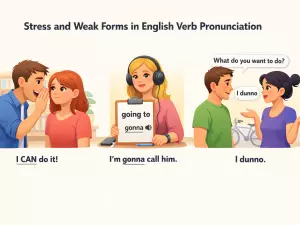
Verb Idioms and Set Expressions in English

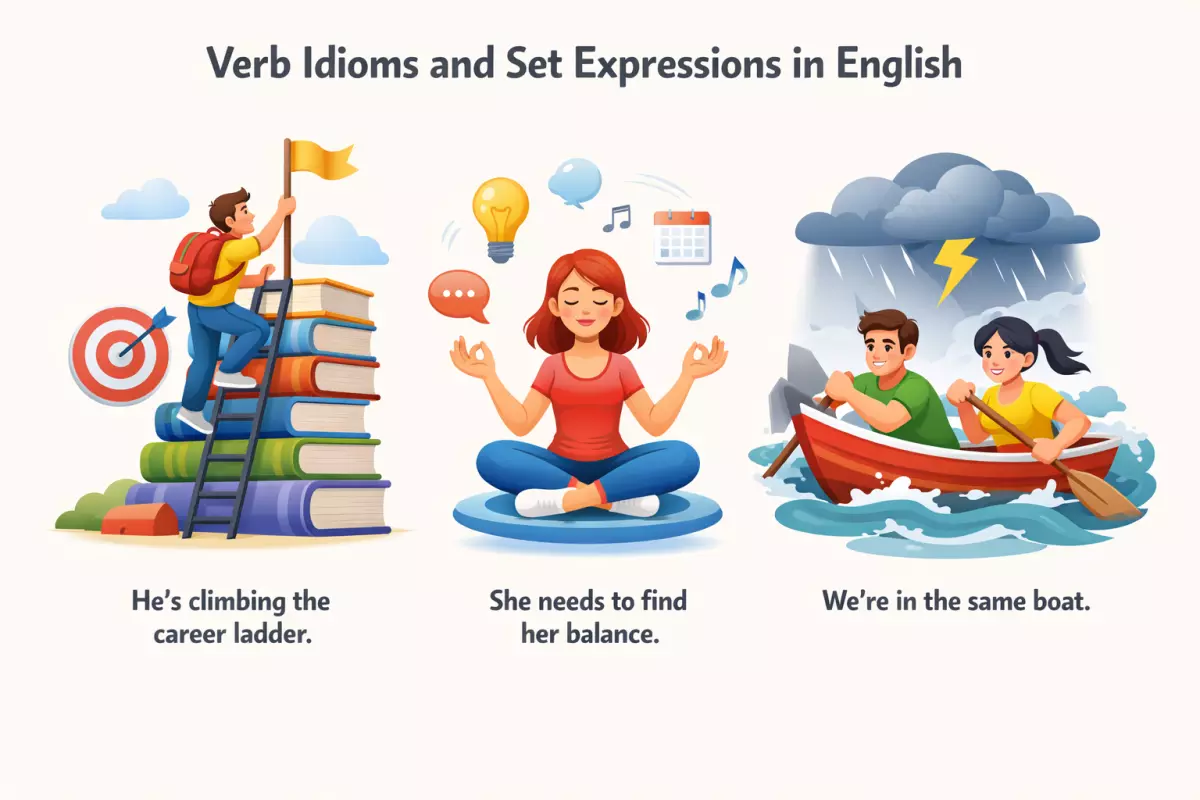 Learn what verb idioms are and how set expressions differ from literal phrases. Review common verb idioms by topic, their meaning and real-life usage, and how register and tone affect them. Spot common mistakes, use memorization strategies, and finish with homework practice tasks.
Everyday English uses many fixed verb phrases and common word combinations whose meaning is not obvious from each word. You might know the vocabulary but still feel confused when someone says they will put something off or come across a new idea. This guide helps you notice these patterns in context, understand what speakers intend, and use them naturally in speech and writing.
What verb idioms are
These are fixed or semi-fixed verb-based expressions whose meaning is not fully predictable from the individual words. They behave like single vocabulary items in real communication: you learn them as a unit, choose them for the situation, and often cannot swap words freely without changing or breaking the meaning.
Core features to notice
- Non-literal meaning: the overall sense goes beyond the dictionary meaning of the verb and its parts (for example, “give up” = stop trying, not “hand something upward”).
- Limited flexibility: many allow only small changes (tense, person), while other substitutions sound unnatural or wrong.
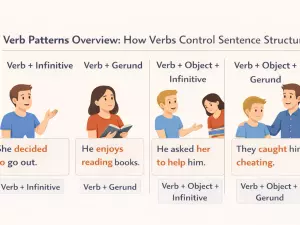
- Common patterns: they often follow repeatable structures such as verb + particle, verb + preposition, or verb + object + particle.
- Register and context sensitivity: some are informal, some neutral, and some are used mainly in specific settings (work, relationships, news, etc.).
- Collocation “stickiness”: certain nouns or pronouns regularly appear with them (for example, “make up your mind,” not usually “make up your decision” in the same sense).
Typical structures (with usage notes)
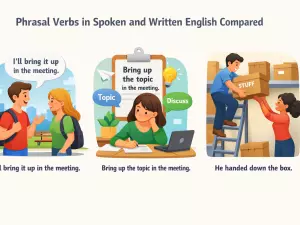
- Verb + particle (phrasal verb): break down, set up, calm down. The particle often changes the meaning dramatically.
- Verb + preposition: look after, run into, deal with. The preposition links the verb to its object and is usually fixed.
- Verb + object + particle (separable pattern): turn the TV off / turn it off. Pronouns typically go in the middle: ✅ “turn it off” ❌ “turn off it”.
- Verb + noun phrase (set collocation): take a break, make a point, pay attention. The noun is part of the expression, not an interchangeable choice.
- Verb + possessive + noun (formulaic): lose your temper, change your mind, do your best. The possessive changes with the subject (my/your/his/their).
- Verb + complement clause (fixed framing): It turns out (that)… / I can’t help (doing)…. The grammar after the verb is part of what you must learn.
Common examples worth learning as complete units
- bring up (a topic/child)
- carry on (continue)
- come across (find by chance; seem)
- figure out (understand/solve)
- get along (have a good relationship)
- get over (recover from)
- give in (stop resisting)
- go through (experience; examine)
- hold on (wait)
- keep up (maintain pace/standard)
- look forward to (anticipate; followed by noun/gerund)
- make up (invent; reconcile)
- pick up (collect; learn informally)
- put off (delay)
- run out of (use up completely)
- set off (start a journey; trigger)
- take care of (handle; look after)
- turn out (result; appear)
In practice, treat these expressions as “chunks”: learn the usual grammar that follows them, the most typical objects or pronouns they take, and the situations where native speakers prefer them over more literal alternatives.
How set expressions differ from literal phrases

Fixed word combinations behave differently from ordinary, literal wording. They often carry a meaning you cannot predict from the individual words, and they tend to resist changes in grammar, word order, and vocabulary choice. Recognizing these patterns helps you decide when to interpret a verb phrase as an idiom and when to read it at face value.
Key differences you can test in real sentences
- Meaning is not fully compositional: In a set phrase, the whole unit can mean something beyond the dictionary meanings of its parts (e.g., “give in” = stop resisting), while a literal phrase usually adds up word by word.
- Limited word substitution: Literal language allows easy swapping of near-synonyms (“begin the meeting” / “start the meeting”). Many fixed expressions do not (“kick the bucket” ❌ “strike the bucket”).
- Restricted word order: You can often rearrange literal phrases without changing meaning too much, but idiomatic strings typically have a preferred order (“by and large” ❌ “large and by”).
- Grammar flexibility is uneven: Some units allow tense changes (“He gave in” / “He is giving in”), but other changes can sound wrong (“spill the beans” ❌ “spill the bean”).
- Articles and number may be fixed: A literal noun phrase can vary (“a reason” / “the reason” / “reasons”), while some expressions strongly prefer one form (“in the nick of time” rarely varies).
- Pronoun replacement may break the idiom: Literal phrases accept pronouns freely (“I saw the car” → “I saw it”). Some idioms become odd when a key noun is replaced (“pull strings” ❌ “pull them” in the idiomatic sense).
- Modification is limited: Literal phrases take adjectives and adverbs easily (“a very heavy box”). Many set combinations resist extra modifiers (“hit the nail on the head” ❌ “hit the tiny nail on the head” in the idiomatic sense).
- Passive voice may be unnatural: Literal verb-object phrases often passivize well (“The window was broken”). Some idioms sound forced in the passive (“The bucket was kicked” usually returns to a literal reading).
- Stress and rhythm matter: Many formulaic sequences have a typical sound pattern; changing it can make them feel non-native even if the grammar is “correct.”
- Register and context are part of the meaning: A fixed expression may be informal, humorous, or old-fashioned, which affects where it fits. Literal wording is usually more neutral.
- Collocation strength is high: Certain verbs “prefer” certain nouns in conventional pairings (“make a decision,” “take a risk”). These are not fully idiomatic, but they still behave like semi-fixed chunks.
- Translation is unreliable: Literal phrases often translate directly; idioms and set expressions frequently do not, because the image or metaphor is language-specific.
Quick usage checks
- Try a synonym swap: If replacing one word makes the phrase collapse, it is likely a fixed unit (✅ “make up your mind” ❌ “create up your mind”).
- Try a small grammar change: If pluralizing, adding an article, or changing word order makes it sound wrong, treat it as a set combination.
- Check for a “literal fallback” reading: If a change forces a concrete, physical meaning, you probably moved away from the idiomatic sense (e.g., “break the ice” as social easing vs. actually cracking ice).
Common patterns that signal a set combination
- Verb + particle: give up, take off, put up with
- Verb + object with a fixed noun: pay attention, take advantage, draw a conclusion
- Prepositional frames: in a nutshell, on the whole, at short notice
- Binomials (A and B): safe and sound, odds and ends, pros and cons
- Fixed comparisons: as soon as possible, as good as new
- Formulaic clauses: long story short, that said, be that as it may
Common verb idioms by topic
Grouping set verb expressions by situation makes them easier to learn and use accurately. Many of these patterns are fixed (limited changes to articles, prepositions, or word order), so it helps to notice what typically follows the verb: a noun phrase, an -ing form, an infinitive, or a prepositional phrase.
Work, study, and productivity
- meet a deadline (finish on time): “We have to meet the deadline by Friday.”
- pull an all-nighter (work all night): “She pulled an all-nighter to finish the report.”
- burn the midnight oil (study/work late): “He’s been burning the midnight oil all week.”
- get down to work (start working seriously): “Let’s get down to work.”
- wrap up (finish): “We’ll wrap up after the last question.”
- fall behind (lose progress): “I fell behind on my reading.”
- catch up (reach the same level): “I need to catch up on emails.”
- work something out (find a solution): “We’ll work out a plan.”
- set something up (arrange/organize): “I’ll set up a meeting.”
- follow through (do what you promised): “It’s important to follow through.”
- take on (accept responsibility): “She took on too many tasks.”
- hand in (submit): “Please hand in your assignment.”
Social life and relationships
- hit it off (get along immediately): “They hit it off at once.”
- keep in touch (stay in contact): “Let’s keep in touch.”
- catch up with someone (talk after time apart): “We caught up over coffee.”
- make up (become friends again): “They argued, then made up.”
- fall out (stop being friendly): “They fell out over money.”
- get along (have a good relationship): “Do you get along with your neighbors?”
- look after (take care of): “Can you look after my bag?”
- let someone down (disappoint): “I don’t want to let you down.”
- break the ice (reduce awkwardness): “A joke helped break the ice.”
- pop in (visit briefly): “I’ll pop in after work.”
- turn someone down (refuse an offer/invitation): “He turned down the invitation.”
- patch things up (repair a relationship): “They patched things up eventually.”
Money, shopping, and everyday transactions
- cut back (on) (reduce spending/consumption): “We’re cutting back on takeout.”
- make ends meet (manage financially): “It’s hard to make ends meet right now.”
- get a refund (receive money back): “I got a refund for the damaged item.”
- pay someone back (return borrowed money): “I’ll pay you back tomorrow.”
- chip in (contribute money): “Everyone chipped in for the gift.”
- run up a bill (accumulate charges): “They ran up a huge phone bill.”
- pick up the tab (pay for everyone): “She picked up the tab.”
- get by (manage with limited money): “We can get by this month.”
- shop around (compare prices): “Shop around before you buy.”
- splurge on (spend a lot on one thing): “I splurged on a good chair.”
- hold onto (keep, not sell/spend): “Hold onto your receipt.”
- rip someone off (overcharge/cheat) ✅ “They tried to rip me off.” ❌ “They ripped off me.”
Health, feelings, and stress
- come down with (become ill): “I came down with a cold.”
- feel under the weather (feel slightly ill): “She’s under the weather today.”
- perk up (feel better/more energetic): “A short walk helped me perk up.”
- wear someone out (make very tired): “The trip wore me out.”
- burn out (become exhausted from stress): “He burned out after months of overtime.”
- calm down (become less upset): “Take a breath and calm down.”
- cheer up (feel happier): “A call from home cheered her up.”
- bottle up (hide feelings): “Don’t bottle up your anger.”
- freak out (panic/overreact): “Don’t freak out—it’s fixable.”
- let off steam (release stress): “He goes running to let off steam.”
- pull yourself together (regain control): “Pull yourself together and focus.”
- shake it off (stop worrying/feeling bad): “Try to shake it off.”
Communication and misunderstandings
- bring up (introduce a topic): “She brought up the budget issue.”
- point out (draw attention to): “He pointed out a mistake.”
- talk someone into (persuade): “They talked me into joining.”
- talk someone out of (persuade not to): “I talked him out of quitting.”
- get through to (make someone understand): “I can’t get through to him.”
- clear something up (explain and remove confusion): “Let’s clear this up.”
- hear someone out (listen fully): “Please hear me out.”
- put it another way (rephrase): “Let me put it another way.”
- take something the wrong way (misinterpret): “Sorry—you took it the wrong way.”
- get the wrong end of the stick (misunderstand): “You’ve got the wrong end of the stick.”
- beat around the bush (avoid the main point): “Stop beating around the bush.”
- come to the point (state the main idea): “Can you come to the point?”
Time, plans, and change
- put off (delay): “Don’t put off the appointment.”
- call off (cancel): “They called off the meeting.”
- run out of (use up): “We ran out of milk.”
- run late (be delayed): “I’m running late.”
- make up for (compensate): “I’ll make up for lost time.”
- stick to (follow a plan/rule): “Stick to the schedule.”
- go back on (break a promise): “He went back on his word.”
- phase something in (introduce gradually): “They’re phasing in the new system.”
- phase something out (remove gradually): “They’re phasing out the old policy.”
- turn over a new leaf (change behavior): “She decided to turn over a new leaf.”
- move on (continue after a change): “Let’s move on to the next topic.”
- fall into place (become clear/organized): “After a week, everything fell into place.”
When practicing these expressions, pay attention to common “frames” such as verb + preposition (run out of, stick to), verb + object + particle (clear it up, talk him into), and verb + particle without an object (calm down, move on). Keeping the frame intact is often more important than memorizing a single translation.
Meaning and usage in real contexts
Verb idioms and set expressions are best learned as patterns: which verb forms they take, what kinds of objects can follow, and what situations they fit. In real speech and writing, they often carry a practical “social” meaning (polite, firm, humorous, evasive) that is not obvious from the individual words.
Common patterns you will see
- Verb + particle (phrasal-idiom use): turn down (reject), bring up (mention/raise), carry on (continue). Meaning is fixed and may not match the literal verb.
- Verb + preposition + object: run into someone (meet unexpectedly), look after someone (take care of), get over something (recover from).
- Verb + noun phrase (set collocation): make a point, take a seat, give it a try. The noun is part of the expression and is not freely replaceable.
- Fixed clause-like expressions: It turns out (that)..., That said, ..., Come to think of it, .... These behave like ready-made “chunks.”
- Light-verb constructions: have a look, take a break, give a hand. The main meaning sits in the noun, while the verb supports grammar and tone.
- Register-sensitive formulas: I’d appreciate it if... (polite request), Let’s call it a day (informal workplace), Be that as it may (formal contrast).
How to choose the right expression for the situation
- Match formality to context: put off (neutral/informal) vs. postpone (more formal). Some set phrases sound overly casual in reports or emails.
- Use them to manage tone: to be honest can soften disagreement; frankly can sound sharper; no offense, but... often signals criticism and can still feel rude.
- Prefer idioms that fit your audience: highly culture-specific sayings may confuse non-native listeners; clearer set expressions (e.g., in the long run) travel better across contexts.
- Watch for “over-idiomizing”: using too many in one paragraph can sound unnatural. One well-chosen chunk is usually enough.
- Notice typical subjects and objects: meet the deadline is standard; ❌ reach the deadline is less natural in many contexts (though possible in some varieties).
Usage notes that prevent common mistakes
- Separable vs. inseparable particles: turn down the offer / turn the offer down are both common, but with pronouns you normally separate: ✅ turn it down ❌ turn down it.
- Don’t change “fixed” words without checking: ✅ make ends meet ❌ do ends meet. Many set expressions resist synonym swaps.
- Know when the idiom is literal vs. figurative: break down can mean a machine stops working or a plan fails; context decides, but the grammar stays similar.
- Pay attention to tense and aspect: I’ve been putting it off suggests repeated delay up to now; I put it off is a finished past action.
- Some expressions prefer certain determiners: take responsibility (no article) is common; take the responsibility is possible but usually refers to a specific, already-known duty.
Realistic examples you can model
- We ran into Maya at the station, so we grabbed a coffee.
- Can we put off the meeting until Thursday?
- He brought up the budget issue right at the end.
- I’ll look into it and get back to you this afternoon.
- They called it off because the weather got worse.
- Let’s go over the main points before we send it.
- She took it for granted that everyone agreed.
- We’re running out of time, so let’s keep it simple.
- It turns out the file was in the wrong folder.
- All things considered, the plan is workable.
- He backed out at the last minute, which changed everything.
- I’m tied up right now, but I can talk after lunch.
- They came up with a solution that didn’t cost extra.
- We’ll sort it out once we have the full details.
- On the one hand it’s cheaper; on the other hand it’s slower.
- She kept her cool even when the discussion got tense.
Register and tone of idioms
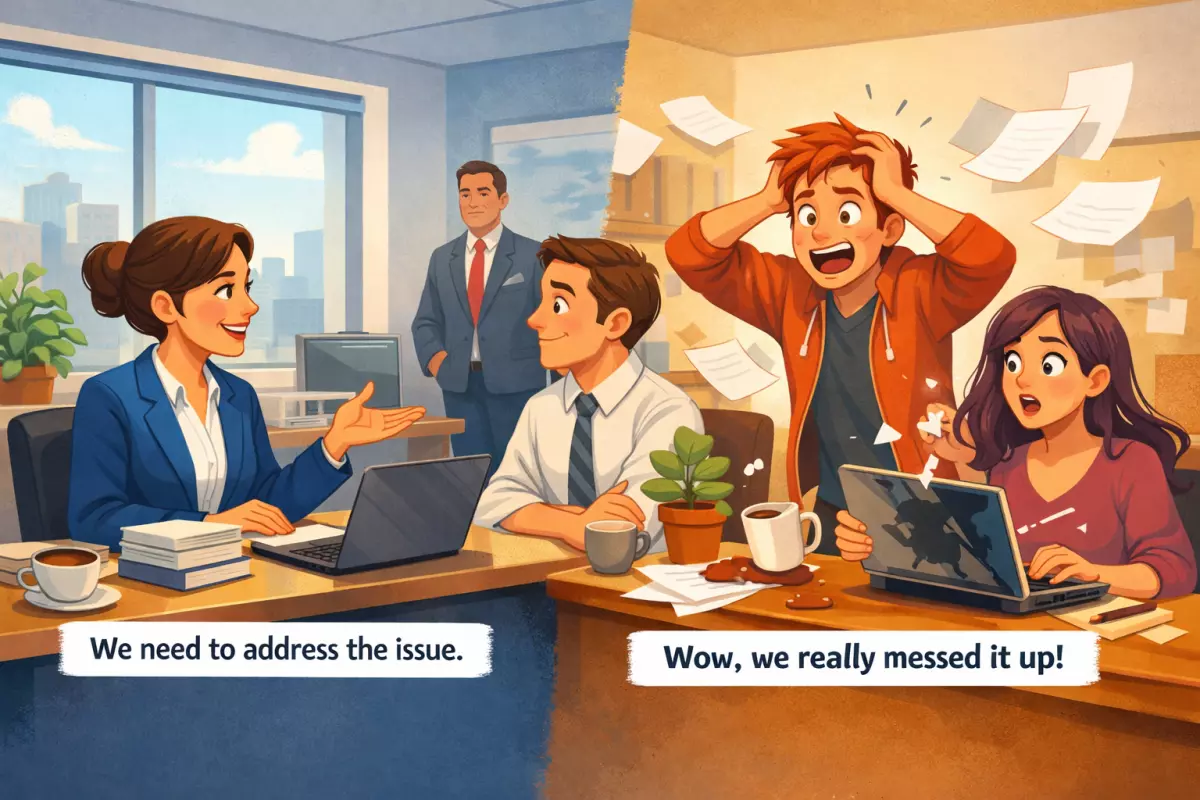
Many verb-based set phrases carry a clear level of formality and an attitude (friendly, critical, humorous, blunt). Choosing an expression that matches the situation matters as much as choosing the right tense: the same idea can sound professional, casual, or rude depending on the idiom.
How to judge formality and attitude
- Context test: If you would not say it to a client, examiner, or senior manager, it is probably informal or slangy (for example, “mess up,” “freak out”).
- Literal alternative check: If a neutral verb works (“increase,” “investigate,” “postpone”), that option is usually safer in formal writing than an idiom (“ramp up,” “look into,” “put off”).
- Emotional charge: Idioms often add judgement or drama (“blow up,” “tear into,” “brush off”). Use them when you want that tone, not by accident.
- Region and community: Some expressions are common in certain workplaces or countries but may sound odd elsewhere. When unsure, prefer widely understood, neutral phrasing.
- Audience sensitivity: Idioms that imply blame (“drop the ball”) or dishonesty (“pull strings”) can damage rapport even if they are common.
Common registers for verb idioms (with typical uses)
- Formal / institutional: Often appear in reports and official speech, but still feel idiomatic. Examples: “carry out” (a study), “set out” (a plan), “follow up” (an inquiry), “phase out” (a product).
- Neutral professional: Frequent in workplace conversation and email; usually acceptable with colleagues. Examples: “touch base,” “roll out,” “step in,” “hold off,” “wrap up.”
- Informal everyday: Natural in speech and friendly writing; can sound too casual in academic work. Examples: “hang out,” “chill out,” “catch up,” “run into,” “head out.”
- Slang / very casual: Strongly tied to spoken style and in-group tone; avoid in formal settings. Examples: “bail on,” “hook up,” “crash at” (someone’s place), “zone out,” “freak out.”
- Harsh / confrontational: Can sound accusatory or aggressive, even when used jokingly. Examples: “tear into,” “shut down,” “call out,” “rip off” (cheat), “chew out.”
- Humorous / light: Adds playfulness; can feel inappropriate in serious messages. Examples: “pig out,” “show up late and play catch-up,” “wing it,” “mess around.”
Politeness and “softening” patterns
- Use hedges: “It looks like we may need to push back the deadline” is softer than “We’re pushing back the deadline.”
- Prefer collaborative phrasing: “Let’s work through the issues” often lands better than “Let’s sort out your mistakes.”
- Avoid blame idioms in feedback: ❌ “You dropped the ball.” ✅ “The handover didn’t happen; let’s fix the process.”
- Choose neutral phrasal verbs when needed: “discuss” → “talk through” (friendly), but “talk through” may be too casual for formal writing.
Pairs that change tone (same idea, different feel)
- “investigate” → “look into” (more conversational)
- “postpone” → “put off” (informal; can imply reluctance)
- “reduce” → “cut back” (often practical, everyday)
- “become angry” → “blow up” (dramatic; suggests loss of control)
- “ignore” → “brush off” (adds a dismissive attitude)
- “deceive” → “string along” (suggests emotional manipulation)
- “criticize” → “tear into” (very strong, confrontational)
- “take responsibility” → “own up” (informal; often about admitting a mistake)
- “succeed” → “pull it off” (casual; highlights difficulty)
- “relax” → “chill out” (very casual; can sound rude as an order)
When you learn verb idioms, learn them with their “social meaning” attached: who uses them, where they fit, and what attitude they signal. That habit helps you sound natural without sounding careless, overly blunt, or unintentionally humorous.
Common mistakes with idioms
Set phrases often behave like fixed “chunks” of language. Many errors come from changing a small word, forcing a literal meaning, or applying normal grammar rules to an expression that doesn’t follow them. The safest approach is to learn each verb idiom with its typical grammar pattern (object position, preposition, and common tense forms).
1) Changing a fixed word (preposition, article, or particle)
Small words carry a lot of meaning in verb-based expressions. Swapping them usually makes the phrase sound non-native or changes the meaning.
- ❌ depend of → ✅ depend on
- ❌ good in math → ✅ good at math
- ❌ interested on → ✅ interested in
- ❌ married with → ✅ married to
- ❌ arrive to the airport → ✅ arrive at the airport
- ❌ arrive in the station → ✅ arrive at the station
- ❌ on the other side (meaning contrast) → ✅ on the other hand
- ❌ in my opinion, I agree → ✅ I agree / In my opinion, it works (avoid stacking fillers)
2) Mixing up phrasal verbs with similar particles
Many phrasal verbs differ only by a particle, but the meaning changes completely. Learn them as separate items, not as “verb + random particle.”
- ❌ look after a word in the dictionary → ✅ look up a word
- ❌ put off the lights → ✅ turn off the lights
- ❌ take in a jacket (meaning remove) → ✅ take off a jacket
- ❌ give up someone at the airport → ✅ pick up someone
- ❌ make up a meeting (meaning schedule) → ✅ set up a meeting
- ❌ break up a problem (meaning analyze) → ✅ break down a problem
3) Putting the object in the wrong place (separable vs. inseparable)
Some verb + particle combinations allow the object in two positions; others do not. Pronouns (it, them, him) follow stricter placement rules.
- With many separable phrasal verbs: verb + object + particle is common, and pronouns usually go in the middle:
- ✅ turn the music down / turn down the music
- ❌ turn down it → ✅ turn it down
- With inseparable phrasal verbs, the object cannot split the verb and particle:
- ❌ look the word up to → ✅ look up to someone
- ✅ run into an old friend (not “run an old friend into”)
4) Over-literal interpretations
Idiomatic meaning often has little to do with the literal words. Misunderstanding the meaning leads to inappropriate use in context.
- “I could care less” is often used, but the intended meaning is usually “I couldn’t care less” (meaning: it doesn’t matter at all).
- “Pull someone’s leg” means joke/tease, not physically pull.
- “Break the ice” means start social interaction, not break actual ice.
- “Spill the beans” means reveal a secret, not spill food.
- “Hit the sack” means go to bed, not hit something.
5) Wrong tense, form, or voice inside a set expression
Many expressions allow tense changes, but the internal wording stays stable. Passive voice is also uncommon for some verb idioms because the focus is on the doer.
- ❌ He has took it out on me → ✅ He has taken it out on me
- ❌ It was taken place yesterday → ✅ It took place yesterday
- ❌ She is used to work late → ✅ She is used to working late
- ❌ I look forward to see you → ✅ I look forward to seeing you
- ❌ He suggested me to go → ✅ He suggested that I go / He suggested going
6) Register problems (too informal, too strong, or too “spoken” for the context)
Some expressions are natural in conversation but sound out of place in formal writing. Others can sound rude if used with the wrong audience.
- “Wanna / gonna” are fine in casual speech but usually avoided in formal writing.
- “Shut up” is much stronger than “Be quiet” or “Could you lower your voice?”
- “I’m pissed off” is stronger and more informal than “I’m upset”.
- “Thanks a bunch” can sound sarcastic depending on tone; “Thank you very much” is safer.
7) Collocation clashes (using the right idiom with the wrong noun)
Even when the expression is correct, the surrounding words may not match typical usage. Learning common pairings helps your English sound more natural.
- ❌ make a photo → ✅ take a photo
- ❌ do a mistake → ✅ make a mistake
- ❌ strong rain → ✅ heavy rain
- ❌ big decision (sometimes OK) → ✅ major decision (often more natural in formal contexts)
- ❌ say a joke → ✅ tell a joke
When learning verb idioms and set expressions, record them with a short model sentence and the grammar pattern (for example: look forward to + -ing, take it out on + person, turn + pronoun + down). This prevents “almost correct” versions that native speakers rarely use.
How to memorize idioms effectively
Learn set expressions faster by focusing on how they behave in real sentences: which verbs they prefer, what objects or prepositions follow, and what situations they typically describe. Treat each item as a small grammar pattern, not just a meaning to translate.
1) Record idioms as “verb + structure”
Many verb idioms are predictable once you notice their fixed parts. When you write them down, include the most common frame and at least one natural example sentence.
- Verb + object: “break the ice” (start a friendly conversation) → “A joke helped break the ice.”
- Verb + preposition + noun: “run out of time” → “We ran out of time before the meeting ended.”
- Verb + particle (phrasal-idiom): “back down” (stop resisting) → “He refused to back down.”
- Verb + complement clause: “make sure (that)…” → “Make sure you lock the door.”
- Verb + -ing form: “can’t help doing…” → “I can’t help laughing.”
2) Chunk by function, not alphabet
Grouping by communicative purpose builds stronger memory cues than alphabetical lists. Keep each group small and review it in context.
- Starting and managing conversations: break the ice; bring up (a topic); get straight to the point; talk someone through (something).
- Agreeing and disagreeing: see eye to eye; beg to differ; meet someone halfway; stick to your guns.
- Decision-making: make up your mind; weigh up the options; go with your gut; sleep on it.
- Problem-solving: figure it out; work around (a problem); iron out (details); get to the bottom of (something).
- Time and deadlines: run out of time; buy time; put something off; beat the clock.
- Effort and persistence: keep at it; push through; go the extra mile; stick with it.
- Social behavior: show up; fit in; make a good impression; rub someone the wrong way.
- Risk and caution: play it safe; take a chance; test the waters; think twice.
3) Learn the “fixed” parts and the “flexible” parts
Set expressions often allow limited variation. Knowing what can change prevents errors and helps you produce the phrase naturally.
- Pronouns often change: “spill the beans” → “spill the beans” stays fixed, but “spill it” does not mean the same thing.
- Tense changes are usually fine: “call it a day” → “We called it a day early.”
- Articles may be fixed: “hit the nail on the head” (not “a nail”).
- Prepositions are commonly fixed: “keep up with” ✅ / “keep up to” ❌.
- Word order can be locked: “by and large” (switching the order sounds wrong).
4) Use contrast to prevent near-miss mistakes
Idioms are easy to confuse with literal phrases or with similar expressions. Build quick contrast pairs so your brain stores the boundary.
- “make up for (something)” (compensate) vs. “make up (a story)” (invent).
- “take over” (gain control) vs. “take up” (start a hobby / use space).
- “look after” (care for) vs. “look for” (search).
- “put up with” (tolerate) vs. “put up” (raise/build/post).
- “get away with” (avoid punishment) vs. “get away” (escape/go on holiday).
5) Practice in short, repeatable sentence frames
Recycling the same frames reduces cognitive load and makes the expression easier to retrieve in speaking and writing.
- Workplace: “Let’s iron out the details before Friday.”
- Planning: “If we run out of time, we’ll continue tomorrow.”
- Feedback: “You really hit the nail on the head with that point.”
- Conflict: “We don’t see eye to eye on this issue.”
- Encouragement: “Stick with it; it gets easier.”
- Small talk: “To break the ice, ask about their trip.”
- Problem: “Let’s get to the bottom of what happened.”
- Decision: “I’ll sleep on it and reply in the morning.”
6) Review with spaced repetition and active recall
Memorization improves when you force retrieval rather than rereading. Keep prompts brief and test yourself on form, meaning, and typical context.
- Cover the idiom and recall it from a meaning prompt: “compensate for a mistake” → “make up for a mistake.”
- Cover the meaning and recall it from a sentence: “We put the meeting off.” → “postpone.”
- Delete one fixed word and restore it: “run out ___ time” → “of.”
- Transform tense/person: “She calls it a day at six.” → “Yesterday she called it a day at six.”
- Use a 3-pass cycle: same day, two days later, one week later (add new items only after accurate recall).
Homework: verb idiom practice tasks
Focus on using set verb phrases naturally in context: keep the main verb tense correct, watch pronouns (it/them/yourself), and notice which preposition or particle is fixed. Many expressions allow small grammar changes (tense, person), but the core wording usually stays stable.
Task 1: Choose the best completion
- I didn’t want to argue, so I decided to ______ and let it go. (back down / back up)
- We need to ______ a solution before Friday. (work out / work up)
- She finally ______ to telling the truth. (owned up / took up)
- He promised to ______ the issue at the meeting. (bring up / bring in)
- They tried to ______ the rules, but the system blocked them. (get around / get over)
- I can’t ______ how expensive it’s become. (get over / get around)
- Please ______ the form and email it back. (fill out / fill in)
- He was nervous, but he didn’t ______; he stayed calm. (crack up / crack down)
Show answers
- back down
- work out
- owned up
- bring up
- get around
- get over
- fill out
- crack up
Task 2: Rewrite using the verb idiom given
Rewrite each sentence so it keeps the same meaning and uses the expression in brackets. Change tense/person as needed, but keep the core phrase.
- I postponed the meeting until next week. (put off)
- She tolerated his rude comments for months. (put up with)
- We discovered the cause of the error. (find out)
- He invented an excuse on the spot. (make up)
- They ended their partnership last year. (break up)
- I will support you during the presentation. (back you up)
- The plane departed at 6:10. (take off)
- She recovered quickly after the flu. (bounce back)
Show answers
- I put off the meeting until next week.
- She put up with his rude comments for months.
- We found out the cause of the error.
- He made up an excuse on the spot.
- They broke up their partnership last year.
- I will back you up during the presentation.
- The plane took off at 6:10.
- She bounced back quickly after the flu.
Task 3: Fix the pattern (particle/preposition/pronoun)
Each sentence has one common mistake with a fixed expression (wrong particle, wrong preposition, or wrong object placement). Rewrite it correctly.
- ❌ Can you look the word up in for me?
- ❌ She brought up it during lunch.
- ❌ I’m looking forward to meet you.
- ❌ He insisted to pay for dinner.
- ❌ They called off it because of the rain.
- ❌ I ran in my old teacher at the station.
- ❌ We talked them into to join us.
- ❌ He takes his father after in personality.
Show answers
- ✅ Can you look the word up for me?
- ✅ She brought it up during lunch.
- ✅ I’m looking forward to meeting you.
- ✅ He insisted on paying for dinner.
- ✅ They called it off because of the rain.
- ✅ I ran into my old teacher at the station.
- ✅ We talked them into joining us.
- ✅ He takes after his father in personality.
Task 4: Mini-dialogues (choose a natural response)
Write the most natural reply using the expression in brackets. Aim for one sentence each.
- A: “Do you want to join the project?” B: (count me in)
- A: “Why didn’t you tell me earlier?” B: (it slipped my mind)
- A: “This plan seems risky.” B: (hear me out)
- A: “The team is arguing again.” B: (calm them down)
- A: “Are you still angry about it?” B: (let it go)
- A: “I can’t understand this instruction.” B: (walk me through it)
Show answers
- Count me in.
- Sorry, it slipped my mind.
- Hear me out—here’s why it could work.
- I’ll talk to them and calm them down.
- No, I’ve decided to let it go.
- Sure—can you walk me through it step by step?
Task 5: Production checklist (self-edit)
- Check tense and subject agreement: “She owns up” / “She owned up.”
- Keep fixed particles: “carry on,” not “carry up”; “run into,” not “run in.”
- Place pronouns correctly with separable phrasal verbs: “bring it up” → not “bring up it.”
- Use the right verb form after prepositions: “look forward to meeting.”
- Avoid literal translations from your first language; choose the established set phrase used by native speakers.
- After writing, underline each multi-word verb and confirm the particle/preposition is the standard one.