Nouns in Idiomatic Expressions Used in Daily Spoken English

 Here we how nouns work in English idioms, gives examples of common noun idioms, explains their figurative meanings, when to use them, how they differ from regular phrases, typical learner mistakes, and includes practice matching idioms to meanings.
- Role of nouns in idioms and fixed expressions
- Common everyday idioms built around key nouns
- How noun idioms create figurative and non-literal meaning
- Register and tone: when to use noun idioms in speech
- Differences between idioms and free noun phrases
- Typical learner errors when translating idioms literally
- Practice: match noun idioms with meanings and contexts
Everyday conversations are full of vivid expressions that use particular nouns to communicate ideas beyond their direct meaning. These well-known phrases enrich spoken English by adding layers of humor, depth, and imagination, which help people connect and keep interactions lively. By choosing words that evoke strong images or emotions, speakers can make their messages more memorable and relatable, ensuring that their conversations are not only clear but also enjoyable for everyone involved.
Role of nouns in idioms and fixed expressions
Nouns often serve as the core elements in many common idiomatic phrases and set expressions. These words give substance to the phrase, anchoring abstract ideas in concrete imagery or familiar concepts. In daily conversation, these noun-based phrases help speakers express complex ideas or emotions succinctly and colorfully.
How nouns shape meaning in set phrases
Within fixed expressions, the noun can carry the bulk of the metaphor or symbolism. For example, in the phrase "a piece of cake," the noun "cake" evokes ease and enjoyment. The noun is not just a random word; it usually has cultural or imaginative resonance that makes the idiom memorable and effective.
Typical functions of nouns in idioms
- Representing objects or concepts (e.g., "bucket" in "kick the bucket")
- Symbolizing emotions or states ("heart" in "wear your heart on your sleeve")
- Indicating roles or stereotypes ("black sheep" of the family)
- Describing situations or problems ("can of worms")
- Referring to time or quantity ("a drop in the ocean")
- Providing contrast or comparison ("needle in a haystack")
- Implying value or significance ("apple of my eye")
- Suggesting risk or danger ("walking on thin ice")
- Highlighting origin or source ("storm in a teacup")
- Depicting action or result ("silver lining")
Common patterns involving nouns
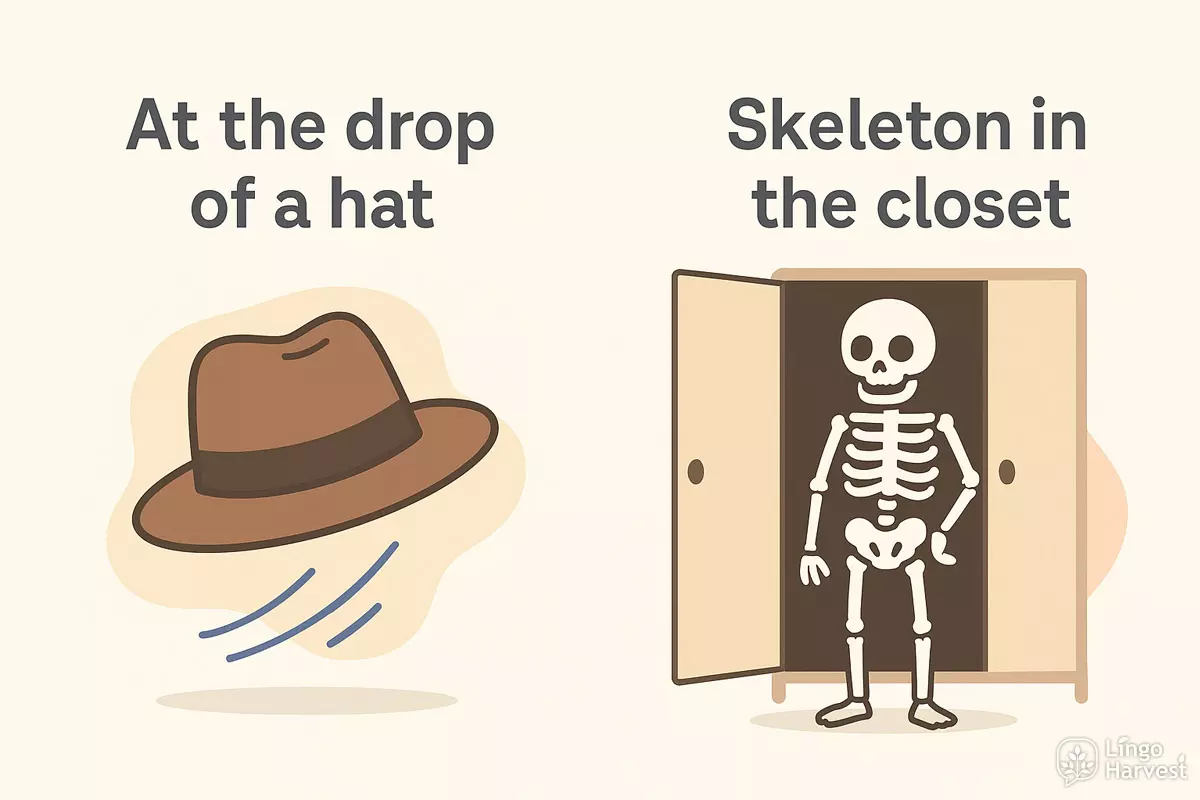
Many English idioms use a simple noun phrase structure, often with articles or possessives. For example:
- At the drop of a hat
- Skeleton in the closet
- Ballpark figure
- Red herring
- Elephant in the room
- Cash cow
- Dead end
- Cold shoulder
- Food for thought
- Loose cannon
- Rain check
- Shot in the dark
- Tough cookie
- White elephant
- Wild goose chase
- Yellow belly
Comparing literal and idiomatic noun usage
Nouns in idioms often lose their everyday, literal meaning and adopt a figurative sense. This shift is what makes the phrase idiomatic and sometimes confusing for learners. For example, "red tape" does not refer to actual tape, but to excessive bureaucracy.
| Literal Noun Usage | Idiomatic Expression |
|---|---|
| Apple (fruit) | Apple of my eye (someone cherished) |
| Bucket (container) | Kick the bucket (to die) |
| Skeleton (bones) | Skeleton in the closet (hidden secret) |
| Needle (sewing tool) | Needle in a haystack (something hard to find) |
| Goose (bird) | Wild goose chase (futile search) |
Nouns, then, are not just grammatical necessities in idioms—they provide the vivid imagery and metaphorical value that make these expressions so useful and memorable in everyday spoken English.
Common everyday idioms built around key nouns
Idiomatic expressions often rely on familiar nouns to convey meaning beyond the literal sense of the words. These phrases are used daily in casual conversations, making them essential for understanding and participating in natural English dialogue. Below, you'll find a selection of widely used idioms grouped by the main noun they feature, along with their meanings. Learning these can help you sound more fluent and understand others more easily.
Examples of idioms featuring key nouns
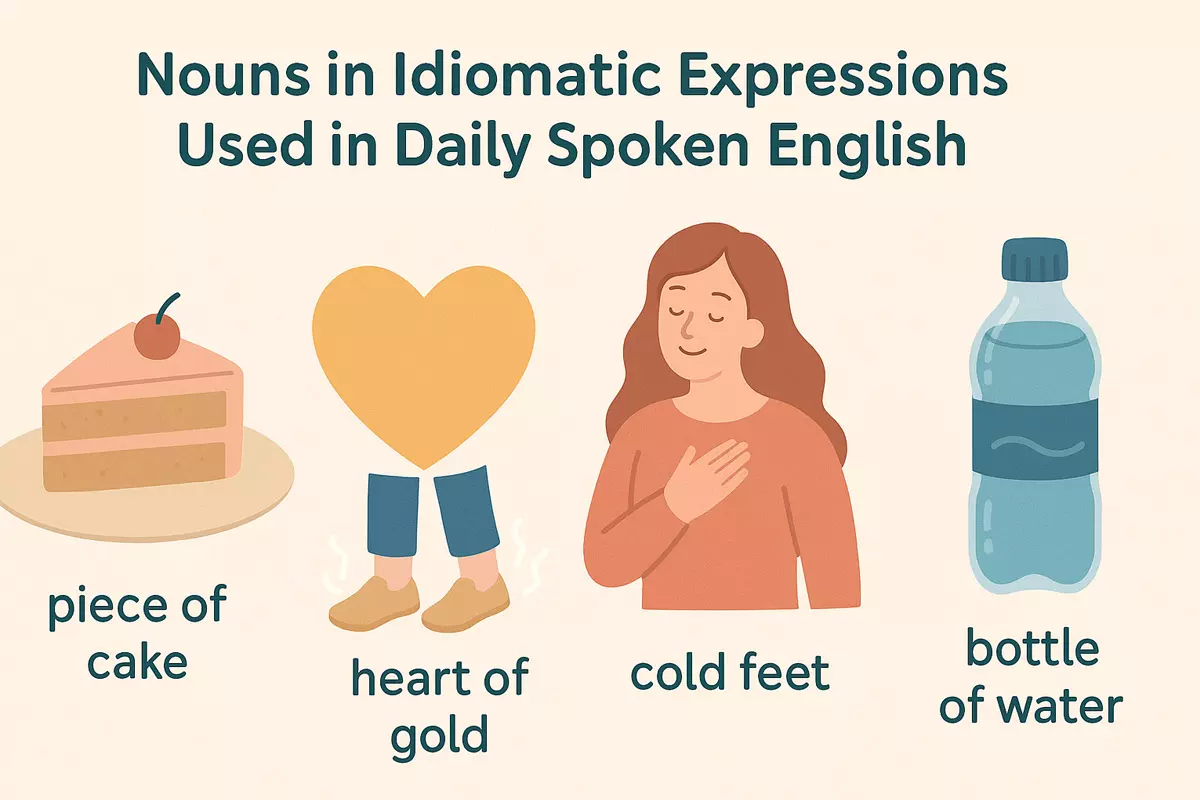
- Piece of cake – Something very easy to do
- Couch potato – A person who spends a lot of time sitting and watching TV
- Cold feet – Sudden nervousness before a big event
- Big cheese – An important or influential person
- Heart of gold – A very kind and generous character
- Fish out of water – Someone who feels out of place in a situation
- Storm in a teacup – A lot of fuss about something unimportant
- Backseat driver – Someone who gives unwanted advice
- Black sheep – A person who is different from the rest of the group, often in a negative way
- Loose cannon – Someone unpredictable who may cause damage
- Apple of (someone’s) eye – A person who is cherished above others
- Ballpark figure – An approximate number or estimate
- Cash cow – A product or service that reliably generates profits
- Breadwinner – The person who earns the main income for a household
- Drop in the bucket – A very small part of something big or whole
- Red flag – A warning sign or indicator of potential problems
- Skeleton in the closet – A hidden and potentially embarrassing secret
- Wild goose chase – A futile or hopeless pursuit
- Jack of all trades – Someone who can do many different jobs
- Head start – An advantage at the beginning of something
How these idioms are used in conversation
These expressions are sprinkled throughout everyday speech, often used for humor, emphasis, or to quickly sum up a situation. For example, when someone says, "Finishing that report was a piece of cake," they're simply stating it was easy. Similarly, calling someone the "big cheese" at work highlights their authority in a light-hearted way.
Quick comparison: Literal vs. idiomatic meaning
| Idiom | Literal Meaning | Idiomatic Meaning |
|---|---|---|
| Piece of cake | A slice of cake | Something very easy |
| Cold feet | Feet that are cold in temperature | Feeling nervous |
| Black sheep | A sheep with black wool | Odd or disapproved group member |
| Red flag | A flag colored red | Warning sign |
| Skeleton in the closet | Actual bones stored in a cupboard | Hidden secret |
Getting comfortable with these turns of phrase will make your English sound more natural and help you interpret the real meaning behind what others say. Practice using them in relevant situations to boost your conversational skills.
How noun idioms create figurative and non-literal meaning
Noun-based idiomatic expressions give English its vividness by conveying ideas indirectly. Instead of stating meaning outright, these phrases use concrete nouns as symbols for more abstract concepts. This makes conversations more colorful and allows speakers to express attitudes, emotions, or judgments subtly. For instance, when someone is called a “dark horse,” the phrase draws on imagery of horse racing to describe a person whose abilities or intentions are hidden, rather than literally referring to an animal.
Why English leans on noun idioms
English speakers often reach for noun idioms to describe situations, people, or feelings in a way that is more engaging or memorable. These expressions can compress complex information into a single phrase, making communication efficient and sometimes playful. They also help express cultural references or shared assumptions, which strengthens social bonds.
Common noun idiom patterns
Many idioms rely on everyday objects, animals, or roles. Here are some typical patterns:
- Animal nouns: “cash cow,” “black sheep,” “early bird”
- Body parts: “pain in the neck,” “cold shoulder,” “heart of gold”
- Household items: “hot potato,” “skeleton in the closet,” “silver spoon”
- Food nouns: “big cheese,” “bad apple,” “piece of cake”
- Nature elements: “storm in a teacup,” “ray of sunshine,” “drop in the ocean”
- Professions or roles: “whistle-blower,” “black sheep,” “jack-of-all-trades”
Literal vs. figurative meaning
Noun idioms usually have a figurative sense that’s quite different from their literal definition. For example, “hot potato” doesn’t refer to food but to a sensitive issue. This difference can be confusing for learners, but context usually clarifies the intent.
| Idiom | Figurative Meaning | Literal Meaning |
|---|---|---|
| White elephant | Something costly and useless | An actual rare animal |
| Loose cannon | Unpredictable person | A cannon not secured on a ship |
| Red herring | Misleading clue | A smoked fish |
| Big fish | Important person | Large aquatic animal |
| Cold turkey | Quitting abruptly | Chilled poultry |
Why figurative noun idioms matter in conversation
Using these expressions helps speakers sound more fluent and natural. They can soften criticism (“pain in the neck”), add humor (“couch potato”), or highlight a person’s role or behavior (“black sheep”). Mastery of such phrases is a sign of cultural competence and can make daily interactions smoother and more engaging.
Register and tone: when to use noun idioms in speech
Choosing the right moment and style for using noun-based idioms depends a lot on the context and your relationship with the listener. Idiomatic expressions built around nouns are common in everyday English, but they can sound too casual or even confusing if used in the wrong setting. Knowing when to sprinkle them into conversation can make your speech more relatable and natural, but awareness of formality and audience is key.
Informal settings: more freedom with idioms
In relaxed conversations with friends, family, or close colleagues, noun idioms add color and personality. They help express emotions or opinions quickly and often with humor or emphasis. Here are some common scenarios where these expressions fit right in:
- Chatting about daily life or personal experiences
- Sharing stories or anecdotes
- Reacting to surprising news
- Joking or teasing in a friendly way
- Describing people or situations vividly
Formal contexts: use with caution
In professional or unfamiliar situations, idiomatic noun phrases should be used more sparingly. They may not be understood by everyone, especially in international or multicultural environments. Overusing them can also make you seem unprofessional or too informal.
- Job interviews ❌ (not recommended) → Correct: “I have strong experience in project coordination.”
- Business meetings with new clients ❌ (not recommended) → Correct: “We propose implementing this solution in three stages.”
- Academic presentations ❌ (not recommended) → Correct: “The data indicates a significant increase in efficiency.”
- Emails to superiors ❌ (not recommended) → Correct: “Could you please advise on the next steps?”
- Official reports or documents ❌ (not recommended) → Correct: “The analysis shows consistent year-over-year growth.”
How idiom choice affects tone
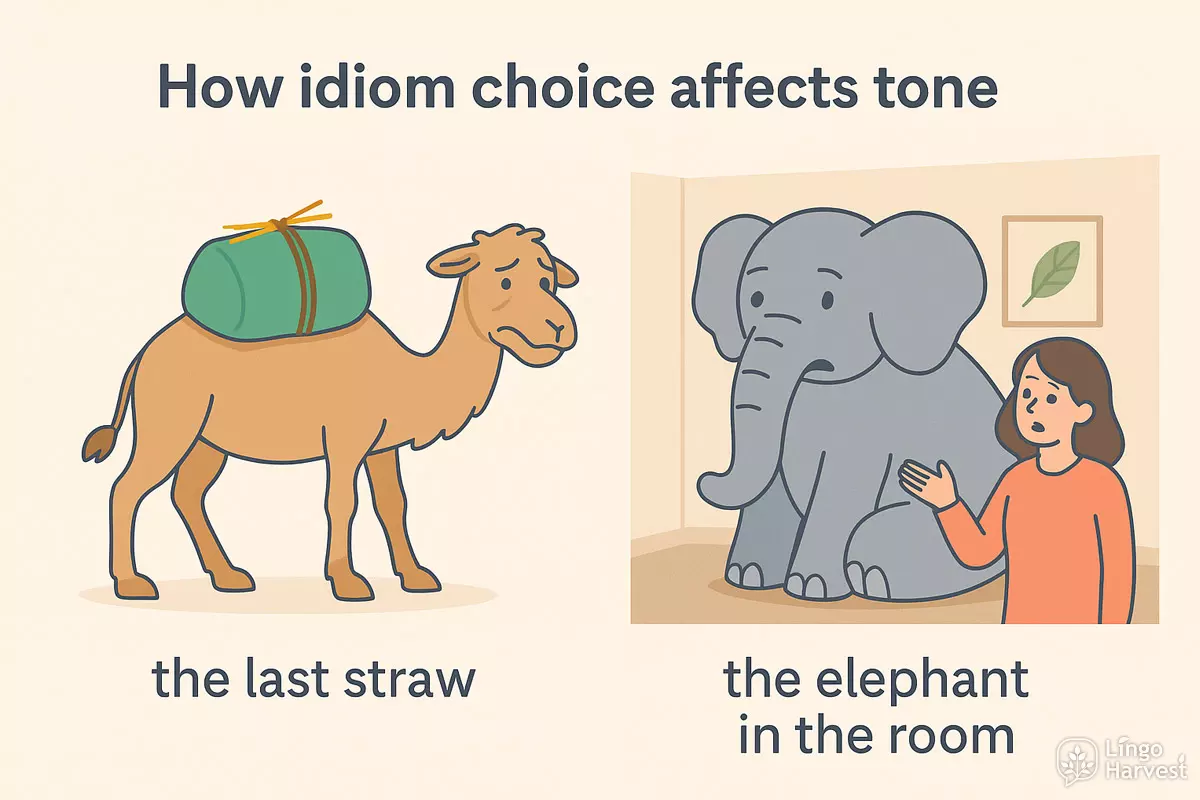
The type of noun idiom you choose can instantly set a tone—playful, sarcastic, critical, or supportive. Some idioms are lighthearted, while others can sound harsh or dismissive. Here’s a look at how different idioms can shift the mood:
| Idiom | Tone/Typical Use |
|---|---|
| piece of cake | Friendly, encouraging (easy task) |
| pain in the neck | Annoyed, informal complaint |
| the last straw | Frustration, final limit reached |
| the elephant in the room | Acknowledging an obvious problem, often in group settings |
| cold shoulder | Aloof, unfriendly (ignoring someone) |
| big cheese | Playful, sometimes sarcastic (important person) |
| loose cannon | Warning, unpredictable behavior |
| heart of gold | Warm, positive (kind person) |
| black sheep | Outsider, often negative |
| dark horse | Surprising, underestimated person |
Tips for natural use
- Match idioms to the relationship: more with peers, less with authority figures.
- Gauge the listener’s familiarity with English; simplify if needed.
- Use idioms to add emotion or humor, but avoid overuse in serious discussions.
- If unsure, explain or paraphrase the idiom for clarity.
In sum, noun idioms can enrich spoken English but only when chosen thoughtfully for the audience and situation. Attentiveness to setting and intent ensures your words strike the right note.
Differences between idioms and free noun phrases
Understanding how idiomatic expressions differ from regular noun phrases is essential for mastering natural English. While both can contain nouns, their meaning, structure, and use in conversation vary a great deal.
Meaning: Literal vs. Non-literal
Idioms often have figurative meanings that cannot be understood by interpreting the individual words. For example, "kick the bucket" means "to die," which is unrelated to kicking or any real bucket. In contrast, free noun phrases like "a red bucket" or "the tall man" are straightforward and literal; each word contributes directly to the meaning.
Flexibility and Structure
Free noun phrases allow for a lot of flexibility. You can modify, rearrange, or expand them: "the old wooden chair" can become "the very old wooden chair in the corner." Idioms, on the other hand, are fixed in form; altering them usually destroys their meaning. "Kick the bucket" doesn't work as "kick the old bucket" if you want the idiomatic sense.
Usage in Daily Speech
In everyday English, idioms add color and expressiveness, but they can confuse learners due to their unpredictability. Regular noun phrases are used for clear, direct description and are easier for learners to understand and use.
Comparing Idioms and Free Noun Phrases
| Idioms (with nouns) | Free Noun Phrases |
|---|---|
| Non-literal meaning e.g., "spill the beans" (reveal a secret) |
Literal meaning e.g., "a bowl of beans" (actual beans in a bowl) |
| Fixed structure ❌ Usually cannot change word order or add modifiers |
Flexible structure ✅ Easily modified or expanded |
| Often unpredictable for learners | Predictable, follows grammar rules |
| Used for stylistic effect, humor, or emphasis | Used for clear, specific reference |
Common Examples
- Idioms: "hit the sack", "cost an arm and a leg", "the ball is in your court", "let the cat out of the bag", "a blessing in disguise"
- Free noun phrases: "my blue shirt", "the city park", "a cup of coffee", "her favorite book", "those noisy children"
In summary, while both idioms and free noun phrases may feature nouns, their roles in spoken English are quite distinct. Idiomatic expressions rely on shared cultural knowledge and fixed wording, whereas free noun phrases provide clarity and flexibility for describing people, places, and things.
Typical learner errors when translating idioms literally
When learners encounter idiomatic expressions containing nouns, a common pitfall is to interpret each word separately and translate them word-for-word. This leads to confusion, awkward phrasing, or even complete misunderstanding in conversation. Idioms rarely make sense when broken down into their individual components, especially in spoken English where context and cultural nuance matter.
Common misunderstandings and pitfalls
Many errors stem from assuming that a noun in an idiom carries its usual dictionary meaning. For example, thinking “to spill the beans” is about actual beans, not about revealing a secret. This can result in translations that are either confusing or unintentionally humorous.
- Mistaking literal meaning for figurative intent (e.g., interpreting “kick the bucket” as an actual action rather than meaning “to die”).
- Translating idioms directly into one’s native language, resulting in phrases that make little sense to native speakers.
- Overusing or misusing idioms in inappropriate contexts because the underlying meaning is unclear.
- Omitting key nouns or substituting them with synonyms, believing the core message will remain unchanged.
- Assuming all idioms have direct equivalents in other languages.
Examples of literal translation errors in idioms with nouns
Below are several idiomatic expressions involving nouns that often trip up learners when translated word-for-word:
- Break a leg → Wishing someone actual harm instead of good luck.
- Under the weather → Thinking someone is literally beneath weather conditions, not feeling unwell.
- Piece of cake → Believing it refers to dessert rather than something easy.
- Cold feet → Imagining someone’s feet are cold instead of them feeling nervous.
- Hit the sack → Assuming someone is physically hitting a bag, not going to bed.
- Let the cat out of the bag → Visualizing a cat and a bag, missing the idea of revealing a secret.
- Butterflies in my stomach → Taking it as an actual medical issue instead of feeling nervous.
- Burning the midnight oil → Imagining literal oil burning, not staying up late working.
- On the fence → Picturing someone sitting on a fence, not being undecided.
- Throw in the towel → Thinking of discarding a towel, not giving up.
- Hit the books → Believing someone is striking books instead of studying.
- Pulling someone’s leg → Imagining physical action rather than joking or teasing.
- Cost an arm and a leg → Interpreting this as physical loss, not high expense.
- Walking on eggshells → Taking it literally, missing the sense of being cautious.
- At the drop of a hat → Looking for an actual hat, not understanding immediacy.
Why literal translation fails with idioms
Idioms are deeply rooted in culture and history. Their meanings are often metaphorical, and the nouns included serve as imagery rather than concrete references. Direct translation strips away this nuance and replaces it with confusion. For effective communication, it’s crucial to learn the figurative meanings and appropriate situations for these expressions.
Improving idiomatic understanding
To avoid these missteps, learners should:
- Study idioms in context, not isolation.
- Check reliable explanations for figurative meanings.
- Practice using idioms in real-life scenarios.
- Ask native speakers for clarification when unsure.
Recognizing these typical misinterpretations can help learners become more confident and accurate in their use of spoken English idioms.
Practice: match noun idioms with meanings and contexts
Understanding idiomatic expressions with nouns helps you sound more natural in conversational English. Let’s work on recognizing what these idioms mean and when people use them. Below you'll find a matching exercise, along with context examples to make things clearer.
Match the idiom to its meaning
Read each idiom and choose the most suitable meaning from the list. Consider the context in which you might hear each phrase.
- Cold shoulder
- Loose cannon
- Piece of cake
- Big picture
- Red flag
- Elephant in the room
- Green thumb
- Hot potato
- Silver lining
- Wild goose chase
- Arm and a leg
- Heart of gold
- Fish out of water
- Backseat driver
- Rat race
- A. Someone who is unpredictable and can cause trouble
- B. Something very easy to do
- C. A warning sign of trouble
- D. An expensive thing
- E. Avoiding an obvious problem
- F. A person who gives unwanted advice
- G. Being unfriendly or ignoring someone
- H. Someone who is very kind and generous
- I. A difficult or sensitive issue
- J. A pointless or hopeless search
- K. A positive aspect in a bad situation
- L. Someone who is uncomfortable in a situation
- M. Seeing the overall situation, not just the details
- N. An exhausting, competitive routine
- O. A person who is good at gardening
Show answers
- G. Being unfriendly or ignoring someone
- A. Someone who is unpredictable and can cause trouble
- B. Something very easy to do
- M. Seeing the overall situation, not just the details
- C. A warning sign of trouble
- E. Avoiding an obvious problem
- O. A person who is good at gardening
- I. A difficult or sensitive issue
- K. A positive aspect in a bad situation
- J. A pointless or hopeless search
- D. An expensive thing
- H. Someone who is very kind and generous
- L. Someone who is uncomfortable in a situation
- F. A person who gives unwanted advice
- N. An exhausting, competitive routine
Contexts: Where do these idioms fit?
Now, try to match each idiom with a suitable everyday context. This helps you recognize when to use them in conversation.
- 1. When someone spends too much money: Arm and a leg
- 2. When a friend avoids discussing an obvious family problem: Elephant in the room
- 3. When a colleague is acting unpredictably at work: Loose cannon
- 4. When you encourage someone to look beyond small issues: Big picture
- 5. When a task is extremely simple: Piece of cake
- 6. When a person is always helpful and caring: Heart of gold
- 7. When you see early signs of trouble in a relationship: Red flag
- 8. When someone gives driving advice from the passenger seat: Backseat driver
- 9. When someone ignores you after an argument: Cold shoulder
- 10. When you search for something that doesn’t exist: Wild goose chase
Show answers
- 1. Arm and a leg
- 2. Elephant in the room
- 3. Loose cannon
- 4. Big picture
- 5. Piece of cake
- 6. Heart of gold
- 7. Red flag
- 8. Backseat driver
- 9. Cold shoulder
- 10. Wild goose chase
Summary Table: Idiom, Meaning, and Example
| Idiom | Meaning | Example Context |
|---|---|---|
| Red flag | Warning sign of trouble | “His constant lateness is a red flag.” |
| Piece of cake | Something very easy | “The exam was a piece of cake.” |
| Elephant in the room | Obvious problem nobody wants to discuss | “We need to talk about the elephant in the room: our budget cuts.” |
| Fish out of water | Someone uncomfortable in a situation | “He felt like a fish out of water at the fancy party.” |
Practicing these noun-based idiomatic phrases with their meanings and contexts will sharpen your listening and speaking skills in real-life conversations. Try using a few in your next discussion!