Literal vs Idiomatic Phrasal Verbs: Meaning and Usage

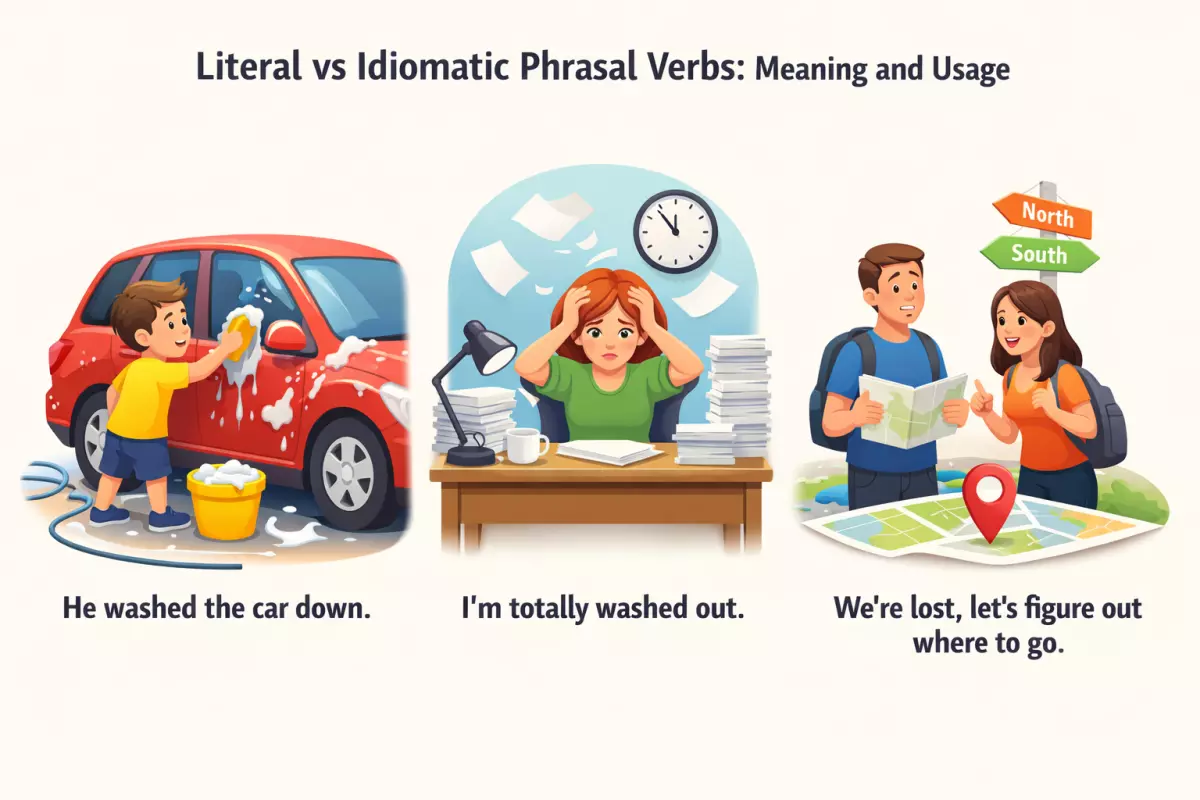 This article explains literal vs idiomatic meanings, how idioms shift meaning, and how to spot literal phrasal verbs. It lists common idiomatic phrasal verbs, shows context clues, flags typical learner mistakes, shares learning strategies, and ends with homework practice.
Phrasal verbs can be tricky because some mean exactly what the words suggest, while others have an everyday meaning you can’t easily guess. In real conversations, that difference matters: you might check a verb and still misunderstand the message if it’s figurative. This article helps you spot which type you’re dealing with and use each one naturally in speech and writing.
What literal and idiomatic meanings are
In phrasal verbs, the same verb + particle combination can point to a concrete action in the real world, or it can carry a “special” sense that you can’t reliably predict from the individual words. Recognizing which type you’re dealing with helps you choose the right object placement, avoid misreading, and sound natural in context.
Literal meaning (transparent, physical, and predictable)
A literal phrasal verb keeps the core sense of the main verb, and the particle (up, down, in, out, off, on, etc.) usually adds a clear direction, location, or completion idea. You can often visualize the action.
- Meaning pattern: verb = the action; particle = direction/position/result you can picture.
- Common clue: you can replace the phrase with a straightforward description without losing much meaning (for example, “enter,” “exit,” “remove,” “lift,” “lower”).
- Typical contexts: movement, placement, handling objects, turning devices on/off, arriving/leaving.
- Examples (literal uses):
- sit down (move into a sitting position)
- stand up (rise to a standing position)
- walk out (leave by walking)
- come in (enter)
- go out (leave a building; move outside)
- take off (remove clothing; an aircraft leaves the ground)
- put on (place clothing on your body)
- turn on (switch a device on)
- turn off (switch a device off)
- pick up (lift something from a surface)
- put down (place something on a surface)
- pull out (remove something by pulling)
- push in (insert by pushing)
- carry on (continue carrying something physically, in some contexts)
Idiomatic meaning (non-transparent, learned as a unit)
An idiomatic phrasal verb acts more like a single vocabulary item: the combined meaning is not the sum of the parts. You usually have to learn it through exposure and examples, because the particle no longer signals a literal direction.
- Meaning pattern: the whole phrase has a new sense that may be abstract (relationships, decisions, emotions, work, rules).
- Common clue: picturing the words literally creates a strange or wrong interpretation.
- Typical contexts: social interaction, business, problem-solving, opinions, routines, and informal speech.
- Examples (idiomatic uses):
- give up (stop trying; quit)
- put up with (tolerate)
- run into (meet unexpectedly)
- look after (take care of)
- look into (investigate)
- bring up (mention a topic; raise a child)
- turn down (reject; reduce volume)
- take on (accept responsibility/work; hire)
- make up (invent; reconcile after an argument)
- break down (stop functioning; lose control emotionally)
- work out (find a solution; exercise; develop successfully)
- get over (recover from an illness or disappointment)
- fall through (fail to happen as planned)
- come across (find by chance; seem/appear)
- pick on (bully; criticize repeatedly)
- hold off (delay)
- carry on (continue doing something)
How to tell which meaning is intended in real sentences
- Check the object: if the object is a physical thing and the action is concrete, a literal reading is more likely (but not guaranteed).
- Check the topic: if the sentence is about plans, feelings, choices, or relationships, the idiomatic sense is often the right one.
- Try a “picture test”: if you can draw the action and it still makes sense, it’s probably literal; if the drawing would be absurd, it’s likely idiomatic.
- Notice fixed pairings: some combinations are strongly associated with one established sense (for example, “look into” = investigate).
- Expect overlap: many phrasal verbs have both types, and context decides (for example, “take off” can be literal for clothing or idiomatic for sudden success).
How meaning changes in idiomatic uses

In idiomatic phrasal verbs, the verb + particle combination stops behaving like a simple “action + direction” formula. Instead, the whole unit takes on a conventional meaning that often can’t be predicted from the individual words, and it tends to act like a single vocabulary item in real usage.
Common meaning shifts you can expect
- From physical movement to abstract change: “pick up” can move from lifting something to “learn” or “improve” (“She picked up Spanish quickly”; “Business picked up in June”).
- From direction to completion: particles like up and out often signal “finish” or “fully” (“use up,” “eat up,” “figure out,” “work out”).
- From location to social interaction: “drop in” becomes an unplanned visit, not literal dropping (“He dropped in after work”).
- From separation to cancellation or removal: “call off” means cancel; “cut off” can mean stop supply/contact (“They called off the meeting”; “The internet was cut off”).
- From “up/down” to emotional or intensity changes: “cheer up”, “calm down”, “wind up” (end up; also “make more excited/tense” in some contexts).
- From “out” to disappearance or extinction: “die out”, “phase out”, “wear out” (become unusable).
- From “on” to continuation: “carry on”, “go on” often mean “continue,” not literal movement onto something.
- From “over” to review or repetition: “go over” can mean review; “do over” means repeat from the start.
- From “through” to completion of a process: “get through” can mean finish or survive (“get through the exam,” “get through a tough week”).
- From “back” to return or retaliation: “pay back” (repay), “hit back” (respond aggressively), which are not literal “backward” actions.
Patterns that signal an idiomatic reading
- The object doesn’t behave literally: “take in a lecture” means “absorb/understand,” not physically bring it inside.
- A synonym is a single verb: “put off” ≈ “postpone”; “find out” ≈ “discover”; “give up” ≈ “quit.” If one verb replaces the whole phrase, it’s often idiomatic.
- The particle feels “non-spatial”: in “make up (a story),” up doesn’t point anywhere; it marks creation/invention by convention.
- Meaning depends heavily on context: “take off” can mean remove clothing, leave the ground, or become successful; the situation selects the intended sense.
- Fixed collocations: certain nouns strongly prefer one phrasal verb (“break out” + fire/war/rash; “carry out” + plan/research/attack).
- Limited substitution: changing the particle often breaks the meaning (❌ “call down” for “call off”; ❌ “look in” for “look up” when meaning “search”).
High-value examples (idiomatic meanings in everyday English)
- bring up = mention/raise (a topic): “She brought up the budget issue.”
- break down = stop functioning; lose emotional control: “The car broke down”; “He broke down in tears.”
- come across = find by chance; seem/appear: “I came across an old photo”; “He comes across as confident.”
- come up with = invent/think of: “They came up with a solution.”
- cut back = reduce: “We’re cutting back on spending.”
- get along = have a good relationship: “Do you get along with your coworkers?”
- get over = recover from: “She got over the flu.”
- give in = stop resisting: “He finally gave in.”
- go through = experience; examine: “They went through a hard time”; “Go through the checklist.”
- hold on = wait: “Hold on a second.”
- keep up = maintain pace/level: “I can’t keep up with the class.”
- look after = take care of: “She looks after her grandparents.”
- look into = investigate: “We’ll look into the complaint.”
- make up = reconcile; invent: “They made up after the argument”; “He made up an excuse.”
- run out = have none left: “We ran out of milk.”
- turn down = reject; reduce volume: “He turned down the offer”; “Turn down the music.”
- work out = exercise; resolve; be successful: “She works out daily”; “We worked it out”; “It worked out well.”
When you learn an idiomatic phrasal verb, treat it as a single unit: learn its typical objects, its common contexts, and whether it allows object separation (for example, “turn the music down” / “turn down the music” vs. patterns that don’t separate naturally). This approach helps you choose the intended sense quickly and avoid literal interpretations that sound off in context.
Identifying literal phrasal verbs
Literal phrasal verbs are easiest to recognize when the verb keeps its basic, physical meaning and the particle (up, down, in, out, off, on, etc.) adds a clear direction, location, or completion. If you can picture the movement or change in space, the meaning is usually literal rather than figurative.
Practical tests you can use
- Visual “scene” test: If you can imagine the action happening in real space (someone moves, an object changes position), the combination is likely literal.
- Direction or location is obvious: The particle answers “where?” or “which way?” (in/out/up/down/away/back/over).
- Replaceable with a simple verb + preposition: Many literal combinations can be paraphrased without much change in meaning (for example, “go out” → “go outside”).
- Object stays concrete: The noun after the verb is often a physical thing (door, box, coat, chair, car) rather than an abstract idea (plan, issue, relationship).
- Pronoun placement feels natural: With separable literal verbs, pronouns typically go between the verb and particle: ✅ “pick it up” ❌ “pick up it”.
- Stress stays on the main verb in neutral speech: In many literal uses, the verb carries the main idea and the particle simply adds spatial detail.
- Minimal change across contexts: The meaning remains stable in different sentences because it depends on physical action, not metaphor.
Common literal patterns (with examples)
- Movement into/out of a place: “walk in,” “step out,” “run out,” “climb in.”
- Up/down as vertical direction: “stand up,” “sit down,” “pull down the blinds,” “lift up the box.”
- On/off as contact or attachment: “put on a jacket,” “take off your shoes,” “stick on a label,” “peel off the sticker.”
- Away/back as distance or return: “throw away the trash,” “carry away the plates,” “bring back the book,” “go back inside.”
- Open/closed states with physical results: “open up the window,” “shut down the lid,” “close up the bag.”
- Separation or removal: “cut off a piece,” “tear off the corner,” “break off a branch.”
- Placement and positioning: “set down the bag,” “put away the tools,” “lay out the clothes,” “hang up the coat.”
- Crossing or passing: “go over the bridge,” “walk across,” “look over the fence.”
- Entry/exit with vehicles: “get in the car,” “get out of the taxi,” “climb out of the boat.”
- Gathering into a container or group: “pack up the dishes,” “bundle up the cables,” “gather up the papers.”
- Rotating or turning: “turn over the page,” “flip over the card,” “roll over the log.”
- Raising/lowering something by force: “push up the window,” “pull down the handle,” “hoist up the flag.”
Watch for “literal-looking” verbs that can turn idiomatic
- Some combinations switch meaning depending on the object: “take off your shoes” (physical removal) vs “the plane took off” (still literal movement) vs “take off as a business” (figurative success).
- Context can shift a spatial particle into a metaphor: “put down the book” (physical) vs “put down an idea” (record) vs “put someone down” (insult).
- If the object becomes abstract and the action is no longer easy to picture, treat it as a likely idiomatic use and check meaning by context.
Common idiomatic phrasal verbs
Many everyday multi-word verbs can’t be decoded by translating each word. The safest approach is to learn them as fixed meanings, then notice patterns: some are separable (object can go in the middle), some are inseparable, and some change meaning depending on context.
High-frequency idiomatic items (meaning + typical use)
- figure out = understand/solve. “I can’t figure out how this works.”
- run into = meet unexpectedly. “I ran into my teacher at the station.”
- come up with = produce an idea/solution. “She came up with a better plan.”
- get along (with) = have a good relationship. “Do you get along with your neighbors?”
- look after = take care of. “He’s looking after his little sister.”
- put off = postpone. “They put off the meeting until Friday.”
- turn down = reject/decline. “She turned down the offer.”
- set up = arrange/organize. “We set up an appointment.”
- give up = stop trying/quit. “He gave up smoking.”
- carry on = continue. “Despite the noise, they carried on working.”
- make up = invent (a story/excuse) or reconcile after conflict. “He made up an excuse.” / “They argued, then made up.”
- break down = stop functioning (machine) or lose emotional control. “The car broke down.” / “She broke down in tears.”
- pick up = learn informally or collect someone/something. “I picked up some Spanish.” / “Can you pick me up at 6?”
- work out = find a solution or be successful. “We’ll work it out.” / “The plan worked out.”
- go on = continue/happen. “What’s going on here?”
- bring up = mention (a topic) or raise (a child). “Don’t bring up politics.” / “She was brought up by her grandparents.”
Usage patterns that help you choose the right form
- Separable vs. inseparable: some allow an object between verb and particle, others don’t.
- ✅ “Turn down the offer.” / “Turn the offer down.”
- ❌ “Look after your bag.” (not “look your bag after”)
- Pronoun placement: with separable phrasal verbs, pronouns usually go in the middle.
- ✅ “Turn it down.” “Pick them up.”
- ❌ “Turn down it.” “Pick up them.”
- One form, multiple idiomatic meanings: context decides the meaning, so learn common “sense groups.”
- make up: invent / reconcile
- pick up: collect / learn / improve
- break down: malfunction / become very upset
- Register and tone: many sound natural in conversation, but some may be too informal in very formal writing.
- More conversational: “put off,” “figure out,” “run into”
- More neutral: “set up,” “look after,” “work out”
When you learn these expressions, focus on the whole unit (verb + particle) and the situations it appears in. That makes it easier to avoid literal interpretations and choose the correct word order with objects.
Context clues for interpretation
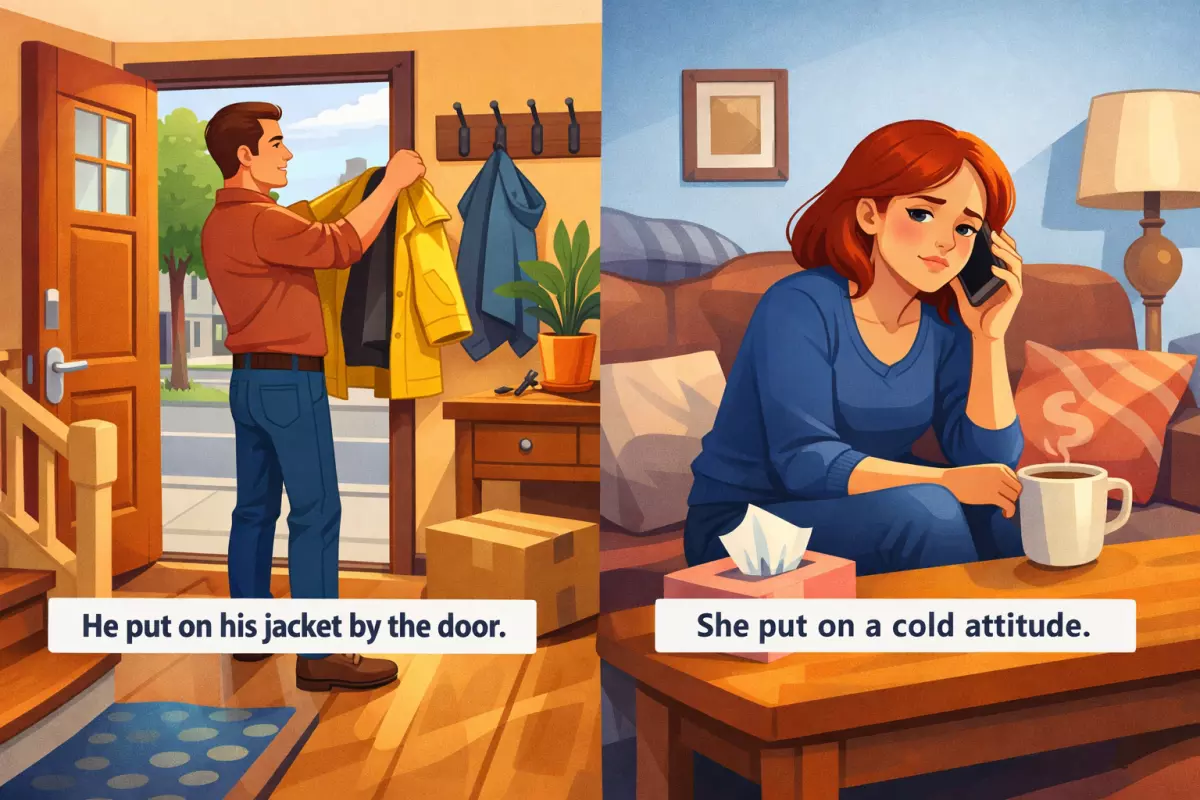
Deciding whether a phrasal verb is literal or idiomatic usually comes from the surrounding details. Look for signals that point to a real, physical action versus a figurative meaning that depends on the situation, relationship, or topic.
Signals that a literal reading is likely
- Concrete location words appear nearby (room, street, shelf, door, upstairs, outside), suggesting real movement or placement.
- A physical object is the direct object (coat, box, phone, light), making the action easy to visualize: “pick up the box,” “turn off the light.”
- The sentence answers “where?” or “in what direction?” naturally: “She ran into the house,” “He walked out.”
- Time and sequence describe steps in an action (first, then, after that), common in instructions: “Put the lid on, then take it off.”
- Tools or body movement are mentioned (hands, keys, ladder, switch), supporting a real-world action.
- The verb keeps its basic meaning and the particle adds a spatial idea: “sit down,” “stand up,” “go in,” “come back.”
- Replacing the phrasal verb with a single verb keeps the same physical sense: “enter” for “go in,” “return” for “come back.”
Signals that an idiomatic reading is likely
- The meaning is about relationships, decisions, or progress, not space: “work out” (resolve), “fall out” (argue), “give in” (yield).
- The object is abstract (idea, plan, issue, problem, responsibility): “carry out a plan,” “bring up an issue.”
- The phrase appears in work, school, or social contexts where metaphor is common: meetings, negotiations, deadlines, conflicts.
- A literal interpretation would sound odd or impossible in context: “I can’t put up with the noise” is not about lifting anything upward.
- The phrasal verb can often be replaced by a more formal verb without changing the topic: “tolerate” (put up with), “mention” (bring up), “cancel” (call off).
- Pronouns are used heavily (it, them, him) because the meaning is understood from the situation: “Let’s call it off.”
- The phrase forms a common fixed unit that learners meet as a chunk: “figure out,” “run into (a problem),” “look after.”
Fast checks you can apply while reading
- Ask “Can I picture it?” If you can clearly visualize the action and setting, a literal sense is more likely.
- Ask “What’s the topic?” If the topic is emotions, plans, conflict, or outcomes, an idiomatic meaning is often intended.
- Swap the object. If changing the object to something physical breaks the meaning, it’s probably figurative: “bring up a child” vs. “bring up a suitcase.”
- Look for collocations. Some pairings strongly prefer idiomatic use: “set up a meeting,” “break down in tears,” “take over a company.”
- Check for a result. Idiomatic uses often emphasize outcome: “work out” → “end well / be solved,” “turn out” → “be discovered.”
- Notice passive voice. Many figurative uses appear naturally in passive structures: “The event was called off,” “A new policy was rolled out.”
Pairs where context does most of the work
- pick up: literal “pick up the keys” vs. idiomatic “pick up Spanish quickly” (learn).
- take off: literal “take off your jacket” vs. idiomatic “sales took off” (increase rapidly).
- run into: literal “run into the room” vs. idiomatic “run into a problem” (encounter).
- turn down: literal “turn down the street” vs. idiomatic “turn down the offer” (decline).
- bring up: literal “bring up the box from the basement” vs. idiomatic “bring up a concern” (mention).
- break down: literal “break down the door” vs. idiomatic “break down the data” (analyze) / “break down” (stop functioning).
- look over: literal “look over the fence” vs. idiomatic “look over the report” (review).
- set up: literal “set up the tent” vs. idiomatic “set up an account” (create/arrange).
- get on: literal “get on the bus” vs. idiomatic “get on with someone” (have a good relationship).
- come across: literal “come across the bridge” vs. idiomatic “come across as confident” (seem).
Typical learner mistakes
Errors with phrasal verbs often come from treating them as fully predictable combinations of “verb + preposition,” or from assuming a literal image when the meaning is actually fixed by idiom. Paying attention to patterns—separability, object placement, and register—reduces most of these problems.
Common error patterns (with quick fixes)
- Assuming the literal meaning when the phrase is idiomatic. Example: “I’ll look up my friend” (often misread as “raise your eyes”). In many contexts, look up means “search for information” or “visit.” Always confirm the intended sense from context.
- Choosing the wrong particle because it “sounds logical.” Learners may swap up/out/off and change the meaning: find out (discover) vs. find up (not used). Treat many combinations as fixed units.
- Misplacing the object with separable phrasal verbs. With many verb+particle combinations, the object can go in the middle: ✅ “Turn the light off” / “Turn off the light.” But with pronouns it usually must split: ✅ “Turn it off” ❌ “Turn off it.”
- Over-separating inseparable phrasal verbs. Some cannot split: ✅ “Look after the kids” ❌ “Look the kids after.” When you learn a new item, note whether it’s separable or inseparable.
- Using a transitive pattern for an intransitive phrasal verb (or the reverse). ✅ “The plane took off” (no object) vs. ✅ “They took off their shoes” (object). The same form can behave differently depending on meaning.
- Forgetting that idiomatic meanings can be topic-specific. Take off can mean “leave quickly,” “remove,” or “become successful.” Choosing the wrong sense can make a sentence confusing even if grammar is correct.
- Using an idiom in a context where a literal verb is expected. In formal or technical writing, a single-word verb may be clearer: “investigate” instead of “look into,” “continue” instead of “carry on.” Register matters.
- Mixing up phrasal verbs with similar meanings but different usage. Put off (postpone) vs. put out (extinguish / publish) vs. put up with (tolerate). Similar core verb, very different outcomes.
- Adding an unnecessary preposition after a phrasal verb. ✅ “We discussed it” / “We talked about it.” But ❌ “We discussed about it.” Some multiword verbs already contain the needed preposition.
- Dropping the preposition in prepositional verbs. ✅ “Depend on,” “approve of,” “listen to.” Removing the preposition makes the structure ungrammatical or changes the meaning.
- Confusing “phrasal verb” with “verb + adverb” that is purely literal. “Walk in,” “sit down,” and “go out” can be straightforward directions; not every combination is idiomatic. Decide whether the meaning is compositional (literal) or fixed (idiomatic) before paraphrasing.
- Overusing one high-frequency phrasal verb for many meanings. Using get + particle for everything (“get on,” “get over,” “get by”) can lead to vague or incorrect phrasing. Prefer the specific combination that matches the situation.
- Using the wrong verb form in tense/aspect with multiword verbs. The verb carries the tense, not the particle: ✅ “She has given up” (not “has up given”). Keep the particle fixed after the verb phrase.
- Misinterpreting passive possibilities. Some transitive phrasal verbs allow passive: “The meeting was put off.” Others are awkward or change focus. If passive sounds unnatural, switch to an active sentence or a single-word verb.
- Creating nonstandard combinations by translating directly from the first language. If a literal translation produces an unfamiliar pairing (“make up a photo,” “open the TV”), replace it with a common English collocation (“take a photo,” “turn on the TV”).
- Confusing “back” as a particle vs. “back” as a noun/adverb. “Call back” (return a call) differs from “call from the back.” Check whether “back” is part of a set phrase or just describing location.
Practical checks before you use one
- Identify the sense: is it describing a physical action (literal) or a fixed meaning (idiomatic)?
- Check separability: can the object go between verb and particle, and what happens with pronouns?
- Confirm transitivity: does it take an object in this meaning?
- Match register: everyday conversation may favor multiword verbs; formal writing may prefer single-word alternatives.
- Learn it with a short, typical frame: “put it off,” “look after someone,” “run into someone,” rather than as isolated words.
Learning strategies for idioms
Idiomatic phrasal verbs are easiest to master when you treat them as fixed chunks with typical contexts, not as words you can decode literally. Focus on the patterns they appear in (objects, pronouns, tense, and register) and build recall through repeated, varied use.
1) Learn the “chunk,” not the individual words
- Record the full unit you will actually say: carry on, put up with, run into, figure out.
- Include the most common grammar frame: “carry on + -ing,” “put up with + noun/-ing,” “run into + someone,” “figure out + noun/wh-clause.”
- Store a short, plain meaning next to it (one line), then add one natural example sentence.
2) Group by usage pattern (separable, inseparable, object position)
- Separable (object can go in the middle): “turn it down,” “turn the offer down.”
- Pronoun rule (pronoun must go in the middle for separable forms): ✅ “turn it down” ❌ “turn down it”.
- Inseparable (object cannot split the verb): “look after the kids,” not “look the kids after.”
- No object (intransitive): “show up,” “back off,” “calm down.”
3) Attach each expression to a situation and a typical subject
- run into (people, unexpectedly): “I ran into my old teacher at the station.”
- put up with (annoying situations): “She won’t put up with rude comments.”
- work out (plans, relationships, solutions): “It worked out in the end.” / “We’ll work it out.”
- break down (machines, talks, systems): “Negotiations broke down.”
- take off (planes, trends, careers): “The product really took off.”
4) Notice common “meaning families” for particles
- up often signals completion or increase: “use up,” “speed up,” “clean up,” “end up.”
- out often signals discovery or distribution: “find out,” “figure out,” “hand out,” “run out (of).”
- off often signals separation or reduction: “cut off,” “drop off,” “back off,” “pay off” (idiomatic result).
- down often signals reduction or calming: “calm down,” “turn down,” “slow down,” “break down” (idiomatic failure).
- Use these as memory hooks, but confirm meaning from real examples because idioms can break the pattern.
5) Practice with high-yield transformations
- Tense shift: “She puts up with it” → “She put up with it” → “She has put up with it for years.”
- Pronoun swap: “turn the radio down” → “turn it down.”
- Question form: “You figured it out.” → “Did you figure it out?”
- Negative: “He went through with it.” → “He didn’t go through with it.”
- Clause expansion: “find out the answer” → “find out what happened.”
6) Build a short “core set” and recycle it across topics
- Start with 10–15 that appear constantly in conversation and workplace English: “bring up,” “set up,” “follow up,” “point out,” “deal with,” “carry on,” “hold on,” “pick up,” “drop off,” “run into,” “work out,” “figure out,” “come up with,” “get along,” “turn out.”
- Write two contexts per item (personal + professional) to prevent one-situation memorization.
- Review by mixing them: tell a short story that uses 4–6 of your core items in one paragraph.
7) Watch for register and tone
- Some phrasal verbs are neutral and common (“find out,” “work out”), while others can sound informal (“chill out,” “mess up”).
- When you learn a new one, label it: neutral, informal, or more formal alternative (e.g., “continue” vs “carry on”).
- Prefer the natural option for the setting rather than forcing a phrasal verb into every sentence.
8) Learn common collocations and “neighbors”
- Pair with frequent nouns: “set up a meeting,” “carry out research,” “bring up an issue,” “follow up with a client.”
- Pair with common adverbs/time markers: “end up eventually,” “turn out to be,” “work out in the end.”
- Note prepositions that follow: “catch up with,” “get away with,” “look forward to.”
9) Use quick error checks to avoid literal traps
- If the meaning seems “too physical” for the context, test an idiomatic reading: “take off” (remove clothing) vs “take off” (become successful).
- If you can replace it with a single verb without changing meaning, you likely have the idiomatic sense: “figure out” → “solve/understand.”
- If splitting sounds wrong, check separability before you practice it aloud: “look after” stays together; “turn down” can split.
Homework: literal vs idiomatic practice
Focus on two skills: (1) spotting whether a phrasal verb is being used in a physical, “real-world” sense or in a figurative sense, and (2) choosing the grammar pattern that native speakers typically use (object position, pronouns, and whether the verb can be separated).
1) Identify the meaning (literal or idiomatic)
- Decide whether the phrasal verb is literal or idiomatic: “She put down the box carefully.”
- “He put down my idea in front of everyone.”
- “The plane took off at 6:10.”
- “Her career took off after that interview.”
- “Please turn down the music.”
- “They turned down my application.”
- “I ran into a chair in the dark.”
- “I ran into my old teacher at the station.”
- “He picked up the keys from the table.”
- “She picked up Spanish quickly.”
- “We set up the tent near the lake.”
- “They set up a meeting for Monday.”
Show answers
- Literal
- Idiomatic
- Literal
- Idiomatic
- Literal
- Idiomatic
- Literal
- Idiomatic
- Literal
- Idiomatic
- Literal
- Idiomatic
2) Choose the correct pattern (separable vs. inseparable)
Some phrasal verbs allow the object to go between the verb and particle (separable). Others do not (inseparable). A key usage rule: if the object is a pronoun (it, them, him), separable phrasal verbs usually require the pronoun in the middle (verb + pronoun + particle).
- Choose the best option: “Please turn (it down / down it).”
- “She put (the baby down / down the baby) for a nap.”
- “She put (him down / down him) in front of the team.”
- “We picked (the kids up / up the kids) after school.”
- “We picked (them up / up them) after school.”
- “I ran (my cousin into / into my cousin) at the mall.”
- “They looked (the word up / up the word) in a dictionary.”
- “They looked (it up / up it) online.”
- “He took (his shoes off / off his shoes) at the door.”
- “He took (them off / off them) at the door.”
Show answers
- it down
- the baby down
- him down
- the kids up (also acceptable: up the kids)
- them up
- into my cousin
- the word up (also acceptable: up the word)
- it up
- his shoes off (also acceptable: off his shoes)
- them off
3) Replace with a natural idiomatic alternative
Rewrite each sentence by replacing the underlined literal phrase with a phrasal verb. Keep the tense and meaning. Use these target verbs: figure out, give up, carry on, put off, work out, bring up, run out of, look after, find out, come across.
- “I finally understood the instructions.”
- “Don’t stop trying after one mistake.”
- “They decided to continue despite the noise.”
- “We had to postpone the meeting.”
- “Everything will become successful if we plan well.”
- “He mentioned the budget problem again.”
- “We used all the milk.”
- “Can you take care of my dog this weekend?”
- “I discovered the truth yesterday.”
- “I found an old photo while cleaning.”
Show answers
- I finally figured out the instructions.
- Don’t give up after one mistake.
- They decided to carry on despite the noise.
- We had to put off the meeting.
- Everything will work out if we plan well.
- He brought up the budget problem again.
- We ran out of milk.
- Can you look after my dog this weekend?
- I found out the truth yesterday.
- I came across an old photo while cleaning.
4) Production task (short writing)
Write 8–10 sentences about a normal day. Include at least:
- 4 literal uses (movement/position: take off, put down, pick up, set up, etc.).
- 4 idiomatic uses (progress/decisions/relationships: turn down, bring up, work out, give up, etc.).
- At least 3 object pronouns (it, them, him/her) placed correctly with separable phrasal verbs.
- One sentence where the same phrasal verb could be literal or figurative; make the meaning clear using context.
After writing, underline each phrasal verb and label it (L) or (I). Then check word order: if you used a pronoun object, confirm it appears between the verb and particle in separable patterns (✅ “turn it down” ❌ “turn down it”).