Articles in Reported Speech and Backshifted Contexts

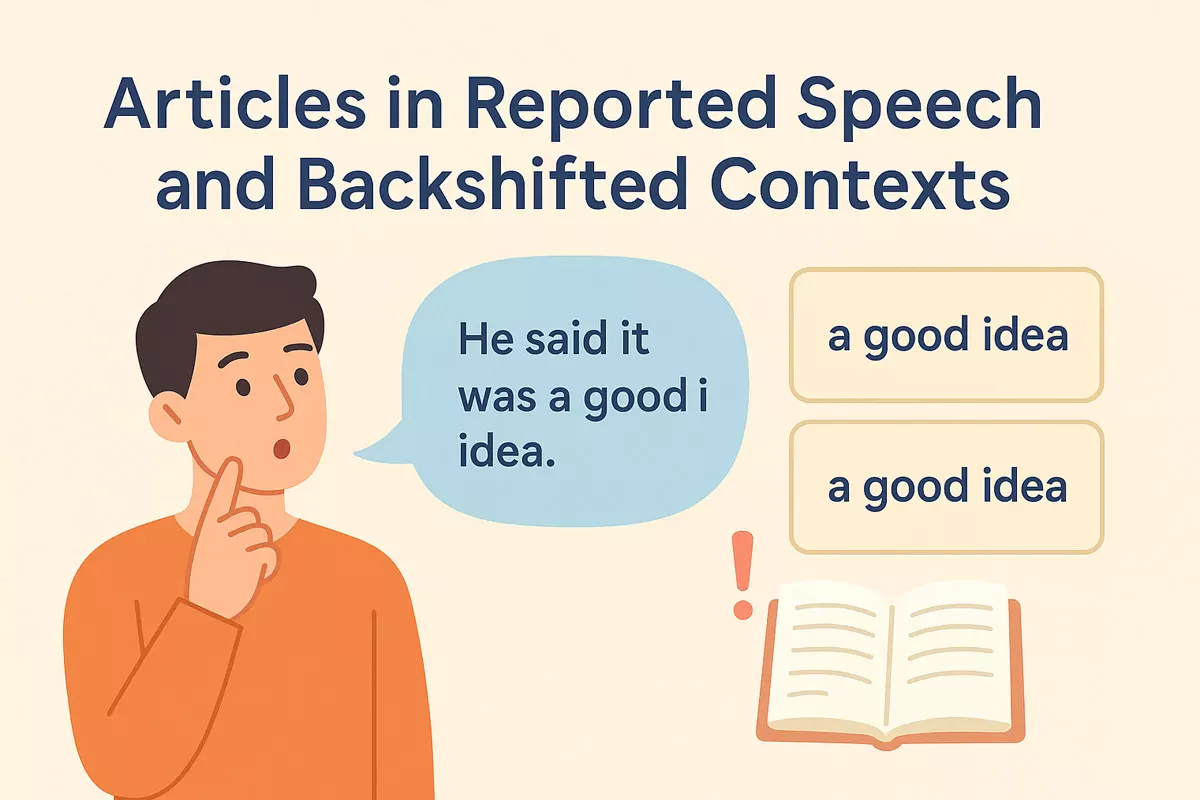 Here we how reported speech influences the use of English articles. It explains when articles should change or stay the same due to shifts in time, place, and context, highlights common mistakes, and provides practice for accurate article adjustment.
Retelling what others have said often makes the use of definite and indefinite articles unexpectedly challenging, particularly when shifting tenses to match the original context. It is important to understand how articles such as "a," "an," and "the" function in indirect speech, as they may change depending on the information being reported and the listener's familiarity with it. Mastering the adaptation of these small words is crucial for ensuring clarity and accuracy when conveying someone else's statements in a new context.
How reported speech affects reference
When speech is reported indirectly, the way we refer to people, things, and ideas can shift in subtle but important ways. This happens because reported statements often rely on the context of the original utterance, rather than the context of the report itself. As a result, articles (“a,” “an,” “the”), demonstratives (“this,” “that”), and pronouns frequently change or require reinterpretation to preserve clarity.
Shifts in definite and indefinite reference
In backshifted or indirect speech, the use of articles may alter depending on whether the original speaker and the reporter share the same knowledge or assumptions. For example, a definite article (“the”) in direct speech might become indefinite (“a”) in reported speech if the referent is no longer uniquely identifiable to the new audience.
- Direct: She said, “I saw the manager.” (Both speaker and listener know which manager.)
- Reported: She said that she saw a manager. (The identity may be unclear to the reporter.)
Demonstratives and context
Words like this and that are often context-dependent. In indirect speech, these may change to reflect the new frame of reference, often becoming “the” or dropped altogether.
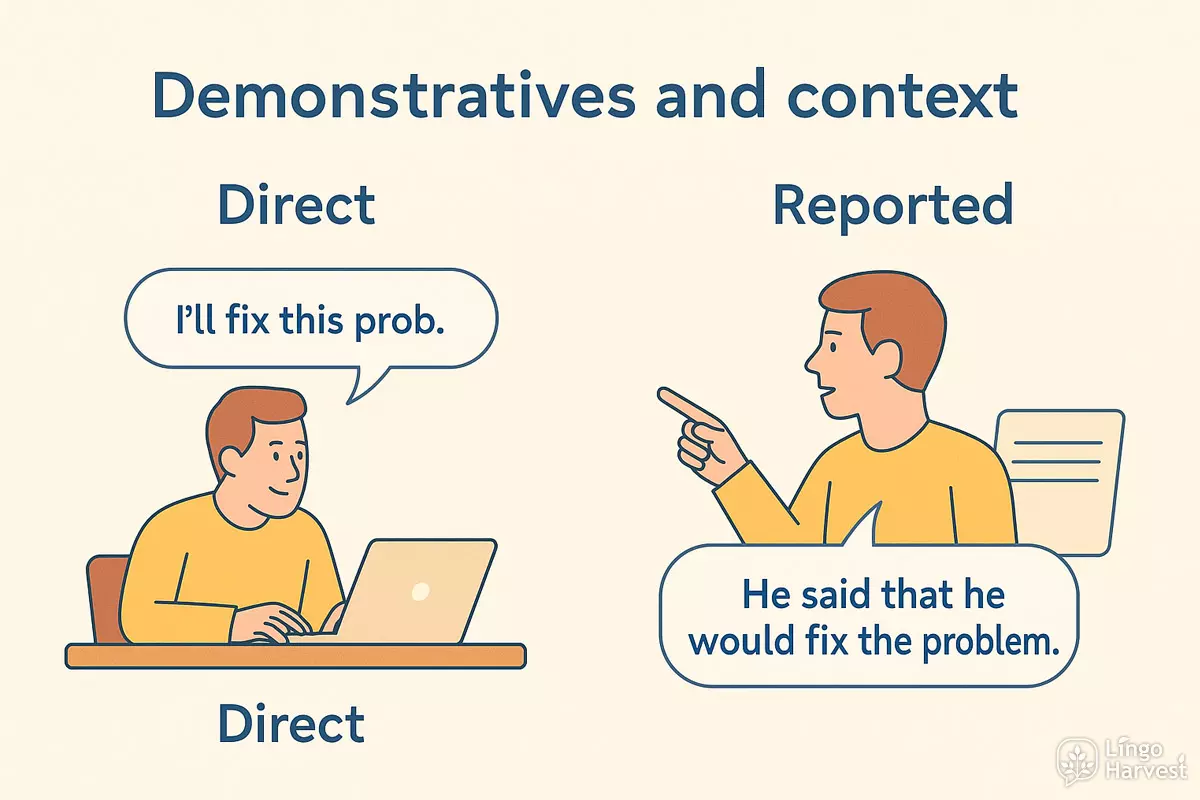
- Direct: He said, “I’ll fix this problem.”
- Reported: He said that he would fix the problem.
Reference ambiguity and resolution
Indirect reporting can create ambiguity if the original referents are unclear. The reporter must sometimes clarify or adjust articles and phrases to avoid confusion. For example, generic references (“a teacher,” “an answer”) might require additional explanation if there’s a risk of misunderstanding.
Patterns of reference change in reported speech
| Original Direct Speech | Typical Indirect Speech Form | Reference Effect |
|---|---|---|
| I met the director yesterday. | She said she had met a director the day before. | Definite to indefinite; referent less specific in new context. |
| I need this document. | He said he needed the document. | Demonstrative becomes definite article; context adapted. |
| Can you give me an example? | He asked if I could give him an example. | Indefinite article often unchanged; reference stays generic. |
| I have some news. | She said she had some news. | Quantifier retained; reference typically preserved. |
| Let’s discuss those results. | He suggested discussing the results. | Demonstrative to definite article; reference generalized. |
Common adaptations in reference
- Definite to indefinite articles if referent is unclear to the new audience
- Demonstratives (“this,” “that,” “these,” “those”) often become definite articles
- Pronouns may be replaced by nouns for clarity
- Temporal and spatial references adapt to the new reporting context
- Generic references may require extra detail
- Possessives (“my,” “our”) change to fit the speaker in the report
- Articles may be dropped if the noun becomes abstract or general
- Proper nouns rarely change, but their accompanying articles might
- “Some” and “any” often maintain their function but may shift in emphasis
- Reference chains (multiple pronouns or articles in sequence) need careful adjustment to avoid ambiguity
Ultimately, reporting speech demands careful attention to how reference is constructed and interpreted. The goal is to ensure that the listener or reader understands who or what is being discussed, even as context, perspective, and knowledge shift.
Changes in time, place, and shared knowledge
When converting direct speech into reported speech, it’s not just the verb tenses that often change. References to time, place, and assumed knowledge between speaker and listener may also need to be updated to fit the new context. This is especially important when the original situation is different from the reporting one, or when the listener does not share the same background information as those in the original conversation.
Shifting Time and Place References
Words like "today," "here," or "tomorrow" are anchored to the original speaker’s time and location. In reported speech, these need to be adjusted so the meaning remains clear from the new point of view. This process is essential for accurate communication, especially in formal or narrative contexts.
| Direct Speech | Reported Speech |
|---|---|
| today | that day |
| tomorrow | the next day / the following day |
| yesterday | the day before / the previous day |
| now | then / at that moment |
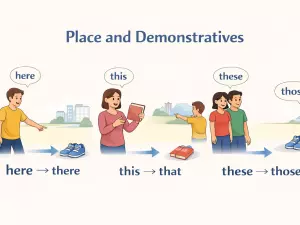
| here | there |
| this | that |
| these | those |
| ago | before |
| next week | the following week |
| last year | the previous year / the year before |
Adjusting for Shared Knowledge
In addition to changing time and place markers, speakers must consider what information is assumed or “shared” between the original participants versus the reporter and their audience. For example, articles like "the" may signal shared knowledge (“the meeting” assumes both know which meeting), but in reported speech, the referent might need clarification if the new audience lacks context.
- If the original reference was clear to both speakers, but not to the new listener, add details: “He said the report was finished” may become “He said the project report was finished.”
- Sometimes, articles change: “She is at the office” could become “She was at her office,” if specificity is needed in the new context.
- Generic references may need to be made more specific, or vice versa, depending on the audience’s knowledge.
Summary
Successfully reporting someone else’s words involves more than grammatical shifts. Adapting references to time, place, and what is presumed to be known ensures that the message remains accurate and clear, regardless of the audience or context. Paying attention to these adjustments helps avoid misunderstandings and maintains coherence in both spoken and written narratives.
When articles remain the same after backshifting
In reported speech, the definite and indefinite articles (the, a, an) usually don’t change, even when verb tenses are backshifted. This is because articles are determined by the meaning and context of the noun phrase, not by the tense of the reporting verb. Whether you’re reporting someone’s words from the present or the past, the choice of article depends on whether the noun is specific, previously mentioned, or known to both speaker and listener.
General Rules for Article Consistency
- Definite article "the" stays when the noun is specific or unique in both direct and reported speech.
- Indefinite articles "a" and "an" remain if the noun is non-specific or introduced for the first time, regardless of tense changes.
- Zero article (no article) is also preserved when talking about plural or uncountable nouns in a general sense.
Common Contexts Where Articles Are Unchanged
- Talking about unique things: "the sun", "the president"
- Referring to specific objects already mentioned: "the book", "the keys"
- Introducing something for the first time: "a problem", "an idea"
- Describing jobs or roles: "a teacher", "an engineer"
- Generalizations with plurals: "dogs are friendly"
- Abstract or uncountable nouns: "happiness", "information"
- Places or institutions used in a general sense: "school", "prison"
- Meals, seasons, or times of day: "breakfast", "winter", "morning"
- Nationalities and languages: "French", "English"
- Proper names and titles: "Queen Elizabeth", "Mount Everest"
- Idiomatic expressions: "in a hurry", "on the way"
- Generic references: "a computer can be useful"
Examples: Direct vs. Reported Speech
| Direct Speech | Reported Speech |
|---|---|
| I saw a dog in the park. | She said she had seen a dog in the park. |
| The teacher is absent today. | He told me the teacher was absent that day. |
| We need some information. | They said they needed some information. |
| There is an apple on the table. | He said there was an apple on the table. |
| Cats are good pets. | She said cats are good pets. |
| I met the president. | He said he had met the president. |
| Breakfast is ready. | She said breakfast was ready. |
| This is the only solution. | He said that was the only solution. |
| I am a student. | He said he was a student. |
| Mount Everest is the highest mountain. | She said Mount Everest is the highest mountain. |
Key Takeaways
Articles are chosen based on the noun’s specificity or generality, and that choice does not shift when changing from direct to reported speech. In English, the rules for articles are stable across different tenses and reporting contexts, making them predictable even during backshifting.
Context shifts that require article changes
When switching from direct to reported speech, or when the context of a statement changes, the use of definite and indefinite articles often needs to be adjusted. This happens because the original reference point for what is "known," "unknown," or "shared" between speakers can shift as information is retold. The speaker’s perspective, time frame, and assumed knowledge all influence whether "the," "a," or no article is appropriate in the new context.
How context affects article choice
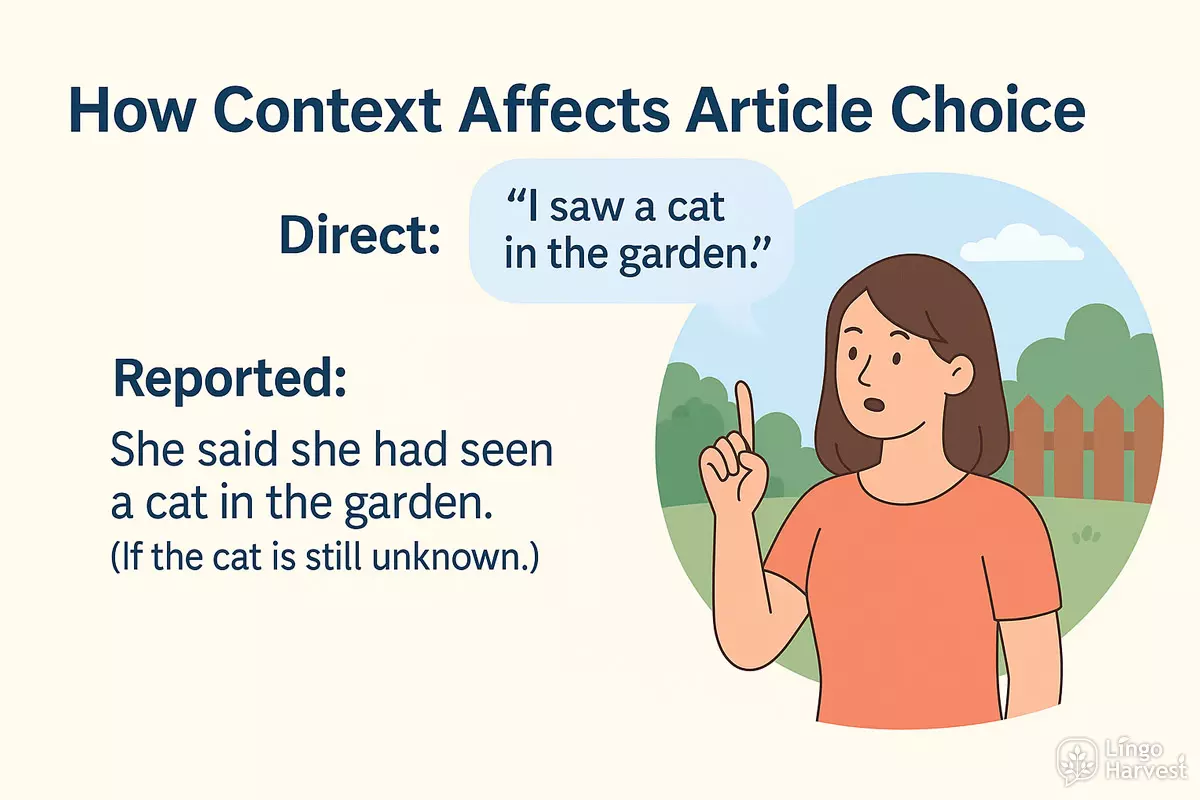
A noun phrase that was specific in the original utterance may become general or indefinite when reported, and vice versa. For example, an object introduced for the first time in direct speech might require "a" or "an," but if it becomes known in the reported context, "the" may be needed. Additionally, time references, locations, and unique objects can change their article depending on how much the listener is presumed to know.
- Direct: She said, "I saw a cat in the garden."
Reported: She said she had seen a cat in the garden. (If the cat is still unknown.) - Direct: "I left the keys on the table."
Reported: He said he had left the keys on the table. ("The" remains if both know which keys and table.) - Direct: "There is a new manager."
Reported: She said there was a new manager. ("A" stays unless the manager becomes identified later.) - Direct: "I bought a book."
Later reported: He said he had bought the book I recommended. (Now specific, so "the" is used.) - Direct: "We visited a museum."
Reported: They said they had visited the museum we discussed. ("A" to "the" as it becomes definite.) - Direct: "I met a student."
Reported: She said she had met the student who won the prize. - Direct: "She went to the doctor."
Reported: He said she had gone to a doctor. ("The" to "a" if the doctor is not known in the new context.) - Direct: "He read the instructions."
Reported: She said he had read some instructions. ("The" to "some" if not specific anymore.) - Direct: "I saw an owl last night."
Reported: He said he had seen the owl again. ("An" to "the" if now familiar.) - Direct: "Let's meet at the station."
Reported: She suggested meeting at a station nearby. ("The" to "a" if listener doesn't know which station.) - Direct: "I’ll buy a car."
Reported: He said he would buy the car we saw. ("A" to "the" as it becomes specific.) - Direct: "There’s an issue."
Reported: She said there was the issue we had discussed before. ("An" to "the" if now definite.) - Direct: "She wants a dog."
Reported: He said she wanted the dog from the shelter. ("A" to "the" with new specificity.)
Common patterns in article shifts
| Original Context | Reported/Shifted Context | Article Change |
|---|---|---|
| "I saw a movie." | She said she had seen the movie we talked about. | a → the |
| "He met the director." | He said he had met a director at the event. | the → a |
| "There is an answer." | She said there was the answer she needed. | an → the |
| "I need the report." | He said he needed a report for his project. | the → a |
| "She bought a cake." | She said she had bought the cake for the party. | a → the |
| "We saw the painting." | They said they saw a painting in the gallery. | the → a |
In summary, article usage often changes in reported or backshifted contexts due to shifts in specificity and shared knowledge. Attention to these details ensures clarity and accuracy when transforming statements between direct and indirect speech.
Common pitfalls with reported descriptions
Many learners run into trouble when using articles in reported speech, especially when the original context gets backshifted in time or perspective. A frequent source of confusion is whether to keep the definite or indefinite article from the original statement, or to adjust it based on the new reporting context. This section highlights the most typical missteps and offers clarity on how to avoid them.
Shifting Reference and Article Choice
When reporting speech, speakers often forget that the reference of nouns may change. For example, “She bought a car” may become “He said she had bought a car,” but if both speaker and listener now know which car, it should switch to “the car.” Missing this shift can result in unclear or incorrect sentences.
- Forgetting to change “a” to “the” when the referent has become specific in the new context.
- Using “the” prematurely, when the listener has not been introduced to the noun.
- Repeating the indefinite article when the object has already been established.
- Mixing up zero article usage with countable and uncountable nouns after backshifting.
- Not recognizing when a generic reference becomes a specific one in reported speech.
- Failing to update articles when the time frame or knowledge about the noun has changed.
Backshifting and Context Loss
Backshifted contexts can create ambiguities. Learners may backshift the tense but forget to adjust the article, leading to sentences like “She said she would buy a house,” when, in context, it should be “the house” if both parties know which house is meant.
| Original Statement | Reported Version (Potential Pitfall) | Corrected Version |
|---|---|---|
| “I found a book.” | He said he had found a book. (✅/❌) | He said he had found the book. (if the book is now known) |
| “We saw the movie.” | They said they had seen the movie. (✅) | They said they had seen a movie. (if unspecified) |
| “She wants water.” | He said she wanted the water. (❌) | He said she wanted water. (uncountable, no article) |
| “I bought an apple.” | She said she had bought an apple. (✅) | She said she had bought the apple. (if specific apple is known) |
Other Frequent Mistakes
Learners also encounter these issues:
- Overusing the definite article with plural or abstract nouns (“He said the dogs are friendly” when “dogs” is meant generally).
- Omitting articles entirely with singular countable nouns (“He said he saw cat”).
- Inconsistent article use after reporting verbs in complex sentences.
- Transferring article use from the source language, leading to unnatural English phrasing.
- Confusing article use after modal verbs in reported contexts.
- Neglecting the listener’s knowledge or previous context.
- Applying articles incorrectly to proper nouns after backshifting (“She said she visited the Paris”).
Staying mindful of how reference, specificity, and context change in indirect speech will help you avoid these common traps and make your reported descriptions clear and accurate.
Practice: adjust articles when rewriting into reported speech
When converting direct speech into reported speech, one common challenge is choosing the correct article ("a," "an," or "the") in the new context. The meaning and definiteness can shift when moving from a speaker’s words to a narrative report, especially if the listener or reader did not witness the original conversation. Accurate use of articles ensures clarity and grammatical correctness.
Common situations requiring article adjustment
- Generalizing: Changing a specific reference ("the book") to a general one ("a book").
- Introducing new information: Adding "a" or "an" if the noun is mentioned for the first time in reported speech.
- Maintaining specificity: Keeping "the" if both speaker and listener know what is meant.
- Omitting articles: For uncountable or plural nouns when appropriate.
Examples: Direct vs. Reported Speech
- Direct: She said, "I saw a cat in the garden."
Reported: She said that she had seen a cat in the garden. - Direct: He said, "The keys are on the table."
Reported: He said that the keys were on the table. - Direct: Tom said, "I want an apple."
Reported: Tom said that he wanted an apple. - Direct: Anna said, "Books are expensive."
Reported: Anna said that books were expensive. - Direct: "A dog barked," she said.
Reported: She said that a dog had barked. - Direct: "The teacher is absent," he said.
Reported: He said that the teacher was absent. - Direct: "I bought some oranges," she said.
Reported: She said that she had bought some oranges. - Direct: "There is a problem," he said.
Reported: He said that there was a problem. - Direct: "The answer is correct," she said.
Reported: She said that the answer was correct. - Direct: "I need an umbrella," he said.
Reported: He said that he needed an umbrella.
Quick practice: Choose the correct article
- Direct: "She has idea."
Reported: He said that she had ___ idea. - Direct: "Bring me book from the shelf."
Reported: She asked him to bring her ___ book from the shelf. - Direct: "I saw elephant at the zoo."
Reported: He said that he had seen ___ elephant at the zoo. - Direct: "The cake is delicious."
Reported: She said that ___ cake was delicious. - Direct: "There is problem with the car."
Reported: He said that there was ___ problem with the car. - Direct: "She bought umbrella yesterday."
Reported: He said that she had bought ___ umbrella yesterday. - Direct: "I need information about the project."
Reported: He said that he needed ___ information about the project. - Direct: "We visited museum last weekend."
Reported: They said that they had visited ___ museum last weekend. - Direct: "The teacher explained the rule."
Reported: She said that ___ teacher had explained the rule. - Direct: "I met interesting person today."
Reported: He said that he had met ___ interesting person today.
Show answers
- an
- a
- an
- the
- a
- an
- — (no article with uncountable "information")
- the
- the
- an
Tips for article use in reported speech
- Check if the noun is being mentioned for the first time (use "a"/"an").
- If the noun is already known or specified, use "the".
- For plural or uncountable nouns, articles may not be needed unless specifying ("the information").
- Adjust articles if the context changes in reported speech (e.g., "my car" in direct speech may become "the car" if contextually clear).
Consistent attention to article choice helps readers follow the logic and detail of reported statements. Practice adjusting articles in various contexts to develop accuracy and confidence.