Place and Demonstrative Changes in Reported Speech

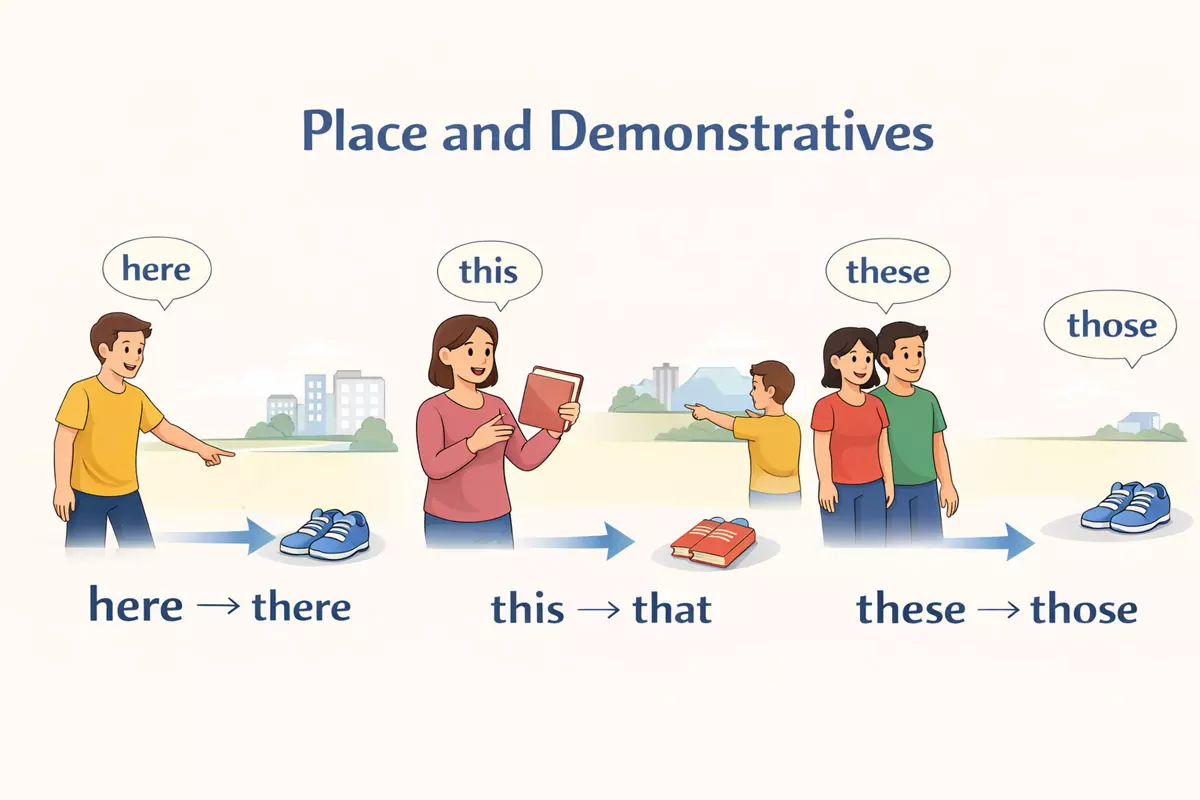 Here we why place references change in reported speech, how demonstratives like this, that, these, and those are used, the use of here and there, how speaker perspective and context affect choices, and typical mistakes learners make.
When retelling what someone has said, we often need to adjust words related to location and pointing out objects so they fit the new context. For example, words like "here" or "this" in direct speech might become "there" or "that" when reported indirectly. These subtle changes are important because they help the listener understand the intended meaning and maintain clarity. Making these adjustments in indirect speech ensures that the message remains accurate and relevant to the situation in which it is being reported.
Why place references change
When speech is reported, the context often shifts from the original speaker’s location to that of the reporter or listener. This shift in perspective is the main reason spatial references like “here,” “there,” “this place,” or “that” are often changed. The new context requires the language to adapt so that listeners can understand the intended location relative to the new speaker’s position or frame of reference. This adjustment helps avoid confusion and ensures the message remains clear, even if the original and new speakers are in different places.
Contextual Shifts in Reported Speech
Spatial expressions are inherently deictic, meaning their interpretation depends on who is speaking and where they are. When relaying someone else’s words, these references often need to be modified to fit the new context. For example, “here” spoken by the original speaker may become “there” when reported by someone at a different location.
- “here” → “there”
- “this” (place) → “that” (place)
- “come” → “go” (if direction changes)
- “in this room” → “in that room”
- “over here” → “over there”
- “right here” → “right there”
- “at my house” → “at his/her house”
- “nearby” → “there” or “over there”
- “in front of me” → “in front of her/him”
- “on this side” → “on that side”
- “next to us” → “next to them”
- “this way” → “that way”
- “from here” → “from there”
- “close to me” → “close to her/him”
- “opposite here” → “opposite there”
- “by my desk” → “by her/his desk”
Reasons for Changing Place References
Several factors motivate these adjustments:
- Deictic shift: The reference point moves from the original speaker to the reporter or listener.
- Clarity: Directly repeating the original reference can cause confusion if the listener is not in the same place as the original speaker.
- Perspective: The physical setting or viewpoint may have changed, requiring a new term to accurately represent location.
- Pronoun adjustment: Possessive or demonstrative pronouns often need to be modified to fit the new context.
Examples of Deictic Changes

| Direct Speech | Reported Speech |
|---|---|
| “I’ll meet you here.” | She said she would meet me there. |
| “This is my favorite spot.” | He said that was his favorite spot. |
| “Come to my house.” | She told me to go to her house. |
| “Let’s sit on this bench.” | He suggested sitting on that bench. |
| “I left it right here.” | She said she had left it right there. |
In summary, adapting locational expressions in reported speech is crucial for maintaining clarity and accuracy. The changes reflect shifts in viewpoint, ensuring that listeners understand which place is being referred to, regardless of where the conversation is happening.
This, that, these, and those in reported speech
When shifting from direct to reported speech, demonstrative pronouns such as "this," "that," "these," and "those" often need to be adjusted to reflect changes in time and place. This adjustment helps clarify meaning and ensures that the listener understands what or whom is being referred to, especially when the original context is no longer immediate.
How demonstratives change
In reported speech, demonstratives typically shift away from the speaker's immediate context. For example, "this" and "these" (which refer to something close to the speaker) often become "that" and "those" (which refer to something farther away) in indirect speech. This change helps the listener interpret the reference from the reporter's perspective, not the original speaker's.
| Direct Speech | Reported Speech |
|---|---|
| "This is my book," she said. | She said that that was her book. |
| "These are my keys," he said. | He said that those were his keys. |
| "I want that," John said. | John said that he wanted that. |
| "Can you pass me those?" | She asked if I could pass her those. |
Patterns and exceptions
- "This" usually becomes "that" in reported speech, especially if the object is no longer near the reporter.
- "These" changes to "those" for similar reasons.
- "That" and "those" often remain unchanged, since they already indicate distance. However, context may sometimes require further clarification.
- Sometimes, if the context or the object is still present or relevant, demonstratives may not change. Use your judgment based on clarity.
Expanded examples of demonstrative changes
- Direct: "I can't lift this." → Reported: He said he couldn't lift that.
- Direct: "Put these on the table." → Reported: She told me to put those on the table.
- Direct: "Is that yours?" → Reported: He asked if that was mine.
- Direct: "Who owns those?" → Reported: She wondered who owned those.
- Direct: "Take this with you." → Reported: He told me to take that with me.
- Direct: "I like these." → Reported: She said she liked those.
- Direct: "This tastes strange." → Reported: He said that that tasted strange.
- Direct: "Can I borrow these?" → Reported: He asked if he could borrow those.
- Direct: "That is broken." → Reported: She said that that was broken.
- Direct: "Please move those." → Reported: He asked me to move those.
Understanding how demonstrative pronouns shift in indirect statements is key to clear communication. Always consider the location and relevance of the object or person being referred to, and adjust your language to match the new context.
Here and there in indirect speech
When converting direct speech to reported speech, words that indicate location—like here and there—often need to be adjusted to reflect the change in perspective. This shift helps clarify where the speaker and listener are in relation to the original context. Adjusting these place words is crucial for accurate and natural indirect reporting.
How place words change
In direct speech, here usually refers to the speaker’s current location, while there indicates a place further away. When reporting speech indirectly, these references often change based on the position of the reporter relative to the original speaker and listener. The correct substitution depends on whether the context has shifted or remains the same.
- here often becomes there: “I am waiting here” → She said she was waiting there.
- there can remain there: “I went there yesterday” → He said he had gone there the day before.
- Sometimes, here is replaced by a more specific location if clarity is needed: “I’ll meet you here at noon” → She said she would meet me at the café at noon.
- Other place expressions may also shift: this place → that place, over here → over there.
Common transformations
Changing place words isn’t limited to here and there. Demonstratives and related spatial expressions also adapt in reported statements. Here are several typical patterns:
- this → that
- these → those
- now → then (when referring to time, but sometimes used spatially)
- today → that day
- tonight → that night
- next week → the following week
- last year → the previous year
- right here → right there
- over here → over there
- nearby → at that place
- in this room → in that room
- on this side → on that side
- from here → from there
- to here → to there
- at this spot → at that spot
- by my side → by her side
Examples in context
To see how these changes work, compare direct and indirect forms in practice:
| Direct Speech | Indirect Speech |
|---|---|
| “I’ll wait here for you.” | She said she would wait there for me. |
| “Come here quickly!” | He told me to go there quickly. |
| “The keys are right here.” | She said the keys were right there. |
| “I saw him there yesterday.” | She said she had seen him there the day before. |
| “Stand over here.” | He asked me to stand over there. |
| “Is anyone here?” | He wondered if anyone was there. |
Summary points
- Place words change to maintain clarity and coherence in reported speech.
- Always consider the perspective of the new speaker and listener.
- Specific location names may replace general terms if needed for context.
- Consistent transformation of demonstratives avoids confusion.
Being aware of these shifts helps ensure your indirect speech is both accurate and natural-sounding.
Speaker perspective and location shifts
When direct speech is reported, the perspective often changes from the original speaker to the reporter. This shift affects how place references and demonstrative expressions (like here, there, this, and that) are used. The reported speech framework requires a realignment of spatial and deictic terms to match the new speaker's viewpoint, which can cause systematic changes in the forms used.
Adjusting spatial terms in reported contexts
Spatial expressions are frequently recalibrated when retelling someone else's words. For example, a statement like “I’ll meet you here” may shift to “He said he would meet me there” if the reporting speaker is not at the same location as the original. These changes maintain coherence and accurately reflect the new context.
- here → there
- this → that
- these → those
- now → then (when time reference is also involved)
- today → that day
- tomorrow → the next day
- yesterday → the day before
- Place names may stay the same or require additional specification
- Pronouns may shift to reflect the new speaker/addressee roles
- Deictic adverbs like over here or over there are adjusted as needed
Common patterns in demonstrative shifts
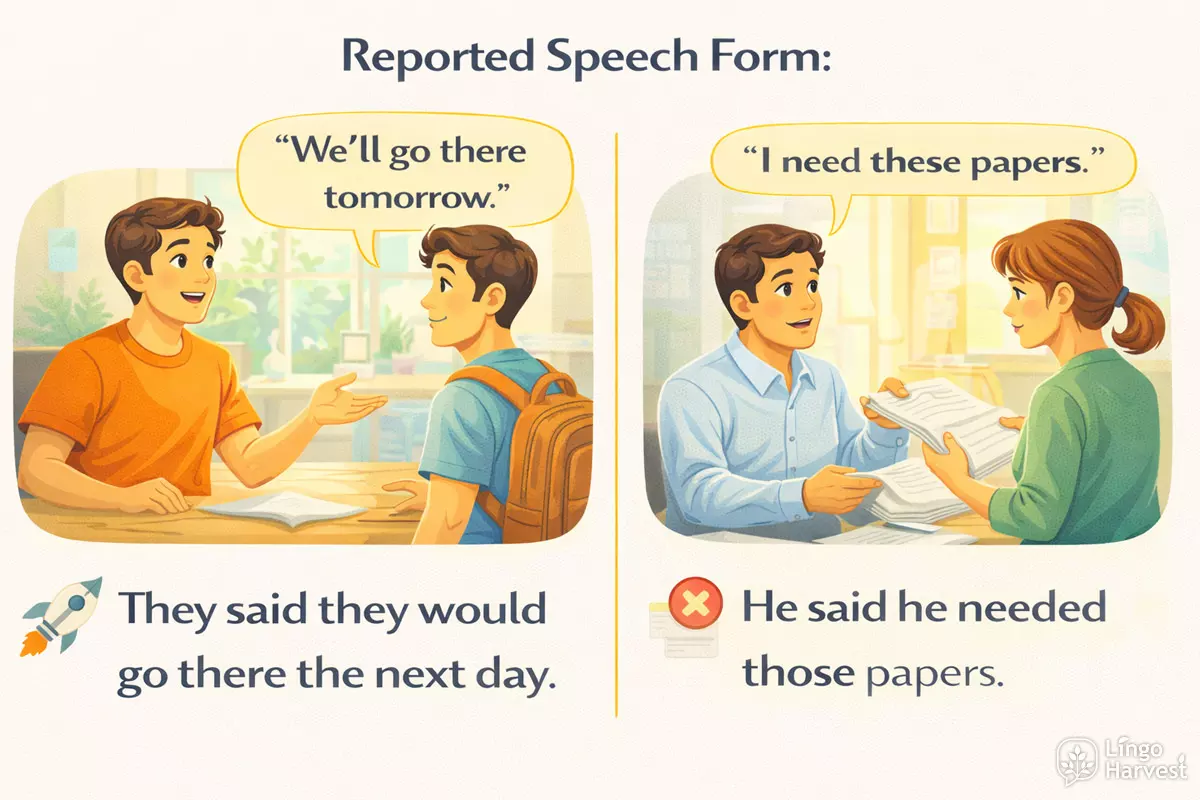
Demonstratives are highly sensitive to context changes. The selection between forms like this/that or these/those depends not only on physical proximity but also on psychological distance and the speaker’s alignment. When reporting speech, the demonstrative often shifts to indicate the original referent's distance from the new narrator.
| Original Expression | Reported Speech Form |
|---|---|
| “I live here.” | He said he lived there. |
| “This is my favorite book.” | She said that was her favorite book. |
| “We’ll go there tomorrow.” | They said they would go there the next day. |
| “I need these papers.” | He said he needed those papers. |
| “Come here!” | She told him to go there. |
| “I saw John yesterday.” | He said he had seen John the day before. |
| “Let’s meet at this café.” | She suggested meeting at that café. |
| “I will do it now.” | He said he would do it then. |
Role of context and ambiguity
Sometimes, the shift in location or perspective can introduce ambiguity, especially if the new context is not clearly established. In these cases, speakers may add clarifying information, such as specifying a place name or using additional descriptive language. The aim is to ensure listeners can reconstruct the original situation as intended by the first speaker, despite the change in narrative viewpoint.
Overall, the adaptation of place and demonstrative terms in reported speech is systematic but context-dependent. Recognizing these shifts is essential for accurate retelling and for understanding how language encodes perspective and location.
Context-based demonstrative choices
When speech is reported, speakers often need to adapt demonstratives—words like "this," "that," "these," and "those"—depending on the new conversational setting. The selection of these terms is rarely arbitrary. Instead, it reflects shifts in perspective, location, and the relationship between the original utterance and the present context. Understanding how these choices work helps explain why demonstrative forms change so frequently in reported statements.
Factors influencing demonstrative selection
Several factors shape which demonstrative is used when quoting or paraphrasing someone else. These include:
- Physical location: Whether the referent is near the speaker, the listener, or neither.
- Deictic center: The perspective from which the event is recounted (original speaker, reporter, or listener).
- Temporal distance: How recent or remote the referenced event or object is.
- Shared knowledge: What is assumed to be familiar or accessible to all participants.
- Contrast: Distinguishing between multiple referents in the discourse.
- Emotional or discourse prominence: Emphasizing a particular item or event.
- Textual distance: How far the referent is from the current point in the narrative.
- Quoting style: Whether the speech is reported directly or indirectly.
- Language-specific patterns: Some languages have more than two demonstrative options, reflecting finer distinctions.
- Register and formality: Informal and formal contexts may favor different demonstrative forms.
Common patterns in reported speech
When re-telling what someone said, demonstratives often shift to reflect the new speaker’s perspective. For instance, a direct quote might preserve the original demonstrative, while indirect speech tends to adjust it to match the current context. Here are some common scenarios:
- If the original speaker says, "I want this book," a reporter may say, "She wanted that book," especially if the book is no longer present.
- When the referent is still accessible to the new speaker and listener, "this" might be retained: "He said, 'I need this pen,' and handed it to me."
- If quoting something that happened in another location, "that" is often used: "They said they enjoyed that restaurant."
- For events or objects previously mentioned, demonstratives help maintain coherence: "Earlier, she mentioned those issues."
Demonstrative shifts: Examples from English
English typically uses "this/these" for items close to the speaker or immediate context and "that/those" for more distant or previously mentioned items. In reported speech, these forms adapt as shown below:
| Original Utterance | Reported Speech | Contextual Shift |
|---|---|---|
| "Take this." | He told me to take that. | Object now distant from reporter |
| "I like these apples." | She said she liked those apples. | Referents no longer present |
| "Can you use those files?" | He asked if I could use those files. | No shift; referents remain distant |
| "Let's meet at this place." | She suggested meeting at that place. | Location no longer immediate |
| "This is urgent." | He said that was urgent. | Topic shifted to reported context |
Cross-linguistic variation
Not all languages handle these shifts in the same way. Some, like Japanese or Spanish, may have additional demonstrative forms that further specify proximity to the speaker, listener, or a third party. Others might use entirely different strategies for indicating distance or relevance.
In summary, the adaptation of demonstratives during the process of reporting speech is guided by contextual cues. These cues include spatial, temporal, and interpersonal factors, and the resulting choices can subtly alter the meaning or emphasis in the reported message.
Typical learner mistakes
Many English learners encounter challenges with place and demonstrative changes when switching from direct to reported speech. These issues often stem from confusion about which words should change, uncertainty about context, or simply forgetting to make the necessary adjustments. Understanding the most frequent slip-ups can help students avoid fossilizing bad habits and develop more accurate reporting skills.
Mixing up place references
One common error is neglecting to adjust words that indicate location, such as “here” and “there.” Learners sometimes keep the original term, even when the perspective has shifted. For example, reporting “I am here” as “He said he was here” instead of the correct “He said he was there.”
Incorrect demonstrative shifts
Demonstratives like “this,” “that,” “these,” and “those” often cause confusion, especially when the context changes in reported speech. Students may not realize that the choice depends on the speaker’s and listener’s positions in time and space.
Overgeneralizing or omitting changes
Sometimes, learners apply rules too broadly, changing words that should remain the same, or they forget to change demonstratives and place words altogether. This leads to sentences that sound unnatural or are unclear.
Frequent mistaken patterns
- Leaving “here” and “now” unchanged in reported speech.
- Not adapting “this” to “that” or “these” to “those” when appropriate.
- Changing place or demonstrative words unnecessarily.
- Forgetting that some words (like “there”) may not need to change, depending on the context.
- Misreporting phrases like “come here” as “come here” instead of “go there.”
- Using “this” when “that” is needed after a time shift.
- Inconsistent changes within the same passage or conversation.
- Confusing the direction of change (e.g., “those” to “these”).
- Failing to consider the listener’s location or time frame.
- Directly translating from another language and missing English conventions.
Common direct & reported speech shifts
| Direct Speech | Reported Speech |
|---|---|
| here | there |
| this | that |
| these | those |
| now | then |
| today | that day |
| tomorrow | the next day |
| yesterday | the day before |
| come | go |
Tips for avoiding these errors
Learners can improve by paying attention to the context and practicing with varied examples. Reading reported speech in books or listening to native speakers can also help develop an instinct for correct usage. Reviewing the most typical changes and checking your own writing or speaking for these patterns will gradually build confidence and accuracy.
Homework
Complete the exercises below to practice how place references and demonstratives change in reported speech. Focus on perspective, location shifts, and whether words like here, this, these, and come need to be adjusted to fit the reporting context.
1. Rewrite with Correct Place and Demonstrative Changes
Rewrite each sentence in reported speech. Change place words and demonstratives where necessary.
- “I’ll wait for you here,” she said.
- “This is my seat,” he said.
- “Put these boxes over here,” the manager said.
- “Come to my office after lunch,” she told me.
- “I left my phone on this table,” he said.
- “Let’s meet in this café,” Anna said.
- “Is anyone here?” he asked.
- “Take this document with you,” she said.
- “We’ll stay here for the night,” they said.
- “I saw him standing right here,” she said.
Show answers
- She said that she would wait for me there.
- He said that that was his seat.
- The manager told us to put those boxes over there.
- She told me to go to her office after lunch.
- He said that he had left his phone on that table.
- Anna suggested meeting in that café.
- He asked if anyone was there.
- She told me to take that document with me.
- They said that they would stay there for the night.
- She said that she had seen him standing right there.
2. Decide What Needs to Change
For each sentence, decide whether the place word or demonstrative should change. Then write the correct reported version.
- He says, “I like this place.” (Reporting later, different location)
- She said, “I’m waiting here.” (You are in a different place)
- They say, “These instructions are clear.” (Instructions are still visible)
- He said, “Come here immediately.” (You are reporting later)
- She said, “I live here.” (Reporting from another city)
- The guide says, “Stand here.” (Live instruction)
- Anna said, “Those seats are taken.”
- He said, “I’ll stay here tonight.” (Reporting the next day)
- She says, “This is important.” (Still discussing the same issue)
- They said, “We met here last year.” (Reporting elsewhere)
Show answers
- He said that he liked that place.
- She said that she was waiting there.
- They say that those instructions are clear.
- He told me to go there immediately.
- She said that she lived there.
- The guide says to stand here.
- Anna said that those seats were taken.
- He said that he would stay there that night.
- She says that this is important.
- They said that they had met there the year before.