Editing Practice: Improve Article Use in a Paragraph

 Here we how to read paragraphs to find article errors, apply a step-by-step editing strategy, identify unclear or inconsistent references, balance zero article, a/an, and the, and practice editing full paragraphs using model examples.
If you find yourself struggling to master the small but essential words in English sentences, especially articles like "a," "an," and "the," you're not alone. Using articles correctly is crucial for making your writing clearer and more natural. This guide provides practical strategies to help you understand the rules and exceptions surrounding articles, offering tips and examples that will improve your grammar skills and boost your confidence in both writing and speaking English.
How to read a paragraph for article problems
Carefully reviewing a paragraph for article mistakes requires a focused approach. Start by reading the text slowly, paying attention to every noun. Many article errors happen when writers overlook the small words before nouns, so it’s best to highlight or underline each noun phrase as you go.
Key steps to spot article issues
- Identify every noun: Ask yourself if the noun is countable or uncountable, singular or plural.
- Check for missing articles: Look for places where “a,” “an,” or “the” should appear but don’t.
- Watch for unnecessary articles: Sometimes an article is used before a proper noun or an uncountable noun where it doesn’t belong.
- Think about specificity: Decide if the noun refers to something specific (needs “the”) or something general (might need “a/an” or no article).
- Review for patterns: Notice repeated mistakes, such as always omitting “the” before unique things like “sun” or “internet.”
Common contexts that need article attention
Reading with these patterns in mind helps you catch frequent errors:
- Jobs and professions: “He is a doctor.”
- General statements: “The dog is a loyal animal.”
- Geographical names: “She visited the Netherlands.”
- Meals and languages: No article with “breakfast,” “English,” etc., unless specified.
- Superlatives: “It was the best day.”
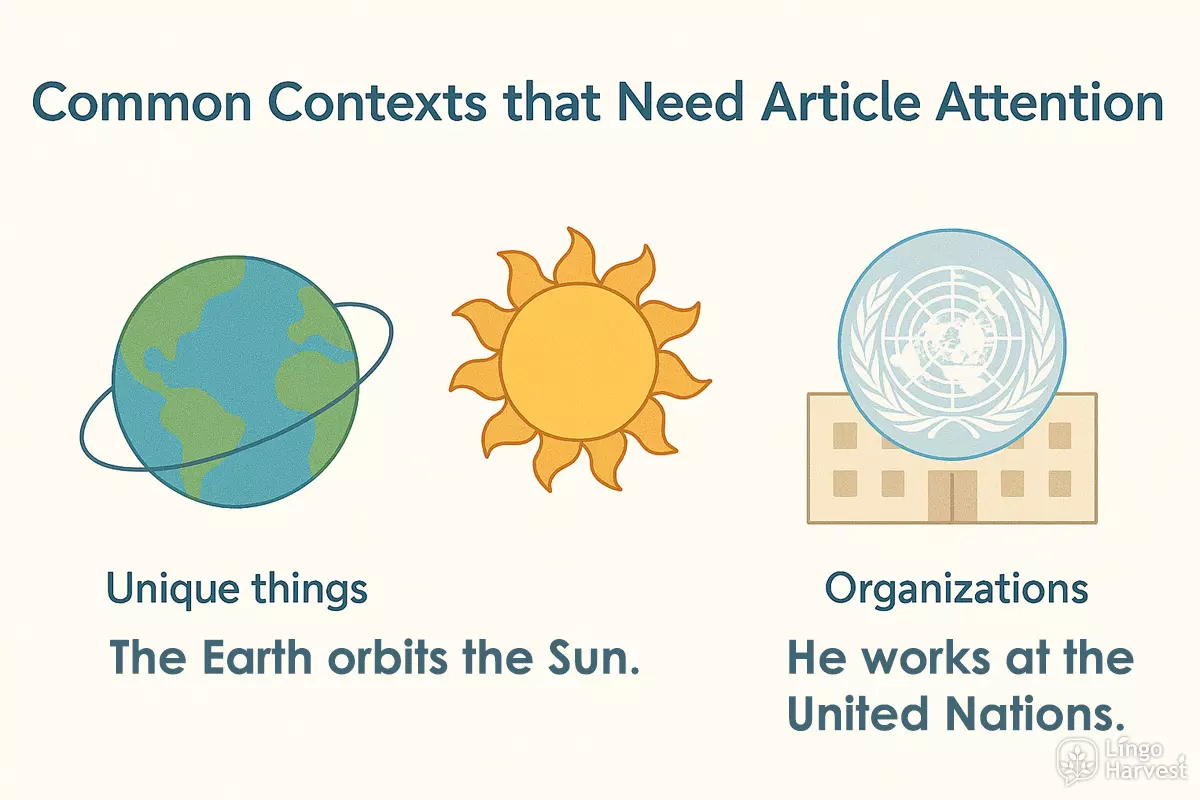
- Unique things: “The Earth orbits the Sun.”
- Organizations: “He works at the United Nations.”
- Musical instruments: “She plays the piano.”
- Transport: “By car” (no article) vs. “In the car.”
- Abstract nouns: Often no article, e.g., “Happiness is important.”
Article choice: quick reference table
| Noun Type | Typical Article Use |
|---|---|
| Singular, countable, general | Use “a” or “an” Example: a cat, an idea |
| Singular, countable, specific | Use “the” Example: the cat on the sofa |
| Plural or uncountable, general | No article Example: Cats are friendly. Milk is white. |
| Plural or uncountable, specific | Use “the” Example: the cats in the yard, the milk in the fridge |
Practical tips
Read each paragraph aloud if possible; this helps you notice awkward or missing words. Mark uncertain spots and revisit them after finishing the paragraph. When in doubt, compare the sentence to a similar, correct example. Over time, recognizing article patterns becomes easier. Focusing on these strategies helps you find almost all article-related issues in any paragraph and strengthens your editing skills.
Step-by-step editing strategy
To effectively improve how articles ("a," "an," "the") are used within a paragraph, it’s helpful to follow a clear sequence of actions. Focusing on one aspect at a time ensures accuracy and builds confidence in editing skills. Below is a practical approach for reviewing and refining article usage in writing.
1. Read the paragraph for overall meaning
Begin by reading the entire paragraph to understand the context. This helps you notice whether nouns are specific or general, which directly impacts article selection.
2. Identify all noun phrases
Spot every noun or noun phrase in the text. Underline or highlight them to make article checking easier. Pay special attention to countable and uncountable nouns, as their rules differ.
3. Check for missing or incorrect articles
Review each noun phrase and ask:
- Is it singular, plural, or uncountable?
- Is it referring to something specific or general?
- Should it have "a," "an," "the," or no article?
Insert, remove, or change articles as needed. Remember that some nouns (like "information" or "advice") rarely take an article.
4. Review common article usage patterns
Refer to a list of frequent patterns to double-check your edits. Here are some useful examples:
- a/an for introducing something new: "She bought a book."
- the for something already mentioned: "I saw a cat. The cat was sleeping."
- No article for general plural or uncountable: "Cats are independent." / "Sugar is sweet."
- "the" for unique things: "the sun," "the president"
- "a/an" before jobs: "She is a doctor."
- No article before most country names: "He lives in Canada."
- "the" with some country names: "the Netherlands," "the United States"
- "the" with superlatives: "the best," "the most interesting"
- No article with meals: "We had lunch."
- "the" with musical instruments: "He plays the piano."
- "a/an" with singular countable nouns: "I need an umbrella."
- No article with languages: "She speaks French."
- "the" with rivers, oceans, seas: "the Amazon," "the Pacific"
- "the" with mountain ranges: "the Alps"
- "a/an" for one of many: "I saw a dog in the park."
- "the" for something unique in context: "Close the window."
- No article with names of streets: "He lives on Baker Street."
- "the" with ordinal numbers: "the first time"
- "a/an" for expressing frequency: "twice a week"
- No article before most academic subjects: "She studies biology."
5. Compare before and after versions
Once edits are made, compare the original and revised paragraphs. Reading them side by side highlights improvements and helps reinforce correct usage patterns.
6. Practice with structured review
To consolidate your understanding, try editing exercises that present both incorrect and corrected article usage. The table below shows typical mistakes and how to fix them:
| Incorrect Example | Corrected Version |
|---|---|
| I have cat. | I have a cat. |
| She went to the school yesterday. | She went to school yesterday. |
| He is doctor. | He is a doctor. |
| The Mount Everest is highest mountain. | Mount Everest is the highest mountain. |
| I like the music. | I like music. |
| She speaks the French. | She speaks French. |
| We visited a Netherlands last year. | We visited the Netherlands last year. |
| Bring me pen, please. | Bring me a pen, please. |
By following this logical process and practicing with real examples, you can steadily develop more accurate and natural article use in your writing.
Spotting unclear or inconsistent reference
Identifying when articles like "a," "an," or "the" are used ambiguously is a key skill for editing clarity. When a sentence leaves the reader unsure about what noun a reference points to, or switches between specific and general usage without reason, confusion can result. Careful review helps ensure each article matches the intended meaning.
Common signals of faulty reference
Writers sometimes misuse articles, leading to unclear or shifting reference points. Look for these signs:
- Switching from "the" to "a" for the same noun in one paragraph
- Using "the" before introducing a noun (e.g., "the report showed" with no report previously mentioned)
- Omitting an article where one is needed for clarity
- Introducing a noun as specific, then discussing it as general (or vice versa)
- Inconsistent use of articles with plural or uncountable nouns
- Articles attached to abstract concepts that don’t need one (e.g., "the honesty" when "honesty" is meant in general)
- Unclear reference when multiple nouns are present ("The solution improved the system," but which system?)
- Shifting from singular to plural without explanation
- Ambiguous pronoun or article use after a list of items
- Using "an" or "a" with a noun that is already defined
Examples of inconsistent article use
Small changes in article usage can alter the meaning of a sentence. Consider these patterns:
- Incorrect: She bought a book and put the book on a shelf. (Which shelf?)
- Correct: She bought a book and put the book on the shelf. (If the shelf is already known.)
- Incorrect: The manager gave advice to a employee. (Should be "an employee.")
- Incorrect: An apple was on the table. The apple was red. (Correct if referring to the same apple; unclear if not.)
Quick reference table: Article consistency checks
| Signal | What to check |
|---|---|
| Switch from "a/an" to "the" | Has the noun been introduced before? |
| Missing articles | Is the reference clear or generic? |
| Plural vs. singular confusion | Does the article match the noun form? |
| Ambiguous references | Can the reader identify the intended noun? |
| Article with abstract nouns | Is the concept general or specific? |
Balancing zero article, a/an, and the
Mastering article use in English means knowing when to choose a, an, the, or no article at all. Each choice signals something about the noun—whether it’s general, specific, known, or unknown. Getting this balance right makes your writing clearer and more natural.
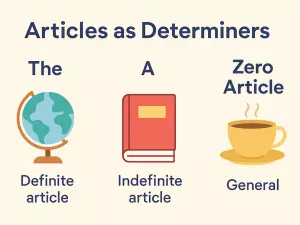
Zero Article: When No Article Is Needed
Sometimes, you don’t need any article before a noun. This often happens with:
- Plural nouns used in a general sense: Cats are independent animals.
- Uncountable nouns when speaking generally: Information is valuable.
- Most proper names: Mount Everest, London
- Meals, languages, and academic subjects: I had breakfast. She studies mathematics.
- Transport and communications (with by, on, at): by train, on foot, at home
Choosing Between "a/an" and "the"
Deciding between a/an (indefinite) and the (definite) depends on whether you’re introducing something new or referring to something already known.
| Zero Article | a / an | the |
|---|---|---|
| Children love music. | I saw a bird. | The bird was blue. |
| Water is essential. | She ate an apple. | The apple was sweet. |
| He speaks Spanish. | I need a pen. | The pen is on the table. |
| Breakfast is ready. | She has an idea. | The idea is interesting. |
| Life is short. | There is a problem. | The problem is serious. |
Quick Tips for Article Selection
- Use a/an for one, non-specific thing: a dog, an umbrella.
- Use the when both the writer and reader know which thing is meant: the keys on the table.
- Omit the article for general statements or when using certain proper nouns.
- Remember: Some nouns never take an article, especially in set phrases.
Practicing these guidelines will help you edit paragraphs for correct article use, making your writing more precise and idiomatic.
Model edited versions with explanations
Below you'll find practical examples of how to revise a paragraph for better use of articles ("a," "an," "the"). Each example highlights common mistakes and demonstrates how to correct them, followed by a brief explanation of the edit. These models are designed to clarify typical problem areas for learners and provide a clear rationale for each change.
Original vs. Improved Sentences
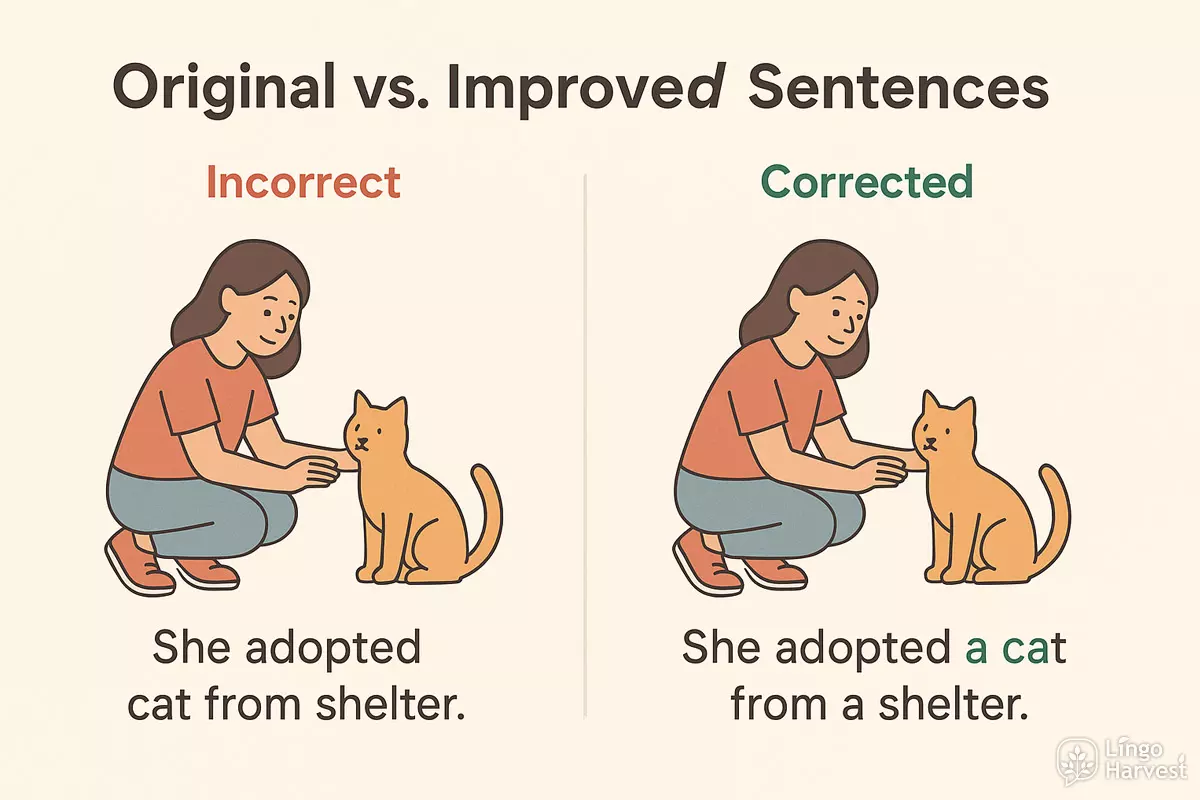
- Incorrect: She adopted cat from shelter.
Corrected: She adopted a cat from a shelter.
Explanation: "A cat" introduces a non-specific, singular noun. "A shelter" is also new information. - Incorrect: I saw bird in garden.
Corrected: I saw a bird in the garden.
Explanation: "A bird" is new; "the garden" is assumed to be known or specific. - Incorrect: Sun rises in east.
Corrected: The sun rises in the east.
Explanation: Use "the" for unique objects (the sun, the east). - Incorrect: She is honest person.
Corrected: She is an honest person.
Explanation: "An" is used before a vowel sound. - Incorrect: He found umbrella on bus.
Corrected: He found an umbrella on the bus.
Explanation: "An umbrella" is new; "the bus" is specific (probably known to the speaker/listener). - Incorrect: I have idea.
Corrected: I have an idea.
Explanation: "Idea" starts with a vowel sound, so use "an." - Incorrect: She is best player in team.
Corrected: She is the best player in the team.
Explanation: Use "the" with superlatives and to specify a particular team. - Incorrect: I want apple.
Corrected: I want an apple.
Explanation: "Apple" is singular and starts with a vowel sound. - Incorrect: Earth moves around sun.
Corrected: The Earth moves around the sun.
Explanation: "The" is used for unique nouns. - Incorrect: She went to university.
Corrected: She went to a university.
Explanation: "University" begins with a "ju:" sound (consonant), so use "a."
Quick Reference Table: Common Article Edits
| Original Phrase | Improved Version & Reason |
|---|---|
| He is doctor. | He is a doctor. Add "a" for professions (singular, countable). |
| We visited museum. | We visited the museum. "The" is used for a specific location known to the speaker/listener. |
| She has umbrella and orange. | She has an umbrella and an orange. Use "an" before vowel sounds. |
| They climbed mountain. | They climbed a mountain. "A" introduces a non-specific, countable noun. |
| We watched movie last night. | We watched a movie last night. "A" for something not previously mentioned. |
These examples show how small changes can clarify meaning and improve flow. When editing, always check for article use with singular countable nouns, unique objects, and when introducing something for the first time. Over time, noticing these patterns will help produce more natural, accurate sentences in English writing.
Practice: edit full paragraphs for better article control
Working with entire paragraphs—rather than isolated sentences—helps writers develop a more natural flow and maintain consistency in their use of articles. Editing at the paragraph level allows you to see patterns, spot overuse or omission, and ensure the articles (“a,” “an,” “the”) support clarity and precision throughout the text.
Common issues to identify in paragraphs
- Switching between general and specific references without clear article use
- Using definite articles (“the”) where an indefinite article would be clearer
- Omitting articles in front of countable singular nouns
- Repeating the same article unnecessarily
- Inconsistent article use within lists or series
- Misusing “the” with proper nouns
- Forgetting to add an article after adjectives before nouns
- Mixing article rules between American and British English
- Incorrect article use with abstract nouns
- Switching article use between similar items in a single paragraph
Paragraph editing exercise
Below are three short paragraphs. Each contains several errors in article usage. Edit each paragraph to improve accuracy and fluency. Focus on how the articles affect meaning and cohesion.
-
Dog ran across street and chased ball. When car appeared, dog stopped. Children who saw event laughed loudly.
-
She wants to become engineer. After graduation, she hopes to get job in city. Dream is to help people through work.
-
Books on shelf belong to teacher. Each student can borrow book for week. At end of week, book must be returned.
Show answers
-
The dog ran across the street and chased a ball. When a car appeared, the dog stopped. The children who saw the event laughed loudly.
-
She wants to become an engineer. After graduation, she hopes to get a job in the city. Her dream is to help people through her work.
-
The books on the shelf belong to the teacher. Each student can borrow a book for a week. At the end of the week, the book must be returned.
Editing checklist for articles in paragraphs
- Is every singular countable noun preceded by an article?
- Are you using “the” only when referring to something specific or previously mentioned?
- Do general statements use “a/an” or omit articles as appropriate?
- Are articles consistent across similar items and repeated references?
- Are abstract nouns used with or without articles correctly?
- Is the use of articles with proper nouns correct?
Before-and-after comparison: Article use in context
| Original Paragraph | Revised with Improved Article Use |
|---|---|
| Student raised hand to ask question during class. Teacher smiled and gave answer. | The student raised his hand to ask a question during the class. The teacher smiled and gave an answer. |
| People enjoy music from different cultures. Music brings people together. | People enjoy music from different cultures. Music brings people together. (No article needed with abstract, uncountable noun.) |
| Family went for walk in park. Children played in grass and mother read book. | The family went for a walk in the park. The children played in the grass and the mother read a book. |
| Hospital is important institution in every city. Doctors help sick and injured people. | A hospital is an important institution in every city. Doctors help the sick and injured people. |
Reviewing whole paragraphs for article use provides more control and helps ensure your writing is both accurate and natural. Use the checklist above regularly to build a habit of effective editing.