Articles as Determiners: The, A, and Zero Article Explained

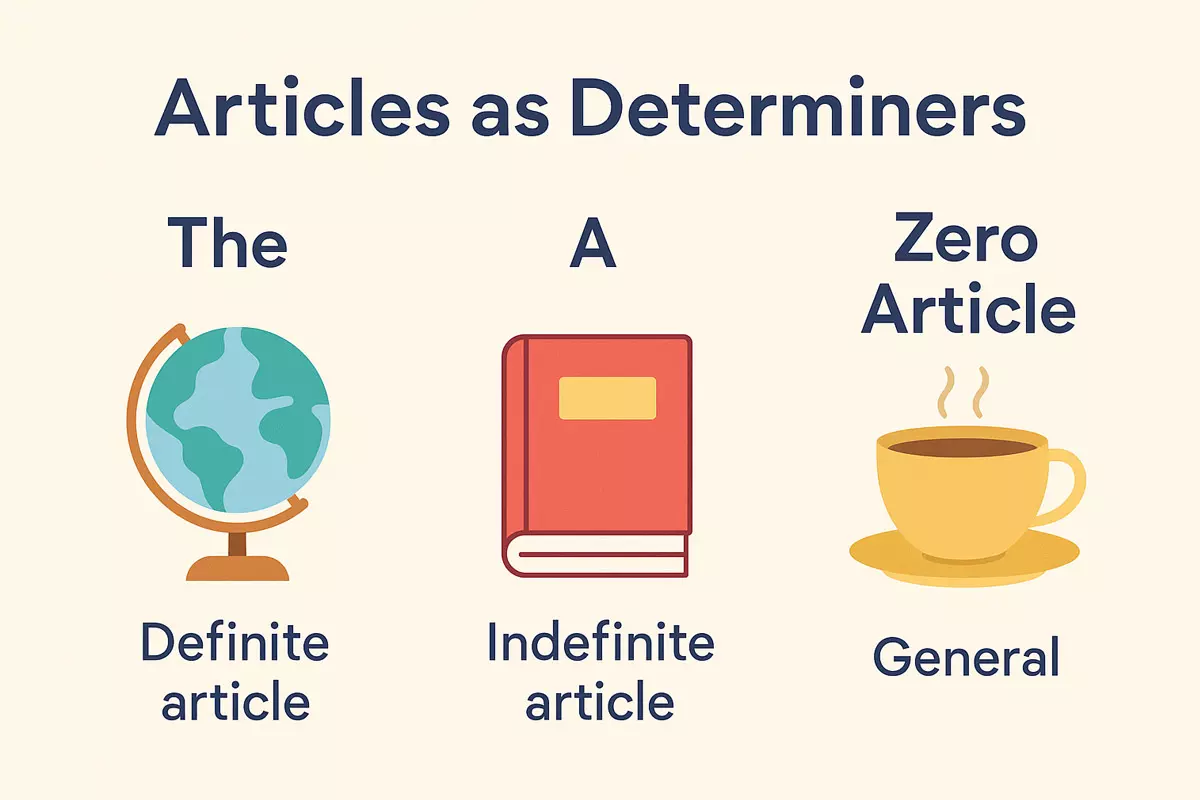 The article explains what determiners are and how articles fit in, clarifies the use of definite, indefinite, and zero articles, provides rules for a, an, and the, shows when to use zero article, reviews common patterns, and addresses frequent mistakes.
- What a determiner is and how articles fit into this group
- Difference between definite, indefinite, and zero article
- Basic rules for using a, an, and the with nouns
- When to use zero article with plural and uncountable nouns
- Common patterns with countries, languages, and places
- Frequent beginner mistakes with articles and how to fix them
- Short practice: choose the correct article in sample sentences
Mastering English can be challenging, particularly when deciding whether to use definite or indefinite articles, or to omit them altogether before a noun. These small words play a significant role in determining the clarity and precision of your message. Knowing when to say "a," "an," "the," or nothing at all helps ensure your meaning is understood and your communication remains both accurate and effective. Developing this skill is essential for anyone aiming to speak or write English clearly and confidently.
What a determiner is and how articles fit into this group
A determiner is a word placed in front of a noun to clarify what the noun refers to. Determiners help us understand whether we are talking about something specific or general, how much or how many, or even whose item is being discussed. In English, articles like the, a, and the so-called “zero article” (the absence of an article) are a special subset of this broader group.
Determiners: The Bigger Picture
Besides articles, determiners include demonstratives (this, that), possessives (my, your), quantifiers (some, many), and numbers. They all serve the function of modifying nouns, but articles are unique because they’re the most basic signal of whether we’re speaking generally or specifically.
- Articles: the, a, an, (zero article)
- Demonstratives: this, that, these, those
- Possessives: my, your, his, her, its, our, their
- Quantifiers: some, any, much, many, few, little, all, most, several
- Numbers: one, two, three, etc.
- Distributives: each, every, either, neither
- Interrogatives: which, what, whose
How Articles Function as Determiners
Articles are the most frequent type of determiner and always appear before the noun (or any adjectives describing it). They set the stage for understanding if the noun is something unique or just one example among many. For example, the dog refers to a particular dog both the speaker and listener know, while a dog could be any dog at all. The “zero article” is used when we don’t need to specify, such as with general ideas, plural nouns, or uncountable nouns: Dogs are friendly, Milk is healthy.
Quick Comparison: Articles vs. Other Determiners
| Type | Examples & Use |
|---|---|
| Articles | the, a, an, (zero article) Specify general vs. specific reference |
| Demonstratives | this, that, these, those Point out particular items or people |
| Possessives | my, your, his, her, its, our, their Show ownership or relationship |
| Quantifiers | some, any, many, much, few, little, several Indicate quantity or amount |
| Numbers | one, two, three, etc. Give exact quantity |
In summary, articles are a core type of determiner, signaling whether a noun is definite, indefinite, or general. Recognizing their role within the determiner family helps clarify sentence structure and meaning in English.
Difference between definite, indefinite, and zero article
Understanding how the, a/an, and the absence of an article (zero article) function is essential for using English naturally. Each form signals something distinct about the noun it modifies, such as whether the speaker assumes the listener knows about the item or not, or whether the noun is countable, uncountable, or plural.
Definite Article: the

The definite article the is used when both the speaker and listener know exactly which person, place, or thing is meant. It can refer to something already mentioned, something unique, or something defined by context.
- The sun rises in the east. (unique)
- I saw the movie you recommended. (already mentioned or known)
- Please close the door. (specific door in context)
Indefinite Articles: a / an
Indefinite articles (a before consonant sounds, an before vowel sounds) introduce a noun that is not specifically identified. The noun is typically singular and countable, and the listener does not know which one is meant.
- I bought a book. (any book, not specified)
- She wants to eat an apple. (any apple, not a particular one)
- Do you have a pen?
Zero Article (No Article)
The zero article is used when no article is needed. This often occurs with plural nouns, uncountable nouns, and certain proper nouns. It usually indicates something in a general sense, rather than something specific.
- Dogs are loyal. (all dogs in general)
- Water is essential. (uncountable, general)
- She went to school. (set expressions, institutions)
- Mount Everest is the highest mountain. (proper noun)
Quick Comparison
| Form | When Used | Example |
|---|---|---|
| The (Definite) | Specific/known noun (singular or plural) | The cat on the roof is mine. |
| A / An (Indefinite) | Any one, not specific (singular, countable) | I saw a bird in the garden. |
| Zero Article | General, uncountable, or plural nouns | Cats are independent animals. |
Common Usage Patterns
- Use the with superlatives: the best, the most interesting
- Use a/an when mentioning something for the first time
- Omit the article with meals: have breakfast, eat lunch
- No article with most country names: France, Japan
- Use the with some geographical names: the Nile, the Alps
- Zero article for languages: She speaks English
- Zero article for professions (in general): Doctors help people
- Use the with unique objects: the internet, the moon
- Use a/an to express one of many: a student, an answer
- No article before most proper names: John, London
To sum up, choosing between the, a/an, or no article depends on whether you’re referring to something definite, indefinite, or something general or abstract. Mastery of these patterns leads to more natural and precise English.
Basic rules for using a, an, and the with nouns
English articles help us clarify whether we’re talking about something specific or something more general. The three main types—a, an, and the—each follow clear patterns that depend on both the noun and the context. Choosing the correct form helps make your meaning clear to listeners and readers.
When to use a and an
The indefinite articles a and an are used when referring to a non-specific or unidentified item. The choice between them depends on the first sound of the word that follows:
- Use a before words starting with a consonant sound: a dog, a university (because "university" starts with a "juː" sound).
- Use an before words starting with a vowel sound: an apple, an hour (the "h" is silent).
These articles are only used with singular, countable nouns. Plural or uncountable nouns do not take a or an.
When to use the
The definite article the is used when the listener or reader knows exactly which person or thing is meant. This can happen because it’s been mentioned before, is unique, or is clear from context:
- Something already mentioned: “I saw a cat. The cat was black.”
- Unique objects: “The sun is bright today.”
- Shared knowledge: “Can you close the door?” (There is only one relevant door.)
- Superlatives: “She is the best player.”
Zero article (no article)
In some cases, no article is needed. This is often called the “zero article.” It’s common with plural or uncountable nouns when speaking generally, or with names of most countries and languages.
- General plural/uncountable: “Books are expensive.” “Milk is healthy.”
- Countries and languages: “France is beautiful.” “He speaks Russian.”
- Meals and days: “We ate lunch.” “Monday is busy.”
Quick reference: Article usage patterns
| Usage situation | Example | Article |
|---|---|---|
| First mention, singular countable | I saw a movie. | a/an |
| First mention, begins with vowel sound | He bought an umbrella. | a/an |
| Already mentioned or unique | The movie was exciting. | the |
| General, plural or uncountable | Books are useful. Water is essential. | (zero article) |
| Specific object/thing | Can you pass the salt? | the |
| Names of most countries/languages | She lives in Italy. He speaks English. | (zero article) |
Common mistakes to avoid
- ❌ Using the with general plural nouns: The dogs are friendly (only if you mean specific dogs; otherwise, use no article).
- ❌ Omitting a/an with singular countable nouns: I want apple → I want an apple.
- ✅ Remember: Use a/an for something new or unknown, the for something known or unique, and no article for general statements.
When to use zero article with plural and uncountable nouns
Omitting an article is common with plural and uncountable nouns in English, especially when speaking about things in a general sense. This means you don't use the, a, or an before these types of nouns unless you want to specify or limit their meaning. Understanding when to leave out an article helps your sentences sound natural and clear.
General statements and categories
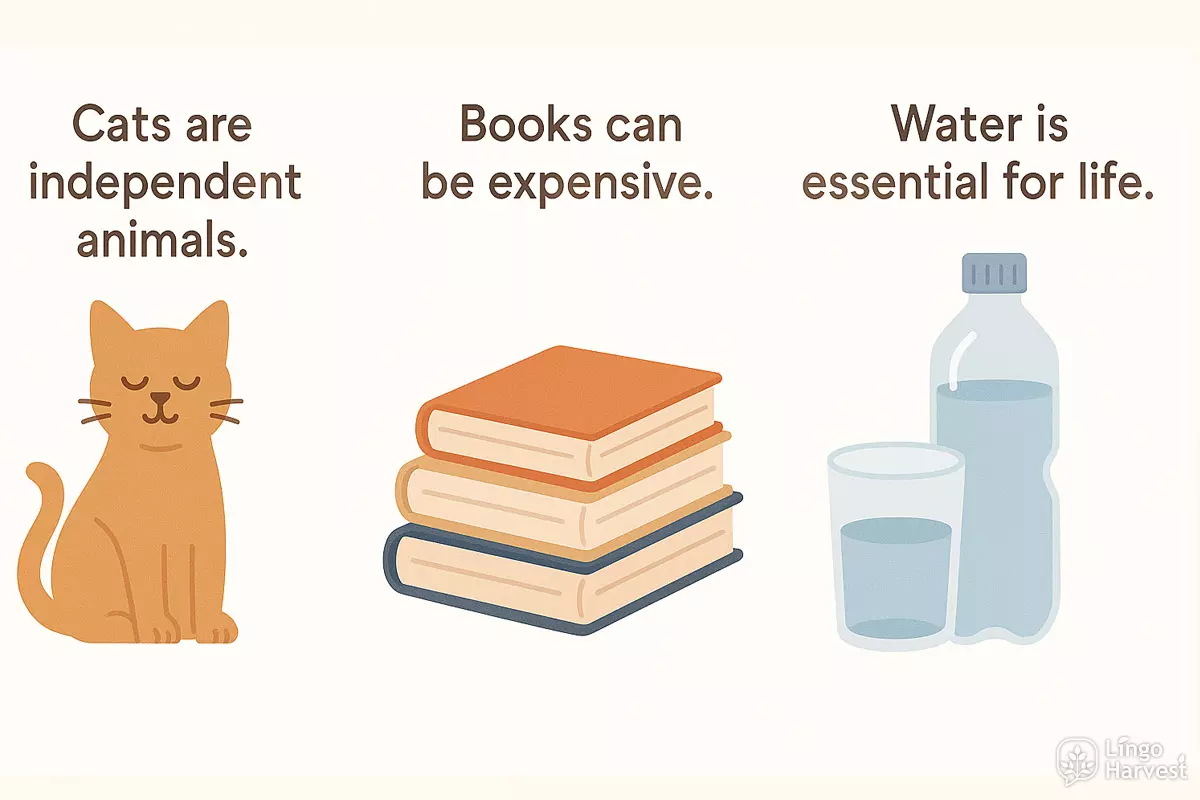
Zero article is used when you refer to whole groups or categories rather than specific members. For example:
- Cats are independent animals. (all cats in general)
- Books can be expensive. (not specific books)
- Water is essential for life. (all water, not a certain type)
- Information travels quickly online. (information in general)
With uncountable nouns for general meaning
Uncountable nouns like milk, music, and advice do not take an article when you're talking about them in a broad sense. Some examples:
- Music helps me relax.
- Advice can be helpful.
- Furniture is expensive in this city.
- Air pollution is a problem.
Zero article with plural countable nouns
When you mean "all" or "any" of something, plural countable nouns appear without an article:
- Cars pollute the air.
- Children need attention.
- Computers are everywhere now.
- Dogs make loyal pets.
Common patterns for zero article usage
Here are more situations where no article is needed before plural or uncountable nouns:
- After of when it refers to a general group: Most students prefer online classes.
- In lists: We need eggs, flour, sugar, and milk.
- With academic subjects: She studies mathematics and biology.
- With meals: We had lunch at noon.
- With languages: He speaks Spanish and German.
- With transport: People travel by train or plane.
- With institutions (when used generally): Children go to school.
- With seasons (sometimes): Winter is cold here.
- With abstract ideas: Freedom is important.
- With names of sports: She plays tennis.
- With diseases: He has diabetes.
- With days and months: Monday is busy.
Summary: When to use no article
To sum up, leave out articles before plural nouns and uncountable nouns when talking generally, describing categories, or following certain patterns. If you want to refer to something specific, you’ll need to use the or another determiner.
Common patterns with countries, languages, and places
Understanding how articles are used with geographical names, languages, and locations can be tricky, as English follows some unique conventions. While many names don’t need an article at all, others always require one. Recognizing these patterns will help you use “the,” “a,” or no article (“zero article”) correctly in context.
Countries and territories
Most country names are used without an article. However, there are exceptions—typically for countries with plural names or political descriptions. Here are some common rules:
- No article: France, Japan, Brazil, Canada
- Use “the” with plural or descriptive names: the Netherlands, the United States, the Philippines, the United Kingdom, the Czech Republic
Languages and nationalities
Languages and adjectives for nationalities never take an article when used in general statements.
- I speak Spanish.
- She is Italian.
- They are learning Chinese.
- He understands German.
- We are studying French.
- My neighbor is Brazilian.
- She feels more comfortable speaking Japanese.
- They hired a Korean designer.
But, when referring to a specific group of people, “the” may be used:
- The French are known for their cuisine.
- The Italians love good food.
- The Japanese value politeness.
- The Spanish celebrate many festivals.
- The British are fond of tea.
Cities, towns, and regions
Most cities and towns stand alone, without articles:
- London
- Tokyo
- Berlin
- Paris
- Rome
- Bangkok
- New York
- Sydney
Regions can vary:
- the Middle East
- the Alps
- the Balkans
- the Arctic
- Central Asia (no article)
- South America (no article)
- Eastern Europe (no article)
Rivers, seas, mountains, and landmarks
Geographical features often have their own conventions. To clarify, here’s a structured comparison:
| Feature Type | Typical Article Usage |
|---|---|
| Rivers | the Nile, the Amazon, the Thames |
| Seas & Oceans | the Pacific Ocean, the Baltic Sea |
| Mountain Ranges | the Andes, the Himalayas |
| Individual Mountains | Mount Everest, Mount Fuji (no article) |
| Buildings & Landmarks | the Eiffel Tower, the White House Buckingham Palace (no article) |
Other notable patterns
- Islands: the Bahamas, but Greenland
- Deserts: the Sahara, the Gobi
- Parks: Central Park (no article), the Grand Canyon
- Streets/Avenues: Baker Street, Fifth Avenue (no article)
- Universities: Oxford University (no article), the University of Oxford
Summing up, English uses articles with place names and languages in specific, sometimes unpredictable ways. Practice and attention to these patterns will help you sound natural and accurate.
Frequent beginner mistakes with articles and how to fix them
New learners of English often struggle with article usage, especially since many languages don’t use “the,” “a,” or a zero article in the same way. Misusing these small words can lead to confusion or awkward phrasing. Below, you’ll find some of the most common pitfalls and practical tips to correct them.
Omitting articles where one is needed
Leaving out an article is a frequent error, especially before singular countable nouns. For example:
- I have cat. ❌ → I have a cat. ✅
- She is teacher. ❌ → She is a teacher. ✅
- He bought car. ❌ → He bought a car. ✅
- I need umbrella. ❌ → I need an umbrella. ✅
- She found job. ❌ → She found a job. ✅
- He is engineer. ❌ → He is an engineer. ✅
If you’re talking about something for the first time, use “a” or “an.”
Using “the” with general statements
Beginners might use “the” when speaking about things in general. For instance:
- The dogs are friendly. ❌ → Dogs are friendly. ✅
- I like the music. ❌ → I like music. ✅
- The students need rest. ❌ → Students need rest. ✅
- The water is important for life. ❌ → Water is important for life. ✅
- The cars cause pollution. ❌ → Cars cause pollution. ✅
- I enjoy the nature. ❌ → I enjoy nature. ✅
Remember, “the” refers to something known or specific. For general ideas, leave it out.
Forgetting to use “the” with unique or specific nouns
Some nouns are unique or have already been mentioned, so “the” is necessary:
- Sun rises in east. ❌ → The sun rises in the east. ✅
- Book on table is mine. ❌ → The book on the table is mine. ✅
- Moon is bright tonight. ❌ → The moon is bright tonight. ✅
- Teacher entered classroom. ❌ → The teacher entered the classroom. ✅
- Manager called me after meeting. ❌ → The manager called me after the meeting. ✅
- Car in garage is broken. ❌ → The car in the garage is broken. ✅
Confusing “a/an” and “the”
Learners sometimes swap “a/an” and “the” incorrectly. Here’s a breakdown:
| Incorrect | Correct |
|---|---|
| I saw the dog in the park. (first mention) | I saw a dog in the park. |
| Can you pass me a salt, please? | Can you pass me the salt, please? |
| I bought a new shoes yesterday. | I bought new shoes yesterday. (no article: plural) |
| The Mount Everest is high. | Mount Everest is high. (no article: proper noun) |
Common patterns where articles are tricky
Here are typical situations that confuse learners:
- Before meals: We had lunch (not the lunch).
- With languages: She speaks Spanish (not the Spanish).
- With places: Go to school / at home (not the school / the home unless specific).
- With professions: He is a doctor (not He is doctor).
- With superlatives: The best day, the biggest city.
- With ordinal numbers: The first time, the second floor.
- With countries: the Netherlands, the United States (but France, Japan).
- With unique objects: the moon, the internet.
- With musical instruments: play the piano, play the guitar.
- With transportation: by car, by train (no article).
Tips for avoiding mistakes
Practice reading and listening to native material, and pay attention to articles in context. When in doubt, ask yourself: is this noun specific, general, or unique? With time and exposure, correct usage will become more natural.
Short practice: choose the correct article in sample sentences
Understanding when to use "the," "a/an," or no article at all can be tricky. Here, you'll find a set of sentences where you can test your knowledge of English articles by filling in the blanks. Read each sentence carefully and decide which article fits best, or if you should leave it blank (zero article).
Fill in the blanks with "a," "an," "the," or leave it blank
- ______ apple a day keeps ______ doctor away.
- She wants to become ______ engineer when she grows up.
- We visited ______ Eiffel Tower during our trip to Paris.
- He doesn't like ______ coffee in the morning.
- ______ Mount Everest is the highest mountain in the world.
- Can you pass me ______ salt, please?
- ______ English language is spoken in many countries.
- They saw ______ elephant at the zoo.
- My brother is ______ honest person.
- ______ water in this lake is very clean.
- She plays ______ piano very well.
- We saw ______ beautiful bird in the garden.
- ______ gold is a precious metal.
- He is ______ best player on the team.
- ______ children like to play outside after school.
- She goes to ______ school by bus every day.
- ______ sun rises in the east.
- I have ______ idea!
- ______ literature can teach us about different cultures.
- We need ______ umbrella; it’s starting to rain.
Show answers
- An apple a day keeps the doctor away.
- An engineer
- The Eiffel Tower
- — (no article) coffee
- Mount Everest
- The salt
- The English language
- An elephant
- An honest person
- The water
- The piano
- A beautiful bird
- The best player
- — (no article) Children
- The sun
- An idea
- An umbrella
Quick tips for choosing articles
- Use "a/an" for singular, countable nouns being mentioned for the first time or when the exact identity is not known.
- Use "the" for specific nouns that both the speaker and listener know.
- Use zero article (no article) with most plural and uncountable nouns when speaking generally, and with names of most countries, languages, and meals.
Practice like this helps reinforce the logic behind articles and makes their use feel more natural. Refer back to these tips as you review your answers.