How to Give Advice in English with Modal Verbs

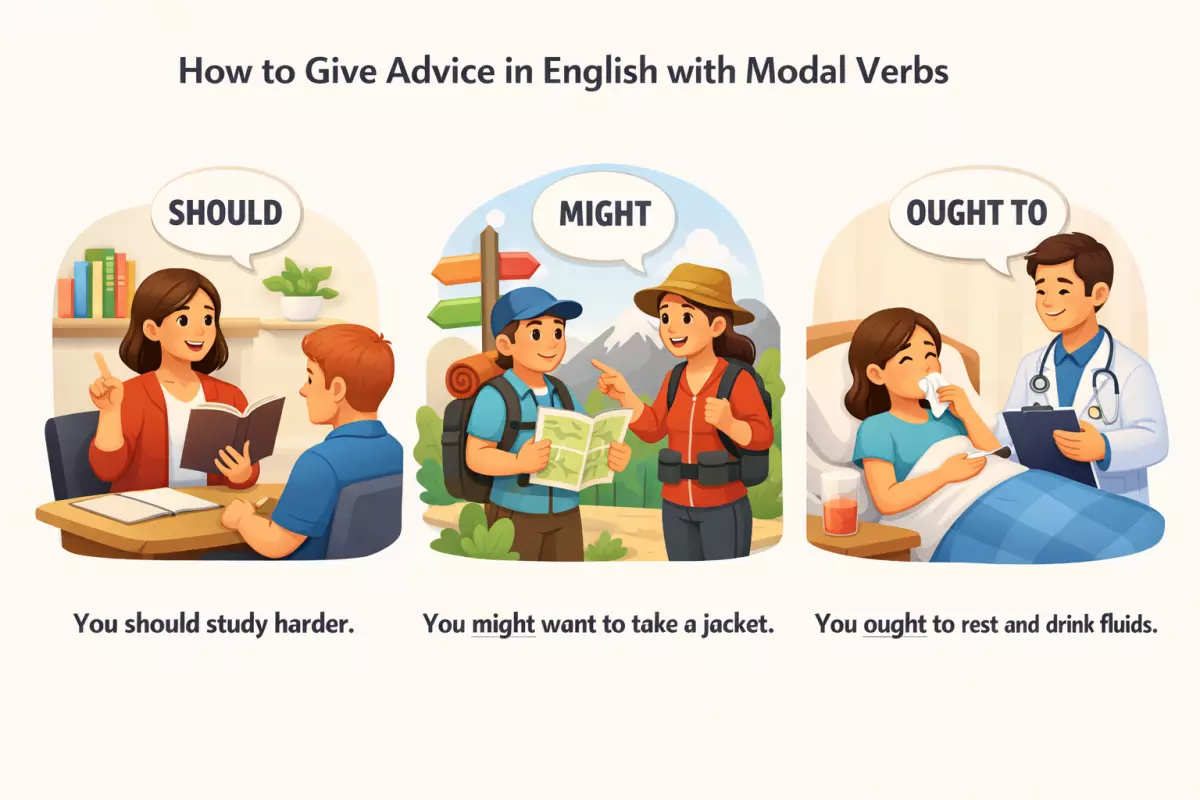 This article explains common advice modals and how should, ought to, and could change the tone. It shows sentence patterns and everyday examples, how modals soften or strengthen advice, common learner mistakes, context tips, plus exercises and practice.
- Modal verbs commonly used when giving advice
- How should, ought to, and could create different tones of recommendation
- Sentence patterns for suggesting actions
- Examples of advice in everyday conversation
- How modal verbs soften or strengthen recommendations
- Typical learner mistakes when giving advice with modals
- How context influences the choice of modal verb
- Exercises and practice activities on giving advice with modal verbs
Giving helpful guidance in English often depends on choosing the right modal verbs to match your tone. In everyday talk, switching from can to could, or from should to might, can make advice feel supportive rather than bossy. This article explains how modals shape politeness, show respect, and help you offer suggestions to friends, coworkers, or strangers in a natural, confident way.
Modal verbs commonly used when giving advice
When you advise someone in English, modal verbs help you control how strong, polite, or indirect your suggestion sounds. The same basic idea (helping someone choose a good action) can be expressed as a gentle hint, a practical recommendation, or a firm warning depending on the modal you choose.
Core modals and semi-modals for advice
-
Should (general recommendation; common and neutral)
-
Pattern: should + base verb
-
Example: You should back up your files before updating.
-
Negative: You shouldn’t skip breakfast if you get dizzy in the morning.
-
Question (asking for advice): Should I email them again or wait?
-
-
Ought to (similar to “should,” slightly more formal)
-
Pattern: ought to + base verb
-
Example: You ought to read the instructions first.
-
Negative: You ought not to drive if you’re exhausted.
-
-
Could (options and possibilities; softer than “should”)
-
Pattern: could + base verb
-
Example: You could try restarting the router.
-
Use it to offer choices: You could call them, or you could send a short message.
-
Negative (less common for advice): You couldn’t really rely on that source.
-
-
Can (practical suggestions, especially about what is possible)
-
Pattern: can + base verb
-
Example: You can save time by using a template.
-
Tip: “Can” often sounds like giving an option rather than judging what is best.
-
-
May (polite, cautious suggestions; common in formal contexts)
-
Pattern: may + base verb
-
Example: You may want to check the dates before you book.
-
Note: “May want to” is a frequent advice phrase when you want to sound indirect.
-
-
Might (very tentative advice; gentle and non-pushy)
-
Pattern: might + base verb
-
Example: You might want to take a break if you’re losing focus.
-
Use it when the listener should decide: You might consider waiting until tomorrow.
-
-
Need to (strong advice that sounds close to necessity)
-
Pattern: need to + base verb
-
Example: You need to wear a helmet on that route.
-
Negative: You don’t need to apologize; it was a misunderstanding.
-
Tip: “Don’t need to” removes pressure and reassures the listener.
-
-
Have to (very strong; obligation, rules, or non-negotiable situations)
-
Pattern: have to + base verb
-
Example: You have to submit the form by Friday.
-
Negative: You don’t have to decide today.
-
Tip: Use it carefully for advice; it can sound like an order unless the situation truly requires it.
-
-
Must (strongest; often rules, safety, or urgency)
-
Pattern: must + base verb
-
Example: You must see a doctor if the pain gets worse.
-
Negative (prohibition): You mustn’t share your password.
-
Tip: “Must” can feel intense in everyday advice; it fits best with clear risk or strict requirements.
-
-
Had better (strong warning; suggests consequences)
-
Pattern: had better + base verb (often shortened to ’d better)
-
Example: You’d better leave now, or you’ll miss the train.
-
Negative: You’d better not mention that topic at the meeting.
-
Common mistake: ❌ You had better to leave. ✅ You had better leave.
-
Useful advice patterns with these verbs
-
Should / shouldn’t for balanced guidance: You should ask for clarification; you shouldn’t guess.
-
Could to present alternatives: You could take the earlier flight to avoid delays.
-
May/might want to to soften the suggestion: You might want to double-check the address.
-
Need to / have to for deadlines and requirements: You need to renew your license this month.
-
Mustn’t for strong prohibitions: You mustn’t touch that switch.
-
’d better when consequences are likely: You’d better save your work before closing the program.
How should, ought to, and could create different tones of recommendation

These three modal verbs all help you give advice, but they signal different levels of strength and different relationships between the speaker and listener. Choosing the right one helps your recommendation sound appropriately firm, polite, or open-ended.
| Modal | Tone and strength | Common patterns | Example |
|---|---|---|---|
| should | Clear, practical advice; fairly strong but usually friendly | should + base verb; should probably + base verb; should not / shouldn’t + base verb | You should back up your files before updating. |
| ought to | More “moral” or duty-based; slightly formal; can sound judgmental if overused | ought to + base verb; ought not to + base verb | You ought to apologize for the misunderstanding. |
| could | Gentle suggestion; gives options and reduces pressure | could + base verb; could try + -ing / base verb; could also + base verb | You could try restarting the router first. |
| Summary | From stronger to softer: should → ought to (duty) → could (option) | Mix with softeners: maybe, if you want, it might help to… | Maybe you could ask for an extension. |
Using should: direct, practical guidance
Use should when you want to sound confident that one choice is best. It often fits workplace advice, study tips, and everyday problem-solving.
- Affirmative: should + base verb → You should call them today.
- Negative: shouldn’t + base verb → You shouldn’t skip the instructions.
- With a reason: You should leave now because traffic is heavy.
- With “probably” to soften: You should probably save a copy first.
- With “I think” to reduce force: I think you should talk to your manager.
- Question form for gentle advice: Should you ask for clarification first?
- ✅ You should take notes. ❌ You should to take notes.
Using ought to: advice linked to responsibility
Ought to is close to should, but it often implies what is “right” or expected. Because it can sound more serious, it works best when there is a clear obligation or social norm.
- Affirmative: ought to + base verb → You ought to tell them the truth.
- Negative: ought not to + base verb → You ought not to share that password.
- More formal tone: We ought to inform customers about the delay.
- Careful with sensitive topics: “You ought to…” can sound like criticism; consider “You might want to…” or “You could…” for a softer approach.
- ✅ You ought to be on time. ❌ You ought be on time.
Using could: suggestions and options
Could is useful when you want to offer possibilities rather than one “correct” solution. It’s common in customer service, teamwork, and situations where the listener should decide.
- Basic suggestion: could + base verb → You could email them instead.
- Offering an alternative: You could take the train, or you could drive.
- Adding another idea: You could also check the settings menu.
- Problem-solving tone: You could try restarting the app.
- Softening further: Maybe you could ask for feedback.
- ✅ You could try calling later. ❌ You could to try calling later.
Example set: same situation, different tone
- Should: You should talk to your professor after class. (clear recommendation)
- Ought to: You ought to talk to your professor after class. (sounds like a responsibility)
- Could: You could talk to your professor after class. (one helpful option)
- Even softer with a hedge: Maybe you could talk to your professor after class. (low pressure)
Sentence patterns for suggesting actions
When you recommend what someone should do next, English often uses modal verbs plus a base verb to keep the advice practical and polite. The patterns below show common structures, what they imply (strong vs. gentle), and how to form them accurately.
Common structures (with meaning and examples)
- You should + base verb (clear, direct advice): “You should back up your files before updating.”
- You shouldn’t + base verb (warning against an action): “You shouldn’t skip breakfast if you feel dizzy.”
- You could + base verb (a gentle option, not a command): “You could ask your manager for clarification.”
- You might + base verb (very soft suggestion, low pressure): “You might try restarting the router.”
- You may want to + base verb (polite, common in professional contexts): “You may want to double-check the address.”
- You might want to + base verb (even softer than “may want to”): “You might want to bring a jacket.”
- You need to + base verb (strong necessity; not exactly a modal, but used like one in advice): “You need to renew your passport before you travel.”
- You don’t need to + base verb (reassurance; removes pressure): “You don’t need to apologize for asking.”
- You have to + base verb (external obligation; can sound strict): “You have to submit the form by Friday.”
- If I were you, I would + base verb (classic advice formula; tactful): “If I were you, I would call them today.”
- I’d + base verb (short form of “I would”; friendly, informal): “I’d wait until tomorrow and see how you feel.”
- It might be a good idea to + base verb (indirect, diplomatic): “It might be a good idea to save a copy.”
- It would be better to + base verb (comparison; suggests an improved choice): “It would be better to email than to text.”
- Why don’t you + base verb? (suggestion as a question; conversational): “Why don’t you take a short break?”
- How about + -ing / noun? (proposal; casual): “How about meeting at 3?”
- What about + -ing / noun? (similar to “How about”; often checks agreement): “What about trying a different approach?”
- Let’s + base verb (includes the speaker; collaborative): “Let’s review the plan together.”
- You’d better + base verb (strong warning; can sound threatening): “You’d better leave now if you want to catch the train.”
Form notes that prevent common mistakes
- After modals, use the base verb: ✅ “You should call.” ❌ “You should to call.”
- Use not for negatives: “You should not / shouldn’t drive when you’re exhausted.”
- Use have to (not “must”) when you want advice to sound less forceful: “You have to file it today” can still sound strict, but “You need to” or “You should” is often softer.
- For suggestions framed as questions, keep normal word order: ✅ “Why don’t you try it?” ❌ “Why don’t you to try it?”
- With “How about / What about,” use -ing or a noun: “How about taking notes?” / “How about a short break?”
Examples of advice in everyday conversation
In daily English, advice often appears as short modal-verb sentences that match the situation: gentle suggestions, stronger recommendations, warnings, or “what I’d do” opinions. Notice how modals change the level of pressure, and how speakers soften advice with time phrases (now, today, this week) or reasons (because…).
Common situations and natural modal-verb advice
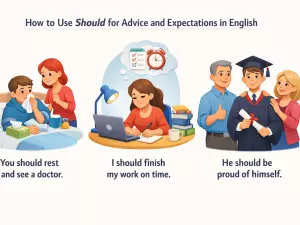
- Health (general): “You should get some rest tonight.”
- Health (stronger): “You ought to see a doctor if it gets worse.”
- Urgent safety: “You must wear a helmet on that bike.”
- Prohibition / warning: “You mustn’t mix those two cleaning products.”
- Work priorities: “You should finish the report before the meeting.”
- Polite suggestion: “You could email them first to check availability.”
- Options (low pressure): “You might try a different route to avoid traffic.”
- Study habits: “You should review your notes for 10 minutes each day.”
- Money (practical): “You should set a budget for groceries.”
- Money (cautious): “You might want to wait for a sale.”
- Tech troubleshooting: “You should restart your phone and try again.”
- Travel planning: “You should book tickets early in peak season.”
- Social plans: “You could invite them for coffee instead of dinner.”
- Relationships (gentle): “You should talk to them when you’re both calm.”
- Conflict (boundary): “You shouldn’t reply right away if you’re angry.”
- Career (recommendation): “You should update your CV before applying.”
- Decision-making: “If I were you, I would choose the simpler option.”
- First-time experience: “You should try the local food at least once.”
Useful patterns that make advice sound natural
- Modal + base verb: “You should call them.” (not “should to call”) ✅ “You should call.” ❌ “You should to call.”
- Softening with “maybe”: “Maybe you could ask for an extension.”
- Softening with “I think”: “I think you should speak to your manager.”
- Adding a reason: “You should back up your files because the laptop is acting up.”
- Conditional advice: “If you’re tired, you should take a break.”
- Offering choices: “You could take the train, or you could drive—either works.”
- Stronger recommendation with context: “You must submit it today if you want it approved.”
- Gentle “might want to”: “You might want to double-check the address.”
Quick contrasts: strength and tone
- Could / might = light suggestion: “You could try turning notifications off.”
- Should / ought to = clear recommendation: “You should apologize.”
- Must / mustn’t = rule, necessity, or strong warning: “You mustn’t share that password.”
- Would (often with “If I were you”) = personal viewpoint, less direct: “I would wait until tomorrow.”
How modal verbs soften or strengthen recommendations

Modal verbs let you control how direct your advice sounds. By choosing a weaker or stronger modal, you can signal anything from a gentle suggestion to a firm warning. The same basic idea can feel polite, neutral, or forceful depending on the modal, the subject (you/we), and the surrounding phrases.
Strength scale: from gentle to firm
- Could (very soft suggestion): “You could try restarting your router.”
- Might (soft, tentative): “You might want to back up your files first.”
- May (formal, cautious): “You may want to speak to HR about it.”
- Should (clear recommendation): “You should update your password.”
- Ought to (similar to should, slightly formal): “You ought to tell them in advance.”
- Had better (strong, often with consequence implied): “You’d better submit it today.”
- Must (very strong, obligation): “You must wear a helmet on site.”
Common patterns that soften advice
- Modal + try: “You could try calling again after lunch.”
- Modal + consider: “You might consider taking a short break.”
- Modal + want + to: “You may want to check the instructions.”
- Modal + be able to (focus on possibility): “You might be able to swap shifts.”
- Modal + if-clause (conditional, less direct): “If you’re unsure, you could ask for a second opinion.”
- Modal + perhaps/maybe: “Maybe you could email them instead.”
- Question form: “Could you try a different browser?” / “Should we look at another option?”
- We + modal (shared responsibility): “We could postpone the meeting.”
- I think + modal (adds distance): “I think you should talk to your manager.”
- It might be a good idea to…: “It might be a good idea to save a copy.”
Patterns that make recommendations stronger
- Should without hedging: “You should apologize directly.”
- Had better to highlight urgency: “You’d better leave now to catch the train.”
- Must for rules or non-negotiables: “You must sign in at reception.”
- Must not / can’t for prohibitions: “You mustn’t share that password.” / “You can’t park here.”
- Need to (not a modal, but similar force in advice): “You need to get that checked.”
- Direct subject + modal (more pointed): “You should…” feels stronger than “We should…”
- Consequence clause: “You should back it up, or you could lose everything.”
Usage notes: choosing the right level
- Could and might work well when the listener has options or you are unsure: “You could/might…” suggests, rather than instructs.
- Should is the default for practical advice: it sounds confident but not authoritarian in most contexts.
- Must is best for rules, safety, and requirements; it can sound too harsh for personal choices.
- Had better often implies a negative result if the advice is ignored: “You’d better…” can feel like a warning.
- May is more formal than might in many settings: “You may want to…” is common in professional writing and careful speech.
- To reduce pressure, add a choice frame: “You could either A or B,” or “You might want to start with A.”
Quick correctness checks
- ✅ “You should see a doctor.” ❌ “You should to see a doctor.”
- ✅ “You could try again.” ❌ “You could to try again.”
- ✅ “You’d better leave now.” ❌ “You’d better to leave now.”
- ✅ “You mustn’t do that.” ❌ “You don’t must do that.”
Typical learner mistakes when giving advice with modals
Advice with modal verbs is often clear in meaning but tricky in form. The most common problems come from mixing patterns (modal + base verb), choosing a modal that sounds too strong or too weak, and using the wrong time reference when talking about past situations.
1) Using the wrong verb form after a modal
After a modal, English uses the base form of the verb (no to, no -s, no -ing). This is one of the most frequent grammar slips in advice sentences.
- ❌ You should to see a doctor. → ✅ You should see a doctor.
- ❌ She must goes now. → ✅ She must go now.
- ❌ You could going earlier. → ✅ You could go earlier.
- ❌ He should studies more. → ✅ He should study more.
2) Confusing advice with obligation
Some modals sound like strong rules rather than suggestions. Learners sometimes choose a modal that changes the relationship or the level of pressure.
- Using
mustfor friendly advice can sound like an order: ❌ You must talk to your boss. (often too forceful) → ✅ You should talk to your boss. - Using
shouldwhen a rule is required can sound too soft: ❌ You should wear a helmet on site. (if it’s mandatory) → ✅ You must wear a helmet on site. - Using
have toas “general advice” can imply external pressure: ❌ You have to try yoga. → ✅ You might want to try yoga.
3) Mixing up past advice: “should” vs “should have”
Advice about the past needs a perfect form. Learners often use should + base verb when they mean “it was a mistake” or “it would have been better.”
- ❌ You should call me yesterday. → ✅ You should have called me yesterday.
- ❌ He shouldn’t miss the train. (but he already missed it) → ✅ He shouldn’t have missed the train.
- ❌ We could take a taxi last night. (regret) → ✅ We could have taken a taxi last night.
4) Overusing “should” and missing softer options
When every suggestion is framed with should, the tone can feel repetitive or too direct. English often uses softer patterns for polite advice, especially with strangers or sensitive topics.
- Too direct: ❌ You should change jobs. → Softer: ✅ You might want to look for a new role.
- Too direct: ❌ You should lose weight. → More tactful: ✅ You could talk to a doctor about a plan.
- Too direct: ❌ You should stop complaining. → Softer: ✅ You may want to focus on what you can control.
5) Using “can” when you mean “should”
Can often expresses ability or permission, not advice. If the goal is to recommend an action, learners usually need should, could, or a suggestion phrase.
- ❌ You can see a dentist. (ability/option) → ✅ You should see a dentist. (recommendation)
- ❌ You can rest more. (possible) → ✅ You could rest more. (gentle suggestion)
- ❌ You can not eat late. (unclear) → ✅ You shouldn’t eat so late. (clear advice)
6) Negative forms placed incorrectly
Negatives with modals follow a fixed pattern: modal + not + base verb (or contracted forms like shouldn’t, mustn’t). Word order mistakes can make the sentence hard to understand.
- ❌ You not should do that. → ✅ You should not do that. / You shouldn’t do that.
- ❌ He doesn’t should drive. → ✅ He shouldn’t drive.
- ❌ You mustn’t to worry. → ✅ You mustn’t worry.
7) Choosing the wrong modal for prohibition: “mustn’t” vs “don’t have to”
These two forms are often confused, but they mean very different things. This creates serious misunderstandings in advice or instructions.
mustn’t= it is forbidden / not allowed: ✅ You mustn’t park here.don’t have to= it is not necessary: ✅ You don’t have to come early.- Common confusion: ❌ You don’t have to smoke here. (sounds like permission) → ✅ You mustn’t smoke here.
8) Making advice sound like a prediction
Will often sounds like a prediction or a promise, not a recommendation. Learners sometimes use it when they mean “this is a good idea.”
- ❌ You will drink more water. (prediction/order) → ✅ You should drink more water.
- ❌ You will talk to her about it. (command-like) → ✅ You could talk to her about it.
9) Missing common advice structures with modals
Advice is frequently expressed with short, natural patterns. Using these helps your recommendation sound fluent and appropriately polite.
You should + base verb: You should back up your files.You could + base verb: You could ask for an extension.You might want to + base verb: You might want to check the settings.If I were you, I’d + base verb: If I were you, I’d wait a day.Why don’t you + base verb?: Why don’t you take a short break?Maybe you can + base verb(option-focused): Maybe you can email them first.
How context influences the choice of modal verb
The modal you choose depends on your relationship with the listener, how urgent the situation is, and how certain you are about the advice. In English, small shifts in context change the level of pressure (gentle suggestion vs. strong recommendation) and the level of authority (peer-to-peer vs. expert-to-client).
Key context factors and the modal patterns they trigger
- Relationship and power distance: With friends, softer modals are common (should, could, might). In a manager-to-employee or teacher-to-student setting, stronger forms may appear (need to, have to), especially when rules or performance are involved.
- Urgency and risk: Higher risk pushes speakers toward firmer language. Compare: “You might want to back up your files” (low urgency) vs. “You need to back up your files today” (high urgency).
- Certainty and evidence: When the advice is based on clear facts, speakers often use should or need to. When it’s a guess or one option among many, could and might sound more accurate and less pushy.
- Formality: More formal situations often prefer complete, measured phrasing: “You may want to…” or “You might consider…”. Casual speech often uses “You should…” or “You could…”.
- Who benefits: Advice that mainly benefits the listener tends to be framed as a suggestion (could, might). Advice that protects others or prevents harm often becomes stronger (must, need to), especially in safety contexts.
- Rules vs. preferences: If it’s a rule, use obligation language (have to, must). If it’s a preference or best practice, use recommendation language (should, could).
- Face-saving and politeness: To reduce pressure, English often uses indirect structures: “You might want to…” / “You could try…”. These are useful when the advice could feel critical.
- One-time fix vs. ongoing habit: For a single action, modals with a clear next step work well (“You should email them today”). For habits, softer guidance can sound more supportive (“You might try setting a reminder”).
- Listener’s autonomy: When you want to leave the decision fully open, prefer could or might. When you want to steer strongly, prefer should or need to.
- Emotional sensitivity: In personal topics (health, relationships), speakers often soften: “You might want to talk to someone” rather than “You must talk to someone,” unless there is immediate danger.
- Professional responsibility: In roles with duty of care (medical, safety, compliance), stronger modals can be expected when the stakes are high: “You must report this” / “You need to stop using that machine.”
- Negotiation and collaboration: When brainstorming options, could is common because it invites discussion: “We could move the deadline” / “You could ask for clarification.”
Common context-to-modal matches (with example patterns)
- Friendly suggestion: “You could try…” / “You might want to…”
- General recommendation: “You should…” / “I think you should…”
- Strong recommendation (high stakes): “You really should…” / “You need to…”
- Rule or requirement: “You have to…” / “You must…”
- Soft, formal advice: “You may want to…” / “You might consider…”
- Advice with options: “You could either A or B…”
- Warning + advice: “You should be careful…” / “You need to watch out for…”
- Encouragement: “You can…” (ability/possibility) + a next step: “You can start by…”
- Gentle correction: “You might want to double-check…”
- Time pressure: “You should do it today” → “You need to do it now”
- Reducing blame: “You could consider…” (sounds less like criticism than “You should…”)
- Setting boundaries: “You shouldn’t…” (advice) vs. “You mustn’t…” (prohibition)
When choosing a modal for advice, aim for a match between the situation and the level of force in your language. If the listener might resist, start with a softer modal and strengthen it only if the context clearly justifies it.
Exercises and practice activities on giving advice with modal verbs
Use the activities below to practice common advice patterns with modal verbs. Focus on form (modal + base verb), tone (strong vs. gentle), and context (health, work, relationships, study). Write complete sentences, and check that your modal choice matches how direct you want to sound.
-
1) Choose the best modal for the situation (strength and politeness)
Complete each sentence with should, ought to, could, might want to, had better, or must. Use each option at least once.
- You look exhausted. You _____ take a break and get some sleep.
- If you keep missing deadlines, you _____ talk to your manager today. (warning)
- You _____ try restarting your laptop; sometimes that fixes the issue. (soft suggestion)
- It’s a formal event. You _____ wear something more professional.
- You’re driving in heavy snow. You _____ slow down. (safety rule)
- If you want to save money, you _____ cook at home more often. (neutral advice)
- You _____ check the address again; I’m not completely sure this is the right building. (tentative)
- Your passport expires next month. You _____ renew it before you travel. (practical necessity)
- You _____ speak to a doctor if the pain continues. (responsible advice)
- If you’re not ready, you _____ say yes right now. (permission to refuse)
Show answers
- should
- had better
- could
- ought to
- must
- should
- might want to
- had better
- should
- don’t have to
-
2) Fix the form: modal + base verb (spot the pattern errors)
Rewrite each sentence correctly. Watch for: no “to” after most modals, base verb form, and correct negatives.
- ❌ You should to call her tonight.
- ❌ He musts see a dentist.
- ❌ You don’t should stay up so late.
- ❌ We could to take the earlier train.
- ❌ She ought call him back.
- ❌ You had better to bring your ID.
- ❌ They might wants to leave early.
- ❌ You mustn’t to park here.
- ❌ I should went to bed earlier.
- ❌ You could to not mention it.
Show answers
- ✅ You should call her tonight.
- ✅ He must see a dentist.
- ✅ You shouldn’t stay up so late.
- ✅ We could take the earlier train.
- ✅ She ought to call him back.
- ✅ You had better bring your ID.
- ✅ They might want to leave early.
- ✅ You mustn’t park here.
- ✅ I should have gone to bed earlier.
- ✅ You could not mention it. / You could avoid mentioning it.
-
3) Match the advice to the goal (tone control)
Rewrite each item twice: (A) a gentle suggestion, and (B) a strong warning. Use modal verbs to show the difference.
- Someone is nervous about a presentation.
- A friend keeps forgetting to pay bills on time.
- A coworker is about to send an email with an angry tone.
- Someone has a bad cough for two weeks.
- A student wants to improve listening skills quickly.
- A traveler is leaving for the airport very late.
Show answers
- A: You could practice once more and take a few deep breaths.
B: You must prepare your key points before you go on stage. - A: You might want to set up reminders on your phone.
B: You had better pay them on time, or you’ll get fees. - A: You could wait ten minutes before you reply.
B: You mustn’t send that email while you’re angry. - A: You should consider seeing a doctor.
B: You must see a doctor if it’s been two weeks. - A: You could listen to short podcasts every day.
B: You should listen daily and review new words, not just “sometimes.” - A: You might want to leave now to avoid traffic.
B: You had better leave now, or you’ll miss your flight.
-
4) Build advice with common patterns (expand your options)
Use each prompt to write one natural sentence. Keep the structure accurate.
- Pattern: should + base verb → (sleep / more)
- Pattern: shouldn’t + base verb → (skip / breakfast)
- Pattern: could + base verb → (ask / for help)
- Pattern: might want to + base verb → (double-check / details)
- Pattern: ought to + base verb → (apologize / politely)
- Pattern: had better + base verb → (back up / files)
- Pattern: mustn’t + base verb → (share / passwords)
- Pattern: don’t have to + base verb → (answer / immediately)
- Pattern: If I were you, I would + base verb → (talk / to them)
- Pattern: Why don’t you + base verb → (take / a short walk)
- Pattern: It might be a good idea to + base verb → (save / receipts)
- Pattern: You may want to + base verb → (arrive / early)
-
5) Mini role-plays (realistic practice)
Choose one scenario and write 6–8 lines of dialogue. Include at least four different modals and at least one negative form.
- Scenario A: A friend is overwhelmed with work and not sleeping.
- Scenario B: A roommate plays loud music late at night.
- Scenario C: A colleague is preparing for a job interview.
- Scenario D: Someone is trying to eat healthier but keeps ordering fast food.
Checklist before you finish:
- Use modal + base verb (no extra endings like “musts”).
- Use at least one soft suggestion (could / might want to).
- Use at least one strong warning (had better / mustn’t) only where it fits.
- Keep advice specific (one clear action per sentence).