Practice: 40 Short Sentences to Master Articles

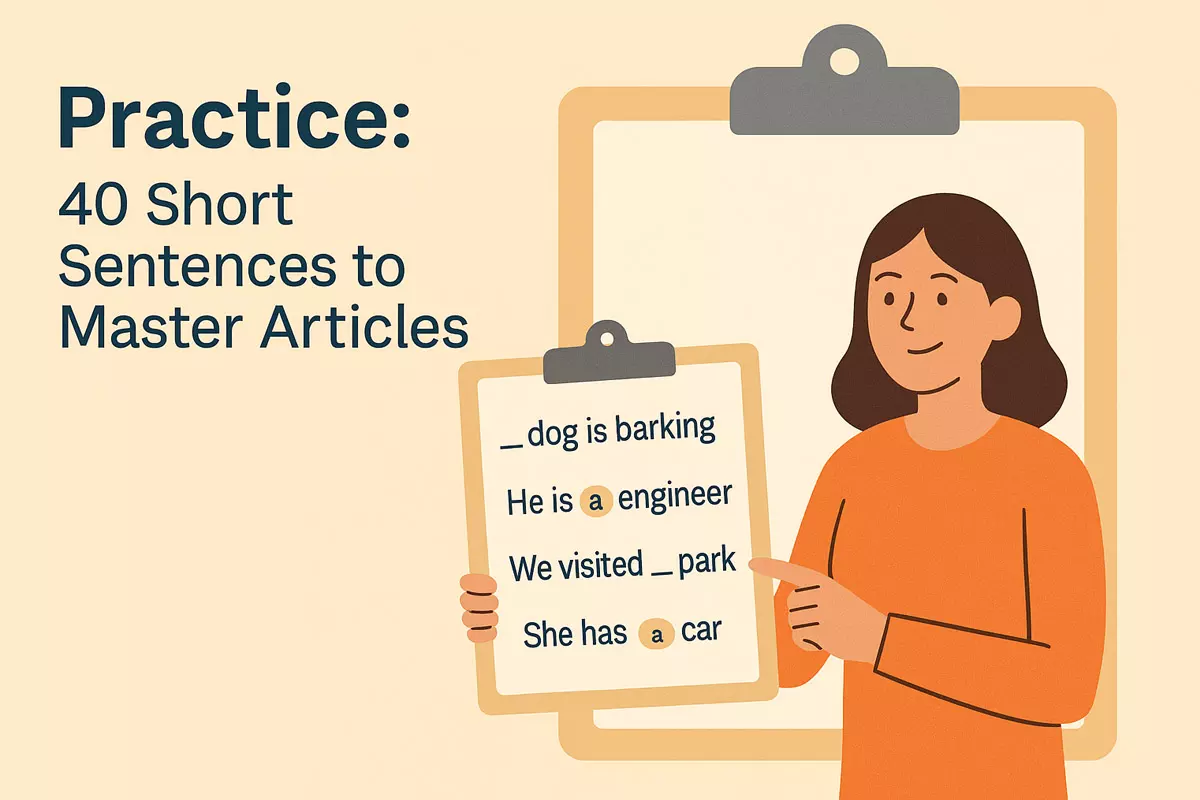 Here we how to use practice sets to master English articles. It includes fill-the-gap and article choice exercises, rewriting sentences without articles, a self-check answer key, and advice for ongoing improvement.
Mastering English articles can be challenging, but practicing with short, focused sentences is an enjoyable and efficient way to improve your confidence and accuracy. In this collection, you will discover forty clear examples designed to help you strengthen your grasp of articles in everyday use. By reviewing these examples, you can develop a better understanding of when to use "a," "an," and "the," making your English sound more natural and precise in both writing and conversation.
How to Use This Practice
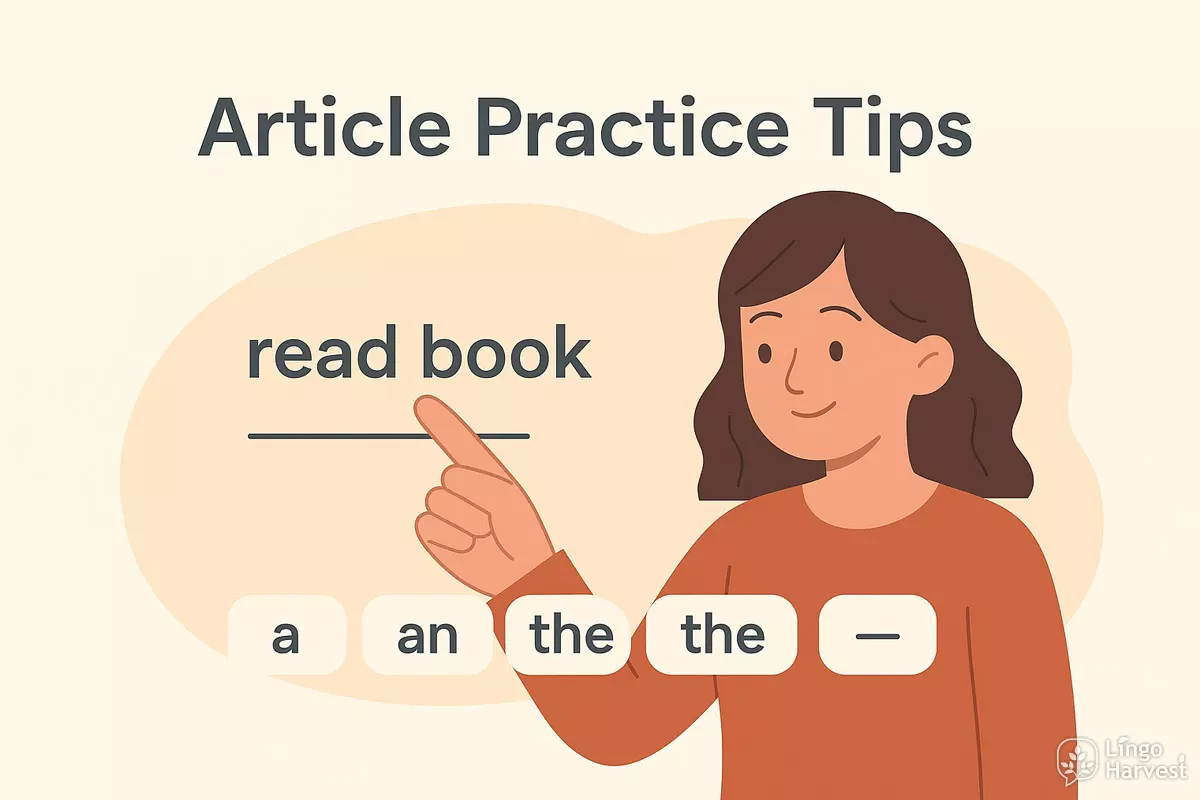
Begin by reading each sentence carefully and paying close attention to the articles ("a," "an," "the," or no article) used in context. This exercise is designed for hands-on learning, so it's most effective if you actively engage—don’t just passively read. Try covering the article in each sentence and guessing which one fits before checking.
Step-by-Step Approach
- Preview the sentences to get a sense of the structure and topic.
- Attempt each sentence by filling in the article you think is correct. Say the sentence out loud for better retention.
- Check your answer after each guess, and note any patterns you notice.
- Repeat sentences that you find difficult, focusing on the rules or exceptions they illustrate.
Tips for Effective Practice
- Group sentences by type (definite, indefinite, zero article) to see patterns.
- Highlight or write down sentences where you made mistakes for review later.
- Try to explain, in your own words, why a certain article is used in each case.
- Practice with a friend or record yourself to reinforce learning.
Common Patterns to Notice
- Use of "the" for specific or previously mentioned nouns.
- Use of "a/an" for introducing something new or non-specific.
- No article with plural or uncountable nouns when speaking generally.
- Fixed phrases and exceptions (e.g., "in a hurry," "go to school").
Sample Article Choices Table
| Context | Typical Article Use |
|---|---|
| First mention, singular, countable | a / an |
| Specific, known to speaker and listener | the |
| General idea, plural or uncountable | (no article) |
| Fixed expressions (e.g., "by car") | (no article) |
Mini Practice Quiz
Fill in the correct article ("a," "an," "the," or leave blank):
- ___ apple a day keeps the doctor away.
- She is ___ engineer.
- I saw ___ stars in the sky.
- He went to ___ school by bus.
Show answers
- An
- an
- (no article)
- (no article)
For best results, revisit these sentences regularly and try to create your own using similar patterns. This will help reinforce your understanding and make article usage feel more natural over time.
Fill-the-Gap Exercise Sets
Practicing articles in short sentences helps build confidence and accuracy. Below, you’ll find varied fill-in-the-blank tasks designed to reinforce the correct use of “a,” “an,” and “the.” Each set focuses on a different aspect, offering both simple and slightly more challenging contexts. Take your time, think about the rules for definite and indefinite articles, and fill in the missing words.
Quick Practice: Choose the Correct Article
Insert a, an, or the in each blank. If no article is needed, leave the space empty.
- She has ___ umbrella in her bag.
- ___ sun rises in the east.
- I saw ___ elephant at the zoo.
- Can you pass me ___ salt?
- He wants to buy ___ car.
- ___ apples on the table are fresh.
- There is ___ university near here.
- We visited ___ museum yesterday.
- Is this ___ answer you wanted?
- I need ___ hour to finish this.
Show answers
- an
- The
- an
- the
- a
- The
- a
- the
- the
- an
Common Mistakes: Spot the Error
Some sentences below use articles incorrectly. Rewrite each sentence with the correct article or remove it if unnecessary.
- He is a best player in the team.
- I have the idea for an new project.
- We went to a school yesterday.
- She is an honest person.
- They saw a Mount Everest last year.
Show answers
- He is the best player in the team.
- I have an idea for a new project.
- We went to the school yesterday.
- She is an honest person. (No error)
- They saw Mount Everest last year.
Grouped Examples: Article Patterns
Below is a set of sentences showing common patterns with articles. Fill in each blank according to the pattern you observe.
- I want to read ___ interesting book.
- ___ moon looks beautiful tonight.
- She is ___ engineer.
- ___ Pacific Ocean is vast.
- He drank ___ cup of tea.
- ___ water in this bottle is cold.
- I saw ___ owl in the tree.
- ___ books on the shelf are new.
- She is ___ honest woman.
- ___ Amazon River is long.
Show answers
- an
- The
- an
- The
- a
- The
- an
- The
- an
- The
Challenge: No Article Needed?
Some sentences don’t require any article. Decide if you need to add a, an, or the, or leave the blank empty.
- ___ Breakfast is ready.
- She goes to ___ school every day.
- ___ Mount Everest is the highest mountain.
- He plays ___ guitar well.
- ___ History is my favorite subject.
Show answers
- (no article)
- (no article)
- The
- the
- (no article)
Working through these exercises will help you recognize article patterns and avoid common mistakes. Try to complete each set without looking at the answers first, then check your work inside the expandable sections above.
Choose the Correct Article
Selecting the appropriate article—a, an, or the—can be tricky, especially for English learners. Articles help specify whether we’re talking about something general or something specific. To build confidence, practice is essential. Below, you’ll find short sentences with a missing article. Try to decide which article fits best, keeping in mind the rules for definite and indefinite articles.
Quick Tips for Article Selection
- Use a before words that start with a consonant sound and are non-specific.
- Use an before words that start with a vowel sound and are non-specific.
- Use the when referring to something specific or already mentioned.
Practice Sentences: Fill in the Blank
- ____ cat is sleeping on the sofa.
- She wants to buy ____ orange.
- ____ sun rises in the east.
- He found ____ interesting book.
- Could you pass me ____ salt, please?
- They saw ____ elephant at the zoo.
- ____ apple a day keeps the doctor away.
- We had ____ amazing time at the park.
- She is ____ engineer.
- ____ car in front of the house is new.
- He is looking for ____ job.
- ____ movie we watched was exciting.
- Do you have ____ umbrella?
- ____ teacher gave us homework.
- There is ____ spider on the wall.
- ____ answer was correct.
- She adopted ____ dog from the shelter.
- ____ sky is very clear tonight.
- He drank ____ cup of tea.
- ____ idea sounds interesting.
Show answers
- a
- an
- the
- an
- the
- an
- an
- an
- an
- the
- a
- the
- an
- the
- a
- the
- a
- the
- a
- the
Homework: Insert the Correct Article
- She bought ____ umbrella because it was raining.
- I saw ____ European artist at the gallery.
- Please close ____ window.
- He wants to become ____ engineer.
- We visited ____ Pacific Ocean last year.
- Do you like ____ coffee in the morning?
- She waited for ____ hour in the lobby.
- ____ Mount Everest is the highest peak in the world.
- That is ____ best solution we have.
- He lives in ____ small apartment near the river.
Show answers
- an
- a
- the
- an
- the
- — (no article)
- an
- — (no article)
- the
- a
Common Challenges and Solutions
Learners often confuse when to use no article at all. For example, we say “I like music,” not “I like the music,” unless we mean specific music. The table below highlights some typical article choices in context:
| Sentence | Correct Article | Explanation |
|---|---|---|
| I saw ____ dog in the park. | a | Any dog, not specific. |
| ____ moon looks beautiful tonight. | the | There is only one moon; it’s specific. |
| She is ____ honest person. | an | ‘Honest’ starts with a vowel sound. |
| He doesn’t like ____ coffee. | — (no article) | Talking about coffee in general. |
When you practice, focus on whether the noun is general or specific, countable or uncountable, and whether it starts with a vowel sound. Over time, choosing the right form will become more natural. For more practice, try writing your own sentences and swapping out the articles to see how the meaning changes.
Rewrite Without Articles
Mastering English means understanding when to use—and when to skip—words like a, an, and the. One effective practice is rewriting short statements without these small words. This helps you notice their impact on meaning and sentence flow. Stripping sentences of such words can be surprisingly challenging, especially for those used to relying on them for clarity.
Why Remove Definite and Indefinite Articles?
Leaving out these words forces you to focus on core vocabulary and sentence structure. In some languages, articles don’t even exist, so this exercise can help speakers of those languages build confidence in English. It also sharpens your awareness of when articles are truly necessary and when you can drop them without losing sense.
Examples: Sentences With and Without Articles
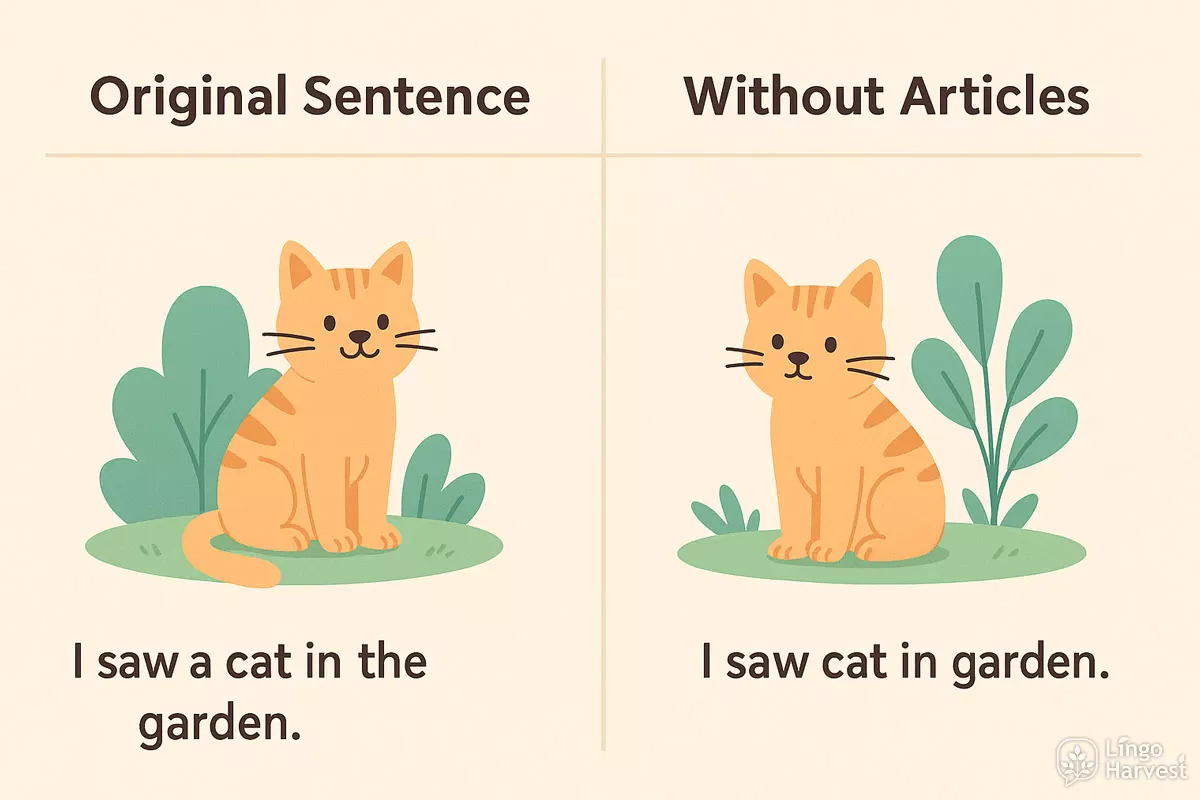
Below is a comparison of typical English sentences and their altered forms without articles. Notice how omitting these words affects clarity and, in some cases, meaning.
| Original Sentence | Without Articles |
|---|---|
| I saw a cat in the garden. | I saw cat in garden. |
| She bought an apple from the store. | She bought apple from store. |
| The book is on the table. | Book is on table. |
| He is an engineer. | He is engineer. |
| We visited the museum yesterday. | We visited museum yesterday. |
| The children are playing in the park. | Children are playing in park. |
| She has a dog and a cat. | She has dog and cat. |
| He opened the window. | He opened window. |
| They found an old coin. | They found old coin. |
| The movie starts at eight. | Movie starts at eight. |
Practice Tips
- Try rewriting sentences from your daily life or reading material, omitting these small words.
- Notice if the meaning changes or if the sentence sounds unnatural.
- Experiment with both simple and complex statements for variety.
This approach highlights just how much these little words matter in English. By practicing both with and without them, you’ll develop a deeper understanding of sentence construction and the nuances of English grammar.
Self-Check Answer Key
Check your progress with these solutions for the 40 practice sentences on English articles. The explanations below focus on article usage: a, an, the, or leaving the noun with no article (ø). Review each answer, then compare your responses to spot where you need more review.
Quick Reference: Common Patterns
- A is used with singular, countable nouns starting with a consonant sound (e.g., a cat, a book).
- An is used before singular, countable nouns starting with a vowel sound (e.g., an apple, an hour).
- The is for specific nouns, previously mentioned things, or unique items (e.g., the sun, the car we saw).
- Zero article (ø) is used with plural or uncountable nouns in general statements (e.g., Dogs are friendly. Water is important.).
Selected Answer Explanations
- 1. I saw a dog in the park. (First mention, any dog.)
- 2. The dog was chasing a ball. (Now the dog is specific.)
- 3. She wants to buy an umbrella. (Any umbrella, starts with vowel sound.)
- 4. The umbrella is blue. (Known umbrella.)
- 5. ø Water is essential for life. (Uncountable, general statement.)
- 6. He is an engineer. (Profession, singular noun, vowel sound.)
- 7. A cat climbed the tree. (First mention.)
- 8. The tree is tall. (Specific, already mentioned.)
- 9. The sun rises in the east. (Unique noun.)
- 10. She had a sandwich for lunch. (Any sandwich.)
- 11. ø Dogs are loyal animals. (Plural, general.)
- 12. He gave me an orange. (Any orange, starts with vowel sound.)
- 13. The oranges on the table are fresh. (Specific group.)
- 14. She plays the piano. (Musical instruments.)
- 15. I need a pen. (Any pen.)
- 16. ø Children like sweets. (Plural, general.)
- 17. The children in this class are smart. (Specific group.)
- 18. He is eating an apple. (Any apple, vowel sound.)
- 19. The apples on the plate are green. (Specific apples.)
- 20. ø Music makes me happy. (Uncountable, general.)
Article Usage Table: Quick Comparison
| Article Type | Example Sentence | Explanation |
|---|---|---|
| a | I saw a bird. | First mention, any bird. |
| an | She ate an egg. | Starts with vowel sound, any egg. |
| the | The car is fast. | Specific car, already known or mentioned. |
| ø (no article) | ø Books are expensive. | Plural, general statement. |
Tips for Checking Your Work
- Ask yourself if the noun is specific or general.
- Listen for the sound at the start of the word (for a/an).
- Remember unique things (the moon, the earth) take the.
- For general plural or uncountable nouns, use no article.
If you missed several, try reading each sentence out loud and listening for what sounds natural. Consistent review helps you spot patterns and exceptions in article usage.
Next Steps to Keep Improving
Building on your mastery of articles through short sentences is a solid foundation. To deepen your understanding and boost accuracy, it helps to develop regular habits and introduce a variety of practice methods. Here are some practical strategies to continue making progress with English articles:
Integrate Articles in Everyday Use
- Write a short diary entry every day, focusing on using "a," "an," and "the" correctly.
- Try to describe objects around you using full sentences, paying attention to article usage.
- Read aloud from a book or news article, and notice how articles are used in context.
Expand Your Exposure
Reading and listening to authentic materials helps reinforce correct patterns. Notice how native speakers use articles in different situations:
- Watch English-language videos or shows with subtitles and pause to observe article use.
- Listen to podcasts or conversations, and jot down interesting phrases with articles.
- Compare how articles appear in headlines versus regular sentences.
Practice with Patterns
Recognize common structures where articles are often needed or omitted. Here’s a table of useful patterns to guide your practice:
| Pattern | Example Sentence |
|---|---|
| a/an + singular countable noun | She found a wallet. |
| the + unique noun | The sun is bright today. |
| no article + plural/uncountable in general | Cats like milk. |
| the + noun mentioned before | I saw a dog. The dog was barking. |
| a/an + job or profession | He is an engineer. |
| the + superlative | This is the best answer. |
Self-Check and Feedback
- After writing, reread your sentences and check if articles are used correctly.
- Ask a friend, tutor, or language partner to review your writing and point out mistakes.
- Use online quizzes or worksheets for extra practice and instant feedback.
Set Mini-Challenges
Challenging yourself can make practice more engaging. Try setting goals like:
- Write 10 sentences about your day using as many different articles as possible.
- Spot and correct article mistakes in a paragraph you wrote last week.
- Record yourself speaking and listen for article use.
Gradually, these varied activities will help you internalize article usage and become more confident in both writing and speaking. Stay curious and keep experimenting with new ways to practice—consistency is key for lasting improvement!