Advanced Error Correction: Fixing Meaning, Tense, and Logic in Conditionals

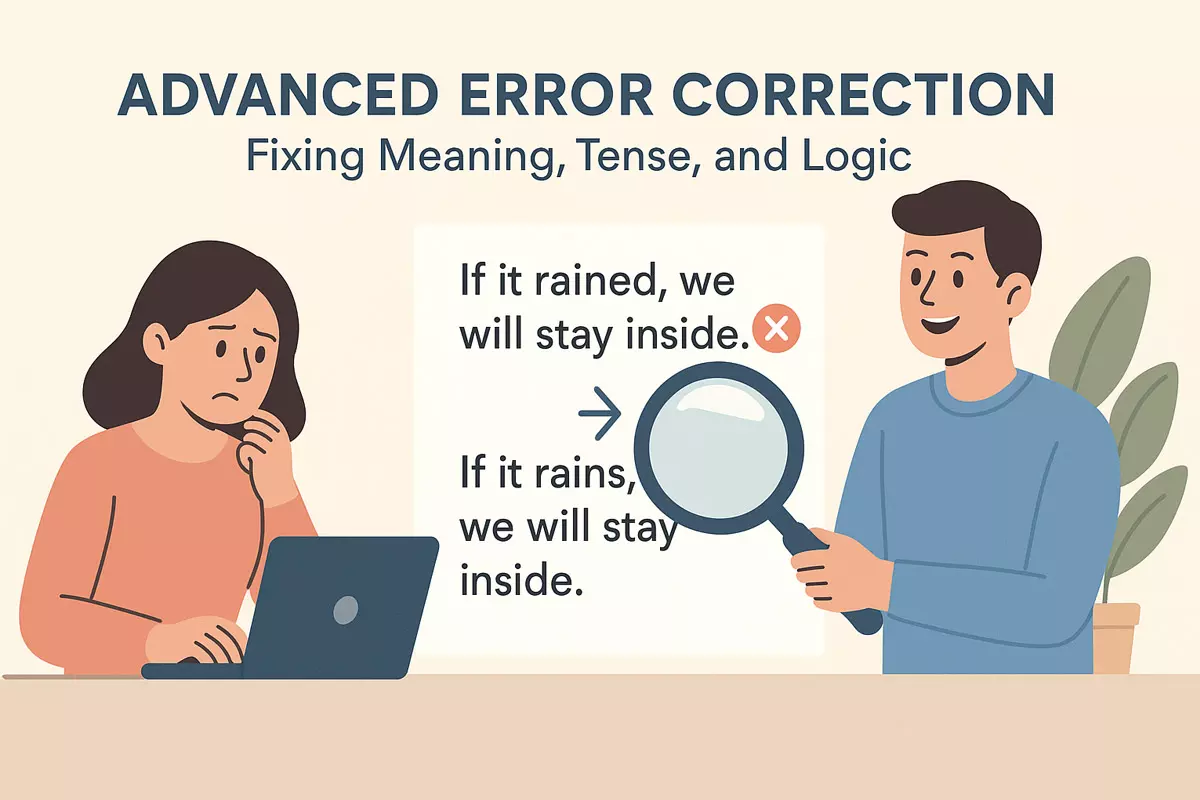 The article explains frequent C1–C2 conditional errors, including tense, modality, and meaning misalignment, mistakes in mixed and inverted conditionals, and strategies for spotting flawed logic. It also provides corrected examples and editing practice.
- Common C1–C2 level conditional errors
- Misalignment of tense, modality, and meaning
- Errors in mixed conditionals and inversion structures
- Strategies for identifying flawed logic in complex sentences
- Examples of corrected advanced conditional structures
- Practice: edit and improve flawed conditional paragraphs
Addressing mistakes in hypothetical statements requires more than just correcting surface grammar; it involves careful attention to meaning, verb tense accuracy, and clear logical progression. This article examines advanced strategies for identifying and resolving these nuanced issues, helping writers and speakers convey hypothetical scenarios more effectively and avoid common pitfalls that can obscure intended meaning or disrupt the flow of ideas.
Common C1–C2 level conditional errors
Learners at advanced levels often struggle with subtle issues in conditional sentences, especially where meaning, logic, and tense interact. While basic mistakes are less frequent, higher-level users can still make nuanced errors, particularly when handling complex or mixed conditionals, implied results, or hypothetical pasts.
Typical advanced mistakes with conditionals
Even proficient speakers can slip up with these areas:
- Using the wrong tense to express hypothetical or unreal situations
- Mixing conditional types inappropriately (e.g., blending second and third conditionals without clear logic)
- Misplacing or omitting modal verbs like "would," "could," or "might"
- Confusing real and unreal conditionals, especially in indirect speech
- Shifting tenses incorrectly when reporting conditionals
- Overusing or misusing "if" versus alternatives like "unless," "provided that," or "should"
- Forgetting to invert subject and auxiliary in formal conditionals ("Had I known...")
- Creating ambiguous meaning by misaligning the time reference between clauses
- Incorrectly using "will" or "would" in both parts of the conditional
- Using the zero conditional for hypothetical or future situations
- Errors with "wish" or "if only" constructions
- Unnecessary double negatives in conditional clauses
- Misusing "even if" when "only if" or "unless" is needed
- Problems with implied conditionals (elliptical structures)
- Inconsistent logic in counterfactuals (e.g., impossible pasts with possible presents)
Mixed and advanced conditional forms
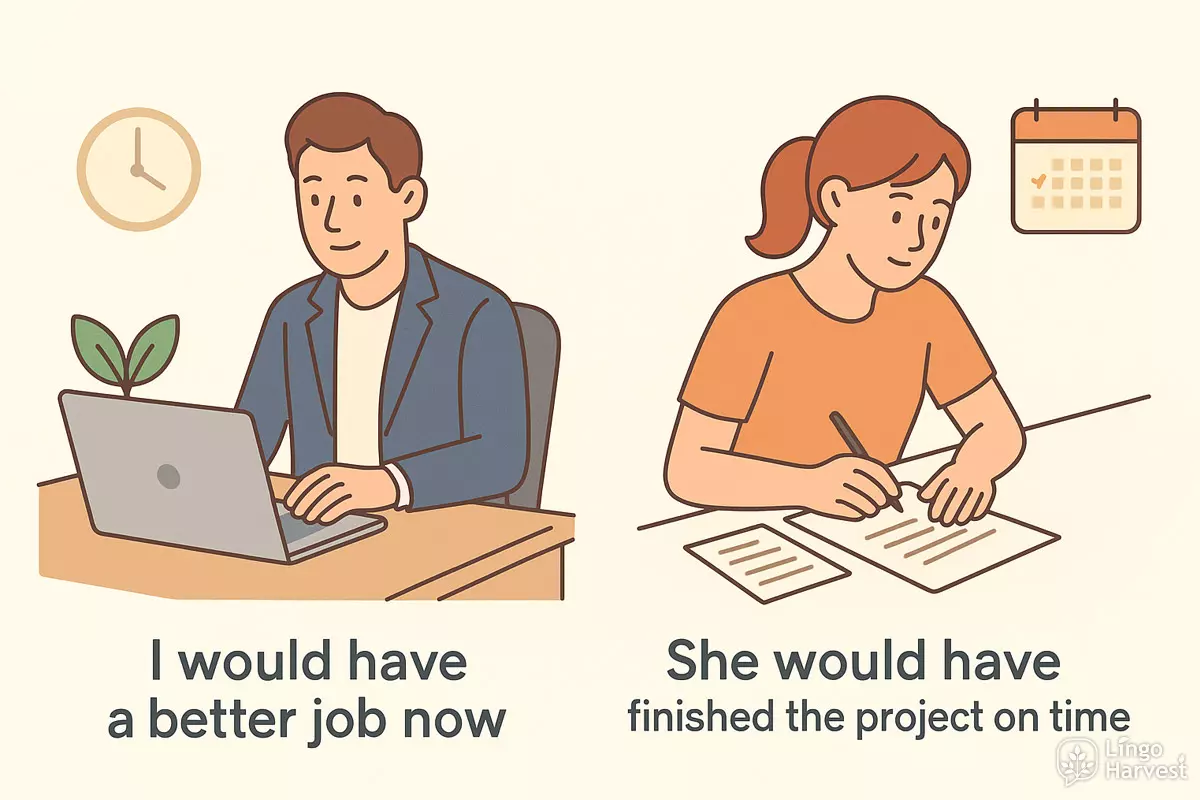
When discussing past actions with present consequences, or hypothetical scenarios that cross timelines, advanced English users may stumble. Below is a structured comparison of common mixed conditional patterns and their correct uses.
| If-clause | Main clause | Meaning |
|---|---|---|
| If I had studied harder | I would have a better job now | Past action, present result |
| If she were more organized | She would have finished the project on time | Present state, past result |
| If they had left earlier | They wouldn't be stuck in traffic | Past action, present result |
| If you weren't afraid of flying | You would have visited Japan last year | Present state, past result |
Logic and meaning mismatches
Advanced users sometimes create sentences where the logic between clauses is inconsistent or the timeline is unclear. For example, saying "If I would have known, I would tell you" mixes past and present unreal meanings incorrectly. Keeping a clear relationship between time, cause, and result is essential for precise communication. Attention to these details helps avoid ambiguity and ensures your conditionals convey exactly the intended meaning. Practice with authentic examples and careful review of mixed forms can significantly reduce these advanced-level errors.
Misalignment of tense, modality, and meaning
When constructing conditional sentences, mismatches between verb tense, modal verbs, and the intended message often cause confusion or ambiguity. These issues can lead to sentences that sound unnatural or convey a meaning different from what the writer intended. To achieve clarity and precision, it’s important to align the verb forms, modal choices, and logical relationships in conditionals.
How mismatches arise in conditionals
Problems frequently occur when the tense in the "if" clause does not correspond logically with the result clause, or when modal verbs are used inappropriately. For example, using a present tense in the condition with a past tense in the result can distort the intended time frame or possibility. Similarly, modal verbs like "would," "could," or "might" need to match both the degree of certainty and the temporal context.
- If you will go to the store, buy some milk. ❌ (Incorrect: "will" doesn’t belong in the "if" clause)
- If he had left earlier, he would arrive now. ❌ (Tense mismatch: past perfect with present conditional result)
- If it rains, we can cancel the picnic. ✅ (Correct: present simple with present modal)
- If she studied harder, she would have passed. ❌ (Mixed unreal past and present result)
Common patterns of misalignment
Writers and speakers often confuse the three main types of conditional structures. Each type signals a different relationship between time, possibility, and result. Recognizing these distinctions helps avoid errors. Below is a summary comparing standard forms and their typical errors:
| Conditional Type | Standard Form | Frequent Errors | Meaning Impact |
|---|---|---|---|
| Zero Conditional | If + present, present | If + will, present | Suggests uncertainty, not general truth |
| First Conditional | If + present, will/can/may + base | If + will, will | Implies prediction, not real possibility |
| Second Conditional | If + past simple, would/could + base | If + past perfect, would + base | Confuses present/future unreal with past unreal |
| Third Conditional | If + past perfect, would/could have + past participle | If + past simple, would have + past participle | Blurs past hypotheticals with present/future |
Quick checklist for alignment
Before finalizing a conditional sentence, review these points:
- Are the tenses in both clauses logically consistent?
- Does the modal verb fit the intended degree of certainty or possibility?
- Is the meaning clear and unambiguous?
- Does the sentence match the standard pattern for the conditional type?
- Are you expressing a real, unreal, or impossible situation appropriately?
Careful attention to these elements helps ensure that your conditional statements are both accurate and easily understood. Misalignments can obscure meaning or even reverse the intended logic, so a systematic check is always worthwhile.
Errors in mixed conditionals and inversion structures
Mastering advanced conditionals and inversion in English can be tricky, especially when it comes to combining different time references or switching the word order for emphasis or formality. Learners often make mistakes with tense consistency or choose the wrong structure, which can distort meaning or logic.
Common pitfalls with mixed conditionals
Mixed conditionals link two different time frames in one sentence—usually pairing a past condition with a present result, or vice versa. The challenge is keeping verb tenses aligned with the intended meaning. Here are frequent mistakes:
- Using the same tense in both clauses (e.g., If I had known, I would have helped instead of If I had known, I would help now).
- Mixing up the order of condition and result, leading to illogical sequences.
- Forgetting to use the past perfect in the ‘if’ clause when referring to a past unreal condition.
- Confusing modal verbs, such as using would in the ‘if’ clause (If you would have told me, I would help ❌).
- Incorrectly shifting the present result to a past form, muddying the time reference.
- Omitting necessary auxiliary verbs, which breaks the structure.
- Using nonstandard contractions or informal patterns in formal writing.
- Failing to reflect the logic of cause and effect between the two time frames.
- Overusing the mixed form where a standard conditional would be clearer.
- Neglecting agreement between subject and verb in complex clauses.
Inversion structures: typical errors
Inversion structures in conditionals are used for formality or emphasis, especially in written English. Instead of starting with "if," the auxiliary verb comes before the subject. Problems often occur when learners:
- Forget to invert the subject and auxiliary (e.g., Had I known instead of I had known).
- Use inversion with the wrong type of conditional (e.g., applying it to zero conditionals).
- Keep "if" together with inversion, which is redundant (If had I known ❌).
- Misplace negative adverbs or modifiers, leading to awkward sentences.
- Fail to adjust pronouns or verb forms after inversion.
- Use inversion in spoken English where it can sound unnatural.
- Mix up inversion with question forms, causing confusion.
- Forget to use the correct tense with the auxiliary in inversion (e.g., Were I to know for present/future hypotheticals).
- Overcomplicate simple conditionals by forcing inversion unnecessarily.
- Neglect punctuation, which can change the sentence’s meaning or clarity.
Quick reference: mixed conditional patterns vs. inversion forms
| Pattern | Correct Example |
|---|---|
| If + past perfect, would + base verb | If I had studied medicine, I would be a doctor now. |
| If + simple past, would have + past participle | If I were more careful, I would have avoided the mistake. |
| Inversion (no "if"): Had + subject + past participle, ... | Had she listened, she would not be in trouble now. |
| Inversion (future): Were + subject + to + base verb, ... | Were he to arrive early, we could start sooner. |
| Inversion (present unreal): Were + subject + base verb, ... | Were I in your position, I would do the same. |
Careful attention to verb forms, logic, and word order can help you avoid these typical errors and produce clear, accurate conditionals and inversions. Practice with real examples is the most effective way to internalize these patterns.
Strategies for identifying flawed logic in complex sentences
When working with intricate conditional statements, it's easy for subtle errors in reasoning to slip by unnoticed. Spotting these logical missteps requires a blend of grammatical awareness and critical thinking. Instead of focusing solely on grammar or tense, pay close attention to how the ideas connect and whether the outcome logically follows from the condition.
Common indicators of logical issues
- Contradictory conditions and results (cause and effect reversed or mismatched)
- Impossible or unrealistic scenarios (e.g., "If I had wings, I will fly to school")
- Mixed time frames that don’t align (present condition with a past result, etc.)
- Unclear or ambiguous references that confuse the relationship between clauses
- Assumptions that aren’t supported by the condition (“If it rains, the picnic was cancelled”)
- Double negatives or unnecessary complexity leading to confusion
- Statements that imply circular reasoning ("If it is true, then it is true")
- Overgeneralization or absolute statements that ignore exceptions
- Redundant or tautological phrasing (restating the condition as the result)
- Results that do not logically depend on the condition
- Incorrect use of modal verbs that change the intended logic
- Confusing factual and hypothetical situations
- Omitting necessary context that affects the logic
- Shifting subjects between clauses, causing ambiguity
- False cause-and-effect relationships
Step-by-step approach to analyzing logic
Begin by isolating each clause in the sentence. Identify the condition (the "if" clause) and the result (the main clause). Next, ask yourself whether the result is a reasonable consequence of the condition. If the sentence links different time frames or mixes real and unreal situations, check if this shift is intentional and clear. Use the following checklist to guide your review:
- Is the conditional structure appropriate for the intended meaning?
- Do the time references in each clause match?
- Are any assumptions clearly stated or left implicit?
- Does the main clause logically depend on the "if" clause?
- Is there ambiguity in pronouns or references?
Examples: Detecting and correcting flawed logic
To make these concepts practical, compare flawed and corrected examples. Notice how adjusting the logic, tense, or structure changes the meaning and clarity.
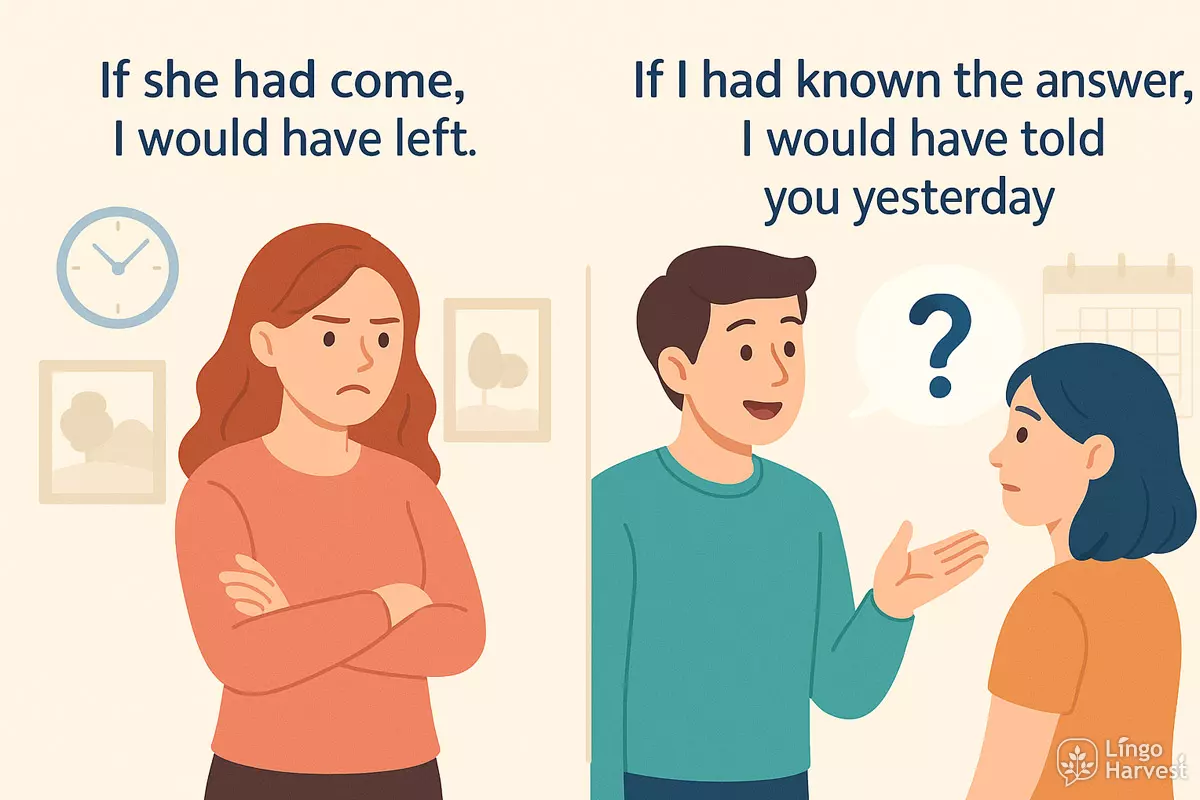
| Flawed Example | Corrected Logical Sentence |
|---|---|
| If she will come, I would have left. | If she had come, I would have left. |
| If I knew the answer, I tell you yesterday. | If I had known the answer, I would have told you yesterday. |
| If it rains tomorrow, we went home early. | If it rains tomorrow, we will go home early. |
| If everyone was honest, there is no crime. | If everyone were honest, there would be no crime. |
| If you eat too much, you got sick last night. | If you ate too much last night, you got sick. |
Tips for refining logical accuracy
Practice regularly by rewriting problematic sentences, focusing on the relationship between the clauses. Read sentences aloud to catch awkward or illogical connections. When in doubt, simplify the statement and gradually rebuild complexity, ensuring each step makes sense.
Examples of corrected advanced conditional structures
Understanding and improving complex conditional sentences often requires attention to tense consistency, logical flow, and accurate meaning. Below, you'll find a range of illustrative cases showing how advanced conditionals can be corrected for clarity and precision. These examples highlight common pitfalls and their effective solutions.
Common Issues and Their Corrections
- Incorrect tense sequence: If she will come, we would start early. ❌
Corrected: If she comes, we will start early. ✅ - Logic error (impossible past): If I had known, I will help you. ❌
Corrected: If I had known, I would have helped you. ✅ - Mixed conditionals mishandled: If she had studied, she will have a better job now. ❌
Corrected: If she had studied, she would have a better job now. ✅ - Ambiguous meaning: If you would leave now, you catch the train. ❌
Corrected: If you leave now, you will catch the train. ✅ - Incorrect use of modal: If he can have arrived earlier, we would not have waited. ❌
Corrected: If he had arrived earlier, we would not have waited. ✅ - Redundant auxiliary: If you would have told me, I could help. ❌
Corrected: If you had told me, I could have helped. ✅ - Confused hypothetical: If I know her number, I would have called her. ❌
Corrected: If I had known her number, I would have called her. ✅ - Present result of past condition: If you had taken the course, you know more now. ❌
Corrected: If you had taken the course, you would know more now. ✅ - Unreal present with incorrect tense: If I would be taller, I could play basketball. ❌
Corrected: If I were taller, I could play basketball. ✅ - Conditional with missing modal: If she practiced more, she win the competition. ❌
Corrected: If she practiced more, she would win the competition. ✅
Comparing Incorrect and Corrected Forms
| Original (Incorrect) | Corrected Version |
|---|---|
| If I would have seen him, I tell him the news. | If I had seen him, I would have told him the news. |
| If it rains tomorrow, we would have stayed home. | If it rains tomorrow, we will stay home. |
| If he studied harder, he will have passed the exam. | If he had studied harder, he would have passed the exam. |
| If you will call me, I will come. | If you call me, I will come. |
| If they had left earlier, they catch the bus. | If they had left earlier, they would have caught the bus. |
Key Points When Correcting Advanced Conditionals
- Match tenses between condition and result clauses for logical coherence.
- Use past perfect for unreal past conditions, and modal verbs for hypothetical results.
- Be cautious with mixed conditionals, especially for present results of past conditions.
- Eliminate unnecessary auxiliaries and modals that distort meaning.
- Always clarify the intended time frame and logical possibility.
By analyzing and correcting these advanced conditional patterns, you can ensure your statements are clear, logically sound, and grammatically accurate.
Practice: edit and improve flawed conditional paragraphs
Working with conditionals often means spotting and fixing errors in meaning, tense, or logic. The following exercises challenge you to analyze short paragraphs containing problematic conditional sentences. Your task is to identify issues—such as mismatched tenses, illogical outcomes, or ambiguous meanings—and rewrite the sentences for clarity and correctness.
Common Issues in Conditional Sentences
- Confusing real and unreal conditionals
- Mixing up verb tenses (e.g., using present with past where not appropriate)
- Logical disconnects between condition and result
- Ambiguous or vague conditional clauses
- Using "will" in the "if" clause when not permitted
- Neglecting to match time references in both parts
- Improper use of modal verbs
- Forgetting to use the subjunctive where needed
- Omitting necessary linking words or punctuation
- Inconsistent subject or pronoun reference
- Overloading one sentence with multiple conditions
- Incorrect inversion for formal or literary conditionals
- Missing or extra commas that change meaning
- Misplaced adverbs disrupting conditional flow
- Switching from hypothetical to factual within a sentence
- Redundant repetition of the same condition
- Unclear or awkward phrasing of the result clause
- Unreal conditionals lacking a clear impossible condition
- Conditionals that do not match the intended time frame
- Using past perfect where simple past is required (or vice versa)
Exercise: Identify and Correct Flaws
Read each paragraph and improve any conditional sentences to fix errors in tense, logic, or meaning. Rewrite the flawed sentence(s) for clarity and accuracy.
- If she will arrive early, she can join the meeting. She would finish her work if she has more time.
- If I would have known about the traffic, I leave earlier. If it rains tomorrow, I would stay home.
- If he studied harder, he will pass the test. If you have called me, I would help you.
- If we are going to Paris last year, we visit the Eiffel Tower. If we go to Paris next year, we had seen the Eiffel Tower.
Show answers
- 1. If she arrives early, she can join the meeting. She would finish her work if she had more time.
- 2. If I had known about the traffic, I would have left earlier. If it rains tomorrow, I will stay home.
- 3. If he studies harder, he will pass the test. If you had called me, I would have helped you.
- 4. If we went to Paris last year, we visited the Eiffel Tower. If we go to Paris next year, we will see the Eiffel Tower.
Quick Reference: Conditional Forms & Corrections
| Flawed Example | Corrected Version |
|---|---|
| If you will finish, let me know. | If you finish, let me know. |
| If he would study, he passes. | If he studied, he would pass. |
| If she called, I help. | If she calls, I help. OR If she called, I would help. |
| If I had saw him, I would tell you. | If I had seen him, I would have told you. |
| If they goes, they will enjoys it. | If they go, they will enjoy it. |
| If you will be here, we start. | If you are here, we will start. |
| If we will win, we celebrate. | If we win, we will celebrate. |
| If you called, I help yesterday. | If you had called, I would have helped yesterday. |
| If I know, I tell you. | If I knew, I would tell you. |
| If she will go, she see him. | If she goes, she will see him. |
Mastering the revision of flawed conditional sentences boosts clarity and logical flow. Regular practice helps you quickly spot common problems, making your writing and editing more precise.